
The best renters insurance 2026 has to offer costs less than most people think. The National Association of Insurance Commissioners (NAIC) puts average premiums at just $15 to $30 a month, yet fewer than half of U.S. renters actually carry it. The reason is a costly misunderstanding: most renters believe their landlord’s insurance covers their belongings. It does not. Your landlord’s policy covers the building. Your furniture, laptop, clothes, and liability are on you.
We ranked the 6 best renters insurance companies of 2026 by renter situation, not by a generic leaderboard, because the right policy for a student with a laptop is not the right policy for a family bundling auto insurance. Below: the short answer, the comparison, and exactly how to pick.
Related Guides: Planning to bundle? See how renters + auto bundling cuts your premium, and if your policy offers identity-theft protection add-ons, read our identity-theft guide before you pay for a standalone service. Got a dog? Your pet’s medical bills are a separate product. See our pet insurance guide.
Helpful Official Resources: NAIC — Renters Insurance Guide · Insurance Information Institute (Triple-I) — Renters Insurance · CFPB — Get Prepared Before a Disaster
The Short Answer: The Best Renters Insurance of 2026
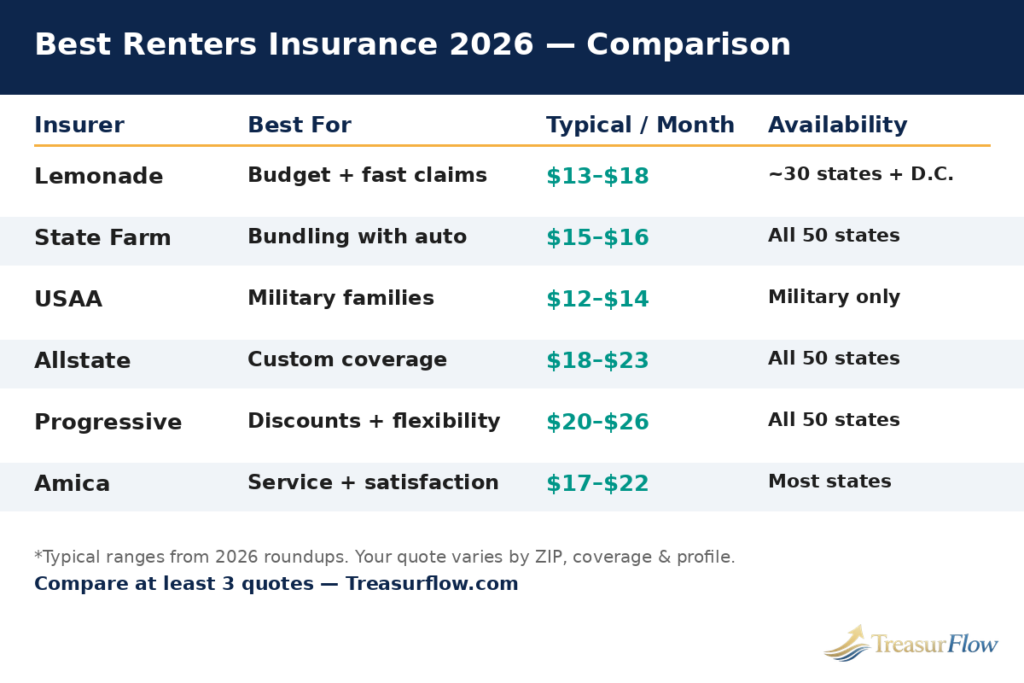
*Typical monthly premiums are consensus ranges from 2026 competitor roundups (MoneyGeek, Insurify, Insuranceopedia, Crediful). Your actual quote will vary by ZIP code, coverage amount, deductible, and profile. Compare at least 3 quotes — identical coverage can differ by $100+ a year between insurers in the same ZIP code.
Bottom line: If you want the cheapest solid policy and you like doing everything on your phone, start with Lemonade. If you already insure a car, State Farm’s bundle is usually the best total deal. Military families should check USAA first. It is consistently among the lowest-priced options for those who qualify.
How We Compared These 6 Insurers
We did not rank by who spends the most on advertising. We ranked by what actually matters when you buy and, more importantly, when you file a claim:
- Price for a realistic profile — a renter with $20,000–$30,000 in personal property coverage, $100,000 in liability, and a $500 deductible (the most common deductible).
- Claims experience — how fast and how painless the claims process is, because a cheap policy that fights every claim is not cheap.
- Coverage flexibility — replacement-cost options, add-ons for valuables, pet liability, and identity-theft endorsements.
- Availability — national insurers scored higher than regional ones, but a strong regional pick still earns a spot if it serves its states well.
- Financial strength and complaint record — all six hold strong financial-strength ratings, and we weighed customer-satisfaction and complaint data alongside price.
One more signal: advertisers spend heavily in this market because these searches convert. Google’s Ads Transparency Center shows Lemonade running roughly 6,000 active ads, State Farm roughly 100,000 across all its product lines, and Progressive roughly 9,000. That competition is good news for you: it means insurers are fighting for your premium.
| Insurer | Best For | Typical Monthly Premium* | Availability |
|---|---|---|---|
| Lemonade | Budget renters & fast digital claims | $13–$18 | ~30 states + D.C. |
| State Farm | Bundling with auto insurance | $15–$16 | All 50 states |
| USAA | Military families | $12–$14 | Military members, veterans & eligible family only |
| Allstate | Custom coverage & add-ons | $18–$23 | All 50 states |
| Progressive | Discounts & flexibility | $20–$26 | All 50 states |
| Amica | Service & customer satisfaction | $17–$22 | Most states |
The 6 Best Renters Insurance Companies of 2026
Best for Budget Renters: Lemonade
Lemonade is the pick for renters who want a good policy at a low price and want to buy it in minutes, not days. Quotes and claims run through the app, and Lemonade is known for settling simple claims fast through its digital process. Typical premiums run about $13–$18 a month for a standard profile, among the lowest in this roundup.
Why it wins for budget renters: Low base premiums, a fully digital experience, and optional add-ons (including identity-theft coverage) that let you build the policy you actually need instead of paying for a bloated one.
Watch out for: Lemonade is available in about 30 states plus D.C., not everywhere. If you want an in-person agent, this is not your insurer. And if you own high-value items (jewelry, cameras, instruments), check the per-item sublimits. You may need a scheduled-items endorsement.
Best for Bundling With Auto: State Farm
State Farm is America’s largest property-casualty insurer, and its real advantage for renters is the bundle. If you already insure a car with State Farm, adding renters insurance is often the cheapest total package. Bundling renters with auto typically saves 5–15% on the renters premium, and State Farm’s multi-policy discount is among the most reliable in the industry.
Why it wins for bundlers: Nationwide availability (all 50 states), a huge agent network if you prefer talking to a human, and typical premiums around $15–$16 a month before the bundling discount.
Watch out for: The digital experience is not as slick as Lemonade’s. If you want everything in an app, State Farm will feel slower. Compare bundling options with our car insurance guides before you commit to a single carrier.
Best for Military Families: USAA
If you are eligible, stop here first. USAA — open to military members, veterans, and eligible family members — consistently posts some of the lowest renters premiums in the market (typically $12–$14 a month) with high customer-satisfaction scores. Its policies are built around military life, including coverage that follows you through moves and deployments.
Why it wins for military families: The lowest typical premiums on this list, plus service built for people who move often.
Watch out for: Eligibility is strict. If you are not military-affiliated, you cannot buy USAA. Everyone else should look at Lemonade or State Farm.
Best for Custom Coverage: Allstate
Allstate is the pick if your situation is not standard. Want higher liability limits? Scheduled coverage for expensive gear? Extra protection for a home office? Allstate’s policy customization is the deepest on this list, and its agent network can walk you through options that app-only insurers don’t offer.
Why it wins for custom coverage: The widest menu of add-ons and endorsements, available in all 50 states, with typical premiums around $18–$23 a month.
Watch out for: You pay for the flexibility. Allstate is rarely the cheapest quote. Compare it against Lemonade or State Farm on the exact same coverage before deciding.
Best for Discounts & Flexibility: Progressive
Progressive is the tinkerer’s pick. Its renters policies are highly customizable, and it stacks discounts aggressively: bundling, paperless, pay-in-full, and protective-device discounts can add up. Typical premiums run $20–$26 a month before discounts, so the headline price looks high, but the final price after discounts is often competitive.
Why it wins for discounts: If you qualify for multiple discounts, Progressive’s effective price drops fast. Its policy flexibility (adjusting coverage and deductibles online) is also strong.
Watch out for: The base rate is on the higher side. Get the discounted quote, not the sticker price, before you compare.
Best for Service & Satisfaction: Amica
Amica is the pick if you care most about what happens when you actually file a claim. It posts the highest customer-satisfaction scores in this group and the lowest average premium in MoneyGeek’s 2026 analysis (about $116 a year on their test profile). Typical premiums run $17–$22 a month.
Why it wins for service: Consistently top-rated customer experience and a reputation for fair, fast claims handling.
Watch out for: Amica is not available in every state, and its digital tools lag behind Lemonade’s. If you want a fully app-based experience, look elsewhere.
What Renters Insurance Covers — and What It Doesn’t
A standard renters insurance policy (form HO-4) has three core protections, per the Insurance Information Institute:
1. Personal property. Your belongings — furniture, electronics, clothing, appliances — against fire, smoke, lightning, vandalism, theft, explosion, windstorm, and water damage from burst pipes. This covers your stuff even when it is away from home: a laptop stolen from your car or a bike stolen from campus is typically covered.
2. Personal liability. If you, a family member, or even your pet accidentally injure someone, or you damage someone else’s property, liability coverage pays their medical costs and your legal defense if they sue. Most landlords who require insurance ask for at least $100,000 in liability coverage.
3. Additional living expenses (loss of use). If a covered disaster makes your rental uninhabitable, this pays for a hotel, temporary rental, and extra food costs while your home is repaired.
What it does NOT cover:
- Floods and earthquakes. Standard policies exclude both. Flood coverage for renters is available separately through the National Flood Insurance Program (NFIP) and some private insurers. Earthquake coverage usually requires a separate endorsement.
- Your roommate’s belongings (unless they are listed on your policy).
- Damage from wear and tear, pests, or intentional acts.
- High-value items above sublimits. Most policies cap jewelry, cash, firearms, and collectibles at a few thousand dollars per category unless you add a scheduled-items endorsement (sometimes called a floater).
Replacement cost vs. actual cash value — the choice that matters most. Replacement cost coverage pays what it costs to buy a new equivalent item. Actual cash value (ACV) pays the item’s depreciated value: what your five-year-old couch is worth today. Replacement cost costs a bit more, but the NAIC notes it is usually the better value, because ACV leaves you paying the difference out of pocket. When you compare quotes, make sure you are comparing the same type. A cheap ACV quote is not cheaper than a replacement-cost quote.
How Much Does Renters Insurance Cost in 2026?
Less than you probably think. The NAIC puts average renters insurance premiums at $15 to $30 a month. Insurance Information Institute data puts the national average premium at roughly $171 a year (about $14 a month). Most renters land somewhere in the $12–$26-a-month range depending on where they live and how much coverage they buy.
What moves your price:
- Location. Rates vary sharply by state and ZIP code. Coastal and high-crime ZIP codes cost more; a $500 deductible policy in Vermont can run under $20 a month, while the same coverage in a coastal Texas ZIP can run $40+.
- Coverage amount. $20,000 in personal property coverage costs less than $50,000. Add up what you actually own before you pick a number. Most renters underestimate.
- Deductible. A $500 deductible is the most common choice. Raising it to $1,000 can cut your premium by roughly 10%.
- Claims history. A claims-free record earns discounts; frequent claims raise your rate.
- Credit and profile. In most states, insurers use credit-based insurance scores as one pricing factor.
- Building features. Smoke detectors, deadbolts, sprinklers, and security systems can earn discounts.
The quote gap is real. For identical coverage in the same ZIP code, premiums from different insurers can differ by $100 or more per year. That is why “get 3 quotes” is not generic advice. It is the single highest-value action in this entire article.
How to Save Money on Renters Insurance
- Bundle with auto insurance. The fastest discount available. Bundling renters with auto typically saves 5–15% on the renters premium. If you already have auto insurance, quote the bundle from that insurer first, then compare against Lemonade and USAA (if eligible).
- Raise your deductible to $1,000 if you can cover $1,000 out of pocket. Expect roughly a 10% premium cut.
- Choose replacement cost wisely. Replacement cost is worth it for most renters, but if your belongings are mostly old and low-value, ACV can save money. Do the math on your actual stuff.
- Ask about every discount: paperless billing, pay-in-full, protective devices (smoke detector, deadbolt, alarm), claims-free history, and professional-group or alumni discounts.
- Don’t over-insure. A $50,000 personal-property limit on $15,000 worth of belongings is wasted premium. Do a quick home inventory: list your big items and estimate replacement cost — then buy that much, plus a buffer.
- Check identity-theft add-ons before buying standalone protection. Many renters policies offer an identity-theft endorsement for a few dollars a month. Compare that against a standalone identity-theft service before you pay for both.
5 Mistakes Renters Make With Insurance
1. Assuming the landlord’s insurance covers them. It covers the building. Not your belongings. Not your liability. This is the single most expensive misunderstanding in renting.
2. Buying too little liability. $100,000 sounds like a lot, until someone is seriously injured in your apartment and sues. If you have savings or assets to protect, consider $300,000 in liability or an umbrella policy. The premium difference is small.
3. Skipping the home inventory. After a fire or theft, you will need to list everything you lost, with values. Doing that from memory, under stress, is how renters under-claim. Spend 10 minutes photographing each room and saving receipts for big items. It makes claims faster and larger.
4. Forgetting about pets. Your dog biting a guest is a liability claim, not a vet bill. Standard liability covers it, but many insurers exclude certain dog breeds or cap pet-related liability. If you have a dog, confirm the breed is covered before you buy. (Your pet’s own medical bills are a different product. See our pet insurance guide.)
5. Ignoring the flood/earthquake gap. If you live in a flood zone or earthquake country, a standard renters policy leaves your biggest risks uncovered. Check FEMA flood maps for your address and ask your insurer about separate flood coverage. NFIP policies have a 30-day waiting period, so don’t wait until storm season.
What Readers Ask
How much does renters insurance cost?
Most renters pay $15 to $30 a month, according to the NAIC. Insurance Information Institute data puts the national average at roughly $171 a year (about $14 a month). Your actual price depends on your ZIP code, coverage amount, deductible, and profile. Compare at least 3 quotes.
Does my landlord’s insurance cover my belongings?
No. Your landlord’s insurance covers the building’s structure: walls, roof, common areas. It does not cover your personal belongings or your liability. If a fire destroys your apartment, the landlord’s policy rebuilds the building; only your renters policy replaces your stuff.
Is renters insurance required by law?
No state legally requires renters insurance. However, most landlords can, and many do, require it as a lease condition, typically with at least $100,000 in liability coverage. Even when it’s not required, it’s worth carrying: a $15-a-month policy protects thousands of dollars in belongings plus liability.
What does renters insurance cover?
A standard policy covers three things: (1) personal property — your belongings against fire, theft, vandalism, windstorm, and burst pipes, including theft away from home; (2) personal liability — injuries or property damage you, a family member, or your pet accidentally cause; (3) additional living expenses if a covered disaster makes your rental uninhabitable. Floods and earthquakes are not covered by standard policies.
Does renters insurance cover my pet if it injures someone?
Yes, in most cases. The liability portion of a standard renters policy covers injuries caused by your pet — for example, if your dog bites a guest. But many insurers exclude certain dog breeds or cap pet-related liability, so confirm your breed is covered before you buy. Your pet’s own medical bills are not covered. That requires separate pet insurance.
Does renters insurance cover my roommate’s belongings?
No. A standard policy covers the named insured’s belongings only. Your roommate needs their own policy unless they are explicitly listed on yours. If you share expensive items (a TV, a gaming setup), decide whose policy covers them and put it in writing.
How do I file a renters insurance claim?
Document the loss first: photos, receipts, and your home inventory list. Report the incident to your insurer as soon as possible, and file a police report for theft or vandalism. Your insurer will assign an adjuster, who reviews the claim and pays covered losses up to your policy limits, minus your deductible. Keeping an up-to-date inventory with photos makes the process faster and increases the chance you claim everything you’re owed.
The Takeaway
The best renters insurance 2026 has to offer is not the cheapest policy on the internet. It is the right policy for your situation at a price you can afford. For most renters, that means Lemonade (budget + digital), State Farm (bundling), or USAA (military). Allstate, Progressive, and Amica earn their spots for customization, discounts, and service.
Whatever you pick, do three things before you buy: (1) get at least 3 quotes on identical coverage, (2) choose replacement-cost coverage unless your belongings are mostly low-value, and (3) spend 10 minutes on a home inventory. Those three steps will save you more money than any single discount, and they are the difference between a policy that pays and a policy that disappoints.

Muhammad Zakir is the founder of Treasurflow and the author of its personal finance guides. He researches consumer banking, credit, and personal loans, and every guide cites primary sources such as the CFPB, FDIC, FTC, and IRS. His content is educational and is not personalized financial advice.
3 thoughts on “Best Renters Insurance 2026: 6 Picks Ranked by Your Renter Situation”