
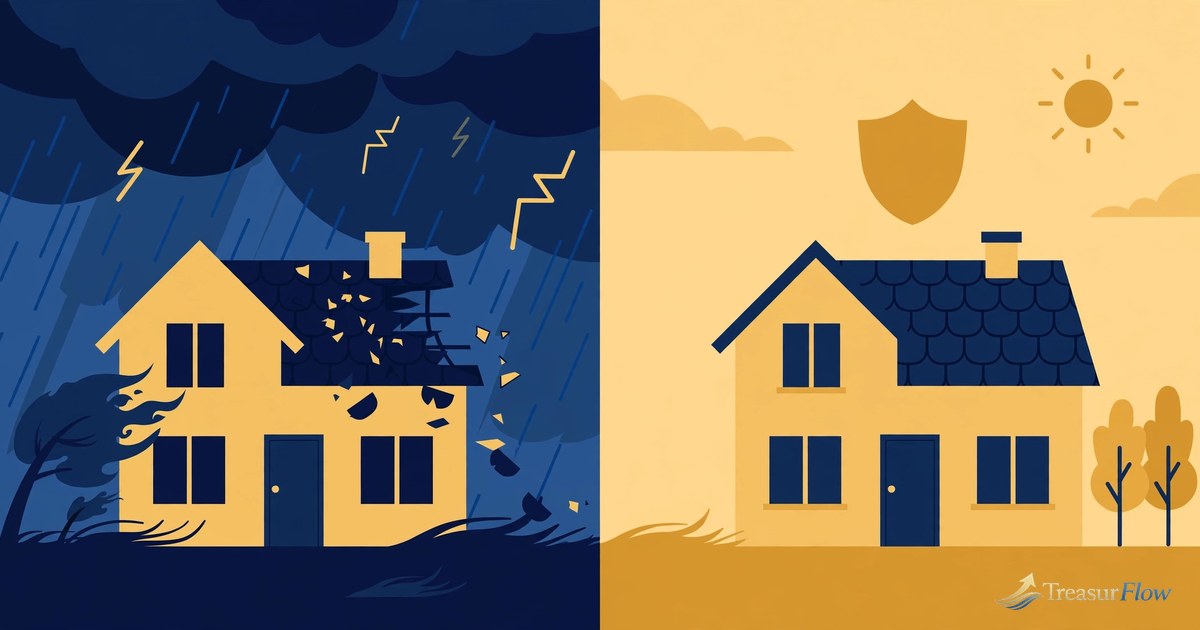
Two neighbors on the same street. Same storm. Same torn-off roof. One gets a check that covers a brand-new roof. The other gets a check that covers barely half of it — and has to borrow the rest.
Neither insurer cheated. The difference was in the policy details the second neighbor never looked at: how the roof was valued, what deductible applied, and whether the dwelling limit kept up with rebuild costs. That is the whole game in homeowners insurance. The “best” company is not the one with the catchiest ads. It is the one whose policy fits your house, your risk, and your budget — and pays the way you expect when something goes wrong.
This guide to the best homeowners insurance 2026 ranks seven insurers by homeowner profile instead of a generic list, because a first-time buyer in Ohio, a high-value homeowner in Connecticut, and a coastal homeowner in Florida are not buying the same product. You will also see the three numbers that decide what a claim actually pays, what 2026 premiums really look like, the deductible surprise that catches coastal buyers off guard, and the flood hole that exists in every standard policy.
Related guides: If you are still renting while you save, start with our best renters insurance 2026 guide — and if the house purchase is still ahead of you, our walkthrough on how people in the USA actually save for a house while renting shows how insurance fits into the monthly payment.
What a homeowners policy actually buys you
A standard homeowners policy — most commonly the HO-3 form — is not one coverage. It is six, labeled A through F. The dwelling limit (Coverage A) is the anchor: almost every other limit is set as a percentage of it.
| Coverage | What it pays for | Typical default |
|---|---|---|
| A — Dwelling | Rebuild or repair the house itself: structure, roof, attached garage, built-in systems | You choose the limit; must reflect rebuild cost. |
| B — Other structures | Detached garage, shed, fence, pool house | Usually 10% of Coverage A. |
| C — Personal property | Furniture, clothing, electronics, appliances — at home and often anywhere in the world | Usually 50–70% of Coverage A. |
| D — Loss of use | Extra living costs (hotel, rental, extra food) while your home is uninhabitable after a covered loss | Usually 20–30% of Coverage A. |
| E — Personal liability | Legal costs and damages if someone is injured on your property or you damage someone else’s property | Commonly $100,000–$300,000. |
| F — Medical payments to others | Small medical bills for guests hurt on your property, regardless of fault | Commonly $1,000–$5,000 per person. |
Two things in that table deserve a closer look. First, Coverage B at 10% of A is fine for a shed and a fence, but if you have a detached garage plus a pool house plus a workshop, 10% can run out fast. Second, personal property (C) often defaults to actual cash value unless you add a replacement-cost endorsement — which matters enormously, as the claim math below shows.
The HO-3 form covers the dwelling on an “open perils” basis — everything is covered unless it is explicitly excluded — while personal property is usually covered on a “named perils” basis, meaning only listed events count. The broader HO-5 form covers both dwelling and contents on an open-perils basis. If an insurer offers HO-5, ask for the price difference; for homes with a lot of contents value, it is often modest.
Three numbers that decide what a claim pays
Forget brand loyalty for a minute. Three numbers on your declarations page decide your payout more than the logo on the policy.
1. Your dwelling limit — and the 80% rule
Your dwelling limit must track rebuild cost, not market value and not your purchase price. Rebuild cost is what a contractor charges to reconstruct your house from scratch — materials, labor, debris removal, permits. Replacement-cost estimators commonly put that at roughly $150–$300 per square foot depending on region and finish level, so a 2,000-square-foot home can easily need a $300,000–$600,000 dwelling limit even in a market where the house itself would sell for less.
Most policies include an “80% rule”: you must carry dwelling coverage of at least 80% of your home’s replacement cost to receive full payment on partial losses. Fall below it, and the insurer applies a coinsurance penalty — it pays only a proportion of the loss.
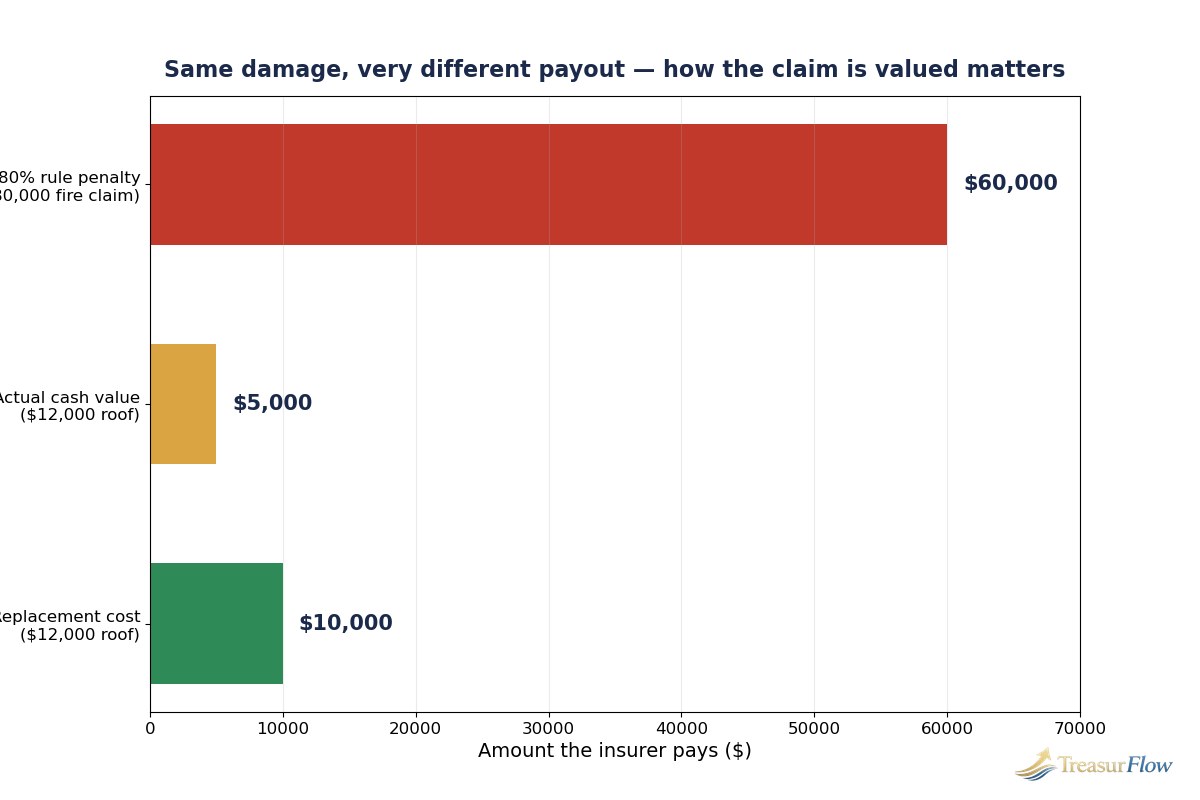
Illustrative example (stated assumptions: $400,000 rebuild cost, $80,000 kitchen-fire loss, $1,000 deductible): The 80% rule requires at least $320,000 of dwelling coverage. If you carry only $240,000 (60%), the insurer pays 75% of the loss — $60,000 — and you cover the remaining $20,000 plus your deductible. The same fire, the same policy form, a $20,000 difference because the limit was stale. Rebuild costs rose sharply in recent years, so a limit set when you bought the house five years ago is the most common way people drift under 80% without noticing.
2. Replacement cost vs. actual cash value
Actual cash value (ACV) pays replacement cost minus depreciation. Replacement cost value (RCV) pays the cost to repair or replace with similar kind and quality, with no depreciation deduction. Dwelling coverage is usually written at replacement cost; personal property often defaults to ACV unless you add the endorsement.
Illustrative example (stated assumptions: roof replacement costs $12,000 today, $2,000 deductible): With replacement cost coverage, the payout is $10,000. With actual cash value coverage on a roof depreciated to $7,000, the payout is $5,000. Same storm, same roof, a $5,000 gap.
Replacement cost coverage typically costs about 10–20% more than ACV. There are also two upgrades worth knowing: extended replacement cost adds a cushion — usually 20–50% above your dwelling limit — if rebuild costs exceed the limit, and guaranteed replacement cost pays the full rebuild cost regardless of the limit. Take a $300,000 home whose rebuild ends up costing $400,000 after a disaster: standard replacement cost leaves you $100,000 short; 25% extended replacement cost leaves you $25,000 short; guaranteed replacement cost leaves you owing nothing. If you live in an area where post-disaster labor and material prices spike, extended or guaranteed coverage is one of the highest-value upgrades in the policy.
3. Your deductible — flat dollars, or a percentage?
Most homeowners pick a flat deductible — commonly $500, $1,000, or $2,500 — for ordinary claims. But wind, hail, and hurricane losses often carry a separate percentage deductible, typically 1–5% of your dwelling coverage. On a $300,000 dwelling limit, a 2% wind deductible is $6,000 out of pocket before the insurer pays anything. Read the declarations page for every deductible that applies, not just the headline one. The full deductible story — including hurricane deductibles — gets its own section below, because it is where the nastiest surprises live.
The 2026 price picture: why every “average” disagrees
If you have seen five different “average” homeowners premiums this year, they are probably all real — they just measure different homes. Bankrate’s True Cost of Home Insurance report puts the national average at $2,470 per year for a $300,000 policy, equal to about 3.18% of median household income, and up more than 9% since 2023. NerdWallet’s analysis lands at $2,490 per year for $400,000 of dwelling coverage. Insurance.com’s 2026 data puts the national figure at $2,872, and The Zebra’s 2026 State of Insurance report at $2,966. Treat roughly $2,500–$3,000 as the national band for a typical home, then adjust hard for your state, roof, and rebuild cost.
The state spread is enormous. In Insurance.com’s 2026 data, Florida averages $8,471, Nebraska $5,513, Colorado $5,511, Oklahoma $5,378, Kansas $5,289, Louisiana $5,185, and Texas $4,582 — while Hawaii sits near the bottom at roughly $600–$900 depending on the dataset. NerdWallet’s state table tells the same story from a different angle: Oklahoma $7,255, Nebraska $6,015, Kansas $5,455, Arkansas $4,955, Texas $4,915 at the top; Hawaii $900, Vermont $1,170, Delaware $1,365 at the bottom. The exact ranking moves with each study’s coverage assumptions, but the pattern never changes: hurricane coast, tornado alley, and hail belt pay multiples of what low-risk states pay.
Three forces are pushing premiums up. First, rebuilding costs: materials and labor are far more expensive than a few years ago. Second, severe weather: the Consumer Federation of America found premiums rose in 95% of U.S. ZIP codes between 2021 and 2024, with the average premium up $648 to $3,303 over that span, and one-third of ZIP codes seeing increases above 30%. Third, insurers are retreating from the riskiest homes: NAIC data shows company-initiated nonrenewal rates rose 96–216% from 2018 to 2024 depending on region, with 2024 regional rates running 11.7 to 25.1 per 1,000 policies — most often tied to roof age and condition, old wiring or plumbing, and wildfire or storm exposure.
Two more numbers explain why shopping matters this year. Intercontinental Exchange’s Mortgage Monitor found the average premium among mortgaged single-family homes rose 14% in 2024 alone to $2,290, a five-year increase of 61% — and a record 11.4% of borrowers switched carriers in 2024. Meanwhile, a LendingTree analysis found about 13.6% of owner-occupied homes — roughly 11.3 million — carry no homeowners insurance at all. Going bare is the worst response to rising premiums: one uninsured total loss can erase decades of equity. The right response is the comparison work in this guide.
Home age is one lever buyers underestimate. The Zebra’s data shows homes built in 2021 or later averaging $1,429 per year, versus $2,230 for homes built between 1971 and 1990. Newer roofs, modern wiring and plumbing, and current building codes are simply cheaper to insure. If you are choosing between two similar houses, a ten-year age gap can be worth hundreds of dollars a year in premiums.
Best Homeowners Insurance 2026: Seven Insurers, Matched to Four Kinds of Homeowner
There is no single best homeowners insurer — there is a best insurer for each situation. These four profiles cover most buyers. Each insurer below is listed under the profile it fits best, with what it actually offers and where it falls short.
Profile 1: The new buyer in a low-risk area
You just bought a home in a suburb with no hurricane, wildfire, or hail history. Your priorities: a fair price, a policy that is easy to understand, and a company that answers the phone when something breaks.
Amica — best for claims and satisfaction. Amica ranked first in homeowner satisfaction in J.D. Power’s 2026 U.S. Home Insurance Study with a score of 680, its second consecutive year at the top, ahead of Erie (678) and Chubb (676). Its dividend policies may return up to 20% of premiums in a given year, and bundling home with auto, umbrella, and life can push the bundle discount up to 30%. The catch: dividends are not a day-one discount, and Amica’s premiums are not always the lowest quote on the table — you are paying for the claims experience. If you would rather have the best-measured claims handling than the cheapest premium, start here.
Erie Insurance — best for built-in replacement cost. Erie ranked second in the same J.D. Power 2026 satisfaction study at 678. Its standout feature is guaranteed replacement cost coverage as standard on qualifying policies — the uncapped version of the upgrade described above — plus multi-policy discounts of 15% or more. The limitation is availability: Erie operates in a limited set of states, mostly the Midwest and Mid-Atlantic. If Erie writes in your state, it deserves a quote.
Profile 2: The high-value homeowner
Your home’s rebuild cost is well above average, you own valuables that need scheduling, and a standard policy’s limits and service model will feel thin.
Chubb — best for high-value homes. Chubb ranked third in J.D. Power’s 2026 satisfaction study at 676, and its policies are built for expensive homes: extended replacement cost, personal liability limits up to $100 million, and services like HomeScan, which flags issues in your home that could lead to damage. Chubb also offers wildfire defense services for qualifying homes. The trade-offs: you generally cannot get a quote online — you will work through an agent — and Chubb is not priced for average homes. If your rebuild cost is $750,000 or more, or you have significant jewelry, art, or collections to schedule, Chubb is the benchmark.
State Farm — best big national insurer. State Farm is the largest homeowners insurer in the country by a wide margin: $31.46 billion in direct premiums written in 2024 and 18.2% market share, roughly double second-place Allstate at 9.0%, according to NAIC data. It sells through more than 19,000 agents nationwide and carries an A++ financial-strength rating from A.M. Best. Useful features include an increased-dwelling-limit add-on that can raise replacement cost by 20% if your home is insured to estimated replacement cost. The honest downside: State Farm’s satisfaction scores in J.D. Power’s homeowners study trail the leaders above, so its advantage is reach, agent access, and one-stop bundling — not top-ranked service. If you want a local agent who can also write your auto, life, and umbrella policies, start here.
Profile 3: The disaster-prone homeowner (coast, storm belt, wildfire edge)
You live where the weather makes the news. Your priorities: a company that will still be writing in your ZIP code at renewal, wind/hail terms you understand, and mitigation discounts that reward hardening your home.
USAA — best for military families. USAA is restricted to military members, veterans, and their families — if you qualify, it is hard to beat. Replacement cost coverage is included at no extra charge. Its published discount schedule is unusually transparent: bundling home with auto saves 10%, adding more products can save another 5%, five-plus claim-free years can save up to 15%, loyalty can add up to 5%, protective devices up to 5%, and a connected-home program with leak detectors can save 7%. It also carries an A++ A.M. Best rating. If you are eligible, get the quote before you look anywhere else.
Travelers — best for the storm-belt middle. Travelers is one of the large national carriers that still writes broadly, with solid claims infrastructure and a wide menu of endorsements for wind, water backup, and equipment breakdown. It suits the homeowner who wants a mainstream national carrier with real local agent support in a state where smaller insurers have pulled back. When you quote Travelers, ask specifically about wind/hail deductible options, roof-settlement terms (replacement cost vs. actual cash value for older roofs), and whether a wind-mitigation inspection in your state earns a discount — those three answers matter more than the headline premium.
Profile 4: The budget shopper who still wants real coverage
You need the lowest honest premium — but you refuse to buy a hollow policy that pays nothing at claim time.
Progressive Home — best for bundlers who live online. Progressive is one of the country’s largest advertisers in insurance — in the ad-transparency data reviewed for this article, Progressive showed roughly 9,000 U.S. ads and State Farm roughly 6,000 — which tells you how aggressively it competes for business. Its home policies are typically underwritten through its home-insurance operation, and its strength is digital-first quoting plus bundling with its giant auto business. When you quote Progressive Home, check the underwriting carrier named on the declarations page, confirm whether personal property is replacement cost or actual cash value, and compare the bundle total against the best separate home and auto quotes — a bundle at an overpriced carrier can still cost more than two separate policies at competitive ones.
Amica again — worth a second look for budget shoppers. Yes, Amica appears twice, because its dividend structure changes the math: a policy whose premiums return up to 20% in dividends can end up cheaper over several years than a lower-premium policy with no dividend. Ask for the dividend illustration in writing and compare total cost over three years, not just year one.
A note on who is missing: this ranking leaves out regional carriers (Erie excepted) and small mutuals, some of which beat every national company in their home states. If a well-rated regional insurer writes in your ZIP code, get its quote too — especially in the Midwest and Northeast, where regionals are often the value leaders.
Deductibles: the $500 vs. $15,000 surprise
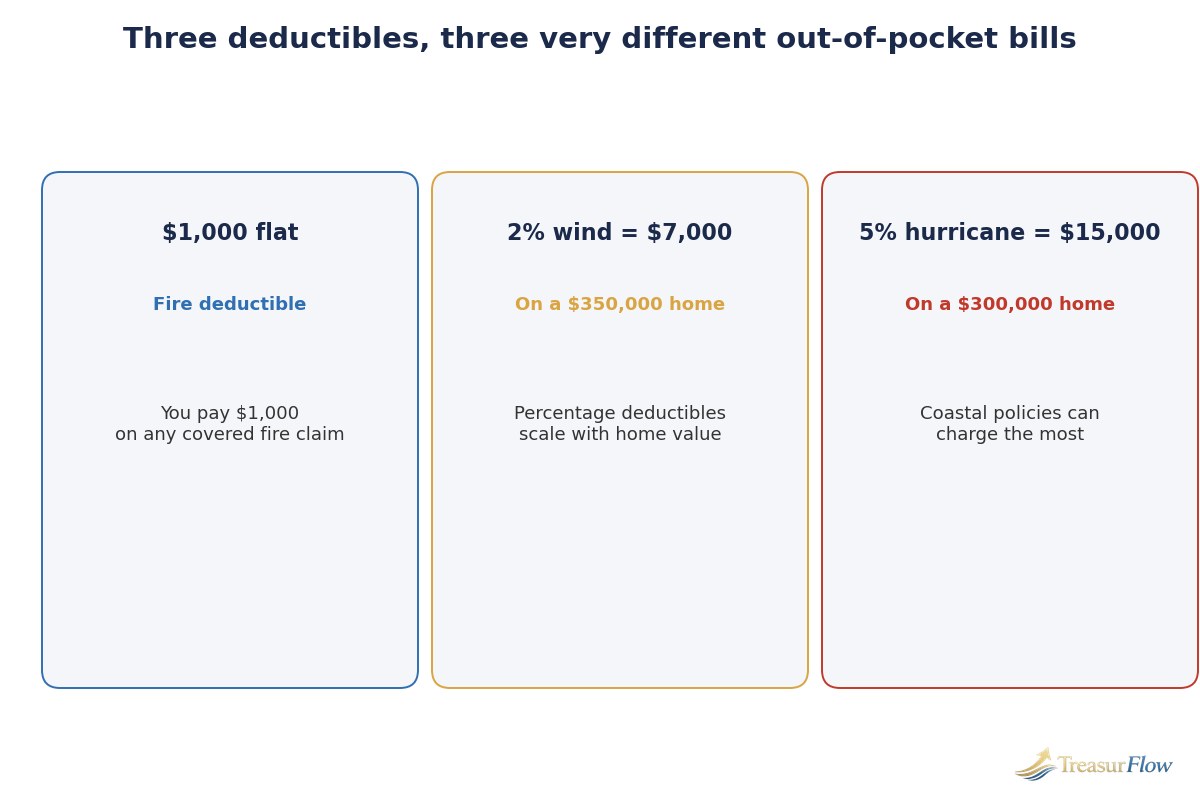
Here is the scenario that produces the angriest phone calls after a storm. A homeowner in Florida has a $300,000 dwelling limit, a $500 standard deductible, and a 5% hurricane deductible. A fire would cost them $500 out of pocket. A hurricane costs them $15,000 before the insurer pays a dollar. Both deductibles are in the same policy. Most buyers only remember the $500.
Hurricane deductibles apply in about 19 coastal states plus Washington, D.C., and they typically run 1–5% of your dwelling coverage, though some reach 10%. Florida lets policyholders choose among $500 or 2%, 5%, or 10% of insured value, and insurers must show the actual dollar amount on the policy. Alabama allows 1–10%, Maryland caps the hurricane deductible at 5%, and Louisiana applies its hurricane deductible on a per-year basis rather than per event. The trigger is usually a storm named by the National Hurricane Center or National Weather Service — and the exact trigger varies by state and carrier, so confirm yours in writing.
Wind and hail deductibles work the same way in many storm-belt and hail-belt states: a separate percentage deductible for wind or hail losses, often 1–5% of Coverage A. A $350,000 home with a 2% wind/hail deductible means $7,000 out of pocket on a hail-damaged roof before coverage begins.
Illustrative example (stated assumptions: $350,000 dwelling limit, $1,000 standard deductible, 2% hurricane deductible): A hurricane tears off part of your roof. Repair estimate: $28,000. Your out-of-pocket cost is $7,000 (2% of $350,000), and the insurer covers the remaining $21,000. If the same damage came from a kitchen fire, your out-of-pocket cost would be $1,000. Same house, same policy, a $6,000 difference because of which deductible the loss triggers.
Three decisions follow from this:
- Choose your percentage deliberately. A lower hurricane deductible (1%) costs more premium but caps your storm exposure; a higher one (5%) cuts premium but can leave you unable to fund repairs. Pick the percentage you could actually pay from savings the week after a storm — not the one that makes the quote look best.
- Keep a deductible fund. If your hurricane or wind deductible is $7,000, that amount should sit in an accessible savings account, not in home equity. A deductible you cannot pay is coverage you cannot use.
- Ask about wind-mitigation credits. Impact-resistant windows and doors, a reinforced or hurricane-rated roof, storm shutters, and roof-to-wall hurricane straps can cut premiums — in Florida and other coastal states, mitigation upgrades can reduce premiums by 20–40%, the single most powerful discount cluster for hurricane-exposed homes. Ask your insurer about a wind-mitigation inspection; the inspection often pays for itself in the first year.
The flood hole in every standard policy
Standard homeowners insurance does not cover flood. Rising water — storm surge, an overflowing river, days of heavy rain pushing water across the ground and into your home — is excluded from nearly every standard policy. Burst pipes and roof leaks are covered. Water that comes up from the ground is not. This is the most expensive misunderstanding in American home insurance.
Flood is the most common and most costly natural disaster in the United States, and it reaches far beyond the mapped high-risk zones: roughly one-quarter to one-third of flood claims come from outside high-risk flood areas. FEMA’s rule of thumb is that one inch of water inside a home can cause roughly $25,000 in damage. If your home is in a Special Flood Hazard Area with a federally backed mortgage, flood insurance is required. Everywhere else, it is optional — and often skipped until it is too late.
You have two ways to buy it:
- NFIP (National Flood Insurance Program), run by FEMA. Coverage is capped at $250,000 for the building and $100,000 for contents. There is generally a 30-day waiting period before a new NFIP policy takes effect, so you cannot buy it when a storm is already forecast. NFIP policies do not cover loss of use or additional living expenses — if a flood forces you out, the federal policy pays nothing toward the hotel or rental.
- Private flood insurance. A growing private market now covers roughly 27% of the residential flood market. Private policies can offer higher limits than the NFIP caps, broader terms including loss-of-use coverage, and sometimes shorter waiting periods — but they are not available everywhere or for every property.
If your rebuild cost exceeds $250,000 — and most do — the NFIP alone leaves you underinsured against flood. Compare a private quote alongside the NFIP quote, and check whether your homeowners insurer offers a flood endorsement or a companion private policy. Do this before storm season, not during it: the 30-day NFIP waiting period means a policy bought the week a hurricane forms may not be in force when the water arrives.
Discounts that actually move your premium — and the ones that don’t
Discounts are real money, but only if you treat them as a stack, not a headline. Most carriers let discounts combine, and stacking five or six legitimate ones can cut 25–40% off the effective premium at some carriers. The catch: many discounts are not applied automatically. You have to ask for them.
| Discount | Typical size | What it takes |
|---|---|---|
| Bundling home + auto | 10–25% | Both policies with the same carrier. |
| Claims-free history | 5–15% | Usually 3–5+ years without a claim. |
| Monitored security / protective devices | 5–20% | Monitored alarm, smoke/fire detection, sometimes water-leak sensors. |
| Wind mitigation / hurricane hardening | 20–40% in coastal states | Impact windows, reinforced roof, shutters, hurricane straps, inspection. |
| New roof / impact-resistant roof | Up to ~20% | Roof age and material; some carriers require impact-rated shingles. |
| Loyalty / tenure | 3–5% | Multi-year customer. |
| Paid-in-full / autopay / paperless | Small each (a few %) | Billing choices. |
Illustrative example (stated assumptions: $2,400 base premium, discounts applied multiplicatively as carriers typically do): Bundling at 15% takes the premium to $2,040. A claims-free discount of 10% takes it to $1,836. A monitored-security discount of 5% takes it to about $1,744. Autopay and paperless shave a little more. The total saving is roughly $700 a year — without cutting a dollar of coverage.
What does not move the needle as much as people expect: a single smart gadget with no monitoring, a loyalty discount at a carrier whose base rate is already inflated, or a discount you never told the insurer you earned. The discount conversation should happen every renewal: ask the agent to run the full discount list against your profile, and compare the discounted total against two competing quotes. A 25% discount on an overpriced policy is still an overpriced policy.
Two more money moves that are not discounts but behave like them. First, raise your flat deductible from $500 to $1,000 or $2,500 if you have the savings to absorb it — the premium saving is real, and you should only file claims above the deductible anyway (see below). Second, pay annually instead of monthly if the carrier waives installment fees; monthly billing fees quietly add up.
Filing a claim without losing money twice
A claim done well gets you paid faster and protects your future premiums. A claim done badly costs you twice: once in a low settlement, once in higher rates.
The sequence:
- Make it safe, then document everything. Once it is safe, photograph and video all damage inside and out — roof, siding, rooms, yard — before cleanup. Save damaged items (a bag of hail-bruised shingles, for example) until the adjuster has seen them. Make temporary repairs to prevent further loss: tarp the roof, board windows, remove hazardous debris. Save every receipt for emergency repairs and lodging.
- Notify the insurer fast — within 24 to 72 hours. Report through the app, portal, or claims hotline. Have your policy number, the date and time of the loss, and a brief description ready. Ask which deductibles apply, including any percentage or hurricane deductible, and get the claim number in writing.
- Meet the adjuster prepared. The adjuster inspects and writes an estimate. Walk the property together, point out every room, and share your photos, inventory, and any contractor estimates. Ask how depreciation and recoverable depreciation work on your form: many replacement-cost policies first pay actual cash value, then release the withheld depreciation after repairs are completed.
- Review the settlement line by line. If the offer looks low, request a re-inspection, submit additional contractor estimates, or ask for a supervisor review. Keep a claim diary: adjuster names, dates, emails, and every promise.
- Know the clock. Simple claims often pay within 7–14 days after the adjuster’s inspection; complex or disputed claims can take 4–8 weeks. In most states, insurers must acknowledge your claim within about 15 days and issue payment within roughly 30–45 days of approval. J.D. Power’s claims research found claims took an average of 29.6 days from filing to finished repairs and 40.7 days from first notice of loss to final payment — so a slow claim is not automatically a bad claim, but silence is a reason to escalate in writing.
When NOT to file: If the repair cost is near or below your deductible, pay out of pocket. Filing small claims can raise your premium or count against you at renewal — claims history is tracked, and insurers price the most recent three to five years most heavily. A useful rule: file when the damage is large, sudden, and clearly covered; self-pay when it is small, gradual, or maintenance-related. And never file a claim for damage your policy excludes (flood without flood coverage, wear and tear, or a sewer backup without a water-backup endorsement) — the denial still lands on your claims record at some carriers.
The nonrenewal trap: Even without filing, your policy can be nonrenewed for roof age, old systems, or area risk — remember the 96–216% rise in nonrenewal rates from 2018 to 2024. If you get a nonrenewal notice, do not wait: shop immediately, ask your agent about remediation (roof replacement, updated wiring) that could restore eligibility, and check your state’s FAIR plan as a last-resort option. A lapse in coverage can trigger force-placed insurance from your mortgage servicer at a far higher price.
Your 10-Minute Best Homeowners Insurance 2026 Decision Checklist
Do not buy on the first quote. Run this checklist, in order, and the right policy mostly picks itself:
- Get your rebuild number. Use a replacement-cost estimator or your insurer’s rebuild worksheet. Insure to 100% of rebuild cost — not market value, not purchase price.
- Set every limit deliberately. Coverage A = rebuild cost. Coverage B: raise above 10% if you have a detached garage plus outbuildings. Coverage C: replacement cost, not ACV, for personal property. Coverage D: at least 20% of A. Liability: $300,000 minimum; $500,000+ if you have significant assets, a pool, or a dog on a restricted-breed list.
- Pick your deductibles on purpose. Flat deductible you can pay tomorrow; hurricane/wind percentage you can pay the week after a storm. Write both numbers down before you compare quotes.
- Price the flood gap. Get an NFIP quote and a private flood quote. If you are in any flood zone — or anywhere water has pooled in living memory — buy one of them.
- Get three quotes, same limits. Amica or Erie for service; State Farm or Travelers for national reach and agent access; Progressive Home or a regional carrier for price. Identical limits and deductibles, or the comparison is meaningless.
- Ask for the full discount list. Bundling, claims-free, security, mitigation, new roof, loyalty, paid-in-full. Get the discounted totals in writing.
- Read the roof clause. Is roof settlement replacement cost or actual cash value? For roofs older than 10–15 years, this single clause can be worth thousands.
- Check the carrier. Confirm the A.M. Best financial-strength rating and look up the insurer’s NAIC complaint index — complaints relative to market share — before you bind.
- Confirm the start date before canceling the old policy. Never let coverage lapse between policies; your mortgage servicer can force-place expensive coverage if it sees a gap.
- Calendar two dates. Renewal minus 30 days (re-shop), and the annual coverage-limit review (rebuild costs move every year).
If you are saving for the house itself, remember that insurance is part of the monthly payment your lender counts. Our guide to how to save money in 2026 shows where an insurance line item fits in a realistic household budget — and if you are protecting a growing family, pairing the right home policy with the right life insurance for your stage of life is how the two biggest safety nets fit together.
Frequently asked questions
How much homeowners insurance do I need?
Insure your dwelling for 100% of its rebuild cost — what a contractor would charge to reconstruct your home from scratch — not its market value or purchase price. Most policies also require at least 80% of rebuild cost to avoid a coinsurance penalty on partial losses. Set personal property to replacement cost (not actual cash value), loss of use to at least 20% of the dwelling limit, and liability to at least $300,000, or $500,000+ if you have significant assets.
Does homeowners insurance cover flood?
No. Standard homeowners policies exclude flood — rising water from storm surge, overflowing rivers, or heavy rain. You need a separate flood policy: the federal NFIP (capped at $250,000 for the building and $100,000 for contents, with a general 30-day waiting period) or private flood insurance, which can offer higher limits and loss-of-use coverage. Roughly one-quarter to one-third of flood claims come from outside mapped high-risk zones, so “not in a flood zone” is not the same as “no flood risk.”
What is the difference between replacement cost and actual cash value?
Actual cash value pays replacement cost minus depreciation; replacement cost pays the full cost to repair or replace with similar kind and quality, with no depreciation deduction. On a $12,000 roof with a $2,000 deductible, replacement cost coverage pays about $10,000 while actual cash value coverage on a depreciated $7,000 roof pays about $5,000. Dwelling coverage is usually replacement cost; personal property often defaults to actual cash value unless you add a replacement-cost endorsement.
How do hurricane deductibles work?
In about 19 coastal states plus Washington, D.C., policies include a separate hurricane deductible, usually 1–5% of your dwelling coverage (up to 10% in some places). It replaces your standard flat deductible for hurricane losses. Example: on a $300,000 dwelling limit with a 5% hurricane deductible, you pay the first $15,000 of hurricane damage yourself. The trigger is typically a storm named by the National Hurricane Center, and the exact rules vary by state and carrier.
Can I switch homeowners insurance mid-policy?
Yes. You can switch at any time; your old insurer refunds the unused premium on a pro-rata basis. The critical rule: bind the new policy before canceling the old one so coverage never lapses. If your premium is escrowed through your mortgage, notify your servicer so the escrow payment redirects to the new insurer — otherwise the old insurer may still get paid and your new policy could be canceled for nonpayment.
Will filing a small claim raise my premium?
It can. Claims history is tracked, and insurers price the most recent three to five years most heavily. If the repair cost is near or below your deductible, paying out of pocket is usually smarter than filing. File when damage is large, sudden, and clearly covered — and document it thoroughly, because the quality of your documentation directly affects the settlement.
Helpful official resources: NAIC 2024 Market Share Report (PDF) · J.D. Power 2026 U.S. Home Insurance Study · Bankrate True Cost of Home Insurance · FEMA Flood Insurance (NFIP) — FloodSmart · NAIC — National Association of Insurance Commissioners · Consumer Financial Protection Bureau

Muhammad Zakir is the founder of Treasurflow and the author of its personal finance guides. He researches consumer banking, credit, and personal loans, and every guide cites primary sources such as the CFPB, FDIC, FTC, and IRS. His content is educational and is not personalized financial advice.