
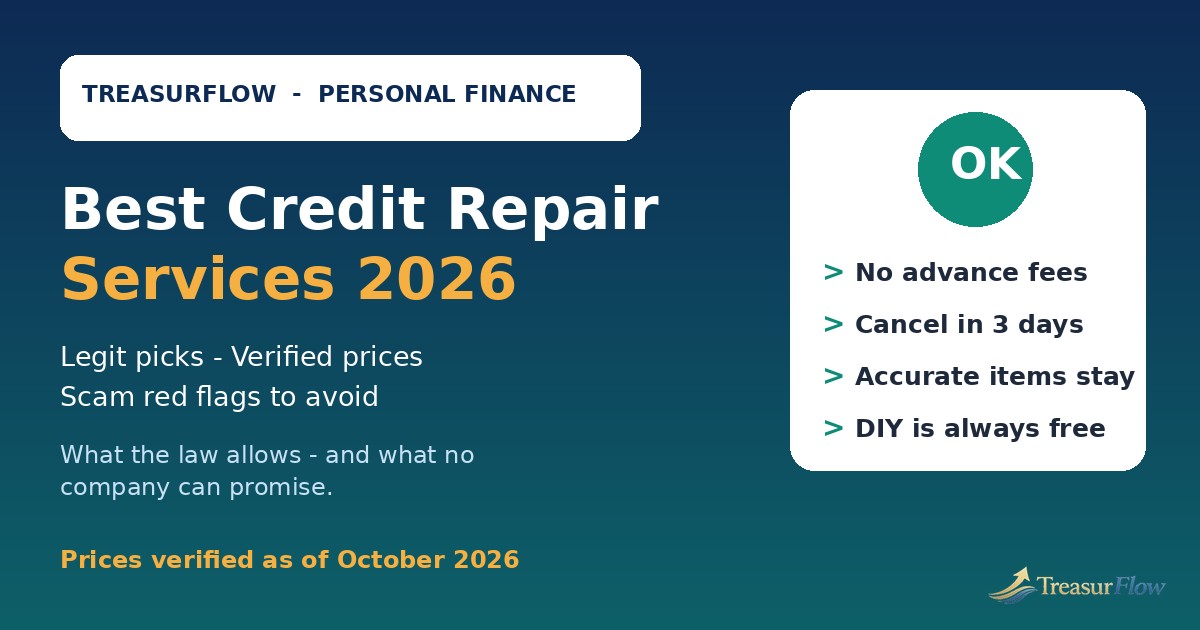
Best Credit Repair Services 2026: Legit Picks, Real Prices, and the Scams to Avoid
If your credit report is holding you back from a car loan, an apartment, or a mortgage, you have probably already seen the ads. They promise a clean report, a fast score jump, and a fresh start — usually for a fee you have to pay before anyone lifts a finger. Here is the truth this entire guide is built on: everything a credit repair company can legally do, you can do yourself for free. That is not our opinion. It is what federal law requires every legitimate company to tell you before you sign anything.
So why does this guide to the best credit repair services 2026 exist at all? Because “you can do it free” and “you have the time to do it free” are two different things. Disputing errors across three credit bureaus means pulling reports, writing letters, tracking 30-day deadlines, following up when a bureau stalls, and repeating the cycle for months. Some people would rather pay a reputable company $79 to $140 a month to run that paperwork for them — the same way you might pay someone to do your taxes even though the forms are free. That is a fair trade, as long as you know exactly what you are buying, what it legally can and cannot do, and how to walk away from the many operators who break the rules.
This guide takes a scam-guard approach. We start with the law, because the law is your best scam detector. We then help you decide between the free do-it-yourself route and hiring help. Only after that do we rank six services — Credit Saint, Sky Blue Credit, The Credit People, The Credit Pros, Lexington Law, and Dovly — using pricing verified from company pages and reputable roundups as of October 2026. Every price below was checked in October 2026, and prices change, so confirm the figure on the company’s own pricing page before you enroll. No company in this guide can remove accurate information from your report, and none can guarantee you a specific score. Any company that tells you otherwise is breaking the law — and that is your cue to hang up.
Related Guides
Helpful Official Resources
- FTC Consumer Advice: Credit Repair and Fixing Your Credit — the Federal Trade Commission’s guidance on your rights and scam warning signs
- Consumer Financial Protection Bureau (CFPB) — file complaints and read plain-language credit guidance
- AnnualCreditReport.com — the only federally authorized site for your free credit reports from Equifax, Experian, and TransUnion
First, the Law: What Credit Repair Legally Can and Cannot Do
Credit repair is one of the most heavily regulated corners of personal finance, and for good reason: the industry has a long history of operators charging desperate people for promises nobody can keep. Two federal laws do most of the protecting — the Credit Repair Organizations Act (CROA) and the Fair Credit Reporting Act (FCRA) — and a third, the Telemarketing Sales Rule, closes the loophole for companies that sell by phone. Understanding four rules from these laws will protect you better than any review site, including this one.
Rule 1: No company can charge you in advance for telemarketed services
Under CROA, a credit repair organization cannot request or receive payment until it has fully performed the services it promised. The Telemarketing Sales Rule goes further for phone sales: a company that markets credit repair by telephone cannot charge you until it has delivered the service and documented the results — in practice, legitimate phone-sold services bill monthly after work is done, and structure any “first work fee” or “setup fee” so it is charged days after signup, once initial work has begun, rather than at the moment you sign. The practical takeaway is simple: if a company demands a large payment up front, before any work exists, that is illegal — not aggressive, not standard, illegal. Walk away and consider reporting it.
Rule 2: You can cancel within 3 business days, free and clear
CROA gives you the right to cancel your contract for any reason, without penalty, within three business days of signing. The company must tell you about this right in writing, in a separate disclosure, before you sign. This cooling-off window exists because high-pressure sales calls are the industry’s oldest problem. Use the window. If you signed on a call and feel rushed the next morning, cancel in writing, keep a copy, and take your time deciding.
Rule 3: No one can remove accurate information — ever
This is the rule that separates every legitimate service in this guide from every scam. A credit repair company can dispute information that is inaccurate, incomplete, outdated, or that a creditor cannot verify. It cannot remove a late payment that really happened, a collection you really owe, or a bankruptcy that was really filed. Accurate negative information stays on your report until the legal reporting period expires — generally seven years for most negative items, and up to ten years for certain bankruptcies. The FTC is blunt about this: only scammers say they will remove all negative information from your credit report. A company can sometimes ask a creditor for a goodwill adjustment, and a creditor can say yes or no — but that is a request, not a right, and no honest company will promise the outcome.
Rule 4: Everything they can do, you can do yourself for free
Before a credit repair company starts work, CROA requires it to give you a disclosure titled “Consumer Credit File Rights Under State and Federal Law.” That document states, in plain language, that you have the right to dispute inaccurate information yourself, that you can get your reports free, and that no one can legally do anything for your credit that you cannot do yourself. The FTC repeats the same point in its consumer guidance: anything a credit repair company can do, you can do for yourself for little or no cost. When a company hands you that disclosure willingly and explains it, that is a good sign. When a company skips it, hides it, or asks you to waive your rights under CROA — which is itself prohibited — that is a disqualifying sign.
What a legitimate company actually does for its fee
If companies have no secret powers, what are you paying for? You are paying for labor and persistence. A legitimate service pulls your reports from Equifax, Experian, and TransUnion; audits them line by line for errors such as accounts that are not yours, wrong balances, duplicate collections, late payments recorded on the wrong dates, and items that have aged past the reporting limit; drafts and sends dispute letters to the bureaus and, where useful, directly to creditors and collectors; tracks each bureau’s investigation deadline; reviews the results; and files follow-up rounds for items that remain wrong. Under the FCRA, bureaus generally have 30 days to investigate a dispute and must delete or correct any item they cannot verify. A good company simply makes sure no round is missed and no deadline slips. You are buying someone else’s time and organization — nothing more, and any pitch that suggests more is a red flag.
DIY vs. Hiring a Company: An Honest Decision Guide
Because the free route is real, the first decision is not which company to hire. It is whether to hire one at all. Work through this section honestly before you look at a single price.
Do it yourself (free) if:
- You have only a few errors. One wrong late payment, one account that is not yours, one duplicate collection — these are an afternoon of work, not a six-month subscription. Pull your free reports from AnnualCreditReport.com, dispute online or by mail with each bureau reporting the error, and calendar the 30-day investigation window.
- Money is tight. Credit repair fees run roughly $474 to over $1,000 across six months depending on the plan. If that money would otherwise go toward paying down a balance, paying the balance almost always helps your score more, because credit utilization is a major scoring factor and no dispute can remove an accurate high balance.
- Your problem is accurate information. If every negative item on your report is correct, there is literally nothing to dispute. A company will take your monthly fee anyway in some cases, but the honest fix is time, on-time payments, and lower balances. Save the fee.
- You are comfortable with paperwork. The dispute process is not complicated. It is repetitive. If repetition does not bother you, you already own every tool the professionals use.
Hiring a company can make sense if:
- Your reports are a mess across all three bureaus. Identity theft fallout, a dozen collections, mixed files with another person’s accounts — the volume alone can justify paying for organized, tracked dispute rounds.
- You have a deadline. A mortgage pre-approval or a job that checks credit can make “eventually” too slow. A company will not make bureaus answer faster than the law requires, but it will keep every round moving without gaps while you handle everything else.
- You know you will not follow through. Be honest with yourself. A dispute you never send fixes nothing. Paying for follow-through you will actually get beats free intentions you will not act on — as long as you choose a company that follows the rules in the section above.
- You value the extras. Some services bundle credit monitoring, identity theft protection, score tracking, and coaching. If you would pay for monitoring separately anyway, a bundled plan can be reasonable value.
The middle path most people should try first
Pull your free reports this week. Highlight every item you believe is wrong. Dispute the two or three clearest errors yourself — a balance that is not yours, a payment marked late that was on time. Wait for the results. If the process feels manageable, keep going and keep your money. If it turns into a tangle of letters, deadlines, and bureau form responses, you now know exactly what work you are outsourcing, and you can hire a company below with clear eyes and a specific list of items to work on. That one experiment, which costs nothing, is the best protection against paying for a service you never needed.
How We Picked These Services
We ranked services on the things that actually protect your wallet: verified pricing (monthly fee and first-work or setup fee, because the second number is where budgets get ambushed), the refund or guarantee terms in writing, cancellation flexibility, what is bundled beyond dispute letters, and how long the company has operated. We excluded any service whose model depends on large advance payments, score guarantees, or “new credit identity” pitches — all illegal under CROA and the FTC’s Telemarketing Sales Rule. Prices below are as of October 2026, drawn from company pricing pages and reputable roundups including Money and management.org, and cross-checked against each other. Where sources disagreed, we say so rather than picking the prettier number.
The Picks: Best Credit Repair Services of 2026
Best Overall: Credit Saint
Credit Saint earns the top spot the boring way: clear tiers, published prices, and the most detailed written guarantee terms in the group. It offers three plans, so you can match the level of dispute work to how damaged your reports actually are instead of paying for the maximum package by default.
- Credit Polish: $79.99/month, $99 first-work fee — bureau challenges (not unlimited), score tracker and analysis, creditor intervention letters
- Credit Remodel: $109.99/month, $99 first-work fee — adds inquiry targeting and a personalized credit-building guide
- Clean Slate: $139.99/month, $195 first-work fee — the most aggressive tier, with unlimited challenges
The guarantee is a 90-day money-back guarantee: if no questionable items are deleted within your first 90 days, you can request a full refund. Read the conditions before you count on it — you must stay active and current on payments, and the request window and documentation requirements are specific. That narrowness is typical of the industry, but Credit Saint at least publishes the terms where you can read them before enrolling, which is more than most competitors do. On the cheapest plan, six months costs about $579 all-in ($99 plus six payments of $79.99), so go in knowing the real total. Choose Credit Saint if you want the full-service experience with the fewest pricing surprises. Skip it if a $99–$195 first-work fee strains your budget — the two picks below start cheaper.
Best Value and Best for Couples: Sky Blue Credit
Sky Blue Credit, operating since 1989, is the simplest pricing story in credit repair — and for couples, it is not close. Three plans, no tier games, and a second person added at roughly half price.
- Basic: $79/month for individuals, $119/month for couples
- Full Service: $99/month for individuals, $149/month for couples
- Premium: $119/month for individuals, $179/month for couples
Money’s October 2026 roundup lists a set-up fee equal to the plan price ($79, $99, or $119); some roundups report no separate setup fee listed on the site, so confirm the first charge on your signup call — it is typically billed about six days after enrollment, after initial work, with the first monthly payment a month later. Two features make Sky Blue the value pick beyond the sticker price. First, a 90-day money-back guarantee. Second, the ability to pause or skip a month without being charged while paused — a genuinely consumer-friendly policy in an industry that prefers to keep billing. Basic members get report updates every 60 days, while Full Service and Premium run on 45-day cycles with added tools such as creditor interventions, debt validation letters, and cease-and-desist letters on higher tiers. Six months on Basic runs about $474, the lowest six-month total among the full-service companies here. If two of you need repair, the couples pricing ($119 versus $158 for two separate Basic accounts) makes Sky Blue the automatic first call.
Best Guarantee: The Credit People
Most credit repair “guarantees” last 90 days and come wrapped in conditions. The Credit People offers the longest protection window on this list for buyers of its flat-rate plan: a six-month satisfaction guarantee. Its pricing is also the easiest to budget, because one option removes the monthly meter entirely.
- Standard: $99/month
- Premium: $119/month
- Premium Flat Rate: $599 for six months
Setup costs are low — Money lists a $45 first-work fee, while some reviews report figures between $19 and $45, and the flat-rate plan carries no separate setup fee — so verify the exact first charge before signing. The flat rate deserves a pause in both senses: $599 for six months of Premium beats paying $119 monthly for six months ($714), and you know your total cost on day one. But ask two questions before choosing it: when exactly is the $599 collected, given the federal rule against charging before work is performed, and what portion is refunded if you cancel in month two? Get the answers in writing. The company offers unlimited challenges across all three bureaus and a dashboard for tracking progress, and monthly-plan customers can cancel at any time without being charged for that month. Choose The Credit People if a capped, known total cost matters more to you than the lowest possible monthly bill.
Best for Monitoring and Tools: The Credit Pros
The Credit Pros is the pick if you want dispute work bundled with the monitoring and money tools you would otherwise buy separately. Plans pair credit repair with credit monitoring, identity protection, and budgeting features, which suits people rebuilding their whole financial picture rather than fixing a single error.
- Build Credit: $69/month, $119 first-work fee
- Repair Credit: $129/month, $129 first-work fee
- Repair and Build Credit: $149/month, $149 first-work fee
A family member can join at a discount — management.org’s 2026 review notes 50% off the monthly rate for an additional family member. Now the caution, because this is exactly the kind of guarantee wording this guide exists to decode: The Credit Pros’ satisfaction guarantee extends your service at no cost rather than refunding your money. If nothing improves, you get more months of the same service, not your cash back. That may still be fair value if the tools are what you wanted, but do not buy this plan believing the guarantee works like Credit Saint’s or Sky Blue’s refund. The company is also not BBB accredited, per management.org’s review, though it reports strong Trustpilot ratings via CNBC Select. Choose The Credit Pros for the bundle; choose one of the refund-based picks above if getting your money back matters most.
Best-Known Attorney-Led Name — With a History to Read First: Lexington Law
Lexington Law is the name most Americans have heard, and its current offer is simple: one plan at $139.95/month, with no separate first-work fee listed in October 2026 roundups, no money-back guarantee, and case work reviewed by attorneys and paralegals — the firm operates as a law firm (Oquirrh Mountain Law Group, P.C., doing business as Lexington Law Firm). That attorney-led structure is the appeal for people whose reports involve genuinely legal questions, such as debts they believe were discharged or reporting they think violates the FCRA in ways a form dispute will not fix.
Honesty requires the other half of the story. The group that marketed the Lexington Law brand for years was at the center of a major CFPB enforcement case, settled in 2023, over allegations that included charging illegal advance fees — the exact practice Rule 1 above describes. The brand’s current operation and pricing are what they are today, and the site notably does not promise specific results, which is legally correct behavior. Our advice: Lexington Law belongs on a comparison list because of its scale and legal structure, but it is the most expensive monthly price here with no refund guarantee, so read the contract with extra care, confirm who your contract is actually with, and compare its $139.95 against Credit Saint’s tiers and Sky Blue’s simplicity before you commit. Brand recognition is not a feature worth $60 extra a month by itself.
Best Low-Cost App: Dovly
Dovly is the different animal on this list: not a traditional done-for-you company, but an app-based, AI-assisted dispute and monitoring tool that sits between pure DIY and a full-service firm. Its pricing, from Dovly’s own site, undercuts every human-staffed service here.
- Free plan: $0 — monthly TransUnion report and score, plus one dispute per month
- Premium: $39.99/month, or $99.99/year — unlimited disputes, broader monitoring and credit-building features
There is no setup fee and no money-back guarantee — reasonable at this price, but know it going in. The trade-offs are equally clear. The free plan centers on TransUnion, so errors sitting only on your Equifax or Experian reports still need your own disputes there. And an automated engine is best at straightforward, documentable errors; a report tangled with identity theft, mixed files, or aggressive collectors may need a human-staffed service from the picks above, or a consumer attorney. Choose Dovly if your errors are simple, your budget is small, and you want software to draft and track disputes you would otherwise write yourself. The free tier makes it the lowest-risk experiment on this list — try it before paying any company anything.
Pricing Comparison: What Six Months Really Costs
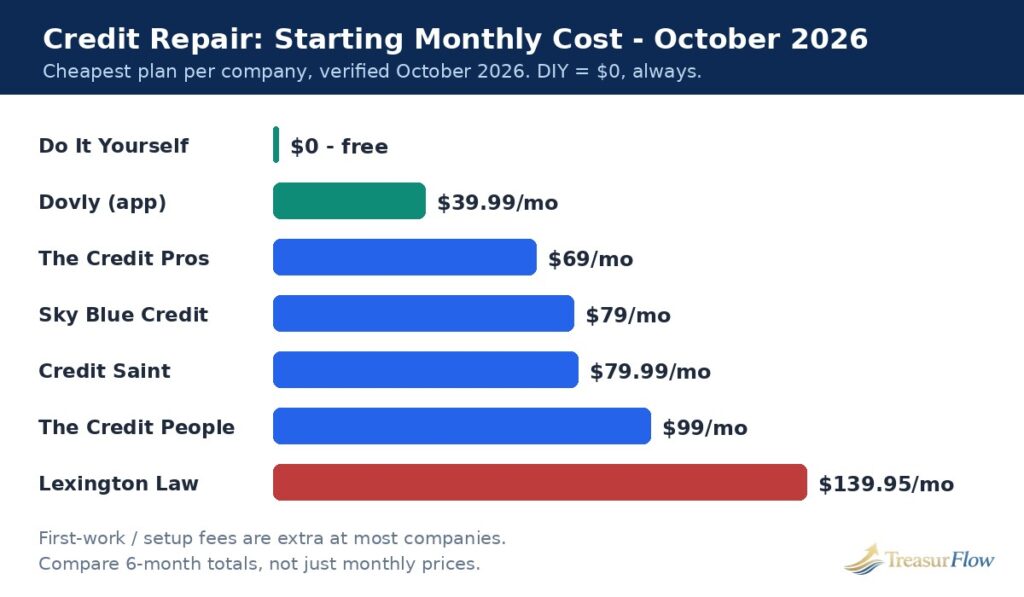
Monthly fees are how these services are advertised. Six-month totals are how they should be compared, because most dispute work takes several rounds. Figures below use each company’s cheapest plan, as of October 2026, and assume one first-work or setup fee plus six monthly payments.
| Company | Best for | Monthly fee (cheapest plan) | First-work / setup fee | Guarantee | Approx. 6-month cost |
|---|---|---|---|---|---|
| Credit Saint | Best overall | $79.99 | $99 | 90-day money-back if no deletions (conditions apply) | ~$579 |
| Sky Blue Credit | Best value / couples | $79 | $79 (per Money; confirm at signup) | 90-day money-back; pause anytime | ~$474–$553 |
| The Credit People | Best guarantee / flat rate | $99 (or $599 flat for 6 months) | $19–$45 (confirm at signup) | 6-month satisfaction guarantee on flat-rate plan | ~$594–$599 |
| The Credit Pros | Monitoring bundle | $69 | $119 | Satisfaction guarantee extends service (not a refund) | ~$533 |
| Lexington Law | Attorney-led name | $139.95 | None separately listed | No guarantee | ~$840 |
| Dovly | Low-cost app | $39.99 (free plan available) | $0 | No guarantee | ~$240 (or $0–$100 on free/annual options) |
| Do it yourself | Anyone with a few errors | $0 | $0 | N/A — it’s free | $0 |
Read the last row again. The DIY route stays in this table on purpose: every dollar above buys convenience and persistence, not stronger legal rights. If your six-month total with any company approaches the size of a debt you could have paid off instead, the math usually favors paying the debt.
Red-Flags Checklist: Walk Away If You See Any of These
The FTC and CFPB publish nearly identical warning lists, because scam operators keep using the same script. Before you sign with any company — including the ones recommended above — run this checklist. One hit is enough to end the conversation.
- They demand payment before doing any work. Advance fees for telemarketed credit repair are banned under the Telemarketing Sales Rule, and CROA bars charging before promised services are performed. A first-work fee billed days after signup, once work has begun, is the industry-standard structure; a big charge today, before anything exists, is not.
- They guarantee a score jump. “We will raise your score 100 points” is a promise no one can legally make or keep. Scores depend on your whole file and your future payments. Guaranteed numbers = illegal claim.
- They promise to remove accurate information. See Rule 3. Impossible, and claiming otherwise violates CROA’s ban on misleading statements.
- They pitch a “new credit identity” or CPN. A credit privacy number scheme means using a nine-digit number in place of your Social Security number to build a fresh file. Those numbers are frequently stolen SSNs — often belonging to children or deceased people — and using one to apply for credit is fraud. This is the single most dangerous pitch in the industry.
- They tell you not to contact the bureaus yourself, or to dispute items you know are accurate. Both are classic FTC scam markers. Disputing accurate information as a tactic is also prohibited advice under CROA.
- They suggest filing a false identity theft report or lying on an application. That is asking you to commit a crime for their business model. The FTC specifically warns against companies that push false identity theft reports.
- There is no written contract, no total cost, or no mention of your 3-day cancellation right. All three are legally required. A company that skips the paperwork is telling you exactly how it treats the rest of the law.
- They ask you to waive your CROA rights. Prohibited. Full stop.
- They pressure you to sign today. Your 3-business-day cancellation right exists precisely because of this tactic. A legitimate company survives your sleeping on it.
On August 10, 2026, the FTC announced that a federal court had temporarily shut down a large credit repair operation the agency alleges took nearly $200 million from consumers through deceptive practices, including illegal upfront fees — a reminder, reported by Money, that these are not hypothetical risks. Enforcement actions at that scale happen because the checklist above works: the victims almost always describe the same red flags, recognized too late.
How Disputes Actually Work, Step by Step
Whether you hire a company or do it yourself, the machinery underneath is identical. Here is the full cycle, so you can judge any company’s claims against reality.
Step 1: Pull all three reports. Get your Equifax, Experian, and TransUnion reports free at AnnualCreditReport.com. Errors are often bureau-specific — an account may be wrong on one report and fine on the other two — so all three matter. (A company will do this pull for you as part of onboarding; this is also the step where you hand over identification documents, which is why choosing a legitimate operator matters.)
Step 2: Audit every line. Check personal information (names, addresses, Social Security number variations), then every account: balances, limits, payment history, dates, and status. Flag accounts you do not recognize, duplicates of the same debt sold to multiple collectors, payments marked late that were on time, closed accounts reported as open, and anything older than the reporting limit — generally seven years from the original delinquency for most negatives.
Step 3: Dispute with the bureau reporting the error. Online, by mail, or by phone — mail with a return receipt creates the strongest paper trail. State clearly what is wrong and why, and include copies (never originals) of supporting documents such as statements or payment confirmations. The dispute must be specific; “this is wrong, remove it” without a reason invites a form-letter denial.
Step 4: The bureau investigates — usually within 30 days. Under the FCRA, the bureau must investigate and contact the creditor or collector that supplied the information. If the furnisher cannot verify the item, or agrees it is wrong, the bureau must correct or delete it and send you the results. If the item is verified as accurate, it stays — and this is the point where honest companies tell you so, while dishonest ones invent a new “round” of the same dispute to keep billing you.
Step 5: Review results and escalate only where evidence supports it. If a bureau refuses to fix a genuine error, you can add a statement of dispute to your file, dispute directly with the furnisher, and file a complaint with the CFPB, which forwards it to the company and tracks the response. New evidence — a document you did not include the first time — makes a second dispute meaningful. The same dispute with nothing new is usually dismissed as frivolous.
Step 6: Protect the gains. Deletions only fix the past. Your score from here is built by the unglamorous basics: pay on time, every time; keep card balances low relative to their limits; avoid opening several new accounts at once; and recheck your reports a few times a year so new errors get caught in the first round, not the fifth. If you hired a company, this is also your cue to ask whether you still need it.
How Long Do Results Realistically Take?
Set your expectations by the calendar the law imposes, not by a sales page. Each dispute round takes about 30 days because that is the bureau’s investigation window. Companies typically work in 35- to 60-day cycles — Sky Blue, for example, updates Basic files every 60 days and Full Service and Premium files every 45 — so even a fast case moves in monthly steps.
Realistically: a report with one or two clear, documentable errors can improve within one or two cycles — call it one to three months. A report with many collections, charge-offs, and cross-bureau inconsistencies commonly takes three to six months of rounds, and complex identity-theft cleanups can run longer. Six-month cost estimates in our pricing table exist because six months is a normal engagement, not a pessimistic one.
Two honest caveats. First, a deletion does not translate into a fixed number of points. Removing a recent collection from a thin file can matter a great deal; removing an old late payment from a thick file may barely move a score, and your score also reflects balances and payments happening now. Second, items that are accurate will still be there when the process ends, aging toward their seven-year fall-off date. Any timeline you are given that ignores those two facts is marketing, not a forecast.
Before You Sign: A Five-Minute Contract Check
If you decide to hire, spend five minutes on the contract itself — CROA requires it to contain the information below, and its absence is information too.
- Total cost in writing, including the first-work fee, the monthly fee, and how long billing continues.
- A description of the services and an estimated completion date.
- The 3-business-day cancellation notice, with the separate “Consumer Credit File Rights” disclosure.
- The guarantee terms, in full — refund or service extension, conditions, and the exact window and method for claiming.
- How to cancel later: phone, email, or portal; any notice period; and confirmation that canceling stops future charges.
Screenshot or save everything. If a dispute with the company ever reaches the CFPB or your state attorney general, that paperwork is your case.
The Bottom Line on the Best Credit Repair Services 2026
The best credit repair service in 2026 is, for most people with a handful of errors, no service at all — your free reports, your own dispute letters, and 30 days of patience do the same legal work. If your reports are a genuine tangle, or your time is worth more than the fee, hire the paperwork, not the promise: Credit Saint for the clearest tiers and a written refund guarantee, Sky Blue Credit for value and unbeatable couples pricing, The Credit People if a capped flat rate and the longest satisfaction guarantee fit your budget style, The Credit Pros for a monitoring bundle, Lexington Law only with its history read and its premium price justified, and Dovly if an inexpensive app is all the help you actually need. Whichever route you take, the law is on your side — as long as you use it before you sign, not after.
Straight Answers Before You Pay Anyone
Can a credit repair company remove accurate negative information from my credit report?
No. No company can legally remove accurate, current negative information, such as a late payment that really happened or a bankruptcy that was really filed. Companies can only dispute information that is inaccurate, incomplete, outdated, or unverifiable. Accurate items generally stay for seven years, and any company promising to remove them is a red flag.
How much do the best credit repair services cost in 2026?
As of October 2026, verified monthly fees range from $39.99 for Dovly Premium to $139.95 for Lexington Law, with full-service companies such as Credit Saint and Sky Blue Credit starting at about $79 to $79.99 per month. Most companies also charge a first-work or setup fee, so compare six-month totals, not just the monthly price.
How long does credit repair take to show results?
Expect several months. Credit bureaus generally have 30 days to investigate each dispute, and many reports need two or three rounds. A report with one or two clear errors may improve within one or two cycles, while a report with many items often takes three to six months or longer. No legitimate company can promise a result by a specific date.
Is it legal for a credit repair company to charge me upfront?
No. Under the Credit Repair Organizations Act, a credit repair company cannot charge you before it has fully performed the promised services, and the Telemarketing Sales Rule bans advance fees for credit repair sold by phone. You also have the right to cancel your contract within three business days of signing, without penalty.
Can I repair my credit myself for free?
Yes. Everything a credit repair company can legally do, you can do yourself for free. Get your reports at AnnualCreditReport.com, dispute any errors with the bureaus reporting them, and follow up within the investigation window. Paying a company buys you time and persistence with the paperwork, not stronger legal rights.
What is a CPN and should I ever use one?
A CPN, or credit privacy number, is a nine-digit number sold as a way to hide a bad credit history or start a new credit identity. These pitches are illegal scams. The numbers are often stolen Social Security numbers, and using one to apply for credit is fraud. Never buy a CPN and never let a company create a new identity for you.

Muhammad Zakir is the founder of Treasurflow and the author of its personal finance guides. He researches consumer banking, credit, and personal loans, and every guide cites primary sources such as the CFPB, FDIC, FTC, and IRS. His content is educational and is not personalized financial advice.