
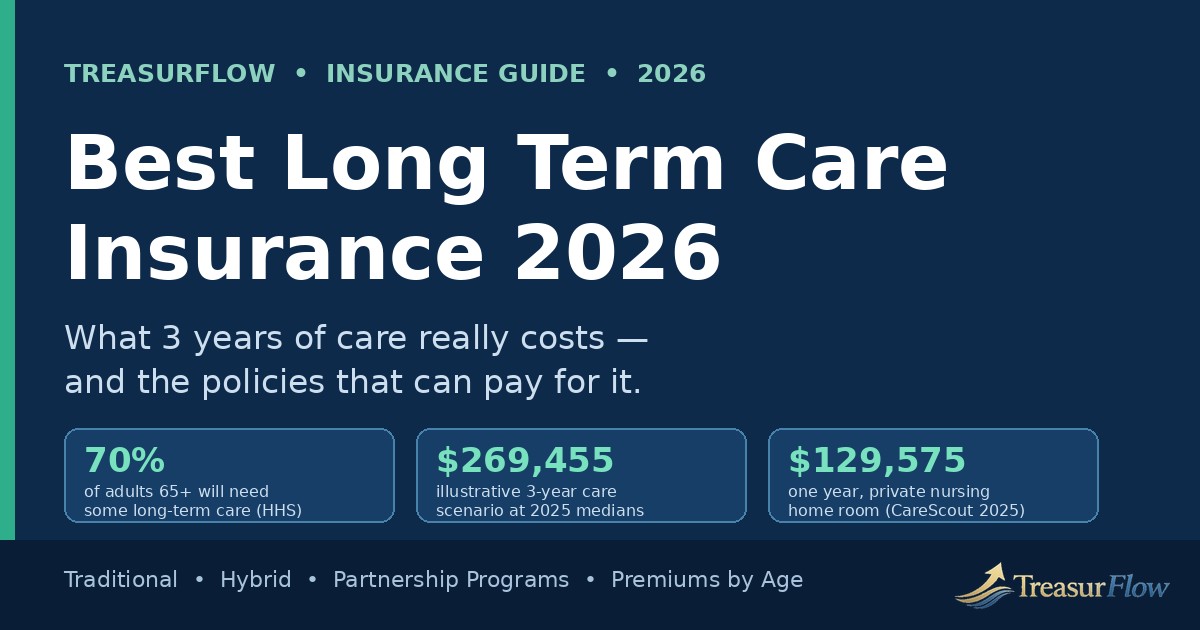
Best Long Term Care Insurance 2026: What 3 Years of Care Really Costs — and the Policies That Can Pay for It
Most retirement plans fail at the same quiet moment. It is not a stock market crash. It is the year a spouse can no longer bathe, dress, or get out of a chair safely alone, and the family discovers — usually in the same week — two things: Medicare will not pay for that kind of care, and the care itself costs more per year than the mortgage on their first house did in total.
This guide to the best long term care insurance 2026 options starts where your decision should start: with the bill. Below, you will walk through a realistic three-year care scenario priced with the latest national survey data, compare the three honest ways to pay for care — traditional long-term care insurance, hybrid life-plus-care policies, and short-term care or self-insuring — and then see which carriers earn a place on a shortlist in October 2026, and why. You will also learn the five benefit-design levers that matter more than the brand name on the brochure, how state Partnership Programs can protect your savings even if you eventually need Medicaid, the age window when buying makes the most sense, and the underwriting warnings nobody puts in the sales deck.
One promise before we begin: no scare tactics and no invented numbers. Every cost figure in this article comes from the CareScout (Genworth) Cost of Care Survey or the American Association for Long-Term Care Insurance (AALTCI) Price Index, date-stamped as of October 2026. Every premium range is a published benchmark, not a quote — your price will depend on your age, health, state, and policy design, and the only way to get a real number is to compare quotes with a licensed agent who sells long-term care insurance every week, not once a year.
Related Guides
- Best Life Insurance 2026 — the foundation coverage a hybrid long-term care policy builds on.
- Best Life Insurance for Seniors Over 70 — what is still buyable later in life, and at what price.
- Best Homeowners Insurance 2026 — protecting the home itself while you plan for care inside it.
Start With the Bill: A Realistic 3-Year Care Scenario
Forget averages for a moment and picture one ordinary path through care — the kind elder-law attorneys and discharge planners see every week.
Year 1 — help at home. After a fall and a slow recovery, you need a paid caregiver at home for personal care and household help. The CareScout 2025 Cost of Care Survey — the current edition as of October 2026, based on more than 25,000 provider rates collected between July and November 2025 — puts the national median for a non-medical caregiver at $35 per hour, which totals $80,080 a year at 44 hours of care per week. That is not round-the-clock care. That is roughly six hours a day.
Year 2 — assisted living. Home care is no longer enough, or family caregivers are burning out, so you move to an assisted living community. The same survey puts the national median at $6,200 per month, or $74,400 a year — up 5% from the prior year, after a 10% jump the year before that.
Year 3 — nursing home. A stroke, advancing dementia, or simple frailty raises the level of care beyond what assisted living provides. The national median for a semi-private nursing home room is $315 per day, or $114,975 a year. A private room runs $355 per day, or $129,575 a year.
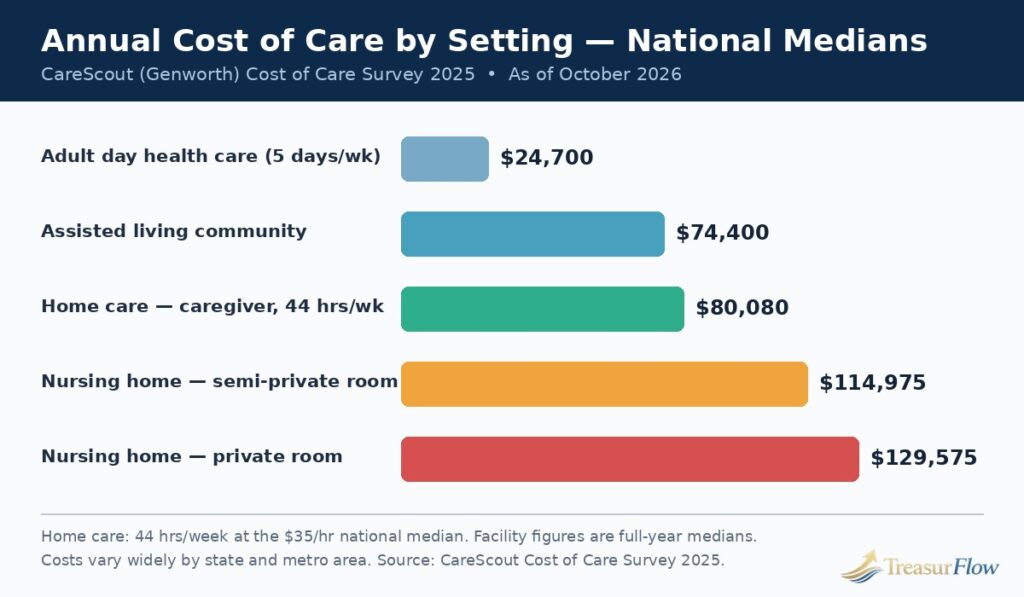
Add the three years together — one year at home, one year in assisted living, one year in a semi-private nursing home room, all at today’s median prices with no future inflation — and the illustrative total is $269,455. Stay in one setting for all three years instead, and the math is just as sobering: three years of assisted living totals $223,200, three years of home care at 44 hours a week totals $240,240, and three years in a semi-private nursing home room totals $344,925. A private room for three years reaches $388,725.
Two more facts frame that scenario honestly. First, needing care is not a remote risk: research from the U.S. Department of Health and Human Services (HHS), through its Office of the Assistant Secretary for Planning and Evaluation, found that about 70% of adults who survive to age 65 will develop severe long-term services and supports needs before they die, and about 48% will receive some paid care. “Severe need” in that research means difficulty with at least two activities of daily living expected to last 90 days or more, or severe cognitive impairment. Second, most care does not look like the worst case. Many people need help for a shorter stretch, much of it at home, and family members still provide a large share of it unpaid. The planning problem is the tail risk: the one-in-five or so whose care lasts five years or longer, often with dementia, is the scenario that can consume a retirement portfolio — and it is precisely the scenario insurance exists for.
Costs also vary enormously by state and metro area. The figures above are national medians: half of providers charge more. CareScout’s own analysis underlines how fast the ground is moving — $250,000 of savings that covered about 3.8 years of care in 2020 covered only about 2.8 years by the 2025 survey. And if care is 20 years away, inflation compounds the problem: at a purely illustrative 3% annual increase, one year in a private nursing home room that costs $129,575 today would cost roughly $234,027 in 20 years. That is why the inflation-protection lever, covered later in this guide, is not a luxury add-on for younger buyers. It is the feature that decides whether the policy you buy at 58 still resembles the cost of care at 82.
Helpful Official Resources
- LongTermCare.gov — Administration for Community Living (HHS) — the federal government’s plain-language guide to care options, costs, and planning, including the research behind the 70% statistic.
- Medicare.gov — Long-Term Care — Medicare’s own statement of what it does and does not cover. Short version: it does not pay for custodial long-term care.
- NAIC — Long-Term Care Insurance Buyer’s Guide — the National Association of Insurance Commissioners’ consumer guide and the questions regulators suggest you ask before you buy.
Three Ways to Pay for Care in 2026
Every long-term care plan is some mix of three approaches. Understanding the trade-offs between them matters more than picking a carrier, because the right carrier for the wrong approach still leaves you with the wrong plan.
Option 1: Traditional (Standalone) Long-Term Care Insurance
A traditional policy does one job: it pays for care — at home, in assisted living, in adult day care, or in a nursing home — when you cannot perform at least two of the six activities of daily living (bathing, dressing, eating, toileting, transferring, and continence) or you develop a severe cognitive impairment such as Alzheimer’s disease. You choose a monthly or daily benefit, a benefit period, an elimination (waiting) period, and optional inflation protection, and the policy pays up to those limits, usually as reimbursement of actual expenses, though some modern designs offer a cash-benefit option.
The strengths are leverage and price efficiency. Because every premium dollar buys care benefits and nothing else, a traditional policy delivers the most long-term care coverage per dollar of any insurance approach. Tax-qualified policies also come with tax advantages: benefits are generally received income-tax-free, and a portion of premiums may be deductible depending on your age and tax situation — confirm your specifics with a tax advisor.
The honest weaknesses deserve equal billing. Traditional coverage is “use it or lose it”: if you never need care, the premiums bought peace of mind, not a payout. And premiums on traditional policies are not guaranteed. Insurers price them as guaranteed renewable, meaning the carrier cannot cancel your policy or raise your individual rate because of your health — but it can, with state regulator approval, raise rates for an entire class of policyholders in a state. That has happened repeatedly across the industry as carriers corrected optimistic assumptions made in the 1990s and 2000s. When you compare quotes, ask each carrier for its rate-increase history in your state, and buy a benefit level you could still afford if premiums rose. A policy you are forced to lapse at 80 because of a rate increase is worse than a slightly smaller policy you keep.
Traditional coverage tends to fit buyers in their 50s and early 60s with meaningful assets to protect — enough that Medicaid is not a plan, not so much that a multi-year care bill is a rounding error — who want maximum care coverage per premium dollar and can tolerate the possibility of future class-wide rate adjustments.
Option 2: Hybrid Life Insurance + Long-Term Care (Linked-Benefit) Policies
Hybrid policies combine permanent life insurance with long-term care benefits in a single contract. If you need care, the policy accelerates and extends benefits to pay for it — a $100,000 life policy might provide $200,000, $300,000, or more in total long-term care benefits depending on the design. If you never need care, your beneficiaries receive the death benefit. Many designs also include a return-of-premium option if you change your mind, though exercising it usually means giving up the coverage on favorable-or-unfavorable terms spelled out in the contract, so read that section before you count on it.
Hybrids solve the two objections that sink traditional sales: the money is not “wasted” if you stay healthy, and premiums are typically guaranteed — often paid as a single premium or over a fixed schedule of five or ten years, after which the rate-increase question disappears entirely. That predictability is genuinely valuable for retirement budgeting, and it is the main reason hybrids now outsell traditional policies.
The trade-off is efficiency. Because part of your money funds a guaranteed death benefit, a hybrid delivers less care coverage per premium dollar than a traditional policy with the same outlay. Hybrids also often require larger upfront commitments — single premiums in the tens of thousands of dollars are common — which can mean repositioning assets rather than adding a monthly bill. They tend to fit buyers who already intended to hold permanent life insurance or earmark a lump sum for care, who dislike open-ended premium commitments, and who value a guaranteed outcome in every scenario: care, death without care, or (with the right rider) their money back.
Two hybrid designs dominate 2026 shortlists. Nationwide CareMatters II pays cash indemnity benefits — a fixed monthly check once you qualify, with no receipts to submit — which lets you pay family caregivers or mix formal and informal care freely. Lincoln MoneyGuard (currently sold in Fixed Advantage and Market Advantage versions) is one of the longest-running hybrid brands, known for guaranteed premiums, return-of-premium options, and, on current designs, no elimination period for eligible care. New York Life’s Asset Flex brings a top-rated mutual insurer into the same category. Product names, versions, and availability change and vary by state, so verify the current form on any illustration you are shown.
Option 3: Short-Term Care Insurance and Self-Insuring
The third path is really two different plans sharing a section.
Short-term care insurance covers care for a limited period — commonly up to 360 days. It is cheaper than full long-term care insurance, underwriting is often simpler, and it can be available at older ages or to applicants who cannot qualify for a traditional policy. Used deliberately, it can cover the most common short recovery spells, bridge an elimination period, or protect a modest asset base for the first year while family decisions get made. Its limit is right in the name: it does almost nothing against the multi-year dementia claim that creates the catastrophic bill. Treat it as a partial shield, not a substitute, and never let a short-term policy’s low premium talk you out of coverage you actually need and can qualify for.
Self-insuring means earmarking your own assets for care. It is a rational choice at both ends of the wealth spectrum. If your investable assets are modest, premiums can consume income you need for living expenses, and Medicaid — which requires spending down to very low asset levels, with rules that vary by state and protections for a spouse at home — becomes the de facto backstop; the NAIC itself cautions that if your only income is Social Security or SSI, long-term care insurance is probably not suited to you. If your assets are substantial — for many households, a dedicated reserve in the high six or seven figures that can sit untouched — you can absorb even a long claim without changing your family’s standard of living, and insurance becomes a preference about legacy and liquidity rather than a necessity. The danger zone is the middle: households with, roughly, a few hundred thousand to a couple of million dollars in savings, where one spouse’s five-year care need can impoverish the healthy spouse. That middle is exactly who the first two options were built for.
Whichever path you choose, choose it on purpose. “We will figure it out” is also a plan — it is just the one where your children figure it out, at retail prices, under time pressure.
Best Long-Term Care Insurance Companies for 2026, by Use Case
Carrier lineups change, and any ranking is a starting point, not a verdict. The picks below reflect the carriers that independent roundups — including Money’s October 2026 review of 11 insurers and LTC News coverage of the standalone and hybrid markets — return to most often, organized by the job each does best. Financial strength ratings are shown as reported in January–October 2026 roundups; ratings change, so confirm the current rating for the exact issuing company before you buy. As a rule of thumb for a promise that may not be claimed on for 25 years, look for AM Best ratings of A (Excellent) or better — and prefer A+ and A++ when the price difference is small.
Best for Standalone Coverage: Mutual of Omaha
Mutual of Omaha (AM Best A+, Superior, in 2026 roundups) is one of the few carriers still fully committed to traditional long-term care insurance, and Money named it the best for stand-alone coverage in October 2026. It sells two designs. MutualCare Custom Solution is the flexible flagship: a benefit pool you can set between $50,000 and $500,000, monthly benefits from $1,500 to $10,000, elimination periods from 0 to 365 days, and optional shared care, inflation protection, return of premium, and survivorship features. MutualCare Secure Solution is the streamlined version, with benefit periods of 24, 36, 48, or 60 months, elimination periods of 90, 180, or 365 days, and a choice between cash-benefit and reimbursement payment styles. Home care benefits and international coverage for up to 12 months appear across the lineup, and stackable discounts — for couples, for married applicants, and for good health, where available — can trim premiums meaningfully. If you want a traditional policy designed your way rather than off the shelf, this is the first quote to request.
Best Hybrid for Customization and Cash Benefits: Nationwide
Nationwide (AM Best A+, Superior, in 2026 roundups) anchors the hybrid category with CareMatters II, which Money rated best for policy customization. Its defining feature is cash indemnity: once you qualify and satisfy the 90-calendar-day elimination period — which Nationwide pays retroactively on current CareMatters designs — you receive the full monthly benefit without submitting receipts, and you can spend it on care the way your family actually delivers it, including paying informal caregivers. Benefit periods run from two to seven years, monthly benefits on the hybrid lineup range broadly (Money lists $2,500 to $20,833), inflation protection options include 3% and 5% designs, and premiums can be paid as a single deposit or over five years, ten years, or to a set age. For couples, CareMatters Together offers a shared pool of benefits either spouse can draw from. If the “use it or lose it” objection is what has stopped you, get a CareMatters illustration next to a traditional quote and compare care dollars delivered, not just premiums.
Best for Financial Stability: New York Life
If your first question is “will this company certainly be here in 30 years?”, New York Life is the answer the ratings agencies give. It holds the top tier from all four major agencies as reported in 2026: A++ from AM Best, AAA from Fitch, Aaa from Moody’s, and AA+ from S&P. Money named it best for financial stability. Its menu spans both worlds: standalone policies (New York Life My Care, with a one-time deductible design and coverage amounts from $50,000 to $250,000, and New York Life Secure Care, with a 90-day elimination period, daily maximums of $100–$250, and benefit periods of two, three, five, or seven years) and the Asset Flex linked-benefit hybrid for buyers who want a death benefit under the care coverage. Inflation protection and couples discounts are available across the lineup. The trade-off is process: expect agent-led illustrations rather than instant online quotes. For a contract measured in decades, that trade is usually worth making.
Best for Couples: Northwestern Mutual
Northwestern Mutual (AM Best A++, Superior — the highest rating — in 2026 roundups) earned Money’s best-for-couples nod on the strength of its QuietCare standalone policy and a spousal or companion discount of up to 30% when both partners are approved (a smaller discount applies if only one qualifies). QuietCare offers monthly benefits from $1,500 to $12,000, two benefit periods — three or six years — and elimination periods of 6, 12, 25, or 52 weeks. Distinctive touches include a caregiver-training benefit worth up to 20% of the monthly benefit, premium waiver once you need care, participating-policy dividend eligibility (dividends are not guaranteed), and a survivorship rider that can excuse the surviving spouse’s premiums after the first death when both spouses hold the rider. Northwestern sells through its own advisor network, so its quote will not appear in an independent broker’s multi-carrier comparison — if couples coverage is your priority, request it directly and compare it against the broker’s best shared-care alternative.
Best Established Hybrid Alternative: Lincoln Financial (MoneyGuard)
Lincoln Financial’s MoneyGuard suite has sold hybrid coverage since 1988, and longevity in this niche matters: the carrier has priced, reserved for, and paid linked-benefit claims across several economic cycles. Current versions — MoneyGuard Fixed Advantage for guaranteed, predictable designs, and MoneyGuard Market Advantage for buyers who accept market-linked policy values in exchange for growth potential — offer guaranteed premiums, return-of-premium options, and no elimination period for eligible care on current Fixed Advantage materials, with an optional indemnity election that pays 80% of the reimbursement maximum as cash. Underwriting is streamlined, with no medical exam or labs on current designs. One caution on ratings: Lincoln National’s financial strength ratings were reported as A (Excellent) from AM Best in Lincoln’s May 2026 statistical supplement (with A+ ratings from S&P and Fitch) — solidly in the secure range, a notch below the A++/A+ mutuals above, which is exactly the kind of detail to verify on the day you apply rather than from any article, including this one.
Also Worth a Quote
Two more names belong in a serious comparison. OneAmerica, through its Asset Care hybrid lineup, is notable for annuity-funded designs and joint policies with lifetime (unlimited) benefit options in many states — a structure few competitors match. National Guardian Life (NGL), with its EssentialLTC standalone policy, is a traditional-market regular offering shared-care designs for couples and optional limited-pay premiums. Neither displaces the five picks above for most buyers, but either can win on price for a specific age, state, or health profile — which is the entire argument for comparing quotes instead of marrying a brand.
The Five Benefit-Design Levers That Decide What Your Policy Actually Pays
Two policies with the same premium can pay wildly different claims. The difference lives in five design levers. Set them deliberately, in this order.
Lever 1: Daily or Monthly Benefit Amount
This is the cap the policy pays per day or month of care. Anchor it to real prices in the place you expect to receive care: as of October 2026, the national medians are $6,200 a month for assisted living and about $9,581 a month for a semi-private nursing home room ($114,975 ÷ 12), with home care priced by the hour. You do not have to insure 100% of the cost — many households deliberately cover 60–80% and co-insure the rest from income — but insure a percentage on purpose, knowing today’s gap will grow if your benefit does not (see Lever 4). Monthly benefits are generally easier to budget against real facility bills than daily ones.
Lever 2: Benefit Period and Total Pool
The benefit period (two, three, five years, or lifetime on the shrinking number of designs that still offer it) multiplied by your daily or monthly benefit creates your total pool of money. A $6,000 monthly benefit over three years is a $216,000 pool. Framing matters: because most policies pay from a pool, unused benefits during a light-care month are not lost — they extend how long the pool lasts. Statistically, a three-to-five-year pool covers the large majority of claims; lifetime or unlimited designs (more common in hybrids such as OneAmerica’s) price the dementia tail risk for buyers who specifically want it covered. Couples should price both ways — see shared care below.
Lever 3: Elimination Period
The elimination period is your deductible measured in time: the number of days you must qualify for care and pay out of pocket before benefits begin — 90 days is the most common choice, with options from 0 to 365 days across carriers. Longer waits cut premiums substantially, and most families can fund 90 days of care far more easily than they can fund three years of it, which is why the 90-day design is the market’s sweet spot. Read the fine print on how days count: calendar-day periods run faster than service-day periods, which only count days you actually receive paid care. On hybrid designs, note the difference between Lincoln’s no-elimination approach and Nationwide’s 90-day period paid retroactively once satisfied — the cash-flow experience in month one of a claim is very different.
Lever 4: Inflation Protection
Care you buy at 58 will likely be claimed at 80 or later, and at even a modest 3% annual rise, prices roughly double in 24 years. Inflation protection grows your benefit and pool over time — typically 3% compound, with 5% compound and lower-cost simple-interest or 2% options also available. It is the single biggest premium driver: in the AALTCI 2025 Price Index benchmark, adding 3% compound growth to a $165,000 pool more than doubles a 55-year-old’s premium. It is also, for buyers under 65, usually the last feature to cut. If the premium strains the budget, reduce the starting benefit or lengthen the elimination period before you strip inflation growth you can never buy back later at the same health. Partnership policies, covered next, require specific inflation protection by age — another reason to settle this lever with your state’s rules in view.
Lever 5: Shared Care for Couples
Shared care lets two spouses draw from one combined pool (or tap each other’s unused benefits, depending on design). If one spouse needs six years of care and the other needs none, a shared pool pays the six years; two separate three-year policies would stop at three. Shared designs usually cost less than two fully separate policies with equivalent total coverage, and they pair naturally with couples discounts — up to 30% at Northwestern Mutual when both partners are approved, and stackable couple and marital discounts at Mutual of Omaha. The risk to weigh is symmetric: a very long first claim can drain the pool the second spouse was counting on. Hybrids answer this differently — Nationwide’s CareMatters Together is built as a joint pool from the start — so couples should compare one traditional shared-care quote, one hybrid joint quote, and two individual quotes before deciding.
What Long-Term Care Insurance Costs in 2026: Premium Benchmarks by Age
Premiums are where good intentions meet arithmetic, so let us use the industry’s standard benchmark rather than teaser rates. The AALTCI 2025 Price Index — the current edition as of October 2026 — prices a policy with an initial benefit pool of $165,000. With 3% annual compound growth, that pool grows to about $400,500 by age 85 for a buyer who purchases at 55. Figures below are annual premiums for a healthy applicant; “level” means no inflation growth, which is shown only so you can see what inflation protection actually costs.
| Purchase age | Single man — level / with 3% growth | Single woman — level / with 3% growth | Couple (both partners) — level / with 3% growth |
|---|---|---|---|
| 55 | $950 / $2,200 | $1,500 / $3,750 | $2,080 / $5,050 |
| 60 | $1,200 / $2,610 | $1,900 / $4,550 | $2,600 / $5,800 |
| 65 | $1,750 / $3,280 | $2,700 / $5,290 | $3,750 / $7,150 |
Source: American Association for Long-Term Care Insurance (AALTCI) 2025 Price Index, as reported in 2026 cost guides. Benchmarks assume a $165,000 initial benefit pool and standard-to-select health; actual quotes vary by state, carrier, health class, benefit period, elimination period, and riders.
Three patterns in that table should shape your timing. First, women pay substantially more than men for standalone coverage — at 55 with inflation growth, $3,750 versus $2,200 — because women live longer and claim more often and for longer. (Hybrid pricing narrows this gap in some designs, one more reason single women in particular should compare both structures.) Second, waiting is expensive in two currencies: the same coverage bought at 65 instead of 55 costs roughly 40–50% more per year, and the decade of waiting is a decade in which a diagnosis can close the door entirely. Third, even at 65, the couple’s combined premium with inflation protection — $7,150 a year — is less than a single month in a nursing home at today’s median prices. That comparison does not make the premium cheap. It makes the risk it retires concrete.
Hybrid premiums do not fit a tidy table because they are usually quoted as a single premium or a fixed multi-year schedule against a specific death benefit and care multiple. Expect the total commitment to be significantly higher than a traditional policy’s first-year premium, in exchange for guaranteed rates and a guaranteed payout in every scenario. Judge hybrids on the illustration’s guaranteed columns only — care pool, residual death benefit, and return-of-premium value — and ignore any non-guaranteed projections when comparing carriers.
The State Partnership Program: The Asset-Protection Feature Most Buyers Miss
Here is the most under-reported feature in American long-term care planning. Most states — more than 40, plus a patchwork of reciprocity agreements between them — operate a Long-Term Care Partnership Program: a formal collaboration between the state Medicaid program and private insurers. Buy a qualifying Partnership policy, use its benefits for care, and if you still need help afterward, Medicaid lets you keep assets equal to the amount your policy paid out — on top of the small allowance Medicaid normally permits — and still qualify for assistance. In most states this is called the dollar-for-dollar model: a policy that paid $200,000 in benefits protects $200,000 of your savings from Medicaid spend-down, and those protected assets are also shielded from Medicaid estate recovery after death.
A concrete example shows why this matters to middle-class households specifically. Suppose your Partnership policy pays $180,000 toward your care before its pool runs dry, and you then apply for Medicaid in a state where an individual would ordinarily have to spend down to about $2,000 in countable assets. With Partnership protection, you can retain roughly $182,000 — the standard allowance plus $180,000 in disregarded assets — and still qualify, assuming you meet the other eligibility rules, including income rules. Without the Partnership policy, nearly everything above $2,000 would have had to be spent first. The four original Partnership states — California, Connecticut, Indiana, and New York — run older program variants (Indiana and New York include total-asset options; California currently has no insurers actively selling new Partnership policies), so state specifics genuinely matter here.
Partnership policies must meet federal and NAIC consumer-protection standards, be tax-qualified, and include inflation protection that scales with purchase age: compound inflation protection is required if you buy before age 61, some level of automatic inflation protection is required from 61 through 75, and it must be offered (but is optional) at 76 and older. Not every policy an agent shows you is a Partnership policy, even in a Partnership state — ask explicitly, in writing, whether the exact policy form you are buying is Partnership-certified in your state, and confirm it with your state insurance department or State Health Insurance Assistance Program (SHIP). For households whose realistic worst case ends at Medicaid’s door, a Partnership-certified traditional policy is often the most asset-efficient purchase in this entire guide.
When to Buy: The Age Window That Actually Works
Ask a room of long-term care specialists when to buy and you will hear the same answer the AALTCI gives: the mid-50s to early 60s. The premium table above shows why — prices at 55 are the lowest you will ever be offered for coverage that still has decades to compound, and health underwriting is never easier than it is today. Buying much earlier, in your 40s, locks in insurability but adds a decade or more of premiums and is usually reserved for people with strong family histories of dementia or early disability. Buying later is not pointless — carriers issue traditional policies into the late 70s, and hybrid and short-term designs can extend options further — but each birthday raises the premium, shrinks the inflation-protection runway, and increases the odds that underwriting, not price, decides for you.
Age interacts with design, too. A 57-year-old can rationally choose a five-year traditional pool with 3% compound inflation growth and let time do the heavy lifting. A 68-year-old first-time buyer might get more real protection from a hybrid funded by repositioning an underperforming asset, or from a smaller traditional policy with a longer elimination period that targets years two through five of a claim rather than day one. There is no universal right answer — there is a right answer for your age, health, assets, and state, and it falls out of side-by-side illustrations, not rules of thumb.
Underwriting: Why You Can Be Declined, and How to Apply Smart
Long-term care insurance is medically underwritten, and this is the section to read before you assume coverage is available at any price. Carriers review your application, medical records, prescription history, and often a brief cognitive and functional screening. Conditions that commonly result in a decline include diagnosed dementia or cognitive impairment, Parkinson’s disease, multiple sclerosis, a stroke with residual limitations, oxygen use, organ failure, metastatic cancer, and — most decisively — already needing help with activities of daily living or already receiving care. Other conditions, from controlled diabetes to joint replacements to a distant cancer history, sit in a gray zone where carriers differ widely: one company’s decline is another’s standard rate and a third’s rated (higher-priced) approval.
Four working rules protect you here. Apply while healthy — the cheapest underwriting decision is the one made before a diagnosis exists. Pre-screen informally: an experienced independent agent can take your health profile to several carriers’ underwriters for an informal view before a formal application, so a likely decline does not go on your record as one. Never shade the truth on an application — policies can be contested, and benefits investigated, if material facts were misrepresented; an honest rated policy beats a cheap policy that fails at claim time. And do not give up after one decline — particularly for hybrid and short-term designs, whose underwriting is often simpler and faster (some hybrids use no exam or labs at all), a different structure may still get you covered. What you should not do is wait for a health event to make the decision for you: after the fall, the diagnosis, or the first memory-clinic referral, the menu shrinks to self-insuring, short-term coverage if you can get it, and Medicaid planning with an elder-law attorney.
How to Compare Quotes Step by Step
Long-term care insurance cannot be bought well from a single quote, because the product is the design as much as the carrier. Work through these steps in order:
- Price your local care first. Use the CareScout Cost of Care Survey figures for your state and metro area — not the national medians in this article — and write down the monthly cost of home care, assisted living, and nursing care where you actually live.
- Decide your co-insurance. Choose what share of that monthly cost the policy must cover and what share your income and assets will carry. This sets your monthly benefit with a clear conscience instead of a guess.
- Fix the levers before you shop. Set your benefit period, elimination period, inflation option, and shared-care choice using the lever section above. Every carrier then quotes the same design, and premiums become comparable.
- Get at least three like-for-like quotes across structures. One traditional (Mutual of Omaha and New York Life both belong in this set), one hybrid (Nationwide CareMatters II and Lincoln MoneyGuard), and one couples or Partnership variant if either applies to you. Use an independent agent who can place business with several carriers, and request the direct Northwestern Mutual quote separately if couples coverage matters.
- Interrogate the carrier, not just the price. Ask for the AM Best rating of the exact issuing company, the carrier’s rate-increase history on traditional policies in your state, whether premiums are guaranteed (hybrids) or guaranteed renewable (traditional), and what the guaranteed — not projected — benefit pool is at ages 80 and 85.
- Read the exclusions and triggers before you sign. Confirm the benefit triggers (two of six activities of daily living or severe cognitive impairment), how the elimination period counts days, which care settings and caregiver types are covered — including whether family caregivers can be paid under a cash-benefit design — and any pre-existing condition limitations.
- Use the free-look period. After delivery, you typically have a window (often 30 days for long-term care policies) to review the actual contract and return it for a refund if the fine print differs from the illustration. Read it then, with the illustration beside it.
That process takes a few weeks, involves no obligation, and is the difference between owning a policy and owning a brochure.
Who Should Buy — and Who Should Probably Not
Buy serious coverage, traditional or hybrid, if you are roughly 50 to 65, in underwritable health, and hold assets you intend either to live on with a spouse or pass to family — broadly, the middle band described earlier, where a multi-year claim changes real lives. Prioritize Partnership certification if your state offers it and Medicaid is your plausible backstop.
Think carefully, and get personalized advice, if premiums would consume income you need for current living expenses, if your assets are small enough that Medicaid planning with an elder-law attorney is the realistic route, or if your wealth makes even a $388,725 three-year private-room scenario absorbable without touching your family’s lifestyle. And whatever you decide, decide it as a household: the person long-term care impoverishes most often is not the person receiving care — it is the healthy spouse still paying for the house, the car, and the next 20 years of groceries.
Long-Term Care Questions Buyers Ask Before They Apply
Does Medicare cover long-term care?
No, except in narrow cases. Medicare does not pay for custodial long-term care — ongoing help with bathing, dressing, eating, toileting and transferring. It can cover up to 100 days of skilled nursing facility care after a qualifying hospital stay of at least three days, and limited skilled home health, but once you need only personal care, you pay privately, use long-term care insurance, or qualify for Medicaid.
What is the best age to buy long-term care insurance?
For most buyers, the mid-50s to early 60s is the practical window. Premiums are materially lower than at 65 or 70, health underwriting is easier to pass, and inflation protection has decades to compound. Waiting can save premium years, but each year raises the price and the risk that a new diagnosis makes you uninsurable.
How much does long-term care insurance cost in 2026?
It depends on age, sex, health and design. As a benchmark, the AALTCI 2025 Price Index puts a $165,000 initial benefit pool with 3% annual growth at about $2,200 a year for a single man age 55, $3,750 for a single woman age 55, and $5,050 combined for a couple both age 55. At age 65 with the same growth, the figures are about $3,280, $5,290 and $7,150. Your quote will differ by state and carrier.
What is the difference between a traditional and a hybrid long-term care policy?
A traditional policy pays only for care — if you never need care, premiums buy protection but no payout. A hybrid combines life insurance with long-term care benefits, so money comes back as a death benefit if care is never needed, and premiums are typically guaranteed. Hybrids usually cost more upfront and provide less care benefit per premium dollar than a traditional policy.
Can I be declined for long-term care insurance because of my health?
Yes. Long-term care insurance is medically underwritten, and conditions such as dementia, Parkinson’s disease, stroke with ongoing limitations, or needing help with daily activities now commonly lead to a decline. Each carrier underwrites differently, so a decline from one company does not always mean every company will decline you — which is why an experienced agent checks your health profile before you formally apply.
What is a Long-Term Care Partnership policy?
A Partnership policy is a qualifying long-term care policy sold in participating states that lets you protect assets if you later need Medicaid. Under the dollar-for-dollar model used in most states, you can keep assets equal to the benefits your policy paid — on top of your state’s normal Medicaid allowance — and those protected assets are also shielded from Medicaid estate recovery.
The Bottom Line
The best long term care insurance in 2026 is not a brand. It is a design — a monthly benefit sized to your local care costs, a three-to-five-year (or shared, or lifetime) pool, a 90-day elimination period you can self-fund, inflation protection matched to your age, and, where available, a Partnership certification — issued by a carrier rated A or better whose rate history you have actually seen. Traditional policies from Mutual of Omaha, New York Life, and Northwestern Mutual deliver the most care per premium dollar, with the honest caveat that class-wide rates can rise. Hybrids from Nationwide and Lincoln trade some of that leverage for guaranteed premiums and a guaranteed payout either way. Short-term care and self-insuring have real roles at the edges. All of them beat the default plan, which is to discover the $269,455 scenario at the start of this article in real time, with no policy in force and no time left to buy one.
Start this month, while the decision is still yours: price care in your state, fix your design levers, and sit down with a licensed agent who specializes in long-term care for three like-for-like quotes. Bring this guide’s questions with you.
This article is educational information, not financial, tax, or legal advice. Insurance products, product names, features, and availability vary by state and change over time; verify current details, financial strength ratings, and Partnership status on the illustration and with your state insurance department before purchasing. Consult a licensed insurance agent and, for Medicaid and estate questions, an elder-law attorney.

Muhammad Zakir is the founder of Treasurflow and the author of its personal finance guides. He researches consumer banking, credit, and personal loans, and every guide cites primary sources such as the CFPB, FDIC, FTC, and IRS. His content is educational and is not personalized financial advice.