
Original Medicare pays a lot — but it does not pay everything. There is no annual cap on what you can owe under Parts A and B alone, the hospital deductible alone is $1,736 per benefit period in 2026, and you normally owe 20% of the cost of most doctor and outpatient care with no ceiling. That open-ended exposure is exactly why Medicare Supplement insurance, called Medigap, exists.
This guide to the best medicare supplement plans 2026 works differently from most roundups. Instead of starting with insurance company logos, it starts with the plan letter — because the letter is what actually determines your benefits. Once you understand Plan G, Plan N, and high-deductible Plan G, the carrier comparison at the end becomes simple: you are shopping for the same standardized product at a different price, with a different history of rate increases and a different level of service.
Every dollar figure for Original Medicare in this article comes from Medicare.gov and the Centers for Medicare & Medicaid Services (CMS). CMS released the 2026 amounts on November 14, 2025: a standard Part B premium of $202.90 per month, a Part B deductible of $283, a Part A inpatient hospital deductible of $1,736, and a high-deductible Plan G deductible of $2,950 for 2026. Where premium averages for Medigap itself are shown, they are presented as ranges attributed to published sources and date-stamped as of October 2026, because there is no single official Medigap price — and any article that gives you one number without a source, a state, an age, and a pricing method is not telling you the whole story.
Related guides
Helpful Official Resources
What Is Medigap, in Plain English?
Medigap is private insurance you buy from an insurance company to supplement Original Medicare — Parts A (hospital insurance) and B (medical insurance). It does not replace Medicare, it does not work with Medicare Advantage, and it does not include prescription drug coverage. You keep Original Medicare as your primary coverage, you keep the freedom to see any provider in the country who accepts Medicare, and your Medigap policy pays some or most of the deductibles, coinsurance, and copays that Original Medicare would otherwise leave to you.
Think of the flow of a medical bill in three steps. First, your provider bills Medicare. Second, Medicare pays its approved share — for most Part B services, 80% after you have met the annual Part B deductible. Third, the remainder is either billed to you or, if you own a Medigap policy, billed to your Medigap insurer, which pays according to the standardized benefits of your plan letter. For a Plan G policyholder, that usually means the only remaining medical cost for covered services in 2026 is the $283 Part B deductible itself.
Medigap matters more in 2026 than it did a few years ago for a simple arithmetic reason: the gaps it fills got bigger. The Part B premium rose to $202.90 per month, up $17.90 from $185.00 in 2025. The Part B deductible rose to $283, up $26 from $257. The Part A hospital deductible rose to $1,736, up $60 from $1,676. Hospital coinsurance for days 61 through 90 is $434 per day in 2026, lifetime reserve day coinsurance is $868 per day, and skilled nursing facility coinsurance for days 21 through 100 is $217.00 per day — all figures confirmed in the CMS fact sheet for 2026. A single hospital stay without supplemental coverage can therefore cost several thousand dollars even though Medicare is paying the large majority of the bill. A Medigap policy converts that unpredictable exposure into a predictable monthly premium.
There are also things Medigap plainly does not do, and getting them wrong is expensive. Medigap does not cover prescription drugs — you need a separate Part D plan for that. It does not cover routine dental care, vision care, hearing aids, private-duty nursing, or long-term custodial care in a nursing home. Current standardized plans sold to new beneficiaries do not cover the Part B deductible. And a Medigap policy cannot be sold to you if you are enrolled in a Medicare Advantage plan — the two approaches to covering Medicare’s gaps are alternatives, not layers you stack on top of each other.
The One Fact That Makes Medigap Shopping Simple: Standardized Benefits
Here is the point Medicare.gov makes on its Medigap basics page, and it is the most useful sentence in this entire article: all Medigap policies are standardized, and policies with the same letter offer the same basic benefits no matter where you live or which insurance company you buy the policy from. Price is the only difference between plans with the same letter sold by different companies.
Read that again, because it reverses how most people shop for insurance. With auto insurance or homeowners insurance, a cheaper policy often means less coverage hidden in the fine print. With Medigap, a Plan G from one carrier pays the same medical benefits as a Plan G from any other carrier, by federal standardization. The benefits are defined by the letter, not negotiated by the company. So if two carriers quote you Plan G at prices $60 apart per month, you are not buying $60 more of medical coverage from the expensive one. You are paying $60 more for the same benefits — possibly justified by stronger customer service, a more stable rate history, household discounts, or extra perks that are not part of the standardized medical benefits, but not by broader medical coverage.
There are ten standardized plan types offered in most states, named by letters: A, B, C, D, F, G, K, L, M, and N. Not every letter is sold in every state, and not every company sells every letter it is allowed to sell. Three states — Massachusetts, Minnesota, and Wisconsin — standardize Medigap policies in a different way, so the letter system in this article does not map neatly onto policies sold there. Some insurers also sell Medicare SELECT policies, which are Medigap policies that may require you to use specific hospitals or providers; if you buy one, you have the right to change your mind within 12 months and switch to a standard Medigap policy.
Standardization also has a second, quieter benefit: it makes switching rational later. If you bought Plan G from a carrier whose premiums have climbed faster than the market, a Plan G from a cheaper carrier is not a downgrade — it is the identical benefit package at a lower price. The obstacle to switching is rarely the product. It is medical underwriting, covered in detail later in this article, which is why the timing of your first purchase matters so much.
The 2026 Medicare Costs That Medigap Has to Fill
Before comparing letters, fix the underlying numbers in your head, because every plan discussion below refers back to them. All of the following are CMS figures for calendar year 2026.
The standard monthly premium for Medicare Part B is $202.90 in 2026. You pay this whether or not you buy Medigap — it is the price of Part B itself, and higher-income beneficiaries pay more through income-related monthly adjustment amounts (IRMAA), with total Part B premiums ranging up to $689.90 per month at the highest income tier in the CMS table. The annual deductible for Part B is $283 in 2026. After you meet it, you normally owe 20% coinsurance on most Part B services, with no annual out-of-pocket maximum under Original Medicare alone.
For Part A, most people — about 99% of beneficiaries, according to CMS — pay no premium, because they or a spouse have at least 40 quarters of Medicare-covered employment. The cost that matters for Part A is the inpatient hospital deductible of $1,736 per benefit period in 2026. A benefit period is not a calendar year: it begins when you are admitted to a hospital and ends after you have not received inpatient hospital or skilled nursing care for 60 consecutive days, so you can owe that deductible more than once in a year. Beyond the deductible, Part A coinsurance is $0 for days 1 through 60 of a benefit period, $434 per day for days 61 through 90, and $868 per day for lifetime reserve days. Skilled nursing facility coinsurance is $217.00 per day for days 21 through 100.
Those are the gaps. A $1,736 deductible here, 20% of a surgery there, $434 a day if a hospital stay runs long — each one is manageable in isolation and genuinely dangerous in combination, especially on a fixed retirement income. The plan letters in the next sections are simply different answers to the question: how much of that exposure do you want the insurance company to take off your shoulders, and how much monthly premium are you willing to pay for the transfer?
A note on stale numbers, because you will see them if you comparison-shop online: some competitor pages and older articles still quote a $257 Part B deductible or a $1,676 Part A deductible. Those were the 2025 figures. For 2026 planning, use $283 and $1,736. If a quote, a brochure, or an article is built on the old numbers, treat everything else on that page with suspicion as well.
Plan G: The Fullest Coverage Available to New Enrollees
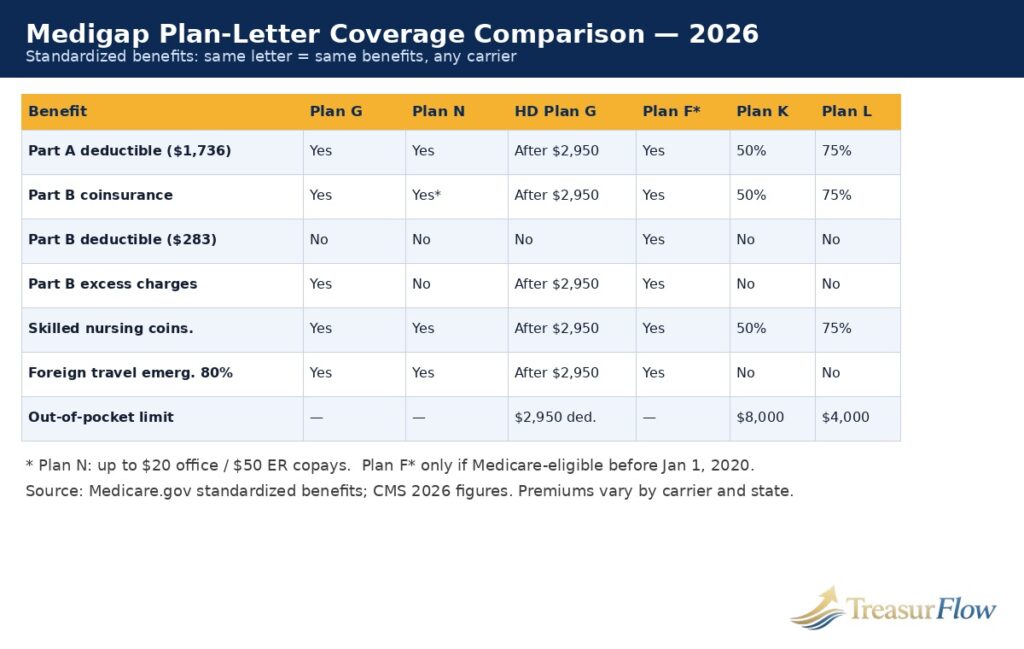
Plan G is the most comprehensive Medigap plan available to people who became eligible for Medicare on or after January 1, 2020, and it is the plan most new buyers choose. It covers the Part A hospital deductible, Part A coinsurance and hospital costs up to an additional 365 days after Medicare benefits are used up, Part B coinsurance, the first three pints of blood, hospice care coinsurance, skilled nursing facility care coinsurance, Part B excess charges, and 80% of foreign travel emergency care (subject to a separate deductible and lifetime limit under the standardized benefit). The one major gap it deliberately does not cover is the annual Part B deductible — $283 in 2026.
That single exclusion is not an accident or a carrier trick. Federal law changed so that Medigap policies sold to people newly eligible for Medicare on or after January 1, 2020 cannot cover the Part B deductible. Plan G is therefore as close to first-dollar coverage as a new enrollee can legally buy: pay your premiums, pay the first $283 of Part B care each year, and the plan covers the rest of your Medicare cost-sharing for covered services.
Who Plan G fits best is straightforward. It fits people who see doctors frequently, who manage chronic conditions with regular specialist visits, who want the most predictable possible medical budget in retirement, and who do not want to think about per-visit costs when deciding whether to seek care. It also fits people whose doctors do not accept Medicare assignment, because Plan G is one of the plans that covers Part B excess charges — the additional amount, capped by federal law, that a non-participating provider can bill above the Medicare-approved amount. If your cardiologist or surgeon charges excess fees, a plan that does not cover them leaves that bill entirely with you.
The cost of that predictability is the highest premium among the plans open to new enrollees. As of October 2026, published roundups disagree with each other by a wide margin — ValuePenguin reports an average Plan G cost of about $180 per month for a 65-year-old in 2026, while MoneyGeek’s analysis reports averages ranging from about $196 per month under attained-age pricing to about $306 per month under community pricing, with another MoneyGeek cost analysis putting Plan G at about $220 per month at age 65. That spread is not an error you need to resolve; it is the lesson itself. Averages blend different states, ages, genders, tobacco statuses, and pricing methods. Your real Plan G price is the quote for your ZIP code, your age, and your rating method — which is why the only honest comparison is several quotes for the same letter, in the same state, on the same day.
Plan N: Lower Premium, Small Copays, One Real Gap
Plan N covers almost as much as Plan G, and for many healthy buyers it is the better value — provided you understand its three trade-offs precisely, because two of them are small and one of them can occasionally be large.
Plan N covers the Part A hospital deductible, Part A coinsurance plus the additional hospital days, Part B coinsurance, the first three pints of blood, hospice coinsurance, skilled nursing facility coinsurance, and 80% of foreign travel emergency care, on the same standardized terms as Plan G. Like Plan G, it does not cover the Part B deductible, so you pay the $283 in 2026 yourself.
The first trade-off is copays. Plan N pays Part B coinsurance, but it may charge you a copay of up to $20 for some office visits and up to $50 for emergency room visits that do not result in an inpatient admission. Those figures — up to $20 office, up to $50 ER — come straight from the Medicare.gov standardized benefit description and are the most-quoted numbers in Medigap for a reason: they are the entire day-to-day cost difference between Plan N and Plan G for most people. If you see a doctor four times a year, Plan N’s copays might total $80. If you see specialists twice a month, they might total nearly $500, and the premium saving that made Plan N look cheaper can quietly disappear.
The second trade-off is the real gap: Plan N does not cover Part B excess charges. If every provider you use accepts Medicare assignment — meaning they accept the Medicare-approved amount as payment in full — excess charges never arise and this gap costs you nothing. Most providers do accept assignment. But if a provider you rely on does not, each bill can carry an excess charge of up to 15% above the Medicare-approved amount, and under Plan N that amount is yours. Before choosing Plan N, call the billing offices of the doctors you actually use and ask one question: do you accept Medicare assignment? Their answers should drive this part of the decision more than any advertisement.
The third trade-off is really just the mirror image of the first two: Plan N’s premium is lower. Published 2026 roundups consistently price Plan N below Plan G — ValuePenguin at about $137 per month on its stated basis, MoneyGeek analyses in a higher range but still below their Plan G figures — and the practical rule from those comparisons is that Plan N tends to run roughly $20 to $50 per month less than Plan G from the same carrier in the same market. Do the break-even arithmetic for your own quotes: divide Plan G’s annual premium advantage by $20 and you get the number of office-visit copays per year at which Plan N stops saving you money. For most low-use buyers, Plan N wins that arithmetic comfortably. For high-use buyers, Plan G wins it just as comfortably. Neither answer is universal, which is exactly why both plans exist.
High-Deductible Plan G: Plan G Benefits Behind a $2,950 Door
High-deductible Plan G is the same standardized Plan G benefit package with one structural change: before the policy pays anything, you must pay Medicare-covered costs up to the annual high-deductible amount, which is $2,950 in 2026. That figure is set by CMS and confirmed across CMS-referenced sources and carrier pages for 2026. The Part B deductible counts toward that $2,950 — it is part of the cost-sharing you pay on your way to the threshold, not an extra deductible stacked on top of it. Once you have paid $2,950 in covered costs in a calendar year, the policy behaves like standard Plan G for the rest of that year, including covering Part B excess charges and the Part A deductible for later care.
In exchange for accepting that first $2,950 of risk each year, you pay a far lower monthly premium. Published 2026 figures put high-deductible Plan G at roughly $52 to $76 per month in the ValuePenguin and MoneyGeek analyses cited above — a fraction of standard Plan G. Over a healthy year in which you never approach the deductible, the saving is large and real. Over a year with a hospitalization, you will pay the $2,950 — which is still a known, capped number for covered cost-sharing, unlike the uncapped 20% exposure of Original Medicare alone.
Who should consider it? Buyers who are generally healthy at enrollment, who have the savings to absorb a $2,950 year without stress, who are comfortable self-insuring routine care in exchange for catastrophic protection, and who understand that the deductible resets every calendar year. Who should be cautious? Anyone who already knows they have expensive, recurring care scheduled, anyone for whom a sudden $2,950 bill would be a genuine hardship, and anyone who would delay needed care because of the deductible — a plan that makes you hesitate to see a doctor is not saving you money in any sense that matters.
One eligibility point worth stating plainly: high-deductible Plan G is available to new Medicare beneficiaries. It is not restricted the way high-deductible Plan F is, because Plan F itself is restricted to people eligible for Medicare before 2020. If an article or an agent tells you high-deductible G is a legacy-only product, they are confusing it with its Plan F counterpart.
Plan F: The Legacy Plan — Only If You Were Eligible Before January 1, 2020
Plan F was, for years, the most popular Medigap plan in America, because it covered everything — including the Part B deductible — making it the last true first-dollar plan. It still exists, and existing policyholders can generally keep it. What changed is who can buy it. Under the federal MACRA rules, Medigap plans that cover the Part B deductible, including Plan F and Plan C, cannot be sold to people who became eligible for Medicare on or after January 1, 2020. If you were eligible before that date — even if you delayed enrollment — you can still buy Plan F today.
If you are in that grandfathered group, is Plan F worth it? Compare it honestly against Plan G, because the only benefit difference between the two is the Part B deductible: $283 in 2026. If Plan F’s annual premium exceeds Plan G’s by more than $283 — and in many markets it exceeds it by considerably more, partly because the Plan F pool is closed to younger new entrants and aging — then Plan G is the better buy even for people who can still get F. Run the subtraction with real quotes rather than assuming the famous plan is the better one.
There is also a high-deductible version of Plan F, with the same $2,950 deductible in 2026, subject to the same pre-2020 eligibility restriction. It can be inexpensive, but it inherits the same shrinking-pool dynamic, so check its premium trend and the carrier’s rate history with the same care you would give any closed or closing block of business.
Plans K and L: Partial Coverage With a Hard Out-of-Pocket Ceiling
Plans K and L are the budget end of the standardized lineup, and they work differently from every plan discussed so far. Instead of covering cost-sharing in full, they cover a percentage of most Medicare cost-sharing — 50% under Plan K and 75% under Plan L — and in exchange they give you something Plans G and N do not: a hard annual out-of-pocket limit. For 2026, the out-of-pocket limit is $8,000 for Plan K and $4,000 for Plan L. Once your eligible out-of-pocket spending reaches that limit in a calendar year, the policy pays 100% of the covered cost-sharing for the rest of the year.
Read those 2026 limit figures carefully, because this is a place where even legitimate-looking sources go stale. Older CMS and carrier material shows limits such as $7,220 and $3,610 — those are 2025 numbers that still circulate in PDFs and comparison tables. The 2026 limits, published by CMS in its K & L out-of-pocket limit announcements, are $8,000 and $4,000. If you are comparing K or L quotes, confirm the limit printed in the outline of coverage matches the 2026 figures.
Under Plan K, the plan pays 50% of the Part A deductible, 50% of Part B coinsurance, 50% of skilled nursing facility coinsurance, 50% of hospice cost-sharing, and 50% of the first three pints of blood, until you reach the $8,000 limit. Under Plan L, the same categories are covered at 75% until you reach $4,000. Neither K nor L covers the Part B deductible itself or Part B excess charges, and foreign travel emergency coverage is not part of K or L. What they do cover in full, once triggered, matters too: after you hit the limit, the plan covers the rest of the year’s included cost-sharing at 100%.
What are the premiums like? Published 2026 analyses put Plan K around $60 per month and Plan L around $107 per month on the bases those analyses state. Treat those as orientation, not quotes — the same state-to-state variance applies — but the shape is reliable: K and L are materially cheaper per month than G, and somewhat cheaper than or comparable to N, in exchange for meaningful cost-sharing until the cap.
Who do K and L fit? People who want a true worst-case ceiling more than they want day-one coverage, people with low expected usage who find even Plan N’s premium hard to justify, and people who are comfortable tracking their own out-of-pocket spending against the limit. Who should avoid them? Anyone who would be strained by several thousand dollars of cost-sharing in a bad year before the limit engages — the cap protects you from catastrophe, but $4,000 or $8,000 of exposure on the way there is not nothing, and it arrives precisely when you are sick.
How Medigap Pricing Really Works: Attained-Age, Issue-Age, and Community-Rated
Two people can buy the same Plan G, in the same ZIP code, on the same week, from two different carriers, and pay prices that differ by more than $100 a month — and the gap can widen or narrow over time, because Medigap premiums are set using one of three rating methods, and the method matters as much over a 20-year retirement as the starting price. Medicare.gov’s buying guide explains the three, and every quote you collect should come with the question: which method is this?
Attained-age-rated policies price your premium partly on the age you have attained right now. They start lower — sometimes much lower — and the premium steps up as you age, on top of any increases for medical inflation. An attained-age Plan G quote that looks like a bargain at 65 deserves a specific follow-up: ask the carrier for its rate schedule or a quote at ages 70, 75, and 80, and compare the lifetime path, not the first-year price. MoneyGeek’s 2026 analysis, which put attained-age Plan G averages near $196 per month against roughly $306 for community-rated, is measuring exactly this front-loaded cheapness — the attained-age number is an average across ages, and your personal number will climb.
Issue-age-rated policies price your premium on the age you were when the policy was issued. Buy at 65 and your premium is always calculated as if you were 65; it can still rise with inflation and healthcare costs, but never merely because you had a birthday. Issue-age policies often start higher than attained-age ones and look better with every passing year. They are not sold in every state — availability depends on state rules and the carrier.
Community-rated policies charge everyone in the pool the same premium for the same plan regardless of age. They tend to start the most expensive at 65 — that MoneyGeek community-rated average near $306 per month reflects this — and the most stable in relative terms as you age, because the oldest members are subsidized by the youngest. A healthy 65-year-old comparing only year-one prices will nearly always pick attained-age and nearly always be comparing the wrong thing.
Two more pricing realities belong in any honest comparison. First, the same carrier can sell the same letter under slightly different entity names in different states, and a carrier’s premium for a letter says nothing about its premium for another letter, so collect quotes letter by letter. Second, ask about household discounts, which many carriers offer when both spouses buy from the same company, and about the carrier’s actual history of rate increases on the block of business you would join — a low introductory price from a carrier with a record of steep annual increases is an attained-age-style trap wearing a different costume.
The disciplined way to use all of this: pick your letter first, then get at least three quotes for that letter in your ZIP code, note the rating method next to each, and compare the quote you like against the second-cheapest over a 10-year horizon, not a 1-year one.
When to Enroll: The 6-Month Window You Do Not Get Back
Everything above assumes you can buy the plan you choose. Whether you actually can — at the standard price, without health questions — depends heavily on when you apply. Federal protections for Medigap are real but time-boxed, and the single most important date in this entire article is the start of your Medigap Open Enrollment Period.
That period lasts 6 months and begins the month you are both 65 or older and enrolled in Medicare Part B. During it, an insurance company cannot refuse to sell you any Medigap policy it offers, cannot charge you more because of health problems, and cannot make you wait for coverage of pre-existing conditions. If you take one thing from this guide, take this: applying inside that window is worth more than any carrier comparison, any discount, and any plan-letter fine-tuning in the rest of the article combined.
The trap inside the rule is the Part B trigger. If you delay Part B — for example, because you are still working and covered by an employer plan — your Medigap open enrollment does not start until you actually enroll in Part B. That is fine, as long as you know it and apply promptly then. What is not fine is drifting: enrolling in Part B, letting months pass while you mean to get around to Medigap, and surfacing after the window has closed with a new diagnosis in hand. Outside the window, in most states, insurers can medically underwrite you — ask health questions, charge more, impose waiting periods, or decline you outright.
There are exceptions, and they matter. Certain life events create guaranteed-issue rights — special situations in which an insurer must sell you a policy without underwriting even outside open enrollment, such as losing employer coverage or a Medicare Advantage plan leaving your area or moving out of its service area. Some states also add their own protections beyond the federal floor: a few have annual guaranteed-issue windows or birthday rules, and a small number restrict underwriting more broadly. Because these rules are state-specific and change, the practical steps are: first, check whether any guaranteed-issue event applies to you; second, call your State Health Insurance Assistance Program (SHIP) for free, local, unbiased help before you assume you are locked out; third, never let a policy lapse casually, because getting back in later may require underwriting you cannot pass.
A related timing question comes up constantly: should you buy the most generous plan now, while you are guaranteed in, or start cheaper and upgrade later? The caution from the enrollment rules is clear — upgrading later, outside a protected window, usually means underwriting. Buying a letter you can keep is generally safer than planning to trade up after your health changes, because your health changing is precisely the event that can close the door.
Finally, a paperwork warning that prevents real harm: do not cancel an existing Medigap policy until a replacement is approved and in force, and if you are leaving Medicare Advantage to return to Original Medicare plus Medigap, confirm your guaranteed-issue or trial rights in writing first. The sequence matters as much as the selection.
Carrier Comparison: Same Benefits, Different Companies
Because the benefits of a given letter are identical everywhere, the carrier section of a Medigap guide should never claim one company’s Plan G ‘covers more’ than another’s. It cannot. What differs is the price for your letter in your state, the rating method, the company’s financial strength and rate-increase history, whether your specific state is one where the carrier actively sells the plan, its household discount, and how it treats customers over decades. The carriers below are the names that recur across visible 2026 U.S. Medigap roundups — treat the notes as orientation for building a quote list, not as verdicts, and confirm availability and price in your own state before relying on any of them.
Mutual of Omaha is one of the most frequently cited Medigap carriers in 2026 roundups and is marketed in most states — Investopedia’s positioning describes it as available in 49 states. It sells Medigap through its insurance subsidiaries and is commonly quoted for Plans G and N. Get its quote for your letter, ask which rating method your state uses, and ask specifically about its recent rate-increase history on that block.
Aetna (a CVS Health company) likewise appears across 2026 roundups as a widely available Medigap carrier — Investopedia describes Aetna Medigap as available in 49 states. Aetna is often competitive on Plan N and Plan G pricing in quote comparisons. As with every carrier here, price the exact letter in your state rather than trusting any national ‘average cost’ figure attached to the brand.
State Farm sells Medigap through its agent network and is listed among carriers in 2026 comparisons; its distribution runs through captive agents, which some buyers prefer for face-to-face service. Its state availability varies by plan in published sources, so confirm your letter is sold in your state before spending time on a quote.
United American Insurance Company is one of the oldest names in the Medicare supplement market and recurs in carrier comparisons. It is a long-standing specialist in supplemental health products. Compare its quote and rating method against the larger multi-line carriers on your list.
AFLAC (American Family Life Assurance Company of Columbus) appears in 2026 Medigap carrier comparisons and supplemental-insurance roundups. AFLAC is better known nationally for supplemental products, which makes it worth a specific question when you quote: confirm the exact Medigap plans it sells in your state and the rating method applied.
Blue Cross Blue Shield is not one company but an association of regional plans, so ‘BCBS Medigap’ means a different insurer — and a different premium — in different states. Visible 2026 sources are mixed on national availability framing: some list BCBS plans as state-by-state offerings while at least one cost guide presents them as broadly available, so the only safe statement is the practical one: find your state’s Blue plan, confirm it sells Medigap there, and quote your letter with it.
AARP / UnitedHealthcare — Medigap policies branded with AARP and insured by UnitedHealthcare — are among the most widely marketed in the country, and UHC is frequently described in roundups as one of the largest Medigap carriers by enrollment. Availability and plan mix vary by state. AARP membership is required for the AARP-branded policies. Quote the letter you chose and ask about the household discount and any rate-increase history available for your state.
How should you actually run this comparison? Fix the letter. Collect at least three quotes for that letter in your ZIP code on the same day, from carriers that actually sell it in your state. Write next to each quote: the monthly premium, the rating method, whether a household discount applies, and anything the carrier will tell you about recent increases. Then rank by the 10-year picture, not the first invoice. Because the product is standardized, the ‘best’ carrier for you is simply the financially solid one offering your letter on the most favorable pricing terms — and that answer is local, personal, and temporary in a way no national ranking can capture.
Medigap vs Medicare Advantage: The Fork in the Road
Every Medigap decision sits next to an alternative that is not a Medigap plan at all: Medicare Advantage (Part C), in which a private insurer delivers your Medicare benefits through its own plan, often with its own provider network, prior-authorization rules, and an annual out-of-pocket maximum for in-network Part A and B services. Advantage plans often carry low or zero additional premiums beyond Part B and frequently bundle prescription drug coverage and extras such as dental or vision allowances — things Medigap deliberately does not include. Neither route is ‘better’ in the abstract; they are different trades between premium, freedom, and predictability.
The honest comparison runs like this. Medigap plus Original Medicare generally costs more per month in premiums and gives you near-total freedom: any provider in the country who accepts Medicare, no networks, no referrals, virtually no prior authorization for Medicare-covered services, and cost-sharing that is mostly or entirely handled by the supplement. Medicare Advantage generally costs less per month and gives you a managed system: lower premiums and an out-of-pocket cap, in exchange for networks, plan rules, and cost-sharing that varies by service. The decision that deserves the most care is the one-way door aspect: switching from Advantage back to Original Medicare is always possible during enrollment periods, but getting a Medigap policy afterward usually requires medical underwriting unless a guaranteed-issue or trial right applies. People who value provider freedom and can afford the premiums often choose Medigap at 65 precisely because that is when the door is open widest. If you are weighing a specific Advantage plan against Medigap, compare it line by line using our Medicare Advantage guidance alongside this article — and check our Medicare Advantage vs Medigap comparison before you decide.
How to Choose: A Step-by-Step Decision
Step 1 — Confirm your window. Find the month your Part B starts (or started) and mark the 6-month Medigap Open Enrollment Period on a calendar. Every step after this one is easier inside that window and potentially harder outside it. If the window has already closed, check for guaranteed-issue events and state-specific protections before assuming underwriting applies to you.
Step 2 — Decide the fork first. Medigap or Medicare Advantage? Settle the structural question from the previous section before comparing letters, because the letter comparison only exists on the Medigap branch.
Step 3 — Estimate your usage honestly. Count last year’s doctor visits, specialists, and any planned procedures. Frequent, ongoing care pushes toward Plan G. A handful of visits a year pushes toward Plan N or high-deductible G. Very low usage plus a strong preference for a hard cap makes K or L worth pricing.
Step 4 — Check assignment. If Plan N is on your shortlist, call your key providers’ billing offices and ask whether they accept Medicare assignment. A ‘no’ from a provider you cannot replace is a concrete argument for Plan G’s excess-charge coverage.
Step 5 — Pick the letter, then hold it fixed. Write the letter down. From here on, every quote you request is for that letter only, so the prices are comparable.
Step 6 — Collect at least three quotes. Same letter, same ZIP, same day. For each, record premium, rating method, household discount, and any rate-history information. Include at least one carrier from the list in this article and your state Blue plan if it sells Medigap.
Step 7 — Stress-test the choice. Ask two questions of your leading option. What does my worst realistic year cost under this plan — premiums plus the cost-sharing it leaves me? And if my health worsens, can I still afford and keep this policy at 75 and 80, given its rating method? If both answers are comfortable, you have your plan. Apply inside your window, and do not cancel any existing coverage until the new policy is in force.
Medigap Questions, Answered Before You Enroll
What is the difference between Plan G and Plan N?
Plan G covers everything Plan N covers, plus Part B excess charges, and it charges no copays. Plan N may charge up to $20 for some office visits and up to $50 for emergency room visits that do not result in admission, and it does not cover Part B excess charges. Both leave you the $283 Part B deductible in 2026. Plan N’s premium is lower, so the better choice depends on how often you see doctors and whether your providers accept Medicare assignment.
When is the best time to buy a Medigap policy?
During your 6-month Medigap Open Enrollment Period, which begins the month you are 65 or older and enrolled in Part B. In that window, insurers cannot refuse you, charge you more for health conditions, or impose pre-existing condition waiting periods. Buying then is the closest thing to a guaranteed best price you will ever be offered for the same policy.
Can I be denied a Medigap policy because of my health?
Yes — outside your open enrollment period and outside a guaranteed-issue situation, insurers in most states can medically underwrite your application and may decline you, charge more, or impose waiting periods based on your health. Inside the protected windows, they cannot. Some states add their own protections, so check your state’s rules or ask your SHIP counselor before assuming the worst.
Does Medigap cover prescription drugs, dental, or vision care?
No. Medigap supplements Original Medicare’s cost-sharing; it does not add drug, dental, vision, hearing, or long-term care coverage. Prescription drugs require a separate Part D plan (or drug coverage within a Medicare Advantage plan), and dental, vision, and hearing are generally paid out of pocket or through separate standalone policies.
Can I use my Medigap policy anywhere in the United States?
Yes. A Medigap policy works with any doctor, hospital, or provider in the country who accepts Medicare — there is no network. That portability, including when you travel or split the year between two homes, is one of the main reasons people choose Medigap over network-based coverage.
How much does a Medicare Supplement plan cost in 2026?
It depends on the letter, your state, your age, and the carrier’s rating method, which is why published averages disagree: 2026 analyses put Plan G roughly in the $180 to $306 per month range depending on the source and pricing method, Plan N around $137 to the low $200s, high-deductible Plan G around $52 to $76, Plan K around $60, and Plan L around $107. Your real answer is a set of same-day quotes for one letter in your ZIP code — no national average can substitute for that.
Conclusion: Letter First, Company Second, Window Always
The best medicare supplement plans 2026 are not a brand or a logo; they are a sequence of decisions made in the right order. Choose your coverage structure first — Medigap or Medicare Advantage. Choose your letter second, using your real expected usage: Plan G for maximum predictability, Plan N for lower premiums with small copays and no excess-charge protection, high-deductible Plan G for low premiums against a $2,950 first-dollar risk, Plans K and L for partial coverage with a hard out-of-pocket ceiling, and Plan F only if your pre-2020 eligibility makes it available and its premium beats Plan G by less than $283 a year. Choose your carrier third, on the same letter, comparing premium, rating method, household discount, and rate history across at least three quotes in your state. And do all of it inside your 6-month open enrollment window if you possibly can, because that window is the one part of this purchase that money cannot buy back later.
Start with the official sources linked at the top of this article, get your quotes while your window is open, and use your state SHIP program’s free counseling if any step feels unclear. The right Medigap policy is the one whose letter fits your health and budget, whose pricing method you understand, and whose premium you can sustain for the whole of retirement — not just the first year of it.

Muhammad Zakir is the founder of Treasurflow and the author of its personal finance guides. He researches consumer banking, credit, and personal loans, and every guide cites primary sources such as the CFPB, FDIC, FTC, and IRS. His content is educational and is not personalized financial advice.