
Most people shop for the best 0% APR credit cards 2026 backwards. They sort by the longest headline — 21 months sounds better than 15 months, so 21 months must win — and only later discover the transfer deadline was 60 days, the transfer fee was 5%, or they needed just nine months to clear a purchase but gave up rewards they would actually have used for a year and a half.
Start the other way around. How many months do you actually need?
If you owe $3,000 and you can reliably pay $350 a month, you need about nine months, plus a cushion. A 15-month purchase and balance transfer offer with cash back will serve you better than a 21-month no-rewards card you will never push to its limit. If you owe $9,000 and $300 a month is your honest ceiling, you need 30 months at 0% — which no card on this list offers — so the real plan is not “find a longer card,” it is “use the longest window you can get, pay as much as you can inside it, and decide today what you will do about any balance left when the promotion ends.” If you are financing a $2,400 appliance, a dental bill, or a home repair you can clear in a year, the math is different again: the purchase window matters more than the transfer window, and a card you want to keep after the promotion matters more than two extra months you will never use.
This guide is built payoff-plan-first for exactly that reason. The picks below are organized by job — longest balance-transfer window, longest purchase window, a card that does both jobs well, rewards plus an intro APR, and a no-late-fee safety net — not by who shouts the biggest number. After the picks, you will find a fully worked payoff example with the arithmetic shown, the transfer deadlines and deferred-interest traps that quietly erase the savings, what actually happens in the month the promotion ends, and the application sequence to follow so you do not lose your window before you have even used it.
All offer terms in this guide are as of October 2026, based on issuer terms and major roundups available at that time. Intro APR offers change, approval is never guaranteed, and your regular APR after the promotion will depend on your creditworthiness. Always confirm the intro length, transfer window, transfer fee, and regular APR on the issuer’s application page before you apply. A 0% offer is a tool with an expiry date — used with a plan, it can save you well over a thousand dollars in interest. Used without one, it just moves the debt and the deadline.
Related Guides
- Best Balance Transfer Credit Cards 2026 — a deeper look at transfer fees, windows, and payoff math if moving existing debt is your only job for the card.
- Best Cash Back Credit Cards 2026 — if you pay in full most months and would rather earn rewards than chase the longest intro window.
- Best Secured Credit Cards 2026 — building or rebuilding credit first, before you are likely to qualify for the longest 0% offers.
- No Credit Check Credit Cards 2026 — what to expect, and what to watch out for, when your credit history is thin or damaged.
Helpful Official Resources
- Consumer Financial Protection Bureau — Credit Cards — the CFPB’s explainers on how credit cards, promotional rates, and balance transfers work, plus tools to compare offers.
- Consumer Financial Protection Bureau — Ask CFPB — plain-language answers on promotional APRs, what happens when a promotion ends, and your rights as a cardholder.
- Federal Trade Commission — Credit, Loans, and Debt — FTC guidance on managing debt, avoiding credit scams, and understanding the true cost of borrowing.
- Federal Trade Commission — Choosing a Credit Card — what to compare beyond the headline rate, including fees, grace periods, and penalty terms.
Start With Your Payoff Timeline, Not the Longest Offer
Before you look at a single card name, do three quick calculations. They take five minutes, and they will tell you which section of this guide is actually for you.
Step 1: Write down the real number you need to finance or transfer
Use the full amount, not the amount you wish it were. For a balance transfer, that is the statement balance you plan to move, plus any purchases you expect to put on the new card in the first few months — and you should try hard to make that second number zero, for reasons explained below. For a purchase card, it is the price of the thing you are buying, including tax, delivery, and installation if those will go on the card. People routinely underestimate by 10% to 15% and then wonder why the plan slipped by two months.
Remember, too, that you may not be able to transfer the full amount. Issuers set a credit limit when they approve you, and transfers typically cannot exceed that limit. Some issuers also cap transfers below the full limit. You will not know your limit until you are approved, which is one more reason the application sequence in the final section matters: apply first, learn your limit, then request the transfer sized to fit it.
Step 2: Divide by the monthly payment you can sustain, not the one you hope for
Take the amount from Step 1 and divide it by a monthly payment you have actually made before, or that fits your current budget without optimistic assumptions about overtime, a bonus, or cutting spending you have never successfully cut. The result is the number of months you need.
$3,600 divided by $300 a month is 12 months. $6,000 divided by $300 is 20 months. $6,000 divided by $200 is 30 months — longer than any intro offer in this guide, which tells you immediately that a single 0% card cannot finish the job on that payment, and you need either a higher payment, a smaller transfer, or a follow-on plan for the remainder.
Add at least one month of cushion to whatever number you get. Life happens inside a 15- or 21-month window: a car repair, a lean month, a payment that lands a day late. If your raw math says you need exactly 15 months and you choose a 15-month card, you have built a plan with zero tolerance for being human. Choose the next window up, or raise the payment slightly so you finish a month or two early. Finishing early is the best outcome a 0% card can give you — the remaining months cost you nothing.
Step 3: Decide whether this card has a job after the promotion
Some of the cards below are pure tools: no rewards, no reason to keep them in your wallet once the balance is gone, but the longest windows available as of October 2026. Others earn cash back or travel rewards and have a regular APR and rewards structure you might happily use for years after the intro period — if you pay in full. Neither is better in the abstract. If debt payoff is your only goal and every extra month reduces real risk for you, take the tool card and close or drawer it later. If you have a moderate balance you will clear with room to spare, a rewards card with a 15-month intro can leave you with a keeper card and a few hundred dollars of cash back earned on spending you were doing anyway — as long as new spending never slows the payoff. The moment rewards start justifying extra purchases, they stop being a bonus and become the most expensive trap in this entire category.
Keep your answers to those three steps in front of you as you read the picks. Every card below is labelled with the job it does best, who it fits, and who should skip it.
Quick Comparison: The Best 0% APR Credit Cards 2026 at a Glance
The table below summarizes the headline terms as of October 2026. It is a starting point, not a substitute for the per-card notes that follow it — transfer windows and fees differ in ways a single column cannot capture, and those details decide whether you actually get the full intro period on a transferred balance.
| Card | Intro APR — Purchases | Intro APR — Balance Transfers | Transfer Window / Fee Note | Regular APR (Variable, as of Oct 2026) | Annual Fee | Rewards |
|---|---|---|---|---|---|---|
| Wells Fargo Reflect® | 0% for 21 months | 0% for 21 months on qualifying transfers | Transfers within 120 days; fee 5%, min $5 | 17.74% / 24.24% / 28.49% (based on creditworthiness) | $0 | None |
| BankAmericard® | 0% for 21 billing cycles | 0% for 21 billing cycles on transfers in first 60 days | Transfers must be made in first 60 days | 15.24%–26.24% | $0 | None |
| Citi® Diamond Preferred® | 0% for 12 months | 0% for 21 months | See issuer for transfer window and fee | 16.74%–27.49% | $0 | None highlighted |
| Citi Simplicity® | See issuer — positioned for transfers | 0% for 21 months | See issuer for transfer window and fee | See issuer page for current range | $0 (per roundups) | None; no late fees, no penalty APR |
| Chase Freedom Unlimited® | 0% for 15 months | 0% for 15 months | See issuer for transfer fee | 18.49%–27.99% | $0 | 1.5% on everything; 3% dining/drugstores; 5% Chase Travel |
| Discover it® Cash Back | 0% for 15 months | 0% for 15 months | See issuer for transfer fee | See issuer page for current range | $0 | 5% rotating quarterly categories; 1% elsewhere; Cashback Match first year |
| Capital One Quicksilver | 0% for 15 months | 0% for 15 months | See issuer for transfer fee | 18.74%–28.74% | $0 | 1.5% flat cash back |
| Capital One VentureOne | 0% for 15 months | 0% for 15 months | See issuer for transfer fee | See issuer page for current range | $0 | Travel rewards (see issuer) |
| Blue Cash Everyday® Card from American Express | 0% intro option available — see issuer for current length | See issuer | See issuer | See issuer page for current range | See issuer | Cash back oriented to grocery and everyday spending |
A note on the gaps in that table: where the verified fact sheet for this guide did not include a figure — a specific transfer fee for a given card, or a regular APR range — this guide says “see issuer” rather than filling the cell with a plausible-sounding guess. Intro offers are contractual terms. If a number matters to your decision, the number on the issuer’s application page on the day you apply is the only one that counts, and it is worth the two minutes it takes to confirm it there.
One card is deliberately discussed separately rather than slotted neatly into the table: the U.S. Bank Shield™ Visa® Card. As of October 2026, sources conflict on its core terms — one roundup lists 21 billing cycles for its intro offer while another lists 18 billing cycles, and one source describes its regular APR as not published. Because the entire value of a 0% card is the length of its window, this guide will not state one figure as certain for Shield. If the card appeals to you, go directly to the U.S. Bank issuer page, confirm the current intro length, transfer window, fee, and regular APR in writing there, and compare that confirmed offer — not any roundup’s version of it — against the cards above.
Best Picks by Job: Choose the Card That Matches Your Plan
Longest Balance-Transfer Window: Wells Fargo Reflect® and BankAmericard®
If your Step 2 math says you need close to the maximum time available — roughly 18 to 21 months — start here. Two cards tie at the top on window length as of October 2026, but they differ on the deadline to make your transfer, and that difference matters.
Wells Fargo Reflect® — 21 months on purchases and qualifying balance transfers
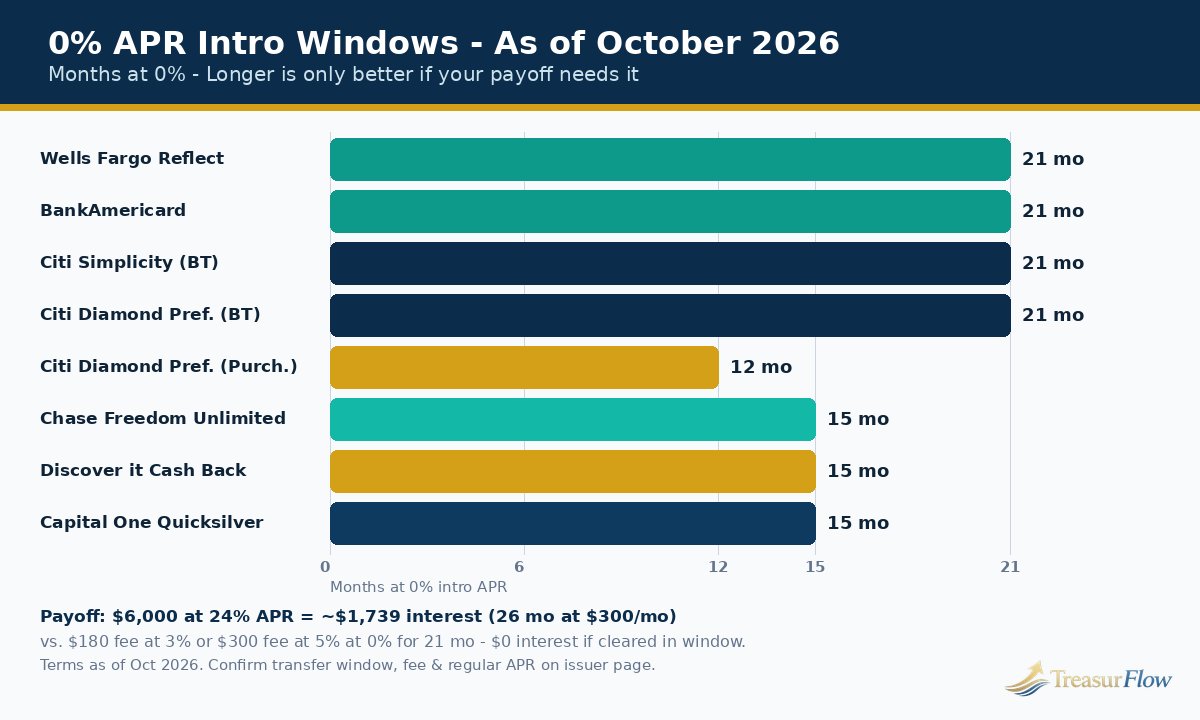
The Reflect offers 0% intro APR for 21 months on purchases and on qualifying balance transfers, with transfers needing to be made within 120 days of opening the account to qualify for the intro rate, as reported in October 2026 roundups. After the intro period, the regular variable APR is 17.74%, 24.24%, or 28.49%, depending on creditworthiness. The balance transfer fee is 5% with a $5 minimum, and the annual fee is $0. There are no rewards.
That combination tells a clear story. The 120-day transfer window is the most forgiving on this list — double the 60-day window on the BankAmericard below — which helps if you are consolidating balances from more than one card or waiting for a statement to close before you move a balance. The trade-off is the 5% transfer fee, at the higher end of the market. On a $6,000 transfer, 5% is $300, which is real money — but as the worked example later in this guide shows, $300 once can still beat roughly $1,739 in interest on a 24% APR card paid at $300 a month. Run your own numbers with your own fee before deciding: fee percentage multiplied by amount transferred, compared against the interest you would otherwise pay, over the months you would otherwise take.
The Reflect fits borrowers with good to excellent credit who have a large balance, a payment that needs most of 21 months to finish the job, and no interest in rewards. Skip it if your balance is small enough that a 5% fee on a short payoff compares poorly with a lower-fee or shorter offer, or if you know you will want one card for both payoff and everyday spending afterwards — a no-rewards card gives you no reason to reach for it once the balance is gone, and new purchases on it during the payoff only complicate the plan.
BankAmericard® — 21 billing cycles, with a tighter 60-day transfer deadline
The BankAmericard offers 0% intro APR for 21 billing cycles on purchases and on balance transfers made in the first 60 days, with a regular APR of 15.24% to 26.24% variable and a $0 annual fee, as of October 2026. On paper, its window matches the Reflect’s. In practice, its transfer deadline is half as long, and that single fact should drive your behaviour if you choose it: have your account numbers, balances, and transfer amounts ready before you apply, and request the transfer as soon as the account is open and you have confirmed your credit limit.
The lower end of its regular APR range — 15.24% — is also the lowest starting point among the cards in this guide with a published range, which matters only if you expect to carry a small remainder past the promotion. It should not be a reason to relax: even 15.24% on a leftover balance will undo months of careful progress faster than most people expect, as the section on the month the promotion ends explains.
The BankAmericard fits the same borrower as the Reflect, with one extra requirement: you must be organized enough to move your balance within 60 days. If your debt sits across several cards, or you are mid-dispute on a balance, or you simply know paperwork slips for you, the Reflect’s 120-day window may be worth more than any other difference between the two cards. Skip both 21-month no-rewards cards if your payoff math says 12 to 15 months — you are giving up rewards and keeper-card value for months you will not use.
Longest Purchase Window That Is Also a Transfer Window: Wells Fargo Reflect®, Revisited
Purchase and transfer windows are not always the same length on the same card — the Citi Diamond Preferred below is the clearest example, at 12 months for purchases and 21 months for transfers. If you need a long window for a large purchase you have not made yet, rather than for debt you already have, the Reflect’s 21 months on purchases is, as of October 2026, the longest purchase window among the verified picks in this guide, tied in length with the BankAmericard’s 21 billing cycles on purchases.
A long purchase window changes the risks, though. With a transfer, the amount is fixed on day one and your only job is to shrink it. With a purchase card, the temptation is to add a second purchase, then a third, because “it is 0% anyway.” Every addition restarts your Step 2 math without extending your deadline. The discipline that makes purchase offers work is boring and absolute: one planned purchase (or one planned project with a fixed total budget), a payment set the week the card arrives, and no further spending on the card until the balance is zero. If you want a card for ongoing spending as well, keep the jobs separate — put the big purchase on the intro card, keep everyday spending on a card you pay in full, and do not mix the two statements in your head.
Best Split Window: Citi® Diamond Preferred® — 12 Months to Buy, 21 Months to Transfer
The Citi Diamond Preferred offers 0% intro APR for 12 months on purchases and 0% for 21 months on balance transfers, with a regular APR of 16.74% to 27.49% variable and a $0 annual fee, as of October 2026. That split is not a flaw; it is a design that fits a specific and common situation: you have existing debt that needs the longest possible runway, and a smaller, near-term purchase you can comfortably clear within a year.
Read the split carefully before you count on it, because it is the easiest term in this guide to misremember. Borrowers routinely hear “21 months” and assume everything is 21 months. On this card, a purchase made in month one starts accruing interest after month 12 if it is not paid off — even while a transferred balance on the same account is still inside its 21-month window. How issuers allocate your payments between balances at different rates is governed by the cardholder agreement and federal rules that generally require amounts above the minimum to go to the highest-rate balance first, but you should not build a plan that depends on allocation subtleties. The clean way to use a split-window card is to treat the shorter window as the deadline for the purchase portion: clear any purchase balance well inside 12 months, and let the transfer run on its own, longer track.
The Diamond Preferred fits borrowers whose main job is a transfer needing close to 21 months, with at most a modest purchase they can clear within a year. Skip it if your purchase is the main event and needs more than 12 months — that is the Reflect or BankAmericard’s job — and confirm the transfer window, transfer fee, and how to request a transfer on Citi’s issuer page before you apply, since those specifics were not part of the verified terms summarized for this guide.
Rewards Plus Intro APR: When 15 Months Is Enough
Drop from 21 months to 15, and the market changes character. The cards below give up six months of window in exchange for rewards, keeper value, and — for many borrowers with moderate balances — a better overall outcome. Fifteen months clears $4,500 at $300 a month, or $6,000 at $400 a month, with room to spare. If your math fits inside that, read this section first, not last.
Chase Freedom Unlimited® — 0% for 15 months, then a card you will keep
The Freedom Unlimited offers 0% intro APR for 15 months on purchases and balance transfers, a regular APR of 18.49% to 27.99% variable, and a $0 annual fee, as of October 2026. Its rewards are simple to value: 1.5% cash back on everything, 3% on dining and drugstore purchases, and 5% on travel purchased through Chase Travel. That structure is why this card so often wins the “one card to apply for” argument for moderate balances: the intro period handles the payoff or the big purchase, and the rewards handle the years afterwards, without an annual fee pressuring you to justify keeping it.
Two cautions, both familiar. First, rewards are earned on spending, and spending is the opposite of payoff — if you transfer a balance to this card, do not add new purchases to it until the transfer is gone, or you will muddy both goals. Use it as a purchase-intro card, or as a transfer card, and let the rewards phase start after the 0% phase ends. Second, confirm the balance transfer fee and transfer window on Chase’s page before you apply; a fee at the higher end can narrow the gap between this card and a longer-window alternative on a large balance, even after you credit the rewards.
The Freedom Unlimited fits borrowers with good credit, a balance or purchase they can clear inside about 13 months (leaving cushion inside the 15), and a genuine intention to keep a simple cash back card afterwards. Skip it if you need 18-plus months — no amount of 1.5% cash back compensates for a balance hitting 18.49% to 27.99% in month 16 with four months of payments still to go.
Discover it® Cash Back — 15 months, rotating 5% categories, and a first-year match
The Discover it Cash Back card offers 0% intro APR for 15 months on purchases and balance transfers, as of October 2026, with 5% cash back in rotating quarterly categories (on up to the quarterly maximum when you activate, per the issuer’s well-known structure) and 1% on all other purchases. Its signature feature is Cashback Match: Discover states it will automatically match all the cash back you have earned at the end of your first year. That match can turn a good first year into a very good one — but only on spending you would have done anyway, and only if the intro balance is cleared on schedule.
Rotating categories reward attention. If you enjoy activating categories and steering spending toward a quarterly bonus — groceries one quarter, restaurants or digital wallets another — the effective return beats a flat-rate card for that portion of your spending. If you know you will never activate a category in your life, be honest about it and take the flat-rate card below instead; a 5% category you miss earns the same 1% as everything else. Also confirm acceptance where you shop, the current transfer fee, and the current regular APR on Discover’s issuer page, since those figures were not part of the verified set summarized here.
This card fits the organized optimizer with a sub-15-month payoff and first-year spending that matches Discover’s typical categories. Skip it if you want set-and-forget simplicity, or if the match tempts you to spend more in year one — matched cash back on money you did not need to spend is still money spent.
Capital One Quicksilver and VentureOne — flat, simple 15-month options
Capital One’s Quicksilver and VentureOne both offer 0% intro APR for 15 months, as of October 2026. Quicksilver earns a flat 1.5% cash back on purchases and carries a regular APR of 18.74% to 28.74% variable. VentureOne is the travel-oriented sibling — the choice if you prefer miles-style rewards and Capital One’s travel ecosystem over cash, with specifics to confirm on the issuer page. Neither card’s pitch depends on categories, activation, or portals unless you choose to use them, and that simplicity is the point.
Between the two, the decision is about what you want after month 15, because the intro windows summarized here are the same length. Take Quicksilver if you value cash you can apply anywhere and a rewards rate you can state in four words: one point five, everything. Consider VentureOne if your post-payoff spending is travel-heavy and you will actually redeem travel rewards rather than letting them sit. In both cases, confirm annual fee, transfer fee, transfer window, and — for VentureOne — the full regular APR range and rewards terms on Capital One’s page before applying, since only Quicksilver’s regular APR range and flat rate were in the verified terms for this guide.
These cards fit borrowers who want the 15-month window without category homework. Skip them, like every 15-month card here, if your honest payoff timeline runs past about 13 months with cushion — step up to the 21-month section instead, and come back to rewards when the debt is gone.
Blue Cash Everyday® Card from American Express — the grocery shopper’s intro option
The Blue Cash Everyday Card from American Express is included as a 0% intro option for grocery shoppers — a card whose long-term value is tied to everyday spending at U.S. supermarkets and similar categories rather than to winning the longest-window contest. This guide keeps its terms qualitative on purpose: the exact intro length for this card was not part of the verified fact set used here, and intro lengths on this card have been presented in different forms over time. Treat this entry as a pointer, not a specification: if your spending is grocery-heavy, you can clear your balance well inside a typical intro window, and you prefer American Express cash back on everyday categories, check the current intro APR length, regular APR, annual fee, and category caps directly on the American Express issuer page, and compare that confirmed offer against the 15-month cards above.
That restraint is deliberate, and it applies to any card you meet outside this guide as well. A grocery rewards rate is worth comparing only after the intro math works. A card that returns an extra 1% or 2% on groceries but gives you a window two months too short for your balance will cost you far more in month-after-month interest than it will ever return at the checkout.
No-Late-Fee Safety Net: Citi Simplicity®
The Citi Simplicity offers 0% intro APR for 21 months on balance transfers and is positioned in October 2026 roundups as a debt-payoff pick, with no late fees and no penalty APR. That last pair of features is its entire identity, and for the right borrower it is worth more than rewards.
Most cards charge a late fee when a payment arrives after the due date, and many can impose a penalty APR — a higher rate, sometimes applied broadly — after a late payment. Simplicity removes both punishments, per the roundup descriptions summarized for this guide. It does not remove the other consequences of paying late, and this distinction matters: a late payment can still be reported to the credit bureaus once it is 30 or more days past due, with real damage to your credit score; interest rules for other balances still apply as the agreement states; and a pattern of late payments is a signal that the payoff plan itself needs resizing, whatever card you hold. The safety net catches a slip — a forgotten due date during a house move, a payment that lands two days late — it does not make a habit safe.
Simplicity fits a borrower with a transfer that needs close to 21 months, a life chaotic enough that one late payment in two years is a realistic fear, and no need for rewards. If that description fits, the absence of late fees and a penalty APR is genuine insurance on a long payoff. Confirm the current purchase intro terms, transfer window, transfer fee, regular APR, and annual fee on Citi’s issuer page before applying, since the verified summary for this guide positions the card primarily on its 21-month transfer window and its no-late-fee, no-penalty-APR terms, and does not publish the full remaining term set. Skip it if you pay reliably on autopay and would get more value from a keeper rewards card inside a shorter window — autopay, set for at least the amount your plan requires, is the better safety net for most people, and it is free on every card in this guide.
The Payoff Plan, Worked in Full: $6,000 at $300 a Month
Examples in credit card guides are often so tidy they teach you nothing. This one uses round numbers on purpose — a $6,000 balance and a $300 monthly payment are easy to follow — and shows every step, so you can rebuild it with your own balance, your own payment, and any card’s fee. It is illustrative only: your real interest will depend on your exact APR, statement timing, payment dates, and whether your balance changes. The method, not the pennies, is what you are meant to take away.
Option A: Stay on a 24% APR card and pay $300 a month
Assume a $6,000 balance, a 24% APR (a monthly rate of 24% divided by 12, or 2% per month), and a fixed $300 payment each month, with no new purchases. Each month, interest is charged on the remaining balance, then your payment reduces it.
Month 1: interest is $6,000 × 2% = $120. You pay $300, so $180 reduces the balance, leaving $5,820.
Month 2: interest is $5,820 × 2% = $116.40. Your $300 leaves $5,636.40.
The pattern continues — the interest shrinks slowly as the balance falls, which is why early payments feel like they barely move the total.
Run that arithmetic to the end and the balance takes 26 months to clear, with approximately $1,739 in total interest paid. In other words, the $6,000 you borrowed or spent costs you about $7,739, and for the first several months more than a third of every $300 payment is consumed by interest alone. If your APR is higher than 24%, or your payment dips in any month, both the timeline and the interest get worse — at a lower payment the balance can grow even while you pay, if the payment ever falls below the month’s interest.
Option B: Transfer $6,000 to a 0% card for 21 months
Now transfer the same $6,000 to a card offering 0% on balance transfers for 21 months, and keep paying on schedule inside the window. The interest inside the window is $0 — that part really is as simple as the advertisements suggest — provided the transfer qualifies for the intro rate, you pay on time under the cardholder agreement, and you clear the balance before the window closes. What is not $0 is the transfer fee, charged once, up front, and usually added to your transferred balance.
With a 3% transfer fee: the fee is $6,000 × 3% = $180. Your starting balance on the new card is $6,180. To clear it in 21 months, you need $6,180 ÷ 21 = $294.29 a month — call it $295, and $300 a month clears it comfortably inside the window with a small cushion.
With a 5% transfer fee (the Wells Fargo Reflect’s fee as of October 2026): the fee is $6,000 × 5% = $300. Your starting balance is $6,300. To clear it in 21 months, you need $6,300 ÷ 21 = $300.00 a month exactly. Your existing $300 payment is precisely enough — with zero cushion. Pay $310 or $320 instead if you possibly can, so that one tight month near the end does not push a remainder into the regular APR.
Without any fee in the calculation, the bare balance needs $6,000 ÷ 21 = $285.71 a month. That $285.71 figure is the one to remember as the floor: any fee raises it, and any month you pay less raises what the remaining months must cover.
Compare the three paths honestly. Staying put: about $1,739 in interest over 26 months. Transferring at 3%: $180 in fees, $0 interest if cleared in 21 months — a saving of roughly $1,559 versus staying. Transferring at 5%: $300 in fees, $0 interest if cleared in 21 months — a saving of roughly $1,439. The 5% card is not “worse” in any absolute sense; on this balance and timeline, it still saves well over a thousand dollars versus doing nothing. Fee shopping matters most on large balances and short timelines. On a $2,000 balance you would clear in eight months anyway, the interest avoided is much smaller, and a 5% fee ($100) consumes a far larger share of the saving — sometimes enough that a shorter, lower-fee offer, or simply paying the original card harder, is the better plan. Always run both sides of the comparison with your numbers, not the example’s.
Turn the example into your plan in four lines
Write these four lines down — literally, on paper or in a notes app — before you apply for any card in this guide.
Line 1: Amount to transfer or spend, plus the transfer fee if any. Example: $6,000 + $300 fee = $6,300.
Line 2: Intro months, minus one month of cushion. Example: 21 − 1 = 20 planned months.
Line 3: Line 1 divided by Line 2. Example: $6,300 ÷ 20 = $315 a month. That is your plan payment — note how planning to finish a month early raises it from $300 to $315. That small raise is the cheapest insurance in this guide.
Line 4: The calendar date the promotion ends, taken from your first statement once the account opens, and a phone reminder set for 60 days before it. Plans fail on forgotten dates far more often than on bad arithmetic.
Set autopay for at least your Line 3 amount — not the minimum payment, which is designed to stretch a balance across years, not to clear it inside a promotion — and check the balance monthly against where the plan says it should be. If you fall a month behind, fix it the following month by raising the payment for the remaining months (re-divide the current balance by the months left), rather than hoping to catch up “later.” Later, on a 0% card, has a date, and after that date the rate is no longer zero.
Transfer Deadlines, Deferred Interest, and the Traps That Erase the Saving
The headline rate is the least dangerous part of a 0% offer. The terms around it are where the money is lost. The CFPB’s credit card resources make the same point in plainer language: a promotional rate applies only as the offer defines it — to the stated balance type, for the stated period, when you follow the stated steps. Read the two traps below before you apply, not after your first statement surprises you.
Trap 1: The transfer window is not the intro window
These are two different clocks, and confusing them is the most expensive mistake in this category.
The intro window is how long the 0% rate lasts — 15 or 21 months, say. The transfer window is how soon after opening the account you must make the transfer for it to qualify for that rate — 60 days for the BankAmericard, 120 days for qualifying transfers on the Wells Fargo Reflect, as of October 2026. A transfer made after the transfer window closes may be declined, or may land at the regular APR instead of 0%, depending on the issuer’s terms. Either way, the plan you built collapses: you have a new card, possibly a hard inquiry and a new account on your credit report, and the same interest-bearing debt you started with.
The defence is sequencing, covered in full in the application section below: prepare your transfer details before you apply, request the transfer immediately after approval once you know your credit limit, and confirm — on a statement or in the app, not by assumption — that the transferred balance shows the 0% promotional rate. If a balance will not be transferable in time (for example, it sits on a card from the same issuer — transfers between accounts at the same bank are generally not permitted), know that before you apply, not on day 59.
Trap 2: Deferred interest is a different product wearing a similar costume
The cards in this guide offer true 0% intro APRs: if you have a balance left when the promotion ends, interest starts accruing on that remaining balance from that point forward, at the regular rate. Nothing retroactive happens.
Deferred-interest promotions — common on retail, store, and some medical financing offers, and described in CFPB and FTC consumer guidance as a feature to understand before you sign — work differently and far more harshly. With deferred interest, if any part of the original balance remains unpaid when the promotion ends, interest can be charged on the full original purchase amount, calculated back to the purchase date, as if the promotion had never existed. Owing $40 on a $2,000 deferred-interest purchase in the final month can therefore trigger hundreds of dollars of backdated interest. That single remaining $40 is the most expensive $40 in consumer credit.
Before you accept any “no interest if paid in full within X months” offer — note that exact phrasing, which is the deferred-interest tell — check whether it is a true 0% APR promotion or a deferred-interest plan, and read what happens if you are one dollar short on the deadline. The offers summarized in this guide are presented by their issuers as 0% intro APRs, but the question is worth asking on the application page of any card, every time, because the two products are marketed in nearly identical language and behave in opposite ways at the deadline.
Three smaller traps worth one paragraph each
Grace period loss: on many cards, if you carry a balance — including a transferred balance — new purchases may start accruing interest from the purchase date, with no grace period, until the account is paid in full. The cardholder agreement governs this, and it is a strong technical reason, beyond the discipline argument made earlier, to avoid mixing new purchases onto a card holding a transferred balance. Minimum-payment illusion: paying only the minimum inside a 0% window feels safe because no interest is accruing, but the minimum will not clear the balance before the window closes — the day the promotion ends, the full remaining balance meets the regular APR at once. The plan payment from your four lines, not the minimum, is the payment that makes a 0% card work. Paying late: a late payment can, on many cards, end a promotional rate early and may trigger late fees and, on cards that have one, a penalty APR. The Citi Simplicity’s lack of late fees and penalty APR, described above, is the exception that proves how standard those punishments otherwise are. Autopay for at least your plan amount, set the day the account opens, removes most of this risk in one step.
What Happens the Month the Promotion Ends
Picture the morning after a successful plan and the morning after a nearly successful one, because the difference between them is the whole value of this guide.
If your balance is zero: nothing happens, and that nothing is the reward. The regular APR — 17.74% to 28.49% on the Reflect, 15.24% to 26.24% on the BankAmericard, 16.74% to 27.49% on the Diamond Preferred, 18.49% to 27.99% on the Freedom Unlimited, 18.74% to 28.74% on Quicksilver, as of October 2026 — applies only to future balances you choose to carry, which, having just proved you can live without carrying one, you will pay in full. Keep the account open if it has no annual fee and keeping it does not tempt you to spend; an older, paid-off, no-fee account generally helps the length-of-history and utilization parts of your credit profile. If the card has no rewards and no future job, drawer it with autopay off and a zero balance, and use it once in a long while for a small purchase you pay immediately if you want to keep it active under the issuer’s inactivity policies.
If a balance remains: interest begins accruing on that remaining balance at the regular APR, generally from the end of the promotional period (or from the transaction date for new purchases, per the agreement). There is no penalty box, no backdating on a true 0% card — but the arithmetic turns hostile quickly. A $1,500 remainder at 24% APR accrues about $30 in interest in its first month, and if you keep paying the same dollar amount you paid at 0%, a growing share of it now feeds interest instead of principal. Your payoff date, which was a fixed calendar event inside the promotion, stretches — the $1,500 remainder at $300 a month and 24% APR takes about six months and roughly $100 in interest to clear, which is manageable; the same remainder at a $75 payment takes well over two years and several hundred dollars of interest. The remainder is not a failure if you planned for it — some borrowers knowingly use a 21-month window to cut a balance by 80% and finish the rest at the regular rate, still saving most of the interest they would have paid. It is a failure only when it arrives as a surprise. Decide today, using your four lines, whether your plan ends at zero or at a known remainder with its own follow-on payment plan — and if it is a remainder, consider whether a second, smaller step (a stricter final six months, a lump sum from a tax refund applied deliberately, or, with great caution about repeating the cycle, another transfer whose fee you have costed) belongs in the plan now, while you are thinking clearly, rather than in the pressured month the promotion expires.
Either way, mark the end date visibly. Issuers are required to show the promotional expiry on your statements as the end approaches, but a statement is easy to skim past. Your own reminder, set for 60 days and again for 14 days before expiry, is the deadline you will actually respect.
Application Sequence: Apply Before You Transfer, In This Order
The order of operations decides whether you get the offer you applied for. Follow these steps in sequence, and do not skip the confirmation steps — most lost promotions are lost to an unconfirmed assumption, not to a denied application.
Step 1: Check your credit and pick one card — one
Long 0% offers, particularly the 21-month cards, are generally aimed at borrowers with good to excellent credit. Check your credit score and reports before you apply (you are entitled to free reports from the major bureaus; the FTC’s consumer site explains how to obtain them safely and avoid impostor sites). If your score is well below the good range, a denial is likely and costs you a hard inquiry for nothing — in that case, the honest route is to build first, with the secured-card options in our guide to the best secured credit cards 2026, or to weigh the trade-offs in our guide to no credit check credit cards 2026, and return to 0% offers when approval is realistic. Pick exactly one card to apply for first, matched to your timeline from the opening section. Multiple applications in a short burst add inquiries and new-account effects without improving any single offer.
Step 2: Apply, and record the decision and your credit limit
Apply on the issuer’s site and note three things the moment you are approved: your credit limit, your regular APR as assigned (issuers assign a specific rate inside the published range, based on your creditworthiness), and the exact transfer deadline, counted in days from account opening under that issuer’s terms — 60 days for the BankAmericard’s intro transfer rate, 120 days for qualifying Reflect transfers, as of October 2026, and whatever the issuer states for any other card here. Your credit limit may be lower than the balance you hoped to transfer. If it is, transfer what fits (issuers generally require you to leave room for the transfer fee within the limit), and keep paying the remainder on the original card — a partial transfer at 0% still saves interest on every dollar moved.
Step 3: Request the transfer immediately — do not wait for the physical card if the issuer allows online requests
You generally cannot transfer a balance from another card issued by the same bank, and transfers typically take from several days to a couple of weeks to complete. Until a transfer completes, the balance still sits on the old card accruing its old interest, and you must keep making at least the minimum payment on the old card until the transfer posts and you have confirmed it — balances that slip into late status during a transfer gap are a painfully common own goal. Request the transfer as soon as the issuer permits, keep paying the old card until you see the payment land there, and then verify on the new card’s first statement that the transferred amount shows at the 0% promotional rate with the expiry date you expected. If anything on that statement differs from the offer you accepted, call the issuer that week, while correction is still easy.
Step 4: Set the machinery on day one
Set autopay for your plan payment (Line 3 from the worked example), not the minimum. Set calendar reminders for 60 days and 14 days before the promotional end date. Stop using the old card — a transfer moves a balance; it does not close the old account or change the habits that built the balance, and re-spending on the old card while paying the new one is how borrowers end up with two balances at the deadline instead of none. If the old card’s availability tempts you, remove it from your wallet and from saved payment methods, without necessarily closing the account.
Step 5: Re-run your four lines monthly
Balances, payments, and life all drift. Once a month, divide your current balance by the months remaining before the promotional end date. If the resulting required payment has crept above what you are paying, raise the payment that month — small corrections early are painless compared with a large correction in the final quarter. If you are ahead — because of a lump sum, a raise, or simply a good run of months — you may either lower the payment to the new required figure or, better, hold the payment and finish early. Finishing early, banked and done, beats optimizing the last few weeks.
How to Choose Among These Cards in 60 Seconds
If choices still feel tangled, run this short decision path, in order, and stop at the first card type that fits.
Do you need more than about 15 months to clear the balance at a payment you can sustain? If yes, you are in 21-month territory: choose between the Wells Fargo Reflect (120-day transfer window, 5% fee as of October 2026, no rewards) and the BankAmericard (60-day transfer window, published regular APR starting lower) based on how quickly you can organize the transfer — and consider the Citi Simplicity alongside them if protection against a late fee and penalty APR is worth more to you than any other difference. If your need is mainly a purchase, on a similar timeline, the same long-window cards apply, with the Diamond Preferred’s split — 12 months purchases, 21 months transfers — fitting only if the purchase portion clears within a year.
Do you need 15 months or fewer, with cushion? Then take the rewards you have earned the right to enjoy: the Chase Freedom Unlimited for broad, simple cash back with strong dining and drugstore rates; the Discover it Cash Back if you will work rotating categories and want the first-year Cashback Match; the Capital One Quicksilver for flat-rate simplicity, or VentureOne if travel rewards are genuinely how you will redeem. Grocery-heavy households should check the current Blue Cash Everyday offer on the Amex site as a fourth contender, using the issuer’s confirmed intro length rather than any summary.
Are you unsure you will qualify for any of them? Then the best 0% card for you, this year, may be no card at all — six months of on-time payments on a secured card and a lower utilization can move you from likely-denied to likely-approved for the next cycle of offers, and that path costs you no hard inquiries spent on hope. The guides linked in the Related Guides box at the top of this article cover both of those stepping-stone routes, and our roundup of the best cash back credit cards 2026 is worth reading alongside this one if, on reflection, you pay in full in most months and the intro window is a convenience rather than a necessity for you — in which case, optimize for rewards from the start, and let the 0% period be a welcome extra rather than the plan. For borrowers whose sole job is moving debt, our dedicated guide to the best balance transfer credit cards 2026 goes deeper on fee comparisons across a wider set of transfer offers.
A final note on the U.S. Bank Shield, since it appears in many October 2026 roundups of this category: as flagged in the comparison section, sources used for this guide conflict — 21 billing cycles in one roundup, 18 in another, with its regular APR described as not published in one source. That conflict is exactly the kind that a transfer plan cannot tolerate, because a plan built for 21 months fails in month 19 if the true window was 18. This guide therefore includes Shield as a name to investigate, not a recommendation to rely on: if you pursue it, obtain the current intro length, transfer window, fee, and regular APR directly from U.S. Bank, in the offer presented to you, and build your four lines from those figures only.
Zero-Percent Questions Borrowers Ask Before They Transfer a Balance
How long do I have to transfer a balance after opening a 0% APR card?
It depends on the card, and the deadline is shorter than the intro period itself. As of October 2026, the BankAmericard requires balance transfers in the first 60 days for the intro rate, while qualifying transfers on the Wells Fargo Reflect must be made within 120 days. Check your card’s transfer window on the issuer page, request the transfer as soon as you are approved and know your credit limit, and confirm the balance shows at 0% on your first statement.
Does a balance transfer fee make a 0% APR card not worth it?
Usually not on a large balance, but you should run the numbers. On a $6,000 balance, a 3% fee is $180 and a 5% fee is $300, while staying on a 24% APR card and paying $300 a month costs about $1,739 in interest over 26 months. The fee is worth it if you clear the balance inside the intro window. On a small balance you would clear quickly anyway, the fee takes a larger share of the saving, so compare both costs first.
What happens if I still have a balance when the 0% intro APR ends?
On a true 0% intro APR card, interest starts accruing on the remaining balance at the regular APR from the end of the promotion. Nothing is charged retroactively. A $1,500 remainder at 24% APR accrues about $30 of interest in the first month, and it will take longer to clear because part of each payment now goes to interest. Plan either to finish at zero or to have a follow-on payment plan for the remainder.
Is deferred interest the same as a 0% intro APR on a major credit card?
No. With a true 0% intro APR, interest after the promotion applies only to any balance that remains, from that point forward. With deferred interest, common on retail and store offers, if any part of the original balance is unpaid at the deadline, interest can be charged on the full original amount back to the purchase date. Look for the phrase no interest if paid in full, and check the terms carefully before you accept that kind of offer.
Will opening a new 0% APR card hurt my credit score?
It can cause a small, temporary dip. Applying triggers a hard inquiry, and a new account lowers the average age of your accounts and adds to your credit limit, which can lower utilization. For most borrowers with good credit, the effect is modest and fades over months, especially if the transfer lowers utilization and every payment is on time. The bigger risk is re-spending on the old card and ending up with more total debt.
Can I transfer a balance from a card from the same bank?
Generally no. Issuers typically do not allow you to transfer a balance from another account they issue to a new card with a promotional rate. For example, you usually cannot move a balance from one card to another card at the same bank to get the intro APR. Check the issuer’s transfer rules before you apply, and if your debt is at the same bank as the card you want, choose a card from a different issuer instead.
Conclusion: The Best 0% Card Is the One Your Plan Finishes On Time
Strip the marketing away, and the best 0% APR credit cards 2026 divide into two honest groups. The 21-month cards — Reflect, BankAmericard, Diamond Preferred on transfers, and Simplicity — exist for borrowers whose payoff math genuinely needs the time, and they charge for it in fees, deadlines, and discipline. The 15-month cards — Freedom Unlimited, Discover it Cash Back, Quicksilver, VentureOne, and Blue Cash Everyday on its current offer — exist for borrowers whose payoff is quicker, and they pay for that speed by giving the card a life after the promotion ends. Neither group is better. They answer different amounts of debt, different monthly payments, and different habits.
So do the unglamorous things, in the order this guide set them out, because they are the whole plan. Write your four lines before you apply: amount plus fee, intro months minus one, the resulting payment, the end date. Apply for one card, request the transfer immediately, set autopay at your plan payment, keep the old card out of your wallet while its balance runs down, and re-run the division monthly. Do that, and the promotion does what it promises — your balance reaches zero inside the window, the interest you did not pay stays in your pocket, and the card’s regular APR becomes a number you never have to think about. The intro window is borrowed time; the plan is what makes it yours.

Muhammad Zakir is the founder of Treasurflow and the author of its personal finance guides. He researches consumer banking, credit, and personal loans, and every guide cites primary sources such as the CFPB, FDIC, FTC, and IRS. His content is educational and is not personalized financial advice.