
The best wedding loans 2026 has to offer are not really about finding the lowest advertised rate. They are about borrowing the smallest amount that closes a real gap in your wedding budget, at a fixed rate you can clear quickly, without starting married life with a payment that crowds out rent, savings, and everything you want to do next. Get that order right — budget first, lender second — and a wedding loan can be a tidy, short-lived tool. Get it backwards, and you can end up financing flowers, chair rentals, and a cake at credit-card prices for the next five years.
Best wedding loans 2026: Here is the plain truth to hold onto from the first paragraph: a wedding loan is a personal loan used for a wedding. No lender in this guide sells a distinct “wedding loan” product with special wedding rules, a special application, or a special rate. “Wedding loan” is marketing language. Underneath it is an ordinary personal loan — a lump sum, a fixed APR, a fixed monthly payment, and a fixed payoff date — that you spend on a venue, a caterer, rings, and photography. Shop for it exactly like any other personal loan: compare APR, fees, term, and total interest across several lenders, and ignore any branding that makes the same loan sound romantic.
This guide is built budget-first for a reason. We start with what weddings actually cost in 2026, then give you a framework for deciding how much — if anything — to borrow. Only after that do we rank lenders, by couple profile rather than in one generic list: the lender for excellent credit is not the lender for a couple applying jointly, adding a co-signer, securing the loan with collateral, rebuilding credit, or racing a venue deadline. After the picks, we run the comparison most couples actually face — loan versus credit card versus buy now, pay later — with worked math, name the red flags that make wedding borrowing expensive, and finish with a payoff plan to clear the debt before your first anniversary.
All lender figures below are as of October 2026 and are presented as attributed lender or roundup ranges, not as promises. Your actual APR will depend on your credit, income, debts, loan amount, and term. The lowest rate in any range is reserved for the strongest borrowers, usually with the shortest term and autopay. Check your rate with a soft credit inquiry wherever a lender offers it, so you can compare real offers without hurting your score.
Related Guides
- Best Personal Loans 2026 — the wider personal loan market beyond weddings, ranked by borrower profile.
- No-Credit-Check Personal Loans 2026 — what to expect, and what to avoid, if your credit is very limited.
- Best Secured Credit Cards 2026 — a lower-cost way to build credit before you apply for a larger loan.
Helpful Official Resources
- Consumer Financial Protection Bureau (CFPB) — guidance on borrowing, comparing loan offers, and filing a complaint if a lender mistreats you: https://www.consumerfinance.gov/complaint/
- Consumer Financial Protection Bureau (CFPB) — consumer tools and education on managing debt and understanding credit: https://www.consumerfinance.gov/
- Federal Trade Commission (FTC) — consumer advice on credit, loans, and debt, including warnings about advance-fee loan scams: https://consumer.ftc.gov/
- Federal Trade Commission (FTC) — what to know about advance-fee loans: https://consumer.ftc.gov/articles/what-know-about-advance-fee-loans
What Weddings Actually Cost in 2026 — and Why the Average Misleads
Start with the headline number, then immediately put it in its place. The average wedding cost was $36,000 in 2026 per Zola’s First Look report, as cited by Credit Karma. That figure is useful as a reality check — weddings are expensive, and you are not imagining it — but it is dangerous as a borrowing target. An average blends a $12,000 courthouse-and-backyard celebration with a $90,000 hotel ballroom, and it tells you nothing about what your wedding, in your city, with your guest count, should cost.
What drives the total is rarely mysterious. In most budgets, a handful of line items do almost all of the damage, and each one scales with decisions you control.
The venue and catering usually come first. This pair combines a room hire fee with per-person food and drink, so every extra guest is a meal, drinks, staffing, and rentals — cutting twenty names can save more than months of hunting for small discounts elsewhere. Photography, video, music, and flowers come next: skilled, one-day services where what is included in a package matters more than a small headline price difference. Attire, rings, beauty, and the details add up quietly — dress or suit, alterations, stationery, transport, cake, decor, and the license itself belong in the budget from day one. Taxes, service charges, and tips are the hidden layer: couples routinely price a wedding on list prices, then discover service charges, sales tax, delivery fees, and gratuities push the real total well above the spreadsheet. If a quote does not state what is excluded, ask before you sign, not after.
Why does all of this belong at the top of a loans guide? Because the most expensive wedding loan mistake is not picking the wrong lender — it is borrowing against an unfinished budget. Borrow $20,000 in March for a wedding you have only half priced, and if the fully priced wedding costs $27,000, you will fill the remaining gap in the worst possible way: on credit cards, in a hurry, in the final weeks. Price the wedding first, then borrow once, for a number you can defend line by line. Many couples who price honestly also discover the gap is much smaller than the average suggested — an $18,000 wedding with $13,000 saved or confirmed from family leaves a $5,000 gap, a small loan that can be cleared in a year. Borrow against your number, not against an average of strangers.
A quick reality test for your own budget
Before you look at a single lender, write down five numbers: the full priced cost of the wedding you are actually planning, including tax, service charges, and tips; the cash you have saved today that is genuinely for the wedding — not your emergency fund; the amount you can save before each payment deadline without pausing essential bills; any family contribution confirmed clearly, ideally in writing, rather than hinted at; and a small contingency held in cash for day-of surprises. Subtract the second, third, and fourth numbers from the first. What remains is your true gap — and that gap, only that gap, is the maximum loan you should consider.
How Much Should You Borrow? The Borrow-for-the-Gap Framework
The borrow-less rule is simple: borrow for the gap, not the whole wedding. Almost every piece of wedding-loan marketing pushes the other way — lenders advertise maximums of $60,000, $75,000, and $100,000 because a larger loan earns them more interest, and vendors offer point-of-sale financing because a monthly payment makes an upgrade feel painless. Neither of them will be making your payment in month fourteen. You will. Treat any lender approval above your budgeted amount as irrelevant: an approval is not a recommendation, only a ceiling.
Work through the framework in four steps.
Step 1: Separate what must be paid in cash from what can wait
Not every wedding cost has the same deadline. Deposits are due on signing, balances often fall due weeks before the day, and a few costs land afterward. Map each cost to its due date. Cash you will save before a late due date does not need to be borrowed today — couples who borrow the full gap months early pay interest on cash that sits idle. Timing the loan closer to when large balances fall due can trim interest, but never cut it so fine that a funding delay puts a vendor payment at risk.
Step 2: Protect the money you must not borrow against
Two pots of money stay out of your wedding calculation entirely. The first is your emergency fund: a wedding is a planned celebration, not an emergency, and starting married life with no cushion turns the first car repair into new card debt on top of your loan. The second is money committed to essentials after the wedding — rent, a planned move, tuition. If repaying the loan only works by raiding one of those pots later, the loan is too big now.
Step 3: Test the payment against your real monthly life
Take the payment on the amount and term you are considering and run it through a normal month, not your best month — rent or mortgage, utilities, food, transport, insurance, existing minimum payments, and ordinary life. Could you pay it in a month when one of you earns less? Could you pay it and still save something? If the answer to the first question is no, the loan is too large, no matter how attractive the rate looks.
Illustrative payments make this concrete. At an illustrative 11% APR over 36 months, a $10,000 loan costs $327.39 per month and $1,786 in total interest; a $15,000 loan costs $491.08 per month and $2,679 in interest; a $25,000 loan costs $818.47 per month and $4,465 in interest. The rate did not change in those examples — the amount did. That is why amount discipline matters more than rate shopping at the margins: shaving a point off the APR helps, but borrowing $10,000 less helps far more.
Step 4: Borrow once, for priced costs, with a buffer held in cash
Borrow once for costs you have priced and contracted, rather than in stages every time a new expense appears — multiple small loans mean multiple inquiries, multiple fees, and a confusing pile of payments. Keep your contingency as cash you already have, not as extra loan taken “just in case.” Borrowed contingency charges you interest for a problem that may never happen.
One more discipline belongs here: decide, together and in advance, what the loan will not pay for — guest-list additions after invitations are ordered, decor upgrades chosen in the final fortnight, any vendor add-on presented as “only a little more per month.” That is how a controlled gap loan turns into open-ended wedding debt, and your first year of marriage will be calmer for having said no.
The Best Wedding Loans 2026 at a Glance
With the budget set, you can compare lenders efficiently. The table below summarizes the picks in this guide, organized by the couple profile each one serves best. All figures are as of October 2026, attributed as noted in each lender section that follows.
| Lender or Marketplace | Best For | APR Range (as of Oct 2026) | Loan Amounts | Key Note |
|---|---|---|---|---|
| Earnest | Affordable loans for good credit | Among the lowest rates in NerdWallet’s review | Check lender for current range | Minimum credit score 680; rate discounts including principal paydown |
| SoFi | Larger loans and longer terms | 8.74%–35.49% | $5,000–$100,000 | Terms 2–7 years; free financial planning session; $5,000 minimum is higher than rivals |
| LendingClub | Joint applications | 6.53%–35.99% | $1,000–$60,000 | Best for joint loans; payment date can be changed; origination fee up to 8% |
| Upgrade | Co-signed loans | 6.70%–35.99% | $1,000–$75,000 | Best for co-signed loans; origination fee 1.85%–9.99% |
| Best Egg | Secured wedding loans | Check lender for current range | Check lender for current range | Secured by vehicle or home fixtures; no joint or co-sign applications |
| Experian partner marketplace / LendingPoint example | Fair credit and fast funding | Headline rates as low as 5.96% on the marketplace; LendingPoint example 7.99%–35.99% | LendingPoint example $2,000–$30,000 | LendingPoint example: 24–48 months, next-business-day funding, fair credit OK |
Credit Karma’s wedding loan picks also included Regions Bank for excellent credit, Avant for less-than-perfect credit, and Wells Fargo for flexible options. We keep those three qualitative here because we did not verify rate and amount figures for them from the fact base used here — if one is your existing bank, it is still worth a quote, compared on total cost against the picks above.
How to read any APR range in this table: the low end generally goes to borrowers with excellent credit, strong income relative to their debts, a smaller amount, and a short term. The high end is what a riskier profile may actually be offered. Neither end is your rate — yours only exists after a lender reviews your profile, which is why prequalification with a soft inquiry is the most valuable step in this process. Get at least three real offers, then compare them on APR, fee, amount you actually receive, monthly payment, and total interest.
Best Wedding Loans by Couple Profile
Best for Affordable Loans With Good Credit: Earnest
Earnest earns the first spot for couples whose credit is solid and whose priority is a low rate without unnecessary extras. In NerdWallet’s review, Earnest was noted as offering among the lowest rates, which makes it a natural first quote for a borrower who expects to qualify near the competitive end of the market.
The trade-off is the door you have to fit through. Earnest’s minimum credit score is 680, which is higher than most lenders on this list. If you sit comfortably above that line with stable income and manageable debts, Earnest deserves a place on your shortlist. If you are hovering just below it, do not waste a hard inquiry hoping for an exception — get quotes from the fair-credit and marketplace options below, or spend a few months building your score first.
Earnest also offers rate discounts, including a discount connected to principal paydown. When you get an Earnest offer, read exactly which discounts are included in the quoted APR, which ones require action from you, and what happens to your rate if that action lapses. A discount you will actually earn is worth more than a headline rate you will never see.
Choose Earnest if: your credit score is 680 or above, you want one of the lowest rates highlighted in NerdWallet’s review, and you are disciplined enough to earn and keep any rate discounts attached to your offer.
Look elsewhere if: your score is below 680, or you need a joint or co-signed structure that better fits one of the picks below.
Best for Larger Loans and Longer Terms: SoFi
SoFi is the pick when the gap you have honestly calculated is larger, or when you want the flexibility of a longer term without giving up a fixed-rate personal loan structure. Per the NerdWallet-compiled table used for this guide, SoFi offers $5,000 to $100,000, with terms of 2 to 7 years and an APR range of 8.74% to 35.49% as of October 2026.
That $100,000 ceiling and 7-year maximum term give SoFi range that smaller lenders do not match. Use it carefully: a longer term lowers the monthly payment while quietly adding thousands in interest. Always multiply the payment by the number of months and look at the total before you choose the term, and pick the shortest term whose payment fits your normal month rather than defaulting to the longest one.
Two SoFi details deserve plain mention. First, its $5,000 minimum is higher than rivals that start at $1,000 or $2,000 — for a small gap, such as $3,000 to cover a final catering balance, SoFi is simply not the tool. Second, SoFi includes a free financial planning session. For a couple merging finances around a wedding, a neutral hour on how the loan payment, joint accounts, and first-year goals fit together is worth taking.
Choose SoFi if: your gap is $5,000 or more, you want amounts or terms beyond what smaller lenders offer, and you will compare total interest across terms instead of defaulting to the longest one.
Look elsewhere if: you need less than $5,000, or a co-signer or joint structure is the main reason you are applying.
Best for Joint Applications: LendingClub
For many couples, the most natural way to borrow for a shared wedding is to apply together — and LendingClub is the pick built for that, identified as best for joint loans in the roundup material for this guide. Per the compiled table as of October 2026, LendingClub offers APRs of 6.53% to 35.99% on amounts of $1,000 to $60,000.
A joint application cuts both ways. The lender can consider two incomes, which can support a larger amount, and a partner with stronger credit can improve the overall picture. But both partners are fully responsible for the full payment — not half each in the lender’s eyes, but the whole debt, jointly — and a missed payment can appear on both credit reports. That is a reason to talk first, unhurriedly, about whose account the payment leaves, what happens if one income drops, and how you will handle a tight month. Couples who have that conversation before signing handle joint debt well.
Two practical LendingClub features are worth noting. Your payment date can be changed — moving it to just after a payday is one of the simplest ways to avoid accidental late payments. And LendingClub charges an origination fee of up to 8%, which on a $15,000 loan would be $1,200, directly reducing what you receive. Always ask for the fee on your specific offer, the amount you will actually receive, and the APR with the fee included, then compare that APR — not the interest rate alone — against other offers.
Choose LendingClub if: you plan to apply jointly, you value being able to change your payment date, and your quoted APR still wins after its origination fee is counted.
Look elsewhere if: a high origination fee on your offer wipes out its rate advantage, or only one of you intends to be responsible for the debt.
Best for Co-Signed Loans: Upgrade
Sometimes the strongest application is not a joint one but a co-signed one — for example, when a parent with long, strong credit history is willing to stand behind the loan. Upgrade is the pick identified as best for co-signed loans in the material for this guide. As of October 2026, Upgrade offers APRs of 6.70% to 35.99% on amounts of $1,000 to $75,000, with an origination fee of 1.85% to 9.99%.
Understand what a co-signer actually does, because wedding emotion can blur it. A co-signer lends their credit profile to your application and becomes fully responsible for the debt if you do not pay. The loan can appear on the co-signer’s credit report, count against their borrowing capacity, and a missed payment harms their credit as well as yours. Accept that help rigorously in return: share the full offer terms before anyone signs, set the payment on autopay, and prioritize this loan. If there is any doubt about your ability to carry the payment alone, do not ask someone you love to carry the risk. Borrow less instead.
Upgrade’s origination fee range is wide — 1.85% to 9.99% — so your specific offer matters enormously: the same lender can be good value at the low end and poor value at the high end. Do the fee math on your actual numbers, then compare Upgrade’s APR and total cost against at least two other real offers. Co-signing may improve your rate enough to outweigh the fee, or it may not.
If you are still building credit and a co-signer is not an option, our guide to the best secured credit cards 2026 covers a slower but safer route to a stronger profile before a future application. And if your credit is limited enough that mainstream lenders are declining you, read our guide to no-credit-check personal loans 2026 before accepting any high-cost offer — the warnings there apply with full force to wedding borrowing under time pressure.
Choose Upgrade if: a willing, fully informed co-signer strengthens your application and your all-in APR, after the origination fee, beats your solo offers.
Look elsewhere if: no co-signer is available, or the fee quoted on your offer erases the benefit of co-signing.
Best for Secured Wedding Loans: Best Egg
Best Egg occupies a different niche: secured wedding loans, backed by your vehicle or by home fixtures. Securing a loan with an asset can change both approval odds and pricing, because the lender’s risk falls. The corresponding truth is yours to weigh: your risk rises, because the asset stands behind the debt.
Keep the asset math blunt. If a vehicle secures the loan and payments fail, the vehicle is at risk — along with your ability to get to work, which is usually how the payments get made. Home fixtures sound abstract until you read the agreement’s definition of them. Before choosing a secured loan for a wedding, compare its APR and total cost against the best unsecured offer you can actually get. If the saving is small, it is not worth pledging property for a party. If unsecured credit is unavailable to you at any sane price, a modest secured loan that you can comfortably pay may be better than high-APR revolving debt — but only with the payoff plan in this guide attached.
Two structural notes from the guide’s material: Best Egg does not offer joint or co-sign applications on these loans. If your plan depends on a partner’s or co-signer’s profile, this is not your lender. Solo applicants whose asset and payment are both solid are the audience here.
Choose Best Egg if: you understand exactly which asset secures the loan, the secured terms beat your realistic unsecured offers by a margin that justifies the risk, and you can carry the payment without strain.
Look elsewhere if: you need a joint or co-signed application, or the asset at risk is one your household cannot function without.
Best for Fair Credit and Fast Funding: LendingPoint via Experian’s Partner Marketplace
Not every couple starts from strong credit, and pretending otherwise would make this guide useless to the people who most need clear comparisons. Experian’s partner marketplace is a reasonable front door for fair-credit borrowers: its material describes headline rates as low as 5.96% from partners and lenders that work with less-than-perfect credit. Read that headline as an invitation to check your real offers, never as a promise — the rate you are actually offered depends on your profile, and fair-credit offers usually land far from the advertised floor.
Within that marketplace material, LendingPoint is the worked example worth studying: APRs of 7.99% to 35.99%, amounts of $2,000 to $30,000, terms of 24 to 48 months, and the possibility of funding as soon as the next business day, with fair credit acceptable. Next-day funding matters when a final vendor balance is genuinely due — but do not let speed make the decision. A loan funded tomorrow at 30% APR costs exactly as much as the same loan funded next week.
Discipline for the fair-credit end of the market: (1) confirm whether prequalification uses a soft inquiry before you submit anything; (2) compare at least two marketplace offers on APR and total interest, not on monthly payment alone; (3) refuse add-ons you did not ask for; (4) keep the amount at your gap figure even if you are approved for more — approval for $20,000 is not evidence you should borrow $20,000; and (5) put the payoff plan below in place the week the money lands, while motivation is highest.
Choose the marketplace / LendingPoint route if: your credit is fair, you need $2,000 to $30,000, speed genuinely matters, and you will still compare total cost before accepting.
Look elsewhere if: your credit is strong enough for the prime lenders above — their realistic rates will usually beat marketplace offers — or if any lender pressures you to sign the same day without written terms.
How we ordered these picks
The order of this list is functional, not a price ranking: strongest-credit affordability first, then size and term flexibility, then application structures (joint, co-signed, secured), then fair-credit access. Your own order may differ — a fair-credit couple should start at the bottom of the list and work up. Where a figure could not be verified from the source material used for this guide, we wrote “check the lender” rather than filling the gap with a guess. For the broader lender landscape beyond weddings, see our guide to the best personal loans 2026. Every pick above should still be tested with a real prequalification against at least two rivals before you sign anything.
Wedding Loan vs. Credit Card vs. Buy Now, Pay Later: The Real Cost Comparison
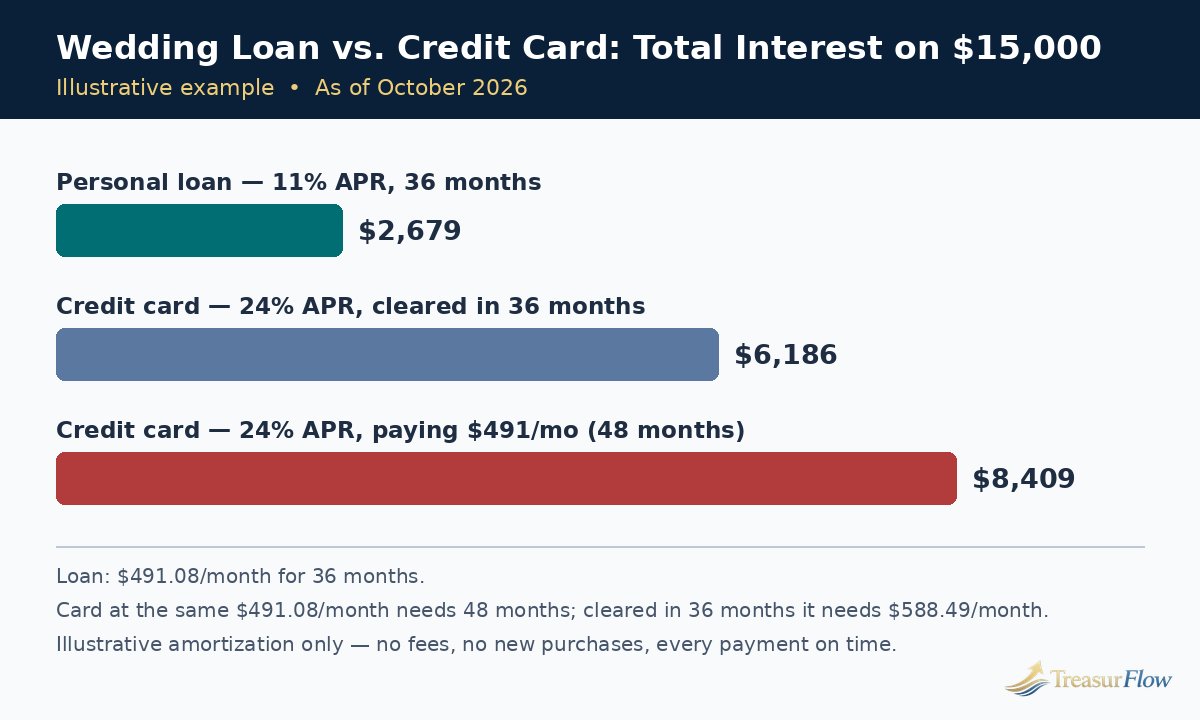
A loan is only one way to cover a wedding gap. Credit cards and buy-now-pay-later plans are the alternatives most couples actually reach for, usually because they are already in your wallet and require no new application. This section prices all three on the same amount, so the difference is the mechanism, not the wedding. The figures below come from the worked example carried in this guide’s source material; they are illustrative, calculated on stated assumptions, and labeled as of October 2026.
The worked example: $15,000, three ways
Option A: A personal (wedding) loan.
- Borrowed: $15,000 at 11% APR over 36 months.
- Monthly payment: about $491.
- Total repaid: about $17,679, of which about $2,679 is interest.
Option B: A credit card repaid at the same monthly amount.
- Borrowed: $15,000 at 24% APR, paid at the same $491 a month.
- Time to clear: about 48 months — a full year longer than the loan.
- Total repaid: about $23,409, of which about $8,409 is interest.
Option C: Buy now, pay later for parts of the wedding.
BNPL plans vary: some are short, interest-free installment plans when paid on time; others are longer financing offers that charge interest. Suppose a couple puts $4,000 of smaller vendor costs on an interest-free plan paid within its term: the finance cost can be $0. Spread across several plans with different due dates, though, BNPL becomes a stack of overlapping obligations, and missed or late payments can trigger fees or, on some products, interest reaching back over the balance. Use BNPL for small, defined items you can clear inside the interest-free window — never as a parallel borrowing system for the whole wedding.
Two conclusions survive every version of this example. First, at typical card APRs, even a disciplined fixed payment takes about a year longer and costs roughly three times the interest of an 11% loan. Second, the monthly payment alone would have hidden this entirely: both main options ‘cost’ $491 a month at the start. The honest comparison numbers are term, total repaid, and total interest.
| Option | Amount | Rate | Monthly | Time to Clear | Total Interest |
|---|---|---|---|---|---|
| Personal loan | $15,000 | 11% APR | ~$491 | 36 months | ~$2,679 |
| Credit card at same payment | $15,000 | 24% APR | $491 fixed | ~48 months | ~$8,409 |
| BNPL (interest-free plan, paid on time) | $4,000 example | 0% within term | Per plan schedule | Within plan term | $0 if paid on time |
| BNPL (missed/late payments) | Varies | Fees or interest may apply | Varies | Varies | Can erase the $0 advantage |
Illustrative only, as of October 2026; assumes fixed payments, no new charges, no fees, and no rate changes. Your figures depend on your actual APR, payment, and lender terms.
When the credit card actually wins
There is one case where the card genuinely wins, and honesty requires naming it: a true 0% introductory APR period that you clear in full before it ends. Charge only what the promo period can absorb, divide the balance by the number of months in the promotion minus one, and set that payment on autopay. If every dollar is gone before the regular APR starts, the card’s finance cost is $0 — cheaper than any loan.
The conditions are strict, and they fail often. The moment a balance survives past the promotional end date, the regular APR — usually in the 20s — applies to what remains, and the advantage over the loan evaporates within months. Some deferred-interest retail offers go further and charge interest back to the purchase date if any balance remains; read for the phrase “deferred interest” and treat it as a trap, not a feature. The card also wins for genuinely small, short gaps — a $1,200 balance you will clear from the next two paychecks, where a loan application is more machinery than the problem deserves. It loses as a general strategy for funding a $15,000 gap at a standard APR, as the table above shows.
Red Flags That Make Wedding Loans Expensive
Most expensive wedding loans are not expensive because of the headline rate. They are expensive because of structures and fees that sit underneath it — and a few outright fraud patterns that target people borrowing under celebration pressure. Learn to spot them before you sign.
Origination fees that come out of your proceeds
Some lenders deduct an origination fee from the amount disbursed rather than adding it on top. Apply for $15,000 with an 8% fee — the top of LendingClub’s range as compiled for this guide — and $1,200 is withheld: you receive $13,800 but owe payments calculated on $15,000, and you will pay interest on the full amount. At Upgrade, the compiled range is 1.85% to 9.99%, so your specific offer determines whether the fee is a footnote or a serious cost.
The practical handling: ask every lender, before signing, for (1) the origination fee as a percentage and a dollar figure on your amount, (2) the net amount that will actually land in your account, and (3) the APR, which by law folds the fee’s effect into the rate. Then, if you need $15,000 in hand, gross up your application amount accordingly — or choose the lender whose fee structure costs less. Never discover the shortfall on the week a vendor balance is due.
Deferred-interest traps
Deferred interest is the single most dangerous phrase in wedding financing. Under a deferred-interest promotion, interest is quietly calculated from the purchase date at the full standard APR. Pay the balance off entirely inside the promotional window and the interest vanishes. Leave even a small balance after the deadline and interest for the entire original amount, backdated to day one, lands on your account. The remaining $200 balance can carry hundreds of dollars of retroactive interest with it.
This structure appears most often in retail and store-linked financing — precisely the channels couples use for rings, attire, and decor. It is not the same as a true 0% introductory APR on a general credit card, where interest after the promotion applies only to what remains. Before accepting any “no interest if paid in full” offer, find the words “deferred interest” or “paid in full by” in the terms. If they are there, your safety margin is total payoff before the deadline — partial payoff is failure. A straightforward personal loan has no such cliff edge.
Four more warnings worth their space
Advance-fee loan scams. A “lender” who guarantees approval regardless of credit, cannot be verified as a real business, and demands an upfront fee — by gift card, wire, or transfer — before releasing your loan is not a lender at all. Legitimate fees are disclosed in your loan documents and are typically deducted from proceeds or capitalized, not collected in advance through untraceable channels. The FTC’s guidance on advance-fee loans is linked in the resources box at the top of this guide; read it before sending money to anyone.
Vague total cost. If an offer will not state the APR, the term, the total you will repay over the life of the loan, and the dollar fee total in writing, it is not an offer — it is a sales conversation. Every legitimate lender in this guide publishes or discloses these figures. Walk away from any that will not.
Precomputed interest and prepayment penalties. Some contracts calculate interest as though you will take the full term regardless of early payment, or charge a fee for paying the loan off early. Both structures punish exactly the behavior this guide encourages. Check for the words “prepayment penalty” and ask whether interest is simple interest calculated on the declining balance. If paying extra saves you nothing, choose a different lender.
Rolling one loan into another. Refinancing a wedding loan into a new one resets fees and can reset the interest clock. It makes sense only when the new APR is clearly lower and the new total cost, computed in writing, is lower after all fees — and when you do not extend the term back out in the process.
If an offer already taken turns out to be abusive, or a lender will not resolve an error, the CFPB accepts complaints about consumer financial products and forwards them to the company involved; the FTC publishes practical guidance on credit, loans, and scams. Both organizations’ official sites are linked in the resources box near the top of this guide — use those links rather than search results, because impostor sites copy regulator branding.
How to Apply — and How to Improve the Offer You Get
Step 1: Set the budget before you touch an application. Complete the framework earlier in this guide — priced wedding, cash in hand, protected funds removed, gap calculated. The amount you apply for comes from that arithmetic, not from the size of the approval a lender dangles. Decide your target term at the same time: the shortest term whose payment fits a normal month, with twelve months as the aspiration.
Step 2: Prequalify with at least three lenders using soft inquiries. Prequalification shows you a realistic APR, amount, fee, and payment without committing to anything. Where a lender offers prequalification, confirm that it uses a soft credit inquiry — the kind that does not affect your score — and treat any that will only quote after a full application with appropriate caution. Put each offer in writing or save the offer screen.
Step 3: Compare the offers on five lines, not one. For each offer, write down: (1) APR, (2) origination fee in dollars, (3) net amount you will receive, (4) monthly payment and term, and (5) total interest plus total of payments. An offer with a lower rate and an 8% fee can lose to an offer with a slightly higher rate and no fee — the table does not lie, but a single highlighted number can. Re-run the framework’s month test with the winning payment before you sign.
Step 4: Improve the offer before you accept it. Several levers are in your hands. A co-signer with stronger credit (Upgrade) or a joint application (LendingClub) can move your tier. A smaller amount and a shorter term usually price better than a larger, longer one. Paying down existing card balances before applying can improve utilization and, within a cycle or two, your score. And if your wedding date allows a delay, even a few months of saving shrinks the gap — every $1,000 you do not borrow is $1,000 plus interest you never pay. If the offers you receive are far worse than your profile suggests, pause and check your credit reports for errors before proceeding; inaccuracies are common and disputing them is free.
A Payoff Plan to Be Debt-Free Before Your First Anniversary
Borrowing well is only half the job. The couples who look back on a wedding loan without regret are the ones who treated payoff as part of the plan from the day the money landed, not as a problem for after the honeymoon. Building on the framework earlier in this guide, here is a milestone-based plan with a twelve-month horizon. Its target matches the most common advice for this debt: have the wedding loan gone before your first anniversary, and start married life proper with the payment freed up.
Option 1: Keep a longer contractual term, but pay it like a 12-month loan.
Take this route if your income is uneven — freelance work, seasonal hours, commission — or if a larger loan simply cannot clear safely in twelve required payments. Contract for 24 or 36 months so the minimum payment stays survivable in a bad month, then set your actual autopay at the twelve-month payoff amount. On the illustrative $15,000 at 11% APR, the 36-month payment is about $491; clearing the same loan in twelve months takes about $1,319 a month. The difference is the plan. In a strong month, pay the full $1,319 or more. In a genuinely bad month, drop to the contractual $491 without penalty or panic — that flexibility is exactly what you bought by choosing the longer term. Then return to the accelerated amount the following month, without exception.
The interest math rewards the effort. Follow the twelve-month pace to the end and total interest falls from about $2,679 on the 36-month schedule to roughly $900 — a saving of about $1,800 — because the balance, and therefore the interest charged on it each month, shrinks three times as fast.
Option 2: Take a 12-month term and finish on contract.
Take this route if your incomes are stable and the twelve-month payment passes the framework’s month test with room to spare. The shorter contractual term removes the temptation entirely: about $1,319 a month on the same illustrative loan, interest of roughly $900 in total, and a zero balance at month twelve — typically within weeks of your first anniversary if the loan funded just after the wedding. Couples who prefer a commitment device over flexibility do better with the obligation than with good intentions.
Either way, add three habits that cost nothing and save real money. First, set the payment on autopay a few days after payday, so the money leaves before it can be spent. Second, route windfalls — wedding cash gifts you choose to allocate, a bonus, a tax refund — against the balance in the first sixty days, when every extra dollar of principal saves the most interest.
Third, hold a monthly ten-minute money check-in, on the same day as the loan payment, to look at the falling balance together and re-forecast the payoff date. It keeps the plan visible, catches a slipping month early, and turns the loan from a source of low-level dread into shared evidence that the two of you can retire a debt on schedule — a skill worth far more than the wedding it paid for.
Wedding Loan Questions Couples Ask Before They Borrow
What is a wedding loan?
A wedding loan is an unsecured personal loan used to pay wedding costs. It is not a separate regulated loan type: normal personal-loan rules, disclosures, and credit checks apply. You receive a lump sum, spend it on vendors, and repay it in fixed monthly payments over an agreed term.
How much should we borrow for our wedding?
Borrow only the gap: price the full wedding, subtract the cash you can spend without touching your emergency fund or money owed elsewhere, and borrow the shortfall once. Do not borrow the whole wedding cost or a round number, and keep a small cash buffer back for final-week surprises rather than increasing the loan. For example, on a $35,000 wedding with $20,000 available in cash, the loan should be around $15,000, not $35,000.
Is a wedding loan better than a credit card?
For any balance you will carry longer than a few months at a standard card APR, usually yes. In this guide’s illustrative example, $15,000 at 11% APR over 36 months costs about $2,679 in interest; the same $15,000 at 24% APR, paid at $491 a month, takes about 48 months and costs about $8,409 in interest. The exception is a genuine 0% introductory APR card that you clear in full before the promotion ends — then the card’s finance cost is $0.
What credit score do we need for a wedding loan?
It depends on the lender. In the lender material reviewed for this guide, Earnest sets a minimum credit score of 680, while marketplace options such as Experian’s partner marketplace cater to fair credit. Stronger scores, lower debts, and stable income generally qualify for lower APRs, but your real rate is known only after prequalification.
Can we apply for a wedding loan together?
Yes, with the right lender. LendingClub is identified as best for joint loans in the material used for this guide, and a joint application lets the lender consider both incomes and both credit profiles. Remember that both partners are then fully responsible for the full payment, not half each, and a missed payment can appear on both credit reports. Other structures exist: Upgrade is the co-signed option in this guide, while Best Egg offers no joint or co-sign applications.
What should we watch out for before signing?
Five things: origination fees deducted from your proceeds (ask for the net amount you will actually receive); deferred-interest wording — “no interest if paid in full” is not the same as 0% APR; prepayment penalties or precomputed interest that punish early payoff; vague pricing with no APR and total cost in writing; and advance-fee scams demanding payment before funding. If in doubt, compare against the CFPB and FTC guidance linked in the resources box at the top of this guide.
Bottom Line: Borrow for the Marriage, Not Just the Day
The best wedding loans 2026 comparison comes down to is not really a ranking of lenders — it is a sequence of decisions made in the right order. Budget first, using real prices instead of averages. Borrow second, for the gap only, after comparing at least three real offers on APR, fee, net amount, payment, and total interest. Protect the structures that matter — no draining the emergency fund, no deferred-interest cliffs, no co-signer asked to carry a risk you have not stress-tested. Then pay the loan like it matters: on autopay, accelerated where income allows, gone within a year.
Do those four things and the loan becomes what it should be — a brief, boring bridge between the wedding you planned and the savings you had, closed out and forgotten by your first anniversary. Skip them, and even a good rate cannot save an oversized loan from becoming the most expensive part of the day. Borrow for the gap, not the whole wedding.

Muhammad Zakir is the founder of Treasurflow and the author of its personal finance guides. He researches consumer banking, credit, and personal loans, and every guide cites primary sources such as the CFPB, FDIC, FTC, and IRS. His content is educational and is not personalized financial advice.