
Most loans follow a simple order: you borrow money, the money lands in your account, and then you pay it back. A credit builder loan reverses that order completely — and if you do not understand the reversal before you sign up, almost everything else about the product will confuse you: why you cannot spend the money, why you pay interest on funds you have not received yet, and why you get back less than you paid in.
Best Credit Builder Loans 2026: The short version: a credit builder loan can be a structured way to add installment payment history to your credit reports if you have no credit history, a thin file, or a low score, little or no other debt, and the ability to pay on time every month. The Consumer Financial Protection Bureau (CFPB) describes these loans as a way to build credit and savings at the same time, and its funded study found they worked best for participants who started without existing debt. That same research is the strongest warning here: borrowers already stretched by other debts did worse, and late payments were common enough that these products should never be treated as automatic or risk-free.
All rates, plan prices, and terms are stated as of October 2026, checked against provider pages and current roundups from Credit Karma, Crediful, and MoneyRates, and can change. Confirm the exact APR, fees, payout, and reporting policy in your own agreement before you commit — the agreement, not any roundup, controls your money. No product in this guide can guarantee a specific score increase, and this article does not promise one.
Related Guides
- Best Secured Credit Cards 2026 — the revolving-credit alternative to a builder loan, compared in detail later in this guide.
- How Long Does It Take to Build Credit From Scratch? — realistic timelines from no file to a scoreable, usable credit history.
- Best Personal Loans 2026 — for readers who need actual loan proceeds now, not locked savings later.
- Best Debt Consolidation Loans 2026 — if existing debt, not a thin file, is the main problem to solve first.
Helpful Official Resources
- CFPB — Targeting Credit Builder Loans (research report) — the Consumer Financial Protection Bureau’s funded evaluation of how credit builder loans affected scores, late payments, and savings.
- CFPB — Credit Reports and Scores — the CFPB’s hub for understanding reports, scores, and your rights.
- AnnualCreditReport.com — the federally authorised site for free credit reports from Equifax, Experian, and TransUnion; the CFPB notes you can get a free copy from each company once a week there.
- FTC — Free Credit Reports — Federal Trade Commission consumer advice on getting truly free reports and avoiding look-alike sites that charge for them.
- FTC — Understanding Your Credit — FTC consumer advice on what credit reports contain and why that information matters to lenders, landlords, and employers.
How a Credit Builder Loan Works, Step by Step: Follow the Money
Forget the word “loan” for a moment. A better model is a locked box, a payment plan, and a reporting pipe to the credit bureaus. The box holds money you cannot touch. The payment plan is how you earn its release. The reporting pipe is the actual product, because the stream of on-time payments sent to the bureaus is what can build your credit history.
Step 1: The lender creates the loan — and keeps the proceeds
On approval, the lender does not send the loan amount to your checking account. It moves its own funds — the principal — into a locked savings account or certificate of deposit (CD) held in your name. The CFPB’s general description puts typical credit builder loans at about $300 to $1,000 repaid over 6 to 24 months, although several modern providers go higher: Self’s plans total up to $3,600 in payments, DCU lends $500 to $3,000, and Credit Strong reports installment tradelines well above $1,000 on longer plans. The structure is identical at every size: the money exists, your name is on it, and you cannot spend it yet.
Step 2: Choosing a plan is really choosing a payment, a term, and a payout
You are not really choosing how much to “borrow.” You are choosing a monthly payment you can sustain, a term over which to sustain it, and the amount released at the end. Self, as of October 2026, makes this transparent with four fixed plans: $25, $35, $48, or $150 per month, each for 24 months. DCU works the other way: pick $500 to $3,000 and a term of 12 to 24 months, and the payment follows from its 5.00% APR. Credit Strong stretches the choice over years. The right question is never “what is the biggest plan I qualify for?” It is “what payment can I still make in my worst month, not just my best one?”
Step 3: Each payment is split — part savings, part price
Every payment has two jobs. Part pays down principal — the locked amount that will eventually be yours. Part pays interest, and with some providers part also covers an administrative or membership fee. That split explains the end-of-term maths that surprises so many borrowers: you receive less than you paid in, and the difference is the true cost.
Step 4: The lender reports each payment to the credit bureaus
As you pay, the lender reports the account and your payment behaviour to one or more credit bureaus. This reporting — not the loan, not the savings — is what you are buying. An installment account appears on your reports, and each on-time payment adds to your payment history, the most heavily weighted category in common scoring models. Most major providers here report to all three major bureaus — Equifax, Experian, and TransUnion — and DCU goes further, as the checklist below explains. Reporting typically begins after your first successful payment.
Check two details before signing. First, confirm the lender reports to all three bureaus, not one or two: a future lender may pull a different bureau than the one your builder loan reported to, and a thin file there stays thin. Second, understand that reporting cuts both ways — the same pipe that carries on-time payments carries a 30-day late payment just as faithfully.
Step 5: At the end of the term, the lock comes off — minus interest and fees
After the final payment, the locked account is released: the remaining CD balance (Self), the held proceeds, which at DCU can also earn dividends (DCU), the principal you built up (Credit Strong), or the reserve balance (MoneyLion, where part may have been released earlier). Providers vary the ending in ways worth knowing in advance. MoneyLion may release part of the proceeds upfront and hold only the rest in its Credit Reserve Account — exactly why its membership cost needs separate scrutiny. Credit Karma Credit Builder is not an interest-bearing loan at all: you pay in amounts you choose, and once you have saved $500, that amount is released to your Credit Karma Checking account. Early exit is usually possible with most providers, but you receive only the eligible balance after interest and fees already incurred, and you stop the reporting stream that was the whole point of the account.
Self Credit Builder Account: Best for a Simple, Fixed Online Plan
Self is the cleanest example of the classic model, as of October 2026: pick one of four fixed monthly payments, pay for 24 months, have every payment reported to all three major bureaus, and receive the remaining balance of a bank-held CD at the end, minus interest and fees. Accounts are made or held through FDIC-member partner banks, reporting starts after your first successful payment, and there is no hard credit check — which is why Credit Karma rates Self its pick for low credit scores and Crediful rates it best for simple online setup. Self notes that offers to a particular applicant may differ from its public sample plans, so confirm your own offer before starting.
The four sample plans, as of October 2026, are: $25 per month for 24 months at 15.92% APR ($600 paid in, estimated payout about $520); $35 per month at 15.69% APR ($840 paid in, about $724 back); $48 per month at 15.51% APR ($1,152 paid in, about $992 back); and $150 per month at 15.82% APR ($3,600 paid in, about $3,076 back). A small one-time, non-refundable administrative fee applies to open an account — Self’s current disclosures describe a variable administrative fee — so include the fee on your own offer in your cost calculation. Some customers may also become eligible for a secured Self Visa Credit Card as they build progress in the account, a neat bridge from installment to revolving credit without changing providers.
The limitations are cost and rigidity. An APR of 15.51% to 15.92% is roughly three times DCU’s rate: the dollar cost is a manageable $80 or so on the smallest plan, but rises to about $524 on the $150 plan for the same 24 months of reporting. The single 24-month term also cuts both ways. And Self’s own disclosures warn that payments 15 or more days late can attract a late fee, while a payment more than 30 days late can be reported as late. Set up autopay on day one.
Choose Self if: you want a predictable, app-based plan with no hard credit check and all-three-bureau reporting, and you accept a mid-teens APR for convenience. Look elsewhere if: you qualify for a low-APR credit union loan, which buys the same reporting for roughly a third of the interest.
Credit Strong: Best for a Long Installment History From One Account
Credit Strong, a division of Austin Capital Bank, answers the time question oppositely to Self. As of October 2026, it sells a menu of accounts built around different lengths and sizes of reported tradeline, all reporting to Experian, Equifax, and TransUnion, with no hard credit pull and accounts held at an FDIC-insured bank. Its personal products are Revolv (a revolving tradeline — a different tool), Instal (its entry installment account), and MAGNUM (large, long installment accounts). For comparison with the other loans here, Instal and MAGNUM are the relevant products.
Instal is the cleanest to price. As listed on Credit Strong’s own product pages as of October 2026, Instal reports a $1,010 installment tradeline, costs $28 per month, builds up to 48 months of payment history and $1,010 in savings over that term, with a $15 activation fee described in current plan summaries. The true-cost maths: $28 × 48 months = $1,344 paid in, plus the $15 fee, minus the $1,010 returned, equals about $349 for four years of reported payments — roughly $7.27 per month of reporting. Other Instal levels, such as $38 per month over 36 months and $48 per month over 24 months for similar reported amounts, appear in Credit Strong’s listings; shorter terms cost less total interest, so pick the shortest term your budget handles comfortably, not the smallest payment.
MAGNUM reports installment tradelines from $1,000 up to $25,000, with plans from $16 per month and terms up to 120 months — suited to someone deliberately building a long installment record ahead of a future mortgage or business goal. Be clear-eyed, though: stretching modest principal over ten years means interest accumulates for ten years, and a big reported tradeline is not cash in hand and not, by itself, a better score. Credit Strong lets you cancel from the dashboard, but cancelling early forfeits interest and fees already paid and stops reporting.
Choose Credit Strong if: length of reported installment history is your priority and you can commit to 24–48 months or longer. Look elsewhere if: you want the lowest cost over a short term, or your file actually lacks revolving credit — compare secured cards first.
MoneyLion Credit Builder Plus: Best if You Need Some Proceeds Upfront — but Price the Membership First
MoneyLion breaks the classic model in one important way, which is why Credit Karma names it best for immediate access to money. With Credit Builder Plus, as of October 2026, you may receive part of your loan proceeds at the start, while the rest is held in a Credit Reserve Account and released when the loan is paid off. For a reader who needs to build credit and needs some cash this month, that partial access is a real difference. But MoneyLion also breaks the classic pricing model, and that matters just as much.
The loan terms, as of October 2026, are: amounts from $500 to $1,000, APRs from 5.99% to 29.99%, a 12-month term, reporting to Equifax, Experian, and TransUnion, and no hard credit check. The loan requires Credit Builder Plus membership at $19.99 per month, and it is not available in every state. MoneyLion’s own disclosures add fine print worth reading: a soft credit pull is conducted; part of the proceeds may be required to sit in the reserve account at the lender’s discretion; reserve funds sit in money market or cash sweep vehicles and are not FDIC insured the way a bank savings account is; and on default, the reserve may be liquidated to satisfy what you owe.
Now the maths. Membership alone is $19.99 × 12 = $239.88 over one 12-month loan — before a cent of interest. Add interest on a $1,000 loan over 12 months — roughly $33 at 5.99% APR and roughly $170 at 29.99% APR on a standard amortisation calculation — and total cost lands between roughly $273 and $410, depending on the APR you are offered. Compare roughly $80 for Self’s smallest plan (which reports twice as long) or roughly $53 of interest on a $1,000, 24-month DCU loan. MoneyLion can still be right — if you value the partial upfront access and actually use the membership features — but it is almost never the cheapest way to buy reported payments. Treat provider marketing about members’ score gains the same way for every brand: past customers under particular conditions, not a promise about your file.
Choose MoneyLion if: partial upfront access is worth a materially higher total cost, your offered APR is at the lower end of the range, and you will use the membership. Look elsewhere if: you do not need cash now — you would pay $239.88 for a feature you never use.
DCU Credit Builder Loan: Best Low-Cost Loan if You Can Join
Digital Federal Credit Union — DCU — is the value pick in this guide, and it is not close. As listed on DCU’s own rates page, effective October 20, 2026, members can borrow $500 to $3,000 for 12 to 24 months at a fixed 5.00% APR, with an estimated monthly payment of $43.87 per $1,000 borrowed on the longest term. Proceeds are held for the life of the loan and released after you pay in full, the money you pay in can earn dividends in a DCU savings account, and DCU promotes a 60-day window with no payments due after approval — breathing room no other pick here matches as clearly.
Price it properly: $43.87 × 24 payments = $1,052.88 on a $1,000 loan, so interest is about $52.88 — before any offset from dividends on the held funds, which this guide does not count because dividend rates vary. Put that $53 next to Self’s roughly $80 on a smaller plan, Credit Strong Instal’s roughly $349 over 48 months, and MoneyLion’s membership-plus-interest total, and the pattern is obvious: a low fixed credit union APR is the biggest lever on true cost. If two products both report your payments and one charges 5.00% while the other charges about 15.5% to 15.9%, the reporting is not three times better from the expensive one. It is the same stream of payments, bought at a third of the price. Membership is required, and no funds are released early, so confirm your eligibility on DCU’s site before counting on this option.
Choose DCU if: you are eligible for membership, need none of the money before the term ends, and want the lowest interest cost plus the widest reporting. Look elsewhere if: you cannot join, or the extra step means you would never actually open it — an account you never open builds nothing.
Credit Karma Credit Builder: Best Zero-Cost Option, With a Different Mechanism
Credit Karma Credit Builder’s price is zero — because it is not structured like the other loans here. As Credit Karma describes it, opening Credit Builder opens a line of credit and a locked savings account in your name through its partner arrangement. You choose how much to pay in each pay period — contributions can be as little as $10 — each payment is reported to the credit bureaus, and once you have saved $500, that amount is transferred to your Credit Karma Checking account. Credit Karma states the plan is free: no fees and no interest.
That structure solves the category’s biggest failure mode. Credit Karma lists the ability to skip payments if you are short on cash as a feature, with the main activity rule being a contribution at least once every three months to keep the account active. Compare a fixed loan payment due in full in a month when your hours were cut — and the CFPB finding, covered in the risks section, about how often builder borrowers pay late. The same platform also hosts credit monitoring, so you can watch the account appear and your profile change in one place.
The trade-offs: you must be in the Credit Karma Money ecosystem rather than taking a standalone loan; funds stay locked until the full $500 threshold, with no partial release; and eligibility rules — Credit Karma has historically targeted this product at members with lower scores — must be checked in your own account, because a product you do not qualify for is not an option however free it is. Finally, this is a pay-at-your-own-pace arrangement, not a fixed installment loan with a contractual schedule; if your goal is specifically to show a future lender a completed fixed-term installment loan, Self, Credit Strong, or DCU matches that goal more literally.
Choose Credit Karma Credit Builder if: cost is your top priority, your cash flow is irregular, and you already use — or will open — the required accounts. Look elsewhere if: you want a traditional fixed-term installment loan, a larger reported amount, or you do not meet current eligibility rules.
The Local Credit Union Option: Often the Smartest Loan You Will Not See Advertised
National roundups, this one included, can only list nationally available, publicly described products. That creates a blind spot: one of the strongest options for many readers is the credit builder or share-secured loan at a credit union in their own town, workplace, or community — the kind of product the CFPB had in mind when it described these loans as typically offered by banks and credit unions at about $300 to $1,000 over 6 to 24 months.
Ask these six questions, and do not sign until each answer is in the agreement: What is the APR, and is it fixed? What are the total fees, including membership, application, and late fees? Is the full amount held, or is any portion released early? Which credit bureaus do you report to? What is my exact payout at the end of my term, after interest and fees? Can I close early, and what would I receive? A lender — local or online — that cannot answer the payout and reporting questions is telling you something important about itself.
Choose a local credit union if: you already belong to one, or can join one, and its quoted APR undercuts the online options while reporting to at least the three major bureaus. Look elsewhere if: the local product reports to only one bureau, or fees erase its rate advantage.
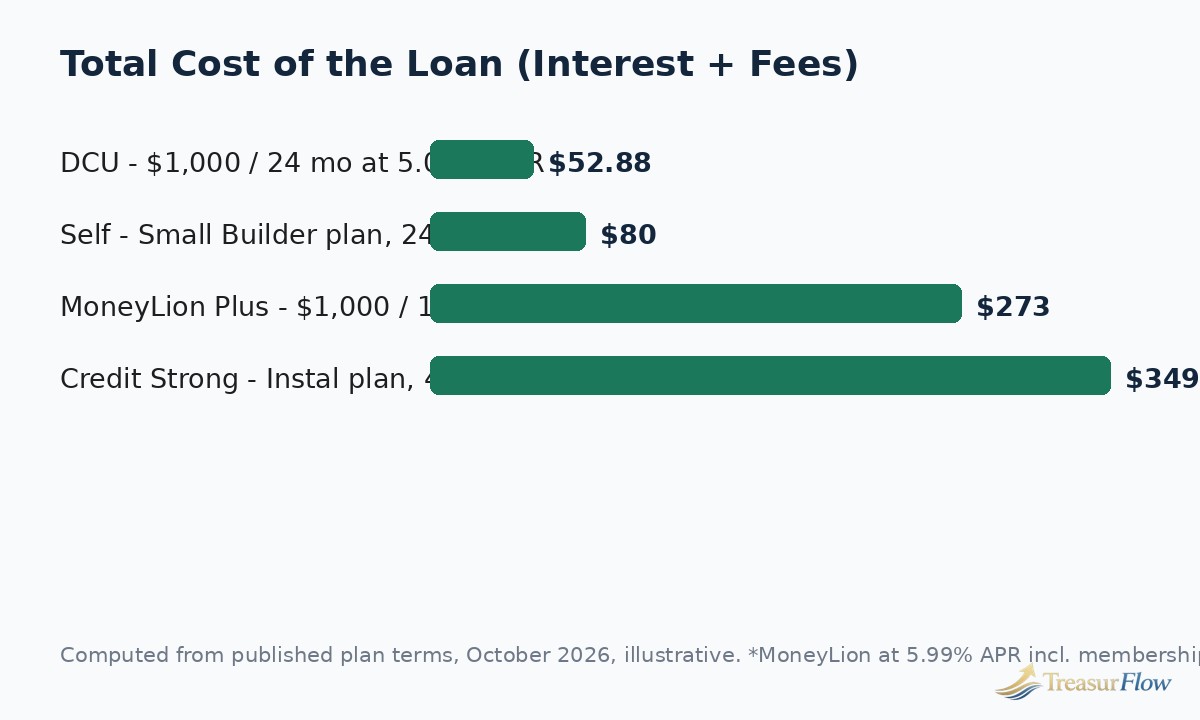
The True Cost of Each Pick: Total Interest and Fees, Not Monthly Payments
Monthly payments are the worst way to compare these products, because a smaller payment can simply mean a longer term, a smaller payout, or a fee billed elsewhere. The honest comparison is total cost of credit: everything you pay in, minus everything you get back, plus any fee charged outside the payment, such as a membership or activation fee. The figures below are illustrative calculations from the verified plan terms cited above, as of October 2026; repeat this exact subtraction on your own agreement before signing.
Self — Small Builder plan: about $80 over 24 months. You pay $25 × 24 = $600 in; the published estimated payout is about $520; $600 − $520 = about $80, covering interest and applicable fees in the sample plan. Method: total payments minus published estimated payout, using Self’s sample terms as reported by LendEDU and Crediful (15.92% APR on this plan). On the same method, the $35 plan costs about $116 ($840 in, about $724 back), the $48 plan about $160 ($1,152 in, about $992 back), and the $150 plan about $524 ($3,600 in, about $3,076 back). The APR barely changes between plans, so bigger plans cost proportionally more dollars for the same 24 months of reporting — the smallest plan you will complete is usually the most efficient purchase.
DCU — $1,000 over 24 months: about $53 in interest. DCU’s rates page, effective October 20, 2026, publishes an estimated payment of $43.87 per $1,000 at 5.00% APR on the longest term. $43.87 × 24 = $1,052.88; minus the $1,000 released at the end, interest is about $52.88. Method: published payment example × term, minus principal; dividends on held funds are excluded, so a member’s net cost could be slightly lower. A 12-month DCU loan costs materially less total interest, because the balance is outstanding half as long — at a low APR, the shorter term you can afford is the cheaper product.
Credit Strong — Instal plan: about $349 over 48 months. $28 × 48 = $1,344 paid in, plus the $15 activation fee, minus $1,010 returned, equals $349. Method: total payments plus activation fee, minus principal returned, using Credit Strong’s published Instal terms. In raw dollars that is the second-highest cost here — but it buys 48 months of reporting, so per reported month it is about $7.27, between DCU’s roughly $2.20 and Self’s roughly $3.33 on their representative plans. That per-month view is the fair way to compare products of different lengths — and the view providers least often show you.
MoneyLion Credit Builder Plus — $1,000 over 12 months: about $273 to $410, depending on your APR. The fixed part is membership: $19.99 × 12 = $239.88. Add amortised interest on $1,000 over 12 months: about $33 at 5.99% APR, about $170 at 29.99% APR. Method: membership × term, plus amortised interest at the stated APR range; optional features and transfer fees excluded. However you frame it, the membership — not the loan interest — is the main cost, buying the shortest reporting stream in this guide at the highest price per month. It can still be worth it if you use the upfront access and membership features, but it should never be mistaken for a cheap loan.
Credit Karma Credit Builder: $0 in interest and fees. There is no APR and there are no fees as Credit Karma describes the plan, so the subtraction is zero: what you pay in builds toward the $500 release. Method: provider-stated no-fee, no-interest structure as of October 2026. The real costs are constraints — locked funds until $500, required accounts, eligibility, and contributing at least once every three months to stay active. Zero cost does not mean zero trade-offs, but on price nothing else here ties it.
Bureau-Reporting Checklist: Where Your Payments Actually Show Up
A builder loan that does not report where your future lenders look is an expensive savings plan and nothing more. Work through this checklist before committing, and get answers from the provider’s disclosures or agreement, not a marketing headline.
Does it report to all three major bureaus? That is the 2026 baseline: Equifax, Experian, and TransUnion. Self, Credit Strong, and MoneyLion all state all-three-bureau reporting for the products covered here, as of October 2026. It matters because you cannot control which bureau a future auto lender, card issuer, landlord, or mortgage lender pulls — a perfect record at one bureau does not help when the decision uses another bureau’s file.
Does it report to a fourth bureau? DCU is the standout: it reports to four bureaus — the three majors plus Innovis. Innovis is a genuine fourth nationwide consumer reporting company; it plays a smaller role than the big three in most mainstream lending, but some furnishers and lenders use it, particularly in certain mortgage, auto, and utility contexts. Four-bureau reporting at the lowest APR in this guide is a rare combination. Keep it in proportion, though: four bureaus is broader coverage, not four times the benefit.
When does reporting start, and how do you verify it? Commonly after your first successful payment, so an account opened today may take weeks to appear. Verification is free: pull your reports at AnnualCreditReport.com — the CFPB confirms a free copy from each major company once a week there — and confirm the account appears, with the right balance and payment status, at every promised bureau. If it has not appeared after two payment cycles, contact the provider in writing and ask where it is reporting.
Credit Builder Loan vs. Secured Credit Card: Which Kind of Credit Does Your File Need?
The most common real choice is not between two builder loans — it is between a builder loan and a secured credit card, and they build different types of credit. Our guide to the best secured credit cards 2026 covers the card side in depth; this is the decision framework.
A builder loan adds installment credit: a fixed amount, fixed payment, fixed end date. Its strengths are discipline and safety from yourself — nothing to spend, no balance to run up, no utilisation to manage, and a payment that never changes, which makes it easy to automate. Its weaknesses are cost and finality: you pay interest and possibly fees, your money is locked, and when the loan ends the account closes, so it stops generating fresh on-time payments.
A secured card adds revolving credit: a refundable deposit typically sets your limit, you spend against it and pay monthly. Used lightly and paid in full, a good secured card can cost nothing in interest, most issuers report to all three bureaus, and many cards graduate to unsecured, return your deposit, and stay open for years, building account age. Its weaknesses are behavioural and mathematical: overspending triggers interest at card APRs that dwarf anything here, and using too much of a small limit raises utilisation, which can work against your scores even when you pay on time. A secured card in the hands of someone who treats a limit as income will do damage a builder loan simply cannot do, because the builder loan gives you nothing to spend.
Decide by profile. No revolving credit, a tidy budget, and confidence you will pay in full and keep utilisation low — ideally well under 30% of the limit, lower is better? A secured card is often the more efficient first tool. Spending temptation is your risk, your income is steady, or your file specifically lacks installment history? A builder loan is the safer, targeted purchase. Carrying existing balances or behind anywhere? Neither comes first — the CFPB research warns that adding a builder payment on top of strained debt made outcomes worse, and the same logic applies to a new card. Facing a specific near-term application? Read our timeline guide on how long it takes to build credit from scratch first, because no legitimate tool builds a mature file overnight.
The Risks Nobody Should Sign Without Understanding
A 30-day late payment turns the product against you. This is the central risk, in the CFPB’s framing: the same reporting that builds your credit transmits your failures. A payment reaching 30 days past due can be reported as late, late information can remain on credit reports for years, and on a thin file — where one tradeline is a large share of your history — the damage can exceed the good the earlier on-time payments did. The CFPB-funded study of a credit union credit builder loan found late payments were far from rare among participants. Hence the worst-month test, repeated throughout this guide: only take a payment you could still make in a month when your hours are cut or another bill spikes. If no payment size passes that test right now, the correct builder loan is none, yet.
Existing debt changes the expected result. The CFPB study’s headline finding is unusually clear: the loan helped most — in establishing scores and in improvement — for participants without existing debt, whose score gains were 60 points higher than participants with existing debt, while participants who already had debt saw little benefit and in some analyses saw scores fall slightly on average, partly because the extra payment made keeping up with other obligations harder. This article promises no one a score increase, and the study is why: the same product produced opposite average outcomes depending on debts already carried. If you have existing debt, read our guide to the best debt consolidation loans 2026 and stabilise what you owe first.
Your savings are locked, and emergencies do not care. For 12 to 24 months — or up to a decade on the longest Credit Strong terms — the money you pay in is not your emergency fund. If an emergency hits mid-term, your options are to keep paying from other resources, close early and accept a reduced payout and the end of reporting, or miss payments and take the credit damage. A small cash cushion outside the builder account should exist before the account does. A builder loan is a good second financial step; it is a bad first one.
How to Apply and Set Yourself Up to Finish
Use the true-cost method: for each candidate, list total paid in, amount returned, every outside fee, the term, and the bureaus reported to — on one page, in dollars. Pick the cheapest option that reports to at least the three major bureaus and whose payment passes your worst-month test. If two options are close, prefer the shorter term you can still afford: it returns your money sooner and ends the obligation sooner.
Before the first payment, do four things. Set up autopay from an account that reliably holds a buffer, and set a reminder a few days before each due date anyway. Note the furnisher name the account will appear under, and the bureaus it should appear at. Keep every other account current — a late payment elsewhere can erase the builder loan’s value. And decide now what you will do if money gets tight: whether payments can be skipped or the account closed, and who you will contact before a due date, not after it.
Credit Builder Questions Borrowers Ask Before They Commit
Do credit builder loans actually build credit?
They can, if the lender reports your payments to the credit bureaus and you pay on time every month. The loan adds an installment account and a stream of reported payments to your credit reports, which can help you establish a score or add positive payment history. There is no guaranteed score increase, and a payment that is 30 days or more late can be reported as late and hurt the credit you were trying to build.
How much does a credit builder loan really cost?
The true cost is the interest and fees you do not get back, not the full amount you pay in. For example, as of October 2026, Self’s $25-per-month plan costs about $80 over 24 months because you pay in $600 and receive about $520 back, while a $1,000 DCU loan at 5.00% APR over 24 months costs about $53 in interest using DCU’s published payment example. Always subtract the amount you will receive at the end from the total you will pay in, and add any membership or administrative fees.
Which is better for building credit, a credit builder loan or a secured credit card?
Neither is automatically better, because they build different types of credit. A credit builder loan adds installment credit with fixed payments and no spending temptation, while a secured credit card adds revolving credit that you can keep using and, with many issuers, eventually graduate from. If you can manage a card without overspending, a secured card may be more flexible; if you want a forced savings habit and a set end date, a builder loan may fit better, and some people use one of each at different times.
Can you get a credit builder loan with no credit or bad credit?
Often, yes, because the locked savings or certificate of deposit protects the lender if you stop paying. Several providers in this guide, including Self, Credit Strong, and MoneyLion, do not require a hard credit check to apply, as of October 2026, but you will usually still need to verify your identity, show a way to make the payments, and meet any membership or account rules. Approval is never guaranteed, so read the eligibility terms before you apply.
What happens if you miss a payment or close a credit builder loan early?
A missed payment can lead to late fees, and a payment that is 30 days or more past due can be reported to the credit bureaus as late, which can damage your credit reports for years. If you close early or stop paying, the lender can typically use the locked funds to cover what you owe, you lose the interest and fees you already paid, and you stop building new positive payment history. Contact the lender before a payment is due if you think you will miss it.
How long does it take to see results from a credit builder loan?
Reporting usually starts after your first successful monthly payment, but building a usable credit history takes time. If you are starting from scratch, scoring models generally need several months of reported activity before a score can be generated, and the full benefit of a builder loan comes from completing the whole term on time. Check your reports for free at AnnualCreditReport.com during the term to confirm the account is being reported the way the lender promised.
Conclusion: Small Payments, On Time, Every Time
A credit builder loan is a backwards loan, and once you follow the money — locked on day one, released at the end, with interest and fees skimmed along the way — the category becomes simple to judge. You are buying reported, on-time installment payments and a forced savings habit, and the right questions are always what that bundle costs, where it reports, and whether you can sustain it in your worst month.
On those measures, as of October 2026: DCU is the low-cost benchmark at 5.00% APR with four-bureau reporting, for those who can join. Credit Karma Credit Builder is unbeatable on price at zero cost, if its structure and eligibility fit you. Self is the simplest fixed online plan, at a mid-teens APR. Credit Strong sells the longest reporting streams, at a total cost you must calculate term by term. MoneyLion sells partial access to your money now, at a membership-inclusive price that only makes sense if you use that access. And your local credit union may quietly beat them all, if you ask it the six questions in this guide.
None of them guarantees a score increase, all of them report late payments as faithfully as on-time ones, and the CFPB’s evidence says the product works best for people not already carrying other debt. Pick the smallest plan that does the job, automate it, verify it on your free reports, and finish it. A completed small loan is a real credit history; an abandoned large one is just an expensive lesson.

Muhammad Zakir is the founder of Treasurflow and the author of its personal finance guides. He researches consumer banking, credit, and personal loans, and every guide cites primary sources such as the CFPB, FDIC, FTC, and IRS. His content is educational and is not personalized financial advice.