

If a client says your advice cost them money, your design missed something, your software failed at the worst possible moment, or a deadline slipped and their launch collapsed, general liability insurance will usually not save you. That is not what it was built for. The policy built for that moment is professional liability insurance — also called errors and omissions insurance, or E&O — and in 2026 it remains one of the most misunderstood purchases a professional, freelancer or small firm can make.
Most comparison guides start in the wrong place: they rank carriers first and explain the policy later, if at all. That order is backwards, and it is dangerous. Professional liability is almost always written on a claims-made basis, which means the date a claim is reported matters as much as the date the work was done. A cheap policy with the wrong retroactive date, no prior acts coverage and no tail plan when you switch or retire can leave years of work effectively uninsured — even if you paid premiums every year. A slightly dearer policy that preserves your original retroactive date can be worth far more when a claim arrives, often years after the work itself.
So this guide works in a different order, on purpose: anatomy first, carriers second. First, what professional liability and E&O actually cover and exclude, and how claims-made versus occurrence, retroactive dates, prior acts and tail coverage really work. Only after that do we rank the best professional liability insurance 2026 options by buyer type — ERGO NEXT, Hiscox, The Hartford, CNA, Travelers and, for larger firms, Chubb — then cover cost as attributed ranges by profession, how to choose limits and deductibles, and who is actually required to carry this insurance by law versus by client contract.
A note on money and ratings: every premium figure here is date-stamped as of October 2026 and attributed to its source, presented as a range or a source’s stated average for a defined group — never as a promise of what you will pay. We also do not print financial strength letter grades unless we could verify them for the specific legal company issuing your policy, because brands write through subsidiaries with different ratings. Instead, we show you how to check a carrier’s rating and complaint record yourself before you buy.
Related Guides
Helpful Official Resources
- U.S. Small Business Administration — Get Business Insurance — the SBA’s plain-language guide to assessing risk, finding a licensed agent, shopping around and reassessing cover every year.
- National Association of Insurance Commissioners — Consumer Insurance Search — the NAIC’s free tool to check whether an insurer is licensed, review its complaint record and confirm the exact legal company behind a policy.
- Federal Trade Commission — Business Center and Cyber Insurance Guidance — the FTC’s business guidance hub, including its cyber insurance resources developed with the NAIC, for firms whose professional risk is now also a data risk.
What Professional Liability Insurance Actually Is
Professional liability insurance protects a business or professional against claims that their services, advice, expertise or failure to perform caused a client financial harm. MoneyGeek, which publishes the leading national comparison for this product, lists its core responses as legal defense costs, settlements, court judgments, negligence claims, errors or omissions, missed deadlines or incomplete work, and misrepresentation related to services provided. The U.S. Small Business Administration puts it briefly: professional liability is for businesses that provide services to customers, protecting against financial loss from malpractice, errors and negligence.
The name changes by profession, which causes endless confusion, but the product is recognisably the same. Consultants, real estate agents, accountants, technology firms and agencies usually hear it called errors and omissions, or E&O. Healthcare providers and lawyers usually hear malpractice insurance. Outside the United States it is often professional indemnity. MoneyGeek’s comparison makes the point explicitly: there is no functional difference between professional liability and E&O, malpractice is a specialised form tailored to regulated fields, and professional indemnity is the international term. Do not let the label distract you. What matters is whether the form, profession class and exclusions match the work you actually do.
Here is the simplest test for whether you need it. If a client pays you for your judgment — advice, a design, a calculation, a recommendation, software, a filing, a valuation, a plan — and being wrong could cost that client money, you have professional liability exposure. You do not need to have made a dramatic mistake. You only need a client who believes you made one and puts that belief into a demand letter or lawsuit. The policy pays first for defense, and defense alone is often the reason to buy: even a baseless claim must be answered, and answering it competently in a document-heavy dispute is expensive long before any settlement.
What a Policy Typically Covers
A standard professional liability policy, read carefully and matched to your profession, typically responds to the following, up to your per-claim and aggregate limits and subject to your deductible:
A standard policy, matched to your profession, typically responds to the following, up to your per-claim and aggregate limits and subject to your deductible:
- Negligence, errors and omissions in your professional services — a miscalculation, flawed design, incorrect recommendation, missed step or omitted information that caused a client loss.
- Misrepresentation related to your services — a claim that a client relied on a statement about your services, timelines or expected results and lost money as a result.
- Missed deadlines and failure to deliver as promised, where the delay or shortfall caused a measurable financial loss.
- Legal defense costs — attorney fees, expert costs and court costs for a covered claim. Ask whether defense is paid inside or outside your limit, because that term can change the real value of a $1 million policy dramatically.
- Settlements and judgments on a covered claim, up to the remaining limit, often with a consent-to-settle provision.
- In some forms, add-ons such as disciplinary proceedings cover, subpoena assistance, intellectual property claims arising from your work, or privacy and network security components. These are never automatic — confirm them on your own quote. Hiscox and The Hartford, for example, both describe profession-specific technology, healthcare, consulting and other specialty forms in MoneyGeek’s analysis.
What a Policy Typically Does Not Cover
Exclusions are where buyers get hurt, because they shop on price and headline limits and read the exclusions — if at all — after a claim. Read these before you buy:
Exclusions are where buyers get hurt, because they shop on price and read exclusions after a claim. Before you buy, note what a policy typically does not cover:
- Bodily injury and property damage to third parties — that is general liability territory.
- Intentional wrongdoing, fraud and dishonesty — deliberate deception is not an insurable professional error in the ordinary form.
- Employees’ employment claims — discrimination, harassment and wrongful termination belong under employment practices liability (EPLI).
- Directors’ and officers’ management decisions — governance claims belong under D&O, not a client-facing E&O policy.
- Pure contract disputes with no professional negligence — a fee dispute alone does not automatically become a covered claim; some forms, especially technology forms, treat contractual liability more broadly, so ask on any quote.
- Work performed before your retroactive date — the trap door explained in full in the claims-made section below.
- Claims you already knew about before buying and did not disclose — switching carriers does not escape a known problem.
- Cyber events, in a standalone sense — some forms, especially technology E&O, include privacy components or a small sublimit; many do not. If you hold sensitive client data, ask what is included and whether standalone cyber cover is the cleaner answer. The FTC’s cyber insurance guidance for small businesses, developed with the NAIC, is a useful free starting point.
Professional Liability vs. General Liability, in One Example
Consider a consultant at a client site. In the morning she damages a client’s server rack — a property damage problem, answered by general liability. In the afternoon the client discovers her migration plan missed a dependency, the system goes down for two days and the client loses sales — a professional services problem, answered by professional liability. Same day, same consultant, two different policies. Firms that carry only one are uncovered for an entire category of claim, usually the category most likely to arise from the work they are paid to do.
Claims-Made vs. Occurrence: The Anatomy You Must Understand Before Any Pick
This is the most important section in this guide. If you read nothing else, read this, and read it before you compare a single premium.
Professional liability policies are, in MoneyGeek’s words, almost always written on a claims-made basis. That means the policy in force when a claim is filed responds — not the policy in force when the work was performed. General liability, by contrast, is commonly written on an occurrence basis, where the policy in force when the incident happened responds, even if the claim arrives years later. The difference sounds technical. In practice it decides whether you are covered at all.
The Two Triggers, Side by Side
An occurrence policy is triggered by the date of the incident: if the work happened during the policy period, that policy can respond even if the claim arrives years later, with no retroactive date to manage and no tail to buy. A claims-made policy is triggered by the date the claim is first made and reported: the work must have been performed on or after the retroactive date, and the claim must be reported while the policy is in force or during a purchased extended reporting period. If either condition fails, the claim can fall into a gap neither policy will fill.
The Retroactive Date: How Far Back Your Coverage Really Reaches
The retroactive date — often shortened to the retro date — is the earliest date of work a claims-made policy will cover. Work performed before it is excluded, even if the claim arrives in the middle of a policy you are paying for today.
When you buy your first policy, the retro date is commonly set to that policy’s inception date. The danger arrives when you switch carriers. If the new policy is issued with a fresh retro date set to its inception date and nobody notices, you have silently erased coverage for every piece of work performed under the old policy for which no claim has yet been filed. The fix is essential to verify in writing: carry your original retroactive date forward into the new policy, with no interruption in coverage. MoneyGeek’s buying guidance flags exactly this question. Check the declarations page of the new policy before the old one expires, and keep proof of continuous coverage.
Prior Acts Coverage and Tail Coverage: Two Ways to Build the Same Bridge
Prior acts coverage and tail coverage are mirror images of each other. One of them is usually needed at every transition, or a gap opens.
Prior acts coverage (sometimes called nose coverage) is the mirror image: your new claims-made policy agrees to cover incidents that happened before it started, back to your original retroactive date. One of prior acts or tail is usually needed at every transition, or a gap opens.
Tail coverage, formally an extended reporting period or ERP, means your departing policy accepts claims after it ends, for work done while it was active and on or after its retroactive date. As industry guidance quoting the International Risk Management Institute makes clear, a tail only buys time to report claims about old work: it does not create coverage for new work after the policy ends, and it does not move your retroactive date.
Tails are commonly offered for set periods such as one, two, three or five years, sometimes longer. The price is typically a multiple or percentage of the expiring annual premium and can be substantial — which is why it should be planned for, not discovered at retirement, sale or closure. Some carriers build tail options, or free tail in defined circumstances such as retirement, death or disability, into the policy. Ask about those terms at purchase, when you still have leverage, not at exit, when you do not.
A Worked Example of How a Gap Opens
A management consultant carries claims-made E&O continuously from 2022 through 2025. She retires at the end of 2025 and lets the policy lapse without buying tail coverage, reasoning that she no longer does the work and therefore no longer needs the insurance. In 2026, a former client alleges that a 2024 recommendation caused a quantifiable loss and files a claim. The work happened while she was insured. The claim arrived after her coverage ended. Under a claims-made form with no tail, there is no coverage. Under an occurrence form, or with tail purchased at retirement, the same facts would have produced a covered claim. Same work, same alleged error, opposite outcomes — decided entirely by policy structure and by a decision made months before the claim existed.
Change one fact: instead of retiring, she switches carriers in 2025 for a lower premium, and the new policy resets her retroactive date to 2025. In 2026 the same 2024 claim arrives. The new policy is in force, but the work predates its retro date, so it is excluded — and the old policy has ended. Again, no coverage, despite continuous premiums. This is the standard failure mode of claims-made coverage, and every protection against it — carrying the retro date forward, confirming prior acts, buying tail at exit, reporting circumstances promptly — is cheap at the moment of transition and impossible to buy after a claim appears.
Three More Terms That Decide Real Claims
Defense costs inside or outside the limits. The majority of professional liability policies pay defense costs inside the limits, meaning attorney fees erode the same pool of money available to pay a settlement or judgment. On a $1 million per-claim limit, $300,000 of defense leaves $700,000 for damages. Some carriers offer defense outside the limits, or a separate defense allowance, for additional premium. In document-heavy, expert-heavy litigation, pricing that option is not a luxury.
With that anatomy in place — trigger, retro date, prior acts, tail, defense treatment, consent and notice — you are finally equipped to judge carriers on the terms that matter. Price is still important. It is now price for a known product, not price for a label.
How We Judged the Carriers in This Guide
We ranked by buyer type, not one universal winner, using MoneyGeek’s framework of affordability, customer experience (buying, policy management and claims handling) and coverage options. MoneyGeek’s national rankings, updated in October 2026, place ERGO NEXT first overall at 4.50 out of 5, The Hartford second at 4.32 and Hiscox at 4.24. Where a carrier outside that top three — notably CNA and Travelers — is stronger for a specific buyer type, we say so and explain why. Before buying from any carrier, verify its financial strength rating directly and check its complaint record in the NAIC Consumer Insurance Search; do not rely on a grade quoted in any roundup.
Best Professional Liability Insurance 2026 by Buyer Type
ERGO NEXT — Best for Fast Online Cover for Solo Professionals and Very Small Firms
If your problem is speed without an agent — professional liability in place, a certificate of insurance in a client’s inbox, and policy management you can handle yourself — ERGO NEXT is the pick MoneyGeek ranks first overall for professional liability, leading its analysis across affordability, customer experience and coverage options. MoneyGeek describes firms with under ten employees needing fast, agent-free coverage as the natural fit, with processes that can finalise policies in under six minutes, fast certificates, and highly rated app and website management.
On price, MoneyGeek reports ERGO NEXT as its second-cheapest professional liability insurer on average, at $46 per month or $557 per year on average in its analysis, 18% below its national benchmarks, as of October 2026 — an attributed average across the profiles it analysed, not a quote for your firm. It notes ERGO NEXT is most often cheapest across industries including arts and media, childcare, construction, fitness, healthcare, pet care and recreation, and for businesses with zero to nine employees. Its stated trade-off is claims depth versus larger insurers with specialist teams, which matters more for complex, high-severity work than for straightforward professional services.
Best for: solo professionals and firms with under ten employees who value a fast, digital, agent-free purchase and certificate process. Watch out for: complex or high-severity claims handling depth versus larger, agent-supported carriers, per MoneyGeek’s analysis.
Hiscox — Best for Small Firms and Freelancers Who Want Specialty Packages Online
Hiscox has built its reputation on selling professional liability directly to small firms and freelancers, profession by profession, and MoneyGeek ranks it among the national leaders, with specialised packages it calls the most extensive in its study for certain industries. It performs best, in that analysis, for specialised risks including construction and engineering, for beauty and nonprofit work, and for select technology work including software development and SaaS, and for firms that also need cyber insurance alongside professional liability.
The specialty depth is the reason to shortlist Hiscox. MoneyGeek summarises packages including technology E&O (software copyright infringement, website errors causing client revenue loss, data losses, missed deadlines), architects and engineers cover (design flaws, specification errors, delays, code violations), real estate cover for agents, brokers and property managers, and consulting, marketing, legal and financial, and health and wellness forms, each with profession-specific features. Confirm availability and any sublimits on your own quote — but the pattern matters: a form built around your profession’s actual claims tends to fit better than a generic form adapted by endorsement.
On price, MoneyGeek describes Hiscox as its third most affordable professional liability insurer, the last provider offering over 10% average savings versus its national benchmarks, with price strength in beauty, body and wellness and in nonprofits, as of October 2026. It also notes Hiscox lacks affordability for most high-risk industries such as finance and contracting in its analysis, and that claims speed is a relative weakness.
Best for: freelancers and small firms, especially in beauty and wellness, nonprofits, select technology, consulting, marketing and real estate, who want a profession-specific form bought online. Watch out for: pricing in higher-risk industries and slower claims resolution, per MoneyGeek.
The Hartford — Best for Established Small Businesses That Want Bundles and Agent Support
The Hartford is the established-carrier answer, and MoneyGeek’s verdict is striking on two fronts: it describes The Hartford as the most affordable professional liability insurer on average in its analysis, with 20% average savings, and as earning a top claims experience rating, performing best for consultants and financial professionals. That combination — price and claims — is exactly what the anatomy section tells you to look for, because this policy is only ever really tested on the day a claim arrives. Its trade-off, per MoneyGeek, is a slower, more agent-centric and clunkier buying experience than digital rivals — friction for a click-and-done buyer, but the point for a firm coordinating a wider programme with an agent.
The fit is different from ERGO NEXT’s. MoneyGeek places The Hartford’s strength with established small businesses with ten or more employees, and with technology, medical and consulting firms, including specialised forms for technology E&O (software failures, missed development deadlines), healthcare and counsellor malpractice, and consultant professional liability, plus miscellaneous professional liability for larger commercial risks. MoneyGeek notes online limits up to $2 million per claim and $4 million aggregate, with tailored limits through agents, and features including a crisis hotline and a consent-to-settle provision. Confirm each feature and limit for your profession on your own quote.
Best for: established small businesses, especially consultants, financial professionals, technology and healthcare-adjacent firms, that want professional liability bundled with other small-business cover and supported by an agent and a strong claims operation. Watch out for: a slower, more agent-led buying experience than digital-first rivals, per MoneyGeek.
CNA — Best for Technology, Engineering and Larger Professional Firms That Need Specialty Depth
CNA belongs on a different kind of shortlist. It is not primarily a six-minute online purchase for a solo freelancer. It is a specialty and middle-market carrier whose own materials describe tailored insurance for middle-market businesses, with an appetite list that explicitly includes architects and engineers, financial institutions, life sciences, professional services, real estate and technology. CNA has a long-standing architects and engineers professional liability franchise through CNA/Schinnerer for mid-sized firms, and dedicated complex claims specialists for architect and engineer liability. That is a carrier set up for firms whose claim is not a refund dispute but a multi-party design failure with expert evidence on both sides. Pricing is underwritten account by account, so the right use of this pick is a broker conversation: ask whether CNA was approached on your submission, what retroactive and prior acts terms were offered, and how defense costs are treated.
Best for: mid-sized and larger professional firms — especially architects, engineers, technology firms and complex professional services — buying through a broker and needing specialty underwriting and claims depth. Watch out for: no instant online route for most buyers; value depends heavily on broker quality and on the specific form negotiated.
Travelers — Best for Broad Professions and Firms Where E&O and Cyber Now Overlap
Travelers approaches professional liability as part of a broad management and professional liability suite. Its own product pages list, side by side, cyber risk cover for a cyber event or security breach (forensic investigations, legal expenses, regulatory defense), D&O, employment practices cover, and E&O that, in Travelers’ words, helps protect businesses and individuals against allegations of inadequate work or negligent actions. It also offers specialised E&O programmes for specific classes — for example, its insurance professionals E&O programme, administered by Hall & Company, for adjusters, auditors, investigators, appraisers and insurance-related forensic engineers.
That breadth is the reason to consider Travelers when your professional risk no longer fits in one tidy box. A technology or professional services firm holding client personal data, or a firm whose largest contract demands E&O, cyber, crime and management liability in a coordinated programme, is often better served by a carrier and broker who can structure the whole programme than by four unrelated online purchases. Travelers routes buyers to an agent to tailor coverage rather than offering an instant quote. Ask, in writing, whether a privacy claim arising from your professional services would be answered by the E&O form, by a cyber form, by both in sequence, or by neither — the answer you must not discover after an incident.
Best for: firms across a broad range of professions, especially those needing E&O coordinated with cyber and other management liability covers through an agent or broker. Watch out for: an agent-led, underwritten process rather than instant online purchase, and the need to pin down exactly where professional liability ends and cyber begins on your specific forms.
Chubb — For Larger Firms and Complex Practices, Through a Broker
For larger practices, multinational work and complex risk profiles, Chubb is the name brokers commonly bring into a professional liability conversation. Chubb markets professional liability for businesses and is known for broker-led, customised placements for larger accounts rather than instant small-business quotes — including, at the very large end, working alongside Zurich North America and National Indemnity from July 2025 on an excess casualty facility offering up to $100 million in lead excess capacity for large companies. That facility is excess casualty, not a professional liability form, and we cite it only as evidence of Chubb’s account scale, not as a professional liability limit.
We are deliberately not printing a Chubb premium, standard limit or financial strength grade here, because none is a single verifiable fact for the policy a given firm would actually be issued: the issuing subsidiary, profession, jurisdiction and negotiated form all change the answer. If your firm is at Chubb’s scale — larger revenues, multiple jurisdictions, clients demanding high limits, or a wider corporate programme that may also involve carriers such as Zurich through your broker — the evaluation is a broker submission, not a web comparison. Bring three years of loss history, a precise description of services, your largest contract terms and your current declarations page showing your retroactive date, and judge returned forms on retro date, defense treatment, consent to settle, tail terms and cyber overlap.
Best for: larger firms and complex or multinational practices placing cover through a broker. Watch out for: no meaningful online benchmark price; everything depends on the underwritten submission and the exact issuing company, whose rating you should verify directly before binding.
How Much Does Professional Liability Insurance Cost in 2026?
Here is the honest headline, with its source attached: as of October 2026, MoneyGeek reports professional liability costs around $56 per month on average nationally. Its state-level guides put state averages in a tight band around that figure — $51 per month in Maine, $52 in Wyoming, $54 in Alaska and $55 in Maryland — each with profession as the primary driver of the spread, ranging for example from $16 per month for cleaning services to $144 for childcare providers in Maine. Insureon reports a higher median for policies its own customers buy — $88 per month for professional liability / E&O in its small business cost data updated in February 2026, as summarised in 2026 roundups. Those figures describe different populations — a broad modelled average versus one marketplace’s median for very small customers — and the gap is itself the lesson: there is no single average price that is meaningful for your firm.
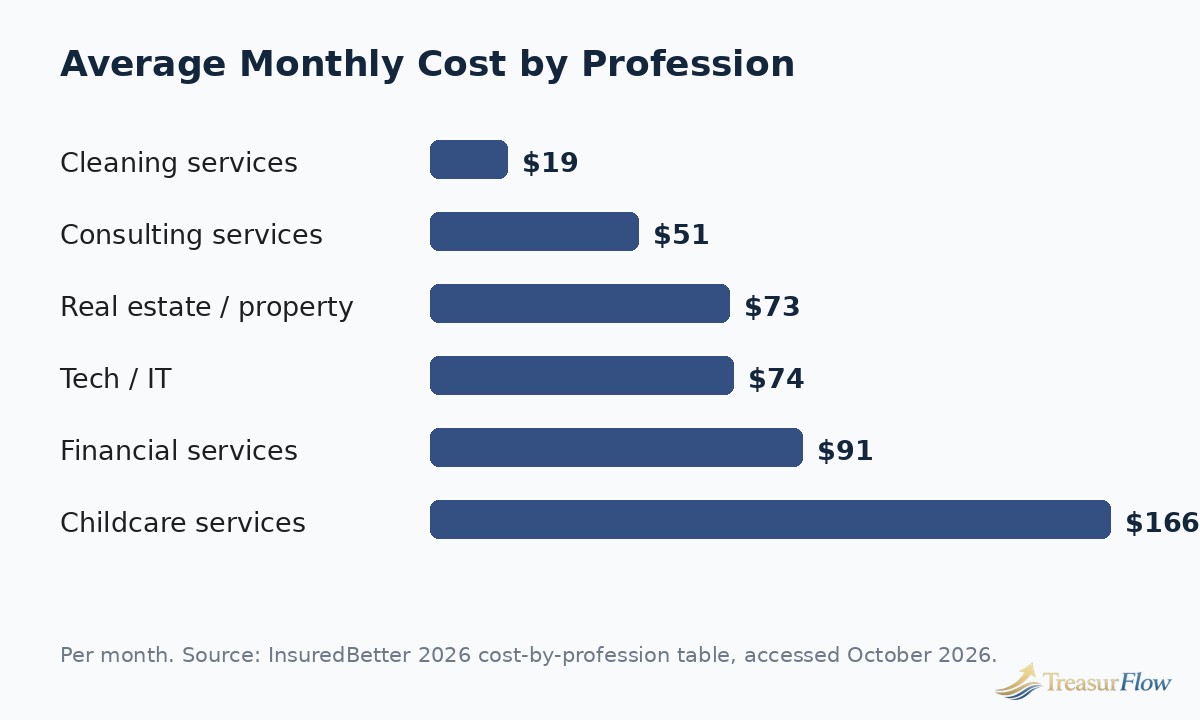
What is meaningful is cost by profession, because profession is the main driver. The table below lists average monthly premiums by profession from the 2026 cost-by-profession table published by InsuredBetter, which summarises market averages consistent with the profession pattern in MoneyGeek’s state-level guides. Use it to place your profession on the low-to-high spectrum and to budget a range, then get real quotes — do not use any single row as a quote.
| Profession | Average monthly premium | Average annual premium |
|---|---|---|
| Cleaning Services | $19 | $224 |
| Fitness Services | $30 | $365 |
| Beauty, Body and Wellness Services | $34 | $403 |
| Marketing and Communications | $39 | $468 |
| Arts, Media and Entertainment | $39 | $471 |
| Healthcare and Medical | $43 | $515 |
| Other Professional Services | $47 | $569 |
| Consulting Services | $51 | $610 |
| Real Estate and Property Services | $73 | $874 |
| Tech / IT | $74 | $888 |
| Construction and Contracting | $84 | $1,010 |
| Financial Services | $91 | $1,095 |
| Childcare Services | $166 | $1,988 |
Source: InsuredBetter 2026 cost-by-profession table for professional liability insurance, accessed October 2026. Averages for defined market profiles; your premium will differ by revenue, state, limits, deductible, claims history and retroactive date.
Carrier-level averages from MoneyGeek’s national analysis, as of October 2026, give a second lens: ERGO NEXT at $46 per month or $557 per year on average, 18% below its benchmarks; The Hartford described as most affordable on average overall, with 20% average savings and above 40% in technology, finance and consulting profiles where it is strongest; and Hiscox third most affordable, with over 10% average savings concentrated in its specialty areas. Use these to shortlist who to quote first for your profession — not as a ranking of what you will pay, because a carrier cheapest on average across eighteen industries may not be cheapest, or even eligible, for yours.
Six factors move your actual premium, and MoneyGeek’s cost guidance names most of them explicitly: profession and service risk (financial oversight, healthcare, legal advice and engineering design price higher than lower-risk advisory work); revenue and client base (more contracts mean more exposure); limits (higher per-claim and aggregate limits cost more); deductible (higher lowers premium); claims and operating history (a prior claim raises price, while a clean, established record helps); and retroactive scope and location (an earlier retro date can cost more, and state legal climate feeds the rate). If a quote surprises you, ask which factor is doing the work — the answer usually points to a lever you can discuss.
How to Choose Limits and Deductibles
For limits, the common starting point for a small firm is $1 million per claim. MoneyGeek’s baseline is $1 million per claim / $1 million aggregate for straightforward work, with higher limits for higher-risk fields such as healthcare and law and for enterprise clients. Its limits guidance refines the ladder: low exposure (marketing consultants, graphic designers, business coaches) — $500,000 per claim / $1 million aggregate may be sufficient; moderate exposure (accountants, HR consultants, software developers, real estate brokers) — $1 million per claim / $1 million to $2 million aggregate; higher exposure (architects, engineers, healthcare professionals, attorneys, financial advisors) — $1 million to $2 million per claim / $2 million to $5 million aggregate are common. MoneyGeek also notes ERGO NEXT offering up to $1 million per claim / $2 million aggregate and The Hartford up to $2 million per claim / $4 million aggregate online, with higher, tailored limits through agent channels. Confirm the options on your own quote, and weigh the aggregate as well as the per-claim figure if you run many engagements a year.
Two structural questions matter as much as the headline numbers. First, is the aggregate high enough for the number of engagements you run? A per-claim limit that survives one claim is of limited use if a modest aggregate is exhausted by two unrelated claims in one year. Second, are defense costs inside or outside the limit? A $1 million limit with defense outside it can be worth materially more in a contested case than a $1 million limit that defense erodes. Normalise for that term before deciding a cheaper quote is better value. Review limits at every material change: a larger client, a new service line, a new jurisdiction, or a contract whose liability cap exceeds your current limit.
For deductibles, verified guidance converges on a practical range. MoneyGeek’s limits guidance gives worked examples of a $2,500 deductible for a consulting business at $1 million / $2 million limits, and a $5,000 deductible for a technology business at $2 million / $4 million limits. Independent buying guidance summarised in our research describes deductibles commonly ranging from $1,000 to $10,000, with $2,500 a frequent choice, and notes that moving to $5,000 or $10,000 can trim premium by roughly 10% to 15% in the examples it discusses — illustrative guidance, not a guaranteed saving. Choose the highest deductible you could pay immediately, in cash, in the same month a claim lands — and no higher. Also confirm whether the deductible applies to defense costs, damages, or both, and whether first-dollar defense is offered on your form.
Review limits at every material change: a larger client, a new service line, a new jurisdiction, employed staff replacing subcontractors, or a contract whose liability cap exceeds your current limit. Professional liability should scale with the largest loss your current work could plausibly cause, not with the size your firm was when you first bought it.
Who Is Required to Carry Professional Liability Insurance?
There are two different kinds of requirement in this market, and confusing them leads firms to buy the wrong amount for the wrong reason. The first is a legal or licensing requirement imposed by a state or a regulator. The second — far more common — is a contractual requirement imposed by a client, a landlord, a platform, a franchisor or a lender. Both can end a working relationship if you ignore them. Only the first can cost you a licence.
Legal requirements are state-specific and profession-specific; there is no single federal mandate for most professions. MoneyGeek’s state guides illustrate the pattern: in Wyoming, physicians in certain practice settings are mandated and real estate agents and brokers must carry E&O to activate a licence, while attorneys must disclose whether they carry it; in Maryland, active real estate licensees must carry it through the Maryland Real Estate Commission and insurance producers must carry it as a condition of licensure; in Alaska, health care providers and real estate professionals must carry it, and attorneys must either hold it or disclose in writing that they do not. In short: real estate licensees are required in many states, healthcare providers in defined settings in many states, attorneys are more often subject to disclosure duties, and almost everyone else is governed primarily by contract. Verify your own position with your licensing board and state insurance department before relying on any general guide.
Contract requirements are where most professionals actually meet this insurance. Enterprise and government clients routinely require evidence of professional liability at specified limits before work begins, maintenance of cover for a period after the work ends — a clause that interacts directly with tail coverage — and certificates of insurance. MoneyGeek treats contract requirements as a standard reason a business needs this cover and instructs buyers to treat any contract minimum as a floor. Read the insurance clause in your largest client contract before you choose limits: if it requires $2 million per claim, a $1 million policy bought for price is not a saving, it is a breach waiting to be discovered. Even where nothing requires it, the voluntary case is strong — a single defended claim can cost more than many years of premiums at the attributed averages in this guide. Follow the SBA’s discipline: assess your risks, find a reputable licensed agent or direct carrier, shop around on comparable terms, and reassess every year.
How to Buy Without Opening a Gap: A Short Checklist
First, write down your exposure: services, clients, largest contract value, and the worst plausible loss if the work fails. Second, collect every requirement — client contract clauses, licensing rules and association rules that name a limit. Third, decide structure before you shop: per-claim and aggregate limits, a deductible you can fund, and, if you already carry cover, your current retroactive date, which must be preserved. Fourth, shortlist two or three carriers by buyer type and confirm each can meet your limits, retroactive terms and tail needs. Fifth, compare finalists on identical terms and ask explicitly about defense inside or outside the limits, consent to settle, cyber overlap and tail cost and duration. Sixth, before binding a switch, check the new declarations page for the retro date in writing and confirm there is no uncovered day between policies. Seventh, keep the habits that keep claims-made cover real: report claims and circumstances promptly in writing, keep engagement letters, renew without a lapse, and revisit limits at every material change.
E&O Questions Professionals Ask Before They Buy
What does professional liability insurance actually cover?
Professional liability insurance covers legal defense costs, settlements and judgments when a client claims your work, advice or service caused them financial harm. It typically responds to negligence, errors or omissions, misrepresentation, missed deadlines and failure to deliver promised services, up to your policy limits.
Is professional liability insurance the same as general liability insurance?
No. Professional liability covers financial harm from your professional services, while general liability covers third-party bodily injury, property damage and certain advertising injuries. Many service businesses need both because each policy responds to a different kind of claim.
How much professional liability insurance do I need?
Many small firms start with $1 million per claim as a common starting point, then raise limits for larger contracts, regulated work or higher-risk advice. Check client contracts and licensing rules first, because any required limit is your floor, not your final decision.
What is tail coverage and when do I need it?
Tail coverage is an extended reporting period that lets you report claims after a claims-made policy ends for work done while the policy was active. You typically need it when you retire, close, sell your firm or switch carriers without prior acts coverage from the new carrier.
Who is required to carry professional liability insurance?
Requirements vary by state and profession. MoneyGeek’s state guides note mandates for physicians in certain settings and for real estate licensees in many states, and disclosure duties for attorneys in some states, while most other professionals carry it because client contracts require it.
How much does professional liability insurance cost in 2026?
As of October 2026, MoneyGeek reports professional liability costs around $56 per month on average nationally, with state averages in its guides around $51 to $61 per month. Your actual price depends mainly on profession, revenue, limits, deductible, claims history and retroactive date.
Conclusion: Buy the Definition Before the Premium
The best professional liability insurance in 2026 is not the cheapest first-year quote or the largest number on a declarations page. It is the policy whose form matches your profession, whose retroactive date reaches back to the work you have already done, whose limits match the largest plausible loss from your current work and the highest limit any client contract demands, whose defense and consent terms you understood before a claim, and whose chain of coverage you will keep unbroken — through renewals, carrier switches and, when the time comes, retirement or sale, with tail or prior acts cover building the bridge at every transition.
Start with the anatomy, then choose by buyer type. Solo professionals and very small firms should quote ERGO NEXT first, with Hiscox alongside it for profession-specific small-firm packages. Established small businesses that want cover bundled and backed by a strong claims operation should centre the comparison on The Hartford. Technology, engineering and larger firms should run a broker-led process that includes CNA, firms whose professional and cyber risks arrive together should test Travelers, and larger or multinational practices should expect a customised, broker-placed solution of the kind Chubb is brought in to write. At every level, verify the issuing company’s rating and complaint record yourself, date-stamp every premium quoted, and never let a small one-year saving cost you years of prior acts protection.
Do that, and professional liability stops being a certificate you buy to satisfy a client and becomes what it is supposed to be: a durable promise that one allegation — fair or unfair, this year or five years from now, about work you did carefully and would defend proudly — will be defended and paid for by someone other than you alone.

Muhammad Zakir is the founder of Treasurflow and the author of its personal finance guides. He researches consumer banking, credit, and personal loans, and every guide cites primary sources such as the CFPB, FDIC, FTC, and IRS. His content is educational and is not personalized financial advice.
2 thoughts on “Best Professional Liability Insurance 2026: Compare E&O Coverage, Claims-Made Rules and Costs by Profession”