

A premium credit card is not really a rewards card. It is a prepaid bundle of travel credits, lounge visits, insurance and status that you buy once a year, whether you use it or not. In 2026 that bundle got pricier and more complicated at once: the American Express Platinum Card now carries an $895 annual fee and the Chase Sapphire Reserve a $795 annual fee, as of October 2026, while even mid-tier cards ask you to track credits resetting monthly, quarterly or half-yearly, each with its own portal, enrollment step and fine print. That is why this guide does not start with a ranking. It starts with arithmetic.
That is why this guide does not start with a ranking. It starts with arithmetic.
Most roundups of the best premium credit cards 2026 add up every advertised credit at full face value, declare $2,000 or $3,000 in value, and move on. Real life does not work that way. A $300 hotel credit usable only on a prepaid two-night luxury stay you would not otherwise book is not $300 in your pocket. A quarterly shopping credit that expires while you live your life is not its headline number. Judged by marketing totals, almost every premium card looks like a bargain. Judged by credits you will realistically redeem, at prices you would honestly pay anyway, the picture changes completely — and for many households the honest answer is that no premium card is worth it at all.
This guide is built around that honest test. You will get a five-minute break-even framework, a fully worked line-by-line example for the most expensive mainstream card in America, picks organized by traveler and spender type instead of hype, and the renewal math nobody does at sign-up: when to keep, downgrade, product-change or walk away before the second fee posts.
A note on accuracy before we begin. Every fee, credit, earn rate and welcome offer here is date-stamped as of October 2026 and was checked against issuer and major comparison sources published in 2026. Offers change frequently and are often personalized — American Express currently shows offers described as as high as a stated maximum, and yours may be lower or unavailable. Nothing here is a promise of approval, of a specific offer, or of a specific value. Confirm current terms on the issuer’s own application page before you apply, and never chase a welcome-offer spending requirement with money you would not otherwise spend.
One more warning belongs at the top, because it matters more than any lounge. Premium rewards only work if you pay in full, every month. The Federal Reserve’s G.19 release put the average APR on accounts assessed interest at 22.15% in the second quarter of 2026. At that rate, a $5,000 balance carried for a year generates roughly $1,108 in interest on a simple-interest illustration — enough to erase most welcome bonuses. If you regularly carry a balance, start with a payoff plan and our balance transfer guide below instead.
Related Guides
- Best Cash Back Credit Cards 2026 — the simple, no-annual-fee benchmark every premium card in this guide has to beat.
- Best Travel Rewards Credit Cards 2026 — the wider travel-card field, including mid-tier cards that deliver most of the value for a fraction of the fee.
- Best Balance Transfer Credit Cards 2026 — read this first if you carry a balance; it will save you more than any premium perk.
- Best Secured Credit Cards 2026 — the right starting point if you are building or rebuilding credit.
Helpful Official Resources
- Consumer Financial Protection Bureau (CFPB) — plain-language guides to credit card terms, your rights, and how to file a complaint about a card issuer.
- Federal Reserve — source of the G.19 consumer credit data and the average credit card APR figures cited in this guide.
- Federal Trade Commission (FTC) — guidance on credit reports, identity theft, and avoiding credit card scams and misleading offers.
Is a Premium Card Worth It? The Break-Even Framework First
Before you compare a single card, learn the test. Every premium decision reduces to three numbers, and if you cannot estimate all three for your household, you are not ready for a three-digit annual fee.
Step 1: Start with the true fee, not the advertised value
Your starting point is the full annual fee as of October 2026, plus any authorized-user fees you will actually pay. Those are no longer footnotes: the Sapphire Reserve charges $195 per authorized user, as of October 2026, and Capital One’s February 1, 2026 Venture X changes attach new costs to guest and authorized-user lounge access. Write down the all-in household fee first. That is the number every credit and reward must climb over.
Step 2: Count only credits you would redeem anyway, at honest values
This is where most reviews go wrong. Go through the credit list one by one and ask: would I buy this anyway, will the channel and window actually fit my life, and what would I honestly pay in cash? Add up your honest total — not the issuer’s headline total. That is what offsets the fee.
Score each credit simply. Count full value only if it replaces spending you already do, dollar for dollar — a broad travel credit burned on flights you already buy is the classic case. Count 50 to 75 percent if you will use it but the portal price, property list or timing costs you something. Count zero if using it requires changing your behavior, buying something new, or hitting a monthly or quarterly deadline you know you will miss. Spending $75 to rescue a $75 credit you would never have spent is not a saving; it is spending with extra steps.
Add up your honest total. That number — not the issuer’s headline total — is what offsets the fee.
Step 3: Add the rewards edge, and only the edge
Premium cards earn points, but so does the simple alternative you are comparing against. The question is never how much a premium card earns in total. The question is how much more it earns than the card you would use instead, on the same spending.
Run it like this. Take your realistic annual spending in the card’s bonus categories, multiply by the difference in earn rates versus your alternative, and value the extra points conservatively. If a card earns 4 points per dollar on dining where your no-fee card returns 2 cents per dollar, and you spend $8,000 a year on dining, the edge is about 2 extra points per dollar on $8,000 — 16,000 points, or roughly $240 at a cautious 1.5 cents each. Notice how much smaller that honest edge is than advertised total-rewards figures, which credit the premium card with every point and the alternative with nothing.
Step 4: Put it together — and demand a margin
The decision rule is simple:
Honest credits + rewards edge + perks you would genuinely pay for separately (such as lounge access or a trusted-traveler credit you were about to buy) − all-in annual fee = net annual value.
If that number is comfortably positive in year two — not just the welcome-bonus year — the card can be worth keeping. If it is positive only because of the bonus, you are looking at a one-year card, and you should plan the exit before you apply. If it is near zero, choose the simpler card: a near-zero premium card costs attention and reminders every month, while a near-zero simple card costs nothing. If it is negative, no lounge photograph or metal-card feel changes the math. Skip it.
The worked example: an $895 card, honestly scored
Let us run the framework on The Platinum Card from American Express, the most expensive mainstream premium card in the United States as of October 2026. Its annual fee is $895, as of October 2026, up from $695 after the increase for new applicants in September 2025, with existing cardholders moving to the new fee at renewals on or after January 2, 2026. Its welcome offer is described by current sources as high as 175,000 Membership Rewards points after $12,000 in purchases in the first six months, with offers varying, as of October 2026. Its earning is deliberately narrow — 5 points per dollar on flights booked directly with airlines or through Amex Travel on up to $500,000 per year, 5 points on prepaid Amex Travel hotels, and 1 point on everything else, as of October 2026. This is a perks card, not an everyday-earning card.
Now the credits. Six major credits dominate the card’s marketing, as of October 2026: a $600 prepaid hotel credit for Fine Hotels + Resorts or The Hotel Collection, split at up to $300 per half year; a $200 airline fee credit with one selected airline; $200 in Uber Cash ($15 monthly plus $20 in December); a $300 digital entertainment credit ($25 monthly across eligible services); a $400 Resy credit ($100 per quarter); and a $300 lululemon credit ($75 per quarter). At face value those six total exactly $2,000. The card carries further benefits — lounge access, hotel status, a CLEAR Plus credit and a Walmart+ benefit among them — which is how issuer marketing reaches far above $2,000. This example scores only the six major credits, keeping the illustration conservative and checkable.
Meet our illustrative cardholder: a frequent-but-not-obsessive traveler who flies about six times a year, already uses rideshare and streaming, eats at Resy restaurants, and does not buy athletic apparel quarterly. This is an illustrative example, not a prediction of your results. Here is the honest scoring, computed line by line:
- Hotel credit: $600 face value, scored at 75 percent because Fine Hotels + Resorts and Hotel Collection rates are not always the cheapest way to book the same room. Realistic value: $450.
- Airline fee credit: $200 face value, scored at 75 percent because it covers incidental fees with one selected airline, not airfare itself. Realistic value: $150.
- Uber Cash: $200 face value, scored at 90 percent because the traveler already uses the service monthly but will occasionally let a month slip. Realistic value: $180.
- Digital entertainment credit: $300 face value, scored at 80 percent because the traveler already pays for some, but not all, of the eligible services. Realistic value: $240.
- Resy credit: $400 face value, scored at 75 percent because quarterly deadlines and the participating-restaurant list will cost some value. Realistic value: $300.
- Lululemon credit: $300 face value, scored at 40 percent because this traveler buys from the brand occasionally, not quarterly, and part of the credit will expire or force low-value purchases. Realistic value: $120.
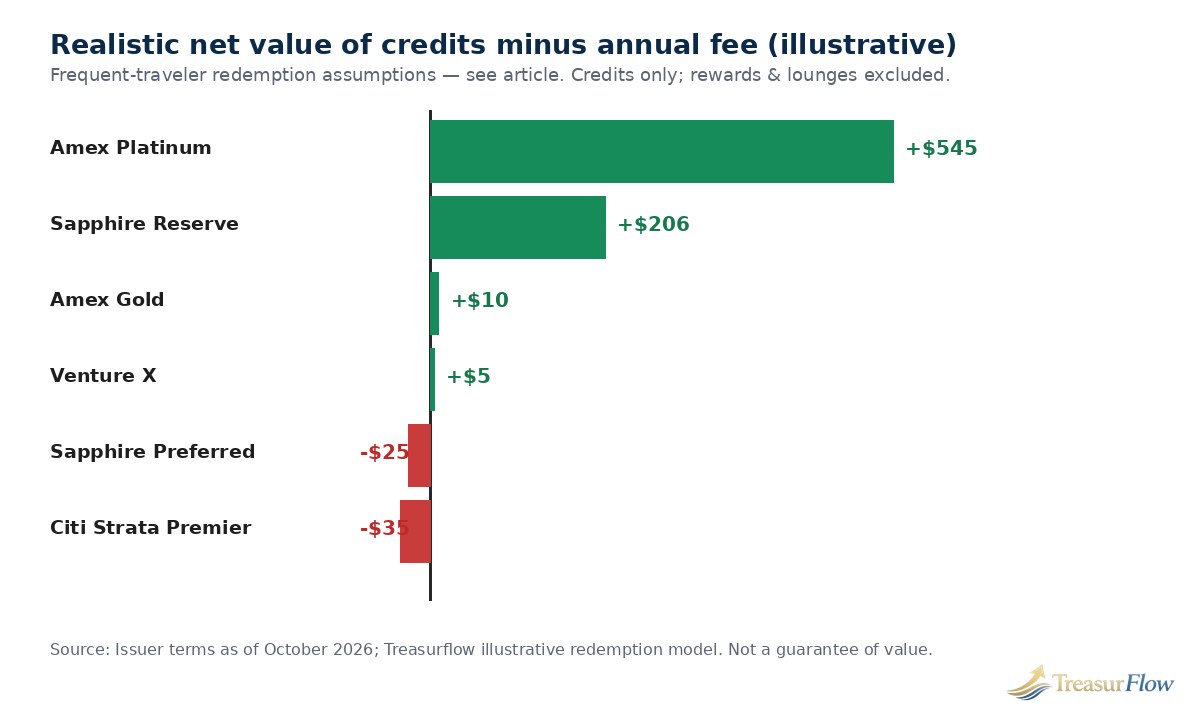
Add those honest values together: $450 plus $150 plus $180 plus $240 plus $300 plus $120 equals $1,440 in realistically redeemed credits. Subtract the $895 annual fee and this traveler is $545 ahead on credits alone, before counting a single point, lounge visit or status benefit. For this specific traveler, the Platinum Card passes the break-even test with room to spare — which is exactly why it remains, for the right person, one of the best premium credit cards 2026 has to offer.
Now change one thing: the traveler. Take a light traveler who flies twice a year, never books luxury prepaid hotels, streams a little, and never shops at lululemon. Score the same six credits honestly for that person: hotel credit $0, airline fee credit $100 at 50 percent, Uber Cash $120 at 60 percent, digital entertainment $150 at 50 percent, Resy $100 at 25 percent, lululemon $0. The realistic total is $470. Subtract the same $895 fee and the result is negative $425 — before the card earns a single useful point, because this traveler also earns at the card’s weak 1-point-per-dollar rate on most everyday spending. Same card, same fee, same advertised $2,000 in credits. One household is $545 ahead; the other is $425 behind. The card did not change. The fit did.
That $970 swing is the most important fact in this guide. Premium cards are not good or bad in the abstract; they are good or bad for a specific pattern of spending, traveling and remembering deadlines. Find out which side of the swing you live on before the fee posts, not after.
Statement Credits Are Not Cash: An Anatomy of the Coupon Book
Premium cards in 2026 are coupon books with a credit line attached. Issuers love statement credits because a credit costs them far less than face value: some cardholders never enroll, some forget a month or quarter, some cannot find an eligible purchase, and some overspend to use one. Every outcome is profit for the issuer and a quiet loss for the cardholder who counted the credit at full value. The five ways credits shrink, below, are how you stop subsidizing that system.
First, credits expire in slices. Monthly credits — Uber Cash, entertainment credits, dining credits delivered $10 at a time — do not roll over. Miss March and March is gone. Quarterly and half-year credits are only slightly kinder. A card advertising $2,000 in annual credits is really twelve, four or two separate mini-deadlines, and your realistic redemption rate is simply the share you will hit while living a normal life. That is what the discount percentages in the framework were measuring.
Second, credits restrict where you can buy. The Sapphire Reserve’s $500 credit applies only to prepaid The Edit bookings, capped at $250 per booking with a two-night minimum; its $300 dining credit applies only at Sapphire Exclusive Tables restaurants and its $300 entertainment credit only through StubHub and viagogo in half-year windows, all as of October 2026. Always compare the required channel’s price with booking freely: a $250 credit on a room that costs $90 more through the portal is a $160 credit in a $250 costume.
Fourth, credits can cannibalize better rewards. Prepaid portal hotel bookings that earn a credit frequently earn no hotel loyalty points, elite-night credit or member rates, and portal flights can be harder to change than direct bookings. Ask what you give up to earn the credit, not just what it gives you.
None of this means credits are worthless. Broad, automatic credits are genuinely valuable: the Reserve’s $300 travel credit is the easiest premium credit to redeem at full value, and the Venture X’s $300 Capital One Travel credit plus 10,000 anniversary miles cover its $395 fee in a way almost any traveler can achieve. Value each credit by its friction, not its face. Automatic and broad beats large and fiddly, almost every time.
The Contenders at a Glance, as of October 2026
With the framework in hand, here is the field. All figures are as of October 2026. Welcome offers vary, change often, and — for American Express — are personalized, so treat each as the current public or as-high-as figure from 2026 sources, not a promise.
| Card | Annual fee | Welcome offer (as of Oct 2026) | Headline earning | Best for |
|---|---|---|---|---|
| The Platinum Card from American Express | $895 | As high as 175,000 points after $12,000 in 6 months | 5x flights direct or via Amex Travel; 5x prepaid Amex Travel hotels; 1x else | Lounge-first frequent flyers |
| Chase Sapphire Reserve | $795 | 100,000 points after $6,000 in 3 months | 8x Chase Travel; 4x flights and hotels direct; 3x dining; 1x else | Flexible travelers who value Hyatt transfers |
| Capital One Venture X Rewards | $395 | 75,000 miles after $4,000 in 3 months | 2x everywhere; 5x flights and 10x hotels and cars via Capital One Travel | Simple premium value |
| American Express Gold Card | $325 | As high as 100,000 points after $8,000 in 6 months | 4x restaurants worldwide; 4x U.S. supermarkets; 3x flights; 1x else | Dining and grocery spenders |
| Citi Strata Elite | $595 | 75,000 points after $6,000 in 3 months | Elevated Citi Travel rates; 1.5x on other purchases | Citi loyalists — verify current terms carefully |
| Chase Sapphire Preferred | $95 | 75,000 points after $5,000 in 3 months | 5x Chase Travel; 3x dining and several 3x categories; 2x other travel; 1x else | The $95 sweet spot |
| Citi Strata Premier | $95 | 60,000 points after $4,000 in 3 months | 10x Citi Travel hotels, cars and attractions; 3x air, hotels, dining, supermarkets and gas; 1x else | Broad 3x earning at a low fee |
| Wells Fargo Autograph Journey | $95 | 60,000 points after $4,000 in 3 months | 5x hotels; 4x airlines; 3x other travel and restaurants; 1x else | Direct-booking travelers at a low fee |
Two deliberate omissions deserve explanation. The U.S. Bank Altitude Reserve is not recommended to new applicants because it is closed to new applicants — unavailable since late 2024. Existing holders pay a $400 annual fee, as of October 2026, and saw its travel redemption value fall from 1.5 cents per point to 1 cent per point in December 2025, even as U.S. Bank added a small set of transfer partners for existing holders in August 2026. If you hold it, the renewal analysis below applies to you; if you do not, you cannot act on a recommendation. Similarly, older sources still quote the Platinum at $695 and the Reserve at $550. Those are the old fees. As of October 2026 the current fees are $895 and $795.
Picks by Traveler and Spender Type
There is no single winner here. There are six distinct jobs a premium card can do, and one clear pick — plus an honest alternative — for each.
Best for lounge-first frequent flyers: The Platinum Card from American Express
If you fly often through airports with Centurion Lounges and value a genuinely good lounge over simple earning, the Platinum Card remains the lounge card to beat in 2026. Its Global Lounge Collection spans Centurion Lounges, Delta Sky Club access when flying Delta, Priority Pass, Plaza Premium and Escape lounges, as of October 2026 — the broadest lounge proposition of any mainstream card — alongside hotel elite status benefits and the industry’s largest credit stack, scored honestly above. The realistic alternative on a budget is the Venture X below: fewer, less glamorous lounges, a much smaller fee, and far less homework.
The case against it is just as clear. At $895, as of October 2026, it is the most expensive card here. Its everyday earning is weak — 1 point per dollar outside flights and prepaid Amex Travel hotels — so it should never be your grocery, dining or general-spending card. Its credits demand the most management of any card in this guide, across monthly, quarterly and half-year deadlines in at least six programs, and its guest and authorized-user economics need checking in current terms. Choose it only if the worked-example math with your own rates clears the fee with margin. If your honest total looks like the light-traveler $470, walk away.
The realistic alternative for lounge lovers on a budget is the Venture X below: fewer and less glamorous lounges, a much smaller fee, and far less homework.
Best for flexible travelers who love transfer partners: Chase Sapphire Reserve
The Sapphire Reserve is the premium card for travelers who want strong earning and the most valuable transfer safety net in the business: Ultimate Rewards points that transfer to a range of airline and hotel partners, including World of Hyatt at 1:1 on this card, as of October 2026. That Hyatt access matters more than any single credit, because well-chosen Hyatt redemptions routinely deliver value that portal bookings cannot match.
Its economics start from a $795 annual fee, as of October 2026, with a welcome offer of 100,000 points after $6,000 in purchases in the first three months, as of October 2026. Its earning is the strongest all-round package among the ultra-premium cards: 8 points per dollar on Chase Travel, 4 points on flights and hotels booked direct, 3 points on dining, and 1 point elsewhere, as of October 2026. Its $300 annual travel credit is the easiest big credit in the industry, applying broadly and automatically. The rest demands work: up to $500 per year for The Edit prepaid bookings at up to $250 per booking with a two-night minimum, up to $300 in Sapphire Exclusive Tables dining credits and up to $300 in StubHub and viagogo credits, each split into two half-year windows, all as of October 2026 — plus monthly DoorDash, Lyft and similar benefits with their own activation rules and end dates to verify.
In our chart scoring, the Reserve’s four headline credits — the $300 travel credit at full value, The Edit at 70 percent, dining at about two-thirds, entertainment at half — total roughly $1,001 against the $795 fee, a net of about positive $206 before rewards and lounges: a pass, but thinner than the Platinum’s for a heavy lounge user, while beating it for most other travelers thanks to travel-and-dining credits people actually use and Hyatt transfers. Add the $195 authorized-user fee, as of October 2026, if your partner needs a card, and re-run the math.
Best simple premium value: Capital One Venture X Rewards
The Venture X answers a specific complaint: I want lounge access, primary rental coverage and a premium travel card without becoming a part-time benefits administrator. Its annual fee is $395, as of October 2026 — less than half the Platinum’s — and its break-even is the cleanest in the tier. A $300 annual Capital One Travel credit plus 10,000 anniversary miles worth $100 toward travel at baseline value totals $400 against the $395 fee, as of October 2026. In our chart scoring, that is a net of about positive $5 before rewards, lounges and protections — achieved with almost no effort, which is precisely the point.
Its earning is equally simple: 2 miles per dollar on every purchase, 5 miles on flights and 10 miles on hotels and rental cars booked through Capital One Travel, as of October 2026. Its welcome offer is 75,000 miles after $4,000 in purchases in the first three months, equal to $750 in travel at baseline value, as of October 2026, with access to Capital One Lounges and Landings plus Priority Pass and partner lounges, as of October 2026.
The 2026 caveats are real. Effective February 1, 2026, Capital One tightened Venture X lounge economics: complimentary guest access is now tied to high annual spending, guests otherwise incur a per-visit fee, and authorized-user lounge access carries an annual fee, as of October 2026. Solo travelers barely notice; couples and families who built a lounge strategy on free guests must re-run the math. The card also lacks a Hyatt-style transfer partner, and its $300 credit requires booking through Capital One Travel — broad by portal standards, but still a portal. For a mostly-solo traveler who books one portal trip a year, it remains the easiest premium fee in America to justify.
Best for dining and grocery spenders: American Express Gold Card
The Amex Gold is not really a travel card wearing a lower fee. It is a food card, and for food-heavy households it can out-earn cards costing twice as much. Its annual fee is $325, as of October 2026. It earns 4 Membership Rewards points per dollar at restaurants worldwide on up to $50,000 per year and at U.S. supermarkets on up to $25,000 per year, plus 3 points on flights, with 1 point elsewhere, as of October 2026. Run the edge math on a household spending $12,000 a year on dining and U.S. supermarkets: 48,000 points, worth about $864 at a cautious 1.8 cents each via transfers, versus about $240 from a flat 2 percent cash-back card — an edge of roughly $624 that clears the $325 fee on earning alone. Spend half that on food and the edge roughly halves, which is why your own grocery and restaurant totals decide this card.
Its credits total $424 at face value, as of October 2026: $120 in Uber Cash at $10 per month, a $120 dining credit at $10 per month at eligible partners with enrollment, a $100 Resy credit at $50 twice a year, and an $84 Dunkin’ credit at $7 per month with enrollment. We scored a realistic $335 of that — $110 of Uber Cash, $90 of dining, $75 of Resy and $60 of Dunkin’ — for a net of about positive $10 against the $325 fee before earning. That is the honest Gold story: credits roughly wash out the fee if you are diligent, and the 4x food earning does the real work. It offers no lounge access. Its welcome offer is described as high as 100,000 points after $8,000 in purchases in the first six months, with offers varying, as of October 2026.
Best premium-lite value at $95: Chase Sapphire Preferred
Every premium guide needs a pressure-release valve, and in 2026 it is the Sapphire Preferred. At a $95 annual fee, as of October 2026, it delivers the feature most travelers actually use from the Sapphire family — transferable Ultimate Rewards points — without the coupon book. Following its June 2026 refresh, it earns 5 points per dollar on Chase Travel, 3 points on dining, online groceries, streaming, gas and EV charging and vacation rentals, 2 points on other travel, and 1 point elsewhere, as of October 2026. Its welcome offer is 75,000 points after $5,000 in purchases in the first three months, as of October 2026 — the same headline bonus size as the Venture X, at a quarter of the fee. It also carries an annual hotel credit of up to $100 for qualifying Chase Travel bookings and a trusted-traveler credit of up to $120 every four years, as of October 2026.
Two fine-print points from the 2026 refresh deserve plain English. First, for new applicants the World of Hyatt transfer ratio on the Preferred changed to 4 Chase points for 3 Hyatt points effective June 15, 2026, while the Reserve retains 1:1 — Hyatt maximalists should price that difference rather than assume the two Sapphire cards transfer identically. Second, sources describe the long-standing 10 percent anniversary bonus as removed for new applicants under the refresh. Neither change makes the Preferred a bad card; both make it a different card from the one older reviews describe. In our chart we scored $70 of realistic value for its hotel credit against the $95 fee, a net of about negative $25 before rewards — and the card still earns its place, because at $95 the rewards edge needs to find only $25 to break even.
Best broad earning at $95: Citi Strata Premier and Wells Fargo Autograph Journey
Two $95 cards challenge the Preferred for travelers whose spending does not fit Chase’s categories, and both deserve a place in any serious list of the best premium credit cards 2026 shoppers should compare before paying ultra-premium fees.
The Citi Strata Premier, at a $95 annual fee, as of October 2026, earns 3 points per dollar across an unusually broad set of categories — air travel and other hotel purchases, restaurants, supermarkets, and gas and EV charging — plus 10 points per dollar on hotels, car rentals and attractions booked through Citi Travel, and 1 point elsewhere, as of October 2026. Its welcome offer is 60,000 ThankYou points after $4,000 in purchases in the first three months, as of October 2026. One comparison source we reviewed showed a higher 70,000-point figure; the majority of current issuer-aligned sources show 60,000, so this guide uses 60,000 and flags the conflict. The card also offers a $100 annual hotel benefit on a qualifying stay of $500 or more through Citi Travel, as of October 2026, which we scored at a realistic $60 — a net of about negative $35 before rewards, comfortably recoverable from its broad 3x earning for the right spender. Choose it if your spending is heavy on supermarkets, gas and direct travel at once.
The Wells Fargo Autograph Journey, also at a $95 annual fee, as of October 2026, takes the opposite approach: narrow, travel-first earning with no portal required for its best rates — 5 points per dollar on hotels, 4 on airlines, and 3 on other travel and restaurants, with 1 point elsewhere, as of October 2026. Its welcome offer is 60,000 points after $4,000 in purchases in the first three months, as of October 2026, and it includes a simple $50 annual statement credit triggered by a minimum airline purchase, as of October 2026. Choose it if you book flights and hotels directly and want your premium experiment to cost $95.
Note: the Citi Strata Elite ($595 annual fee; 75,000 points after $6,000 in 3 months, as of October 2026) appears in the table above for Citi loyalists — verify its current credits directly with Citi, as 2026 sources were still settling on its terms during our research.
Keep, Downgrade or Product-Change? The Renewal Math Nobody Does at Sign-Up
The most expensive premium-card mistake is not applying for the wrong card. It is renewing the right card by accident, year after year, after the travel pattern that justified it has changed. Jobs change, kids arrive, a home airport loses its best lounge. The fee, meanwhile, renews with perfect reliability. Set the renewal decision now: thirty days before each fee posts, re-run the framework with the last twelve months of actual statements, not the life you imagined when you applied.
Keeping the card is correct when three conditions hold at once. Your honestly scored credits from the past year — check statements, do not estimate — plus your rewards edge still clear the all-in household fee, including authorized-user costs. You still use the signature perk regularly, whether lounge access, a transfer partner like Hyatt, or rental coverage you would otherwise buy. And no cheaper card in the same family now fits your changed spending better. If all three hold, keep it without guilt until next year.
Downgrading — a product change to a no-fee or lower-fee card from the same issuer — is usually the smart middle path. It typically avoids a new application and hard inquiry, often preserves the account’s age on your credit reports, and keeps the issuer relationship intact. Ask three questions before you agree. Will your points survive, and will they still transfer to airline and hotel partners afterward? Will holding the downgrade card block you from earning its welcome bonus later, as issuer rules often provide? And does the change alter your credit limit or kill linked benefits mid-cycle? Get the answers in the app or in writing where possible, before the change processes.
The downgrade math is simple. Suppose your Sapphire Reserve renewal approaches at $795, as of October 2026, and an honest look-back shows you redeemed the $300 travel credit in full, $200 of The Edit credit and almost nothing else, with a rewards edge of about $180 over the Preferred. Your keep value is roughly $680 against a $795 fee — a loss of about $115 a year. Product-changing to a no-fee family card stops the loss; moving to the $95 Preferred preserves transferable-points earning at a fee your spending can plausibly clear. Run the same look-back on a Platinum Card: if your scored credits have slid from $1,440 toward $470, paying $895 for $470 of value plus weak 1-point everyday earning needs no further debate.
Cancelling outright still has its place: when you are simplifying, when the issuer offers no worthwhile no-fee landing spot, or when a fee is about to post on a card you have replaced. Before you cancel, spend or transfer the points, note any credits that die with the account, and expect a possible temporary score dip if the closure reduces your total available credit — the CFPB advises understanding your credit reports before making account changes. If debt is your current reality, skip this optimization entirely and start with our guide to the best balance transfer credit cards 2026. If you are building credit, begin with a secured card from the Related Guides box above and graduate to rewards later.
Who Should Skip Premium Cards Entirely
Skip this entire category, without a second thought, if any of the following describe you. You will save money, time and stress by choosing a simple card well.
You carry a balance, or might. At the Federal Reserve’s reported average of 22.15% APR on accounts assessed interest in Q2 2026, interest devours rewards: an $8,000 balance at that rate faces roughly $1,772 in interest over a year on a simple-interest illustration — more than the realistic annual value of any card here. Pay the balance down first; revisit premium cards from strength.
You travel rarely, or travel cheaply and happily. Two trips a year, budget hotels, carry-on only, no lounge habit: your honest totals will look like the light-traveler column, and they will lose. A strong no-fee cash back card returns real money on every purchase with zero deadlines.
You hate homework. Premium value in 2026 lives in enrollment screens, quarterly windows and portal comparisons. If tracking them feels like a chore you will abandon by March — most people do — the advertised value was never yours. Buy simplicity instead.
Your spending is modest or concentrated in everyday basics. If total card spending is under about $15,000 a year and mostly groceries, fuel and bills, the rewards edge over a good flat-rate card is small and the fee is not. Even the Amex Gold’s food math needs substantial dining and supermarket spending to clear $325.
Your credit is still building. Premium cards are generally aimed at good-to-excellent credit profiles, and a rejection costs you a hard inquiry for nothing. Build with secured and starter cards first, and let premium applications wait until approval is likely rather than hopeful.
You are inside a major application window. If a mortgage or auto loan application is coming in the next few months, protect it. New accounts and inquiries can complicate underwriting, and no welcome bonus outranks a home purchase. The cards will still be there afterward.
How to Apply Without Hurting Yourself
If the framework says yes, apply carefully. Confirm the fee, offer, spending requirement and credit terms on the issuer’s own page on the day you apply — every figure here is a snapshot as of October 2026. Never manufacture spending to meet a welcome requirement; buying things you do not need can convert a good bonus into a bad purchase. Track the requirement against spending you already planned.
Mind the issuer rules. Chase applications are shaped by the widely reported 5/24 guideline, under which applicants with many recently opened personal cards are commonly declined. American Express generally limits welcome bonuses to once per lifetime per card and may show a pop-up ineligibility warning before you commit. Citi’s bonus eligibility language has tightened around prior and current holdings in the same card family. None of these is a reason to open cards you do not want; all are reasons to sequence the cards you do want thoughtfully.
Finally, protect yourself as a consumer. Review your free credit reports regularly, dispute errors, and keep records of the offer you accepted. The FTC publishes guidance on credit reports, fraud and identity theft, and the CFPB accepts complaints about issuers — both are linked in the Helpful Official Resources box above. If a third-party site promises dramatically more than the issuer’s own page, trust the issuer’s page.
Premium Card Questions Big Spenders Ask Before Paying the Fee
Is a premium credit card worth it if I only travel twice a year?
Usually not at the $795 to $895 fee level. With only two trips, you will rarely redeem enough hotel, lounge and portal credits to clear the fee, as the light-traveler example in this guide shows a realistic shortfall of $425 on an $895 card. A $95 card such as the Sapphire Preferred, or a no-fee cash back card, will fit most twice-a-year travelers better. Run the break-even framework with your own redemption rates before you apply.
What credit score do I need for the best premium credit cards in 2026?
There is no published cutoff and no score guarantees approval. Premium travel cards are generally marketed to applicants with good to excellent credit, and issuers also weigh income, existing debts, recent applications and their own internal rules, such as the Chase 5/24 guideline and the American Express once-per-lifetime bonus rule. Check the issuer terms, consider a pre-approval or pre-qualification tool where one is offered, and avoid applying if a rejection and a hard inquiry would hurt a more important application, such as a mortgage.
Do premium card statement credits count the same as cash?
No. A statement credit is worth its face value only if it pays for a purchase you would have made anyway, through the required channel, at a competitive price, before it expires. Monthly, quarterly and portal-restricted credits are routinely worth 40 to 80 percent of face value in realistic use, and a credit that pushes you to buy something new is worth zero. Score every credit honestly before you count it against the annual fee.
Can I downgrade a premium card instead of cancelling it?
Often, yes. Many issuers let you product-change to a no-fee or lower-fee card in the same family, which can preserve your account age and, depending on the issuer and the pair of cards, your points. Rules differ sharply: points can expire or lose transfer access if you close the last card that holds them, and a downgrade usually makes you ineligible for a welcome bonus on the card you move to. Call the issuer, ask what happens to your points, credit line and account history, and move or transfer your points before you close anything.
What happens to my points if I close or product-change a premium card?
It depends on the program. Points held in an issuer program generally survive a product change within the same points family but are lost if you close your last account holding them without another eligible account, while cash back, miles already transferred to an airline or hotel program, and points pooled on another card follow their own rules. Never close a premium card with a large points balance until the issuer confirms, in the app or in writing, where those points will live after the change.
Is the welcome bonus alone enough to justify a high annual fee in year one?
It can make year one profitable, but it does not justify keeping the card. A large welcome bonus is a one-time benefit earned by meeting a spending requirement with money you would spend anyway, while the annual fee recurs every year. Judge year one with the bonus and renewal years without it. If the card only wins with the bonus, set a reminder to downgrade or close it before the second annual fee posts, and make sure closing it will not strand your points.
Conclusion: Pay for the Life You Actually Live
The best premium credit cards 2026 offers are genuinely impressive — and genuinely easy to lose money on. The Platinum Card rewards the lounge-first frequent flyer who honestly redeems $1,440 of its credits and laughs at its $895 fee. The Sapphire Reserve rewards the flexible traveler who transfers to Hyatt, books The Edit stays and dines through its programs. The Venture X rewards the traveler who wants premium basics for $395 and almost no homework. The Amex Gold rewards the household whose budget runs through restaurants and supermarkets. And the $95 trio — Sapphire Preferred, Citi Strata Premier and Wells Fargo Autograph Journey — rewards everyone else who wants transferable points without betting hundreds of dollars a year on their own future diligence.
Your decision needs only five honest minutes and four honest numbers: the all-in fee, your realistically redeemed credits, your rewards edge over a simple card, and the perks you would truly pay for separately. If the sum clears the fee in year two, apply with confidence and confirm the current terms. If it does not, close this tab with equal confidence. The most valuable premium-card skill in 2026 is not maximizing. It is declining — politely, arithmetically, and before the fee posts.
Editorial note: This article is educational content, not personalized financial advice. All fees, credits, earn rates and offers are as of October 2026 and are subject to change by the issuers. Verify current terms with the issuer before applying.

Muhammad Zakir is the founder of Treasurflow and the author of its personal finance guides. He researches consumer banking, credit, and personal loans, and every guide cites primary sources such as the CFPB, FDIC, FTC, and IRS. His content is educational and is not personalized financial advice.