
Most lists of the best REITs start with a yield table and end with a ticker. This guide starts somewhere else: with the building. A real estate investment trust is not a generic income product. It is a warehouse that a delivery network cannot move out of, a data center that a cloud company needs power and cooling from every hour of the day, a cell tower with two or three carriers paying rent on the same steel, an apartment block in a city where building new homes is slow and expensive, or a shopping center anchored by a grocery store people visit every week. The rent behind your dividend comes from a specific kind of property, in a specific place, leased to a specific kind of tenant. If you understand that property first, the ticker makes sense. If you start with the yield alone, you can buy a struggling business that happens to pay a large dividend the quarter before it cuts it.
best reits 2026: That sector-first approach matters even more in 2026. According to Morningstar, in the year to date covered by its October 2026 REIT review, the Morningstar US Real Estate Index rose 5.33%, while the Morningstar US Total Market Index gained 14.91%. That gap is not a verdict on REITs and it is not a promise about what happens next. It is a reminder that listed real estate is interest-rate sensitive, that it can lag a broad stock market led by other sectors for long stretches, and that an investor who buys REITs needs a reason beyond “the price went up last year.” The honest reasons are income that is backed by rent, diversification into property types you could never buy on your own, and — for the right sectors — leases that rise over time. In this guide we name those reasons plainly, we show you how to test whether a dividend is covered by real cash flow, we map the eight property sectors that drive almost everything a REIT does, and we organize individual picks by the job you want them to do: an income anchor, a growth holding, or a diversified one-ticker solution you do not have to manage name by name.
A note on method before any names. Every company discussed in this article was checked against a verifiable source, and the starting universe includes the 12 names on Morningstar’s analyst-undervalued list as of October 9, 2026: BXP, Invitation Homes, Healthpeak Properties (ticker DOC following its merger with Physicians Realty Trust), Kilroy Realty, Crown Castle, SBA Communications, Federal Realty Investment Trust, Realty Income, Park Hotels & Resorts, Kimco Realty, Equity Lifestyle Properties, and Regency Centers. Inclusion on that list means Morningstar’s analysts judged those stocks undervalued against their fair-value estimates on that date. It does not mean any of them is right for you, and this article does not repeat that list as a buy list. Instead, we use it as a checked starting point, add established sector leaders such as Prologis, Equinix, American Tower, Public Storage, and VICI Properties where they illustrate a sector or an investor goal clearly, and we explain — in each case — what would have to go wrong. Dividend yields and prices change every trading day, so where this article gives a yield it gives it as an attributed, date-stamped snapshot, in the form “as of October 2026, per [source],” and you should check a current quote before you act. Past performance is never presented here as a reason to buy anything, because it is not one.
If you are completely new to owning property through the stock market, you may also want to read our guide to how to invest in real estate without buying property, which covers crowdfunding, rental property, and REITs side by side. If you already own index funds and a savings account and you are asking a narrower question — “which REITs, if any, belong next to what I already own, and how do I avoid the obvious traps?” — this article is written for you.
What a REIT Is, and Why the 90% Rule Shapes Everything
A REIT, or real estate investment trust, is a company that owns, operates, or finances income-producing real estate. Investor.gov, the U.S. Securities and Exchange Commission’s investor education site, describes REITs as a way for individuals to invest in large-scale, income-producing real estate and to earn a share of the income produced through commercial real estate ownership without having to go out and buy commercial real estate themselves. The properties involved are familiar once you look for them: office buildings, shopping malls and shopping centers, apartments and single-family rental homes, hotels, self-storage facilities, warehouses and logistics buildings, medical offices and hospitals, data centers, and the towers and fiber networks that carry mobile data. Nareit, the trade association for the REIT industry, makes the same point in sector terms: REITs invest in the majority of real estate property types, and most REITs focus on a particular property type rather than owning a little of everything.
There are three broad families, and the distinction matters for risk. Equity REITs own physical property and collect rent. Most publicly traded REITs, and every individual name featured in this guide, are equity REITs. Mortgage REITs, often shortened to mREITs, do not mainly own buildings; they own mortgages and mortgage-backed securities and earn the spread between the interest they receive and the interest they pay to borrow. That makes them closer to a leveraged bond portfolio than to a landlord, with a different and usually sharper sensitivity to interest rates and credit markets. Hybrid REITs mix the two. Mortgage and hybrid REITs are outside the scope of this guide’s picks, not because they are always bad investments, but because the landlord checklist that follows — occupancy, lease length, funds from operations, tenant quality — does not analyze them properly, and a beginner who applies equity-REIT logic to a mortgage REIT will misjudge the risk badly.
Now the rule that defines the whole asset class. To qualify as a REIT, a company must have the bulk of its assets and income connected to real estate investment, and it must distribute at least 90% of its taxable income to shareholders annually in the form of dividends. The SEC states that test in its Investor Bulletin on REITs, and the Internal Revenue Code provisions behind it are the reason REIT tax forms look the way they do. In exchange for meeting the tests, a qualifying REIT is allowed to deduct the dividends it pays from its corporate taxable income, so — as the SEC bulletin puts it — most REITs pay out at least 100% of their taxable income and therefore owe no corporate tax on that distributed income. Read that bargain carefully, because it explains both the attraction and the structural weakness of every REIT you will ever look at.
The attraction is obvious: rent that would otherwise be taxed at the company level and again when paid to you is, in a REIT, largely taxed once — to you. That is why REIT dividend yields are usually higher than the yields on ordinary dividend stocks. The weakness is just as structural. A company that must pay out at least 90% of its taxable income cannot retain much cash to grow. When a normal company wants to build a new factory, it can fund part of the cost from profits it kept. When a REIT wants to buy a new warehouse, data center, or shopping center, it must usually raise the money from outside: by issuing new shares, by borrowing, or by selling older properties. That dependence on capital markets is the single most under-appreciated fact in REIT investing. In calm markets with low interest rates, outside money is cheap and growth is easy. When rates rise and share prices fall, the same REIT may be issuing shares at a depressed price or borrowing at a much higher cost to fund the same building — and that is how a property portfolio that looks unchanged on a map can produce a worse result for shareholders. Keep this in mind when we turn to balance sheets below. For a REIT, the debt is not a footnote. It is part of the business model.
Two more practical distinctions. First, this guide is about publicly traded REITs: companies registered with the SEC, filing regular reports, listed on an exchange such as the NYSE or Nasdaq, and buyable or sellable at a visible market price through any brokerage account. Investor.gov contrasts these with non-traded REITs, whose shares are not listed, have no readily available market price, and can be hard or expensive to exit. Non-traded and private REITs are not covered here, and the liquidity of the listed kind is one of the strongest arguments for starting with listed names or a listed REIT ETF. Second, a REIT is still a stock. Its price moves daily, sometimes sharply, and it can fall even in a year when its properties are full and its rent is rising, purely because interest rates or market sentiment moved. Owning a REIT is owning real estate economics through a stock-market wrapper. You get the rent and the liquidity. You also get the volatility.
How to Judge a REIT: FFO, AFFO, Payout, Debt, and Occupancy
If you take only one section of this guide to a REIT’s investor-relations page, take this one. Ordinary stock analysis breaks on REITs at the very first step, because the earnings number is misleading. A building is depreciated on paper over decades, as if it loses value on a straight line, even when a well-located warehouse or apartment block is holding its value or appreciating. That large non-cash depreciation charge depresses reported net income, which is why a healthy REIT can report low earnings per share — or even a loss — while collecting plenty of cash rent. Judging it on a price-to-earnings ratio is like judging a landlord only by an accounting estimate while ignoring the rent checks. The industry therefore uses its own cash-flow measures, and you need to know exactly what each one includes and what it leaves out.
Funds from operations (FFO): the starting measure
Funds from operations, or FFO, is the most commonly accepted measure of a REIT’s operating performance. Under the definition maintained by Nareit, FFO starts with net income calculated under generally accepted accounting principles, excludes gains and losses from sales of property and impairment write-downs of depreciable real estate, and adds back real estate depreciation and amortization. In plain language: strip out the paper depreciation and the one-off profit or loss when a building is sold, and what remains is much closer to the recurring cash the properties generated. Analysts then talk about price-to-FFO the way they would talk about price-to-earnings for another company, and — more importantly for income investors — they compare the dividend to FFO per share.
FFO is a better starting point than earnings, but it is not the finish line, because it adds back all depreciation while ignoring the real, recurring cash a landlord must spend to keep properties rentable: repairing roofs and parking lots, replacing heating and cooling systems, paying leasing commissions, and funding tenant improvements to win a renewal. A REIT can report stable FFO while quietly spending heavily just to stand still. That gap is exactly what the next measure is for.
Adjusted funds from operations (AFFO): closer to the cash that pays you
Adjusted funds from operations, or AFFO, starts from FFO and deducts recurring capital expenditures and non-cash rent adjustments, such as straight-line rent — the accounting practice of spreading a lease’s total rent evenly over its term even when the cash rent in the early years is lower. AFFO is therefore usually lower than FFO and usually a more honest guide to the cash available to pay dividends. Two cautions. First, there is no single standard AFFO definition: each company adjusts a little differently, so compare a REIT’s AFFO with its own history and with the dividend it pays, rather than assuming two companies’ AFFO figures are calculated identically. Second, look at which adjustments a company chooses to make. A REIT that deducts genuine maintenance spending is giving you a conservative number. One whose “adjusted” figure adds back almost everything that made the quarter look bad deserves skepticism, whatever sector it is in.
The payout ratio: is the dividend covered, and by what?
The payout ratio — dividends per share divided by FFO or, better, AFFO per share — is the direct test of whether the income you are buying is covered by the cash the properties produce. A ratio well below 100% of AFFO means current cash flow covers the dividend with a cushion left for debt reduction, maintenance, or a bad quarter. A ratio at or above 100% of AFFO means the dividend is being paid, in part, from something other than recurring cash flow: asset sales, borrowing, or cash on hand. That can be survivable for a short, explained period. As a permanent condition it is a warning, not a yield opportunity.
Use Realty Income as the worked example of how to read this in practice, using figures already published about its portfolio rather than a live quote. Morningstar’s October 2026 profile describes Realty Income as the largest triple-net REIT in the United States, with over 15,500 properties that mainly house retail tenants, long leases that are frequently 15 years with extension options, and a business built around paying a monthly dividend. A net-lease structure places property taxes, insurance, and maintenance costs on the tenant, which reduces the landlord’s recurring capital spending and makes AFFO coverage easier to sustain than it is for, say, a hotel or office REIT that must constantly reinvest. That does not make the dividend guaranteed — no REIT dividend is — but it shows the correct order of questions: what cash measure, what payout against that measure, and what property costs sit between rent and dividend. Apply that same order to every pick in this article.
The balance sheet: debt, maturities, and the cost of outside money
Because REITs must pay out most of their income, they carry meaningful debt, and the quality of that debt matters as much as its size. Work through four checks. How much? Compare net debt to earnings before interest, taxes, depreciation, and amortization (net debt / EBITDA) with sector peers; there is no universal safe number — a net-lease REIT with 15-year leases can support leverage that would be dangerous for a hotel REIT with one-night leases — but a figure far above peers needs an explanation. When is it due? A REIT with debt spread smoothly over many years can refinance a portion at a time. A REIT with a large wall of maturities in a single year must refinance that wall at whatever rates exist then. The maturity schedule is in the annual and quarterly filings; read it. At what price and on what terms? Fixed-rate debt protects cash flow when rates rise; floating-rate debt transmits a rate rise straight into interest expense. Secured debt ties borrowing to specific properties; unsecured debt depends on the company’s overall credit. What is the credit rating, if any? An investment-grade rating is not a guarantee, but it is an independent check on the balance sheet and it usually means cheaper, more reliable access to capital — which, given the 90% payout rule, is a genuine competitive advantage. Morningstar noted, for example, that Realty Income is one of only two REITs in the S&P High-Yield Dividend Aristocrats Index with a credit rating of A- or better, per its October 2026 commentary. Treat ratings as one input, never as the decision.
Occupancy, leases, and tenants: the property underneath the payout
Finally, look through the financial statements to the buildings. Occupancy tells you what share of the portfolio is actually producing rent; a persistently falling occupancy rate is an early warning that arrives before the dividend is cut. Lease expiry tells you how much rent must be renegotiated, and at what market conditions, in the next few years: a portfolio with an average remaining lease term of many years and expiries spread out over time is far more predictable than one where a third of leases renew next year. Tenant concentration and quality tell you whose promise the rent really is. Ask what share of rent comes from the largest tenant and the largest industry, and how much comes from investment-grade tenants. A diversified rent roll across many tenants and industries — Realty Income, to use the same example, leases to clients across many industries rather than depending on one retailer — can absorb a single bankruptcy. A REIT dependent on one struggling tenant cannot, and its high yield will be the market telling you so.
The yield trap, stated plainly
That last point deserves its own paragraph because it is the most common and most expensive REIT mistake. Dividend yield is a dividend divided by a price. It rises for two opposite reasons: because the dividend grew, or because the price collapsed. A REIT whose shares have fallen by half because tenants are leaving, debt is maturing, and the market expects a dividend cut will screen as a wonderful high-yielder on the day before the cut is announced. Before you are impressed by any yield, answer three questions: Is the dividend covered by AFFO with room to spare? Has FFO or AFFO per share been growing, flat, or shrinking over the last several years? And has the balance sheet been getting stronger or weaker while the yield rose? If you cannot answer those from the company’s filings and a reputable data source, you do not have an income investment yet. You have a headline number. This guide deliberately omits live yield tables that would be out of date within days, and instead attributes the few yields it mentions to Morningstar as of October 9, 2026 — for context on how that analyst list was built, not as a shopping list ordered by payout.
The REIT Sector Map: Eight Property Types, Eight Different Businesses
Two REITs can both pay a 5% dividend, both be described as “real estate,” and have almost nothing in common as investments. The sector is the business. What follows is the map this guide uses for its picks: for each sector, what the properties are, what actually drives rent and occupancy, what kind of lease is normal, and the risk that is specific to that sector rather than to REITs in general. Read the sectors for the property types you are considering, and skim the rest — because a REIT ETF, discussed later, will put several of them in your portfolio whether you choose them individually or not.
Industrial and logistics: the warehouse economy
Industrial REITs own warehouses, distribution centers, and logistics facilities, concentrated near the ports, highways, and large cities that goods must pass through to reach customers. The driver is the movement of physical goods: e-commerce fulfillment, retailers and manufacturers holding inventory closer to buyers, and companies redesigning supply chains so that a single distant warehouse is no longer the whole plan. Prologis is the sector’s defining name — described in market coverage as the global leader in logistics real estate, with a focus on high-barrier, high-growth consumption markets. The appeal of the best-located logistics property is scarcity: land near a major city that can be used for a modern, high-ceiling warehouse is limited, so when leases expire, a landlord with the right building in the right place has often been able to re-let at higher rent. The risks are the mirror image of that story: a building boom in a particular market can deliver too much new supply at once, large tenants consolidate space when trade or consumer spending softens, and a warehouse in the wrong location does not become scarce with age. Industrial leases are usually measured in years rather than months, which gives more visibility than retail foot traffic or hotel nights, but rent growth still depends on local supply and demand, not on the national headline.
Data centers: rent paid for power, cooling, and connection
Data center REITs own the highly specialized buildings in which cloud providers, networks, and large companies house servers. A tenant is not really renting empty space. It is renting reliable electrical power, cooling, security, and — crucially — interconnection: the ability to exchange data directly with many other networks and cloud platforms in the same facility. Equinix is the best-known example of the interconnection model, operating data centers built around connecting customers to each other and to cloud services, while other landlords compete more on wholesale capacity for a small number of very large tenants. Demand drivers are cloud adoption, data growth, and, in the current cycle, the computing capacity required for artificial intelligence workloads. The sector’s specific risks are just as concrete: data centers are extremely capital-intensive, power availability and price can decide whether a site can expand at all, technology changes can alter what tenants need from a building, and a portfolio concentrated on a few very large customers carries customer-concentration risk that a residential REIT with thousands of tenants never faces. A lower dividend yield than other sectors is normal here, because investors are paying for expected growth rather than current payout. Judge a data center REIT on AFFO growth, development returns, and customer diversity — not on yield alone.
Towers and communications infrastructure: many tenants, one structure
Tower REITs own the steel structures, rooftops, and related communications sites on which wireless carriers mount antennas, and the economics are unlike any other property type in this article. A tower’s costs are largely fixed once it is built, so adding a second or third carrier to the same structure can be highly profitable: the rent rises a great deal while the cost rises a little. That operating leverage, plus long leases with built-in annual rent escalators, is the core of the investment case for American Tower — described in market coverage as one of the largest global REITs and a leading independent owner, operator, and developer of multitenant communications real estate, with a portfolio of over 224,000 communications sites, per an October 2026 MarketBeat summary — and for its peers Crown Castle and SBA Communications, which own roughly 40,000 and about 46,000 wireless towers respectively, per Morningstar as of October 2026. Crown Castle and SBA Communications both appeared on Morningstar’s October 9, 2026 undervalued list, with forward dividend yields of 5.34% and 2.74% respectively as of that date, per Morningstar — a useful illustration, inside one sector, of how differently two tower companies can be priced and structured. The sector risks are carrier concentration (in the United States, a handful of mobile networks provide most of the rent), technology and consolidation among carriers, and — for portfolios with large international footprints — currency and country risk. When two carriers merge and decommission duplicate sites, a tower landlord feels it directly.
Residential: apartments, single-family rentals, and manufactured housing
Residential REITs own apartment communities, single-family homes rented to households, manufactured housing communities, and related housing. The driver is household formation and the relative cost of renting versus buying: where home prices, mortgage rates, or slow construction make buying difficult, rental demand and occupancy are supported; where a wave of new apartment construction is delivered into one city, landlords there compete on concessions instead. Invitation Homes, the largest single-family rental REIT with a portfolio of over 85,000 homes, per Morningstar as of October 2026, and Equity Lifestyle Properties, which focuses on manufactured housing and recreational vehicle communities and also appears on Morningstar’s October list, show how different two “residential” portfolios can be: one is suburban houses leased family by family, the other is land and communities leased on a longer, steadier pattern. Residential leases are short by REIT standards — often a year for an apartment — which is a double-edged feature: rents can be reset to market quickly when demand is strong, but income falls faster when a local economy weakens. Watch new supply in the REIT’s specific markets, occupancy, and rent growth net of concessions, rather than national house prices.
Retail and net lease: the most misunderstood split in real estate
Retail REITs divide into two businesses that should never be averaged together. Shopping-center and mall REITs own multi-tenant centers and depend on the health of many retailers, foot traffic, and the ability to re-lease space when a tenant closes. Federal Realty Investment Trust, a shopping-center REIT owning high-quality properties in eight of the largest U.S. metropolitan markets, Kimco Realty, described by Morningstar as the largest shopping-center REIT in the United States following its mergers with Weingarten Realty and RPT Realty, and Regency Centers all sit in this family and all appear on Morningstar’s October 2026 list. Their shared driver is location quality: grocery-anchored and service-heavy centers in dense, higher-income trade areas have a fundamentally different tenant story from a center dependent on discretionary chains that compete directly with e-commerce. Net-lease REITs, by contrast, own mostly freestanding, single-tenant properties under long leases in which the tenant pays property taxes, insurance, and maintenance — a triple-net lease. Realty Income is the archetype, and VICI Properties applies a similar long-term triple-net model to gaming and experiential properties including Caesars Palace Las Vegas, MGM Grand, and the Venetian Resort Las Vegas, leased to the operators who run them. For net lease, the analysis shifts almost entirely to tenant credit, remaining lease term, rent escalators, and diversification by tenant and industry: the landlord does little day-to-day, so the lease and the tenant are the investment. The sector risk for both families is tenant failure, but it arrives differently — gradually, through occupancy, for a center; suddenly, through a single lease, for a concentrated net-lease portfolio.
Healthcare: need-based demand with a payment system attached
Healthcare REITs own medical office buildings, life-science laboratories, hospitals, skilled nursing facilities, and senior housing. The underlying demand driver — people need medical care and, as populations age, more of it — is among the most durable in real estate, and that durability is the sector’s appeal. Healthpeak Properties illustrates the modern shape of the sector: following its 2024 merger with Physicians Realty Trust, its portfolio is centered on medical office and life-science properties, with senior housing exposure as well, per Morningstar’s October 2026 commentary. But healthcare rent is not paid by demographics alone. It is paid by healthcare operators whose revenues depend on government and insurance payment systems, regulation, staffing costs, and — in senior housing — on how much of the operation the REIT itself is exposed to rather than leasing on a triple-net basis. Two healthcare REITs can therefore have very different risk: a medical office building leased long-term to a strong health system is a landlord story, while an operating senior-housing portfolio is partly a care-business story. Identify which one you own, check the largest operators’ share of rent, and be particularly careful with any healthcare REIT whose rent coverage from a single operator is thinning.
Self-storage: thousands of small tenants, month-to-month
Self-storage REITs own facilities made up of many small units rented, usually month to month, to households and small businesses: people moving, downsizing, renovating, storing business inventory, or simply out of space. Public Storage, which describes itself as the world’s largest owner and operator of self-storage facilities, with more than 4,500 facilities across the United States serving well over two million customers, per its investor-relations site as of October 2026, is the sector’s scale leader. The model’s strengths are diversification — no single tenant matters — and operating leverage and pricing systems at scale. Its weakness is the same month-to-month flexibility customers love: occupancy and street rates can move quickly, new facilities are comparatively fast and cheap to build, so a local market can be over-supplied, and demand is tied to housing turnover and life transitions rather than to long contracts. Judge storage on same-store occupancy, realized rent growth, and the supply being built in its markets, not on the length of its leases, because there effectively are none.
Office: the sector where “REIT” tells you the least
Office REITs own workplaces, and no sector in this article has a wider gap between its best and weakest assets. BXP, which develops, owns, and manages premier office properties concentrated in Boston, Los Angeles, New York, San Francisco, Seattle, and Washington, D.C., with 164 properties and approximately 51.1 million rentable square feet, per Morningstar as of October 2026, and Kilroy Realty, with premier office and life-science property on the West Coast and in Austin, both appear on Morningstar’s October 2026 undervalued list precisely because office valuations have been under pressure since remote and hybrid work reduced many employers’ space needs. Morningstar’s commentary on both names is candid about low utilization and weak absorption in some markets. The correct way to approach office is asset by asset and city by city: a fully leased, modern building in a supply-constrained district with long leases to strong tenants is a different investment from an older building facing a wall of expiries in a market with high vacancy, even though both will be filed under “office REIT.” Office also tends to require heavy ongoing capital spending — tenant improvements and leasing commissions — which is exactly why AFFO, not FFO, is the coverage measure that matters here. This guide does not feature an office REIT as a core pick. It includes the sector, and the Morningstar names, so that a reader who is attracted by a discounted office price or a high snapshot yield understands what must be verified first: occupancy trend, expiry schedule, capital-spending burden, and debt maturities.
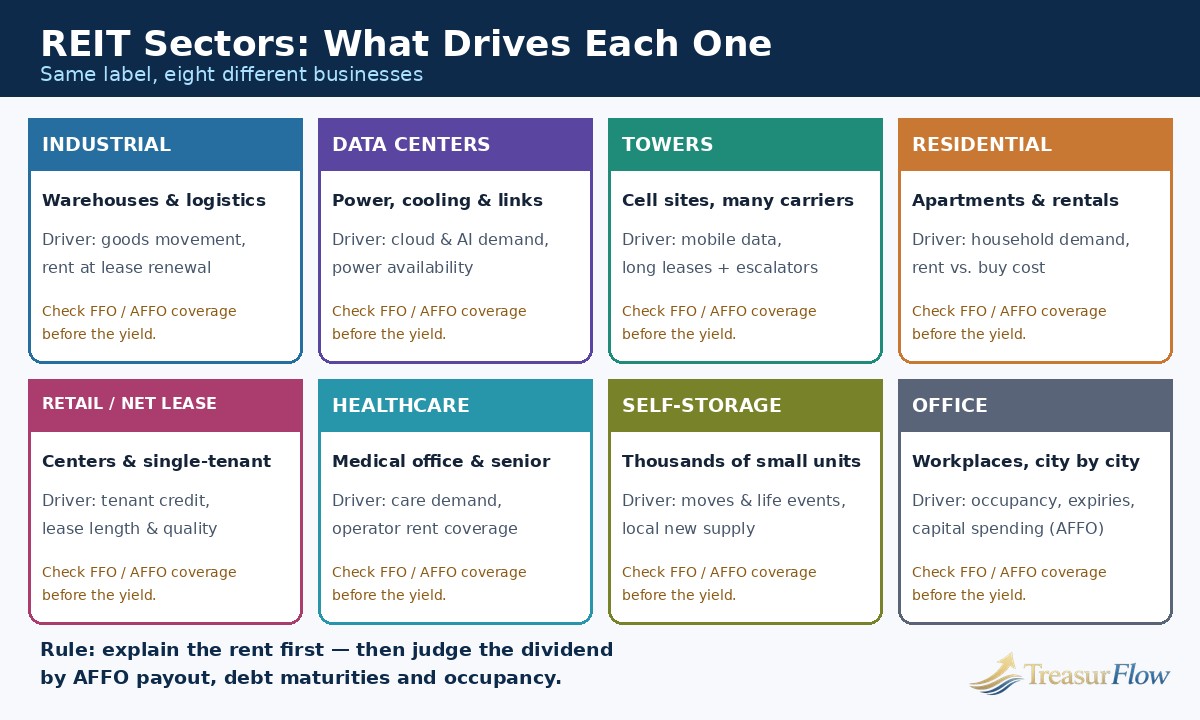
The eight sectors above do not move together. That is the point of owning more than one — or of using an ETF that holds several of them for you.
Taken together, the map explains why there is no single “REIT allocation” decision. Buying an industrial REIT is a view on goods movement and warehouse supply. Buying a tower REIT is a view on mobile data and carrier behavior. Buying a net-lease REIT is a credit decision about tenants. The next section therefore organizes picks by investor goal, and in each case names the sector logic first and the ticker second.
Individual Picks by Investor Goal
No name in this section is a recommendation for you personally. Each is an educational example of a REIT that fits a clearly stated job, with the checks that job requires. Your horizon, tax situation, existing holdings, and ability to tolerate a falling price while you wait for rent to compound will change the answer. Read the “what could go wrong” line for each goal as carefully as the case for it — in REIT investing, the failure mode is part of the pick.
Goal 1 — The income anchor: monthly or steady rent-backed dividends
Realty Income (NYSE: O) — the net-lease anchor. If the job is a steady, frequently paid dividend from a diversified rent roll, Realty Income is the standard example used across the industry, and the facts behind that reputation are checkable. It is structured around long-term net leases, describes itself as “The Monthly Dividend Company,” and pays its dividend monthly rather than quarterly. Morningstar, as of October 9, 2026, put its forward dividend yield at 6.01% and described a portfolio of roughly 15,600 properties, most of them freestanding, single-tenant, triple-net-leased retail properties, with leases frequently of 15 years plus extension options, and a tenant base weighted toward service-oriented, necessity, and otherwise defensive retail. The investment logic is not excitement. It is that thousands of separate leases, across many tenants and industries, with the tenant paying property costs, produce a rent stream that is unusually visible — and that a conservative AFFO payout ratio, which you should verify in the latest filing before buying, would show whether that stream still covers the monthly payment with room to spare. What could go wrong is also in Morningstar’s own commentary: contractual rent increases in many of its leases are low, around 1% a year, so growth depends heavily on acquiring new properties, and acquisitions depend on the cost of debt and equity capital. In a world where financing stays expensive, the anchor can remain dependable and still grow slowly. An income anchor that grows slowly is acceptable if that is the job you hired it for. It is a disappointment if you secretly expected growth-stock returns. For broker and account mechanics — fractional shares, dividend reinvestment settings, and order types — see our guide to the best online broker 2026 options before you place any trade.
Federal Realty Investment Trust (NYSE: FRT) and the grocery-anchored center alternative. Some income investors prefer a shopping-center landlord whose rent growth comes from re-leasing strong space at higher rents rather than from acquisitions. Federal Realty is the example on Morningstar’s October 2026 list: a retail REIT focused on high-quality shopping centers and mixed-use assets in eight major metropolitan markets, with a forward dividend yield of 4.37% as of October 9, 2026, per Morningstar. Kimco Realty, with grocery-anchored centers among its portfolio and a 5.05% forward yield on the same Morningstar date, and Regency Centers are the other large center names on that list, and all three ask the same analytical questions: Is occupancy holding? Are re-leasing spreads positive? Is the tenant mix weighted toward groceries, services, restaurants, fitness, and other visits that e-commerce does not replace? A lower snapshot yield than a net-lease name is not automatically worse value if the underlying rent is growing faster and the balance sheet is stronger — which is exactly the trade-off an income investor should price, rather than sorting a table by yield and buying the top row.
VICI Properties (NYSE: VICI) — net lease, with a concentration warning attached. VICI applies the long-term triple-net model to gaming, hospitality, and entertainment destinations, owning properties that include Caesars Palace Las Vegas, MGM Grand, and the Venetian Resort Las Vegas, leased to experienced operators. The attraction for income investors is the length and structure of those leases and the difficulty of replicating trophy assets on the Las Vegas Strip. The warning is inseparable from the attraction: the tenant and industry base is far more concentrated in gaming and leisure than Realty Income’s thousands of everyday retail leases, so VICI asks you to underwrite a smaller number of operators and a discretionary-spending industry. It belongs in this section as an example of a higher-concentration net-lease choice, not as a substitute anchor for an investor who wants the broadest possible rent roll.
Goal 2 — Growth inside a REIT wrapper: lower yield today, expanding cash flow
Prologis (NYSE: PLD) — logistics growth. Prologis is the example to study if your goal is rent and cash-flow growth from the warehouse economy rather than the largest current dividend. Its portfolio is concentrated in logistics facilities in high-barrier, high-growth markets near major consumption centers, and its results rise or fall with warehouse occupancy, market rent growth when leases renew, development activity, and the supply of competing new buildings. A growth buyer is therefore making two checks an income buyer might skip: what embedded rent growth exists between in-place leases and current market rents in its markets, and how much new supply is being delivered into those same markets over the next two years. If either check fails — in-place rents already at market, and a construction pipeline arriving into softening demand — the growth story weakens even though the buildings are excellent. That is not a contradiction. In growth REITs, the price usually assumes good execution, so the question is rarely “is this a good property company?” and almost always “what growth is already paid for?”
Equinix (NASDAQ: EQIX) — data-center growth. Equinix illustrates the same trade in a different property type. Its data centers sell space, power, cooling, and interconnection to cloud and network customers; demand is driven by the world’s growing need to compute and exchange data, and the constraints are power, construction cost, and customer concentration rather than shopper traffic. Expect, as a pattern for this sector, a dividend yield that looks modest beside a net-lease REIT, paired with the expectation of faster AFFO growth. That pairing only works for you if your horizon is long enough for compounding AFFO, and the dividend increases that usually follow it, to matter more than this year’s payout — and if you are comfortable that data-center development is capital-hungry, which circles back to the balance-sheet checks in the judging section: debt, maturities, and the cost of the outside money every REIT must raise. Do not buy a data-center REIT as a high-income holding and then judge it, a year later, for failing to be one.
American Tower (NYSE: AMT), Crown Castle (NYSE: CCI), and SBA Communications (NASDAQ: SBAC) — infrastructure-style growth and income in one structure. Tower REITs sit between the two goals above, which is why three of them are worth naming together. Their shared model — long carrier leases, annual escalators, and the ability to add tenants to an existing structure at low incremental cost — can support both a dividend and growth, but the balance differs by company: Crown Castle is now a pure-play U.S. tower operator after selling its fiber business, a transaction Morningstar noted closed in May 2026, while SBA Communications holds a large international tower footprint across the Americas and Africa, and American Tower is the global scale leader of the group. Compare them on U.S. versus international exposure, carrier concentration, leverage, and how much of expected growth depends on carriers adding equipment versus building new sites. A tower REIT’s dividend should still be tested against AFFO like any other. “Infrastructure” in the description does not exempt the payout from arithmetic.
Notice what this growth section deliberately does not do. It does not feature Park Hotels & Resorts as a growth pick, even though it appears on Morningstar’s October 2026 undervalued list with a 6.59% forward yield as of October 9, 2026, per Morningstar, because a hotel REIT’s income is reset nightly, not leased for years, and its recovery story depends on travel demand and renovations at specific properties. It is a legitimate specialist holding for an investor who has done that work. It is a poor default example for a general reader, and conflating “undervalued on an analyst list” with “suitable core holding” is exactly the error this guide is organized to prevent. The same reasoning applies to BXP and Kilroy Realty in office: interesting, researched, and on the checked list — and requiring asset-level work that a goal-based starter portfolio does not need.
Goal 3 — The diversified one-ticker choice: own the sector, not a single landlord
For many readers, the honest conclusion of the judging section is that they do not want to underwrite one tenant base, one balance sheet, and one management team. That is not a failure of nerve. It is a recognition that a REIT ETF does, in one trade, the diversification work that would otherwise require buying and monitoring eight or ten companies across eight sectors. The ETF section that follows is therefore not an afterthought to the individual picks. For a beginner, or for an investor adding a modest real-estate allocation beside a broad stock portfolio, it is often the most suitable of the three goals.
REIT ETFs: The Hands-Off Alternative
A REIT ETF holds a basket of REITs selected by an index, charges an annual expense ratio, and passes through the dividends its holdings pay, usually quarterly. You give up the ability to choose sectors, to avoid a company you dislike, and to control exactly when capital gains are realized inside the fund. In return, a single company’s dividend cut, tenant bankruptcy, or debt problem becomes a small drag on the fund rather than a large loss in your account, and rebalancing across sectors happens inside the fund without you trading. Two established, low-cost U.S. examples cover most of what a reader needs to compare.
Vanguard Real Estate ETF (NYSE Arca: VNQ). VNQ provides broad exposure to U.S. real estate companies, tracking the MSCI US Investable Market Real Estate 25/50 Index, and it holds not only equity REITs across the sectors in this guide but also some real-estate-related companies that are not REITs. Its expense ratio is 0.13%, per Vanguard’s own annual shareholder report for the fund for the period ended January 31, 2026, which shows the cost of a hypothetical $10,000 investment in the ETF shares as $13, or 0.13%. On a $10,000 holding, that is about $13 a year in fund costs before any brokerage or tax costs — a useful sense of scale when you compare it with the cost of building and monitoring a ten-name REIT portfolio yourself.
Schwab U.S. REIT ETF (NYSE Arca: SCHH). SCHH tracks an index composed of U.S. real estate investment trusts classified as equities — the Dow Jones Equity All REIT Capped Index — and, as Schwab Asset Management states in its fund summary, the index excludes mortgage REITs and hybrid REITs and offers simple access to REITs without the non-REIT stocks that may be included in other real-estate indices. Its net expense ratio is 0.070%, per the Schwab Asset Management fund page for SCHH. That is lower than VNQ’s 0.13%, and the difference is real but small in dollars: roughly $7 a year versus roughly $13 a year on $10,000, before taxes and trading costs. The more important difference is construction, not cost. SCHH is a purer REIT-only portfolio; VNQ is a slightly broader real-estate portfolio. Neither fact pattern makes one fund universally better. Choose on what you want to own and on the account you already use, and do not switch funds repeatedly to chase a few basis points.
Three ETF cautions. First, an expense ratio is not the total cost of ownership: check dividend tax treatment in your account type, any bid-ask spread when you trade, and whether the fund’s distribution pattern fits your income needs. Second, a REIT ETF is still concentrated in one asset class by design — it diversifies inside real estate, it does not diversify your whole portfolio, and in a rate-driven selloff its holdings can fall together. Third, the sector mix of a broad fund changes over time as market values move, so the fund you bought for industrial and data-center exposure may, a few years later, carry a different weight in healthcare or retail. Review the fund’s holdings annually on the issuer’s page, in the same way you would review an individual REIT’s annual report. Hands-off should mean low-maintenance, never no-maintenance.
If the choice between several individual REITs and one ETF still feels abstract, use this rule of thumb. If you cannot name, for each individual holding, its sector driver, its AFFO payout ratio, and its next big debt maturity year, you do not yet have an individual-stock portfolio — you have a collection of tickers. Start with the one-ticker route, paper-track the individual names in this guide for a year, and revisit the decision with evidence about your own attention and temperament. Many investors discover that the ETF was not the starter option at all. It was the right permanent one.
Taxes: Why REIT Dividends Are Mostly Ordinary Income, and Why Account Location Matters
Taxes are where an otherwise sound REIT decision quietly loses a meaningful share of its return, because the tax character of a REIT dividend is different from the dividend on most ordinary stocks. Most dividends paid by regular corporations to long-term shareholders are “qualified dividends” taxed at the lower capital-gains rates. Most REIT dividends are not. They are generally taxed as ordinary income, at your marginal income-tax rate, in the year you receive them. The reason follows from the structure you have already read: the REIT largely avoids corporate tax by distributing its income, so the tax that a normal corporation would have paid at the company level is instead collected from you, at your rate, on the distribution. A yield that looks a full point higher than a qualified-dividend stock’s yield may look much closer after tax — and for an investor in a high federal and state bracket, it can look lower. Compare REIT income after tax, or do not compare it at all.
In practice, a REIT distribution can arrive in three pieces, and your Form 1099-DIV is the document that sorts them. Your broker or the fund will send you Form 1099-DIV after the year ends; the IRS’s guidance on Form 1099-DIV explains, for example, that ordinary dividends from Box 1a are entered on line 3b of Form 1040, and qualified dividends from Box 1b on line 3a. For REITs, expect the largest piece in most years to be ordinary dividends (Box 1a), taxed as described above. A second possible piece is a capital gain distribution (Box 2a), arising when the REIT sold property at a gain, which is generally taxed at capital-gains rates. A third is a return of capital (Box 3, nondividend distributions), which is generally not taxed as income in the year received but reduces your cost basis in the shares, which in turn increases the taxable gain — or reduces the loss — when you eventually sell. Return of capital sounds alarming and sounds like a gift, and it is neither: it often arises because depreciation makes taxable income lower than cash flow. Read your own 1099-DIV each year rather than assuming last year’s proportions repeat, and keep the forms with your records, because cost-basis adjustments from years of return-of-capital distributions matter at sale time.
One further provision deserves a mention, with a caution attached. Ordinary REIT dividends may be eligible for the Section 199A deduction for qualified REIT dividends, which — where it applies — allows an individual to deduct up to 20% of those dividends in computing taxable income. The amount that qualifies is reported in Box 5 of Form 1099-DIV, labeled Section 199A dividends. Eligibility, limits, and the interaction with the wider qualified business income rules depend on the current law and on your return, and tax law in this area has changed in recent years. Treat the deduction as something to verify for the tax year in question in current IRS guidance or with a tax professional, not as a permanent feature you can bank in a buying decision. This article deliberately does not build any yield comparison on the assumption that you will receive it.
Account location is the lever you actually control. Because REIT dividends in a taxable account are taxed as ordinary income every year whether you spend them or reinvest them, many investors prefer to hold REITs and REIT ETFs inside a tax-advantaged account where that annual drag does not apply. Inside a Roth IRA, dividends are not taxed as they arrive, and qualified withdrawals in retirement are tax-free — which is why the pairing of REITs with a Roth account is so commonly recommended, and why our guide to the best Roth IRA accounts 2026 is the natural companion read to this section. Inside a traditional IRA or 401(k), dividends are likewise not taxed annually, but withdrawals are taxed as ordinary income, so the character of the dividend effectively does not matter inside the account — another reason tax-inefficient income assets are often placed there first. In a taxable account, by contrast, keep a clear-eyed tally: the yield, minus tax at your marginal rate, plus the paperwork of 1099-DIV boxes and cost-basis adjustments. None of this overrides contribution limits, the asset allocation you want overall, or the fact that your highest-growth assets may deserve the Roth space more. Account placement is an optimization applied after the investment decision is sound, never a reason to buy a REIT you would not otherwise own.
Finally, a comparison that keeps REIT income in proportion. If part of your money has a near-term job — a house deposit, next year’s tax bill, an emergency fund — it does not belong in a REIT at all, however attractive the dividend looks, because the share price can be down when you need the cash. That money belongs in insured savings or a certificate of deposit whose return and date are known in advance; see our guides to the best high-yield savings accounts 2026 and the best CD rates 2026 for that side of the decision. REITs are long-horizon investments whose income is variable. Comparing them honestly with a savings yield — variable rent-backed income and a moving price, versus a stated rate and a stable balance — is not a reason to avoid REITs. It is the reason to size them as one part of a plan, funded with money you will not need on a deadline.
Risks Every REIT Investor Should Price In
Interest-rate sensitivity. This is the risk the market prices first, and it works through three channels at once. Higher rates raise the cost of the new debt a REIT constantly needs because it cannot retain most of its earnings. Higher rates also make newly issued bonds and even savings products more competitive against a REIT’s dividend, so some income buyers leave. And higher discount rates, applied by valuers to any long-lived asset, tend to lower what investors will pay for a future rent stream. Morningstar’s October 2026 framing makes the same point in performance terms — real estate lagging the broad market in a period when the broad index rose much faster — but do not reduce the lesson to “REITs fall when rates rise,” because the operating effect differs by sector: a residential REIT with short leases can raise rents in an inflationary, high-rate environment, while a net-lease REIT locked into 1% annual escalators cannot. Price the rate risk through the specific leases and debt maturities of what you own, not through a slogan about the sector.
Sector and tenant concentration. A single-sector REIT is a concentrated bet, however large the company is. A tower REIT depends on a handful of carriers. A gaming net-lease REIT depends on leisure spending and a few operators. An office REIT in two cities depends on those cities’ employment and return-to-office patterns. Even a well-diversified REIT such as Realty Income has a large retail weighting, as Morningstar noted, because that is its business. Concentration is not automatically disqualifying — it is often the source of a specialist landlord’s expertise — but it must be chosen knowingly, sized accordingly, and, for most readers, balanced by other sectors or by holding the exposure through an ETF.
Dividend cuts. A REIT dividend is a board decision, renewed every quarter (or month), not a contractual payment like bond interest. Boards cut dividends when AFFO falls, when debt must be repaid or refinanced on worse terms, when a major tenant is lost, or when management decides — sometimes correctly — that cash spent on properties or debt reduction is worth more than cash paid out. A cut usually arrives with a falling share price, so the investor who bought only for the yield suffers twice. The defenses available to you are the unglamorous ones from the judging section: an AFFO payout ratio with a cushion, a staggered debt maturity schedule, growing or at least stable AFFO per share, and a management record of guiding honestly. There is no yield high enough to compensate for skipping those checks, because the highest yields in the sector are routinely the ones about to be reduced.
Property, development, and valuation risks. Beneath the financial risks sit physical and market ones. Buildings age and require capital; a development project can be delivered late, over budget, or into a market that no longer wants it; property valuations can fall, which matters if a REIT must sell assets or refinance against them; and environmental, zoning, insurance-cost, and local-tax changes can alter a market’s economics one city at a time. Self-storage and industrial supply booms, hotel renovations, data-center power constraints, and office obsolescence are all sector versions of the same underlying fact: the dividend ultimately comes from real buildings in real places, and real buildings can disappoint. On top of that sits ordinary stock-market valuation risk — you can analyze a REIT correctly and still overpay for it, in which case even good operating results may produce a poor shareholder return for years. Analyst lists such as Morningstar’s, which rank by price against an estimated fair value, exist precisely because price paid is a separate decision from quality judged. Respect both decisions.
Liquidity and structure risks beyond listed REITs. This guide’s picks are exchange-listed, which gives you a daily price and the ability to sell. If you are ever offered a non-traded or private REIT, or a real-estate crowdfunding product presented as “like a REIT,” understand that the comparison is incomplete in the dimension that matters most in a crisis: you may not be able to exit at the stated value, or at all, for a long period. Investor.gov’s bulletin draws exactly this distinction for non-traded REITs. Liquidity is a feature. Do not surrender it for a slightly higher stated distribution without understanding the redemption terms in writing.
Related Guides
Related Guides
- Best Online Broker 2026 — where to buy individual REITs and REIT ETFs, and what account features and fees to compare
- Best Roth IRA Accounts 2026 — the tax-advantaged account many investors use to shelter ordinary-income REIT dividends
- Best CD Rates 2026 — the known-rate, known-date alternative for money that cannot accept a moving share price
- How to Invest in Real Estate Without Buying Property — REITs compared with crowdfunding and direct rental ownership
- Best High-Yield Savings Accounts 2026 — where short-horizon money belongs while you build a long-horizon REIT position
Helpful Official Resources
Helpful Official Resources
- Investor.gov — Real Estate Investment Trusts (REITs) — the SEC’s plain-language introduction to what REITs are and how publicly traded and non-traded REITs differ
- SEC Investor Bulletin: Publicly Traded REITs — the SEC bulletin setting out the qualification tests, including the requirement to distribute at least 90 percent of taxable income
- IRS — How do I report this Form 1099-DIV? — IRS guidance on where ordinary and qualified dividends from Form 1099-DIV are reported on Form 1040
- Nareit — Telecommunications REITs and REIT sector education — Nareit (reit.com) sector material illustrating how REIT property sectors, from towers and data centers to the sectors mapped in this guide, are defined and tracked
REIT Questions Income Investors Ask Before They Buy
What is a REIT and how does it make money?
A REIT is a company that owns, operates, or finances income-producing real estate, such as apartments, warehouses, data centers, shopping centers, and healthcare properties. It makes money mainly by collecting rent from tenants, and it must distribute at least 90% of its taxable income to shareholders as dividends to keep its special tax status.
Why do REITs pay such high dividends?
REITs pay high dividends because the law requires them to distribute at least 90% of their taxable income to shareholders each year. That payout rule is the trade-off for generally avoiding corporate-level tax on the income they distribute, so more of the rent a REIT collects reaches investors as dividends instead of being taxed twice.
Are REIT dividends taxed differently from regular stock dividends?
Yes. Most REIT dividends are taxed as ordinary income rather than at the lower qualified-dividend rate, and they are reported on Form 1099-DIV. Part of a distribution may also be a capital gain distribution or a return of capital, and some ordinary REIT dividends may qualify for the Section 199A deduction, so check your 1099-DIV and current IRS guidance each year.
Should I hold REITs in a Roth IRA or a taxable brokerage account?
Many investors prefer to hold REITs in a Roth IRA or another tax-advantaged account because REIT dividends are mostly taxed as ordinary income in a taxable account. Inside a Roth IRA, qualified withdrawals are tax-free, so the dividend tax drag disappears, but contribution limits, your other holdings, and your overall plan matter more than any single rule.
What is the difference between buying individual REITs and a REIT ETF like VNQ or SCHH?
An individual REIT gives you exposure to one company and one property sector, so its dividend and price depend on that company’s tenants, debt, and management. A REIT ETF such as VNQ or SCHH spreads your money across many REITs and sectors in a single ticker, which diversifies single-company risk but means you accept the fund’s mix, yield, and expense ratio.
What are the biggest risks of investing in REITs in 2026?
The biggest risks are interest-rate sensitivity, sector concentration, and dividend cuts. Rising rates can raise a REIT’s borrowing costs and make its yield less attractive versus bonds, a downturn can hit one property sector hard, and a dividend is never guaranteed, so a REIT that pays out too much of its cash flow or carries too much debt can be forced to cut it.
Conclusion: Buy the Rent, Check the Coverage, Respect the Sector
The best REITs in 2026 are not the ones with the largest yield on a screening page. They are the ones whose rent you can explain, whose dividend is covered by adjusted funds from operations with room to spare, whose debt matures in a pattern the company can handle at the interest rates that actually exist, and whose sector driver you still believe in after reading the risk that is specific to it. For an income anchor, that discipline points many readers toward a diversified net-lease landlord such as Realty Income, tested in its latest filing rather than trusted on its reputation. For growth, it points toward logistics, data-center, and tower landlords such as Prologis, Equinix, and American Tower, bought — if at all — for expanding cash flow over years and judged on AFFO growth rather than this quarter’s payout. And for the diversified one-ticker job, it points toward a low-cost REIT ETF such as VNQ, at a 0.13% expense ratio per Vanguard’s fund reporting, or SCHH, at a 0.070% net expense ratio per Schwab Asset Management, chosen by portfolio construction rather than by a fraction of a percent of fees. Each of those is a defensible answer to a different question. None of them is a defensible answer to every question.
So decide the question first. Write down, before you buy anything, the job the holding must do, the sector exposure you are accepting, the account it will live in and the tax character that follows from that choice, and the two or three facts — AFFO payout, occupancy, debt maturities — that would tell you the thesis is broken. Review those facts when each annual report arrives, not when a headline moves the price. That unglamorous routine is what separates an income portfolio from a yield-chasing accident, and it is available to any investor willing to read a filing instead of a ranking. Real estate bought this way will still fall in price sometimes; rent-backed businesses operating in a rate-sensitive market do. But you will know what you own, why you own it, and what would change your mind — and in an asset class built on long leases and slow-moving buildings, that patience is most of the edge there is.
Disclaimer: This article is for general educational and informational purposes only and is not financial advice, and it is not a recommendation to buy or sell any REIT, ETF, or other security. It is not personalized investment, tax, or legal advice for your specific situation. REIT prices can fall, dividends are not guaranteed and can be cut, interest-rate changes can affect REIT values and borrowing costs, and past performance does not guarantee future results. Yields, expense ratios, portfolio figures, and analyst assessments cited here are attributed snapshots as of October 2026 and can change; verify current figures in the issuer’s prospectus, fund page, or company filings before you buy, and consider speaking with a qualified financial or tax professional about your own circumstances.

Muhammad Zakir is the founder of Treasurflow and the author of its personal finance guides. He researches consumer banking, credit, and personal loans, and every guide cites primary sources such as the CFPB, FDIC, FTC, and IRS. His content is educational and is not personalized financial advice.