
A serious diagnosis creates two emergencies at once. The first is medical. The second is financial, and it starts immediately — often weeks before the largest hospital bills even arrive. Your health plan’s deductible resets. Treatment is scheduled in another city. You, or the spouse who would normally be at work, need time away from a job. The mortgage, the car payment, and the utility bills do not pause while any of this is sorted out.
best critical illness insurance 2026: Critical illness insurance exists for exactly that second emergency. It is one of the simplest products in the US insurance market to describe and one of the easiest to buy badly. The description fits in one sentence: if you are diagnosed with a covered serious condition, the insurer sends you a lump sum of cash. The buying mistakes hide in the definitions — in what the policy means by “cancer,” by “heart attack,” and by “stroke,” in whether a condition pays 100% of the benefit or 25%, and in waiting periods and survival periods that most buyers never read about until they file a claim.
This guide is written specifically for US buyers. That matters more than it might sound. Search results for critical illness insurance are crowded with Canadian and Indian guides describing products, currencies, tax rules, and public health systems that have nothing to do with buying a policy in Ohio or Texas. The US market works differently. Here, critical illness cover is sold three ways — as a standalone policy you buy yourself, as a rider attached to a life insurance policy, and as a voluntary benefit you elect at work — and it sits on top of a health insurance system where, according to HealthCare.gov figures cited by Assurity, the maximum out-of-pocket limit for a family reaches $21,200 in 2026. That gap between what health insurance pays and what a household actually spends is the entire reason this product exists.
We will start with definitions, not company names. You will learn what a critical illness policy actually pays, how it differs from health insurance, disability insurance, and life insurance, and how to spot the definition traps that decide whether a claim pays in full, pays a fraction, or pays nothing. Only then do we turn to the US carriers worth shortlisting — each one verified as actually selling critical illness cover to US buyers as of October 2026 — followed by a worked example for sizing your benefit, real sample costs attributed to their sources, and an honest section on who should skip this coverage entirely.
One theme runs through everything below: with critical illness insurance, the policy wording matters more than the marketing headline. Two policies can both advertise “cancer, heart attack, and stroke” on the front page and pay very differently for the same diagnosis. Read this guide with that in mind, and you will know which pages of a policy to read before you sign.
What a Critical Illness Policy Actually Pays
A critical illness policy pays a lump-sum cash benefit directly to you when you are diagnosed with a condition that is named in the policy and that meets the policy’s definition of that condition. Mutual of Omaha, one of the longest-standing US sellers of this cover, describes its own product in exactly these terms: critical illness insurance “pays a lump-sum benefit upon diagnosis of a covered condition,” and “a check is sent to you, not the health care provider.”
Every part of that sentence carries weight:
- Lump sum. You receive one payment — the benefit amount you chose when you bought the policy, or a stated percentage of it — not a series of reimbursements and not a monthly income. If you buy a $30,000 policy and suffer a covered condition that pays at 100%, you receive $30,000.
- Directly to you. The money is not assigned to a hospital, a surgeon, or a health plan. It lands in your hands, and no one audits how you spend it.
- On diagnosis of a covered condition. The trigger is a diagnosis that matches the contract, not a bill, not a hospital stay, and not an inability to work. You do not need to miss a single day of work to qualify, and being unable to work does not qualify you if the condition itself is not covered.
- Use it for anything. Carriers themselves list the same uses again and again: replacing lost income while you or your spouse take time off, keeping up with household bills, covering deductibles and copays, and travelling for treatment. Childcare, a cleaner while you recover, parking and lodging near a specialist centre, and experimental or out-of-network care your health plan will not fund are all legitimate uses, because the cash is unrestricted.
This is why critical illness insurance is classified as supplemental coverage. It does not replace health insurance, and it is not “minimum essential coverage” under federal law — group carriers such as Guardian state that plainly in their policy disclosures. It is a financial shock absorber that sits beside your health plan. Your health plan negotiates and pays medical bills with providers. Your critical illness policy hands you cash to deal with everything those bills leave behind — including the large share of a serious illness’s cost that was never a medical bill at all: the income that stops, the deductible that must be met before health coverage pays anything meaningful, and the travel, lodging, and household help that recovery demands.
The scale of the risk is not hypothetical. According to 2025 data from the American Heart Association reported by NerdWallet, somebody in the United States has a heart attack every 40 seconds. The American Heart Association’s own statistics reporting puts the figure at about 795,000 people experiencing a new or recurrent stroke each year, with heart disease the No. 1 cause of death in the United States and stroke the No. 5 cause. The American Cancer Society projected 2,041,910 new cancer cases in the United States in 2025. And the Centers for Disease Control and Prevention’s National Health Interview Survey found that in 2024, 11.3% of US adults aged 45 and older had ever had heart disease. Cancer, heart attack, and stroke — the three conditions at the core of nearly every critical illness policy — are not edge cases. They are among the most common serious health events in American life, which is precisely why insurers can sell this cover at premiums many households find manageable, and why the definitions attached to those three words deserve your closest attention.
Critical Illness vs Health, Disability, and Life Insurance
The most common buying error with critical illness insurance is expecting it to do the job of a different product. Four types of insurance respond to serious illness in four completely different ways. If you understand the table below, you understand where critical illness cover belongs in a financial plan — and where it does not.
| Feature | Critical Illness Insurance | Health Insurance | Disability Insurance | Life Insurance |
|---|---|---|---|---|
| What triggers a payment | Diagnosis of a named, covered condition that meets the policy definition | Receiving covered medical care | Being unable to work because of illness or injury, after a waiting (elimination) period | Death of the insured (or a qualifying terminal/chronic illness under some riders) |
| Who receives the money | You, directly | Mainly your doctors and hospitals | You | Your beneficiaries |
| How it pays | One lump sum (sometimes a percentage of the benefit for lesser conditions) | Pays providers for covered services, after your deductible, copays, and coinsurance | Monthly payments replacing part of your income for as long as you are disabled, up to the benefit period | One lump sum (the death benefit) |
| What it is for | The financial shock at diagnosis: deductibles, lost income, travel, household costs | Paying for medical treatment itself | Replacing income over weeks, months, or years when you cannot work | Replacing income and settling obligations for the family you leave behind |
| Key limitation | Pays nothing for conditions not on its list, however serious | Leaves deductibles and out-of-pocket maximums — up to $21,200 for a family in 2026 — plus all non-medical costs to you | Usually has an elimination period of 30–180 days before payments begin, and pays only while you cannot work | Pays nothing while you are alive and recovering, unless a living-benefit rider applies |
Read the table row by row and the gaps explain themselves. Health insurance is essential, but it is a payment system for medical providers. Even a good plan can leave you owing thousands before its out-of-pocket maximum is reached, and it pays nothing toward the income you lose while being treated. NerdWallet, citing a 2024 study in the American Heart Association journal Circulation, reports that the median cost of hospital care following a heart attack was $29,500 per patient in 2018 — and hospital care is only the part of the cost that health insurance touches.
Disability insurance solves a different problem: time. It replaces a portion of your income, month by month, when illness or injury stops you working. But it typically imposes an elimination period — a wait of weeks or months before the first payment — and it pays only because you cannot work, not because you were diagnosed. A person who has a heart attack, is treated quickly, and returns to work in five weeks may receive little or nothing from a disability policy with a 90-day elimination period, while facing a full deductible and weeks of reduced earnings. Critical illness cover pays in exactly that scenario, because its trigger is the diagnosis itself.
Life insurance, including the policies compared in our guide to the best life insurance 2026, protects the people who depend on your income if you die. It does nothing for the far more common scenario in which you survive a serious illness — survival is, after all, the expected outcome for most heart attacks, strokes, and many cancers today — and spend months recovering with reduced income and elevated expenses. That space between “survived” and “financially whole” is the space critical illness insurance was built for. For older buyers weighing these trade-offs together, our guide to the best life insurance for seniors over 70 shows how protection priorities change when income replacement matters less and final costs matter more.
None of the four replaces another. A sound protection plan usually layers them: health insurance for treatment, disability insurance for sustained income loss, life insurance for your dependants, and — where the budget and the risk justify it — critical illness cover for the immediate cash shock that the other three leave exposed.
The Definition Traps: Where Claims Are Won and Lost
If you read only one section of this guide before buying, read this one. Critical illness policies do not cover diseases in the everyday sense. They cover definitions. The brochure lists condition names; the contract defines each name with medical criteria, severity thresholds, and exclusions. A diagnosis that sounds identical in conversation can pay 100% under one policy, 25% under another, and nothing under a third. Here are the traps that matter most.
Trap 1: “Cancer” rarely means every cancer
In policy language, the full benefit is usually reserved for invasive cancer. Mutual of Omaha’s standalone policy pays 100% for “internal cancer or malignant melanoma” — note the qualifiers. Early-stage, non-invasive, and in-situ cancers are handled very differently across the market. In Aflac’s group critical illness schedule, carcinoma in situ pays 25% of the benefit amount, and that payment reduces the amount left for a later cancer claim. In one Aflac employer plan summary, skin cancer pays a flat $250 once per calendar year rather than a percentage of the benefit at all. Assurity’s streamlined Quick Issue product covers invasive cancer at the full benefit — and its own materials are careful to say “invasive.”
The practical lesson: if a salesperson tells you a policy “covers cancer,” ask three follow-ups. Does it cover carcinoma in situ, and at what percentage? Does it cover early-stage prostate or thyroid cancers, which some contracts carve out by stage or grade? Does a partial payment for an early-stage cancer reduce or end your cover for a later, invasive cancer? The answers are in the policy’s definitions and benefit schedule, and they differ enough between carriers to change which policy is “best” for a buyer whose main concern is a family history of cancer.
Trap 2: “Heart attack” has a technical meaning — and cardiac arrest may not count
Policies define heart attack as a myocardial infarction meeting specified clinical evidence — typically a combination of symptoms, ECG changes, and cardiac enzyme or troponin results. Events that feel like “a heart problem” to a patient may not meet the definition. Assurity’s own policy footnote is unusually blunt: heart attack “does not include established (old) myocardial infarction occurring prior to the issue date, sudden cardiac arrest, cardiac arrest or cardiopulmonary arrest.” In other words, discovering on a scan that you had a silent heart attack before you bought the policy pays nothing, and a sudden cardiac arrest — a distinct medical event — is excluded from Assurity’s heart attack definition altogether. Aflac, by contrast, lists sudden cardiac arrest as its own separately covered condition in its lump-sum product. Same two words on a brochure, opposite outcomes in a contract.
Trap 3: “Stroke” usually requires lasting damage — a TIA is not a stroke
Stroke definitions typically require a neurological deficit that persists beyond a stated period, confirmed by imaging or clinical examination. A transient ischemic attack (TIA) — often called a “mini-stroke” — by definition resolves, and standard policies do not pay the stroke benefit for it. Washington National’s combined Active Care product illustrates the structure clearly: TIAs appear in its materials as a separate, lesser category of benefit, not as part of the headline lump sum for major critical illnesses. If your family history involves TIAs or early cerebrovascular warnings, understand that the policy may pay little or nothing for the warning events and reserve its benefit for a major stroke with lasting effects.
Trap 4: The percentage grid — 100% conditions and 25% conditions
Most policies sort covered conditions into a full-benefit tier and a partial-benefit tier. Mutual of Omaha’s grid is a clean example. At 100%: internal cancer or malignant melanoma, heart attack, stroke, Alzheimer’s disease, major organ transplant, blindness, paralysis, deafness, and kidney failure. At 25%: coronary artery bypass surgery and coronary angioplasty surgery. Aflac’s individual product shows the same economics in dollars: an initial diagnosis benefit of up to $25,000, with coronary artery bypass graft surgery paying up to $6,250 — exactly 25%.
Partial benefits are not a scam; bypass surgery and angioplasty are serious, expensive events, and 25% of a $40,000 benefit is still $10,000 of unrestricted cash. The trap is assuming every listed condition pays the headline amount. When you compare two policies, compare them tier by tier: which conditions sit at 100%, which sit at 25%, and whether a partial payment reduces your remaining cover. A policy with a shorter condition list but your highest-risk conditions at 100% can be worth more than a longer list that parks them at 25%.
Trap 5: Counting conditions is a marketing game
Carriers advertise condition counts — 4, 11, 17, 30 or more — as if the bigger number automatically wins. The verified US products in this guide show why that logic fails. Assurity’s Quick Issue policy deliberately covers only four conditions at the full benefit: invasive cancer, heart attack, stroke, and advanced Alzheimer’s disease. Mutual of Omaha lists eleven conditions across its two tiers. Guardian’s group plans describe more than 30 major, chronic, and debilitating illnesses. Washington National describes coverage built around 17 critical health conditions plus additional categories of injuries and other events.
Those extra conditions on longer lists tend to be rarer diagnoses. The claims reality of this product is concentrated in the big three — cancer, heart attack, and stroke — which is why a focused four-condition policy can still address the most likely claims, and why a 30-condition policy is chiefly better if the additional conditions match your actual family history: Parkinson’s disease, multiple sclerosis, ALS, or major organ failure, for example. Buy the list that matches your risks, at the percentages that matter — not the longest list on the page.
Trap 6: Exclusions and look-backs buried behind the headline
Finally, read what a policy will not pay for. Assurity discloses that it will not pay benefits for a specified disease caused by a pre-existing condition until the policy has been in force for six months. Washington National’s agent materials describe a five-year look-back for cancer and heart conditions on parts of its product line. Aflac’s group materials require a recurrence of cancer to be separated by at least twelve months of being treatment-free before it pays as a reoccurrence. None of these terms are unusual, and none are hidden — they are printed in the policy documents. They are only a “trap” for the buyer who never reads them. Before you buy any policy, locate four things in the actual contract: the pre-existing condition clause, the definition of each condition you care about, the benefit percentage grid, and the rules for additional or recurring diagnoses. That twenty-minute read is worth more than any comparison table, including ours.
How the Mechanics Work: Waiting Periods, Survival Periods, Terms, and Riders
Beyond definitions, six mechanical features determine how a critical illness policy behaves in real life. They are the levers that separate an adequate policy from a frustrating one.
Waiting periods
A waiting period is the time after your policy starts during which a diagnosis will not be paid. Assurity’s Quick Issue product guide specifies a 30-day waiting period for a cancer diagnosis: no benefits are paid for invasive or non-invasive cancer diagnosed during those first 30 days, with special rules — including voiding the policy and refunding premiums in New York — spelled out in the guide. Washington National’s Active Care materials likewise describe a 30-day waiting period in most states. At the other end of the market, MassMutual’s group critical illness product, launched in 2025, advertises no waiting period under its standard plan designs. The takeaway is not that one design is “right”; it is that the waiting period is a real, variable term. If you are buying cover partly because of a worrying symptom or a scheduled test, understand that a diagnosis landing inside the waiting period — or a condition connected to symptoms that pre-date the policy — is exactly the claim these clauses exist to decline. Buy this cover while you are healthy, not after a scare.
Survival periods
Separate from the waiting period, many critical illness policies include a survival period: you must live for a set number of days after diagnosis — commonly in the range of 14 to 30 days across the wider market — before the benefit becomes payable. The logic is that the product is a living benefit, designed to fund recovery, not a substitute death benefit. Not every US policy imposes one, and the exact term varies by contract, which is why it belongs on your checklist of items to confirm in the specimen policy rather than assume. If a policy has a survival period, a family should know that a death within days of diagnosis may mean the critical illness benefit is not paid, and any financial protection for that scenario needs to come from life insurance instead.
Benefit amounts
Across the verified US products in this guide, benefit amounts cluster in a consistent range. Mutual of Omaha offers $10,000 to $100,000. Assurity’s Quick Issue offers $5,000 to $50,000, tied to income. Aflac’s individual lump-sum product pays up to $25,000 for an initial diagnosis, with up to $12,500 for a subsequent critical illness event. Guardian’s group plans offer lump sums of up to $50,000. Washington National describes lump-sum payments of up to $100,000 for major critical illnesses under Active Care. In practice, most buyers choose between $10,000 and $50,000 — enough to matter at diagnosis without pushing the premium into territory where the money would work harder elsewhere. The sizing section below shows how to pick a number from your own expenses rather than from a brochure.
Term vs lifetime cover
Mutual of Omaha’s structure is representative of the standalone market: you choose a term of 10, 15, 20, or 30 years, or lifetime coverage, with issue ages from 18 to 64, and the policy is guaranteed renewable for the life of the policy. Term cover is cheaper and can be matched to your exposed years — for example, the years when you carry a mortgage, have children at home, and hold a high-deductible health plan. Lifetime cover costs more but removes the risk of the policy expiring just as age makes diagnosis most likely and new cover hardest to buy. Whichever you choose, note the issue-age reality: standalone critical illness cover is primarily a working-age product. If you are already past the mid-60s, new standalone options narrow sharply, and your planning conversation shifts toward the coverage you hold, your savings, and products designed for later life.
Return-of-premium features
Return of premium (ROP) is the feature buyers most often overvalue and under-read. Mutual of Omaha builds an ROP benefit into its critical illness policy in a specific form: a return of premium upon death. Its producer materials work the example plainly — if a policyholder dies while the policy is in force having never claimed, the beneficiary receives 100% of premiums paid, minus any benefits already paid. Washington National markets premium-return features on its product line as well, including a choice of return of premium or cash value in most states on Active Care. ROP makes a policy feel like it cannot “waste” money, and for some buyers that feeling is genuinely worth paying for. Just be clear about which version you are buying — return on death only, return at the end of a term, or cash value — what it costs in extra premium, and what happens to the return if you claim part of the benefit first. Those details, not the label, decide the feature’s value.
Recurrence and additional-occurrence benefits
Older critical illness policies often paid once and ended. Many current US products pay more than once under stated conditions. Aflac’s group materials describe an additional-occurrence benefit — a new, different covered illness diagnosed at least six months after the first can pay the full benefit again — and a reoccurrence benefit for the same condition, generally requiring at least twelve months between diagnoses, and for cancer, twelve months treatment-free. Aflac’s individual product similarly pays up to $12,500 for a subsequent critical illness event, whether a recurrence or a new covered illness. MassMutual’s group product goes further in design, with a severity feature that pays more for more severe diagnoses and a progression feature that can pay up to two times the coverage amount in total if a condition worsens. If you are comparing a cheaper one-and-done policy against a pricier multi-pay policy, this is often the real difference you are paying for — and for buyers with strong family histories of cancer, it may be the difference that matters most.
Three Ways to Buy: Standalone, Life Insurance Rider, or Through Work
The same lump-sum idea reaches US buyers through three channels, and the channel changes the price, the underwriting, and what happens to the rest of your coverage when you claim.
Standalone policies are bought directly from a carrier or an agent, are yours regardless of your job, and pay their benefit without touching any other policy. Mutual of Omaha and Assurity are the clearest examples in this guide, and Aflac and Washington National also sell individual cover. Expect health questions — Assurity’s Quick Issue advertises an application with only five health questions and no medical exam for common coverage amounts — benefit amounts you choose yourself, and premiums based on your age, tobacco use, and benefit size. Portability is total, because the policy was never tied to an employer. The trade-off is that you pay the full retail premium and pass individual underwriting.
Critical illness riders on life insurance attach a living benefit to a life policy. NerdWallet explains the core trade-off precisely: the rider is usually cheaper than a standalone policy, but the amount paid for a critical illness is subtracted from the death benefit your beneficiaries eventually receive. Its example makes the arithmetic concrete — on a $500,000 life policy with a $50,000 critical illness benefit, claiming the $50,000 leaves $450,000 for your beneficiaries; never claiming leaves the full $500,000. Some term policies include a critical illness rider at no extra charge, while on permanent policies it may be included or added for a fee. Riders suit buyers who are already purchasing life insurance, want one application and one premium, and accept that a critical illness claim spends part of the family’s death benefit early. They suit buyers less well when the death benefit is carefully sized and cannot spare the reduction — in that case, a standalone policy keeps the two protections separate. If you are pricing life cover anyway, the comparisons in our best life insurance 2026 guide are the natural place to see what a rider would attach to.
Employer supplemental and voluntary plans are offered at work, usually during open enrollment, with premiums deducted from payroll. Guardian, Colonial Life, MassMutual, Aflac, and Washington National all compete in this channel. The advantages are real: group pricing, simplified or guaranteed-issue amounts with few or no health questions up to a limit — one Aflac group brochure describes guaranteed issue of up to $20,000 for employees and $10,000 for a spouse — and the convenience of payroll deduction. The disadvantages are equally real: the benefit menu and amounts are chosen by your employer, not you; the condition list is the group’s list; and portability varies. Some workplace policies can be kept if you leave and continue paying premiums — MassMutual notes portability on its group product, with exceptions in Alaska and Vermont — while others end or change when employment does. If your employer offers voluntary critical illness cover at a group rate, it is often the cheapest way to own a modest benefit. Just read the portability clause before you rely on it as your only cover, and remember that a policy that ends when a job ends tends to end at exactly the moment a household is least able to replace it.
The Best Critical Illness Insurance in the US for 2026, by Buyer Type
There is no single best critical illness policy — there is a best match for a buying situation. Each pick below is a carrier we verified as selling critical illness cover to US buyers, with the product facts stated as the carrier itself publishes them, as of October 2026. Availability, definitions, and rates vary by state, so treat each pick as a shortlist entry to quote, not a verdict.
Best standalone all-rounder: Mutual of Omaha
Mutual of Omaha is the natural starting point for a buyer who wants to purchase a policy directly and keep it for the long term. Its Critical Advantage critical illness policy pays $10,000 to $100,000, on terms of 10, 15, 20, or 30 years or for lifetime coverage, with issue ages of 18 to 64 and individual, single, or family coverage. The condition grid is published plainly: 100% for internal cancer or malignant melanoma, heart attack, stroke, Alzheimer’s disease, major organ transplant, blindness, paralysis, deafness, and kidney failure; 25% for coronary artery bypass surgery and coronary angioplasty. The policy is guaranteed renewable, uses limited underwriting, charges the same for family coverage regardless of the number of children, and includes a return-of-premium benefit upon death, with optional riders at additional cost. For a self-employed buyer with no access to workplace cover — the person this product most clearly serves — that combination of a six-figure maximum benefit, lifetime term option, and a transparent percentage grid is hard to beat as a first quote.
Best for a fast, simple application: Assurity
Assurity’s Quick Issue Critical Illness Insurance is built for buyers who want modest cover without a drawn-out application. It covers ages 18 to 64 with benefit amounts from $5,000 to $50,000 depending on income, an application built around five health questions, simplified underwriting, level premiums based on gender, tobacco use, age, and benefit amount, and coverage that is guaranteed renewable for life. The trade for that simplicity is focus: the Quick Issue policy pays the full benefit for invasive cancer, heart attack, stroke, and advanced Alzheimer’s disease — the four most consequential diagnoses — rather than a long condition list. Assurity publishes two unusually concrete price examples on its own product page: a $20,000 base policy for a 32-year-old non-smoking man at a total monthly premium of $13.21, and a $75,000 lump-sum benefit example for a 41-year-old non-smoking woman earning $58,000 a year at a total monthly premium of $65.47. If your goal is an affordable, quickly issued policy aimed squarely at the big risks, Assurity is the quote to get. Note the 30-day waiting period for cancer in its product guide, and the New York version is issued by its New York company — a reminder to confirm state-specific terms.
Best for individual cover with repeat-claim potential: Aflac
Aflac is the most recognised supplemental insurance brand in the US, and its individual critical illness product is structured around the possibility of more than one event. Aflac publishes an initial diagnosis benefit of up to $25,000, an initial diagnosis increasing benefit that can add up to $500 per year, a coronary artery bypass graft surgery benefit of up to $6,250, and a subsequent critical illness event benefit of up to $12,500 when a previously covered illness recurs or a new covered illness is diagnosed. Its lump-sum product lists covered conditions including heart attack, sudden cardiac arrest, stroke, major human organ transplant, end-stage renal failure, paralysis, coma, and bone marrow transplant, with a version that adds internal cancer. Optional riders can add a monthly recovery benefit, hospital confinement benefits, ambulance, transportation, and lodging benefits. Aflac suits the buyer who likes the idea of benefits that can rebuild or repeat rather than a single cheque that ends the story — and it is also a major presence in workplace plans, so check whether your employer already offers an Aflac option before buying individually.
Best through your employer: Guardian
Guardian sells critical illness insurance as a group product — its own site directs buyers to elect it through an employer — and it earns its place here on breadth. Guardian’s group materials describe lump-sum benefits of up to $50,000 and cover for more than 30 major, chronic, and debilitating illnesses, including stroke, heart attack, cancer, Alzheimer’s disease, and Parkinson’s disease, with children covered at no additional cost and no health questions required for them, and with recurrence benefit options available. Guardian is also candid about what the product is: a limited plan of supplemental health insurance that is not minimum essential coverage and does not reimburse hospital or medical expenses. If your employer’s open enrollment includes Guardian critical illness cover, it deserves a serious look — particularly for parents, given the included children’s cover — but remember that the plan’s amounts and options are set by your employer, and the cover is tied to that employment relationship.
Best voluntary workplace alternative: Colonial Life
Colonial Life, part of Unum Group, has built its entire business around voluntary benefits sold through employers, and critical illness insurance is one of its core products: a lump-sum benefit, paid directly to the employee, to cover out-of-pocket costs after a diagnosis of a covered illness. Colonial Life’s model leans on benefits counselling and payroll-deduction convenience, and its products are designed to be portable in many workplace arrangements — the City of Somerville’s summary of its Colonial Life offering, for example, highlights portability, direct payment, and the ability to choose your coverage amount and type as selling points. Colonial Life is rarely the product you shop for alone; it is the product you evaluate carefully when it appears in your enrollment packet, comparing its benefit amounts and condition list against what a standalone policy would cost you at your age. When the group rate is good, it is a sensible way to own a first layer of cover.
Best for return-of-premium shoppers: Washington National
Washington National, a CNO Financial Group company, sells critical illness insurance for both individual and worksite purchase, paying lump-sum cash benefits for conditions such as cancer, heart attack, and stroke, usable without restriction for out-of-pocket expenses, deductibles, coinsurance, living expenses, and everyday bills. Its Active Care product combines supplemental benefits in one policy, describes lump-sum payments of up to $100,000 for major critical illnesses, includes recurrence benefits, and offers premium-return features — a choice of return of premium or cash value in most states. Its critical illness page describes coverage built around 17 critical health conditions, 14 types of accidental injuries, and 7 other categories. Washington National suits the buyer for whom the “money back if I never claim” idea is a genuine priority and who wants that feature inside a broader supplemental policy rather than as an afterthought — with the usual instruction to read exactly how the return is calculated and what a claim does to it.
Best new group option to watch: MassMutual
MassMutual entered the group critical illness market in May 2025, and its design choices are the most modern in this roundup. Its Group Critical Illness Insurance, offered as a voluntary workplace benefit with premiums payable by payroll deduction, includes a severity feature that pays more for more severe diagnoses, a progression feature that can pay up to two times the coverage amount in total if a condition worsens, and — under standard plan designs — no lifetime benefit maximum on many conditions, no waiting period, and no pre-existing condition limitation. MassMutual names Alzheimer’s disease, dementia, Parkinson’s, multiple sclerosis, cancer, and ALS among the conditions it designed the product around. Employees can generally keep the insurance if they leave, by continuing to pay premiums, though portability is not available in Alaska and Vermont. You cannot buy this policy on your own — it has to come through an employer — but if it appears in your benefits offering, its no-waiting-period, severity-based design is a meaningful step beyond the traditional one-size lump sum, and it is well worth comparing line by line against older group policies.
A note on a name you may expect to see here: we checked Physicians Mutual carefully and could not verify a current standalone critical illness product on its official site as of October 2026, so it is not included as a pick. If an agent offers you a Physicians Mutual policy described as critical illness cover, ask for the exact product name and specimen policy and verify what it covers before comparing it with the carriers above.
How Much Coverage Should You Buy? A Worked Example
Benefit amounts in this market run from $5,000 to $100,000, which is too wide a range to choose from by feel. The reliable method is to build your number from your own exposure, in three layers. Size the policy to cover the cash you would actually need in the first six to twelve months after a diagnosis — not to make you whole forever, and not to duplicate your health plan.
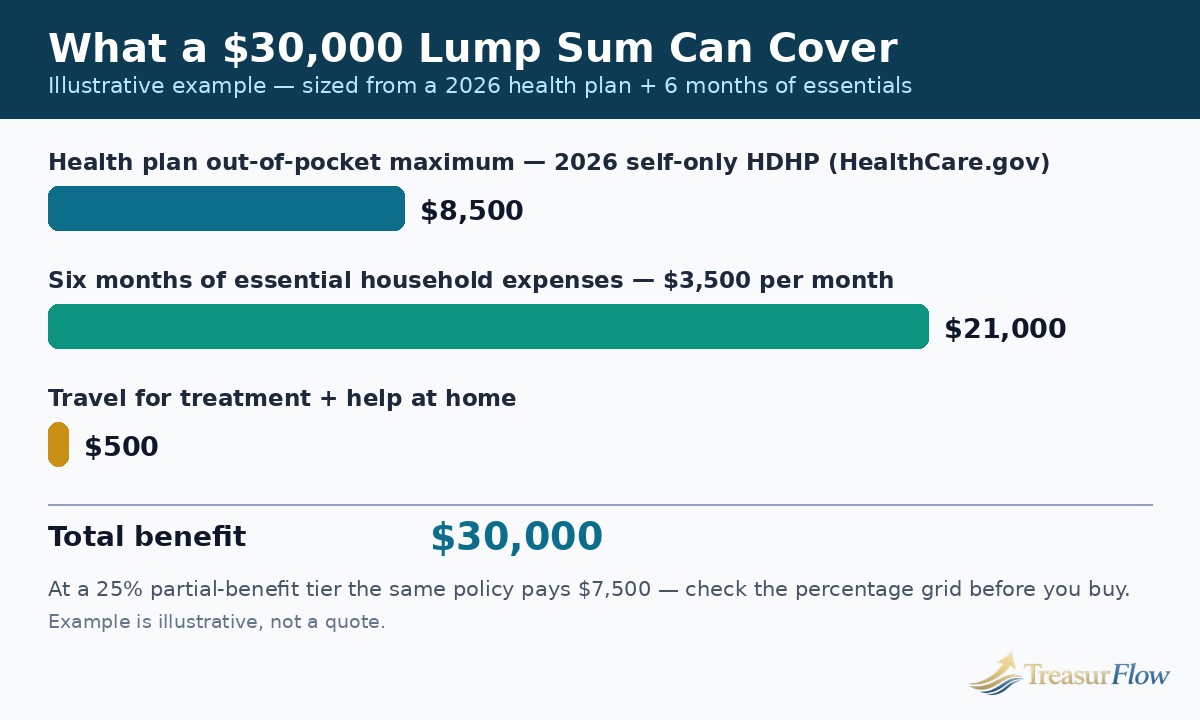
Layer 1: Your health plan’s worst-case year. Start with the most your health insurance can ask you to pay in a bad year. For 2026, HealthCare.gov’s HSA-eligible high-deductible plan limits put the out-of-pocket maximum at $8,500 for self-only coverage ($17,000 for family coverage), and Assurity, citing HealthCare.gov, notes the overall maximum out-of-pocket limit for a family reaches $21,200 in 2026. Whatever your own plan’s out-of-pocket maximum is, write that number down. It is the floor of your critical illness target, because a major diagnosis in a single year will very likely take you to it. This is also why critical illness cover pairs so naturally with high-deductible health plans — the pairing NerdWallet illustrates by suggesting that a buyer with a $10,000 deductible might buy a $10,000 critical illness policy to plug that gap.
Layer 2: Months of essential expenses. Add the income shock. List your non-negotiable monthly outgoings — housing, utilities, food, transport, minimum debt payments, insurance premiums — and multiply by the number of months you want the policy to carry. Six months is a reasonable planning horizon for treatment and initial recovery; twelve months is the more cautious version, especially for a sole earner or a self-employed buyer with no disability insurance.
Layer 3: The diagnosis extras. Add a modest allowance for the costs no other product covers: travel and lodging for treatment at a specialist centre, childcare or household help during recovery, and home adjustments. A few thousand dollars is a typical planning allowance; your Layer 3 will be larger if the best care for your likely conditions is far from home.
Illustrative worked example — labelled as such, and built only from the method above. Meet a hypothetical 38-year-old US buyer with an HSA-eligible health plan. Her plan’s self-only out-of-pocket maximum for 2026 is $8,500 (Layer 1, per HealthCare.gov’s published 2026 HDHP limits). Her household’s essential expenses are $3,500 a month, and she wants six months covered: 6 × $3,500 = $21,000 (Layer 2). She adds $500 for travel and household help in the first months, keeping Layer 3 deliberately small because family live nearby: total target = $8,500 + $21,000 + $500 = $30,000. She buys a $30,000 benefit. If she is later diagnosed with a condition that pays at 100%, the $30,000 is designed to absorb her worst-case health-plan year and half a year of essential bills. If her diagnosis instead falls in a 25% tier — bypass surgery on a policy structured like Mutual of Omaha’s — the same policy pays $7,500, which covers most of Layer 1 but little of Layer 2. That is why the percentage grid matters as much as the headline amount, and why some buyers deliberately size up: a $40,000 benefit pays $10,000 even at the 25% tier.
Run the same arithmetic with twelve months of expenses and the target becomes $8,500 + $42,000 + $500 = $51,000 — a $50,000 policy. Neither answer is “correct” in the abstract. The six-month version assumes an employer disability plan or a healthy emergency fund behind it; the twelve-month version is for the buyer who is the safety net. What is incorrect is choosing $10,000 because the premium looked friendly, without ever checking it against your out-of-pocket maximum — on many 2026 health plans, $10,000 barely clears Layer 1 alone.
What Critical Illness Insurance Typically Costs in 2026
Critical illness insurance is priced primarily on four things: your age when you buy, the benefit amount, your tobacco use, and the breadth of the policy — how many conditions, at what percentages, with which riders. Every credible source agrees on the direction of travel: premiums rise steeply with age, which is why the honest way to present cost is as attributed sample rates, not an invented “average.” All figures below are as published by their sources as of October 2026, and your own quote will differ by state, health, and policy design.
The most complete published sample table comes from NerdWallet, using rates sourced from LifeStein.com and stated as valid as of June 2, 2026. These are annual premiums:
| Coverage amount | Age 30 (men) | Age 40 (men) | Age 50 (men) | Age 30 (women) | Age 40 (women) | Age 50 (women) |
|---|---|---|---|---|---|---|
| $10,000 | $87/year | $141/year | $256/year | $78/year | $118/year | $184/year |
| $15,000 | $117/year | $199/year | $372/year | $105/year | $164/year | $263/year |
| $20,000 | $148/year | $257/year | $487/year | $132/year | $210/year | $343/year |
Source: NerdWallet, “Is Critical Illness Insurance Worth the Cost?”, sample rates from LifeStein.com, data valid as of June 2, 2026; rates subject to change.
Three lessons fall out of that table. First, at younger ages this cover is genuinely inexpensive: a 30-year-old man pays $87 a year — about $7.25 a month — for a $10,000 benefit, and $148 a year for $20,000. Second, age roughly triples the price between 30 and 50, and by age 60 the same $20,000 benefit reaches $1,007 a year for men and $640 a year for women in the same table. Buying at 35 instead of waiting until 55 is not a marginal saving; it is a different price category. Third, women pay less than men at every age and amount in these samples, reflecting the underlying claim patterns the rates are built on.
Carrier-published examples fill in the picture at larger benefit sizes. Assurity’s own product page prices a $20,000 base policy for a 32-year-old non-smoking man at $13.21 a month, and a $75,000 benefit example for a 41-year-old non-smoking woman earning $58,000 a year at $65.47 a month. Those two data points bracket the realistic market for many buyers: somewhere between roughly $13 and $66 a month for benefits between $20,000 and $75,000 in your 30s and early 40s, before tobacco use, riders, or a broader condition list push the figure up. Tobacco users should expect to pay materially more — Assurity’s product guide confirms its premiums are explicitly split into tobacco and non-tobacco classes — and return-of-premium features, recurrence benefits, and lifetime terms all add cost on top of the base rate.
Two cautions before you budget around any table, including this one. Sample rates describe the healthiest slice of applicants; a medical history can move you to a higher rate class or an exclusion. And the cheapest policy in a comparison is often cheapest because its definition grid is narrower — fewer conditions at 100%, more at 25%, a longer waiting period. Cost per dollar of benefit is a useful metric only after you have confirmed the cheaper policy actually covers your priority conditions at the full percentage.
When Critical Illness Insurance Is NOT Worth It
A guide that only sells is an advertisement, so here is the other side, plainly. Critical illness insurance is a poor buy in several common situations.
You have not bought the basics first. Critical illness cover is a supplement, not a foundation. If you lack health insurance, have no emergency fund at all, carry no life insurance while others depend on your income, and have no disability protection, a critical illness policy should not jump that queue. NerdWallet makes the priority call explicitly: if you want to protect your family against your death, a life insurance policy should be a higher priority than critical illness insurance, because it is more flexible and its payout applies to a far broader range of scenarios. Fund the foundation, then consider the supplement.
Your real risk is not on the list. The policy pays for named conditions only. If the health event you are actually worried about — a bad back that ends your ability to do physical work, a mental health condition, a chronic illness that grinds rather than strikes — is not a covered definition, the policy will not help, however ill you become. Disability insurance, not critical illness insurance, is the product built for “I cannot work,” whatever the cause.
You already hold strong overlapping cover. A generous employer package — a low-deductible health plan, employer-paid disability insurance with a short elimination period, and an existing voluntary critical illness benefit — plus a six-to-twelve-month emergency fund may already cover the gap this product fills. Buying a second, standalone policy in that position can mean paying twice to insure the same deductible. Check what you already have during open enrollment before adding more.
A pre-existing condition guts the value. If you have already been diagnosed with, treated for, or investigated for one of the core conditions, expect waiting periods, look-back clauses, exclusions, or a decline. Assurity’s disclosure — no benefits for a specified disease caused by a pre-existing condition until the policy has been in force for six months — is a mild version of a market-wide pattern. A policy that excludes the very diagnosis you fear most may still cover the others, but price it with clear eyes.
You are buying late and the premium has outrun the benefit. The sample rates above show the pattern: by age 60, $20,000 of cover costs a man in the sample table $1,007 a year. Over a decade, that is more than $10,000 of premium for a $20,000 maximum benefit that pays only on a listed diagnosis. At some point the arithmetic favours directing the same money into savings, an HSA if you are eligible, or other protection. That point arrives at different ages for different people, but run the ten-year premium total before you buy at older ages — and remember that standalone issue ages commonly cap at 64, so “later” has a hard deadline.
You cannot sustain the premium. A lapsed policy pays nothing and refunds nothing (unless it carries a return-of-premium feature you have paid extra for). If the premium only fits your budget in a good month, choose a smaller benefit you can hold for decades over a larger one you will drop in year two. In this product, a modest policy kept is worth far more than an impressive policy lapsed.
None of this makes critical illness insurance a bad product. For a healthy 30- or 40-something with a high-deductible health plan, dependants, a mortgage, and thin savings — especially a self-employed buyer or gig worker with no employer disability plan to fall back on — it remains one of the most cost-effective ways to insure the specific, common, financially violent event of a major diagnosis. The skill is matching the product to the gap, which is the whole point of the sections above.
Related Guides
- Best Life Insurance 2026 — the foundation cover to put in place first, and the policies critical illness riders attach to.
- Best Life Insurance for Seniors Over 70 — how protection priorities change after standalone critical illness issue ages have passed.
- Best Homeowners Insurance 2026 — protect the home your critical illness benefit is designed to keep you in.
- Best Travel Insurance 2026 — medical emergencies away from home are the other health-cost shock worth planning for.
Helpful Official Resources
- National Association of Insurance Commissioners (NAIC) — the state regulators’ organisation: consumer guides, company complaint and financial information, and links to your state insurance department.
- HealthCare.gov — High-Deductible Health Plans and HSAs — the official 2026 deductible and out-of-pocket limits used in the sizing example in this guide.
- CDC — Prevalence of Selected Chronic Conditions Among Adults Age 45 and Older (2024 NHIS) — federal survey data on how common heart disease, cancer, and stroke are among older US adults.
- American Heart Association Newsroom — the AHA statistics update behind the heart attack and stroke figures cited in this guide.
- American Cancer Society — Cancer Facts & Figures 2025 — source of the projection of 2,041,910 new US cancer cases in 2025.
Critical Illness Questions Buyers Ask Before They Count on a Lump Sum
What does critical illness insurance actually pay for?
Critical illness insurance pays you a lump sum of cash if you are diagnosed with a condition named in your policy, such as invasive cancer, a heart attack, or a stroke, and your diagnosis meets the policy’s definition of that condition. The money is paid directly to you, not to a hospital, and you can spend it on anything: your health plan’s deductible and out-of-pocket costs, lost income, mortgage or rent, travel for treatment, or childcare while you recover. It does not pay your medical bills for you, and it pays nothing for illnesses that are not on the policy’s covered list.
Is critical illness insurance the same as health insurance?
No. Health insurance pays your doctors and hospitals for covered treatment, after you pay your deductible, copays, and coinsurance. Critical illness insurance is supplemental coverage that pays cash to you after a covered diagnosis, and it is not a substitute for a health plan. The two are designed to work together: your health plan covers the treatment itself, while the critical illness lump sum covers the deductible and out-of-pocket maximum your health plan leaves to you, plus the non-medical costs of being seriously ill, such as lost wages and travel, that health insurance never pays.
How much critical illness coverage should I buy?
A practical method is to add three layers: your health plan’s out-of-pocket maximum for one year, six to twelve months of your household’s essential expenses, and a small allowance for travel and help at home. For example, a buyer with an $8,500 out-of-pocket maximum and $3,500 a month in essential expenses who wants six months of expenses covered would target $8,500 plus $21,000, or about $30,000 of coverage. Buyers with dependants, a mortgage, or no disability insurance usually aim higher, toward $50,000 or more. US policies commonly offer benefit amounts from $5,000 to $100,000.
What does critical illness insurance typically cost in 2026?
Cost depends mainly on your age, benefit amount, and tobacco use. Sample annual rates published by NerdWallet from LifeStein.com, valid as of June 2, 2026, show a $20,000 policy costing $148 a year for a 30-year-old man and $132 a year for a 30-year-old woman, rising to $487 a year for a 50-year-old man and $343 a year for a 50-year-old woman. Assurity publishes examples of $13.21 a month for a $20,000 policy for a 32-year-old non-smoking man and $65.47 a month for a $75,000 benefit for a 41-year-old non-smoking woman. Premiums rise steeply with age, so buying younger is significantly cheaper.
Does critical illness insurance cover pre-existing conditions?
Generally, not right away, and sometimes not at all. Many policies exclude or delay benefits for conditions you had, were treated for, or were investigated for before the policy started. For example, Assurity discloses that it will not pay benefits for a specified disease caused by a pre-existing condition until the policy has been in force for six months, and some products apply multi-year look-backs for cancer and heart conditions. This is why critical illness insurance is best bought while you are healthy. Always read the pre-existing condition clause and the waiting period in the actual policy before you buy.
Is a standalone policy better than a critical illness rider on life insurance?
Neither is automatically better; they solve the same problem differently. A standalone policy pays its own benefit and leaves your life insurance death benefit untouched, stays with you if you change jobs, and usually offers larger benefit amounts and broader condition lists, but it costs more and requires its own application and health questions. A critical illness rider on a life insurance policy is usually cheaper and simpler to buy, but the amount it pays you for an illness is typically subtracted from the death benefit your beneficiaries later receive. Choose a standalone policy if protecting the full death benefit matters; choose a rider if budget and simplicity matter most.
Conclusion: Buy the Definition, Not the Headline
Critical illness insurance is neither the essential everyone must own nor the waste of money its critics describe. It is a targeted tool: a lump sum of unrestricted cash, delivered at the moment a major diagnosis turns your household finances upside down, priced — at younger ages especially — low enough that sample rates for $20,000 of cover start under $150 a year. For US buyers with a high-deductible health plan, people who depend on their income, and thin savings to absorb a shock, it fills a gap that health insurance, disability insurance, and life insurance each leave open in a different way.
If you take one discipline from this guide, make it this: shop on definitions. Confirm that the conditions you most fear are covered at 100%, not 25%. Read the cancer, heart attack, and stroke definitions word for word. Find the waiting period, the pre-existing condition clause, and any survival period before you sign, not after you are diagnosed. Size the benefit from your out-of-pocket maximum and your monthly essentials, the way the worked example does, instead of picking the amount with the friendliest premium. Then get quotes from at least two channels — a standalone carrier such as Mutual of Omaha or Assurity, and whatever your employer offers through carriers like Guardian, Colonial Life, Aflac, or MassMutual — because the cheapest good policy is often sitting in an open-enrollment packet you have never opened.
Do that, and the best critical illness insurance 2026 has to offer stops being a marketing label and becomes what it should be: a defined amount of cash, on defined terms, standing between a diagnosis and a financial crisis.
Disclaimer: This article is for general information and education only and is not insurance, medical, tax, or financial advice. Product features, covered conditions, definitions, benefit amounts, and premiums vary by carrier and by state, and the sample rates cited were published by their sources as of October 2026 and are subject to change. Read the actual policy — including its definitions, exclusions, waiting periods, and pre-existing condition clauses — before buying, and consider speaking with a licensed insurance professional about your own circumstances.

Muhammad Zakir is the founder of Treasurflow and the author of its personal finance guides. He researches consumer banking, credit, and personal loans, and every guide cites primary sources such as the CFPB, FDIC, FTC, and IRS. His content is educational and is not personalized financial advice.