
Most buyers meet the USDA loan backwards. They fall in love with a house, make an offer, and only then discover that the address sits on the wrong side of an eligibility line — or that their household income, counted the USDA way, is $900 over the county limit. At that point the “free” zero-down loan has already cost them an inspection, an appraisal deposit and three weeks.
This guide works in the opposite order, because that is how the program itself works. The best USDA loans 2026 are not really chosen from a list of lenders. They are won or lost at two gates that have nothing to do with any lender at all: Gate 1 is the property address, and Gate 2 is your total household income. Pass both gates and you have access to one of the last true 100% financing programs in American housing — no down payment, a 1% upfront guarantee fee you can finance into the loan, and a 0.35% annual fee that undercuts FHA mortgage insurance by a wide margin. Fail either gate and no lender, however good, can save the file.
So this article starts with eligibility, not advertising. Only then do we name lenders — five of them, matched to five different buyer profiles, from the USDA’s own top originating lender for the third consecutive year to a builder-integrated option for new construction. We finish with a realistic application timeline, a USDA vs FHA vs VA decision framework, and straight answers to the questions rural buyers ask before they apply.
One promise on numbers before we start: USDA does not publish lender interest rates, and neither do most USDA lenders in any official, guaranteed form. Any website quoting you an exact “USDA rate today” without taking an application is estimating. Every rate in this article is therefore labelled illustrative, every fee percentage is date-stamped October 2026, and every program rule below was checked against USDA Rural Development’s own program pages. Your job is not to memorize a rate. Your job is to pass the two gates, understand the fee structure, and then make at least three approved lenders compete on price for the same loan.
Related Guides
– Best Mortgage Refinance 2026 — why many USDA borrowers plan a refinance into a conventional loan once they reach 20% equity, the only clean way to end the USDA annual fee.
– How to Save Money for a House While Renting in the USA (2026) — zero down does not mean zero cash: use this plan to build the closing-cost and reserves fund a USDA purchase still needs.
– Best Personal Loans 2026 — a useful comparison point for unsecured borrowing costs, and a reminder of why a personal loan should never be used as a mortgage down payment.
– Best Homeowners Insurance 2026 — insurance is escrowed into every USDA monthly payment, so shopping this line item lowers your payment from month one.
Helpful Official Resources
– USDA Rural Development — Single Family Housing Guaranteed Loan Program : the primary program page for the Section 502 Guaranteed Loan Program described throughout this guide.
– USDA Rural Development — Rural Development programs and services : the wider Single Family Housing Programs hub, including the Direct loan and home repair programs, with links to the official income and property eligibility tools.
– Consumer Financial Protection Bureau — Loan Estimate and Closing Disclosure explainers : the CFPB’s plain-language walkthrough of the two forms you will use to compare USDA lenders and catch fee changes before closing.
– Consumer Financial Protection Bureau — When do I get a Closing Disclosure? : you must receive this form at least three business days before closing — use that window to compare final costs against your Loan Estimate.
What a USDA Loan Actually Is — and What It Is Not
A USDA loan, in the form almost every buyer uses, is the Section 502 Guaranteed Loan Program, run by USDA Rural Development. The structure surprises people: the USDA does not lend you the money. An approved private lender — a bank, credit union or mortgage company — originates, underwrites and funds the loan, and the USDA guarantees 90% of the loan note to that lender. That guarantee is what makes a lender willing to offer 100% financing with no down payment to a moderate-income household. If the borrower defaults, the government’s backing absorbs most of the lender’s loss, so the lender can say yes where a conventional loan would demand 3%, 5% or 20% down.
Three consequences follow from that structure, and understanding them will save you confusion later. First, because the lender is a private business, interest rates, lender fees and credit overlays vary by lender — the USDA sets the program rules, not your rate. Second, because the USDA is guaranteeing the loan, it gets to set eligibility rules that protect the program’s mission: the home must be in an eligible rural area, it must be your primary residence, and your household income must sit at or below 115% of the area median income. Third, because the guarantee is not free, you pay two guarantee fees — the price of zero down — which we dissect in detail below.
It is also worth separating the Guaranteed program from its sibling, the Section 502 Direct loan. Direct loans are made by the USDA itself to very-low and low-income households, can carry payment assistance that reduces the effective interest rate substantially, and involve applying through a Rural Development office rather than a lender. They are a valuable program, but they are not what lender comparison guides — including this one — are about, they serve a much lower income band, and funding and processing timelines are different. When an advertisement, a neighbour or another website says “USDA loan,” they almost always mean the Guaranteed program through a lender. So does this article, unless we say otherwise.
Finally, what a USDA loan is not: it is not a farm loan. You cannot use it to buy a working farm, an income-producing property, a second home or a vacation cabin. It finances an adequate, modest, decent, safe and sanitary dwelling that you will live in as your primary residence — typically a single-family home, an eligible condo, a townhouse, or in many cases a manufactured home that meets program requirements. It is also not restricted to first-time buyers. Repeat buyers can use it, provided they meet the occupancy, income and property rules and do not retain another home that makes them ineligible under lender and program review.
Gate 1: The Address — How USDA Decides What Counts as “Rural”
The population rule behind the map
USDA eligibility is geographic, and the boundary is drawn by statute and census data, not by how a place feels when you drive through it. In general, eligible areas include open country and communities with populations up to about 35,000 that are rural in character, with the framework built around smaller thresholds — places up to 10,000, and certain places between 10,001 and 20,000 outside metropolitan areas that lack adequate mortgage credit — plus grandfathered areas that were eligible under earlier census counts and, under the current rules, can keep that status if they have grown to no more than 35,000, remain rural in character and still show a shortage of mortgage credit for lower- and moderate-income families. The practical translation is simple: small towns qualify, the outer rings of many metro areas qualify, and a surprising number of ordinary suburbs — with chain stores, subdivisions and a commute into a city — sit inside eligible territory.
How to check an address properly
Do not guess from a ZIP code, a town name or a real-estate listing’s marketing copy. Eligibility can change at a street boundary: one side of a road can be eligible and the other side not, and two houses in the same subdivision phase can occasionally fall on different sides of a line drawn from census geography. The correct process is:
- Go to the official USDA income and property eligibility site linked from the Rural Development program pages.
- Enter the exact property address — street number included — not just the town or ZIP.
- Read the result for the specific program (Single Family Housing Guaranteed).
- Save or print the result for any home you seriously pursue, and have your lender re-verify it early, before you pay for an appraisal.
Build this check into your house hunting, not after it. Tell your real-estate agent that USDA eligibility is a hard filter, on the same level as price and bedrooms. If you are relocating, reverse the usual search: start with the eligibility map, identify eligible pockets within your commute tolerance, and only then look at listings inside them. Buyers who do this routinely discover eligible streets fifteen minutes from streets that are ineligible — at zero-down prices they assumed were impossible near their jobs.
Property standards: the second half of Gate 1
An eligible address is necessary but not sufficient. The property itself must meet program standards for a decent, safe and sanitary dwelling, verified through a USDA-eligible appraisal and lender review. In practice this means the home needs sound structure, a roof and systems in working order, safe water and waste disposal — with well and septic testing where applicable — and no health or safety defects that the appraiser flags as required repairs. This is where USDA purchases of rough fixer-uppers often stall: the standard Guaranteed purchase loan is built for homes that are move-in ready or need only repairs that can be properly handled within program and lender rules, not for properties that cannot be lived in safely at closing.
Gate 2: The Income Limit — 115% of Area Median Income, Counted the USDA Way
Whose income counts (hint: not just the borrower’s)
The second gate is the one that eliminates households who assumed they were safely “middle income.” The Guaranteed program caps household income at 115% of the area median income for the county and household size. The key word is household. USDA counts the income of all adult household members who will live in the home — not only the people named on the mortgage. A spouse who is not a borrower still counts. An adult child living at home with a job counts. A parent moving in with retirement or work income counts. This rule exists because the program measures the economic position of the household that will benefit from the home, not just the legal structure of the loan application, and no, restructuring who is “on the loan” does not change it.
Income limits are published by county and by household size, with one band for households of 1–4 people and a higher band for households of 5–8, and they are higher in higher-cost counties. There is no single national USDA income limit, and any article that gives you one number for the whole country is misleading you. You must look up your exact county.
A worked income-limit example (illustrative county)
Work through this example slowly, because the deductions are where borderline households are rescued. All figures are illustrative, chosen to show the method — your county’s real limit and median will differ.
- Step 1 — Find the ceiling. Suppose the area median income for your county is $100,000 for a 1–4 person household. The Guaranteed limit is 115% of that: $100,000 × 1.15 = $115,000.
- Step 2 — Add up gross household income. Borrower: $72,000 salary. Spouse (not on the loan): $34,500. Adult daughter living at home: $12,000 from part-time work. Total gross household income: $72,000 + $34,500 + $12,000 = $118,500. Compared naively with the $115,000 ceiling, this household looks $3,500 over the limit — and many buyers quit here.
- Step 3 — Apply USDA deductions. The household pays $4,800 a year in childcare for a child under 12 so both parents can work, and it has one dependent other than the borrowers, for whom USDA allows a $480 deduction. Adjusted household income: $118,500 − $4,800 − $480 = $113,220.
- Step 4 — Compare correctly. $113,220 is below the $115,000 limit. The household passes Gate 2 — by $1,780 — once income is counted the way the program actually counts it.
USDA’s deduction framework also includes, among other items, deductions connected with elderly households and with medical or disability-related expenses for eligible household members, and the details matter at the margin. Two lessons follow. First, never self-disqualify on gross income alone; run the official income eligibility tool and let a lender who does USDA volume check your deductions. Second, never assume you pass on a rough guess either — a household genuinely over the limit after deductions is ineligible, and discovering that in underwriting wastes everyone’s money. Check Gate 2 with real pay documents before you shop, which is exactly what a good pre-approval does.
Income is a ceiling, not a target: you still have to afford the payment
Passing the income limit only says you are not too well-off for the program. Your lender must separately confirm you earn enough, dependably enough, to repay. Expect the lender to document stable income and employment history, verify it, and measure your debts. USDA guidelines commonly reference a housing ratio around 29% and a total debt ratio around 41% of gross monthly income, with the automated underwriting system — USDA’s Guaranteed Underwriting System, known as GUS — sometimes approving higher ratios where compensating factors exist, such as strong credit, reserves or minimal payment increase. Treat 29/41 as a planning anchor, not a promise: car payments, student loans and credit-card minimums all compete with the mortgage inside that total ratio, and paying down a revolving balance before applying can move a borderline file more than a small pay rise does.
Credit: The Requirement USDA Does Not Set
Here is the most misreported fact in USDA lending: USDA sets no minimum credit score for the Guaranteed program. There is no line in the program rules that says 640, 620 or any other number. What exists instead are lender overlays — each approved lender’s own minimums, set according to its risk appetite and its confidence in getting clean automated approvals.
In practice, as of October 2026, most USDA lenders work most smoothly at a 640 credit score or above, because that is roughly the level at which GUS automated approval becomes realistic for a typical file. Some lenders publish lower floors or consider manual underwriting below 640, where a human underwriter reviews compensating factors, rental history and explanations for past credit problems — and some of the lenders profiled later in this guide are known for working with lower or alternative credit profiles on government loans. Manual underwriting is slower, more document-heavy and less certain. It is a door, not a highway.
What lenders are really reading in your credit file, beyond the three-digit score, is the pattern: recent late payments on housing or installment debt hurt more than an old collection; a bankruptcy or foreclosure needs the applicable waiting period and re-established credit; and a thin file with no tradelines can be as awkward as a bruised one, though non-traditional credit references such as rent and utility history may help in manual cases. If your score sits in the low 600s, the highest-value move is rarely lender shopping — it is 60 to 90 days of boring repair: pay revolving balances below 30% of their limits (lower is better), dispute genuine errors, make every payment on time, and do not open new credit or buy a car between pre-approval and closing. A 20-point score improvement can change both your approval path and your price, because while USDA does not set your rate, your lender’s pricing absolutely responds to credit risk.
The True-Cost Anatomy of a USDA Loan
Zero down is the headline. This section is the fine print, translated into dollars. All program fee percentages below are current as of October 2026; USDA can adjust guarantee fees by fiscal year, so confirm the fee in force on your loan’s obligation date with your lender.
The two guarantee fees
- Upfront guarantee fee: 1% of the loan amount. On a $300,000 loan that is $3,000. Almost every borrower finances it — adds it to the loan balance — rather than paying cash at closing, which USDA expressly allows. Financing it means you start with a $303,000 balance on a $300,000 purchase and pay interest on the fee over time; paying it in cash costs more on closing day and less over the life of the loan. Either way, compare this 1% honestly against FHA’s 1.75% upfront mortgage insurance premium below.
- Annual guarantee fee: 0.35% of the outstanding loan balance, collected monthly inside your mortgage payment. On a $300,000 balance, 0.35% is $1,050 a year, or $87.50 a month in year one. If you financed the upfront fee, the balance is $303,000 and the year-one figure is about $88.38 a month — we use the round $87.50 figure on the $300,000 base throughout this guide’s comparisons and label it each time. The fee is recalculated on the declining balance, so it shrinks slowly as you pay principal down. Critically, unlike conventional PMI, it does not fall off at 20% equity — it runs for the life of the USDA loan. The exit is a refinance into a conventional loan once you have the equity and credit to qualify, which is why the refinance guide linked at the top of this article belongs in a USDA borrower’s long-term plan from day one.
There is no separate private mortgage insurance (PMI) on a USDA loan. The guarantee fees are the insurance cost of the program — the mechanism that funds the 90% guarantee standing behind your lender.
The worked example: a $300,000 purchase, fully computed
Assumptions, all labelled: purchase price $300,000; 30-year fixed term; an illustrative interest rate of 6.50% used for every loan type so the comparison isolates down payment and insurance costs rather than pretending we know each program’s live rate — USDA does not publish official lender rates, and your actual rate will be set by your lender based on credit, market and lock timing; taxes and homeowners insurance are excluded from the table because they are property-specific and identical across loan types for the same house, but they will be escrowed into your real payment and you must budget for them.
USDA Guaranteed. Down payment: $0. Base loan: $300,000. Upfront guarantee fee: 1% × $300,000 = $3,000, financed. Total loan: $303,000. Principal and interest at 6.50% on $303,000: $1,915.17 a month. Annual guarantee fee in year one: about $87.50 a month on the $300,000 base balance. Combined principal, interest and guarantee fee: about $2,002.67 a month, before taxes and insurance. Cash needed at closing: closing costs only (see below), minus any seller concessions, gift funds or financed amounts the appraisal supports.
Hold that $2,002.67 in mind. It is the number FHA, conventional and VA now have to beat — and the way each of them tries is instructive.
Closing costs: the cash zero-down does not erase
Budget closing costs of roughly 2% to 5% of the purchase price on a typical USDA purchase — $6,000 to $15,000 on our $300,000 example — covering lender origination and processing, appraisal, credit report, title search and insurance, recording, and prepaid items such as the first year of homeowners insurance and property-tax escrow deposits. Rural appraisals and well or septic testing, where required, can add cost that city buyers never see. Three program features exist specifically to keep this bill from killing a zero-down purchase:
- Seller concessions up to 6% of the purchase price — up to $18,000 on a $300,000 sale — can be applied to your closing costs and prepaids. In a balanced or buyer’s market, asking for a seller credit is often worth more to a USDA buyer than a small price cut, because it attacks the cash-to-close problem directly. Note that a concession must be negotiated in the contract; it is not automatic, and in a hot seller’s market it may be refused.
- Gift funds are allowed for closing costs. A family member’s documented gift can cover part or all of the cash to close. Expect gift-letter and paper-trail requirements — lenders must source the funds — so tell your lender about any gift at application, never as a surprise deposit mid-underwriting. USDA does not need a down-payment gift (there is no down payment), which makes gifts simpler here than on FHA or conventional loans, but documentation is still mandatory.
- Costs can sometimes be financed above the price. If the home appraises for more than the purchase price, eligible closing costs may be financed into the loan up to the appraised value. Do not plan your purchase around a hoped-for high appraisal — treat this as a pleasant contingency, not a strategy.
USDA vs FHA vs Conventional vs VA: The Same House, Four Payments
The table below puts all four mainstream paths on the same $300,000 purchase, the same 30-year term and the same illustrative 6.50% rate, so only structure differs. FHA figures use its standard structure for a typical low-down-payment loan as of October 2026: 3.5% down, a 1.75% upfront mortgage insurance premium (UFMIP), and a 0.55% annual mortgage insurance premium (MIP). Conventional assumes 3% down for an eligible first-time or income-qualified buyer and an illustrative PMI cost of 0.50% a year — real PMI pricing is credit- and coverage-dependent and can be materially lower for strong credit or higher for weak credit. VA assumes a first-use purchase with no down payment and the standard 2.15% funding fee for that profile, financed; borrowers with a service-connected disability rating may be exempt from the funding fee entirely, which improves VA’s numbers further, and VA charges no monthly mortgage insurance at all.
| Cost item (illustrative) | USDA Guaranteed | FHA | Conventional (3% down) | VA (first use, $0 down) |
|---|---|---|---|---|
| Down payment (cash) | $0 | $10,500 | $9,000 | $0 |
| Base loan amount | $300,000 | $289,500 | $291,000 | $300,000 |
| Upfront insurance / guarantee / funding fee | 1% = $3,000 | 1.75% = $5,066 | $0 | 2.15% = $6,450 |
| Total loan with fee financed | $303,000 | $294,566 | $291,000 | $306,450 |
| Principal & interest at 6.50% | $1,915.17/mo | $1,861.86/mo | $1,839.32/mo | $1,936.97/mo |
| Monthly insurance cost, year 1 | $87.50 (0.35% annual fee) | $132.69 (0.55% MIP) | $121.25 (0.50% PMI, illustrative) | $0 |
| P&I + insurance, year 1 | ~$2,002.67/mo | ~$1,994.55/mo | ~$1,960.57/mo | ~$1,936.97/mo |
| Insurance can end without refinancing? | No — life of loan; refinance to exit | Only in limited cases (e.g. 10%+ down, MIP ends after 11 years); otherwise life of loan | Yes — PMI removable at 20% equity, auto-terminates at 22% | No monthly insurance to end; funding fee is one-time |
| Income limit | Yes — 115% of area median | No | No (some low-down products have them) | No |
| Area restriction | Yes — eligible rural areas only | No | No | No |
| Who it is for | Moderate-income buyers in eligible areas | Buyers with lower credit or ineligible areas/incomes | Buyers with stronger credit and some cash | Eligible veterans, service members and surviving spouses |
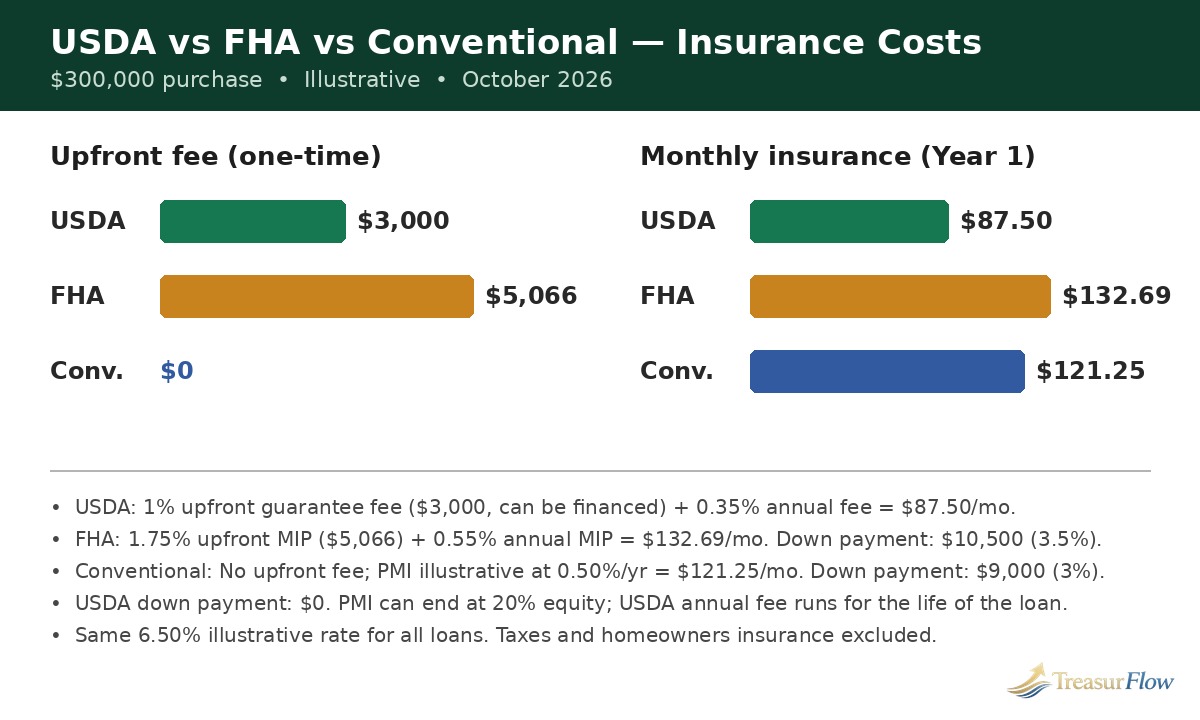
Read the table the way an underwriter would, not the way an advertiser would. VA wins on monthly cost — but only eligible military-connected borrowers can use it, which is most readers’ disqualifier. Conventional shows the lowest P&I-plus-insurance among the three open programs, but it required $9,000 down, its PMI price swings hard with credit score, and at 3% down with a mid-600s score a real PMI quote can erase that apparent edge entirely; conventional also gets harder, not easier, as credit weakens, exactly when USDA stays comparatively forgiving. FHA lands within about $8 a month of USDA on this illustration — essentially a tie on payment — but it demanded $10,500 in cash up front, charges $2,066 more in upfront insurance, and its monthly MIP is $45.19 higher, a gap that widens in USDA’s favour the longer you hold the loan at these balances. USDA’s distinctive win is not the monthly line at all. It is the cash-to-close line: $0 down, the lowest upfront fee of any government program here, and up to 6% seller help against what remains. For the household this program targets — steady income, thin savings — cash preserved at closing is worth more than a single-digit monthly difference.
The Best USDA Lenders in 2026, Matched to Buyer Profiles
A necessary honesty note before the names. No responsible guide can rank USDA lenders by interest rate, because USDA lenders do not officially publish guaranteed USDA rates that a third party can verify and freeze in an article — rates move daily, depend on your credit and lock, and are quoted on a Loan Estimate after application. What can be ranked is verifiable: USDA origination volume and awards, third-party editorial selections, lender specialisation, and the kind of borrower each lender’s model visibly serves. That is how the five picks below are built. Get quotes from at least two of them — the CFPB’s long-standing guidance to shop multiple lenders exists because the spread between offers on the same file is routinely worth thousands of dollars over the loan’s life.
1. Guild Mortgage — Best overall for USDA volume and government-loan depth
If one lender has earned the right to be the default first call, it is Guild. In June 2026, at the USDA’s National Lender of the Year Awards ceremony in Washington, D.C. (June 17, 2026), Guild Mortgage was named the USDA Top Originating Lender for the third consecutive year and the 2026 USDA Manufactured Housing Champion — announced by Guild on June 25, 2026. That is not a review-site badge; it is the program administrator’s own recognition, repeated three years running, and it reflects sustained origination volume in exactly the loan type you are shopping for. Guild also ranked near the very top of USDA purchase-loan volume in independent HMDA-based lender counts for 2025, and specialist lender comparisons credit it with guiding borrowers with lower or alternative credit profiles, including government-loan files well below prime territory.
Choose Guild if you want a large, branch-supported lender whose USDA desk is a core business rather than a side product — particularly if your file has any wrinkle (self-employment income, a manufactured home, a prior credit event) that benefits from a loan officer who has closed this exact program hundreds of times. As with every lender here, confirm the credit floor and fees for your file on a written Loan Estimate; published minimums in comparison tables vary because overlays change.
2. Freedom Mortgage — Best for a large, established government-loan specialist
Freedom Mortgage earns its place through an independent editorial selection: Credit Karma’s best mortgage lenders roundup names Freedom Mortgage its best lender for USDA loans. Freedom is one of the country’s largest government-loan lenders by volume across FHA, VA and USDA, and that specialisation shows up in process: high-volume government lenders tend to have underwriters who live inside agency guidelines daily, submission pipelines to USDA that are routine rather than improvised, and servicing operations built for government loans after closing.
Choose Freedom if you value scale and a lender for whom a USDA file is assembly-line normal — for example, a straightforward purchase with clean documentation where your priority is a competitive quote from a lender that will not learn the program on your file.
3. Fairway Independent Mortgage — Best for branch access with a modern, hybrid closing
Fairway Independent Mortgage Corporation is a perennial top-five USDA lender by national volume in USDA-reported lender rankings, with a large branch footprint and a process built around local loan officers backed by digital tools — including USDA loan qualifier tools online and hybrid closing options that let part of the signing happen electronically. Specialist comparisons consistently place Fairway in the national USDA top tier by loans originated, and its model is deliberately the opposite of a faceless call centre: a named local officer, in a market near the property, who knows local appraisers, local title companies and the specific county’s income limit without looking it up.
Choose Fairway if you are buying in a community where you want a human you can sit across a desk from, but you still want app-based document upload, status tracking and a closing that does not require signing forty documents in wet ink at a title office. Fairway also suits buyers whose purchase involves a responsive seller timeline, since a local team that controls its own file movement can be an advantage when a USDA commitment needs chasing. Verify your specific branch’s USDA volume — within any national network, individual offices vary — by asking the direct question: “How many USDA Guaranteed loans did you personally close last year?”
4. Neighbors Bank — Best for first-time rural buyers who want guidance
Neighbors Bank is a genuine USDA specialist rather than a generalist with a USDA page: lender comparisons place it in the top three nationally for USDA loan volume, and its reputation is built on education — a comprehensive USDA homebuying guide and a process aimed at first-time and rural buyers who need eligibility explained before they need a rate quoted. Reviewers of its USDA offering note the standard program shape — no down payment, income up to 115% of area median, primary residence in an eligible area — with a typical credit expectation in the low-to-mid 600s, consistent with the broader market’s 640-centred practice.
Choose Neighbors if this is your first purchase and your honest self-assessment is that you need a guide, not just a quote: a lender whose staff will walk the map check, the household-income calculation and the documentation list patiently tends to be worth more to a first-timer than a marginal pricing difference they cannot yet evaluate. Get its quote alongside a volume lender’s, and compare both the numbers and how well each explained them.
5. DHI Mortgage — Best for new construction in eligible areas
DHI Mortgage, the mortgage arm affiliated with homebuilder D.R. Horton, was the runner-up for USDA loan volume in lender comparisons of 2025 originations, and its distinctive strength is integration: when the same corporate family is building the home and financing it, construction timelines, closing coordination and incentive structures can be aligned in a way no outside lender can match. USDA lends enthusiastically on new construction in eligible areas — much new affordable building happens exactly in the small-town and fringe locations the map covers — and a builder-lender that does USDA at volume removes the common failure mode of a great house paired with a lender new to construction files. DHI Mortgage was also named by USDA Rural Development in September 2026 as one of the initial participating lenders in the Single Family Housing Guaranteed Delegated Authority LITE Pilot Program, under which selected high-performing lenders can close USDA loans with delegated pre-closing authority — a structural change aimed at faster closings, and a signal of the agency’s confidence in the participants’ past performance.
Choose DHI if you are buying a newly built home — especially a D.R. Horton home — in an eligible area, and you want one accountable counterparty for build and loan.
How to run your own lender comparison in one afternoon
Whichever names you shortlist, the procedure is identical and it is the highest-paid hour of your home purchase. Apply with two or three USDA-approved lenders within the same short window — mortgage credit inquiries for rate shopping within a focused period are treated as a single inquiry by credit scoring models, so shopping properly does not meaningfully harm your score. Give each lender the same facts, request a Loan Estimate for the same price, term and lock assumption, and compare four numbers: interest rate, lender fees in the loan costs section, lender credits, and estimated cash to close. Ignore verbal quotes entirely. Ask each lender three questions in writing: What credit score does your USDA overlay require? How long is your current USDA turn time from contract to commitment? Who reviews the file if GUS does not issue an automated approval? The answers separate USDA lenders from lenders who merely offer USDA.
The Application Timeline: From Map Check to Keys
USDA purchases commonly take about 30 to 60 days from contract to closing — a little longer than a clean conventional file, because there is an extra reviewer in the chain: after your lender underwrites the loan, the file typically goes to the USDA for its commitment and guarantee review before final closing. Plan around this realistic sequence:
- Days −30 to 0 — Before the offer. Check Gate 1 (address eligibility for neighbourhoods you will shop) and Gate 2 (the official income tool for your county). Get a genuine pre-approval from a USDA lender — documented income, assets and credit — not a five-minute online pre-qualification. A USDA-specific pre-approval that has already tested household income is worth more to a listing agent than a generic letter.
- Days 1–3 — Contract and application. Offer accepted. Your lender issues a Loan Estimate within three business days of application. Read it against the CFPB explainer linked at the top of this guide; this is your cheapest moment to catch errors in price, fee financing and escrow setup.
- Days 4–15 — Documentation and appraisal. You supply pay stubs, W-2s or tax returns, bank statements, gift documentation if any, and explanations for anything unusual. The lender orders the USDA appraisal; the appraiser checks both value and property standards. Required repairs, if any, get negotiated or completed now — this is the stage at which condition problems most often delay USDA files.
- Days 10–25 — Lender underwriting and GUS. The lender runs the file through GUS and its own underwriting. An automated approval moves fast; a manual file adds documentation rounds. Respond to every condition within a day — in practice, borrower response time is the single largest controllable factor in USDA closing speed.
- Days 20–40 — USDA review and commitment. The lender submits the file to the USDA state office, which reviews for program compliance and issues the conditional commitment and, ultimately, the guarantee. Turn times here are outside your lender’s control, which is why choosing a lender with a practised USDA submission pipeline matters.
- Days 35–55 — Clear to close and Closing Disclosure. Final conditions clear, you receive your Closing Disclosure at least three business days before closing, and you compare it line by line with your Loan Estimate. Confirm the upfront fee is financed as agreed, the seller concession appears as a credit, and cash to close matches your funds.
- Closing day. Sign, fund, record, keys. Your first payment typically falls due on the first of the month after next, and your annual guarantee fee is already inside that payment — no separate USDA bill ever arrives.
USDA vs FHA vs VA: A Decision Section, Not a Tie
Rankings end in ties; decisions should not. Use these rules, in order:
If you are eligible for VA, start with VA. No monthly insurance, no down payment and a one-time funding fee — which may be waived entirely with a qualifying disability rating — produce the lowest monthly cost on identical maths, as the table above shows ($1,936.97 versus $2,002.67 on our example). VA has no income limit and no rural map. USDA beats VA for a military borrower only in narrower circumstances: for example, a subsequent-use VA funding fee (higher than first-use) combined with a fully financed USDA fee can narrow or flip the upfront comparison, or entitlement already tied up in another property complicates the VA file. Run both Loan Estimates; do not assume, but do start from VA.
If you are not VA-eligible and you pass both USDA gates, USDA is usually your default. Against FHA, it asks for no down payment instead of 3.5%, charges 1% upfront instead of 1.75%, and charges 0.35% a year instead of 0.55% — on our $300,000 example that is about $45 less insurance every month and $10,500 of cash not required at closing. FHA’s counter-arguments are real but specific: it has no map and no income ceiling, and it is generally more forgiving of lower credit scores, with many lenders approving FHA files in the high 500s with 3.5% down where a USDA file would need manual underwriting or fail an overlay. If your address is ineligible, your household income is over the limit, or your credit cannot clear USDA lender overlays, FHA is not a consolation prize — it is the correct tool, and you should use it without regret.
If your credit is strong and you have some cash, price conventional seriously. A 720-plus score with 3–5% down can produce PMI cheap enough — or, at 20% down, no PMI at all — that conventional overtakes USDA on total cost, with no income limit, no map and PMI that ends at 20% equity instead of a life-of-loan fee. USDA’s annual fee permanence is its structural weakness: a buyer who will stay in the home fifteen years, never move and never qualify to refinance pays that 0.35% for fifteen years. Buyers with strong files should treat USDA as one quote among three, not a religion.
And if you fail a USDA gate today, note that gates move. Income limits update, eligibility maps are revised with census cycles, household composition changes, and credit scores rise. Keep building your closing-cost fund with our guide to saving money for a house while renting, and weigh any other borrowing against our best personal loans 2026 comparison — a mortgage decision is never made in isolation from the rest of your balance sheet.
USDA Loan Questions Rural Buyers Ask Before They Apply
What are the income limits for a USDA loan in 2026?
USDA Guaranteed loans cap total household income at 115% of the area median income for your county and household size. There is no single national limit, because limits are published by county and are higher for households of five to eight people and in higher-cost counties. USDA counts the income of all adult household members, not only the borrowers, but deductions such as childcare expenses and a dependent deduction can lower your countable income. Always check your exact county in the official USDA income eligibility tool before assuming you qualify or do not qualify.
Does USDA set a minimum credit score for a USDA loan?
No. USDA does not set a minimum credit score for the Guaranteed Loan Program. Each approved lender sets its own credit requirements, called overlays, and in practice most lenders work most smoothly with scores of 640 or above because that level makes automated approval through the Guaranteed Underwriting System more likely. Some lenders consider lower scores through manual underwriting with compensating factors such as a strong rental history and low debts. Your exact options therefore depend on the lender, so ask each lender for its USDA overlay in writing.
How much are the USDA guarantee fees in 2026?
As of October 2026, USDA charges an upfront guarantee fee of 1% of the loan amount and an annual fee of 0.35% of the outstanding loan balance. On a $300,000 loan, the upfront fee is $3,000 and it can be financed into the loan, bringing the balance to $303,000. The annual fee is about $87.50 a month in the first year on a $300,000 balance, it is collected inside your monthly mortgage payment, and it continues for the life of the loan unless you refinance into a different loan program.
Can the seller pay my closing costs on a USDA loan?
Yes. USDA allows seller concessions of up to 6% of the purchase price toward your closing costs and prepaid items, which is up to $18,000 on a $300,000 purchase. The concession must be written into your purchase contract, and it does not happen automatically. Gift funds from an eligible donor can also be used for closing costs, with a gift letter and documentation of the transfer. If the home appraises for more than the purchase price, some eligible closing costs may also be financed into the loan up to the appraised value.
How long does a USDA loan take to close?
A USDA purchase typically takes about 30 to 60 days from contract to closing. Your lender first underwrites the loan and runs it through the Guaranteed Underwriting System, and the file is then reviewed by the USDA state office, which issues the commitment and guarantee. That extra government review step is the main reason USDA loans often take longer than a conventional loan. You can shorten the process by supplying documents promptly, responding to underwriting conditions within a day, and choosing a lender with strong USDA volume and an established submission process.
Can I use a USDA loan for a second home or an investment property?
No. A USDA Guaranteed loan can only be used for a home that will be your primary residence in an eligible rural area. Second homes, vacation homes and investment properties are not eligible, and the property cannot be used principally for income-producing business purposes. You do not have to be a first-time buyer, so a repeat buyer who meets the income, credit, property and occupancy rules can use the program, but you must actually live in the home as your main residence after purchase.
Conclusion: Pass the Gates First, Then Make Lenders Compete
The best USDA loan in 2026 is not a brand name. It is a sequence executed in the right order. Check the address on the official map before you fall for a house. Count household income the USDA way — all adults, then deductions — against your county’s 115% limit before you assume anything in either direction. Understand that zero down still involves a 1% upfront guarantee fee you can finance, a 0.35% annual fee worth about $87.50 a month on a $300,000 balance that only a refinance can end, and closing costs that seller concessions of up to 6% and documented gift funds exist to help you cover. On identical maths, that structure beats FHA on upfront cash and insurance cost, loses narrowly on monthly cost to an eligible VA loan, and can be overtaken by conventional financing if your credit is strong and your cash is not thin — which is exactly why you compare all of them on real Loan Estimates instead of advertisements.
Then, and only then, choose the lender: Guild Mortgage for USDA-recognised volume and depth, Freedom Mortgage for large-scale government-loan specialisation, Fairway Independent Mortgage for local branches with a modern closing, Neighbors Bank for patient first-time-buyer guidance, or DHI Mortgage if your home is being built. Apply with at least two, compare the same four numbers, and ask the three USDA questions in writing. A program designed to put moderate-income families into homes in the communities the market underserves is, used properly, one of the fairest deals in American finance. Pass the two gates, respect the true costs, and make lenders earn the loan.

Muhammad Zakir is the founder of Treasurflow and the author of its personal finance guides. He researches consumer banking, credit, and personal loans, and every guide cites primary sources such as the CFPB, FDIC, FTC, and IRS. His content is educational and is not personalized financial advice.