
By Muhammad Zakir
Your checking account should be the quietest part of your financial life. Money comes in on payday, bills go out on time, and what is left stays yours.
That slow drain is exactly why I built this guide around a fee audit, not just a list of logos. The best checking accounts 2026 has to offer share a simple trait: they cost you $0 in monthly fees as of October 2026, they do not punish a low balance, and they make it easy to get your cash without paying for the privilege. From there, the right pick depends on how you actually live — whether you want interest on your balance, cash back on debit spending, an ATM on every corner, a second chance after a rough banking history, or a real branch you can walk into.
In this guide you will find my top picks by use case, a side-by-side comparison table, the real math on what a fee-heavy account costs in a year, and a step-by-step plan for switching without bouncing a payment. Every rate and fee below is date-stamped as of October 2026, because checking account terms change often and a rate from last spring is not a rate you can bank on today.
Related Guides
Helpful Official Resources
Disclosure: Rates, APYs, fees and ATM counts in this article are as of October 2026 and are variable — they can change at any time without notice. Always confirm current terms on the bank’s own website before you open an account. This article is for information only and is not financial advice.
What Your Checking Account Really Costs You Each Year
Most people look at a $12 or $15 monthly fee and shrug. It feels small. The fee audit tells a different story once you add up a full year and stack the other charges that tend to travel with a fee-heavy account.
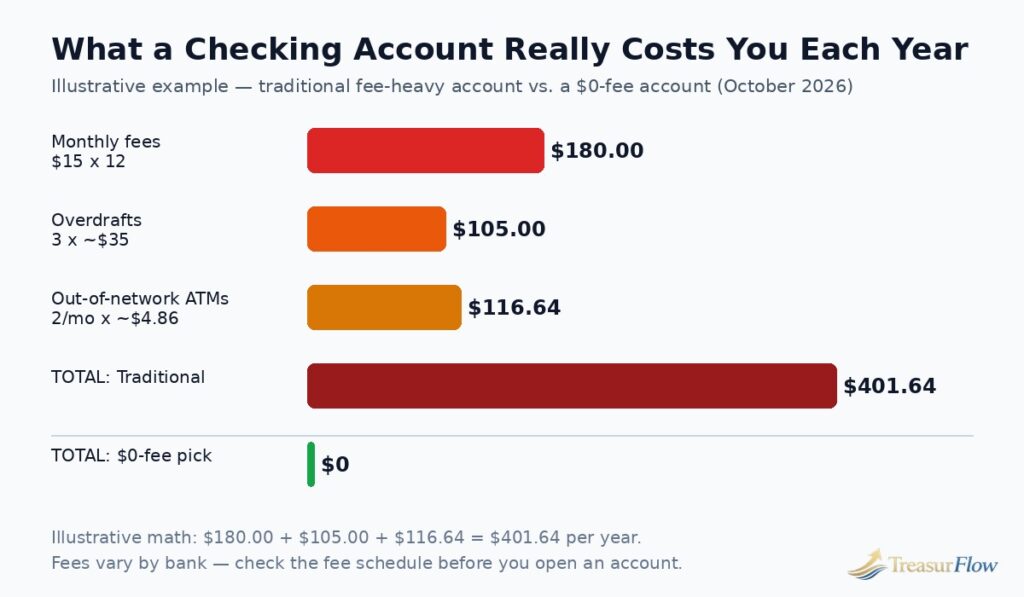
Here is an illustrative example, computed from typical 2026 fee levels. It is not a quote from any single bank — it is a model of what a common pattern looks like over twelve months:
- Monthly maintenance fee: $15 per month × 12 months = $180 per year
- Overdraft fees: 3 overdrafts in a year × about $35 per item, the average cited by the Consumer Financial Protection Bureau = $105 per year
- Out-of-network ATM use: 2 withdrawals per month at a combined cost of about $4.86 per withdrawal × 12 months = $116.64 per year
Add those three lines together and you get $401.64 per year (illustrative). That is $401.64 that bought you nothing — no extra interest, no better service, no rewards. It simply left your account for the right to use your own money. U.S. banks collected $2.96 billion in combined overdraft and non-sufficient funds fees in just the first six months of 2026, according to an analysis of federal call report data, so this is not a rare edge case. It is a business model, and the customer paying the fees is funding it.
Now run the same year through a genuinely no-fee account from this list. Monthly fee: $0. Overdraft fee: $0 at every pick below, though the coverage rules differ. In-network ATM fee: $0, and several picks reimburse out-of-network charges too. Your fee total can fall to $0, and in some cases the account pays you — through interest or cash back — instead of the other way around.
That is the framework for every pick that follows. First, does it pass the fee audit? Second, does it fit your use case? A great APY is worthless if you cannot deposit cash. A huge ATM network does not help if the account requires a banking history you do not have. Read the use cases, not just the headline rates.
The Five Fees That Matter Most
1. Monthly maintenance fee. As of October 2026, traditional accounts commonly charge in the $5 to $20 per month range unless you meet a waiver rule — a minimum balance, a set amount of direct deposits, or both. Every account in this guide charges $0 with no waiver dance required.
2. Minimum balance and minimum-to-open rules. A fee that is “waivable” is still a fee waiting for a bad month. All of my main picks require $0 to open and have no minimum balance requirement, as of October 2026, unless I note otherwise in that account’s section.
3. Overdraft and NSF fees. The industry has moved a lot since 2019, and several major banks have eliminated overdraft fees entirely. Still, where a fee exists it averages about $35 per item. Every pick below charges $0 in overdraft fees as of October 2026 — the difference is how much of a shortfall each one will cover for free, and what you must do to qualify for that coverage.
4. ATM fees. There are two charges hiding in one withdrawal: your bank’s out-of-network fee and the ATM owner’s surcharge. A big fee-free network, or a reimbursement policy, kills both. Network size is why I list ATM counts for every pick.
5. The quiet fees. Paper statements, stop payments, outgoing wires, foreign transactions and cash-deposit charges at retail stores can still appear even in a “no-fee” account. I flag the ones that matter for each pick, and you should read the bank’s fee schedule before you apply — the CFPB recommends exactly that step for any new checking account.
How I Picked These Accounts
I started with the fee audit: no monthly fee, no minimum balance trap, and no overdraft fee as of October 2026. I then verified APYs, ATM networks and overdraft policies against bank and issuer pages and reputable roundups from sources including NerdWallet, Money and The Penny Hoarder in October 2026. Accounts that needed a large balance or a complicated set of transactions to avoid a fee did not make the main list. Finally, I sorted the survivors by job: one best overall, one for APY without hoops, one for a high APY with hoops, one for cash back on debit, one for ATM access and travel, one second-chance option, and one for branch access. If an account is excellent at one job and weak at another, I say so plainly.
A note on safety: every bank pick below is FDIC-insured up to $250,000 per depositor, per ownership category, as of October 2026. Chime is a financial technology company, not a bank — its accounts are provided through partner banks, Stride Bank, N.A. and The Bancorp Bank, N.A., which are FDIC members, so deposits are insured through those banks. You can verify any bank’s insurance status yourself in the FDIC’s BankFind tool linked in the resources box above.
Best Overall: Capital One 360 Checking
If you want one account that does almost everything well and asks for nothing in return, Capital One 360 Checking is my best overall pick for 2026.
As of October 2026, 360 Checking pays 0.10% APY on all balances, charges $0 in monthly fees, requires $0 to open and has no minimum balance. There are no overdraft fees. You get access to 70,000+ fee-free ATMs through Capital One, Allpoint and MoneyPass locations, and — unusually for an account this digital — you can deposit cash at Capital One branches and Cafés and at CVS and Walgreens locations through the app.
Why it wins overall is balance. The APY will not make you rich — on an illustrative $2,500 average balance, 0.10% APY works out to about $2.50 in interest over a year before compounding — but you earn it on every dollar with no direct deposit requirement and no debit-swipe quota. The app is consistently well rated, you can open a 360 Performance Savings account in the same login when you are ready to earn more on money you do not spend, and if you ever need a human, there may be a Café or branch near you. No other pick on this list combines $0 fees, a 70,000+ ATM network, cash deposits at national retailers and physical locations this cleanly.
Watch out for two things. First, Capital One’s no-fee overdraft coverage is not automatic on day one for every customer — eligibility builds with regular deposits, so read the overdraft settings in the app and choose how you want transactions handled if your balance runs short. Second, phone support is not 24/7, which matters if you do your banking at midnight. Neither point breaks the fee audit, but both belong in your decision.
Best for: Most people, especially anyone who wants online pricing with an in-person escape hatch.
Best APY With No Hoops: nbkc Everything Account
The nbkc Everything Account is the rate headline that actually holds up when you read the fine print. As of October 2026, nbkc’s own site lists 1.75% APY on any account balance for the Everything Account, with rates effective as of October 20, 2026. There is no tier to climb and no balance threshold to reach the rate — the minimum balance required to obtain the APY is $0.01, per nbkc.
The rest of the fee audit is just as clean as of October 2026: $0 monthly fees, no minimum balance, no overdraft fees, and access to 90,000+ ATMs through the MoneyPass and Allpoint networks, plus up to $12 per month in reimbursements for out-of-network domestic ATM fees. The account merges checking and savings-style goal tools into one balance, so your spending money and your short-term savings earn the same 1.75% APY until you move them.
To make that rate concrete, here is an illustrative example: $5,000 held for a full year at 1.75% APY would earn about $87.50 in simple interest terms. The same $5,000 in a non-interest checking account earns $0. That will not fund a retirement, but it is real money for doing nothing differently — and it arrives on money that has to sit in checking anyway between payday and bill day. On a smaller illustrative balance of $2,500, the same rate works out to about $43.75 over a year.
The trade-offs are about footprint, not fees. nbkc is based in the Kansas City area, with branches in Kansas and Missouri only, so for most of the country this is an online account. It also does not support Zelle transfers as of October 2026, according to current reviews, so if your household runs on Zelle you will need a workaround such as ACH transfers or another payment app. If neither point bothers you, this is the strongest simple APY in mainstream checking right now.
Best for: Anyone who keeps a few thousand dollars in checking and wants it to earn a real rate without debit-swipe requirements.
Best High APY If You Will Work for It: Axos Rewards Checking
Axos Rewards Checking advertises up to 3.30% APY as of October 2026, and unlike many headline rates, that top number is genuinely achievable — but only if you stack every qualifying activity. The Penny Hoarder’s October 2026 breakdown shows how the rate is built in pieces:
- 0.40% for receiving $1,500 or more in monthly direct deposits
- 0.30% for using your Axos debit card for 10 transactions of at least $3, or signing up for the Personal Finance Manager tool
- 0.99% for maintaining at least $2,500 in an Axos Invest Managed Portfolios account
- 0.99% for maintaining a daily balance of $2,500 in an Axos Invest Self-Directed Trading account
- 0.60% for making a full monthly payment on an Axos consumer loan from the account
Miss a piece and you earn only the pieces you hit. Someone who sets up direct deposit and uses the debit card regularly but does not invest with Axos or borrow from Axos would earn 0.70% APY under that structure — respectable, but a long way from 3.30%. On an illustrative $5,000 balance held for a year, the full 3.30% APY would be about $165 in simple interest terms, while 0.70% APY would be $35. That gap is the whole story of this account: it rewards people who move their entire financial life to Axos and quietly pays everyone else a middling rate.
The fee side is excellent as of October 2026: no monthly fees, no minimum balance, no overdraft or NSF fees, and unlimited domestic ATM fee reimbursements. That last perk is rare and valuable if you travel for work or live somewhere in-network ATMs are scarce. Axos is online-only, so there is no branch to visit, and cash deposits are handled through retail networks rather than a teller.
My honest take: open this account if you already plan to invest with Axos or you enjoy optimizing. If you just want a high rate with no chores, nbkc above pays 1.75% APY for doing nothing extra. Do not chase 3.30% by opening investment accounts you did not want — the extra interest is not worth a financial setup that does not fit your life.
Best for: Optimizers who will consolidate deposits, debit use and investing at one bank.
Best for Earning Interest Plus Savings in One App: SoFi Checking and Savings
SoFi Checking and Savings is a combined account — you get checking and savings together, not as separate products — and it is built for people who want their everyday money and their emergency fund working in the same place.
As of October 2026, SoFi pays a flat 0.50% APY on checking balances regardless of direct deposit status, with $0 monthly fees and $0 minimum balance. On the savings side, members with an eligible direct deposit or $5,000 or more in qualifying deposits earn 3.30% APY on savings as of October 2026, versus 0.80% APY without qualifying activity, and a limited-time promotion for new members can boost the savings rate to up to 4.20% APY for up to six months when the offer terms are met — confirm that promotion is still live at SoFi before you count on it, because it is scheduled around a December 31, 2026 enrollment window.
The checking fee audit is clean: no overdraft fees, free overdraft coverage of up to $50 if you have $1,000 or more in monthly direct deposits, early direct deposit of up to two days early, and 55,000+ fee-free Allpoint ATMs. Cash deposits are possible at Green Dot retail locations, though a retail fee of up to $4.95 per deposit can apply as of October 2026 — that is the one fee in this profile to plan around if you handle a lot of cash. Through SoFi’s Insured Deposit Program, balances can be insured up to $3 million, well above the standard $250,000 FDIC limit, if you opt in.
An illustrative comparison shows why the combined design matters. Keep an illustrative $2,500 in checking at 0.50% APY and you earn about $12.50 over a year in simple terms — modest. But move the $10,000 emergency fund you used to leave in checking into the linked savings at 3.30% APY and that money earns roughly $330 over a year in simple terms instead of sitting at a checking rate. The account’s value is less the checking APY itself and more that it removes every excuse for leaving savings parked in the wrong place.
SoFi has no branches, so support is app, chat and phone. If face-to-face banking matters to you, Capital One above is the better fit. If you want one login, a strong savings rate with direct deposit, and a checking account that still pays something, SoFi is hard to beat.
Best for: Direct-deposit households that want checking and high-yield savings bundled together.
Best Cash Back Debit — With an Availability Warning: Discover Cashback Debit
Discover Cashback Debit has the cleanest rewards math in checking: 1% cash back on up to $3,000 in debit card purchases per month, as of October 2026, with $0 monthly fees, $0 minimum, no overdraft fees and 60,000+ fee-free ATMs. Spend the full $3,000 on eligible debit purchases and you earn $30 that month — up to $360 per year. Even at a more typical illustrative $1,500 per month in debit spending, the cash back adds up to $180 over a year. No direct deposit quota, no debit-swipe count beyond your normal spending, and no interest-rate tiers to decode.
I have to flag an important availability change, because a responsible roundup cannot list this account as if nothing happened. As of October 2026 reporting, Discover is no longer accepting new applications for deposit accounts, and existing Discover deposit accounts are expected to migrate to Capital One following Capital One’s acquisition of Discover. If you already hold Cashback Debit, you can generally keep using it until Capital One tells you otherwise, and the 1% cash back structure above is the account’s published design. If you are shopping for a new account today, verify on Discover’s and Capital One’s sites whether applications have reopened before you plan around this pick — and treat Capital One 360 Checking, my best overall choice, as the practical alternative from the same combined company.
That warning aside, the lesson of this account survives even if the account itself is in transition: if you spend heavily on debit and a bank offers simple cash back with no fee, rewards can beat interest. On an illustrative $1,500 monthly debit spend, $180 a year in cash back beats the $12.50 a year that the same average balance might earn at a 0.50% checking APY — which is why your spending pattern, not the headline APY, should drive this category.
Best for: Existing holders, and debit-heavy spenders checking whether new applications are open.
Best for ATM Access and World Travel: Charles Schwab Bank Investor Checking
If your biggest checking frustration is ATM fees — especially overseas — the Schwab Bank Investor Checking account solves it more completely than any other pick here.
As of October 2026, Schwab Investor Checking pays 0.01% APY, charges $0 in monthly fees with $0 to open, and offers unlimited ATM fee rebates worldwide. Use an ATM in another state or another country, pay whatever surcharge that machine charges, and Schwab refunds it. There is no foreign transaction fee on debit purchases as of October 2026 in current comparisons, which makes the account a long-standing favorite for international travel. The 0.01% APY is essentially nothing — about $0.25 a year on an illustrative $2,500 balance — so be clear about what you are buying here: access and travel economics, not interest.
The account requires a linked Schwab One brokerage account. Opening the brokerage account is part of the application, but you do not have to actively trade or fund it with investments to use the checking account. For investors, that link is a feature — transfers between brokerage and checking are fast and internal. For everyone else, it is one extra account to keep track of, and there is no easy cash-deposit option, since Schwab’s footprint is investment offices rather than a retail branch network.
Run the travel math and the value appears. A traveler who makes eight out-of-network or foreign ATM withdrawals on a trip at an illustrative $5 average total cost per withdrawal would pay about $40 in ATM charges from a typical account. With unlimited rebates, that cost falls to $0. Take two trips a year and add a handful of domestic out-of-network withdrawals, and the rebates alone can outweigh everything a 0.50% checking APY would have paid you.
Best for: Frequent travelers, expats and existing Schwab investors.
Best No-Frills and Second-Chance Option: Chime
Chime is designed for people the traditional banking system has made things hard for — and for anyone who simply wants a clean, app-first account with no fee traps while they rebuild.
As of October 2026, Chime’s checking account charges $0 in monthly fees, requires no minimum balance, and has no credit check to open — Chime states it does not use credit checks or ChexSystems for its checking account, which is why it works as a second-chance option for people with a rocky banking or credit history. You get 47,000+ fee-free ATMs, early direct deposit of up to two days early, and SpotMe, Chime’s fee-free overdraft coverage.
SpotMe deserves a plain-English explanation. If you receive $200 or more in qualifying direct deposits per month, Chime may cover debit purchases and ATM withdrawals that push your balance below zero, starting at a $20 limit and growing up to $200 based on your account history and activity — with no overdraft fee. The covered amount is repaid automatically from your next deposit. It is not a loan and it does not charge interest, but the limit is Chime’s decision, not a guarantee, so do not budget as if $200 is always there.
Remember the structure point from earlier: Chime is a fintech company, not a bank. Banking services are provided by Stride Bank, N.A. or The Bancorp Bank, N.A., both FDIC members, so your deposits are FDIC-insured through those partner banks. In day-to-day use the account feels like any app-based checking account, with a Visa debit card and mobile check deposit. The trade-offs are the absence of branches, a smaller ATM network than Capital One or Ally, and out-of-network ATM fees — $2.50 per withdrawal as of October 2026 in current comparisons — if you stray from the fee-free network.
If you need a second-chance account with more traditional bank structure, also read our guide to no credit check bank accounts linked at the top of this article, and look for accounts certified under the Bank On national standards, which cap fees and require no overdraft charges. Chime remains my pick here for its combination of no credit check, SpotMe coverage and a genuinely $0 monthly cost.
Best for: Anyone starting over, anyone denied elsewhere, and anyone who wants simple, phone-first banking.
Best for Everyday Tools and ATM Coverage: Ally Bank Spending Account
Ally’s Spending Account — Ally’s name for its checking account — is the quiet all-rounder of this list, and for some households its budgeting tools matter more than a few extra dollars of interest.
As of October 2026, Ally’s own rates page (accurate as of October 19, 2026) lists the Spending Account at 0.10% APY for daily balances under $15,000 and 0.25% APY for daily balances of $15,000 or more. There are no monthly maintenance fees, no minimum to open and no overdraft fees. ATM access covers 75,000+ fee-free ATMs through the Allpoint and MoneyPass networks as of October 2026, plus up to $10 per statement cycle in reimbursements for fees charged at other U.S. ATMs. Ally’s CoverDraft service provides fee-free overdraft coverage of up to $100, or up to $250 for eligible customers with direct deposit history, according to current Ally materials — if the shortfall is larger, the transaction is simply declined rather than fee-charged.
On an illustrative $15,000 balance, the top tier at 0.25% APY works out to about $37.50 over a year in simple interest terms. Most checking customers will not keep $15,000 in a spending account, so treat the APY as a small bonus and judge Ally on its tools: spending “buckets” that let you earmark money inside one account for rent, bills and fun, round-ups into an Ally savings account, and 24/7 human customer support, which is still uncommon among online banks. Cash deposits are the weak spot — Ally has no branches, and cash goes in through Walmart Money Centers via the app rather than at an Ally location, so heavy cash earners should look at Capital One instead.
Best for: Budgeters who want buckets, 24/7 support and a large ATM network in one online account.
Best Checking Accounts 2026 at a Glance
All figures below are as of October 2026. APYs are variable and may change. Confirm current terms with each bank before opening an account.
| Account | Best for | APY (as of Oct 2026) | Monthly fee | Minimum to open | Fee-free ATMs | Overdraft policy |
|---|---|---|---|---|---|---|
| Capital One 360 Checking | Best overall / branch access | 0.10% | $0 | $0 | 70,000+ | No overdraft fees |
| nbkc Everything Account | Best APY, no hoops | 1.75% | $0 | $0 | 90,000+ | No overdraft fees; up to $12/mo ATM refunds |
| Axos Rewards Checking | Best high APY with activity | Up to 3.30% | $0 | $0 | Unlimited domestic ATM refunds | No overdraft or NSF fees |
| SoFi Checking and Savings | Checking + savings bundle | 0.50% on checking | $0 | $0 | 55,000+ | No overdraft fees; up to $50 coverage with qualifying direct deposits |
| Discover Cashback Debit | Best cash back debit* | 1% cash back on up to $3,000/mo in debit purchases | $0 | $0 | 60,000+ | No overdraft fees |
| Charles Schwab Investor Checking | ATM access / travel | 0.01% | $0 | $0 | Unlimited rebates worldwide | No monthly fees; linked brokerage required |
| Chime | Second-chance / no-frills | None | $0 | $0 | 47,000+ | SpotMe fee-free coverage up to $200 for eligible members |
| Ally Bank Spending Account | Tools and support | 0.10% under $15,000; 0.25% at $15,000+ | $0 | $0 | 75,000+ | No overdraft fees; CoverDraft up to $250 for eligible customers |
*Discover Cashback Debit: as of October 2026 reporting, Discover deposit accounts are closed to new applications and existing accounts are expected to migrate to Capital One. Verify current availability before applying.
How to Choose the Right Account for Your Life
Start with your cash reality, not the rate table. If your job pays in cash or tips, branch and retail cash deposits matter more than 1% of APY — that points to Capital One. If your income arrives by direct deposit and you keep a steady few thousand in checking, nbkc’s 1.75% APY or the SoFi bundle will quietly pay you every month. If you travel internationally twice a year or more, Schwab’s unlimited worldwide ATM rebates are worth more than any checking APY on this page. If you have been denied a bank account before, Chime’s no-credit-check opening removes the barrier entirely, and you can always graduate to a full-featured bank account later once you have a clean year of account history.
Next, be honest about your behavior. Rewards checking rates like Axos’s up to 3.30% APY only pay in full if you actually do the activities, every month, forever. If a busy month would break your streak — and busy months happen to everyone — price the account at the rate you will realistically earn, not the banner rate. The same honesty applies to debit cash back: it only beats interest if you genuinely spend on debit. If you put everything on a rewards credit card and pay it in full, debit cash back earns you nothing, and you should optimize for APY and ATM access instead.
Finally, check the two practical details people forget. First, how will you deposit checks and cash in your actual weekly routine — mobile deposit limits, retail cash-deposit fees and ATM locations near your home and work? Second, how fast do you need transfers to arrive? Early direct deposit of up to two days is now common across this list, but external transfer speeds and daily limits still vary, and a slow outbound transfer can matter if you keep money at more than one bank.
How to Switch Checking Accounts in 7 Steps
Switching banks sounds like a weekend project, which is why people stay in fee-charging accounts for years. Done in the right order, it takes about an hour of real work spread over two pay cycles — and the order matters, because most switching horror stories come from closing the old account too early.
Step 1: Open the new account first. Apply online with your ID and Social Security number, fund it with a small deposit, and confirm your debit card and app login work. Do not touch the old account yet.
Step 2: List every automatic payment and deposit. Go through three months of old statements and write down every direct deposit, autopay, subscription, loan payment, insurance draft and annual charge. The CFPB offers a similar checklist approach for switching accounts, and it works because memory alone always misses one — usually the annual one.
Step 3: Move your direct deposit. Give your employer or benefits payer the new routing and account numbers. Keep enough money in the old account to cover bills until you see the first deposit actually land in the new one.
Step 4: Redirect your bills. Update autopay details for rent, utilities, cards, loans and subscriptions to the new account. For any biller that takes a cycle to update, note the date you made the change.
Step 5: Run both accounts in parallel for one to two pay cycles. This overlap is your safety net. Watch the old account for stragglers — a forgotten subscription or a paper check you wrote months ago — and move money as needed.
Step 6: Transfer the remaining balance and close the old account. Once a full cycle passes with no activity you did not expect, transfer what’s left, then close the account formally and get written confirmation. Do not just empty it and walk away — an open, empty account can still incur fees or be hit by a delayed charge.
Step 7: Keep your records. Download your final statements and the closure confirmation from the old bank, and keep statements for tax and proof-of-payment purposes. If a welcome bonus was part of why you switched, note its requirements and deadline in your calendar — our checking account bonuses guide explains how to track those without letting a bonus fee-trap you.
Mistakes to Avoid When Picking a Checking Account
Chasing a bonus or a headline APY without reading the requirements. A rate built from five separate activities, or a bonus that needs a large direct deposit in 60 days, may pay you far less than advertised. Price what you will actually earn.
Ignoring the ATM map. A $0-fee account that charges you every time you need cash near home is not a $0-fee account for you. Check the network map for your home, work and travel routes before you apply — or choose an account like Schwab or Axos that reimburses out-of-network fees.
Forgetting cash deposits. Online banks are excellent until your side income, tips or a sold couch arrive as physical cash. If that is your life, pick an account with branches or retail cash-deposit partners, and check the per-deposit cost — SoFi’s Green Dot deposits can cost up to $4.95 each as of October 2026, for example.
Leaving your emergency fund in checking. Even the best checking APY here is a savings rate’s poor cousin. Keep one month of spending in checking if that helps you sleep, and let the rest earn a high-yield savings rate — the accounts in our high-yield savings guide pay multiples of any checking rate in this article.
Opting into overdraft coverage you do not understand. At the accounts above, overdraft fees are $0, but coverage limits and eligibility rules differ, and at traditional banks opting in can still mean a fee per item. Read the overdraft page of any account you open, choose the setting deliberately, and turn on low-balance alerts the same day.
Closing the old account on day one. As the switching steps above explain, parallel running is boring and essential. The cheapest account in the world is expensive if a missed autopay triggers a late fee from your landlord, card issuer or insurer.
Checking Account Questions, Answered Straight
What is the best checking account in 2026 for most people?
For most people, Capital One 360 Checking is the best checking account in 2026 because it charges $0 in monthly fees, pays 0.10% APY as of October 2026, offers 70,000+ fee-free ATMs, and still gives you branches and Cafés for in-person help.
Which checking account pays the highest APY in 2026?
Axos Rewards Checking pays up to 3.30% APY as of October 2026, but you must meet direct deposit, debit, investing and loan payment requirements to earn the full rate. For a high rate with no hoops, nbkc pays 1.75% APY on any balance as of October 2026.
Are online checking accounts safe?
Yes, online checking accounts at FDIC-insured banks are safe because deposits are insured up to $250,000 per depositor, per ownership category. You can confirm any bank’s insurance status using the FDIC’s BankFind tool before you open an account.
How much does a traditional checking account cost per year?
A traditional checking account can cost about $401.64 per year in an illustrative example with a $15 monthly fee, three overdrafts at about $35 each, and two out-of-network ATM withdrawals per month. Switching to a $0-fee account can reduce those account fees to $0.
Can I open a checking account with no credit check?
Yes, you can open a checking account with no credit check through options like Chime, which does not use credit checks or ChexSystems to open its checking account as of October 2026. Bank On certified accounts at traditional banks and credit unions are another no-credit-check path.
Should I keep my savings in my checking account?
No, you should not keep your long-term savings in your checking account because even the best checking APY is usually far below a high-yield savings rate. Keep about one month of spending in checking and move the rest to a high-yield savings account.
The Bottom Line
The best checking accounts 2026 offers are not the ones with the loudest ads — they are the ones that pass a simple fee audit and then fit the way you actually get paid, spend and travel. Capital One 360 Checking is my pick for most people. nbkc wins if you want a strong APY with no chores, SoFi wins if you want checking and savings working together, Schwab wins if ATM fees follow you around the world, and Chime wins if you need a fresh start with no credit check. Whatever you choose, run the seven switching steps in order, keep both accounts open through one full pay cycle, and let the $401.64-a-year habit — the illustrative cost of staying put — be the last money your old account ever takes from you.
Rates and fees change, so confirm today’s terms on the bank’s site before you apply, and re-run your own fee audit once a year. Your checking account should be boring. Your money should not be quietly leaving it.

Muhammad Zakir is the founder of Treasurflow and the author of its personal finance guides. He researches consumer banking, credit, and personal loans, and every guide cites primary sources such as the CFPB, FDIC, FTC, and IRS. His content is educational and is not personalized financial advice.