
Flooding is the most common natural disaster in the United States, and it is also the one most homeowners are quietly uninsured against. The reason is simple, and it surprises people every single storm season: a standard homeowners insurance policy does not cover flood damage. Not a little of it. Not part of it. None of it. If water rises from outside your home — from a swollen river, a storm surge, a flash flood after heavy rain, or even an overwhelmed storm drain at the end of your street — your homeowners policy will not pay to repair your floors, your walls, your furnace, or your furniture. You need a separate flood insurance policy for that, and in 2026 you have two very different ways to buy one.
best flood insurance 2026: That choice is the heart of this guide. On one side is the National Flood Insurance Program, known as the NFIP, the federal program run by FEMA that has sold flood coverage since 1968. On the other side is a fast-growing private flood insurance market, with companies such as Neptune Flood, TypTap, Beyond Floods, and Wright Flood offering policies that look nothing like the federal template: higher limits, shorter waiting periods, replacement-cost coverage for your belongings, and, in many cases, help paying for a hotel while your home is repaired. Neither option is best for everyone. The best flood insurance in 2026 depends on what your home is worth, where it sits, how much water could realistically reach it, what your lender requires, and how much of a flood loss you could afford to pay yourself.
This is a decision guide, not a sales page. We will walk through why homeowners insurance excludes flood damage in the first place, exactly what an NFIP policy does and does not cover — including its $250,000 building limit, its $100,000 contents limit, and its 30-day waiting period — and where private flood insurance genuinely improves on that formula. We will put the two side by side in a comparison table, explain who is required to buy flood insurance and who should buy it even when no one requires it, and break down what flood insurance costs as of October 2026, including how FEMA’s Risk Rating 2.0 pricing system works. Finally, we will cover how to buy a policy step by step, what happens when you file a flood claim, and the questions homeowners ask most before they buy.
A quick note on numbers before we start: flood insurance pricing is property-specific. Two houses on the same street can pay very different premiums, because pricing now depends on your home’s elevation, its distance to water, its foundation, and what it would cost to rebuild. Wherever this guide gives costs, premiums, or limits, they are dated examples and sourced ranges as of October 2026 — not a universal price and not a quote for your address. The only number that matters for your home is a real quote, and by the end of this guide you will know exactly what to compare when you get one.
Related Guides
Helpful Official Resources
- FloodSmart.gov — the NFIP’s official consumer site
- FEMA Flood Map Service Center — look up your flood zone
- FEMA Flood Insurance overview
- Your state department of insurance — find it through the National Association of Insurance Commissioners (NAIC)
Why Homeowners Insurance Excludes Flood Damage
To understand flood insurance, you first have to understand why your homeowners policy leaves it out. It is not an accident, and it is not a loophole insurers invented recently. Flood has been excluded from standard homeowners policies for decades, for a practical reason: flood risk is concentrated. A fire can strike any home at random, so insurers can spread that risk across millions of policyholders. A flood, by contrast, tends to strike the same low-lying, coastal, and river-adjacent neighborhoods again and again. If flood coverage were bundled into every homeowners policy at a flat price, homeowners in low-risk areas would be subsidizing very predictable losses in high-risk areas — and the homeowners most likely to buy the coverage would be the ones most likely to file a claim. Economists call that adverse selection, and it is the core problem flood insurance has always had to solve.
That problem is exactly why the federal government stepped in. Congress created the National Flood Insurance Program in 1968 after private insurers largely withdrew from the flood market following a series of devastating floods. The NFIP was designed as a partnership: FEMA maps flood risk and sets the rules, participating communities agree to adopt floodplain management standards for new construction, and in return, property owners in those communities can buy federally backed flood insurance. Today the NFIP covers millions of policies across more than 22,000 participating communities, and for many homeowners — especially those in high-risk zones — it remains the default, and sometimes the only, option.
What counts as a “flood” for insurance purposes?
Insurance lives and dies by definitions, and “flood” has a specific one. Under the NFIP’s standard definition, a flood is a general and temporary condition of partial or complete inundation of two or more acres of normally dry land, or of two or more properties (at least one of which is yours), caused by the overflow of inland or tidal waters, the unusual and rapid accumulation or runoff of surface waters, a mudflow, or the collapse of land along a lake or similar body of water caused by erosion or undermining from waves or currents exceeding expected levels. In plain English: water has to come from outside, it has to affect a wider area than just your lot, and it has to be the kind of rising water event the policy was written for.
That definition creates lines that surprise people at claim time. Water that backs up through a sewer or drain is not, by itself, a covered flood under an NFIP policy unless it is directly caused by a general flooding condition in the area — sewer backup is normally a separate endorsement on a homeowners policy. A burst pipe inside your home is not a flood at all; that is a homeowners claim. Groundwater that seeps through your foundation walls is generally not covered flood damage either. And a flood that affects only your property — say, a drainage failure that ponds water in your yard alone — may not meet the two-acres-or-two-properties test. None of this means those events are cheap to fix. It means you need to know which policy answers which problem before the water arrives, not after.
The one-inch warning worth remembering
FEMA has used the same illustration for years because it reframes the whole decision: just one inch of water inside an average home can cause about $25,000 in damage. Floors buckle. Drywall wicks water upward and has to be cut out. Electrical systems, appliances, and HVAC equipment sitting at floor level are ruined. Cabinets swell and split. Multiply that by the six, twelve, or twenty-four inches of water in a serious flood, and you are looking at repair bills that routinely reach six figures — bills that, without a flood policy, come out of your savings, your credit cards, or a disaster loan you have to repay with interest. Flood insurance exists to convert that open-ended risk into a known annual premium. Whether the premium is worth it depends on your risk and your finances, which is what the rest of this guide will help you judge.
The NFIP Explained: What Federal Flood Insurance Covers
The NFIP is best thought of as a standardized product. Every NFIP policy, no matter which insurance company or agent sells it, uses the same federal policy forms, the same definitions, and the same coverage limits. Many familiar insurers sell NFIP policies as “Write Your Own” (WYO) carriers — they handle the paperwork and customer service, but FEMA sets the terms and bears the risk. That standardization is both the program’s strength and its weakness: you know exactly what you are getting, and you cannot buy more of it than the federal limits allow.
NFIP coverage limits for homeowners
For a one-to-four-family residential home, the NFIP maximums as of October 2026 are:
- Building coverage: up to $250,000. This pays to repair or rebuild the structure itself — the foundation, walls, flooring, electrical and plumbing systems, central air and furnaces, water heaters, built-in appliances such as dishwashers and stoves, permanently installed carpeting and bookcases, window blinds, and detached garages (subject to policy conditions and a portion of the building limit).
- Contents coverage: up to $100,000. This pays for your personal property inside the home — furniture, clothing, electronics, curtains, portable appliances, washers and dryers, and similar belongings. Contents coverage is sold separately from building coverage, with its own premium and its own deductible, so you have to actively choose it; it is not automatically included.
- Renters can buy contents coverage up to $100,000 without buying building coverage, which makes NFIP contents-only policies one of the most overlooked bargains in this market for tenants in flood-prone areas.
- Commercial properties have higher NFIP maximums of $500,000 for the building and $500,000 for contents, but this guide focuses on homeowners.
Those limits have not kept pace with rebuilding costs. If your home would cost $420,000 to rebuild — a common figure in 2026, given construction costs — an NFIP policy leaves a $170,000 gap on the structure alone, before we even talk about your belongings. That gap is the single biggest reason the private flood market exists, and we will return to it shortly.
Replacement cost vs. actual cash value under the NFIP
How a policy values your loss matters almost as much as its limit. NFIP building coverage can pay replacement cost — the cost to repair or replace with materials of like kind and quality, without deducting for depreciation — but only if strict conditions are met: the home must be your principal residence, it must be insured to at least 80% of its replacement cost (or to the $250,000 maximum), and other conditions in the policy form apply. If those tests are not met, settlement drops to actual cash value.
Contents are stricter still. NFIP contents coverage pays actual cash value only: what your belongings were worth at the moment of the loss, after depreciation. A sofa you bought for $2,000 five years ago might settle for a few hundred dollars. A five-year-old television that cost $800 new might be valued at half that or less. This is one of the least understood NFIP limitations, and one of the clearest advantages private policies offer, because many private flood policies sell replacement-cost coverage for contents. When you compare quotes, “replacement cost on contents: yes or no” should be one of the first boxes you check.
The 30-day waiting period
NFIP policies almost always carry a 30-day waiting period: buy and pay today, and coverage typically takes effect 30 days later. The rule exists to stop last-minute purchases as a storm approaches — without it, flood insurance would be something people bought only when a hurricane was already on the weather map, and the program could not function. There are narrow exceptions. The waiting period generally does not apply when coverage is bought in connection with making, increasing, extending, or renewing a loan — the classic home-closing scenario. A shorter, one-day wait can apply when a property is newly mapped into a high-risk flood zone and the policy is bought within the first 13 months after the map revision. A limited exception also exists for flooding caused or worsened by a post-wildfire condition on federal land when the policy is bought within a set window after the fire is contained. Outside those exceptions, the lesson is blunt: you cannot wait for a forecast. Flood coverage is something you buy on a calm day, well before storm season.
What the NFIP does not cover
The exclusions list deserves its own section, because most flood insurance disappointment comes from expecting items on it to be covered. Under a standard NFIP policy:
- Additional living expenses (ALE) are not covered. If a flood makes your home uninhabitable for three months, the NFIP does not pay for your hotel, rental, or extra food costs. Loss of use coverage simply is not part of the federal form. This is a major difference from both homeowners insurance (which usually includes ALE) and many private flood policies (which often sell it).
- Basement coverage is sharply limited. In a basement or an enclosure below the lowest elevated floor, the NFIP covers structural elements and essential equipment — foundations, utility connections, furnaces, water heaters, central air units, electrical outlets and circuit breakers, sump pumps, and a short list of similar items. It generally does not cover finished walls and floors, furniture, electronics, or most personal property stored below grade. If your finished basement is where your family actually lives, an NFIP policy will not restore it the way you might expect.
- Property outside the building is largely excluded: decks, patios, fences, landscaping, trees, hot tubs, and swimming pools are generally not covered (some limited coverage exists for certain items under specific conditions, but do not count on it).
- Vehicles are not covered. Cars, motorcycles, and similar vehicles belong on your auto policy, under comprehensive coverage — not your flood policy.
- Valuable papers, currency, and certain high-value items are excluded or tightly limited; for example, coverage for items such as artwork, furs, jewelry, and similar valuables is subject to low sublimits under the federal form.
- Moisture, mold, and mildew damage you could have avoided after a flood is excluded, as is damage from earth movement (such as landslides or sinkholes) even when a flood contributed.
- Business interruption and loss of rents are not part of a residential NFIP policy.
Read that list again if you finish your basement, keep expensive electronics below grade, or would need rental housing after a disaster. For many households, one or two of those exclusions — not the headline limit — are the real reason to look at private coverage.
Deductibles under the NFIP
NFIP policies let you choose separate deductibles for building and contents coverage, with minimums that vary by property type and occupancy and options that can run from $1,000 up to $10,000 for certain policies. A higher deductible lowers your premium, but remember how flood deductibles feel in practice: after a flood, you will be paying that amount out of pocket, in cash, at the worst possible moment, possibly twice (once for the building claim, once for the contents claim). Choose a deductible you could actually write a check for during an evacuation week, not just one that makes the annual premium look smaller on a quote screen.
Private Flood Insurance: What the Newer Market Does Differently
Private flood insurance is simply flood coverage written by an insurance company on its own paper, at its own price, instead of through the federal program. It comes in two main flavors. Primary private flood policies stand alone and are designed to meet or exceed NFIP coverage; since 2019, federal lending rules have required lenders to accept qualifying private flood policies that meet the regulatory definition, which removed the old “my bank only takes FEMA” obstacle for compliant policies. Excess flood policies sit on top of an NFIP policy and only pay after the federal limits are exhausted — a structure high-value homeowners sometimes use to top up a $250,000 NFIP building limit to full replacement cost.
The private market stayed small for years, then grew quickly as catastrophe modeling improved. Modern private carriers price flood risk with their own data and models rather than FEMA’s maps alone, and they compete on exactly the points where the NFIP form is rigid. Four names come up again and again in 2026 roundups from outlets such as Insurance.com, NerdWallet, Bankrate, and Policygenius: Neptune Flood, TypTap, Beyond Floods, and Wright Flood — the last of which is unusual in selling both NFIP policies (as one of the largest WYO administrators) and its own private flood products, including an admitted private program backed by Zurich in a growing list of states.
Higher limits that match real rebuilding costs
This is the headline difference. Where the NFIP stops at $250,000 for the building, private carriers commonly write dwelling limits of $500,000, $1 million, and well beyond. Neptune Flood, the largest private flood carrier and the top overall private pick in Insurance.com’s 2026 review, offers residential dwelling coverage up to $4 million and contents coverage up to $500,000, and writes in all 50 states. Wright Flood’s private residential programs have offered dwelling limits up to $1 million in the states where they are filed. Other private programs cited in 2026 comparisons go higher still for high-value and coastal homes. If your home’s replacement cost is above $250,000 — which describes a large share of American homes in 2026 — this single difference may decide the NFIP-versus-private question on its own.
Broader coverage: replacement-cost contents, living expenses, basements, and more
Private policies compete on the NFIP’s exclusion list. Depending on the carrier and the state, private flood policies as of October 2026 commonly offer:
- Replacement-cost coverage for contents, so a destroyed sofa settles at the cost of a comparable new sofa rather than its depreciated value.
- Additional living expenses / loss of use, which the NFIP never pays. Neptune’s policy, for example, has offered additional living expense coverage of $100 per day up to $10,000, per Insurance.com’s 2026 review. Other carriers structure this as a limit you select at purchase.
- Broader basement and below-grade coverage, including defined limits for basement contents the NFIP excludes. Neptune has offered basement coverage up to $10,000 as one example of how carriers package this.
- Coverage for other structures and pools, such as detached buildings and swimming pool repair/refill. Neptune’s 2026-listed options included other structures coverage up to $50,000 and pool coverage up to $10,000.
- A single deductible for building and contents in some private programs (Wright’s Zurich-backed admitted product advertises a single deductible and automatic replacement cost on both dwelling and personal property), instead of the NFIP’s separate building and contents deductibles.
- Building ordinance or law and resiliency options in some programs, which help pay for code-required upgrades or flood-resistant rebuilding after a loss.
None of these features are automatic, and they vary by carrier and state. That is the trade at the center of the private market: you get choice and flexibility, but you have to actually read the policy you are buying, because no two private forms are identical the way NFIP forms are.
Shorter waiting periods
Private waiting periods are typically shorter than the NFIP’s 30 days. Neptune’s standard waiting period is 10 days, with no waiting period when the policy is bought for a loan closing. TypTap markets quicker, digital-first binding without the mandatory 30-day federal wait. Wright’s Zurich-backed admitted private program advertises no waiting period at all in the states where it is offered. Other private carriers fall somewhere in the 0-to-15-day range. A shorter wait is not a license to procrastinate — carriers impose their own storm moratoriums and can suspend binding when a named storm threatens your area — but it does make private coverage more workable for home purchases and mid-season decisions.
How private pricing differs — and when it wins
Private carriers are not bound by Risk Rating 2.0. Each uses its own model, its own appetite, and its own view of your property. The practical result, seen consistently in 2026 comparisons, is that private quotes are often lower than NFIP quotes for newer, elevated, or otherwise favorable-risk homes, and higher — or unavailable — for the riskiest properties private underwriters would rather not take. Neptune has estimated that a substantial share of current NFIP policyholders could find a lower premium in the private market, and independent 2026 roundups echo that pattern for favorable risks. The reverse is also true and just as important: if your home sits below base flood elevation in a coastal high-hazard zone, the NFIP may be your cheapest option or your only option, because the federal program cannot turn you down for risk the way a private carrier can decline an application or non-renew you later.
The cautions that come with private flood insurance
A balanced guide has to state the private market’s weaknesses plainly. First, financial backing differs. NFIP policies are backed by the federal government. Private policies are backed by the carrier and its reinsurance. Many private flood carriers are highly rated, but some write as surplus lines (non-admitted) carriers, which are not covered by state guaranty funds if the carrier fails. Check the carrier’s AM Best financial strength rating before you buy, and ask whether the policy is admitted or surplus lines in your state. Second, continuity differs. The NFIP cannot non-renew you because your risk looks worse this year; a private carrier can choose not to renew, and if you leave the NFIP and later return, you may lose pricing advantages tied to your old policy. Third, forms differ. Because private policies are not standardized, exclusions, sublimits, and definitions of flood can vary in ways that matter at claim time. A cheaper private quote with a surprise exclusion is not a bargain. Get the comparison in writing: limits, contents valuation, ALE, basement terms, deductible structure, and waiting period, side by side with the NFIP quote.
NFIP vs. Private Flood Insurance: Side-by-Side Comparison
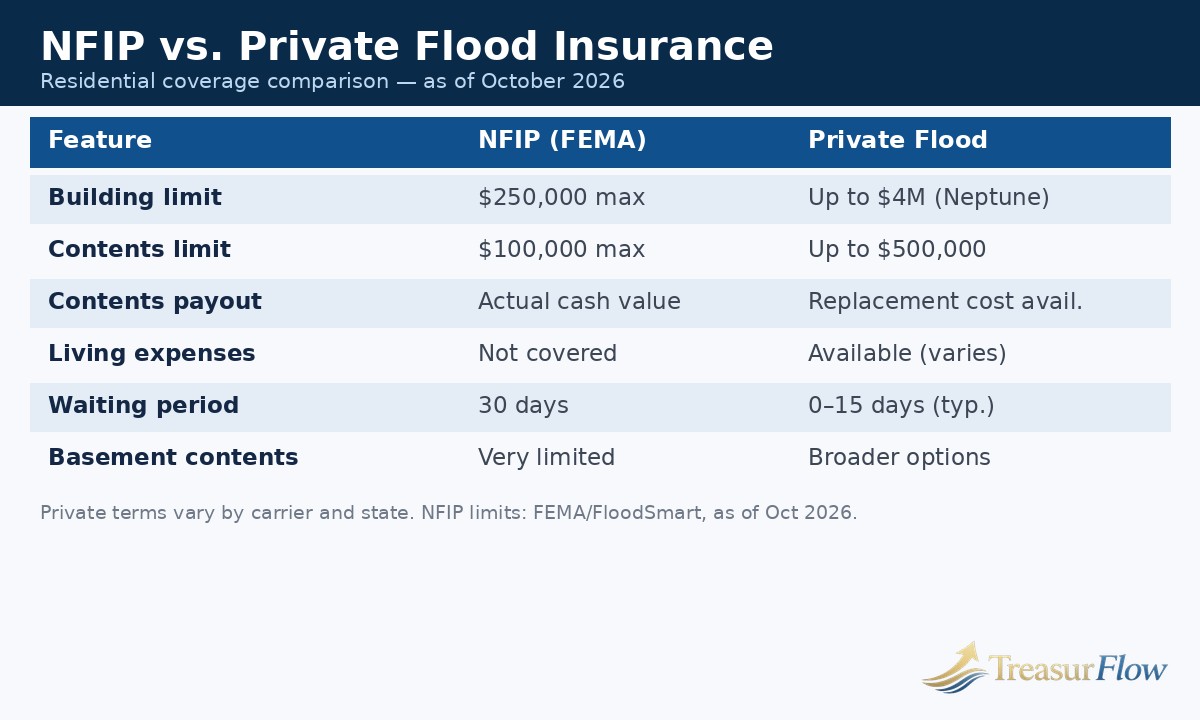
The table below summarizes the decision as of October 2026. Use it as a checklist when you compare real quotes, and remember that private terms vary by carrier and state — the private column describes what the market commonly offers, not a guarantee on any single policy.
| Feature | NFIP (FEMA) | Private Flood Insurance |
|---|---|---|
| Backed by | U.S. federal government | Private carrier and its reinsurers |
| Max building coverage (residential) | $250,000 | Commonly $500,000 to $4 million or more (Neptune: up to $4 million) |
| Max contents coverage (residential) | $100,000 | Commonly higher than NFIP (Neptune: up to $500,000) |
| Contents valuation | Actual cash value only | Replacement cost available from many carriers |
| Additional living expenses | Not covered | Available from many carriers (e.g., Neptune: $100/day up to $10,000) |
| Basement contents | Very limited; mostly structural and essential equipment | Broader options available, often with defined sublimits |
| Waiting period | 30 days (limited exceptions for loan closings and new mappings) | Often 0–15 days (Neptune: 10 days; some Wright private programs: no wait) |
| Pricing system | FEMA Risk Rating 2.0 | Each carrier’s own risk model |
| Annual increase protection | Most increases glide toward full-risk rate under an 18% annual statutory cap framework | No federal cap; carrier sets renewal pricing |
| Availability | Any property in a participating community; cannot be declined for flood risk | Varies by carrier, state, and property; underwriting can decline or non-renew |
| Elevation certificate | Not required to buy under Risk Rating 2.0 (may still help document risk) | Often not required; varies by carrier |
| Lender acceptance | Universally accepted | Federally regulated lenders must accept qualifying private policies; confirm documentation with your lender |
| Policy form | Identical federal form everywhere | Varies by carrier — read the form carefully |
| Best suited for | High-risk properties, homes at or below NFIP limits, buyers who value federal backing and guaranteed availability | Homes worth more than $250,000 to rebuild, households needing ALE or replacement-cost contents, favorable-risk homes that price lower privately |
So which one is “best” in 2026?
Here is the honest answer the roundups converge on. If your home’s replacement cost fits inside $250,000, you do not need living-expense coverage, and your property is in a high-risk zone where private carriers quote very high prices or decline the risk, the NFIP is usually the straightforward choice — federally backed, always available in participating communities, and priced under a single national system. If your home would cost more than $250,000 to rebuild, if a depreciated contents payout would leave you badly short, or if being displaced for months without housing help would strain your finances, a private policy — or an NFIP policy plus an excess flood policy — deserves a serious quote. And in a large middle group of cases, the answer is decided by price: get both quotes. For an elevated, newer home outside the highest-risk areas, a private quote frequently comes in lower than the NFIP quote while offering more coverage; for a low-elevation coastal home, the NFIP quote may win by a wide margin. There is no shortcut around quoting your own address on both sides of this table.
A practical rule used by many agents is worth borrowing: insure the structure to its full replacement cost first (that is what forces the NFIP-versus-private conversation for most homes above the federal cap), then decide how much contents coverage you truly need by doing a rough room-by-room inventory, then spend remaining budget on the features that match your life — ALE if you have no nearby family to stay with, basement coverage if your living space is below grade, and a deductible you can pay without borrowing.
Who Needs Flood Insurance?
If you have a mortgage in a high-risk flood zone, you probably have no choice
Federal law requires flood insurance for homes and buildings in Special Flood Hazard Areas — the high-risk zones on FEMA flood maps, generally zones beginning with A or V — when the mortgage is federally backed or regulated, which covers the large majority of U.S. home loans (including loans sold to Fannie Mae or Freddie Mac and FHA and VA loans). The required coverage amount is generally the lesser of the outstanding loan balance, the home’s replacement cost, or the NFIP maximum of $250,000 — which is why some high-value homes carry an NFIP policy for compliance plus private or excess coverage for real protection. The coverage must be maintained for the life of the loan. Let it lapse, and your lender can buy force-placed flood insurance on your behalf, charge you for it, and give you less coverage for more money in the process. If you are buying in a high-risk zone, build the flood premium into your monthly budget from day one, alongside principal, interest, taxes, and homeowners insurance — it is not optional, and it is not small in the riskiest areas.
If you live outside a high-risk zone, the risk is lower — not zero
This is the statistic that changes minds, and it comes from FEMA itself: about 25% of all NFIP flood claims come from properties outside high-risk flood zones — from moderate-to-low-risk areas where no lender required the policy. More recent analyses of NFIP claims data cited in 2026 coverage put the share even higher in some periods, at roughly one-third of claims from 2013 to 2023 outside high-risk zones. Either way, the point stands: somewhere between a quarter and a third of the people who file flood claims were not in the zones homeowners casually call “flood zones.”
Why? Because flood maps show one kind of risk well — riverine and coastal flooding along mapped floodplains — and other kinds imperfectly. Intense rainfall that overwhelms local drainage, flash flooding far from any river, snowmelt, new development that changes how water runs off pavement, and aging storm infrastructure can all put water inside a home that sits comfortably outside a Special Flood Hazard Area. FEMA’s maps are also snapshots that are updated on a rolling basis; your zone describes mapped risk as of the map’s effective date, not a promise about next year’s weather. The financial silver lining is that coverage outside high-risk zones is often the cheapest flood insurance sold, because Risk Rating 2.0 prices the property’s actual characteristics. If your quote comes back at a few hundred dollars a year, weigh it against the one-inch, $25,000 illustration — and against the fact that federal disaster assistance after an uninsured flood is typically a loan, not a grant, and is far smaller than a typical flood loss.
Renters: your landlord’s policy does not cover your things
Renters are the most exposed group in this entire guide, because two misunderstandings stack on top of each other. First, a landlord’s flood policy (if one exists) covers the landlord’s building, not your furniture, electronics, clothing, or kitchen gear. Second, a standard renters insurance policy excludes flood damage to your belongings for exactly the same reason a homeowners policy does. The fix is inexpensive by insurance standards: an NFIP contents-only policy of up to $100,000, or a private contents policy, priced for tenants. Example ranges published in 2026 local cost guides put contents-only coverage at roughly $150 to $400 per year for $100,000 of coverage in many areas as of October 2026 — your price will vary by property risk, and NFIP contents settle at actual cash value, so ask about replacement-cost options if a private carrier offers them in your state. If you rent on a ground floor, near a creek or drainage channel, or anywhere with a history of water intrusion, this is one of the clearest value decisions in personal insurance.
Condo owners, landlords, and second-home owners
Condo owners should check what the association’s policy covers (usually the structure and common elements) and buy unit-level coverage for their interior and contents; the master policy does not make your personal property whole. Landlords should note that residential NFIP limits apply per building, non-primary residences carry a higher federal surcharge, and loss of rents is not covered by a standard residential flood policy. Second-home owners face an added problem — an empty house floods quietly — so pair the policy with water sensors and a local contact.
What Flood Insurance Costs in 2026 — and How Risk Rating 2.0 Sets Your Price
The averages, with the warning they deserve
As of October 2026, national averages for NFIP premiums cluster in a band rather than at a single point, because different sources average different books of policies. FEMA-based figures cited across 2026 guides put the average NFIP premium at roughly $700 to $1,000 per year, with one 2026 analysis of NFIP policy data citing an average of about $976 per year (about $1,114 in high-risk A/V zones and about $745 in other zones), and FEMA OpenFEMA transaction data analyzed for July 2026 showing an average of $986 among policies written or renewed that month — a transaction snapshot, not a quote for any address. Private flood premiums resist averaging even more, because carriers price property by property; 2026 market commentary consistently finds private quotes running lower than NFIP for favorable risks and higher (or unavailable) for severe risks.
Those averages hide the real story, which is the range. Example ranges published in 2026 cost guides for a standard policy illustrate how wide it runs: in one Florida county guide, NFIP premiums for $250,000 building and $100,000 contents coverage ranged from about $450 to $900 per year in moderate-risk Zone X, about $900 to $1,800 in high-risk Zone AE for homes elevated above base flood elevation, about $1,800 to $3,500 in Zone AE at or below that elevation, and $3,500 to $8,000 or more in coastal high-hazard Zone VE — all as of October 2026 and all specific to that market. Treat those as a map of how pricing behaves, not as national prices: your ZIP code, your elevation, and your home’s characteristics will place you somewhere on a similarly wide ladder.
Risk Rating 2.0: how FEMA prices an NFIP policy now
Since October 2021, FEMA has priced NFIP policies under Risk Rating 2.0, fully phasing it in for renewals by April 2023. It replaced a system that leaned heavily on whether a home sat inside a mapped flood zone and how its elevation compared with the zone’s base flood elevation. The new system prices the individual property. The factors FEMA uses include:
- Distance to a flood source — how close the home is to a river, lake, coast, or other water source, and what types of flooding (riverine, storm surge, heavy rainfall) threaten it.
- Elevation and first-floor height — where the home’s first floor sits relative to surrounding ground and expected flood levels; lower first floors price higher.
- Foundation type and construction — slab, crawlspace, basement, or elevated construction, and whether flood openings and other mitigation features are present.
- Replacement cost of the home — what it would cost to rebuild, which scales the potential claim.
- Prior flooding and claims characteristics built into FEMA’s modeling of the property’s flood frequency and severity.
Two consequences matter for shoppers. First, your flood zone no longer sets your price by itself — two Zone AE homes on the same street can receive meaningfully different Risk Rating 2.0 premiums, and some homes outside high-risk zones pay more than the old system charged them because the model sees risk the zone line missed. Second, you no longer need an elevation certificate just to buy an NFIP policy, although elevation information can still be useful documentation and private carriers may use their own elevation data. On top of the risk-based premium, NFIP policies carry standard charges, including a Homeowner Flood Insurance Affordability Act surcharge ($25 per year for a primary residence and $250 per year for non-primary residences and certain other properties, under the long-standing federal schedule) plus a federal policy fee and reserve fund assessment, which is why your declarations page total is slightly higher than the “premium” line alone.
One protection softens Risk Rating 2.0’s impact: by statute, most NFIP premiums moving toward their full-risk rate can increase by no more than 18% per year, so homes whose full-risk price is far above their old price climb a glide path rather than jumping in a single renewal. Private policies have no such federal cap — another reason to compare not just this year’s price but each carrier’s renewal behavior and financial stability.
Community Rating System discounts
If your community participates in FEMA’s Community Rating System (CRS), NFIP policyholders there earn automatic premium discounts — ranging from 5% to 45% depending on the community’s class — for local floodplain management activities that go beyond the NFIP minimums, such as preserving floodplain open space, enforcing higher building standards, and running flood-risk outreach. You do not apply for this yourself; the discount is built into NFIP pricing for the community. It is, however, a good question for your agent (“What is our CRS class?”) because it can explain part of a price difference between two otherwise similar towns — and private carriers do not use CRS, which occasionally makes the NFIP quote the winner in high-CRS communities.
The honest ways to lower a flood premium
You cannot haggle a Risk Rating 2.0 premium down, and you should be skeptical of anyone who promises to. What you can do is change the inputs and the structure: choose a higher deductible you can genuinely afford; insure contents realistically rather than automatically maxing the limit; ask whether documented mitigation — properly installed flood openings, elevating utilities and HVAC equipment above expected flood levels, or (at the expensive end) elevating the structure itself — changes your property’s rated characteristics; verify that FEMA’s data about your home (foundation type, first-floor height, replacement cost) is correct, since rating errors do happen and correcting them is legitimate; and compare the NFIP quote against at least one private quote, because the two systems regularly disagree about the same house by hundreds of dollars a year. Finally, keep coverage continuous: letting a flood policy lapse can cost you pricing treatment tied to continuous coverage and, if you have a mortgage in a high-risk zone, trigger expensive force-placed insurance.
How to Buy Flood Insurance: A Step-by-Step Plan
Step 1: Look up your mapped risk — then look past it. Start at FEMA’s Flood Map Service Center (msc.fema.gov) and find your property’s flood zone and, for high-risk zones, its base flood elevation. A zone beginning with A or V means high risk (roughly a 1% or greater annual chance of flooding, which compounds to about a 26% chance over a 30-year mortgage). Zone X means moderate-to-low mapped risk. Then ask the questions maps cannot answer: Has this street ever taken water? Is there a creek, canal, retention pond, or drainage channel nearby? Is new development upstream sending more runoff your way? Neighbors and your local floodplain manager know things the map panel does not.
Step 2: Decide what you are insuring. Get your home’s replacement cost from your homeowners declarations page or your agent — that number, not your home’s market value (which includes land), is your building coverage target. Then inventory your contents roughly, room by room, at what it would cost to replace them today; most households that bother to add it up are surprised by the total, and the surprise is the point. Decide in advance how you feel about the three classic gaps: contents at actual cash value, no living-expense help, and limited basement coverage. Your answers will tell you whether to weight the NFIP quote or the private quote more heavily before you see a single price.
Step 3: Get an NFIP quote and at least one private quote. NFIP policies are sold through licensed insurance agents and WYO carriers; FloodSmart.gov maintains a provider finder, and your existing homeowners agent can very likely quote one. For private quotes, carriers such as Neptune Flood (which quotes digitally and writes in all 50 states), TypTap, Beyond Floods, and Wright Flood’s agent network cover much of the market, alongside regional programs. Ask each for the same building and contents limits so the comparison is honest, and get the feature list in writing: contents valuation, ALE, basement terms, deductible structure, waiting period, admitted or surplus lines status, and the carrier’s AM Best rating.
Step 4: Confirm lender acceptance in writing. If a lender requires your coverage, an NFIP policy needs no confirmation. For a private policy, regulated lenders must accept qualifying private flood insurance, but “qualifying” is a documentation test — the policy must meet the regulatory definition of private flood insurance — so send the declarations page to your loan officer or servicer before the closing table, not after. If anyone suggests your lender “only takes FEMA,” ask for that in writing; for a compliant private policy, that position is outdated under current federal rules.
Step 5: Buy early, pay in full, and calendar the renewal. Flood premiums are generally paid annually and in full (escrowed with your mortgage payment in many required-coverage cases). Buy at least 30 days before you need NFIP coverage to be active — earlier if storm season is approaching, because private carriers and NFIP processing alike can be disrupted by storm moratoriums and the sheer volume of last-minute buyers. Keep your policy continuous year after year; continuity protects your pricing treatment and guarantees you are never caught inside a waiting period when weather turns.
Step 6: Store the paperwork where water cannot reach it. Keep your declarations page, agent’s contact information, and a home inventory (photos or video of each room, receipts for major items) in cloud storage. The households that settle fastest after a flood are the ones who can show what they owned and reach their insurer from a phone.
How Flood Claims Work
File promptly, document everything, and mitigate further damage — that is the whole game, for both NFIP and private claims. Contact your agent or carrier as soon as it is safe to do so; after major events, FEMA and carriers surge adjusters into affected areas, and early filers get inspected earlier. Before you clean up, photograph and video all damage, including water lines on walls, damaged contents in place, and serial numbers on appliances and equipment. Separate damaged from undamaged property, but do not throw damaged items away until an adjuster has seen them or told you in writing that you may — for NFIP claims, proof of loss documentation and deadlines (the standard NFIP proof of loss is generally due within 60 days of the loss unless FEMA extends it after a disaster, as it often does) are enforced, and discarded evidence is the most common self-inflicted wound in flood claims.
The adjuster then scopes the damage against your policy’s rules — remember the basement limitations and the actual-cash-value rule for NFIP contents — and your payment cannot exceed your limits, with your deductible off the top. If you disagree, NFIP claims can be appealed to FEMA within a defined window, and private claims follow the carrier’s process and your state insurance department’s complaint process. Note, too, that receiving federal disaster assistance can obligate you to buy and maintain flood insurance afterward — one more reason to buy voluntarily, on your terms.
Our Verdict: How to Choose the Best Flood Insurance in 2026
If you remember one framework from this guide, make it this one. Start with replacement cost. If your home costs $250,000 or less to rebuild and your belongings fit comfortably under $100,000 at depreciated value, the NFIP can fully do its job, and its federal backing, guaranteed availability, and standardized form are genuine advantages — especially in high-risk zones and high-discount CRS communities. If any of those numbers do not fit — and for a majority of mortgaged American homes in 2026, the rebuilding number does not fit — quote private flood insurance (Neptune, TypTap, Beyond Floods, Wright Flood, and regional carriers) or price an excess policy over an NFIP base, because a $250,000 cap on a $450,000 rebuild risk is not a discount; it is a retained loss you have agreed to self-fund. Then let features break ties: replacement-cost contents, living expenses, and basement terms are worth real money to households that need them and nothing to households that do not. Finally, let price decide only among policies that pass the first three tests — and re-run the comparison every few years, because Risk Rating 2.0 glide paths and an expanding private market mean the right answer for your address in 2026 may not be the right answer in 2028.
Related Insurance Guides
- Insurance Guides
- Best Homeowners Insurance 2026: 7 Companies Ranked by the Home You Actually Own
- Best Renters Insurance 2026: 6 Picks Ranked by Your Renter Situation
Flood Insurance Questions Homeowners Ask Before They Buy in 2026
Does homeowners insurance cover flood damage?
No. Standard homeowners insurance policies exclude flood damage from rising water outside the home, such as storm surge, overflowing rivers, and heavy rain that accumulates on the ground. You need a separate flood insurance policy through the National Flood Insurance Program (NFIP) or a private flood insurer to cover flood losses. Damage from a burst pipe inside the home is different and is typically handled as a homeowners insurance claim.
How much does flood insurance cost in 2026?
As of October 2026, the average NFIP premium cited in FEMA-based analyses is roughly $700 to $1,000 per year, but your price depends on your property’s individual risk under Risk Rating 2.0, including its elevation, distance to water, foundation type, and rebuilding cost. Lower-risk properties can cost a few hundred dollars a year, while high-risk coastal properties can cost several thousand dollars a year. Private flood insurance can be cheaper than the NFIP for some homes and more expensive for others, so compare quotes for your address.
What is the difference between NFIP and private flood insurance?
The NFIP is a federal program that caps residential coverage at $250,000 for the building and $100,000 for contents, pays contents claims at actual cash value, does not cover additional living expenses, and has a 30-day waiting period. Private flood insurance is sold by insurance companies and commonly offers higher coverage limits, replacement cost coverage for contents, additional living expenses, and shorter waiting periods. NFIP coverage is backed by the federal government and is available in participating communities regardless of risk, while private carriers set their own prices and can decline or not renew a policy.
Do I need flood insurance if I am not in a high-risk flood zone?
You are not federally required to buy flood insurance outside a high-risk zone, but FEMA reports that about 25% of NFIP flood claims come from properties outside high-risk flood zones. Flooding from heavy rain, poor drainage, and snowmelt can happen anywhere, and standard homeowners insurance will not pay for it. Coverage outside high-risk zones is often relatively inexpensive, so many homeowners buy it for financial protection even when their lender does not require it.
How long is the waiting period for flood insurance?
A new NFIP policy generally has a 30-day waiting period before coverage takes effect, with limited exceptions such as buying coverage in connection with a loan closing. Private flood insurance waiting periods are usually shorter and vary by company, often ranging from no waiting period to about 15 days. Because of these waiting periods and storm-related buying restrictions, buy flood insurance well before a storm is forecast for your area.
Does flood insurance cover basement contents and temporary living expenses?
Under an NFIP policy, basement coverage is limited mainly to the building structure and essential equipment such as furnaces and water heaters, and most personal property in a basement is not covered. The NFIP also does not cover temporary living expenses if a flood makes your home uninhabitable. Many private flood insurance policies offer broader basement coverage and additional living expense coverage, but the limits vary by company, so review those features before you buy.
Final Word: Buy for Your Street’s Water, Not the Headline Price
Flood insurance is the rare policy people buy hoping it was a waste of money — and the one whose absence can quietly undo decades of homeownership in a single weekend. The choice in 2026 is no longer “the federal program or nothing.” It is a genuine decision between the NFIP’s standardized, federally backed, always-available coverage with its $250,000 building cap, actual-cash-value contents, no living-expense coverage, and 30-day wait — and a private market that will insure your home to its real replacement cost, pay replacement cost for your belongings, help house you while you rebuild, and often start coverage in days, at a price that beats the NFIP for favorable risks and loses to it for severe ones. Work through your replacement cost, your contents, your basement, and your displacement plan; pull one quote from each side of the market; and buy on a dry day, well before you need it. That is how you end up with the best flood insurance in 2026 — not the cheapest quote on a screen, but the policy that actually makes you whole.
This article is general educational information about flood insurance in the United States, with figures dated as of October 2026. It is not insurance advice for a specific property. Premiums, limits, and policy terms vary by address, carrier, and state. Talk to a licensed insurance agent and read the actual policy form before you buy.

Muhammad Zakir is the founder of Treasurflow and the author of its personal finance guides. He researches consumer banking, credit, and personal loans, and every guide cites primary sources such as the CFPB, FDIC, FTC, and IRS. His content is educational and is not personalized financial advice.