
A medical bill rarely arrives at a convenient moment. It follows an emergency room visit, a surgery you could not postpone, a dental problem that turned urgent, or a diagnosis that rearranged your life overnight. Then the envelope shows up — sometimes several — and the total looks less like a bill and more like a second mortgage payment. Health coverage in the United States leaves real gaps: high deductibles, out-of-network surprises, services your plan classifies as not covered, and coinsurance percentages that quietly stack up. It is no surprise that millions of people search for the best medical loans 2026 every month, hoping a loan will make the number go away.
This guide to the best medical loans 2026 is deliberately built in an unusual order. Borrowing is step five, not step one. Before any lender earns your attention, you will walk through a cost ladder of free and low-cost options that can shrink the bill itself — an itemized-bill audit, hospital financial assistance, direct negotiation, and a true 0% payment plan from the provider. Only after those rungs are exhausted does it make sense to compare loans, and by then the amount you need to borrow is often thousands of dollars smaller. A smaller loan at a mediocre rate almost always beats a larger loan at a great rate, because interest is charged on the principal you actually carry.
One important clarification before we begin: a “medical loan” is usually not a special product. With a few exceptions, it is an unsecured personal loan that you choose to use for medical expenses — the lender pays you, and you pay the provider. That distinction matters, because it means medical loans compete directly with every other personal loan on the market, and they should also be compared honestly against medical credit cards, which are marketed heavily in waiting rooms and carry a deferred-interest design that can punish you severely for a small mistake. This guide covers all of it: the free options, the traps, the lenders worth considering by credit profile, and the real arithmetic of what borrowing for healthcare actually costs.
Related Guides
Helpful Official Resources
The Alternatives-First Cost Ladder: Do These Steps Before You Borrow
Think of paying a medical bill as a ladder. The bottom rungs cost nothing but time and a phone call. The higher rungs involve payment plans and, finally, borrowed money. Most patients start at the top of the ladder because that is where the marketing points them — the card application is sitting on the receptionist’s desk, while the financial assistance policy is buried on page nine of the hospital’s website. Climb from the bottom instead.
Rung 1: Check the Bill Before You Pay Anything
Request an itemized bill and read every line. Billing errors are common: duplicate charges, services listed that were never performed, quantities that do not match what you received, and procedures billed at the wrong level of complexity. It is also common for a hospital to bill you before your insurance has finished processing, or to bill the wrong insurer entirely. A charge you do not recognize — an extra lab panel, a second room fee, an out-of-network anesthesiologist you never met — deserves a phone call, not a payment.
Compare the itemized bill against your insurer’s explanation of benefits (EOB), which shows what the insurer paid, what it denied, and what it says you owe. When the two documents disagree, the insurer’s number usually governs for in-network care. If a claim was denied, ask why: coding errors can be corrected and resubmitted, and a denied claim that becomes an approved claim can erase most of a bill without a single dollar of borrowing. This step costs an afternoon. It routinely saves more than any loan comparison ever will.
Rung 2: Apply for Hospital Financial Assistance and Charity Care
Nonprofit hospitals in the United States are required to maintain financial assistance policies, and many for-profit systems offer them voluntarily. Depending on the hospital and your household income, assistance can reduce your bill by a percentage — or eliminate it entirely. The catch is that you almost always have to apply, and many eligible patients never do because nobody hands them the form.
Do not assume you earn too much. Many policies extend partial assistance to households earning well above the federal poverty line, and assistance is often calculated on a sliding scale. You will typically need proof of income (pay stubs or a tax return), a hardship letter in some cases, and patience with paperwork. Approval can take weeks, so apply promptly and tell the billing department, in writing, that an application is pending — most hospitals pause collection activity while an application is open.
Apply even if the bill is already in collections or partially paid. Assistance can sometimes be applied retroactively, and a reduced balance changes every calculation that follows, including how much you would need to borrow.
Rung 3: Negotiate the Remaining Balance
If assistance reduces the bill only partially — or not at all — negotiate. Providers routinely accept less than the sticker price, especially for prompt lump-sum payment. A simple script works: state what you can realistically pay, ask whether they can accept that amount as payment in full, and if the first person cannot authorize it, ask who can. Cash today is worth more to a billing department than a promise stretched over two years, and they price that difference.
Two negotiation habits matter. First, always get any agreement in writing before you pay — an emailed confirmation that the reduced amount settles the account in full. Second, never let a negotiated deadline pressure you into a worse financing product; a discount that expires Friday is a tactic, not a law of nature. If the provider will not move, the next rung still might cost you nothing.
Rung 4: Ask for a True 0% Payment Plan From the Provider
Most hospitals and many clinics will let you pay the remaining balance monthly at 0% interest, because it costs them less than selling the debt or losing it entirely. This is the single most valuable financing option in this entire guide, and it requires no credit check and no application beyond asking. Ask directly: “What is the longest interest-free payment plan you offer, and can the monthly amount be adjusted if my income changes?”
Get the plan confirmed in writing, confirm that no interest or fees attach as long as you pay on schedule, and confirm what happens if you miss a payment — some providers convert missed plans to collections quickly, so calendar discipline matters. A genuine provider plan at 0% beats every loan in this article. The only financing that can match it is a loan you never take.
Rung 5: Borrow Only What Is Left — and Only the Amount You Still Owe
Whatever survives rungs one through four is your true borrowing need — and it is frequently a fraction of the original bill. Borrow exactly that amount, not the rounder, larger number a lender suggests. Every extra $1,000 borrowed at 15% over three years costs roughly $248 in interest, and borrowed money sitting unused has a way of being spent. With the ladder climbed, here is how the borrowing options actually compare.
Medical Loans vs. Medical Credit Cards: The Deferred-Interest Warning
Two products dominate medical financing, and they are not interchangeable. The difference between them is the difference between a predictable cost and a potential ambush.
How a Medical Loan (Personal Loan) Works
A personal loan used for medical bills is a fixed-rate, fixed-term installment loan. You borrow a set amount, receive it as a lump sum, and repay it in equal monthly payments over a set period — commonly two to seven years. The interest rate is fixed at approval based mainly on your credit profile, the total interest cost is knowable on day one, and making payments on time never triggers a retroactive charge. If you pay extra or pay the loan off early, you simply save interest; most reputable personal loans have no prepayment penalty. The cost of the loan is visible, finite, and boring — exactly what you want when the underlying expense was an emergency.
How a Medical Credit Card Works — and Where It Traps People
Medical credit cards — the kind offered at the dentist’s desk, the vet’s office, the hearing-aid clinic, or the hospital registration counter — are revolving credit cards restricted to health-related purchases, often promoted with a headline offer: “0% interest for 12 months.” That headline is where the danger lives, because most of these promotions are not true 0% APR offers. They are deferred-interest offers, and the distinction is one of the most expensive in consumer finance.
Under deferred interest, the interest is not waived — it is tracked silently in the background from the date of purchase, at a regular APR that is often very high. If you pay the entire balance before the promotional period ends, the tracked interest is forgiven and you genuinely paid 0%. But if even a small amount remains unpaid when the promotion expires — $50 left of a $6,000 procedure, for example — the issuer can charge you all of the deferred interest that accumulated on the full original balance from day one. Months of careful payments can be met with a sudden interest charge of hundreds or thousands of dollars.
This is not a theoretical risk. The Consumer Financial Protection Bureau has reported on deferred-interest medical credit cards and the harm to patients who believed they had a true 0% deal, and medical credit cards have drawn repeated regulatory scrutiny for being presented in clinical settings where patients are stressed, in pain, or rushed. A patient signing paperwork before a procedure is in the worst possible position to read a deferred-interest clause.
None of this means a medical credit card can never be the right tool. If the balance is small, the promotional period is long, and you are certain — not hopeful, certain — that you will clear the entire balance well before the deadline, a medical card can work. But certainty is rare in medical spending, where follow-up procedures and complications add charges. The safer default for most households is a fixed-rate loan whose worst case is known in advance.
Side-by-Side: Loan vs. Medical Credit Card vs. Provider Plan
In one view: a provider payment plan is 0% with no deferred-interest trap and no credit check — take it first. A personal loan charges fixed interest that is fully disclosed, with a defined end date — take it second, sized to the post-ladder balance. A medical credit card offers what looks like 0% but is usually deferred interest with a retroactive cliff — use it only with a disciplined, early payoff plan, and never for a balance you are unsure you can clear inside the promotion.
Best Medical Loans in 2026 by Credit Profile
With the ladder climbed and the deferred-interest trap understood, these are the lenders worth a quote in 2026, organized by the borrower they fit best. Rates and terms change, so treat the figures below as the landscape as of October 2026 and confirm live numbers when you prequalify — prequalification with a soft credit check is available from most of these lenders and does not affect your credit score.
Best for Excellent Credit: LightStream
LightStream consistently posts some of the lowest starting APRs in the personal loan market for well-qualified borrowers — a range of about 6.49% to 24.89% as of October 2026, with no origination fee and no prepayment penalty. Loans run from $5,000 to $100,000 over roughly 24 to 84 months, and funding can be as fast as the same business day for approved applications completed on schedule. The trade-off is selectivity: LightStream targets good-to-excellent credit with a solid income and history, so it is the first quote to request if your profile is strong — and its published rate floor makes an excellent benchmark against which to judge every other offer.
Best for Fast Funding and Large Amounts: SoFi
SoFi offers large personal loans — up to $100,000 — with APRs roughly from 8.99% to 35.49%, no required fees, same-day funding for many approved borrowers, and terms of two to seven years. SoFi is a strong fit when the post-ladder balance is still large, when you want a single lender relationship, or when unemployment protection features matter to you — SoFi has historically offered payment-modification help for borrowers who lose a job through no fault of their own. Excellent and good credit profiles fare best; check whether any optional origination fee changes your effective rate on the specific offer you receive.
Best for Good Credit With Zero Fees: Discover
Discover’s personal loans (about 7.99% to 24.99% APR, $2,500 to $40,000, terms of 36 to 84 months) stand out for charging no origination fee, no prepayment penalty, and no closing costs — and a late fee is the only common charge. Funding can arrive as fast as the next business day after approval, and Discover returns your first payment free if you change your mind within 30 days and repay in full. For a borrower with good credit financing a mid-size residual bill, that combination of zero fees and a long available term is hard to beat; run the total-cost comparison against LightStream’s lower starting rate to see which wins at your actual amount and term.
Best for Fair Credit: Upgrade
Upgrade serves the fair-credit band (scores from around 620) that prime lenders decline, with APRs roughly 7.99% to 35.99%, loans from $1,000 to $50,000, terms of 24 to 84 months, and an origination fee of about 1.85% to 9.99% deducted from the proceeds. The fee matters: borrow slightly more than the bill only if you must, and always compare on APR and total repayment, not the headline rate. Funding in one to three business days and joint applications make Upgrade a practical route when your score sits in the low-to-mid 600s — provided you have climbed the ladder first so the amount is as small as possible.
Best for Thin or Limited Credit History: Upstart
Upstart underwrites with a model that weighs education, employment, and income alongside credit history, which makes it the natural quote for younger borrowers, recent graduates, and anyone whose thin file understates their actual stability. APRs run roughly 6.60% to 35.99%, amounts from $1,000 to $50,000, terms of 36 or 60 months, and an origination fee of 0% to 12%. Funding can be as fast as one business day. Because the fee can be steep at the riskier end, insist on seeing the APR and the total of payments before you accept — Upstart’s convenience is worth paying for only at a price you have compared.
Best for Bad Credit, With Caution: Prosper
Prosper, the original peer-to-peer marketplace, allows some borrowers with scores around 580 to 600 to be funded by individual investors, with APRs roughly 8.99% to 35.99%, loans of $2,000 to $50,000, terms of three or five years, and an origination fee of about 1% to 9.99%. Funding takes longer — around five business days — and approval depends on investor demand, so treat Prosper as a genuine last resort among mainstream options, not a first choice. At the highest APRs, a Prosper loan can rival the cost of the deferred-interest card this guide warns against; it makes sense only when the alternative is worse and the amount is small, negotiated, and final.
Best for Small Bills: Credit Unions Such as Patelco and PenFed
If your residual bill is small — or you simply prefer a member-owned institution — credit unions deserve a quote before the online lenders. Patelco, for example, offers personal loans from around $300 with no origination or prepayment fees and terms starting from six months, and community and federal credit unions such as PenFed commonly price personal loans well below bank cards. Credit unions require membership (usually easy to qualify for, sometimes via a small deposit or a charitable membership), may lend more conservatively, and often take a day or two longer — but for a $1,500 balance, their combination of a low rate, tiny minimum, and human flexibility on hardship is frequently the best value in this entire comparison.
At-a-Glance Comparison (As of October 2026)
| Lender | APR range | Amounts | Terms | Min. credit score | Funding | Origination fee |
|---|---|---|---|---|---|---|
| LightStream | 6.49%–24.89% | $5,000–$100,000 | 36–84 months | Good–excellent (about 660–700+) | Same day possible | None |
| SoFi | 8.99%–35.49% | $5,000–$100,000 | 24–84 months | Good–excellent (680+) | Same day possible | 0%–7% optional (SoFi Bank loans) |
| Discover | 7.99%–24.99% | $2,500–$40,000 | 36–84 months | 660+ | As fast as next day | None |
| Upgrade | 7.99%–35.99% | $1,000–$50,000 | 24–84 months | 620+ | 1–3 business days | 1.85%–9.99% |
| Upstart | 6.60%–35.99% | $1,000–$50,000 | 36–60 months | 620+ | As fast as 1 day | 0%–12% |
| Prosper | 8.99%–35.99% | $2,000–$50,000 | 36–60 months | About 580–600 | About 5 days | 1%–9.99% |
| Patelco Credit Union | Up to about 18% max | From $300 | From 6 months | Membership required | Varies | Varies |
What a Medical Loan Actually Costs: Worked Math on an $8,000 Bill
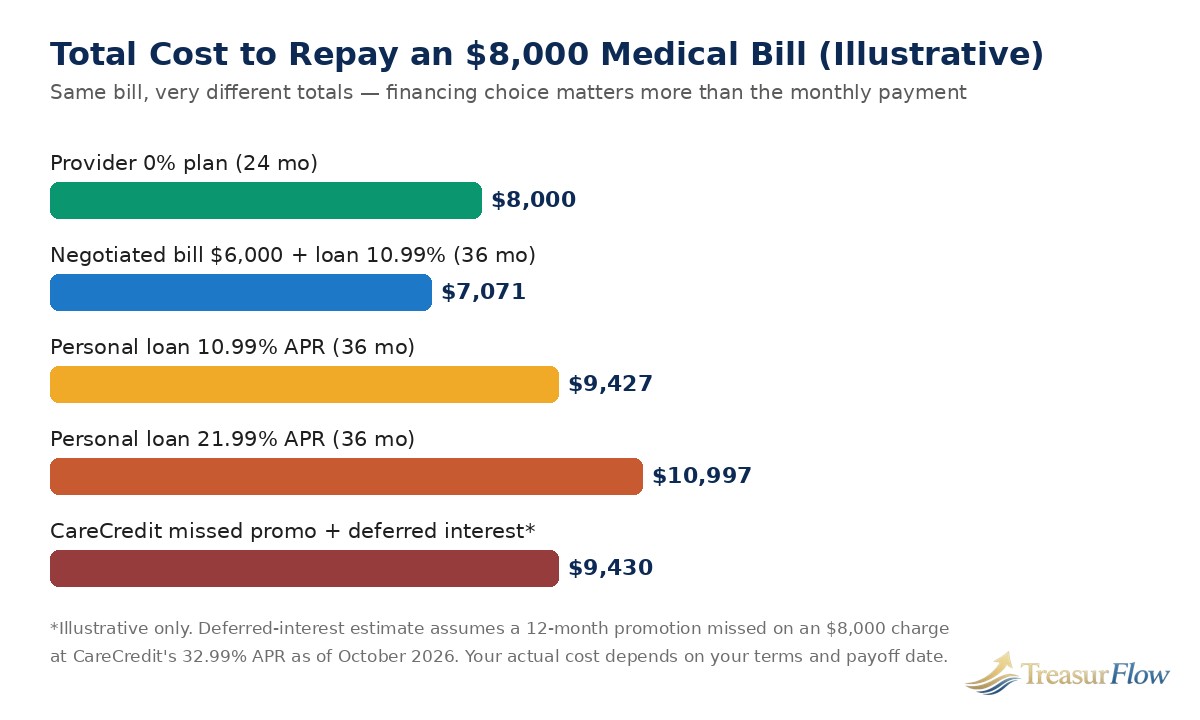
Assume an $8,000 hospital bill after insurance — a realistic remainder after a surgery with a high deductible. Assume also that you want it gone within about three years. Here is what each financing route actually costs in total, using the standard installment-loan amortization formula. Figures are rounded and illustrative, but the comparisons they reveal are structural, not cosmetic.
Option 1 — Provider 0% plan over 24 months. Total repaid: $8,000. Interest: $0. Monthly payment: about $333. This is the benchmark, and it is why rung four of the ladder matters so much. If the provider offers a genuine interest-free plan and you can carry the payment, stop shopping.
Option 2 — Negotiate first, then borrow less: a $6,000 negotiated balance on a personal loan at 10.99% APR over 36 months. Interest: about $1,078. Total repaid: about $7,078. Monthly payment: about $197. Note what happened: the negotiated loan costs less in total than the original bill alone — you repay $7,078 against an $8,000 sticker price. Negotiation beat financing, decisively.
Option 3 — The full $8,000 on a personal loan at 10.99% APR over 36 months (good credit, no negotiation). Interest: about $1,437. Total repaid: about $9,437. Monthly payment: about $262. This is a perfectly reasonable outcome — and it still costs about $2,359 more than Option 2 for the identical medical care. That gap is the cash value of two phone calls.
Option 4 — The full $8,000 at 19.99% APR over 36 months (fair credit). Interest: about $2,700. Total repaid: about $10,700. Monthly payment: about $297. Fair-credit pricing nearly doubles the interest of the good-credit loan. If your score is near a lender’s pricing tier boundary, even a few weeks spent improving it — paying down card balances before you apply, for instance — can move you into a cheaper tier worth hundreds of dollars.
Option 5 — The full $8,000 at 29.99% APR over 36 months (poor credit or a high-cost marketplace loan). Interest: about $4,228. Total repaid: about $12,228. Monthly payment: about $340. At this level the loan costs more than half the original bill again in interest. Compare honestly: a smaller negotiated balance, a credit-union conversation, or a longer provider plan will almost always dominate this option. Borrowing at 29.99% should require the bill to be truly unavoidable and truly final.
Option 6 — The deferred-interest medical credit card, worst case. Charge the $8,000, pay steadily, but still owe a balance when the 12-month promotion ends. The issuer retroactively applies interest at the card’s regular APR — often around 26.99% or higher — on the original $8,000 from the purchase date. A year of “0%” can convert into an interest charge of roughly $2,000 or more arriving in a single statement, on top of what you still owe. This is the trap in its full shape: not a slightly worse rate, but a cliff.
The lesson of the six options is consistent: reduce the principal first, then choose the shortest term you can genuinely afford at the lowest fixed APR available to your credit profile — and treat deferred interest as a hazard, not a discount.
Who Qualifies for a Medical Loan? Eligibility Explained
Eligibility for a personal loan used as a medical loan turns on the usual factors: credit score and history, income relative to your existing debts (your debt-to-income ratio), employment stability, and the absence of recent bankruptcies or defaults. Prime lenders want scores in the high 600s and above with clean recent history; the lenders in this guide span a realistic range down to the high 500s, with pricing rising steeply as scores fall.
If your credit is fair or poor, two levers genuinely help. The first is a co-borrower or co-signer with stronger credit — some lenders allow a second applicant on a joint application, though the co-signer takes real legal responsibility for the debt. The second is borrowing less: because you climbed the ladder, the amount is smaller, the payment is smaller, your debt-to-income ratio looks better, and approval odds improve at every lender simultaneously.
A word on medical debt and your credit reports: under a voluntary industry change in 2022–2023, the three major credit bureaus removed paid medical collections and medical collections under $500 from credit reports, and unpaid medical collections generally do not appear until they are a year old. Rules in this area have been contested and may change — state laws increasingly restrict medical-debt reporting as well — so check your reports, but do not assume a medical collection is damaging your score today in the way it would have a decade ago.
How to Apply for a Medical Loan, Step by Step
Step 1: Finish the ladder first. Itemize, appeal, apply for assistance, negotiate, and ask for the provider plan. Write down the final, confirmed amount you still owe. That number — not the original bill — is your loan amount.
Step 2: Check your credit reports and scores. Pull your free reports at AnnualCreditReport.com, dispute any errors, and note which pricing tier you likely fall into. This takes less than an hour and determines which lenders are realistic.
Step 3: Prequalify with three lenders. Choose one prime lender (LightStream or Discover if your credit is strong), one mid-tier or alternative option (SoFi, Upgrade, or Upstart), and one credit union. Prequalification uses a soft inquiry and returns real, personalized APRs without harming your score.
Step 4: Compare on total cost, not monthly payment. For each offer, record the APR, the origination fee, the term, the total of all payments, and the total interest. A lower monthly payment achieved by stretching the term usually means thousands more in interest. The cheapest offer is the one with the lowest total repayment that you can comfortably afford monthly.
Step 5: Submit the full application promptly. Once you choose, the formal application triggers a hard inquiry — complete your comparison shopping within a short window (rate-shopping for installment loans within roughly 14–45 days is generally treated as a single inquiry by common scoring models). Have ID, income documentation, and bank details ready.
Step 6: Verify the final terms before signing. Rates and fees can change between prequalification and approval. Re-read the APR, fee, amount, and first due date on the final disclosure. If the numbers moved materially against you, you are allowed to walk away and take your second-choice offer.
Step 7: Pay the provider directly and document everything. When funds arrive, pay the provider the exact agreed amount, keep the paid-in-full confirmation with your assistance and negotiation records, and set up autopay for the loan — many lenders discount the APR slightly for autopay, and it protects you from a late fee undoing your careful arithmetic.
Red Flags: Walk Away When You See These
Walk away from any offer with these features: a lender who guarantees approval before seeing your information; upfront fees demanded by a broker before funding (legitimate origination fees are deducted from proceeds, never wired in advance); APRs approaching or exceeding 36% presented as normal; pressure to sign in the provider’s office the same day; a “0%” offer whose fine print uses the words deferred interest without a clear explanation; loan insurance or add-on products bundled invisibly into the amount; and any request to borrow more than the confirmed balance “for safety.” Each of these converts a difficult month into a difficult three years. The lenders in this guide are imperfect but legible — insist on legibility from anyone who wants your signature.
Medical Loan Questions Patients Ask Before They Sign Anything
What is the best medical loan in 2026?
For most borrowers who have completed the free steps first, the best medical loan is the fixed-rate personal loan with the lowest total repayment for their credit profile — often LightStream for excellent credit, Discover or SoFi for good credit, Upgrade or Upstart for fair or thin credit, and a credit union for small balances. But the honest answer is that the best option overall is usually not a loan at all: a provider 0% payment plan on a negotiated, assistance-reduced balance costs less than any loan in this guide.
Can I get a medical loan with bad credit?
Yes, but the price may not be worth paying. Marketplace lenders such as Prosper fund some borrowers with scores in the high 500s, and Upstart looks beyond the score — yet APRs near 30% or higher can add thousands in interest. Before accepting an expensive loan, exhaust the ladder: assistance, negotiation, and a provider plan do not depend on your credit score at all, and a smaller balance borrowed later, after a few months of score improvement, can cost dramatically less.
Are medical credit cards a good idea?
Only in a narrow case: a small balance, a genuinely affordable payoff, and total certainty that the full amount will be cleared well before the promotional period ends. Most medical cards use deferred interest, meaning a small leftover balance at the deadline can trigger retroactive interest on the entire original amount from the purchase date. For anything large or uncertain, a fixed-rate loan or a provider plan is safer because its worst case is known on day one.
Will applying for a medical loan hurt my credit score?
Prequalification with most lenders uses a soft inquiry, which does not affect your score at all — use it freely to compare real offers. A full application triggers a hard inquiry, which may dip your score slightly and temporarily. If you submit your applications within a short window (roughly 14–45 days), common scoring models generally treat them as a single inquiry for rate-shopping purposes. The far bigger credit risk is not the inquiry; it is taking on a payment you cannot sustain.
How fast can I get a medical loan?
Fast — often faster than the billing problem requires. LightStream and SoFi can fund approved loans the same business day, Discover and Upgrade within one to three business days, and credit unions in a few days. Resist using speed as the deciding factor: hospitals rarely require payment the day a bill arrives, and the days you spend on assistance applications and negotiation are usually worth thousands of dollars. Fast money is expensive comfort.
Should I use a home equity loan or HELOC for medical bills?
Almost always no. Home equity products offer lower rates because your home secures them — which converts an unsecured, negotiable medical bill into debt that can cost you your house if life goes further wrong. Medical bills are among the most negotiable, assistance-eligible debts in existence; trading them for secured debt gives up every advantage you have. Reserve home equity for purposes where no unsecured alternative exists, which medical expenses almost never are.
Conclusion: Shrink the Bill First, Then Borrow the Smallest Amount at the Lowest Total Cost
The search for the best medical loans 2026 should begin with a refusal: a refusal to finance a bill that has not been audited, appealed, assisted, and negotiated. The worked math in this guide shows why — the difference between financing $8,000 at a fair-credit rate and financing a negotiated $6,000 at a good-credit rate is roughly $3,600 on identical care, and the difference between either of those and a provider 0% plan is larger still. If borrowing remains necessary after the ladder, choose a fixed-rate loan from a lender matched to your credit profile, size it to the confirmed balance, compare on total repayment, and read every word before you sign. And if anyone offers you “0%” in a waiting room, ask the only question that matters: is it waived interest, or is it deferred?

Muhammad Zakir is the founder of Treasurflow and the author of its personal finance guides. He researches consumer banking, credit, and personal loans, and every guide cites primary sources such as the CFPB, FDIC, FTC, and IRS. His content is educational and is not personalized financial advice.