
Best Gas Credit Cards 2026: Earn 5%, 4% and 3% Back Without Getting Trapped by One Station Brand
Gas is expensive again, and this time it is not a short spike you can wait out. AAA reported a national average of $4.33 for a gallon of regular gasoline on October 15, 2026, after $4.36 on October 8 and $4.41 on October 1 — and AAA noted that the national average has stayed above $4 a gallon since late July 2026 and is more than a dollar higher than it was at the same time last year. When a fill-up costs that much, week after week, the card you hand over at the pump stops being a small detail. The difference between earning 1% back and earning 5% back on the same fuel is real money over a year: about $208 for a driver buying 100 gallons a month, as the worked math later in this guide shows.
But here is the part most gas card roundups bury. The highest headline rate is not automatically the best deal for you. Some of the strongest rates in 2026 come with a warehouse membership you may not want, a spending cap you may hit by autumn, points you cannot turn into cash, or a discount that only works at one brand of station. Other cards pay a slightly lower rate with no cap, no membership and no category to set — and for a lot of drivers, that simpler card quietly wins.
That is why this guide is built around one decision first, and a list of cards second. Step one is deciding which family of card fits your life: a station-brand or warehouse card tied to where you already fill up, or a general cash back card that pays a bonus rate at gas stations anywhere. Step two is matching a card inside that family to your driver profile — commuter, warehouse loyalist, road-tripper, family with a big grocery bill, or driver rebuilding credit. Step three is checking the unglamorous details that decide whether the rewards survive contact with reality: caps, merchant coding, redemption rules, annual fees and, above all, interest.
Every rate, fee and APR in this guide is stated as of October 2026. Card terms change, sometimes mid-year. In fact, one famous 5% option changed in a way that matters a lot this year, and we flag it in its own section below so nobody applies for a card that is no longer open to new applicants. Always confirm the current terms on the issuer’s own page before you apply. Rewards are only worth earning if you pay your statement balance in full each month — at the APRs these cards charge, interest wipes out gas rewards very fast.
Related Guides
Helpful Official Resources
The Decision That Actually Matters: Branded Station Cards vs. General Gas Rewards Cards
Before comparing percentages, split the market into three families. Almost every mistake people make with a gas card comes from shopping across families without noticing — comparing a 10-cents-per-gallon discount at one brand against a 5% rate everywhere, as if they were the same kind of promise. They are not.
Family 1: Station-brand cards that pay in cents per gallon
These are the cards with an oil company’s name on the front. The Shell Fuel Rewards cards are the clearest example in 2026: as of October 2026, they offer instant Fuel Rewards Gold Status and a saving of 10 cents per gallon, on up to 20 gallons per fill-up, with no annual fee and a regular APR of 28.74% variable, according to Citi-issued card summaries reported by multiple card review sources. One version can only be used at Shell; the Mastercard version can be used elsewhere and earns Shell rebates on some other spending.
A cents-per-gallon discount feels satisfying because you see the price roll back on the pump screen. Do the conversion, though. At $4.33 a gallon, 10 cents back is about 2.3% back. At $3.00 a gallon it would be about 3.3%, and at $5.00 a gallon it falls to 2.0%. That is the structural weakness NerdWallet points out in its gas card methodology: a fixed cents discount becomes less valuable as fuel gets more expensive, while a percentage rate holds its value at any price. In a year when gas is above $4, percentage cards have the wind behind them.
Branded cards still have a narrow, honest case. If a Shell station is genuinely on your route and you would fill up there anyway, the discount is automatic and needs no category setting or cap watching. Some branded cards are also available to applicants with fair credit who cannot yet qualify for the best general rewards cards. And the instant discount avoids redemption friction — there are no points to convert and no statement credit to request. Just go in clear-eyed: you are accepting roughly 2% to 2.3% in value, one brand’s stations, and, in Shell’s case, a 28.74% variable APR as of October 2026, which is among the highest in this guide. Never carry a balance on a card priced like that.
Family 2: Warehouse club cards with headline gas rates
The Costco Anywhere Visa Card by Citi and the Sam’s Club Mastercard are not oil-company cards, but they share the branded cards’ core trade: a top-tier rate in exchange for loyalty to one retailer. As of October 2026, the Costco card earns 5% cash back on gas at Costco and 4% on other eligible gas and EV charging, on the first $7,000 in combined annual gas and EV spending, then 1%. It also earns 3% on restaurants and travel, 2% on Costco purchases and 1% on everything else, with no annual fee for the card itself — but a paid Costco membership is required, listed at $65 a year for Gold Star and $130 for Executive in 2026 reviews. The Sam’s Club Mastercard earns 5% back on gas anywhere Mastercard is accepted, on the first $6,000 spent each year, then 1%, plus 3% on dining, with no card annual fee and a Sam’s Club membership required.
That Sam’s Club detail — 5% at any station, not just Sam’s own pumps — makes it the more flexible warehouse option for drivers whose fill-ups happen wherever the day takes them. The Costco card counters with a higher gas cap, a strong 3% travel and dining rate, and that fifth percent when you do fuel at Costco itself. Both cards share two frictions. First, the membership is a real cost: if you join a club only for the gas card, subtract the membership from your first year of rewards before you call the card free. Second, redemption is slower than a normal cash back card: Costco pays rewards as an annual certificate, while Sam’s Club pays in Sam’s Cash tied to your membership, rather than simple cash whenever you ask.
Family 3: General cash back and points cards that treat gas as a bonus category
This is the family most drivers should start with. These cards are issued by banks and credit unions, work at gas stations broadly, and earn rewards you can usually take as cash back, a statement credit or flexible points. In 2026 the leading examples earn between 3% and 6% on gas, as of October 2026:
- Bank of America Customized Cash Rewards: 6% back in your chosen category during the first year, then 3%, if you choose gas and EV charging — subject to a shared quarterly cap explained below.
- Wells Fargo Autograph Card: unlimited 3X points at gas stations and on EV charging, plus several other everyday categories, with no annual fee.
- Blue Cash Preferred and Blue Cash Everyday from American Express: 3% back at U.S. gas stations, paired with some of the strongest supermarket rates on the market.
- PenFed Platinum Rewards Visa Signature: 5X points on gas paid at the pump and on EV charging, with no annual fee, but with points that cannot be redeemed for straight cash back.
General cards win on freedom. You are not rerouting your drive to one brand, you are not maintaining a membership for a credit card, and the same card often earns well on groceries, dining or travel, so it can stay useful if your commute shrinks. Their weakness is fine print of a different kind: category definitions, spending caps and merchant coding. A general card’s gas bonus typically applies at standalone gas stations. Fuel bought at a warehouse club, supermarket or superstore may be coded under a different merchant category and earn only the base rate — a point several issuers and reviewers stress for the Amex Blue Cash cards in particular. Paying at the pump rather than inside the shop also matters on some cards; PenFed’s 5X rate, for example, is for gas paid at the pump.
The framework in one short test
Answer three questions and the right family usually picks itself. First, do you already pay for a Costco or Sam’s Club membership and shop there happily? If yes, price that club’s card first — you are the rare driver for whom the loyalty trade is already paid for. Second, do you buy most of your fuel at one oil brand because it is on your route, and is your credit fair rather than good? If yes, a branded card can be a reasonable starter, with a plan to upgrade later. Third, does neither of those describe you? Then start with a general card, choose between a capped high rate and an uncapped simple rate using your monthly gallons, and stop there. Most readers should land in family three, and the rest of this guide treats it that way — while giving warehouse members their due, because for them the math really is different.
The Best Gas Credit Cards of 2026, Pick by Pick
The cards below are ordered by the driver they suit best, not by headline rate alone. Rates, caps, fees and APRs are as of October 2026.
Sam’s Club Mastercard — best 5% rate for existing Sam’s Club members
Gas rate: 5% back on gas anywhere Mastercard is accepted, on the first $6,000 in gas spending per year, then 1%, as of October 2026. Annual fee: $0 for the card; a Sam’s Club membership is required. Regular APR: confirm the current variable APR on the issuer page before applying — do not carry a balance on a rewards card.
This is the simplest route to a true 5% on fuel without a monthly category cap, provided you are already a Sam’s member. At 100 gallons a month and $4.33 a gallon, you would spend $5,196 a year — just inside the $6,000 cap — and earn about $260 back on gas. The card adds 3% back on dining, which keeps it from being a one-trick card, and rewards are paid as Sam’s Cash. Two cautions. The in-club earning rate depends on your membership tier, so a basic member should not assume the Plus member’s in-store rate. And if you are not already a member, the membership cost belongs in your math: a driver buying only 40 gallons a month earns about $104 a year at 5% on $2,078 of fuel, so a membership bought solely for this card consumes a large share of the benefit.
Best for: Sam’s Club members who drive a lot and fill up at varied stations. Skip it if: you would be joining Sam’s Club only for the card, or you want plain cash you can move to a bank account.
Costco Anywhere Visa Card by Citi — best for Costco members who also travel and dine out
Gas rate: 5% back on gas at Costco and 4% on other eligible gas and EV charging, on the first $7,000 in combined annual gas and EV spending, then 1%, as of October 2026. Annual fee: $0 for the card; Costco membership required, listed at $65 a year for Gold Star and $130 for Executive as of October 2026. Other rates: 3% on restaurants and travel, 2% at Costco and Costco.com, 1% on everything else.
Costco’s card has the highest gas cap in this guide and the broadest set of useful bonus categories of any warehouse card. A member who fuels at Costco at 100 gallons a month earns about $260 a year on gas at 5%; a member who fuels elsewhere earns about $208 at 4%, still ahead of every uncapped 3% card. The 3% on dining and travel means this one card can plausibly be a household’s main card, not just its gas card. The trade-offs are patience and lock-in. Rewards arrive as an annual certificate rather than monthly cash, and the card only makes sense while the membership does. Also note a coding quirk that cuts the other way for everyone else: fuel bought at Costco with a different bank’s card often does not code as a gas station purchase, so members who want a bonus on Costco fuel generally need this card to get it.
Best for: existing Costco members, especially those who fuel at Costco and spend on dining and travel. Skip it if: you are not a member, you want rewards monthly, or you dislike annual-certificate redemption.
Bank of America Customized Cash Rewards — best first-year rate if you will set the category
Gas rate: 6% cash back in the category of your choice during the first year, then 3%, and gas and EV charging is one of the choices, as of October 2026. Annual fee: $0. Welcome offer: $200 online cash rewards bonus after $1,000 in purchases in the first 90 days, as of October 2026. Regular APR: 17.74% to 27.74% variable, as of October 2026, after a 0% introductory APR for 15 billing cycles on purchases and on qualifying balance transfers.
No other widely available no-annual-fee card in this guide pays 6% on gas for a full first year. You choose the category online or in the app, you can change it once a month, and gas is even the default if you never choose. The control comes with a shared ceiling: the 6% or 3% rate and the card’s 2% rate at grocery stores and wholesale clubs apply only to the first $2,500 in combined spending in those categories each quarter, then drop to 1%. A driver spending about $430 a month on gas uses roughly $1,290 of that quarterly allowance on fuel, leaving room for some grocery spending — but a household that also routes most groceries through this card can hit the cap and should watch it. Bank of America Preferred Rewards members can earn a relationship bonus on top of the base rates, which can lift the long-term gas rate above 3% for customers with qualifying balances; that is a genuine edge for existing Bank of America households, and irrelevant if you bank elsewhere.
After year one, be honest about what the card becomes: a solid 3% gas card with a cap and a monthly setting to remember. That is still competitive — it matches the uncapped cards while adding flexibility to move the category to online shopping, dining or travel in a month when your spending changes. For a driver who enjoys that kind of active management, this is arguably the best overall pick in the guide. For a driver who will forget to check the category, an automatic card below is safer.
Best for: organized drivers who want the strongest first-year return, and Bank of America customers who can add a relationship bonus. Skip it if: you want a card you never have to think about, or your combined gas and grocery spending regularly exceeds $2,500 a quarter.
Wells Fargo Autograph Card — best simple, uncapped 3% on gas and much more
Gas rate: unlimited 3X points at gas stations, and the same 3X on travel, dining, transit, popular streaming services and phone plans, as of October 2026. Annual fee: $0. Welcome offer: 20,000 bonus points, a $200 cash redemption value, after $1,000 in purchases in the first 3 months, as of October 2026. Regular APR: 18.74%, 24.74% or 28.74% variable, as of October 2026, after a 0% introductory APR for 12 months on purchases.
If the Bank of America card is for optimizers, the Autograph is for everyone who wants to stop thinking about gas rewards entirely. There is no category to select, no activation calendar, no warehouse membership and no bonus cap on gas to monitor. Three points per dollar is not the highest rate in this guide, but it is the highest simple rate that keeps paying at the same level whether you buy 30 gallons a month or 200. At 150 gallons a month — $7,794 a year at $4.33 a gallon — the Autograph earns about $234 back on gas, while capped 5% cards have already dropped to 1% on part of that spending, narrowing a gap that looks huge at lower volumes. Points redeem at one cent each for cash back, statement credits, gift cards and travel, and Wells Fargo has been adding transfer options; value your points at one cent unless you know you will transfer them well.
The Autograph is also the easiest recommendation in this guide for mixed drivers: households that split spending between fuel, restaurants, transit and streaming get the same 3X across all of it, on one no-fee card. If your life is moving toward an EV, note that the 3X category includes EV charging as well as gas stations, so the card survives a change of vehicle better than a pure cents-off-per-gallon brand card does.
Best for: most drivers, high-mileage drivers who would blow through caps, and anyone who wants one automatic card. Skip it if: you are a warehouse member who can get 4% or 5%, or you want a 6% first-year headline and will manage a category to get it.
PenFed Platinum Rewards Visa Signature Card — 5X points at the pump, with a redemption catch
Gas rate: 5X points on gas paid at the pump and on EV charging, plus 3X at supermarkets, at restaurants and on streaming services, and 1X on everything else, as of October 2026. Annual fee: $0. Welcome offer: 15,000 bonus points after $1,500 in purchases in the first 90 days, as of October 2026. Regular APR: 17.99% variable, as of October 2026 — the joint-lowest regular APR among the rewards cards detailed in this guide.
On paper, 5X with no annual fee and no stated gas cap looks like the best deal here. The catch is what a point is worth and what you can do with it. PenFed does not offer straight cash back on this card; points redeem for merchandise, gift cards and travel, and NerdWallet has valued PenFed points at roughly 0.85 cents each, which turns a nominal 5X into roughly 4.25% in realistic value on a good redemption — still strong, but not 5% cash. You also need to join PenFed Credit Union to hold the card, which is open to many applicants through membership eligibility and a small savings deposit, but it is an extra step a bank card does not ask for. And remember the at-the-pump rule: fuel paid for inside the convenience store may not earn 5X.
For a driver who is happy taking rewards as gift cards or travel, who always pays at the pump, and who likes that comparatively low 17.99% variable APR as a safety margin, PenFed is a legitimate top-tier choice. For a driver who measures every card in cash, the warehouse cards and the Bank of America card deliver their percentages more honestly.
Best for: drivers comfortable with points instead of cash, and PenFed members. Skip it if: you want cash back you can deposit, or you often pay for fuel inside the store.
Blue Cash Preferred Card from American Express — best when groceries, not gas, lead your budget
Gas rate: 3% cash back at U.S. gas stations and on transit, as of October 2026. Annual fee: $0 introductory annual fee for the first year, then $95, as of October 2026. Regular APR: 19.74% to 28.74% variable, as of October 2026. Other rates: 6% back at U.S. supermarkets on up to $6,000 a year, then 1%, and 6% on select U.S. streaming subscriptions.
Nobody should pay $95 a year for a 3% gas rate alone — at 100 gallons a month, 3% is about $156 a year, and a no-fee 3% card gives you the same gas return without the fee. The Blue Cash Preferred earns its place in a gas guide because of the household it fits: one that spends heavily at supermarkets. Six percent on up to $6,000 of supermarket spending is worth up to $360 a year, and against that backdrop the uncapped 3% on gas and transit arrives as a valuable extra rather than the main event. The break-even against its own no-fee sibling is mostly a grocery question: the extra 3% at supermarkets needs roughly $3,200 a year of supermarket spending to cover the $95 fee on groceries alone.
Best for: families with large supermarket bills who also drive. Skip it if: gas is your main reason for applying, you shop mostly at warehouse clubs or superstores that do not code as supermarkets, or your grocery spending is modest.
Blue Cash Everyday Card from American Express — the no-fee version of the same idea
Gas rate: 3% cash back at U.S. gas stations, on up to $6,000 a year in that category, then 1%, as of October 2026. Annual fee: $0. Other rates: 3% back at U.S. supermarkets and on U.S. online retail purchases, each on up to $6,000 a year per category, then 1%.
The Everyday is the easier Amex recommendation for most households: the same 3% on gas as the Preferred, the same useful supermarket category at 3% instead of 6%, a genuinely handy 3% on online retail, and no fee to justify each year. Its $6,000 annual cap on the gas category is high enough that a driver would need to spend more than $500 a month on fuel to reach it. The shared Amex cautions apply: bonus categories are for U.S. merchants, warehouse clubs and superstores generally do not count as gas stations or supermarkets, and there is a foreign transaction fee, so this is a domestic card. If your spending is spread across groceries, fuel and online shopping in roughly equal parts, this card’s three capped 3% categories cover a surprising share of a normal budget.
Best for: no-fee households that want groceries, gas and online shopping on one card. Skip it if: most of your fuel or groceries come from warehouse clubs or superstores.
Rotating 5% cards — useful quarters, not a year-round gas strategy
Cards such as Chase Freedom Flex and Discover it Cash Back appear in many October 2026 gas roundups, including NerdWallet’s, because their rotating bonus categories sometimes include gas stations at 5%. When gas is the category and you activate on time, they are excellent — for that quarter. The rest of the year, gas earns the base rate. Treat a rotating card as a supplement you already hold for its other categories, and enjoy the gas quarters as a bonus. Do not choose one as your primary gas card unless your driving is genuinely seasonal.
A closed door to know about: Citi Custom Cash
Older gas guides, and plenty of pages still ranking in search results, recommend the Citi Custom Cash Card as the default 5% gas card: 5% back on your top eligible spending category each billing cycle, on up to $500 a month. Multiple 2026 sources report that Citi stopped accepting new applications for the Custom Cash on May 28, 2026. Existing cardholders keep the card and its earning structure, and a product change may still be possible for some Citi customers, but a new applicant in October 2026 should not build a plan around applying for it. We list it here only so readers comparing guides understand why it is absent from our picks — and as a reminder to check the date and application status on any recommendation, including ours.
The Worked Math: What Each Rate Is Worth on Real Gas Spending
Percentages feel abstract until you attach them to gallons. The table below uses AAA’s national average of $4.33 a gallon, reported October 15, 2026, and three driver profiles. Every figure is illustrative — a teaching calculation, not a promise — and the first table shows the simple rate math before spending caps and fees, so you can see the pure effect of the rate. The notes underneath then apply the caps, because honest math includes them.
| Driver profile | Gas per year | Spend at $4.33/gal | 5% back | 4% back | 3% back | 2% back | 1% back | 10c/gal discount |
|---|---|---|---|---|---|---|---|---|
| Light driver — 50 gal/month | 600 gal | $2,598 | $129.90 | $103.92 | $77.94 | $51.96 | $25.98 | $60.00 |
| Typical driver — 100 gal/month | 1,200 gal | $5,196 | $259.80 | $207.84 | $155.88 | $103.92 | $51.96 | $120.00 |
| Heavy driver — 150 gal/month | 1,800 gal | $7,794 | $389.70 | $311.76 | $233.82 | $155.88 | $77.94 | $180.00 |
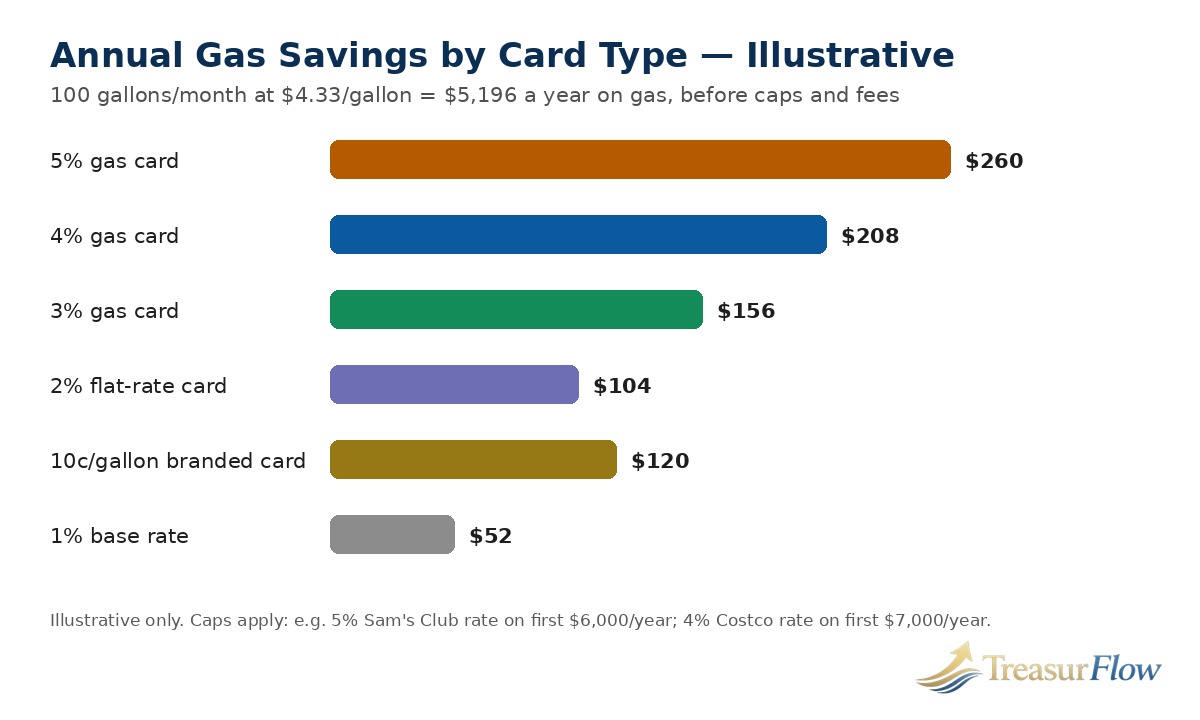
Read the typical-driver row slowly, because it is the row most households live in. Moving from a basic 1% card to a 3% card is worth about $104 a year. Moving from 3% to 5% adds about another $104. Moving from a 2% flat-rate card — already a good everyday card — to a 5% gas card adds about $156. And a branded 10-cents-per-gallon discount, at $120, sits between a 2% and a 3% card. None of these sums will change your life, but they are the honest scale of the decision: a good gas card is worth roughly $100 to $260 a year to a typical driver, which is worth ten minutes of choosing well and not worth obsessive switching.
Now apply the caps to the heavy-driver row, where they bite. The Sam’s Club Mastercard pays 5% only on the first $6,000 of annual gas spending: that is $300, plus 1% on the remaining $1,794, or $17.94, for a real total of about $317.94 — not $389.70. The Costco card pays 5% at Costco or 4% elsewhere only on the first $7,000 combined: a member fueling at Costco earns $350 plus 1% on $794, about $357.94 in total, while a member fueling elsewhere earns $280 plus $7.94, about $287.94. The uncapped Wells Fargo Autograph simply pays its 3% on the full $7,794, about $233.82. The ranking does not flip at this volume — the warehouse cards still lead — but the gap shrinks from a headline $156 to roughly $54 to $124, and it keeps shrinking as volume rises. This is why high-mileage drivers should weight caps as heavily as rates.
Fees change the math in the other direction. The Blue Cash Preferred’s $95 annual fee, charged after the first year as of October 2026, would reduce a typical driver’s gas-only return at 3% from about $156 to about $61 — which is exactly why we recommend that card for its groceries and only count its gas rate as a bonus. Membership costs work the same way: they do not make a warehouse card bad, but they must be subtracted if, and only if, you are paying them for the card rather than for shopping you already value.
Finally, the interest warning, with numbers. Suppose a driver earns a strong $260 in gas rewards over a year but carries an average $2,000 balance on a card at 24% APR. That balance costs roughly $480 in interest over the year — nearly double the rewards. The Consumer Financial Protection Bureau consistently advises consumers to compare the total cost of credit, not just rewards, and gas cards make the reason vivid. If you expect to carry a balance, read our balance transfer guide instead, pay the debt down, and come back to rewards cards when every fill-up can be paid in full.
Picks by Driver Profile
The long commuter. You buy 120 to 200 gallons a month and caps are your enemy. Start with the Wells Fargo Autograph for unlimited 3X, unless you are a Sam’s or Costco member, in which case price the club card’s capped return against the Autograph’s uncapped return at your real volume — the worked example at 150 gallons a month shows how to do it in two minutes.
The warehouse loyalist. You already shop at Costco or Sam’s Club weekly and the membership is not in question. Take your club’s card. The Sam’s Club Mastercard’s 5% anywhere is the single strongest gas rate in this guide for its members, and the Costco card’s 5% at Costco plus 3% on dining and travel makes it the best one-card wallet for its members.
The two-car family. Your biggest lines are supermarkets and fuel together. The Blue Cash Preferred is built for you if supermarket spending passes roughly $3,200 a year; below that, the Blue Cash Everyday gives you 3% on both categories with no fee. Either way, check that your usual fuel stops code as gas stations.
The optimizer. You enjoy setting a category and watching a cap. The Bank of America Customized Cash Rewards pays you 6% on gas in year one for that attention, then 3%, and lets you move the category in a month when travel or online shopping matters more. Set a quarterly reminder for the $2,500 shared cap.
The points collector. You would rather have gift cards and travel than a statement credit, and you always pay at the pump. PenFed Platinum Rewards pays 5X under exactly those habits, at a relatively low 17.99% variable APR as of October 2026. Just value the points honestly at under a cent each when you compare.
The fair-credit driver. The premium cards above generally expect good to excellent credit. A branded station card, or a secured or starter cash back card used only for fuel and paid in full, can be a sensible first step: small, predictable spending, paid monthly, builds the payment history that unlocks better cards. Do not pay an annual fee or accept a very high APR as the price of building credit if a no-fee starter option will approve you, and never let a fill-up become a carried balance.
The EV-and-gas household. One car charges, one car fuels. Prefer cards whose bonus explicitly includes EV charging alongside gas: the Costco card, the Sam’s Club Mastercard, the Wells Fargo Autograph and the PenFed card all describe their top category in gas-and-charging terms as of October 2026, while the Amex Blue Cash cards’ bonus is framed around U.S. gas stations. Read the category definition for the vehicle you actually drive most.
Pros and Cons of Using a Dedicated Gas Card
Pros
- Real, repeatable savings on a purchase you cannot skip, worth roughly $100 to $260 a year to a typical driver at October 2026 prices.
- Percentage rewards gain value as gas prices rise, unlike fixed cents-per-gallon discounts.
- The best general cards bundle gas with groceries, dining, transit or travel, so one card can cover much of a household budget.
- Several top options charge no annual fee, so the rewards are not pre-spent on keeping the card.
- Predictable fuel spending, paid in full monthly, is a clean way to build a payment record.
Cons
- Caps quietly cut the headline rate for heavy drivers, and the drop to 1% is easy to miss mid-year.
- Merchant coding can deny the bonus at warehouse clubs, supermarkets and superstores, and sometimes when paying inside rather than at the pump.
- Warehouse and branded cards trade freedom for rate: membership costs, one-brand fueling and slower, restricted redemption.
- Points-based gas cards may not offer cash back at all, and their points can be worth less than a cent each.
- Regular APRs from 17.74% to 28.74% variable, as of October 2026, mean one carried balance can erase a year of rewards.
- Every application is a hard inquiry, and a wallet full of single-purpose cards is harder to manage well than one good card used consistently.
How to Choose Your Gas Card in Five Checks
Check 1: Count your gallons, not your feelings. Look at two or three recent months of bank activity and total your fuel spending. Under about $250 a month, rate differences are small and simplicity should win. Above $400 a month, caps and top rates deserve real attention.
Check 2: Subtract every fixed cost. Annual fee, plus any membership you would not otherwise buy, comes off the rewards before you compare. A free 3% card beats a 5% card that costs you $95 or a membership you do not use, at low and moderate volumes.
Check 3: Confirm your stations will code correctly. Identify your two most-used fuel stops. If they are warehouse or supermarket pumps, a general card’s gas bonus may never trigger, and a club card or a flat-rate card is the honest choice. If they are standalone stations, pay at the pump and check your first statement to see the bonus post.
Check 4: Decide what you want rewards to be. Cash and statement credits are the most flexible. Sam’s Cash, an annual Costco certificate and PenFed points are each worth less in practice than the same face value in cash, because you can only spend them in certain places or on certain things. Discount the rate in your head accordingly.
Check 5: Be honest about balances. If there is any real chance you will carry the balance, stop shopping for rewards rates. Choose the lowest cost of credit available to you, automate at least the minimum payment to protect your credit, and treat any rewards as a minor bonus. The Federal Trade Commission and the CFPB both publish free guidance on managing credit card debt, linked in the resources box at the top of this guide.
Mistakes That Cost Drivers Their Gas Rewards
The first mistake is chasing the highest percentage into a cap you will hit by June, then earning 1% for the rest of the year while a simpler card would have paid 3% throughout. The second is buying fuel where the bonus does not apply: a month of fill-ups at a supermarket pump on a card that excludes supermarkets is a month at the base rate. The third is letting a branded discount anchor you to a station whose base price is higher than a competitor’s — a 10-cent discount on fuel that costs 15 cents more per gallon than the station across the road is a loss wearing a reward’s clothing. Compare the price on the sign first, then the card.
The fourth mistake is treating a welcome bonus as a reason to overspend. The bonuses in this guide — $200 after $1,000 in spending on the Bank of America and Wells Fargo offers as of October 2026, for example — are easy to earn with normal spending for most households, which is exactly how they should be earned. The fifth, and most expensive, is financing fuel. Gas is consumed in days; a balance carried at 24% or 28% APR is still being paid for long after the tank is empty. If a fill-up cannot be paid in full this month, the cheapest gas card is the one you do not use, and a debit card or cash is the better tool until the balance is gone.
Gas Card Questions Drivers Ask Before They Apply in 2026
What is the best gas credit card in 2026?
There is no single best gas credit card in 2026 for every driver. Sam’s Club members can earn 5% back on gas on the first $6,000 spent each year, and Costco members can earn 5% on gas at Costco and 4% on other eligible gas on the first $7,000, as of October 2026. Drivers without a warehouse membership are usually better served by an uncapped 3% card or by the Bank of America Customized Cash Rewards card if they will set gas as their chosen category.
Are gas station credit cards better than general cash back cards?
Usually not. A typical branded card such as the Shell Fuel Rewards Card saves 10 cents per gallon, which is worth about 2.3% when gas costs $4.33 a gallon, as of October 2026. A general card earning 3%, 4% or 5% back at gas stations beats that rate, works at more than one brand, and earns rewards on other spending too. A branded card can still make sense if you always use that brand, you want the instant discount at the pump, or your credit makes a general rewards card hard to get.
How much can I actually save with a gas credit card each year?
It depends on how many gallons you buy. At $4.33 a gallon, a driver buying 100 gallons a month spends $5,196 a year on gas, as of October 2026. That driver would earn about $260 back at 5%, about $208 at 4%, and about $156 at 3%, before any spending caps or fees. A 10-cents-per-gallon branded discount would save that same driver about $120 a year. These figures are illustrative, not a guarantee, and caps lower the return once you pass a card’s limit.
Do warehouse club gas purchases earn bonus rewards on every card?
No. Many general cards pay their gas bonus only at standalone gas stations, and fuel bought at warehouse clubs, supermarkets and superstores may code differently and earn only the base rate. That is one reason the Costco Anywhere Visa Card and the Sam’s Club Mastercard are valuable to members: they are built to reward fuel bought through their own clubs. Always check a card’s definition of a gas station purchase before you assume a fill-up will earn the headline rate.
Does a high gas rewards rate matter if I carry a balance?
No, not in a helpful way. Gas cards in this guide carry regular APRs ranging from 17.74% to 28.74% variable, as of October 2026. Paying interest at those rates for even a couple of months can erase a full year of gas rewards. If you carry a balance, a lower interest rate or a balance transfer offer matters far more than an extra 1% or 2% back at the pump, and you should focus on paying the balance down first.
Will applying for a gas credit card hurt my credit score?
An application normally involves a hard inquiry, which can cause a small, temporary dip in your credit score, and a new account lowers your average age of credit. Those effects usually fade as you make on-time payments and keep your balance low relative to your limit. The Consumer Financial Protection Bureau notes that how you use the card after opening it — paying on time and keeping balances low — matters much more over time than the inquiry itself.
Conclusion: Buy Rate Only Where Your Life Already Goes
The best gas credit cards 2026 has to offer reward drivers who match the card to the life they already live. Warehouse members should take their club’s 5% or 4% rate and enjoy the easiest win in this guide. Organized drivers should take Bank of America’s 6% first year and manage the category and cap that come with it. Everyone else — which is most people — should take a simple, automatic 3% from a card like the Wells Fargo Autograph or one of the Amex Blue Cash cards, subtract nothing for fees, and move on to financial decisions worth more than the roughly $100 a year that separates good gas cards from great ones at typical volumes.
Whatever you choose, do three things in the first month. Set the category if your card has one. Make your first fill-up at your usual station and confirm on the statement that the bonus rate actually posted. And set up autopay for the full statement balance, because at October 2026 APRs, that single setting protects more money than the choice between any two cards in this guide. Prices at the pump will do what they do — AAA’s October 2026 reports show a market still above $4 a gallon with crude oil near $100 a barrel — but the percentage you earn back on every gallon is, for once, a part of the cost of driving that you get to pick.
Rates, fees, APRs, caps and offers in this article are as of October 2026 and were checked against issuer information and major card roundups published in October 2026. Terms change without notice in this article; confirm current terms with the issuer before applying. This article is educational information, not financial advice tailored to your situation.

Muhammad Zakir is the founder of Treasurflow and the author of its personal finance guides. He researches consumer banking, credit, and personal loans, and every guide cites primary sources such as the CFPB, FDIC, FTC, and IRS. His content is educational and is not personalized financial advice.