
Best No Annual Fee Credit Cards 2026: Keeper Cards, Organized by the Job They Do
Most “best card” lists ask the wrong question. They ask which card is best, full stop — as if one card should win at groceries, gas, rent-day bills, international trips, and a surprise $4,000 repair all at once. No single card does all of those jobs well, and with annual-fee cards you pay rent on the card every year whether it did its job or not.
A no annual fee card works the opposite way. Because it costs $0 to keep, it never has to justify itself again after the year you opened it. You can open it for one specific job — the flat-rate workhorse, the 5% category hunter, the card you take abroad, the 0% breathing-room card — and then keep it for a decade. That is why this guide is organized differently from a generic ranked list. Every pick below is a keeper card organized by job. Decide which job you need done first, then pick the card that does that job. If you need two jobs done, keep two cards. There is no fee clock ticking on either of them.
All card terms in this guide were checked against issuer and major comparison sources as of October 2026. Welcome offers change often, and in two cases below the sources disagreed with each other — where that happened, this guide says so instead of pretending one number is certain. Always confirm the offer on the issuer’s own application page before you apply. Nothing here is personal financial advice; it is a decision framework plus verified terms so you can run your own numbers.
Related Guides
- Best Cash Back Credit Cards 2026 — if you want the deepest dive on cash back structures beyond the no-fee keepers here.
- Best Balance Transfer Credit Cards 2026 — if paying down an existing balance, not earning rewards, is your main job right now.
- Best Travel Rewards Credit Cards 2026 — if you travel enough that a fee card’s perks might beat the free keepers in this guide.
- Best Secured Credit Cards 2026 — if you are building or rebuilding credit and are not yet eligible for the cards below.
Helpful Official Resources
- Consumer Financial Protection Bureau (CFPB) — Credit cards hub — plain-language guidance on comparing offers, understanding rewards, and reading rates and fees before you apply.
- CFPB — Explore credit card offers — the Bureau’s tool for comparing cards on APR, fees, and rewards side by side.
- Federal Reserve — G.19 Consumer Credit release — the official data on consumer credit, including the average APR on credit card accounts assessed interest, which this guide cites when it talks about the cost of carrying a balance.
- Issuer terms pages for each card named below — the only source that controls your actual offer, APR, and fees at application.
Why “Keeper” Is the Whole Point of a $0-Fee Card
Before the picks, it is worth understanding why experienced cardholders treat no-fee cards as permanent and fee cards as probationary. Three mechanics make a $0 card a keeper, and none of them appear in a typical rewards headline.
First, there is no annual keep-or-cancel decision. With a $95 card, every anniversary forces a calculation: did I earn at least $95 more than a free card would have earned? If not, you should downgrade or close it — and both moves take effort and attention. With a $0 card, the calculation never comes up. A quiet year costs you nothing. A great year is pure gain. Over ten years, that absence of friction is worth real money, because the fee card you forget to cancel for two “meh” years has quietly cost you $190.
Second, age of accounts rewards patience. Your credit history length — including the average age of your accounts and the age of your oldest account — is a meaningful part of common credit scoring models. An account you opened years ago and keep open keeps aging in your favor. Closing your oldest card does not always hurt you immediately, because closed accounts in good standing can remain on your reports for years, but keeping a $0 card open removes the question entirely. There is no cost to letting it age. This is also why the best first rewards card is usually a no-fee one: it can become the oldest line in your file and stay there for life at zero cost.
Third, an open, unused limit lowers your utilization. Credit utilization — how much of your available revolving credit you are using — moves scores quickly. A keeper card you barely use still contributes its full credit limit to your available credit. Two or three keepers with modest limits can meaningfully dilute the utilization impact of a month when you do spend heavily on one card. You should never open a card only for this effect, and you should never spend more to “use” a limit, but as a side benefit of cards you already hold for their jobs, it is real.
The discipline that makes keepers work is simple: put one small recurring charge on each keeper you rarely use — a streaming subscription, a phone bill — set autopay for the full statement balance, and the card stays active, ages, and costs nothing. Issuers can close inactive accounts, so a small automatic charge every month is cheap insurance against an unwanted closure. That one habit turns the theory in this section into practice.
The Comparison Table: Every Keeper in This Guide at a Glance
Use this table to shortlist, then read the job section for the card you are considering. Rates, caps, and fees are as of October 2026. “Foreign fee” is the one column most shoppers skip — do not. Section 6 of this guide explains why a 3% foreign fee silently turns a 2% rewards card into a card that loses 1% on every purchase abroad.
| Card | Job it does best | Headline rewards | Welcome offer (as of Oct 2026) | Intro APR | Foreign transaction fee | Annual fee |
|---|---|---|---|---|---|---|
| Wells Fargo Active Cash® | Flat-rate workhorse | Unlimited 2% cash rewards on purchases | Conflicting listings — see card notes below | 0% for 12 months on purchases and qualifying balance transfers | 3% | $0 |
| Citi Double Cash® | Flat-rate workhorse (pay-in-full habit builder) | 2% total — 1% when you buy, 1% when you pay | $200 after $1,500 in purchases in 6 months | 0% for 18 months on balance transfers only | 3% | $0 |
| Chase Freedom Flex® | Rotating 5% hunter | 5% in activated quarterly categories on up to $1,500/quarter; 5% on Chase Travel; 3% on dining and drugstores; 1% otherwise | $250 after $500 in purchases in 3 months (limited-time offer in Oct 2026 listings) | 0% for 15 months on purchases and balance transfers | None in current listings | $0 |
| Discover it® Cash Back | Rotating 5% hunter (first-year doubler) | 5% in activated quarterly categories on up to $1,500/quarter; 1% otherwise; Cashback Match doubles first-year earnings | Unlimited Cashback Match at end of first year | 0% for 15 months on purchases and balance transfers in most current listings | None | $0 |
| Blue Cash Everyday® Card from American Express | Everyday categories — groceries, gas, online retail | 3% at U.S. supermarkets, 3% on U.S. online retail, 3% at U.S. gas stations — each on up to $6,000/year, then 1%; 1% otherwise | As high as $200 after $2,000 in purchases in 6 months (offer varies by applicant) | 0% for 15 months on purchases and balance transfers | 2.7% | $0 |
| Capital One Savor Cash Rewards | Everyday categories — dining, groceries, entertainment | Unlimited 3% on dining, groceries (excluding superstores), entertainment, and popular streaming; 5% via Capital One Travel; 1% otherwise | $200 after $500 in purchases in 3 months | 0% for 12 months on purchases and balance transfers | None | $0 |
| Wells Fargo Autograph® | Travel without a foreign fee | Unlimited 3x points on restaurants, travel, gas, transit, streaming, and phone plans; 1x otherwise | 20,000 points (a $200 cash redemption value) after $1,000 in purchases in 3 months | 0% for 12 months on purchases | None | $0 |
| Capital One VentureOne Rewards | Travel miles, simplest form | Unlimited 1.25x miles on purchases; 5x miles on hotels, vacation rentals, and rental cars booked through Capital One Travel | 20,000 miles after $500 in purchases in 3 months | 0% for 15 months on purchases and balance transfers | None | $0 |
| Wells Fargo Reflect® | Longest 0% runway | No rewards — this card’s job is time, not points | None | 0% for 21 months on purchases and qualifying balance transfers | Check issuer terms before travel use | $0 |
A note on reading this table honestly: the welcome offer column is the least stable column in it. Issuers test different offers by channel, and comparison sites update on different days. Where two reputable October 2026 sources stated different Active Cash bonuses, this guide flags the conflict in the card’s own section rather than picking one quietly. Treat every bonus as “confirm on the issuer page today,” and treat the rewards structure, caps, and foreign fee — the terms that affect you for years — as the real basis for your decision.
Job 1: The Flat-Rate Workhorse — Best 2% on Everything
The job: one card that earns a strong rate on the spending that fits no category — medical bills, car repairs, school fees, insurance premiums, the plumber, the vet. Category cards pay 1% on all of that. A flat 2% card doubles it, forever, with zero tracking.
Wells Fargo Active Cash® — the simplest 2%
The Active Cash earns unlimited 2% cash rewards on purchases, with no categories to activate and no cap. It adds two practical extras that most flat-rate rivals lack: cell phone protection of up to $600 per claim (with a $25 deductible) when you pay your monthly cell phone bill with the card, and a 0% intro APR for 12 months on purchases and qualifying balance transfers. Its regular APR in current listings is 18.74%, 24.74%, or 28.74% variable, depending on creditworthiness.
Two honest cautions. First, the card charges a 3% foreign transaction fee, so it is a domestic workhorse, not a travel card — pair it with a Job 4 card below for trips. Second, its welcome offer is the one figure in this guide where October 2026 sources openly conflict: some current listings show $100 after $500 in purchases in the first 3 months, while other reputable listings and reviews still show $200 on the same $500 spend. Because the sources conflict, this guide does not assert either figure as settled. Check the live offer on Wells Fargo’s site on the day you apply, and do not let a $100 difference in a one-time bonus outweigh the card’s permanent 2% structure, which is the actual reason to keep it.
Pick Active Cash if: you want the 2% paid simply as you spend, you value cell phone protection, or you want a purchase intro APR alongside flat rewards.
Citi Double Cash® — the 2% that rewards paying in full
The Double Cash also delivers 2% on every purchase, but split by design: 1% when you buy and 1% when you pay. If you pay in full every month — the habit this entire guide assumes — you earn the same 2% as Active Cash. If you carry balances, you earn the second 1% later and pay interest that dwarfs it, which is exactly the behavior the structure quietly discourages.
Double Cash’s distinctive strength is its 0% intro APR for 18 months on balance transfers, paired with a welcome offer listed in October 2026 sources as $200 after $1,500 in purchases in the first 6 months. Note the limits: the intro APR applies to balance transfers, not purchases, and balance transfer fees apply (an intro fee for transfers made in the first months, then a higher standard fee — confirm the current schedule with Citi). The card also earns rewards as Citi ThankYou® Points, which matters if you later hold a premium Citi card that unlocks transfer partners. Like Active Cash, it charges a 3% foreign transaction fee.
Pick Double Cash if: you want the flat 2% plus the longest balance-transfer runway among the flat-rate pair, or you are building toward the Citi points ecosystem.
The decision, flat-rate edition
If both cards earn 2%, choose on the second job. Need a purchase intro APR or phone protection? Active Cash. Need a balance-transfer runway or Citi points? Double Cash. Travel abroad more than once in a while? Neither — both charge 3% abroad, so whichever you pick becomes your at-home card, and Job 4 supplies your travel card. That is not a flaw in either card. It is the keeper system working as intended: each card does its job, and no card is asked to do a job it is bad at. If you are still deciding between flat-rate simplicity and category earning as your primary strategy, our guide to the best cash back credit cards models both approaches in more depth.
Job 2: The Rotating 5% Hunter — Best When You Will Actually Activate
The job: earn 5% — two and a half times the flat rate — on a rotating slice of everyday life: groceries one quarter, gas or restaurants or Amazon-style spending in another. The catch is identical on both cards below and it is not hidden, just easy to forget: you must activate each quarter, and the 5% applies only to the first $1,500 in combined category purchases per quarter, then 1%. Max out all four quarters and the categories alone pay $300 a year; forget to activate and the same spending pays $60 at the 1% base rate. The $240 gap between those outcomes is the price of four missed clicks a year. Set four calendar reminders — January 1, April 1, July 1, October 1 — on the day the card arrives.
For context on how live this category is in October 2026: fourth-quarter 2026 listings show the Freedom Flex paying 5% on dining, grocery stores (excluding Walmart and Target), and donations to the American Red Cross, while Discover’s fourth quarter covers restaurants, entertainment, and utilities. Categories change every quarter, so treat those as a snapshot of the mechanism, not a promise about next quarter.
Chase Freedom Flex® — the hunter with a strong everyday fallback
Freedom Flex layers three earning levels. The rotating 5% on up to $1,500 per quarter after activation sits on top of permanent rates: 5% on travel purchased through Chase Travel, 3% on dining (including takeout and eligible delivery) and 3% at drugstores, and 1% on everything else. That fallback matters in real life: in a quarter where the rotating categories miss your spending entirely, the card still earns 3% on two common categories instead of going dormant in a drawer. In a quarter where dining is a rotating category, current Chase listings describe the rates stacking to an effective 7% on dining up to the cap.
October 2026 listings show a limited-time welcome offer of $250 after $500 in purchases in the first 3 months, up from the long-running $200 offer — another figure to confirm on Chase’s page, since “limited time” offers by definition do not stay. The card offers 0% intro APR for 15 months on purchases and balance transfers, then a variable APR listed at 18.49%–27.99%. Notably, current listings show no foreign transaction fee on Freedom Flex, a change from the card’s earlier terms that several October 2026 reviews call out explicitly. If you hold an older mental image of this card as a 3%-abroad card, update it — but verify on Chase’s current pricing page, because fee schedules are exactly the kind of term to confirm firsthand.
Pick Freedom Flex if: you will activate quarterly, your dining and drugstore spending is steady, or you may later pair it with a Chase Sapphire card to move points into travel partners.
Discover it® Cash Back — the hunter that doubles year one
Discover it Cash Back runs the same core mechanic — 5% in rotating categories on up to $1,500 per quarter after activation, 1% otherwise, no annual fee, no foreign transaction fee — and then adds the most unusual welcome structure in this guide: Unlimited Cashback Match. Instead of a fixed bonus, Discover automatically matches all the cash back you earn in your first year, with no minimum and no cap. Earn $480 in year one and you receive another $480. Effectively, your rotating categories pay 10% and everything else pays 2% for twelve months. No other keeper in this guide can touch that first-year math — and no card, including this one, repeats it in year two, which is why this guide evaluates Discover on its ongoing 5%/1% structure and treats the match as a one-time accelerant, not a permanent rate.
Most current listings show 0% intro APR for 15 months on purchases and balance transfers (at least one variant listing splits the periods differently, so confirm the exact offer attached to your application). Two practical limits deserve plain statement: Discover’s acceptance abroad is narrower than Visa or Mastercard even though it charges no foreign fee, so it is a better second travel card than a sole travel card; and the 1% base rate means Discover should rarely be your only card — in a non-category month it earns half of what your flat 2% keeper earns.
Pick Discover it if: you are opening your rotating card early in a year of normal-to-heavy spending — maximizing the match — and you already hold, or plan to hold, a flat 2% card for everything outside the categories.
The decision, rotating edition
Year one, Discover’s match usually wins. Year three, Freedom Flex’s permanent 3% dining and drugstore rates usually win, because they pay every month without depending on the calendar. The keeper answer, if you are willing to hold two free cards, is both: they cost nothing to keep, their quarterly categories often complement rather than duplicate each other, and each covers the other’s weak quarter. Holding both purely to chase categories you do not naturally spend in, however, is the classic rewards trap — never shift a purchase to a worse-value store or buy something unneeded to “use” a 5% category. The categories should hunt your spending, never the reverse.
Job 3: The Everyday Categories Earner — Best 3% on Groceries, Dining, Gas, and Online Shopping
The job: pay an elevated rate on the categories you buy every week, with no activation and no calendar. Rotating cards pay more but only sometimes; flat cards pay everywhere but only 2%. The two cards in this job pay 3% permanently on defined everyday categories. The decision between them is really a decision about which everyday categories dominate your budget — supermarket-and-online, or dining-and-entertainment.
Blue Cash Everyday® Card from American Express — groceries, gas, and online retail at 3%
Blue Cash Everyday pays 3% cash back at U.S. supermarkets, 3% on U.S. online retail purchases, and 3% at U.S. gas stations, with a separate $6,000-per-year cap in each category (then 1%), and 1% on all other purchases. Cash back arrives as Reward Dollars redeemable for statement credit or at Amazon.com checkout. The online-retail category is the quiet differentiator: it rewards the channel, not the store type, so online orders from general retailers can earn 3% even when the same basket bought in person would earn 1%.
Current terms show 0% intro APR for 15 months on purchases and balance transfers, then a variable APR of 19.74%–28.74%, and a welcome offer framed by Amex as “as high as $200” after $2,000 in purchases in the first 6 months — Amex shows the exact offer during application, and you may not be eligible for the highest figure, so this guide deliberately does not promise $200 flat. The card also offers a Disney Bundle credit of up to $7 per month with enrollment. Its limits are clear: a 2.7% foreign transaction fee makes it a domestic card, U.S. supermarkets exclude superstores and warehouse clubs, and a large family can hit the $6,000 grocery cap before year-end — at which point groceries on this card earn 1% and your flat 2% keeper should take over for the rest of the year.
Pick Blue Cash Everyday if: supermarket, gas, and online shopping are your three biggest card categories and each stays near or under $6,000 a year.
Capital One Savor Cash Rewards — dining, groceries, and entertainment at 3%, uncapped
The Savor card (the no-fee Savor, formerly widely known as SavorOne) pays unlimited 3% cash back on dining, at grocery stores (excluding superstores like Walmart and Target), on entertainment, and on popular streaming services, plus 5% on hotels, vacation rentals, and rental cars booked through Capital One Travel, 8% on Capital One Entertainment purchases, and 1% on everything else. Where Blue Cash Everyday caps its 3% categories, Savor’s headline 3% categories are uncapped — heavy dining or grocery spending keeps earning 3% all year.
October 2026 listings show a $200 bonus after $500 in purchases in the first 3 months, 0% intro APR for 12 months on purchases and balance transfers (then 18.74%–28.74% variable), no annual fee, and no foreign transaction fees — a rare combination that lets Savor double as a light travel card, a point Job 4 returns to. Watch the grocery definition: superstore spending earns 1%, so households that buy most groceries at Walmart or Target will see far less 3% than the headline suggests, and should compare honestly against a flat 2% card that pays 2% everywhere, superstores included.
Pick Savor if: dining out, entertainment, and streaming are major budget lines, your grocery spending is uncapped-heavy, or you want one everyday card that also travels without a foreign fee.
The decision, everyday edition
Map last month’s statement before you choose. If the big three are supermarkets, gas, and online orders, Blue Cash Everyday’s trio fits — and check each against the $6,000 cap. If the big three are restaurants, groceries, and entertainment or streaming, Savor fits — and confirm your grocery stores are not superstores. If neither trio covers even half your spend, skip this job for now: a flat 2% keeper will quietly out-earn a 3% card whose categories you only sometimes hit, because 2% on everything beats 3% on a third of your spending plus 1% on the rest. That blended-rate reality — not the headline rate — is what the break-even section and the chart later in this guide keep returning to.
Job 4: The Travel Companion — Best No-Foreign-Transaction-Fee Cards That Still Cost $0 a Year
The job: spend abroad — and on foreign websites from your couch — without surrendering 3% to a fee that buys you nothing. This job exists because of a trap detailed in its own section below: several excellent $0 cards in Jobs 1 and 3 still charge 2.7%–3% abroad. The two cards here charge none, while still costing $0 a year to keep.
Wells Fargo Autograph® — 3x on the categories trips are made of
Autograph earns unlimited 3x points on restaurants, travel, gas stations, transit, popular streaming services, and phone plans, and 1x on other purchases — a category list that reads like a trip itinerary. Points are worth one cent each for cash redemption, and the card now offers transfers to select travel loyalty programs. Current issuer terms show 20,000 bonus points after $1,000 in purchases in the first 3 months (a $200 cash redemption value), 0% intro APR for 12 months on purchases (then 18.74%, 24.74%, or 28.74% variable), up to $600 of cell phone protection with a $25 deductible, no annual fee, and no foreign transaction fee. As a Visa, it also brings the broad international acceptance that a travel card needs.
Pick Autograph if: you want one no-fee card that earns well at home and abroad, especially if your trips run on restaurants, transit, and gas rather than luxury hotels.
Capital One VentureOne Rewards — transferable miles in their simplest form
VentureOne earns unlimited 1.25x miles on every purchase and 5x miles on hotels, vacation rentals, and rental cars booked through Capital One Travel. Miles can cover travel purchases or transfer to Capital One’s 15+ travel loyalty programs, which gives this modest-looking card an upside no pure cash back keeper has. Current listings show 20,000 miles after $500 in purchases in the first 3 months (worth $200 in travel at one cent per mile), 0% intro APR for 15 months on purchases and balance transfers (then 18.74%–28.74% variable; balance transfer fee applies), no annual fee, and no foreign transaction fees.
Be clear-eyed about the trade: 1.25x is a low everyday earn rate. If you redeem for cash-like value, VentureOne earns less on domestic spending than your flat 2% keeper, every single month. Its job is narrow and it does it well — fee-free foreign spending plus a transferable-miles balance that never expires while the account is open — but it should ride alongside your workhorse, not replace it.
Pick VentureOne if: you travel internationally at least occasionally, you value transferable miles, and you are happy to let a 2% card do the domestic heavy lifting. For heavier travel ambitions — lounge access, large transfer bonuses, premium protections — compare against the fee cards in our best travel rewards credit cards guide and run the break-even math in the next major section before paying any annual fee.
Job 5: The 0% Breathing-Room Keeper — Best Long Intro APR With No Fee to Keep It After
The job: time. When a necessary purchase or an existing balance needs months to pay down, the most valuable feature a card can offer is not points — it is a long 0% window with no annual fee adding to the balance you are trying to kill.
Wells Fargo Reflect® — 21 months of runway
The Reflect card offers 0% intro APR for 21 months from account opening on purchases and on qualifying balance transfers, then a variable APR listed in current sources at 17.74%, 24.24%, or 28.49%. Balance transfers carry a fee of 5% (minimum $5) in current listings. It earns no rewards, and that is the point: this card is a financing tool, not a spending tool. Its keeper logic is different from every other card in this guide — after the intro window you may rarely use it, but at $0 a year it can remain open as an aging account and available-credit ballast, with a small recurring charge to keep it active.
Run the honest math before transferring anything. Illustrative example, computed for this guide: moving a $4,000 balance that you would otherwise repay over 12 months at the Federal Reserve’s reported average APR on interest-charged accounts — 22.15% in the second quarter of 2026, per the Fed’s G.19 release — costs about $496 in interest. The same balance at 0% with a 5% transfer fee costs $200 in fees, and with a 3% intro-fee structure (offered by some competing long-window cards, such as Citi’s Diamond Preferred in current listings) it would cost $120 — a saving in the region of $296 to $376 versus interest, if you clear the balance inside the window. That “if” is the entire product. A balance still standing when month 22 arrives starts accruing at a regular APR in the high teens or twenties, and the saving evaporates. Set the payoff amount as a fixed monthly autopay on day one — balance divided by months remaining, rounded up — rather than trusting future motivation.
If a transfer is your primary job, also weigh the hybrid route: the Citi Double Cash in Job 1 pairs an 18-month balance-transfer window with a permanent 2% rewards life afterward, and our best balance transfer credit cards guide compares the longest windows and their fees in full. And if your credit is still building, you may not yet qualify for 21-month offers at all — the best secured credit cards are the correct on-ramp, and a secured keeper upgraded over time can become the oldest account in your file.
The Foreign-Transaction-Fee Trap: How a “Free” Card Loses Money Abroad
“No annual fee” describes exactly one fee. It says nothing about the fee that surprises travelers most. A foreign transaction fee — typically 3% on the cards in this guide that charge one, and 2.7% on Blue Cash Everyday — is added to purchases processed outside the United States, including online orders from foreign merchants even when you never leave home and the price was shown in dollars.
Now do the arithmetic that marketing never prints side by side. Put a $3,000 trip — hotels, meals, trains — on a flat 2% card that charges a 3% foreign fee. You earn $60 in rewards and pay $90 in foreign fees, for a net result of minus $30. You would literally have done better with a debit card earning nothing. On a $5,000 trip the fee alone is $150. The CFPB’s guidance on comparing cards makes the same underlying point this guide keeps making: compare the full rates-and-fees schedule, not the headline reward, because fees are where otherwise-similar cards quietly diverge.
The fix costs nothing, which is the theme of this entire article. Cards in this guide that charge no foreign transaction fee include the Wells Fargo Autograph, Capital One VentureOne, Capital One Savor, Chase Freedom Flex (per current listings), and Discover it Cash Back. Keep one of them for foreign spending and your 2% workhorse never has to leave the country. Two travel habits complete the defense: when a terminal abroad offers to charge you in U.S. dollars, choose the local currency — the dollar option carries the merchant’s own conversion markup on top of everything else — and check acceptance before you rely on an American Express or Discover card as your only card abroad, since Visa and Mastercard are accepted more widely in many destinations.
When a $95 Annual-Fee Card Actually Beats a Free One — The Break-Even Math
Keepers are the default, not a religion. A $95 card beats a free card in a specific, computable situation: when the extra rewards and credits it gives you — above what your best free alternative would give you on the same spending — exceed $95 a year. Everything else is brochure language. Here is how to run that test with real numbers, all computed for this guide and labeled illustrative because your categories will differ from the model.
The generic rule first. If a fee card earns, on your actual spending, an average of 1 percentage point more than your free card, you need $9,500 of annual spending on it just to break even ($95 ÷ 0.01). If it earns only half a point more on your blended spending, you need $19,000. Most households overestimate the gap because they compare the fee card’s best category against the free card’s base rate — the blended comparison is the only honest one.
The cleanest concrete case is groceries, because both sides of the comparison exist in famous form: a $95 card paying 6% at U.S. supermarkets versus the free Blue Cash Everyday paying 3% on the same spending (each capped at $6,000 a year). The extra 3 points must cover $95, which requires $3,167 a year in supermarket spending — about $264 a month. Spend $250 a month on groceries and the free card wins; spend $500 a month and the fee card wins on groceries alone by roughly $85 a year, before counting its other categories and credits. Below the threshold, the “premium” card is a donation. Above it, refusing the fee card on principle costs you money. Neither answer is ideological — both are arithmetic.
Now the full-wallet picture at a representative spend level. The chart in this guide models $1,500 a month ($18,000 a year) three ways. A flat 2% keeper earns $360. A free category stack — $600 a month at 3%, $250 a month routed into 5% rotating categories, and the remaining $650 a month on the flat 2% card — earns $522. A $95-fee grocery-led card on the same total spend — $500 a month at 6%, $200 a month at 3%, $800 a month at 1% — earns $528 gross and $433 after its fee. Read that result carefully, because it is the most useful number in this article: at moderate spending, a well-built free stack can beat a fee card net of its fee. The fee card pulls ahead as spending concentrates and grows — at double the grocery volume its 6% rate has more room to run — which is precisely why the decision must be made with your statement, not with a ranking.
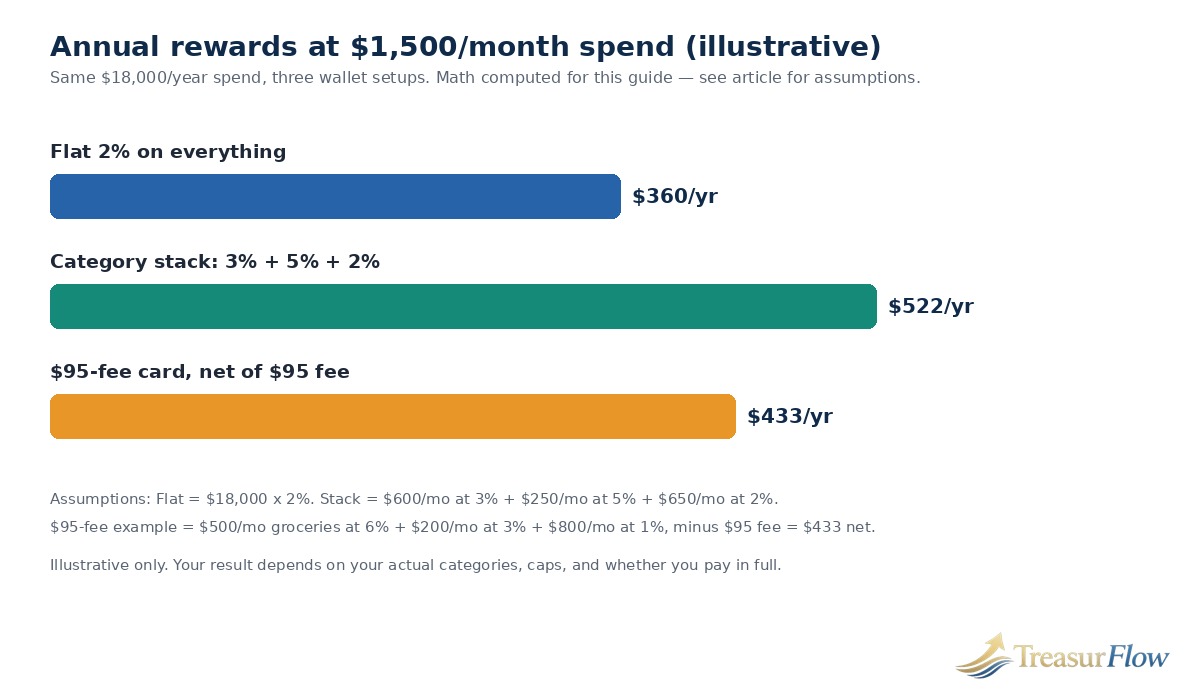
One more break-even trap deserves naming: first-year math lies. In year one, welcome bonuses and waived intro fees make almost any fee card look brilliant. The keeper test is a year-two test, because year two is the first year you pay full price for the card with no bonus sugar. Run every fee-card decision on year-two numbers. If it still wins, pay the fee without guilt and re-run the test every anniversary — the moment it stops winning, downgrade it to the issuer’s no-fee version of the card where one exists, which usually preserves the account’s age far better than closing it outright.
How to Stack Two or Three Free Cards Without Making Life Complicated
A stack is not a collection. The working stacks readers actually sustain for years have exactly three slots, each mapped to a job from this guide, and a rule for every purchase that fits on an index card.
The two-card stack (the default recommendation). Slot one: a flat 2% workhorse — Active Cash or Double Cash — as the default card, the one saved in your browser, your phone wallet, and every subscription. Slot two: one category card matched to your biggest category — Freedom Flex or Discover if you will activate quarters, Blue Cash Everyday or Savor if you will not. Every purchase decision becomes one question: “Is this the category card’s category?” If yes, use it; if no, the workhorse. Two cards, one question, and a blended earn rate that the chart above shows beating most single cards, fee or free.
The three-card stack (add travel or time, not a fourth category). Add either a no-foreign-fee travel keeper (Autograph or VentureOne) if you leave the country at least once a year, or treat a long 0% card as a temporary third slot while a balance is being paid down, retiring it to small-charge keeper duty afterward. Resist the third category card: each additional category card adds a cap to track and a rule to remember, while adding less than the one before it, because your biggest category was already covered by card two. Complexity is a cost even when fees are zero — a stack you abandon in March earns 1% on the card you grab instead.
Practical stack hygiene, learned the hard way by many cardholders: stagger application timing rather than opening everything in one week, since multiple applications in a short window can affect approvals and temporarily affect your score; put one small recurring bill on every keeper so none goes inactive; set autopay for the full statement balance on every card, because one month of interest on one card can erase a quarter of rewards across all of them; and keep a one-line note in your password manager listing each card’s job (“Flex = 5% quarters + dining”), because the stack only works if future-you remembers the system present-you designed. Readers whose credit is not yet strong enough for these approvals should start with a starter or secured on-ramp card and graduate into the two-card stack from there.
Credit Scores, Approval Realities, and Why Keepers Protect Both
Most cards in this guide are aimed at applicants with good to excellent credit — in practice, issuers and comparison sources describe the target for cards like Autograph, Savor, and VentureOne as good/excellent, and the flat 2% cards typically expect good credit or better as well. If your score is below that range, an application spree helps no one: each application can involve a hard inquiry, and denials produce inquiries without accounts. The better sequence is to build with a starter or secured keeper first, let it age while you pay on time, and apply for the Job 1 workhorse second — the order matters because the workhorse is the card most likely to remain your oldest, most-used account.
For existing keepers, three score habits matter more than any optimization. Pay every card on time, every time — payment history is the heaviest-weighted factor in common scoring models, and autopay for at least the minimum is the floor, with full-balance autopay as the standard this guide recommends. Keep utilization modest on the card you use daily by paying mid-cycle in heavy months if needed. And do not close your oldest no-fee card in a fit of wallet minimalism: at $0 a year, the ” clutter” costs nothing, while the account’s age and limit quietly support your file every month it stays open. If an issuer ever converts or discontinues a keeper product, ask about a product change to another no-fee card from the same issuer before accepting a closure — preserving the account’s history is usually the better outcome.
Rates and Fees Disclaimer
Card terms, rewards rates, caps, welcome offers, intro APR periods, regular APRs, and fees cited in this article were checked against issuer pages and major comparison sources as of October 2026 and can change at any time without notice; at least one welcome offer in this guide carried conflicting figures across current sources, as noted in that card’s section. APRs shown are variable and depend on creditworthiness. Balance transfers, cash advances, and foreign transactions may carry fees even on cards with no annual fee. This article is educational information, not financial, tax, or legal advice, and Treasurflow does not guarantee approval for any card. Before applying, read the issuer’s current Rates and Fees disclosure and cardmember agreement — available via the issuer and through the CFPB’s credit card resources linked at the top of this guide — and confirm that any offer matches what you were shown at application.
Keeper-Card Questions People Ask Before They Commit to Free Forever
Does a no annual fee card really cost nothing to keep open?
It costs nothing in annual fees for as long as you hold it, and that is what makes it a keeper. You can still be charged interest if you carry a balance, plus fees that depend on how you use the card, such as balance transfer, cash advance, late payment, and — on some cards — foreign transaction fees. Pay in full and on time, and a no-fee card can genuinely cost $0 a year.
Which is better for most people, a flat 2% card or a rotating 5% card?
For most people, the flat 2% card is the better first keeper because it pays 2% on everything with no activation and no cap. A rotating 5% card earns more only on activated category spending up to $1,500 per quarter, and it pays 1% on everything else. The strongest simple setup is both: the 2% card as your default and the 5% card only for its current categories.
Do no annual fee cards still charge foreign transaction fees?
Some do, and this is the most common hidden cost on free cards. Among the cards in this guide, the Wells Fargo Active Cash and Citi Double Cash charge 3% on foreign transactions and the Blue Cash Everyday charges 2.7%, while the Wells Fargo Autograph, Capital One VentureOne, Capital One Savor, Chase Freedom Flex in current listings, and Discover it Cash Back charge none. Always check the fee schedule before you travel.
Will keeping an old no-fee card open actually help my credit score?
It can help in two practical ways. An open account keeps getting older, which supports the length-of-history part of your credit profile, and its credit limit adds to your available credit, which can lower your overall utilization. There is no guarantee of a specific score change, but because the card costs $0 to keep, there is usually no financial reason to close your oldest no-fee account.
Can I hold two or three no annual fee cards at the same time?
Yes, and that is exactly how the keeper system in this guide is designed to work. A common setup is one flat 2% card for everything, one category card for groceries, dining, or rotating 5% spending, and optionally one no-foreign-fee card for travel. Apply over time rather than all at once, put a small recurring charge on each card, and set autopay for the full statement balance on every card.
When does it make sense to pay a $95 annual fee instead?
It makes sense when the extra value over your best free alternative is more than $95 every year, not just in the first year. For example, a card paying 6% at U.S. supermarkets beats a free card paying 3% on the same spending only once your supermarket spending passes about $3,167 a year, because the extra 3% has to cover the $95 fee. Run the test on second-year numbers, after welcome bonuses and intro fee waivers are gone.
Conclusion: Hire Each Card for One Job, Then Keep It Forever
The best no annual fee credit cards 2026 are not a single winner — they are a small team of specialists that never charge you rent. Start with the job you need most. For most readers that is the flat-rate workhorse: a 2% card that quietly doubles the return on every uncategorized dollar for the rest of your life. Add the rotating hunter only if you will genuinely activate it four times a year, add the everyday 3% card only after your own statement proves its categories are yours, keep a no-foreign-fee card if your life crosses borders, and use a long 0% card as a tool with a payoff date, not as a place for balances to live.
Then do the least exciting and most valuable thing in all of personal finance: nothing. No anniversary calculations, no retention calls, no downgrade deadlines. Put a small bill on each keeper, autopay every balance in full, and let the accounts age while the rewards accumulate at their own steady pace. A fee card must re-win your business every year. A keeper never has to — and over a decade of quiet, correct work, that difference is the whole game.
Before you apply for any card here, open its issuer page, confirm today’s welcome offer, intro APR, and fee schedule with your own eyes, and check the offer against the CFPB’s guidance on comparing cards. The terms as of October 2026 in this guide will get your shortlist right. The issuer’s page on application day gets your contract right. Hire carefully, keep forever.

Muhammad Zakir is the founder of Treasurflow and the author of its personal finance guides. He researches consumer banking, credit, and personal loans, and every guide cites primary sources such as the CFPB, FDIC, FTC, and IRS. His content is educational and is not personalized financial advice.