
The best mutual funds in 2026 are not the ones with the flashiest recent returns. They are the ones that do a clear job — tracking the S&P 500, owning the whole U.S. stock market, holding a diversified bond portfolio, or managing an entire retirement portfolio in a single fund — and do it for a fee so low it barely touches your balance. In 2026 you can buy an S&P 500 index mutual fund for 0.015% a year, a total market fund for 0.00%, and a complete target-date portfolio for 0.08%. Twenty years ago, many investors paid ten to fifty times more for the same basic exposure.
This guide is organized by category, not by hype. Instead of one ranked list that mixes funds doing completely different jobs, you will find a short list of strong, widely available picks for each job a mutual fund can do in a portfolio: S&P 500 index funds, total U.S. stock market funds, international and world stock funds, target-date funds, bond funds, balanced funds, and money market funds. For every pick we give the expense ratio and the minimum investment as of October 2026, explain who the fund suits, and flag the catches — because every fund on this page has at least one.
Two rules guided our choices. First, cost: within a category, we favored the cheapest share class an individual investor can actually buy, because fees are the one part of future performance you can know in advance. Second, simplicity: every pick is a no-load fund (no sales commission) from a major provider — Fidelity, Vanguard, Schwab, or T. Rowe Price — with a long operating history and a prospectus you can read for free. Where sources disagreed on a figure, we say so in the text rather than printing a number we could not verify.
A note on risk before any ticker symbols: investing involves risk, including the possible loss of principal. Mutual funds that hold stocks can fall sharply in a bad market, bond funds can lose value when interest rates rise, and even money market funds are investments, not bank deposits. Past performance does not guarantee future results, and nothing in this guide is a promise of returns. Any growth numbers in this article are clearly labelled hypothetical illustrations. Fund fees, minimums, and yields change; figures here are as of October 2026, and you should confirm the current numbers in the fund’s prospectus before you invest.
Related Guides
- Best Robo Advisors 2026 — if you like the one-decision simplicity of a target-date fund but want an app to manage the whole account
- Best Roth IRA Accounts 2026 — the tax-free account where many investors hold the funds in this guide
- Best Online Broker 2026 — compare the platforms where you can buy these funds outside a workplace plan
Helpful Official Resources
- Investor.gov (U.S. Securities and Exchange Commission) — Mutual Fund and ETF Fees and Expenses — the SEC’s plain-English guide to loads, expense ratios, and 12b-1 fees
- Investor.gov — How Fees and Expenses Affect Your Investment Portfolio — the SEC’s worked example of what a 1% fee does over 20 years
- FINRA — Fund Analyzer — compare the fees and hypothetical growth of two funds side by side
- U.S. Securities and Exchange Commission — SEC.gov — where every fund files the prospectus and reports you can read before investing
- Internal Revenue Service — Retirement Plans — official rules for 401(k)s, IRAs, and contribution limits
What a Mutual Fund Is, and Why It Still Matters in 2026
A mutual fund pools money from many investors and uses it to buy a portfolio of stocks, bonds, or other securities. You buy shares of the fund, not the individual securities, and the fund’s value — its net asset value, or NAV — is calculated once a day after the market closes. When you place an order, you get that day’s closing price, whether you ordered at 10 a.m. or 3 p.m. That once-daily pricing is the defining mechanical difference between a mutual fund and an ETF, and we cover its practical effects in the mutual funds versus ETFs section below.
Mutual funds come in two broad styles. Index funds follow a published list, such as the S&P 500, and simply hold what is on the list. Actively managed funds pay professional managers to choose investments in an attempt to beat a benchmark. Active management costs more to run, so active funds almost always charge higher expense ratios. Sometimes that skill is worth paying for — in categories where indexing is harder, or in balanced and target-date funds where the manager is also handling your asset allocation and rebalancing. Often it is not: data from S&P Dow Jones Indices covering periods ending in 2025, cited in October 2026 fund guides, found that about 86% of actively managed large-cap U.S. funds underperformed the S&P 500 over the trailing 10 years, and roughly 90% over 15 years. That is why this guide leans index-first for stock and bond exposure, and reserves active picks for the categories where a manager is doing a second job for you.
Mutual funds also remain the native language of workplace retirement plans. Most 401(k) menus are built entirely from mutual funds, many of them institutional share classes of the same funds in this guide with even lower fees. If you invest through work, this guide doubles as a translation key for your plan menu: find the fund’s category first, then compare its fee against the retail picks below. If your plan’s S&P 500 fund charges 0.50% while a retail equivalent charges 0.015%, that gap — not stock picking — is the story, and it may be worth a conversation with your plan administrator or a decision to favor your own IRA for extra savings, a route we walk through in our guide to how to build wealth slowly.
Our Picks at a Glance (As of October 2026)
| Category | Fund (ticker) | Expense ratio | Minimum | Best for |
|---|---|---|---|---|
| S&P 500 index | Fidelity 500 Index (FXAIX) | 0.015% | $0 | Lowest-cost large-cap core at Fidelity |
| S&P 500 index | Schwab S&P 500 Index (SWPPX) | 0.02% | $0 | Schwab account holders |
| S&P 500 index | Vanguard 500 Index Admiral (VFIAX) | 0.04% | $3,000 | Vanguard loyalists who can meet the minimum |
| S&P 500 index (zero-fee) | Fidelity ZERO Large Cap Index (FNILX) | 0.00% | $0 | Fee minimalists investing at Fidelity |
| Total U.S. market | Fidelity Total Market Index (FSKAX) | 0.015% | $0 | One-fund U.S. exposure, portable across brokers |
| Total U.S. market | Vanguard Total Stock Market Admiral (VTSAX) | 0.04% | $3,000 | The classic one-fund U.S. portfolio at Vanguard |
| Total U.S. market | Schwab Total Stock Market Index (SWTSX) | 0.03% | See note | Schwab account holders who want the whole market |
| Total U.S. market (zero-fee) | Fidelity ZERO Total Market Index (FZROX) | 0.00% | $0 | Zero-fee total market exposure at Fidelity |
| Target-date (index) | Vanguard Target Retirement series | 0.08% average | $1,000 | A complete retirement portfolio in one fund |
| Target-date (index) | Fidelity Freedom Index series | 0.12% | $0 | Same idea at Fidelity, with no minimum |
| Target-date (index) | Schwab Target Index series | 0.08% net | $0 | Same idea at Schwab, with no minimum |
| Target-date (active) | T. Rowe Price Retirement series | 0.49%–0.63% by year | $2,500 ($1,000 in IRAs) | Investors who want active management on the glide path |
| Bond index | Vanguard Total Bond Market Admiral (VBTLX) | 0.05% | $3,000 | Broad U.S. investment-grade bond exposure |
| Balanced (active) | Vanguard Wellington Investor (VWELX) | 0.24% | $3,000 | A professionally managed roughly 65/35 stock/bond mix |
| Balanced (active) | Fidelity Balanced (FBALX) | 0.46% | $0 | A roughly 60/40 mix with no minimum at Fidelity |
| Money market | Vanguard Federal Money Market (VMFXX) | 0.11% | $3,000 | Low-cost government money market fund |
| Money market | Fidelity Government Money Market (SPAXX) | 0.42% | $0 | Fidelity’s default sweep fund |
Notes on the table: expense ratios and minimums are as reported by fund providers and October 2026 fund data. Schwab’s SWTSX expense ratio of 0.03% is as listed in October 2026 Schwab fund roundups; Schwab does not impose a minimum on its own index funds bought in a Schwab account, but because we could not verify a single provider-stated minimum for every channel, confirm the current figure in the prospectus before buying. The balanced and international sections below explain two places where we deliberately left a number out because sources conflicted.
Best S&P 500 Index Mutual Funds
An S&P 500 fund holds about 500 of the largest U.S. companies, weighted by market value, covering roughly 80% of the U.S. stock market’s total value. It is the most common core holding in American portfolios and the benchmark most active managers fail to beat. All four picks below track the S&P 500 or a near-identical large-cap list, so the real decision is fees, minimums, and where your account lives.
Fidelity 500 Index Fund (FXAIX) — 0.015% expense ratio, $0 minimum. FXAIX is the cheapest widely available S&P 500 mutual fund from a major provider: 0.015% is $1.50 a year on a $10,000 balance. With more than $850 billion in assets (as of October 2026 roundups) it is also one of the largest funds in the world, and Fidelity imposes no minimum, so you can start with $10 and set up automatic monthly purchases of any dollar amount. For most new investors with a Fidelity account — or a 401(k) administered by Fidelity — this is the default S&P 500 pick.
Schwab S&P 500 Index Fund (SWPPX) — 0.02% expense ratio, $0 minimum. Schwab’s answer to FXAIX costs half a basis point more (0.02% versus 0.015% — a difference of 50 cents a year on $10,000) and matches it on the features that matter: no minimum, no load, and the same index. If your brokerage or IRA is at Schwab, there is no practical reason to move money elsewhere to save that 50 cents.
Vanguard 500 Index Fund Admiral Shares (VFIAX) — 0.04% expense ratio, $3,000 minimum. Vanguard invented the retail index fund, and VFIAX is its flagship S&P 500 mutual fund. It costs a little more than the Fidelity and Schwab rivals and asks for $3,000 to start — the standard minimum for Vanguard’s Admiral share class. Long-time Vanguard investors accept both because they value Vanguard’s investor-owned structure and want every account under one roof. If $3,000 is a barrier today, know that the fee difference between 0.04% and 0.015% on a small balance is pennies a year; the habit of contributing matters far more than the sponsor.
Fidelity ZERO Large Cap Index Fund (FNILX) — 0.00% expense ratio, $0 minimum. FNILX charges literally nothing. The trade-offs are structural, not hidden fees: to avoid index licensing costs, FNILX tracks a Fidelity-built index of large U.S. companies rather than the official S&P 500, so its roughly 500 holdings are similar to the S&P 500 but not identical. The fund is also a Fidelity exclusive — if you later move to another broker, you generally must sell it rather than transfer it, which can create a tax bill in a taxable account. Inside an IRA at Fidelity, where selling has no immediate tax cost, free is hard to beat. In a taxable account you may one day move, the portable FXAIX at 0.015% is the safer long-term home.
Best Total U.S. Stock Market Mutual Funds
A total market fund owns the S&P 500 companies plus the mid-sized and smaller companies the index leaves out — several thousand stocks in one fund. Because the giants still dominate by weight, a total market fund and an S&P 500 fund behave very similarly; the total market version is simply the more complete single holding. If you already own an S&P 500 fund, you do not need to switch. If you are starting fresh, one of these is arguably the cleanest one-fund U.S. portfolio.
Fidelity Total Market Index Fund (FSKAX) — 0.015% expense ratio, $0 minimum. FSKAX tracks the Dow Jones U.S. Total Stock Market Index — close to 4,000 stocks — for the same 0.015% Fidelity charges for FXAIX, with no minimum. Unlike Fidelity’s ZERO funds, FSKAX uses a well-known third-party index and can be transferred between brokers, which makes it our preferred Fidelity total market pick for taxable accounts.
Vanguard Total Stock Market Index Fund Admiral Shares (VTSAX) — 0.04% expense ratio, $3,000 minimum. VTSAX is the largest mutual fund in the world and the centerpiece of countless three-fund portfolios. It tracks the CRSP U.S. Total Market Index, covering large, mid, small, and micro-cap stocks. The 0.04% fee and $3,000 minimum mirror VFIAX. Investors who meet the minimum get Vanguard’s deepest, most battle-tested total market fund, with a decades-long record of tracking its index tightly.
Schwab Total Stock Market Index Fund (SWTSX) — 0.03% expense ratio. SWTSX holds roughly 2,900 stocks spanning large, mid, and small companies — about 70% large-cap by weight, similar in spirit to its rivals — for 0.03% a year, and it carries a Gold Morningstar Medalist rating in October 2026 roundups. It sits between the Fidelity and Vanguard picks on price. As noted in the table, verify the current minimum for your account type in the prospectus; Schwab’s own index funds are sold without a minimum in Schwab accounts, but third-party channels can differ.
Fidelity ZERO Total Market Index Fund (FZROX) — 0.00% expense ratio, $0 minimum. FZROX applies the ZERO formula to the whole market: a Fidelity-built total market index, roughly 2,600 stocks held using sampling, and no fee at all. The same portability warning as FNILX applies — it is built to live at Fidelity, so it fits best inside a Fidelity IRA or an account you expect to keep at Fidelity for the long term. Between FZROX (0.00%, proprietary index, less portable) and FSKAX (0.015%, established index, portable), the annual cost difference on $10,000 is $1.50. Portability is worth more than $1.50 to most taxable investors; zero is worth more to committed Fidelity IRA investors. Either is a defensible choice — what is not defensible is paying 0.50% or more for the same exposure elsewhere.
Best International and World Stock Mutual Funds
U.S. stocks have led world markets for a long stretch, but leadership rotates across decades, and a portfolio invested in a single country carries a concentration risk many investors underestimate. International funds hold companies in developed markets such as Europe and Japan and, in broad funds, emerging markets as well. World funds go further and hold everything — the U.S. included — weighted by global market size, so you never have to decide the U.S.-versus-international split yourself.
Vanguard Total World Stock Index Fund Admiral Shares (VTWAX) is the one-fund version of global stock investing: the entire investable world market in a single mutual fund, automatically weighted the way global markets weight themselves. Vanguard Total International Stock Index Fund Admiral Shares (VTIAX) is its natural partner for investors who prefer to set their own split — pair VTIAX with a U.S. total market fund such as VTSAX and you control exactly how much of your stock side sits overseas; sample allocations in most model portfolios put roughly 20% to 40% of the stock allocation in international funds.
An honesty note on this category: we are not printing expense ratios or minimums for VTWAX and VTIAX in this guide. The October 2026 sources we checked disagreed with each other on these funds’ current fees — figures for the same fund differed by several basis points between reputable fund databases and roundups — and printing a number we could not pin to a single provider figure would break this guide’s rule of verified facts only. Both funds are Admiral-class Vanguard index funds, a class whose pricing is consistently among the lowest in its category, but “among the lowest” is as precise as we can honestly be here. Before buying either fund, read the expense ratio and minimum straight from the fund’s current prospectus or Vanguard’s fund page, and use FINRA’s Fund Analyzer to compare the confirmed figure against the U.S. funds above. Fees in this corner of the market have been falling for years, so the live figure may well be better than any number a static article could print.
Whichever route you choose, keep the role of this category straight: international diversification is insurance against a U.S.-only future, bought with the knowledge that it will sometimes lag for years at a time. It is a complement to your U.S. core, not a replacement for it.
Best Target-Date Mutual Funds
A target-date fund is a complete portfolio in one ticker. You pick the fund whose year is closest to when you expect to retire — 2045, 2055, 2065 — and the fund holds a diversified mix of stock and bond funds that automatically becomes more conservative as the date approaches, following a preset path called a glide path. Rebalancing is handled for you. For investors who know they will not rebalance on their own, a target-date fund is often the single best mutual fund choice, because the biggest risk in a do-it-yourself portfolio is the human running it.
Vanguard Target Retirement Funds — 0.08% average expense ratio, $1,000 minimum. Vanguard’s series is the low-cost benchmark for the category: index funds inside, an average fee of 0.08% as of October 2026 comparisons, and a $1,000 starting minimum that is lower than Vanguard’s usual $3,000 Admiral threshold. The glide path runs “to and through” retirement, reaching its most conservative mix around seven years after the target date. If your 401(k) offers these funds, they are very hard to beat on cost.
Fidelity Freedom Index Funds — 0.12% expense ratio, no minimum. Fidelity’s index-based target-date series charges 0.12% — four basis points more than Vanguard — and removes the minimum entirely. Be careful with names at Fidelity: the “Freedom Index” funds are the cheap index series, while the funds called simply “Freedom” (without “Index”) are actively managed and cost substantially more. Read the full fund name on your plan menu before you choose.
Schwab Target Index Funds — 0.08% net expense ratio, no minimum. Schwab’s index series matches Vanguard’s 0.08% headline cost with no minimum to start, making it the natural pick inside a Schwab IRA. As with Fidelity, check the full name: Schwab also sells actively managed target funds at higher fees.
T. Rowe Price Retirement Funds — 0.49% to 0.63% expense ratio by target year, $2,500 minimum ($1,000 in IRAs). T. Rowe Price is the active-management entry on this list. Its Retirement series invests in actively managed T. Rowe Price funds, and its own published figures (returns and gross expense ratios through June 30, 2026) show fees rising with the target year — 0.49% for the 2005 fund up to 0.62% for the 2050 fund and 0.63% for 2055 — because longer-dated funds hold more equities. You pay roughly six to eight times the index series’ fee in exchange for active security selection inside the glide path and a glide path that stays more growth-oriented for longer. That is a legitimate preference, not a mistake — but go in with your eyes open about the size of the fee gap, because the fee-drag math later in this guide shows exactly what a half-percent annual difference compounds into over a working life.
One warning that applies to every target-date fund: the year in the name is a rough guide, not a personal plan. Two investors retiring in 2055 can have completely different risk tolerance, pensions, and other assets. If the fund dated near your retirement feels too aggressive or too timid, choosing the date five years either side is a normal, sanctioned adjustment — every major provider designs the series to be used that way.
Best Bond Mutual Funds
Bond funds exist to cushion a portfolio. They generally fluctuate far less than stock funds, pay regular interest income, and often — not always — hold up better in the weeks when stocks fall hardest. Their risks are real but different: when interest rates rise, existing bond prices fall, so a bond fund can lose value, especially one holding long-term bonds. Broad index bond funds keep that risk moderate by holding thousands of bonds across maturities.
Vanguard Total Bond Market Index Fund Admiral Shares (VBTLX) — 0.05% expense ratio, $3,000 minimum. VBTLX is the default bond pick in American portfolio building: broad exposure to U.S. investment-grade bonds, roughly 70% government-backed and 30% corporate in recent allocations, for a fee of about five cents per $100 per year. A sourcing note, in keeping with this guide’s rules: most October 2026 sources, including fund roundups summarizing Vanguard data, list VBTLX at 0.05%, while one major personal-finance site lists 0.04%. The difference is $1 a year on $10,000, but verify the current figure in the prospectus rather than taking either number on faith — including ours.
Fidelity U.S. Bond Index Fund (FXNAX) is Fidelity’s counterpart for the same job, tracking the broad U.S. investment-grade bond market as an index fund, and it appears on Morningstar’s October 2026 list of top-rated core bond index funds. We are not printing its expense ratio here because we could not verify a single current provider figure across our October 2026 sources — the same discipline we applied in the international section. Inside a Fidelity account it is the natural bond companion to FXAIX or FSKAX; confirm its (historically very low) fee on Fidelity’s fund page before buying.
How much bond exposure you need depends mainly on time horizon and temperament. Money you will spend in the next few years does not belong in stock funds, and investors within sight of retirement usually hold a meaningful bond allocation — which is precisely the mix a target-date fund automates. Money with a 20- or 30-year horizon can usually ride out stock market falls, and too much caution early in life is its own risk: a portfolio that never falls also rarely grows enough.
Best Balanced Mutual Funds
A balanced fund holds a fixed strategic mix — classically around 60% stocks and 40% bonds — in one actively managed fund, rebalancing back to that mix as markets move. Unlike a target-date fund, the mix does not change as you age. Balanced funds suit investors who want professional management and one-fund simplicity without a retirement-date glide path, including many retirees who want a single moderate holding.
Vanguard Wellington Fund Investor Shares (VWELX) — 0.24% expense ratio, $3,000 minimum. Wellington is one of the oldest balanced funds in America, launched in 1929, and it is still the category’s reference point. It typically holds 60% to 70% of assets in dividend-paying stocks of large, established companies — chosen with a value tilt by its managers — and 30% to 40% in investment-grade bonds. Vanguard’s own fund data (as of June 30, 2026) lists the Investor shares at 0.24% and the Admiral shares at 0.16%, remarkably low for active management, with the fund holding roughly $120 billion in assets. You are paying about five times an index fund’s fee, and in return you get active stock and bond selection from one of the most experienced teams in the industry. Whether that trade is worth it is a judgment call; the fee, at least, is honest and low for what it buys.
Fidelity Balanced Fund (FBALX) — 0.46% expense ratio, $0 minimum. FBALX targets a neutral mix of about 60% equities and 40% bonds and other debt securities, with at least 25% of assets in fixed-income senior securities, and it has operated since 1986. Fund data published in October 2026 (AAII and fund databases summarizing Fidelity figures) lists its expense ratio at about 0.46% — note that some secondary sources still show figures around 0.50% to 0.51%, which appear to be older data, so confirm the current number in the prospectus. The practical appeal is access: no minimum investment, inside the Fidelity platform most of this guide’s index picks already use. Its equity side is actively managed with more flexibility — including foreign stocks and some lower-quality bonds — than Wellington’s steadier large-cap value approach, so expect a somewhat livelier ride.
Best Money Market Mutual Funds
A money market fund invests in very short-term, high-quality debt and aims to keep a stable $1.00 share price while paying interest that moves with short-term rates. It is the fund world’s answer to a savings account — with one critical legal difference: money market funds are investments regulated by the SEC, not bank deposits, so they are not FDIC insured. They have an excellent decades-long record of stability, but the guarantee is not the same, and in rare stress events government and prime funds have different rules about redemption fees. Know which type you own: government funds hold Treasury and agency debt; prime funds also hold corporate debt and typically pay a little more for a little more risk.
Yields on money market funds change daily, so treat the figures below as a dated snapshot, not a rate you are promised. As of October 6, 2026, using 7-day yields published by the fund companies:
| Fund (ticker) | Type | 7-day yield (Oct 6, 2026) | Expense ratio | Minimum |
|---|---|---|---|---|
| Vanguard Treasury Money Market (VUSXX) | Treasury | 3.83% | 0.07% | $3,000 |
| Vanguard Federal Money Market (VMFXX) | Government | 3.80% | 0.11% | $3,000 |
| Schwab Value Advantage Money (SWVXX) | Prime | 3.70% | 0.34% net | None |
| Fidelity Money Market (SPRXX) | Prime | 3.57% | 0.42% | $0 |
| Fidelity Government Money Market (SPAXX) | Government | 3.49% | 0.42% | $0 |
The table teaches the category’s core lesson: the expense ratio comes straight out of the yield. Vanguard’s government fund charges 0.11% and shows a 3.80% yield; Fidelity’s government fund charges 0.42% and shows 3.49% — a gap almost exactly the size of the fee difference. SPAXX remains useful as Fidelity’s automatic sweep fund, where uninvested cash lands by default, but money you intend to leave parked for months deserves a deliberate choice. If the cash is an emergency fund or a house deposit, also compare the fund route against a bank product with an actual federal guarantee, using our guides to the best high-yield savings accounts 2026 and the best CD rates 2026 — for money that cannot afford any ambiguity, FDIC insurance is a feature no money market fund can match.
What Fees Actually Cost You: The Fee-Drag Math
Every fund in this guide states its expense ratio, and the numbers can look trivially small — 0.03% here, 0.50% there, less than half a percent of difference. The SEC makes the same point in its investor bulletins: small differences in fees compound into substantial differences in outcomes. Here is the arithmetic, computed for this guide, so you can see the size of the effect rather than taking our word for it.
Hypothetical illustration — not a prediction and not a promise of returns. Assume you invest $10,000 at the end of each year for 30 years ($300,000 contributed in total) and earn a hypothetical 7.00% annual return before fees, every year, with no taxes and no market ups and downs. Real markets do not behave this smoothly, and no fund in this guide is expected to earn 7.00%. The point of fixing the return is to isolate the one variable we are measuring: the fee. Your ending balance depends only on the expense ratio you choose:
| Expense ratio | Net return used | Ending balance after 30 years | You contributed | Cost versus the 0.03% fund |
|---|---|---|---|---|
| 0.03% (low-cost index fund) | 6.97% | $939,525 | $300,000 | — |
| 0.50% (typical active fund) | 6.50% | $863,749 | $300,000 | $75,776 less |
| 1.00% (expensive active fund) | 6.00% | $790,582 | $300,000 | $148,943 less |
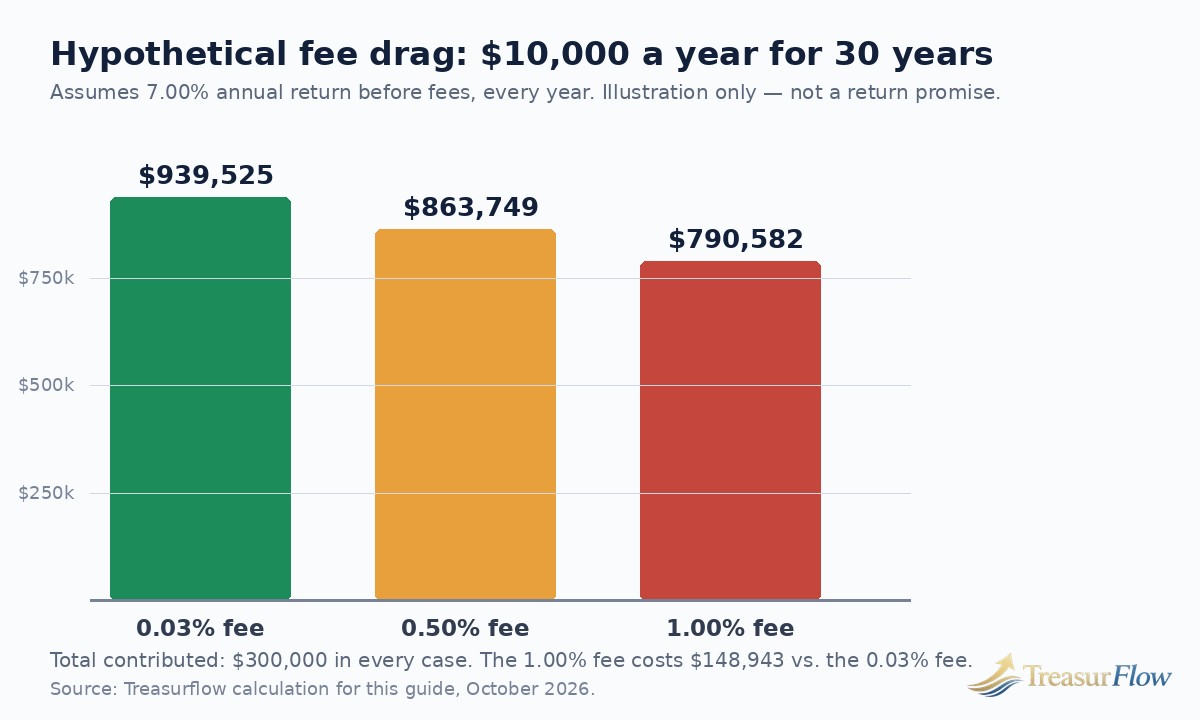
Read that last column slowly. Choosing a 1.00% fund over a 0.03% fund — with identical investments and identical markets — leaves you with about $148,943 less after 30 years of ordinary $10,000 annual contributions. Choosing a mid-priced 0.50% fund still leaves you about $75,776 behind the cheap index fund. The expensive fund does not need to be bad to produce this result; it only needs to be expensive, every year, for 30 years. An active fund can overcome its fee gap, but it must beat its benchmark by roughly the size of the gap, every year, after the fees are taken out — which is exactly what the long-run SPIVA data shows most large-cap active funds failing to do.
This is why our picks cluster at the bottom of the fee range, and why the exceptions are deliberate. Wellington at 0.24% and the T. Rowe Price target-date series at roughly 0.49% to 0.63% charge more because a manager is making allocation decisions for you. That can be a fair price for a service you actually use. What the math rules out is paying active-level fees for index-level work, or paying 1.00% for anything you could replace with a 0.03% fund and a calendar reminder to rebalance once a year. Before you buy any fund not in this guide, run it through FINRA’s Fund Analyzer (linked in the resources box at the top) next to an index alternative and look at the projected fee cost over your own time horizon. Five minutes with that tool is the highest-value research most investors ever do.
Mutual Funds vs. ETFs: Which Wrapper Fits You?
Most popular index exposures now come in both wrappers — the same portfolio as a mutual fund and as an ETF — and beginners reasonably ask which one to buy. Neither is universally better. They differ in mechanics, and the mechanics favor different habits.
Pricing. A mutual fund is priced once a day, after the market closes, and every buyer and seller that day gets the same NAV. You cannot trade it intraday, watch its price flicker, or panic-sell it at 11 a.m. — for long-term investors, many consider that a feature. An ETF trades on an exchange all day at prices that move second by second, which suits investors who want intraday control and slightly tempts everyone else to trade too often.
Minimums and automatic investing. This is the mutual fund’s strongest practical advantage. Mutual funds are bought in dollars, not shares: you can invest exactly $100, or set an automatic $200 purchase every payday, and every cent goes to work, including fractional shares. Most brokerages historically required buying whole ETF shares (fractional ETF buying is spreading, but automatic recurring ETF purchases are still less universal), and some mutual funds carry minimums — $1,000 for Vanguard target-date funds, $3,000 for Vanguard Admiral index funds, $0 for the Fidelity and Schwab index funds in this guide. Inside a 401(k), mutual funds are usually the only option, and payroll contributions invest automatically in dollar amounts by design.
Tax efficiency. In a taxable brokerage account, ETFs have a structural edge: their creation-and-redemption process lets them push low-cost holdings out without selling them, so most equity ETFs distribute little or no capital gains in most years. A mutual fund must sell holdings to meet redemptions and passes resulting capital gains to everyone holding the fund that year — even investors who just bought in. Index mutual funds with low turnover distribute far less than active funds, and Vanguard’s index mutual funds have historically been unusually tax-efficient, but the ETF edge is real for taxable accounts. Inside an IRA or 401(k), the difference disappears entirely, because neither wrapper is taxed year to year. The practical rule: in tax-advantaged accounts, choose by fee, minimum, and habit fit; in taxable accounts, prefer ETFs for stock exposure unless the mutual fund’s automation matters more to you, and hold your least tax-efficient assets (such as bond funds) inside the retirement account where practical.
Costs beyond the expense ratio. Neither wrapper is free of friction. ETFs can trade at small premiums or discounts to NAV and have bid-ask spreads — trivial for giant index ETFs, real for thin ones. Mutual funds can carry purchase or redemption fees in rare cases, and some brokers charge a transaction fee for funds outside their no-transaction-fee list — a $0-expense-ratio fund that costs $49.95 per purchase at the wrong broker is not a bargain. Buying a fund directly from its own provider, or through a broker where it is on the no-fee list, avoids that trap.
The honest summary. For automatic, set-and-forget investing in retirement accounts — which is how most Americans actually build wealth — mutual funds are usually the smoother tool. For taxable accounts and investors who value portability and intraday pricing, ETFs usually win. Many portfolios sensibly use both: mutual funds where payroll and automation rule, ETFs where taxes rule.
How to Buy a Mutual Fund: Three Doors In
Door 1: Your workplace plan (401(k) or 403(b)). If your employer offers a plan with a matching contribution, this door comes first — the match is an immediate return no fund choice can beat. Inside the plan you do not shop the open market; you choose from a fixed menu, often 15 to 25 funds. Use this guide’s categories to read the menu: find the target-date series if you want one decision, or build from the menu’s stock index, international index, and bond index funds if you want control. Compare each menu fund’s expense ratio against the retail figures in our table — plans, especially at large employers, often offer institutional share classes that are cheaper than retail. If every option on your menu is expensive, contribute enough to capture the full match, then direct additional savings to your own IRA (Door 2), where you control the fund list. The IRS publishes the official plan rules and current contribution limits at irs.gov/retirement-plans; check the current year’s limits there before setting your contribution rate.
Door 2: Your own IRA or brokerage account at a fund provider. Opening an account directly with Fidelity, Vanguard, or Schwab and buying that provider’s own funds is the cleanest route for most individuals: no transaction fees on the house funds, automatic purchases in exact dollar amounts, and the minimums listed in this guide. Pair this door with the right account type — for most savers, a Roth IRA (contributions taxed now, qualified withdrawals in retirement tax-free) is where these funds do their best work; our best Roth IRA accounts 2026 guide compares the providers. The IRS’s official summary of Roth rules is at irs.gov/retirement-plans/roth-iras.
Door 3: A general brokerage account. A multi-brand broker lets you buy funds from many families in one account, alongside ETFs and individual stocks. The convenience is real; the trap is transaction fees on funds outside the broker’s no-transaction-fee program and, occasionally, higher minimums for third-party funds. If you go this route, check both before your first purchase, and compare platforms using our best online broker 2026 guide. If you would rather hand the whole task — fund selection, rebalancing, and allocation — to an automated service for a small advisory fee, that is the robo-advisor model compared in our best robo advisors 2026 guide; note that a target-date fund inside your own IRA achieves a similar result with no advisory fee layered on top.
Whichever door you use, the buying process itself is the same five steps: decide the account type, decide the category before the fund, read the prospectus fee table, set up an automatic contribution you can sustain, and then leave the investment alone except for a once-a-year check. The investors who do worst with perfectly good funds are usually the ones who keep changing them.
How to Compare Any Mutual Fund in Ten Minutes
Use this checklist on any fund — including ours — before money moves. Start with the category: compare an S&P 500 fund only against S&P 500 funds, because a fund can look brilliant simply by being compared against the wrong peers. Next, the expense ratio, found in the prospectus fee table that the SEC requires every fund to publish in a standard format; the Investor.gov bulletin in our resources box walks through that table line by line. Check for a load — a sales commission — and avoid load share classes when a no-load class of the same fund exists; also look for 12b-1 distribution fees hiding inside the expense ratio of broker-sold share classes. Confirm the minimum investment and whether it differs inside an IRA. Glance at turnover: high turnover means heavy trading, higher internal costs, and, in taxable accounts, more capital gains distributions. For an active fund, ask who runs it, how long they have run it, and what would have to be true for its fee to be worth paying — if you cannot answer that last question in one sentence, the index fund in the same category is probably your fund. Finally, read the fund’s stated objective and principal risks in the prospectus summary. It is three pages, it is written to be understood, and it is the only document in this entire process that the fund company is legally required to keep honest.
Mutual Fund Questions First-Time Buyers Ask Most
What is the best mutual fund for a beginner in 2026?
For most beginners, the simplest strong choice is a target-date index fund matched to your expected retirement year, because it holds a diversified mix of stock and bond funds and rebalances automatically. If you prefer to choose your own mix, a total U.S. stock market index fund such as FSKAX or VTSAX is a common starting point. The best choice depends on your account type, time horizon, and the minimum you can meet.
How much money do I need to start investing in mutual funds?
It depends on the fund. Fidelity and Schwab index funds in this guide have no minimum, so you can start with any amount. Vanguard Target Retirement funds require $1,000, and Vanguard Admiral index funds such as VFIAX, VTSAX, and VBTLX require $3,000. T. Rowe Price Retirement funds require $2,500, or $1,000 in an IRA. Always confirm the current minimum in the fund prospectus before you open the account.
Are mutual funds or ETFs better for a taxable account?
ETFs are usually more tax efficient in a taxable account because their structure lets them avoid distributing capital gains in most years, while mutual funds pass capital gains to all shareholders. In an IRA or 401(k), the difference does not matter because neither is taxed each year. Many investors hold mutual funds in retirement accounts for easy automatic investing and ETFs in taxable accounts for tax efficiency.
What is a good expense ratio for a mutual fund in 2026?
For a U.S. stock index fund, 0.00% to 0.05% is the competitive range in 2026, and every index pick in this guide falls in it. Target-date index funds at 0.08% to 0.12% are also low cost for the automation they provide. Actively managed funds commonly charge 0.45% to 1.00% or more, so they need to justify the gap with management you actually value.
Can I lose money in a money market mutual fund?
Yes, it is possible, although it is uncommon. Money market funds are investments, not bank deposits, so they are not FDIC insured. They aim to keep a stable $1.00 share price and hold very short-term, high-quality debt, but there is no federal guarantee. If the safety guarantee matters most for your cash, compare a money market fund with an FDIC-insured savings account or CD.
How do I buy a mutual fund in a 401(k) versus an IRA?
In a 401(k), you choose from the fixed menu your employer offers and your contributions are invested automatically from each paycheck. In an IRA, you open the account yourself at a provider such as Fidelity, Vanguard, or Schwab, transfer money in, and choose from thousands of funds. Many savers capture their full employer match in the 401(k) first, then use an IRA for additional savings and wider fund choice.
Conclusion: Keep the Category Right, the Fee Low, and the Habit Steady
There is no single best mutual fund for everyone in 2026, but there is a best process. Decide the job first — U.S. stocks, international stocks, bonds, a balanced mix, a target-date portfolio, or parked cash — then buy the cheapest well-run fund that does that job inside the account you already have. In practice that means an S&P 500 or total market index fund at 0.00% to 0.04% for most stock exposure, a broad bond index fund for ballast, a target-date index fund at 0.08% to 0.12% if you would rather make one decision than five, and a deliberate money market choice for cash instead of whatever sweep fund you were handed by default.
The fee-drag table is worth remembering whenever a fund asks for more: half a percent a year, compounded over a working life of contributions, is not a rounding error — in our hypothetical illustration it was roughly $75,776 of a real saver’s ending balance, and a full percent was roughly $148,943. Pay more only when you can name, in one sentence, the service the extra fee buys and why you will actually use it. Wellington’s active balanced management and T. Rowe Price’s actively managed glide paths pass that test for some investors. An expensive fund that merely holds large U.S. stocks does not, because FXAIX, SWPPX, and VFIAX already do that job for almost nothing.
Finally, keep perspective. The difference between a good fund held steadily for 30 years and a perfect fund traded nervously for 30 years is enormous, and it favors the steady holder. Choose your categories, automate the contribution, rebalance about once a year — or let a target-date fund do it — and spend the time you save on the savings rate itself, which matters more than any single pick in this guide. If you want a calmer frame for the whole project, our essay on how to build wealth slowly is the companion read.
Disclaimer: This article is educational information, not personalized financial, tax, or legal advice. Investing involves risk, including the possible loss of principal, and past performance does not guarantee future results. Fund expense ratios, minimum investments, and yields shown are as of October 2026 from provider and fund data sources and will change; read the fund’s current prospectus, available from the provider and through the SEC, before investing. The growth figures in the fee-drag section are a hypothetical illustration using a fixed assumed return, not a projection of any fund’s performance. Consider consulting a qualified fiduciary adviser about your own situation.

Muhammad Zakir is the founder of Treasurflow and the author of its personal finance guides. He researches consumer banking, credit, and personal loans, and every guide cites primary sources such as the CFPB, FDIC, FTC, and IRS. His content is educational and is not personalized financial advice.