
Dental insurance looks simple on a sales page — one monthly premium, a promise that cleanings are covered at 100%, and a reassuring logo. Then you actually need a crown, and you discover the four numbers that were hiding underneath the headline: an annual maximum that runs out halfway through your treatment, a waiting period that has not expired yet, a coinsurance split that leaves you paying half the bill anyway, and a missing-tooth clause that quietly excludes the exact tooth you bought the plan for. Most disappointed dental insurance buyers were not cheated. They were surprised — and they were surprised because nobody explained the anatomy of a dental plan before they enrolled.
That is why this guide to the best dental insurance of 2026 is built backwards compared with most roundups. It starts with the moving parts of a plan — the annual maximum, waiting periods, coinsurance tiers, the deductible, and the fine-print clauses — so you can judge any plan in about five minutes. Only then do we compare plan types (PPO, DHMO, indemnity, and discount plans) and name specific plans worth shortlisting as of October 2026, for people who need major work soon, seniors filling the Medicare gap, families, and anyone who wants orthodontics covered.
One warning before the numbers: dental premiums, maximums, and waiting periods vary by state, ZIP code, age, and plan tier. Every premium in this article is an example quote or a published sample from a named source, dated October 2026 — never a universal price. Your quote will differ, and the plan document, not any article, is the contract that governs your coverage. Use the figures here to understand the shape of the market and to know which questions to ask, then confirm your own numbers at enrollment.
Related Guides
- Best Life Insurance 2026 — term vs. whole life, compared side by side
- Best Homeowners Insurance 2026 — coverage limits and premiums explained
- Best Travel Insurance 2026 — trip protection, medical cover, and when each is worth it
- Best Pet Insurance 2026 — accident-and-illness plans for dogs and cats
- Best Identity Theft Protection Services 2026 — monitoring and restoration cover compared
Helpful Official Resources
- Medicare.gov — Dental services — what Original Medicare does and does not cover
- HealthCare.gov — Dental coverage in the Marketplace — how stand-alone dental plans work on the Marketplace
- American Dental Association (ADA) and MouthHealthy — oral-health guidance from the national dental association
- National Association of Insurance Commissioners (NAIC) — check a carrier’s complaint record and licensing before you buy
First, Understand the Anatomy of a Dental Plan
A dental plan is not really insurance in the way health insurance is. Health insurance protects you against unlimited catastrophe; dental insurance is closer to a pre-paid benefits account with a hard ceiling. The plan pays generously for cheap, routine care, shares the cost of mid-priced repairs, and then stops paying altogether once it has paid out a set amount in a year. Once you internalize that design, every plan on the market becomes easy to read, because every plan is built from the same five parts.
The annual maximum: the ceiling that decides everything
The annual maximum (also called the annual benefit maximum) is the most the plan will pay for your covered care in a benefit year. It is not a limit on what you can spend — it is a limit on what the plan will spend. After the plan has paid out that amount, you pay 100% of everything else until the benefit year resets.
As of October 2026, individual-plan maximums in the roundups we reviewed run from about $1,000 at the low end to $5,000–$6,000 at the very top. Money’s October 2026 comparison, for example, lists a $1,200 lowest tier at Spirit Dental, $2,000 at Delta Dental and at Ameritas in year one, $3,000 at Guardian, $3,500 in higher Spirit and later-year Ameritas tiers, $5,000 on Spirit’s Pinnacle PPO, and $6,000 at Denali Dental. Physicians Mutual sits outside this pattern entirely, advertising no annual maximum on cash benefits at all — a genuine structural difference we return to below.
Context matters here. A single crown commonly costs $800 to $2,000 without insurance in 2026, with national averages around $1,000 to $1,500 depending on material and region (CoverCapy crown cost guide, reviewed June 2026). That means one crown can consume most — sometimes all — of a $1,000 or $1,500 annual maximum once the plan’s share is counted. If you expect one routine year, a low maximum is fine. If you expect a crown plus a root canal, or staged implant work, the maximum is the first number to compare, ahead of the premium. A cheap plan with a $1,000 ceiling is not cheap the year you need $3,000 of dentistry.
Two refinements are worth checking in the plan document. First, some plans do not count preventive care against the maximum — Ameritas PrimeStar Complete is one example in Money’s October 2026 review — which effectively stretches the maximum for repair work. Second, some no-waiting-period plans withhold the full maximum until you have been enrolled for a period of years; Spirit Dental’s published maximum, for instance, is not fully available until year three. A headline maximum you cannot reach in year one is worth less than it looks.
Waiting periods: the clock that starts at enrollment
A waiting period is the time between your coverage start date and the date the plan will pay for a category of care. The standard pattern, summarized by Money in October 2026, is no wait for preventive care, roughly three to six months for basic procedures such as fillings, and six to twelve months — occasionally longer — for major services such as crowns, bridges, dentures, and implants. Cigna’s Dental 1500 plan documents show the classic version of this ladder: no wait for preventive care, six months for basic restorative care, and twelve months for major restorative care and orthodontia.
Waiting periods exist to stop people from buying a plan on Monday, claiming a $1,500 crown on Friday, and cancelling on Saturday. They are also the single most common source of denied-expectation claims: the treatment was genuinely covered by the plan, just not yet.
There are three legitimate ways around the clock. First, no-waiting-period plans exist — Spirit Dental and Ameritas are the best-known national examples as of October 2026 — but read the trade-off section below before assuming they are strictly better. Second, many carriers waive or shorten waits if you had prior dental coverage recently; Money’s October 2026 review notes that Aetna waives its six- and twelve-month waits for enrollees who had coverage within the past 90 days, and Cigna advises shoppers that waits may be waived with prior coverage. Third, employer group plans often have shorter waits than individual plans, so if dental cover is available at work, compare it before buying your own.
The trade-off with no-wait plans is real and it is arithmetic, not fine print. A plan that pays for major work immediately usually pays a smaller percentage of it in year one, with the percentage stepping up the longer you stay enrolled. Denali’s Summit PPO, per Money’s October 2026 review, covers basic and major care at 30% with no waiting period, reaching 50% after three years and 60% for major work after four years. Ameritas PrimeStar Complete covers major work at 20% from day one, rising to 50% after a year. Humana’s Loyalty Plus follows the same philosophy: no waiting period, but major coverage that starts at 20% in year one and climbs to 50% by year three. None of this makes these plans bad — for someone with a cracked tooth today, 20–30% of a crown now can beat 50% of a crown in twelve months. It does mean “no waiting period” and “full coverage immediately” are two different claims, and only the first one is usually true.
Coinsurance and the classic 100-80-50 structure
Coinsurance is the percentage split between the plan and you, applied after any deductible. Most traditional plans follow the structure the industry calls 100-80-50: the plan pays 100% of preventive care (exams, cleanings, routine X-rays), 80% of basic care (fillings, simple extractions, and similar repairs), and 50% of major care (crowns, bridges, dentures, and often root canals and implants). You pay the rest — 0%, 20%, and 50% respectively.
Three details decide how much that structure is really worth. First, the percentages apply to the plan’s allowed amount, not necessarily to your dentist’s full billed fee. In-network PPO dentists have agreed to contracted fees, so the math is predictable; out-of-network, a dentist can bill above the allowed amount and, on many plans, you owe the difference on top of your coinsurance. Second, procedure classification varies by carrier. Root canal therapy is basic care on some plans and major care on others — on Cigna’s Dental 1500 summary of benefits it sits in the basic tier at 80%, while many other plans place it at 50%. The same treatment can therefore cost you 20% or 50% depending on a line in a benefit schedule. Third, some plans depart from 100-80-50 in your favor at specific tiers: Guardian’s Premier PPO covers basic care at 85% with no waiting period and major care at 60% after its twelve-month wait, per Money’s October 2026 review — both better than the classic split, which is part of why its premium sits in the middle of the range rather than at the bottom.
The deductible — annual, family, and the rare lifetime kind
The deductible is what you pay out of pocket before coinsurance starts, and in dental insurance it is small by health-insurance standards: $50 per person per year is the most common figure on individual PPO plans, often with a $150 family cap. It typically applies to basic and major care only, not to preventive visits.
The exception worth hunting for is the lifetime deductible. A handful of carriers — Denali Dental and Spirit Dental in Money’s October 2026 list, each at $100, and Humana’s Loyalty Plus with a one-time deductible — charge the deductible once, ever, instead of every January. Over a five-year enrollment that is a modest but real saving, and one less reset to track. At the other extreme, Physicians Mutual advertises no deductible at all on its dental plans, which simplifies its math considerably: its plans pay set cash benefits or a percentage of the allowable charge for covered procedures, with no deductible and no annual maximum, though major care carries a twelve-month wait on the carrier’s own FAQ page as of October 2026.
The clauses that quietly decide claims
Four clauses deserve a read before you pay the first premium. The missing-tooth clause excludes replacement of teeth that were already missing when your coverage began — a serious issue if you are buying a plan specifically to fix a gap with a bridge or implant. Some plans waive it after a period of enrollment; many do not. The frequency limitation governs how often a service is paid: two cleanings a year is standard (Spirit and Denali advertise three and four respectively on certain plans), crowns on the same tooth are commonly limited to once every five to ten years, and full-mouth X-rays to once every few years. The least-expensive-alternative-treatment (LEAT) clause lets the plan pay based on the cheaper acceptable treatment — the amalgam filling rate instead of the tooth-colored one, for example — leaving you to fund the upgrade. Finally, check the implant position explicitly: a growing number of individual plans cover implants, but often with their own waiting period, their own percentage, and sometimes a separate lifetime cap — Guardian’s Premier PPO, for example, caps implant benefits at a $1,250 lifetime maximum per Money’s October 2026 review. “Implants covered” on a brochure can mean anything from 50% up to your annual maximum to a few hundred dollars once in your life.
Plan Types Compared: PPO, DHMO, Indemnity, and Discount Plans
With the anatomy in hand, the four plan families are easy to tell apart. They differ mainly in how much freedom you get to choose a dentist, and in whether the plan’s promise is a percentage, a fixed copay, or merely a discount.
| Feature | Dental PPO | DHMO | Indemnity | Discount plan (not insurance) |
|---|---|---|---|---|
| How you pay less | Plan pays a % of contracted fees | Fixed copays per procedure | Plan pays a % of usual-and-customary fees | You pay a discounted fee; plan pays nothing |
| Dentist choice | Any dentist; cheapest in-network | Assigned in-network primary dentist | Any dentist | Participating dentists only |
| Annual maximum | Typically $1,000–$5,000+ | Often none | Typically $1,000–$3,000 | None |
| Deductible | Usually $50–$100/yr, some lifetime | Usually none | Usually $50–$150 | None |
| Waiting periods | Common for basic/major | Usually none | Common for basic/major | None |
| Typical individual premium signal, Oct 2026 | Roughly $20–$70/mo depending on tier | Often the lowest-cost insurance option | Often at the higher end | Roughly $8–$15/mo membership in cited roundups |
Dental PPO plans
A Preferred Provider Organization plan is the default choice for most individual buyers, and every named pick later in this guide is a PPO unless stated otherwise. You may see any licensed dentist, but in-network dentists have agreed to contracted fees, so both the plan’s payment and your coinsurance are calculated from a lower, predictable base. Premiums are higher than DHMO premiums, maximums apply, and waiting periods are common — but if keeping your current dentist matters, a PPO is usually the only structure that reliably allows it, and out-of-network care is at least partially reimbursed rather than excluded.
DHMO plans
A Dental Health Maintenance Organization plan trades freedom for price and predictability. You choose (or are assigned) a primary dentist inside a smaller network, specialists usually require a referral, and instead of percentages you pay published copays for each procedure — a set dollar amount for a filling, a set amount for a crown. DHMO plans commonly have no annual maximum and no deductible, which can make them the cheapest route to extensive work if — and this is the whole decision — a dentist you trust is in the network near you. If your dentist is not, the savings are theoretical, because out-of-network care is generally not covered at all.
Indemnity (fee-for-service) plans
The traditional indemnity design reimburses a percentage of the usual, customary, and reasonable fee for your area, and lets you see literally any dentist with no network at all. In exchange you typically handle more paperwork, may need to pay the dentist in full and claim reimbursement, and can be balance-billed when a dentist charges above the plan’s idea of reasonable. True stand-alone indemnity plans are less common in the individual market than they once were; Physicians Mutual’s any-dentist, no-maximum, cash-benefit design is the closest widely available relative, which is why it keeps appearing in senior-focused roundups.
Discount plans: useful, but not insurance
A dental discount plan (also called a dental savings plan) is a membership, not insurance. You pay an annual or monthly fee — roundups we reviewed cite roughly $80 to $200 a year, or about $8 to $15 a month — and in return you pay reduced fees, commonly advertised at 10% to 60% off, at participating dentists. There are no claims, no maximums, no waiting periods, and no exclusions for pre-existing conditions, because the plan never pays anyone anything. For a person who needs major work immediately and can fund the discounted bill themselves, a discount plan can beat a waiting-period PPO in year one. For a person who wants risk transferred to an insurer, it does not do the job at all. Do not let the similar brochures blur that distinction.
How Much Does Dental Insurance Cost as of October 2026?
Across the October 2026 sources we reviewed, individual dental premiums most often fall in a band of roughly $20 to $70 a month, with family coverage commonly running from about $50 to $150 a month — always varying by state, age, and tier. Published sample quotes from Money’s October 2026 comparison (single adult, plan-specific samples, your quote will differ) illustrate the spread:
| Plan (sample, Oct 2026) | Sample monthly premium | Annual maximum | Headline structure |
|---|---|---|---|
| Spirit Dental (tiers vary) | From $20 | $1,200–$5,000 by tier | No waiting periods; $100 lifetime deductible; $25 enrollment fee |
| Cigna Dental 1500 | $39 average listed premium | $1,500 | 100% preventive; basic 80% after 6 months; major 50% after 12 months; $50 deductible |
| Guardian Premier PPO | From $46 | $3,000 | Basic 85% with no wait; major 60% after 12 months |
| Delta Dental PPO/DPO Premium | $48.34 | $2,000 | Classic 100-80-50 after waits; adult ortho 50% to $1,500 lifetime |
| Ameritas PrimeStar Complete PPO | $54.14 | $2,000 year one, then $3,500 | Basic 80% day one; major 20% day one, 50% after a year; $50 deductible |
| Denali Dental Summit PPO | $67.07 | $6,000 | No waits; basic/major start at 30% and step up; $100 lifetime deductible |
| Physicians Mutual Premier | Quote-based; not listed in Money’s table | None | Set cash benefits / Premier pays 70% of allowable charge; no deductible; major after 12 months per carrier |
Spirit Dental’s own site shows the same geography effect: for ZIP code 33801 in Florida, as of September 2026, its PPO tiers started at $16.09 a month for Preventive Plus ($1,500 maximum) and $32.75 for Pinnacle PPO 5000. Cigna shows it too: a 35-year-old’s Dental 1500 quote in published examples ranged from $34 a month in Orlando to $68 in Boston. Anyone who quotes you a single national price for dental insurance is rounding aggressively.
Beyond the premium, budget for three more lines: the deductible (usually $50 individual, sometimes a one-time $100 lifetime charge), your coinsurance share on any repair work, and the enrollment fee some direct plans charge (Spirit’s is $25). The honest comparison is never premium versus premium; it is premium plus expected coinsurance, versus paying cash, versus a discount plan’s discounted cash. The worked example later in this guide shows that arithmetic in full.
Our Picks by Need, as of October 2026
No single plan wins every category, because the categories want opposite things: the shopper who needs a crown this month and the shopper insuring a healthy family for a decade should not buy the same policy. The picks below are organized by the job to be done. Premiums are the October 2026 samples already introduced above; availability varies by state, and every pick should be re-quoted in your own ZIP code before you enroll.
Best for no waiting period: Spirit Dental and Ameritas PrimeStar
If treatment cannot wait, these are the two national names to quote first. Spirit Dental sells multiple PPO tiers with no waiting periods on any type of coverage, three cleanings a year on its plans, a $100 lifetime deductible, and maximums from $1,200 up to $5,000 on the Pinnacle PPO — with premiums starting from $20 a month in Money’s October 2026 sample and from $16.09 a month on the carrier’s own Florida example. The honest caveats: there is a $25 enrollment fee, the full published maximum is not available until year three, and — as with all no-wait designs — first-year coverage percentages on major work start lower and step up with loyalty. Ameritas PrimeStar Complete takes the other shape of the same idea: basic care at a genuinely strong 80% from day one (90% after a year), major care at 20% from day one rising to 50% after a year, a $2,000 first-year maximum that grows to $3,500, a $50 annual deductible, and preventive care that does not consume the maximum. Money’s sample premium was $54.14 a month. Choose Spirit for tier choice and the higher eventual ceiling; choose Ameritas if your near-term need is basic work — fillings and extractions at 80% immediately is hard to beat.
Best for implants and major work: Denali Dental Summit PPO and Guardian Premier PPO
Major work is a maximums-and-percentages game. Denali’s Summit PPO pairs the highest annual maximum in Money’s October 2026 list — $6,000 — with no waiting periods, four cleanings a year, child and adult orthodontic coverage, and a $100 lifetime deductible, at the list’s highest sample premium, $67.07 a month. Its basic and major coverage starts at 30% and steps up over time (50% after three years, 60% for major after four), so it rewards people who will hold the plan through a multi-year treatment plan — exactly the profile of someone staging implants. Guardian’s Premier PPO is the alternative shape: a $3,000 maximum available from day one rather than a higher one you grow into, basic care at 85% with no wait, and major care at 60% — the highest major percentage in the comparison — after a twelve-month wait, with implants covered up to a $1,250 lifetime maximum. If your major work is a year away, Guardian’s 60% is powerful; if it is this quarter, Denali’s no-wait structure is the safer fit despite the lower starting percentage. Either way, get the implant clause in writing: per-procedure caps, bone-graft treatment, and whether the crown on the implant is covered separately decide the real value.
Best all-rounder for braces and families: Delta Dental
Delta Dental is the largest dental benefits carrier in the United States, operating through 39 independent member companies covering all 50 states, Washington, D.C., and Puerto Rico, and a 2026 Delaware market comparison placed it first for PPO general-dentist network size. For families, network breadth is not a vanity metric: it is the probability that your children’s existing dentist, and the orthodontist across town, are both in-network. Money’s October 2026 pick from Delta, the PPO/DPO Premium plan at a $48.34 sample premium, follows the classic pattern — preventive at 100% with no wait, basic at 80%, major at 50% after waiting periods that vary by state — with a $2,000 annual maximum. What earns it the family slot is orthodontics: it covers adult as well as child orthodontics at 50% up to a $1,500 lifetime maximum per person, which is uncommon in individual plans, and it even covers teeth whitening at 80%. The limits to know: this particular individual plan is sold in only 16 states plus D.C. (other Delta member companies sell different individual plans elsewhere), so enroll before the braces consultation, not after it. Cigna Dental 1500 is the sensible comparison quote where Delta’s plan is not sold: a $1,500 maximum, a $50 individual / $150 family deductible, orthodontia at 50% up to a $1,000 lifetime maximum, and an average listed premium of $39 a month as of October 2026.
Best for seniors: Physicians Mutual and Humana Loyalty Plus
Seniors shop under a constraint younger buyers do not: Original Medicare does not pay for routine dental care (detailed in the next section), so a stand-alone plan is often the only insurance route short of a Medicare Advantage plan with embedded dental benefits. Two designs suit this market for different reasons. Physicians Mutual built its name here with guaranteed acceptance, no deductible, and no annual maximum on cash benefits across more than 350 covered procedures, with freedom to see any dentist and lower costs inside its network; its Premier plan pays 70% of the maximum allowable charge, while its lower tiers pay set dollar amounts per procedure. Preventive and basic benefits start immediately and major care — crowns, bridges, dentures, root canals — is covered after twelve months, according to the carrier’s own FAQ page as of October 2026. One transparency note: Money’s October 2026 summary describes the Premier plan’s major coverage without mentioning that wait, while the carrier’s own page states the twelve-month wait plainly. We follow the carrier — and it is a useful lesson in why the plan document, not the roundup, is authoritative. Humana Loyalty Plus is the other senior-friendly shape: no waiting period for covered services, a one-time deductible, and benefits that deliberately improve with tenure — annual maximum $1,000 in year one rising to $1,500 by year three, basic coverage stepping 40% to 55% to 70%, and major coverage 20% to 30% to 50%. A senior who expects modest yearly work for many years, rather than one large claim, is exactly who that loyalty curve was designed for. Compare both against any Medicare Advantage dental allowance available locally, and remember that Advantage dental benefits are typically capped — often in the $1,000 to $2,000 range in 2026 roundups — and can change each year.
Best budget preventive cover: Cigna Dental Preventive and Guardian Direct tiers
Some buyers do not need major-work cover at all: they need two cleanings, exams, and X-rays a year to stop costing $50 to $350 a visit out of pocket (Money’s October 2026 range for routine care), plus a foot in the door if something small goes wrong. Preventive-focused tiers exist for this buyer. Cigna’s Dental Preventive plan has been listed at about $19 a month in published comparisons, with no annual maximum and no deductible for covered preventive care — but it is preventive cover, not comprehensive insurance, and a crown on this tier is your own expense. Guardian’s direct-sold ladder, described in 2026 comparisons as running from a Starter tier around $15 a month through Core, Achiever, and Diamond tiers, similarly lets healthy buyers pay for the level of restorative cover they actually expect to use, with the Diamond tier shortening the major-work wait to six months in those comparisons. The discipline for budget buyers is to run the preventive-only math in the next section: if two cleanings a year are genuinely all you will use, your premiums should not exceed what those cleanings would cost in cash by very much, or you are buying peace of mind at a markup. There is nothing wrong with that — but buy it knowingly.
Best for broad employer-style choice: Aetna and MetLife, with a caveat
Aetna and MetLife are two of the biggest names in American dental benefits, but as of October 2026 their strength is concentrated in employer group coverage rather than stand-alone individual plans. Money’s October 2026 review considered Aetna’s top PPO plan and found higher premiums and lower maximums than its picks — but flagged one feature worth real money to a specific buyer: Aetna waives its six-month basic and twelve-month major waiting periods for enrollees who had dental coverage within the past 90 days. If you have just left a job with dental cover, that waiver can beat a richer plan that makes you wait a year. MetLife’s individual presence runs largely through marketplace and partner channels, while its core PPO networks serve group members. If either logo is on an offer through your employer or the Marketplace, compare it seriously; if you are buying purely retail, the carriers above will usually quote a more complete individual product.
The Worked Example: One Crown and Two Cleanings, With and Without Insurance
Percentages are abstract until they meet a bill. Here is the full year-one arithmetic for a common year of dentistry, computed from stated assumptions so you can re-run it with your own numbers. This is an illustrative example, not a quote and not a prediction of your claim.
Assumptions. One porcelain crown with a fee of $1,200 (inside the 2026 national average band of $1,000 to $1,500 cited earlier). Two preventive visits — exam, cleaning, and routine X-rays — at $200 each, $400 for the year (inside Money’s $50–$350 per-visit range). A traditional in-network PPO on the classic 100-80-50 structure: preventive paid at 100% with no deductible and no waiting period; the crown, as major care, paid at 50% after a $50 deductible, with the waiting period already satisfied. Premium: $48.34 a month, the published October 2026 sample for Delta Dental’s PPO/DPO Premium plan — used here purely as a realistic mid-market premium, not as an offer.
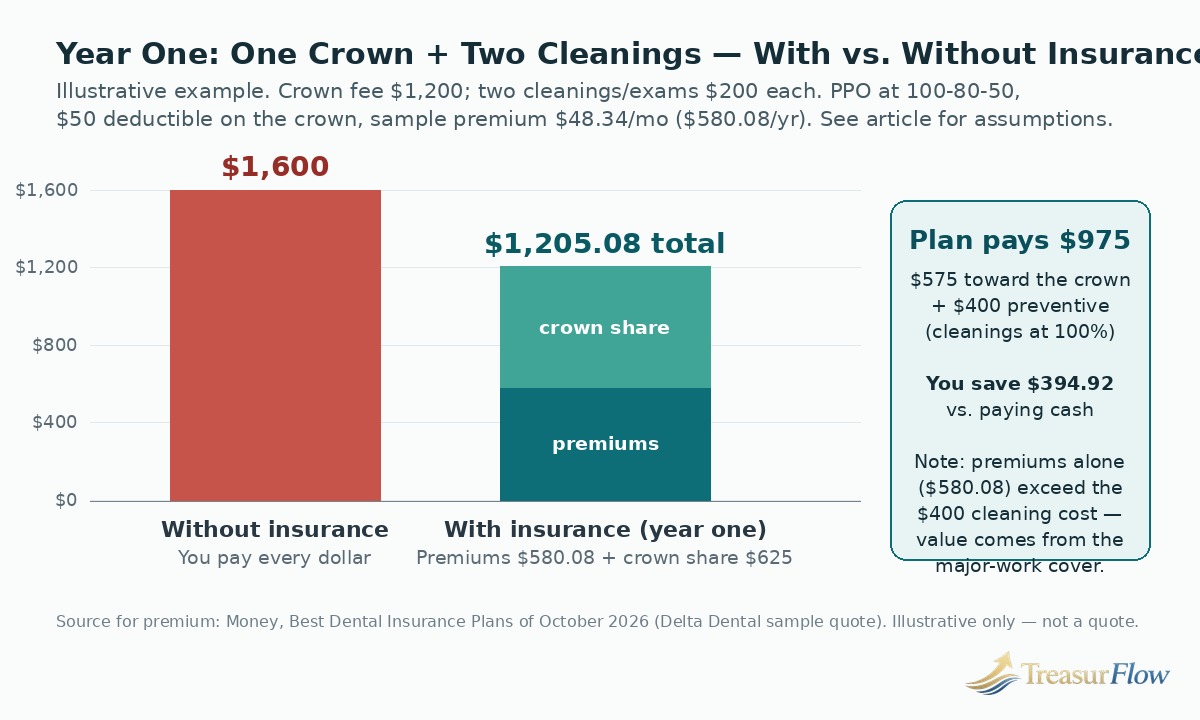
Without insurance. You pay the full fees: $1,200 for the crown plus $400 for the two preventive visits — $1,600 out of pocket, and no premium.
With insurance. Premiums for the year are $48.34 × 12 = $580.08. The preventive visits are covered at 100%, so you pay $0 for them and the plan pays $400. For the crown, you first pay the $50 deductible; the plan then pays 50% of the remaining $1,150, which is $575, and you pay the other $575 — a total crown cost to you of $50 + $575 = $625. Your all-in year-one cost is $580.08 + $625 = $1,205.08. The plan paid $975 in total ($400 preventive + $575 toward the crown), comfortably inside a $2,000 annual maximum, and you spent $394.92 less than paying cash.
The honest counter-case. Run the same plan through a quiet year — the two preventive visits and nothing else. Without insurance you would pay $400. With insurance you pay $580.08 in premiums and $0 at the dentist: $180.08 more than cash. Dental insurance is not a cleaning subscription that always wins; its value appears in the years something breaks. So the right shopping question is not “which plan is best?” but “what work do I realistically expect in the next two to three years?” If the honest answer is preventive care only, a lean preventive tier or a discount plan may beat a full PPO on arithmetic. If a crown, root canal, or implant is plausibly ahead of you, a stronger maximum and a satisfied waiting period are worth paying for before you need them — because the waiting-period clock starts at enrollment, not at diagnosis.
Seniors and the Medicare Gap
This deserves its own section because it is the most consequential misunderstanding in dental coverage. Original Medicare — Part A and Part B — does not cover routine dental care: not cleanings, not fillings, not tooth extractions, not dentures, and not implants, as Medicare.gov’s dental services page makes plain. In most cases you pay the full cost yourself. The narrow exceptions are dental services that are directly tied to a covered medical treatment — for example, an oral exam or necessary dental work before an organ transplant or a heart-valve procedure, or treatment of an oral infection before certain therapies — where the dental care is covered because it is necessary to the success of the medical care, not because it is dental care.
That exclusion is why roughly 24 million Medicare beneficiaries have no dental coverage at all, according to KFF figures cited in 2026 senior coverage guides. If you are approaching 65, do not assume your health coverage follows you to the dentist. Your realistic routes are: a Medicare Advantage (Part C) plan that includes a dental benefit — convenient and sometimes included at no extra premium, but typically capped, network-bound, and changeable every year; a stand-alone dental plan such as the Physicians Mutual or Humana designs described above; retiree coverage from a former employer, where it exists; or disciplined self-funding, helped by a discount plan. Decide before the first post-65 crown, not after — waiting periods apply to seniors exactly as they apply to everyone else. For the wider retiree picture, our best life insurance 2026 guide covers the neighboring decisions.
How to Choose: A 15-Minute Method
You now have everything needed to shop without being sold. Work through these steps in order, with a pen, before you look at a single premium.
Step 1 — List the work. Write down what each person to be covered actually needs in the next 24 months: cleanings only, known fillings, a crown the dentist has already mentioned, an implant to plan for, braces for a child. Plans are priced against this list, not against a logo.
Step 2 — Check your dentist first. Ask your current dentist’s office which networks they participate in, and verify it with the office by phone rather than trusting an online directory alone. Network status converts directly into money: in-network fees are contracted; out-of-network fees may not be.
Step 3 — Compare the maximum before the premium. Match the annual maximum to Step 1. Known major work ahead argues for $2,000 or more, or for a no-maximum design; preventive-only years argue the opposite.
Step 4 — Read the waiting-period ladder and the first-year percentages together. A no-wait plan at 20–30% for major work and a twelve-month-wait plan at 50–60% are both honest products for different timelines. Write down, for your expected procedure, the date you could claim and the dollars the plan would pay in year one. That single line of arithmetic settles most comparisons.
Step 5 — Hunt the four clauses. Missing-tooth, frequency limits, least-expensive-alternative-treatment, and the implant position. If you are buying the plan because of one specific tooth, this step is the purchase.
Step 6 — Price the whole year, three ways. Premium plus deductible plus your expected coinsurance, versus cash at your dentist’s fees, versus a discount plan’s fee plus discounted prices. The worked example above is the template. Choose the cheapest structure that still covers the risk you are actually worried about.
Step 7 — Vet the carrier. Confirm the insurer is licensed in your state and check its complaint history through the NAIC and your state insurance department. Before enrolling, also read the plan’s summary of benefits and the oral-health guidance at the ADA’s MouthHealthy site so your expectations about treatment match mainstream clinical practice. If you are shopping through the Marketplace, remember the HealthCare.gov rule: on HealthCare.gov you can buy a stand-alone dental plan only together with a health plan, children’s dental is an essential health benefit that must be offered, adult dental is not — and premium tax credits do not pay for a stand-alone dental plan. Buying directly from a carrier, outside the Marketplace, is available year-round.
What Dental Insurance Usually Does Not Cover
Set expectations on exclusions now and you will not meet them at the front desk later. Cosmetic dentistry — veneers, bonding for appearance, and most teeth whitening — is excluded by standard plans, which is why Guardian’s and Delta’s whitening benefits get highlighted when they appear: they are exceptions, not the rule. Care that began before your coverage is commonly excluded or reclassified. Orthodontics, where offered, almost always carries its own lifetime maximum separate from the annual maximum — $1,000 at Cigna Dental 1500, $1,200 for child orthodontics at Spirit Dental, $1,500 at Delta’s Premium plan — and frequently a twelve-month orthodontic wait. Finally, an annual maximum is a hard stop: a plan that has paid its $1,500 has finished paying, however medically sensible the next procedure is. None of this makes dental insurance a poor product. It makes it a bounded one — and bounded products reward buyers who read the boundaries.
Related Insurance Guides
- Insurance Guides
- Best Vision Insurance 2026: Compare VSP, EyeMed, Davis Vision, Humana and UnitedHealthcare Before You Pay for Another Pair of Glasses
- Best Medicare Supplement Plans 2026: Plan G vs Plan N, Costs and How to Choose
Dental Coverage Questions Readers Ask Most
How much does dental insurance cost per month in 2026?
As of October 2026, individual dental premiums in the sources we reviewed most often fall between about $20 and $70 per month, and family coverage commonly runs from about $50 to $150 per month, varying by state, ZIP code, age, and plan tier. Published October 2026 samples ranged from Spirit Dental tiers starting at $20 per month to Denali Dental Summit PPO at $67.07 per month. These are example quotes, not universal prices, so always get a quote for your own ZIP code before enrolling.
What does 100-80-50 dental coverage actually mean?
It is the classic coinsurance structure used by many PPO plans. After any deductible, the plan pays 100% of preventive care such as exams, cleanings, and routine X-rays, 80% of basic care such as fillings and simple extractions, and 50% of major care such as crowns, bridges, and dentures. You pay the remaining share, and the percentages apply to the plan allowed amount, which is the contracted in-network fee, not always the dentist full billed charge.
Does Medicare cover dental cleanings, fillings, or dentures?
No. Original Medicare, meaning Part A and Part B, does not cover routine dental care, including cleanings, fillings, tooth extractions, dentures, or implants, and in most cases you pay the full cost yourself, as Medicare.gov explains. Medicare can cover dental services only in narrow situations where the dental care is directly tied to a covered medical treatment, such as an oral exam before an organ transplant or heart-valve procedure. Many Medicare Advantage plans include a limited dental benefit, and stand-alone dental plans are sold separately.
How long are dental insurance waiting periods for crowns and implants?
The standard pattern as of October 2026 is no waiting period for preventive care, about three to six months for basic care such as fillings, and six to twelve months for major care such as crowns, bridges, dentures, and implants. Some plans waive or shorten these waits if you had dental coverage recently, and a small number of plans, including Spirit Dental and Ameritas PrimeStar, advertise no waiting period for major work but pay a lower percentage in the first year that steps up over time.
Is a dental discount plan the same as dental insurance?
No. A dental discount plan, also called a dental savings plan, is a membership and not insurance. You pay a fee, commonly cited at about $80 to $200 per year in 2026 roundups, and then pay reduced fees at participating dentists. The plan itself pays nothing toward your treatment, files no claims, and sets no annual maximum. Dental insurance, by contrast, pays a share of covered treatment after any deductible, up to its annual maximum, and is regulated as insurance in your state.
When is dental insurance not worth buying?
Dental insurance tends to be poor value when you expect only two cleanings and exams in a year, because a year of premiums can cost more than paying for those visits in cash. In the worked example in this guide, premiums of $580.08 exceeded the $400 cash cost of two preventive visits, and the plan only came out ahead once a crown was added. It also tends to disappoint when the annual maximum is lower than the treatment you already know you need, or when a waiting period or missing-tooth clause excludes that treatment.
Final Word: Buy Coverage Around Your Teeth, Not the Brochure
The best dental insurance in 2026 is not the plan with the lowest premium or the loudest no-waiting-period headline. It is the plan whose annual maximum fits the work you actually expect, whose waiting-period ladder matches your timeline, whose coinsurance percentages you have multiplied against real fees, and whose network includes a dentist you trust. Read the anatomy first — maximum, waits, 100-80-50 tiers, deductible, and the four clauses — and the brand comparison becomes the easy part. If you need cover now, start with the no-wait designs from Spirit Dental and Ameritas; if you are planning major work over several years, price Denali and Guardian; if you are a senior bridging the Medicare gap, compare Physicians Mutual and Humana Loyalty Plus against your local Medicare Advantage dental allowances; and if you are insuring a family, let Delta Dental’s network and orthodontic cover set the benchmark in your ZIP code. Whatever you choose, enroll before you need it — in dental insurance, time enrolled is itself a benefit. Our guides to pet insurance, homeowners insurance, and identity theft protection apply the same read-the-limits-first method to the rest of your insurance shelf.

Muhammad Zakir is the founder of Treasurflow and the author of its personal finance guides. He researches consumer banking, credit, and personal loans, and every guide cites primary sources such as the CFPB, FDIC, FTC, and IRS. His content is educational and is not personalized financial advice.
1 thought on “Best Dental Insurance 2026: Compare Premiums, Annual Maximums, Waiting Periods and Coverage”