
Most homeowners shop for a renovation loan backwards. They start with a lender’s advertisement, fall for the lowest APR on the page, and only later discover that the rate was reserved for someone else’s credit score, that an origination fee quietly shrank their payout, or that the “low monthly payment” they loved actually doubled the total interest they will pay. The best home improvement loans 2026 has to offer are not found that way. They are found by starting with the project — its real, contractor-quoted cost — and then climbing a simple financing ladder, rung by rung, until the size of the project, your credit profile, and your home equity point to one clear answer.
That is the method this guide follows, with every rate date-stamped as of October 2026. Small, defined projects usually belong on an unsecured personal loan: fast, fixed, and with no lien on your home. Mid-size projects with uncertain final costs usually belong on a home equity line of credit (HELOC) or a fixed-rate home equity loan, where your equity buys a lower rate in exchange for putting the home up as collateral. And major rehabilitation — the fixer-upper that needs structural work before it is even livable — belongs in renovation-mortgage territory, where the FHA 203(k) program and its conventional cousins finance the purchase and the repairs in a single loan, based on what the home will be worth when the work is done.
Along the way, we will name specific lenders for specific credit profiles, using APR ranges published in October 2026 roundups and lender disclosures, not teaser numbers. We will finance the same $30,000 project three different ways, with the payment math computed and every assumption printed next to it, so you can see why the cheapest monthly payment is often not the cheapest loan. And we will finish where too many guides never go: the contractor’s side of the table. A well-chosen loan can still end badly if you hand the money to the wrong builder on the wrong payment schedule. Milestone payments, lien waivers, license checks, and the Federal Trade Commission’s Cooling-Off Rule are not paperwork formalities. They are the difference between a renovated kitchen and a financed hole in your yard.
One honesty note before we begin, because it shapes everything below. There is no single “home improvement loan rate” in October 2026. NerdWallet’s October 2026 roundup puts unsecured home improvement loan rates at roughly 6% to 36%, and its pre-qualification data for the prior 30 days shows how brutally credit drives that spread: borrowers with excellent credit (720–850) saw average APRs of 14.44%, good credit (690–719) averaged 20.86%, fair credit (630–689) averaged 27.88%, and bad credit (300–629) averaged 33.47%. Two neighbors financing identical bathrooms can legitimately be quoted rates twenty points apart. So this guide will never tell you “the” rate. It will tell you each lender’s published range, who that range is actually built for, and where you will need a same-day personalized quote — a soft-credit-pull pre-qualification that does not hurt your score — before any number deserves your trust.
Related Guides
- Best Personal Loans 2026 — the full unsecured-loan comparison behind the first rung of the ladder below.
- Best Debt Consolidation Loans 2026 — if the renovation is only one of several debts competing for the same paycheck.
- Best Mortgage Refinance 2026 — before you consider a cash-out refinance, compare it against keeping your first mortgage untouched.
- Best Cash Back Credit Cards 2026 — for the small-project rung, where a rewards card paid in full can beat any loan.
Helpful Official Resources
- Consumer Financial Protection Bureau (CFPB) — plain-English guidance on home equity lines of credit, mortgages, and what lenders must disclose before you sign.
- FTC: How to Avoid a Home Improvement Scam — the Federal Trade Commission’s contractor red-flag checklist, plus the Cooling-Off Rule explained.
- U.S. Department of Housing and Urban Development (HUD) — official FHA 203(k) program information, county loan limits, and the HUD consultant roster.
- IRS — Publication 936 rules on when home equity interest is deductible, and the current list of federal energy-efficiency tax credits for upgrades.
Start With the Project Cost, Not the Loan Ad
Every financing decision in this guide flows from one number: what the work actually costs, quoted in writing, with a contingency added. If you have not collected contractor bids yet, you are not ready to compare loans, because the right product changes completely at different price points. To anchor the ladder in real projects, here are typical costs from the Remodeling 2025 Cost vs. Value Report and related sources, as compiled in NerdWallet’s October 2026 home improvement loan roundup: a kitchen remodel averaged $82,793; a bathroom remodel $26,138; an asphalt roof replacement $31,871; a wood deck addition $18,263; a solar panel installation $31,135; an in-ground swimming pool $65,909; and landscaping $3,517. Your local quotes will differ — labor markets vary enormously — but the pattern will not. Most single-room projects land between $15,000 and $50,000, most whole-system replacements (roof, HVAC, solar) land between $15,000 and $35,000, and most projects that change the structure of the house start where unsecured lending stops being sensible.
Once you have a written quote, add a contingency before you borrow, not after. Experienced renovators budget roughly 10% on top of a firm bid for a straightforward job and closer to 15–20% when walls will be opened, because opened walls are where the surprises live: rotted subfloor, outdated wiring, plumbing that was never to code. Borrow for the quote plus the contingency, and if the contingency goes unspent, repay it immediately — every lender in this guide allows prepayment, and most charge no penalty for it. What you must not do is the reverse: borrow the bare quote, hit a $4,000 surprise in week two, and plug the gap with a credit card at a store APR. That is how a carefully chosen 10% loan quietly acquires a 25% tail.
Finally, decide honestly whether the project is an investment, a necessity, or a pleasure — because the financing should match. A failing roof protects the value of everything under it and justifies borrowing at a fair rate. A kitchen you will enjoy for a decade, in a home you plan to keep, can justify a longer term. A pool or a luxury finish chosen mainly for resale appeal deserves the most skepticism: financing a depreciating or taste-specific upgrade with a lien on your home converts an optional pleasure into a mandatory monthly payment, secured by the roof over your family. The ladder below assumes you have passed that test. It only answers how to finance, never whether you should.
The Financing Ladder: Match the Rung to the Project
Rung 1 — Small and defined projects (roughly under $25,000): unsecured personal loan
For a single bathroom refresh, a deck, new flooring, or an appliance-and-cabinet update with a firm quote, the unsecured personal loan is usually the right tool. You receive a lump sum, repay it in fixed monthly installments over two to seven years (and, at one lender below, far longer for home improvement), and never pledge your home. Funding is fast — many online lenders fund within one to a few business days of approval — and there is typically no appraisal, no closing, and no closing costs. In exchange, you accept a higher APR than equity-backed borrowing and a hard ceiling: most lenders in this guide cap unsecured loans at $50,000 to $100,000, and your income and credit decide how much of that ceiling is actually yours. If you are comparing unsecured offers generally, our guide to the best personal loans 2026 walks through the wider market; this article narrows it to the lenders that make sense specifically for renovation money.
Rung 2 — Mid-size projects and phased work (roughly $25,000–$100,000+): HELOC or home equity loan
When the project is bigger, or when its final cost genuinely cannot be known until work begins — a kitchen plus the electrical upgrade it turns out to need, a phased whole-floor renovation — your home equity becomes the cheaper source of money. A home equity loan pays a lump sum at a fixed rate, repaid over terms that can run five to thirty years. A HELOC instead opens a revolving line you draw from as bills arrive, usually with a draw period of about ten years followed by a repayment period, at a variable rate. Both are secured by your home, both normally require an appraisal and closing costs, both take longer to fund than a personal loan, and both can reach far beyond unsecured limits when you have the equity: Bankrate’s October 2026 home equity lender comparison (data current as of October 1, 2026) lists maximums such as $500,000 at Fifth Third Bank and Spring EQ and $750,000 at U.S. Bank. The trade is explicit and the CFPB states it plainly: the rate is lower because the lender can take your home if you do not pay. Section five below does the equity math in full.
Rung 3 — Major rehabilitation: FHA 203(k) and renovation mortgages
The third rung exists for a different problem entirely: a home that cannot be financed conventionally because it is not yet livable, or a renovation so extensive — structural repairs, additions, a full systems overhaul — that it behaves like a construction project, not a purchase. The FHA 203(k) program insures a single mortgage that covers the purchase (or refinance) of the home plus the cost of rehabilitation, underwritten on the home’s after-improved value. That last feature is the whole point: you can borrow against value that does not exist yet, which no personal loan or standard HELOC will let you do. The price of that power is process — approved contractors, inspections, draw schedules, and, on the Standard version, a HUD consultant overseeing the work. Section six covers the two 203(k) variants and their October 2026 rules.
Where credit cards and cash-out refinancing fit — and where they do not
Two other options appear in almost every roundup, and both are narrower than they look. A credit card can be the cheapest financing of all for a small project if you qualify for a 0% introductory APR card, the project fits comfortably under the limit, and you will clear the balance before the promotional period ends — our best cash back credit cards 2026 guide covers the rewards side of that play. Miss the payoff deadline, though, and the remaining balance reprices to a standard card APR that dwarfs every loan in this article. A cash-out refinance replaces your entire first mortgage with a larger one and pockets the difference; it only deserves consideration when today’s mortgage rates are at or below the rate you already have, which is not the position most owners who locked in earlier this decade are in. Replacing a low-rate first mortgage to fund a kitchen is usually the most expensive way to buy that kitchen — compare the structures in our best mortgage refinance 2026 guide before you touch the first lien. A related caution applies if the renovation is tangled up with other balances: folding card debt and project debt into one decision without a plan is how households end up refinancing twice. If that is your situation, read the best debt consolidation loans 2026 comparison alongside this one, and keep the two purposes — and their budgets — separate on paper even if one lender funds both.
Best Home Improvement Lenders in October 2026, by Credit Profile
The picks below are organized the way borrowers actually differ — by credit profile and project shape — rather than as a single ranked list. All APR ranges, amounts, fees, and minimums are as published in NerdWallet’s October 2026 home improvement and personal loan roundups and lender disclosures dated October 2026, and all are date-stamped as of October 2026. Ranges are not quotes: the lowest APR at every lender is reserved for the most creditworthy applicants, usually with autopay, and your figure requires a personalized pre-qualification.
| Lender | Best for | APR range (Oct 2026) | Amounts | Min. credit score | Origination fee |
|---|---|---|---|---|---|
| LightStream | Long terms on big projects, excellent credit | 9.99%–24.94% with AutoPay | $5,000–$100,000 | 660 | None |
| SoFi | Large loans and joint applications | 6.99%–35.49% with discounts | $5,000–$100,000 | None stated | 0%–7% (optional, SoFi Bank loans) |
| Discover Personal Loans | No-fee simplicity, mid-size projects | 6.99%–24.99% | $2,500–$40,000 | 660 | None |
| Happen Bank (formerly LendingClub) | Joint loans, low starting APR | 5.96%–35.99% | $1,000–$75,000 | 600 | 0%–8% |
| Upgrade | Fair credit, co-signed and secured options | 7.74%–35.99% | $1,000–$75,000 | 600 | 1.85%–9.99% |
| Best Egg | Secured loans using home fixtures | 6.99%–35.99% | $2,000–$50,000 | 600 | 0.99%–9.99% |
| Wells Fargo | Existing bank customers | 6.74%–26.74% | $3,000–$100,000 | None stated | Varies — confirm at quote |
| Navy Federal Credit Union | Members; APR capped at 18% | 8.74%–18.00% | $250–$150,000 | None stated | Confirm at quote |
LightStream — best for long repayment terms and fee-free borrowing
LightStream, the online lending division of Truist, is the closest thing the unsecured market has to a purpose-built renovation lender. As of October 2026 it offers $5,000 to $100,000 at 9.99% to 24.94% APR with AutoPay (rates run 0.50 percentage points higher without it), charges no fees of any kind — no origination, no late fee, no prepayment penalty — and, uniquely, offers repayment terms of up to twenty years on home improvement loans over $25,000, where most personal lenders stop at seven. It also lets approved borrowers schedule funding up to 90 days out, which is genuinely useful when a contractor’s start date is a season away, and it backs its pricing with a Rate Beat program that promises to undercut a competing approved offer by 0.10 percentage points. The catch is the door: LightStream lists a 660 minimum credit score, describes its borrowers as good-to-excellent credit, and does not offer soft-pull pre-qualification the way many rivals do, so applying means a hard credit inquiry. If your credit is excellent and your project is large, start here. If it is merely fair, start further down this list, where a declined hard pull costs you nothing.
SoFi — best for large loans, joint applications, and rate discounts
SoFi offers $5,000 to $100,000 over two to seven years, with fixed APRs of 6.99% to 35.49% as of October 2, 2026, reflecting a 0.25% autopay discount and a 0.25% member/direct-deposit discount stacked together — read that carefully, because the headline floor assumes both. SoFi Bank loans carry an optional origination fee of 0% to 7%: you may be offered a lower rate in exchange for a fee deducted from your payout, which is a trade worth computing rather than accepting reflexively (on a $30,000 loan, a 5% fee is $1,500 of project money that never reaches your contractor). Loans made through SoFi’s platform partner Cross River Bank carry a 9.99% origination fee instead, so confirm which entity is making your loan before you compare offers. SoFi allows co-borrowers, which makes it the natural pick for couples financing a shared home, offers same-day funding for many borrowers who sign by its afternoon cutoff, and includes unemployment hardship support that most unsecured lenders do not. It states no minimum credit score, but it is candid that it caters to good-to-excellent borrowers — NerdWallet reports the average SoFi borrower carries a score of 745 — so fair-credit applicants should treat SoFi as a reach, not a plan.
Discover Personal Loans — best for no-fee simplicity on mid-size projects
Discover’s personal loan is the quiet, uncomplicated option on this list: $2,500 to $40,000, APRs of 6.99% to 24.99% as of October 2026, terms of three to seven years, a listed minimum credit score of 660, and no origination fee, no closing costs, and no prepayment penalty. Discover also offers a feature no other lender here matches — return the full loan funds within 30 days and you owe no interest — which functions as a genuine cooling-off period if a project collapses or a better bid arrives immediately after funding. The ceiling is the constraint: at $40,000 maximum, Discover covers the bathroom-and-roof heartland of renovation but not a major kitchen, and you will generally need to be an existing-style prime borrower to see its better rates. For a defined project under $40,000 with good credit, it is one of the cleanest offers in the market.
Happen Bank (formerly LendingClub) — best starting APR, with a fee to watch
In June 2026, LendingClub rebranded as Happen Bank, and its personal loan remains one of the broadest in the market: $1,000 to $75,000 at 5.96% to 35.99% APR as of October 2026 — the lowest published floor in this guide — with a minimum credit score around 600, terms of two to seven years, and joint applications that let a stronger co-borrower pull a weaker application over the line. An autopay discount of 0.50 percentage points is available. The discipline here is the origination fee, which runs from 0% to 8% depending on your grade: at the top of that range, a $30,000 approval delivers $27,600 of usable money while you repay $30,000 plus interest. None of that makes Happen a bad choice — its floor rate is real for top-tier borrowers — but it makes the net proceeds line, not the APR line, the number to compare against LightStream’s and Discover’s fee-free offers.
Upgrade — best for fair credit and flexible qualification
Upgrade is where this list turns from “best rates” to “best chance of approval without a predatory price.” It lends $1,000 to $75,000 at 7.74% to 35.99% APR as of October 2026, lists a minimum credit score of 600, offers terms of two to seven years, and — unusually — lets fair-credit borrowers improve their odds with a co-signed loan or a secured loan backed by collateral. It also bundles credit-health tools that borrowers rebuilding a profile tend to actually use. The cost of that accessibility is the origination fee, 1.85% to 9.99%, deducted from proceeds: on $30,000, that is anywhere from about $555 to $2,997 that never reaches the project. Fair-credit borrowers should therefore borrow the project cost plus the fee, or shrink the project — discovering mid-renovation that your loan netted less than the contract price is an entirely avoidable emergency. Pre-qualify with a soft pull first, and compare Upgrade’s all-in cost against Best Egg below before signing.
Best Egg — best for secured loans and fast, smaller funding
Best Egg lends $2,000 to $50,000 at 6.99% to 35.99% APR as of October 2026, with a minimum score around 600, terms concentrated at three and five years, funding that can arrive in as little as one to three business days after verification, and an origination fee of 0.99% to 9.99%. Its distinguishing feature is a secured option that pledges built-in home fixtures — cabinets, vanities, light fixtures — as collateral, which can unlock approval or a better rate for a homeowner whose unsecured offer was disappointing. Understand what “secured” means before you take that deal: you are converting an unsecured obligation into one backed by property, in exchange for pricing. Best Egg is not available in every state — Iowa, Nebraska, Vermont, West Virginia, and Washington, D.C. are excluded in current disclosures — so check availability before you invest time in an application.
Two more worth a quote: Wells Fargo and Navy Federal
If you already bank at Wells Fargo, its personal loan deserves a place on your shortlist: $3,000 to $100,000 at 6.74% to 26.74% APR in NerdWallet’s October 2026 table, with relationship benefits for existing customers and branch access that pure online lenders cannot offer. And if you are eligible for Navy Federal Credit Union membership — service members, veterans, and their households — note the structural advantage all federal credit unions carry: APRs capped at 18%. Navy Federal’s published range of 8.74% to 18.00% on amounts from $250 to $150,000 means its worst approved price beats the mid-range price at most online lenders, which is exactly the kind of ceiling that matters to a borrower whose credit is good but not excellent.
A deliberate omission: why no Marcus rate appears in this guide
Earlier versions of roundups across the web list Marcus by Goldman Sachs among no-fee personal lenders, and its loans may well suit some borrowers. But the Marcus APR ranges circulating in October 2026 secondary sources conflict with each other materially — different roundups publish different floors, ceilings, and term ranges for the same product — and we could not verify a single current range against a consistent dated disclosure. Under this guide’s rule — no rate is printed unless it traces to a lender page or a dated October 2026 roundup we could cross-check — Marcus appears here without a range. If you are considering it, get a same-day personalized quote directly from Marcus and compare its net proceeds and APR against the verified offers above. That is not a dismissal of the lender. It is the same treatment any figure in this article would get if it failed verification, and it is the standard you should apply to any rate a website — including this one — shows you without a date attached.
One $30,000 Project, Financed Three Ways: The Math That Decides It
Rate comparisons mislead because they hide the term. The honest comparison fixes the project — a $30,000 bathroom-and-roof package, say — and lets each financing route run on its own typical structure. The figures below were computed for this guide, are illustrative only, and use these stated assumptions as of October 2026: an unsecured personal loan at 11.99% APR repaid over five years (a mid-range scenario inside the published LightStream and SoFi ranges above, not a quote from either); a HELOC at 7.34%, the Bankrate national average reported in its October 14, 2026 survey, modelled as fully drawn and then repaid in level payments over ten years; and a fixed home equity loan at 8.63%, Bankrate’s October 14, 2026 national average, repaid over ten years. Origination fees, closing costs, and appraisal fees are excluded so the interest comparison stays clean — in real life, add them, because sections above show they can run from $0 to nearly $3,000 on the unsecured side and typically a percentage of the loan on the equity side.
| Financing route (illustrative) | Monthly payment | Total repaid | Total interest |
|---|---|---|---|
| Personal loan — $30,000 at 11.99% APR, 5 years | $667.18 | $40,030.91 | $10,030.91 |
| HELOC — $30,000 at 7.34%, repaid over 10 years | $353.61 | $42,432.61 | $12,432.61 |
| Home equity loan — $30,000 at 8.63%, 10 years | $374.05 | $44,885.54 | $14,885.54 |
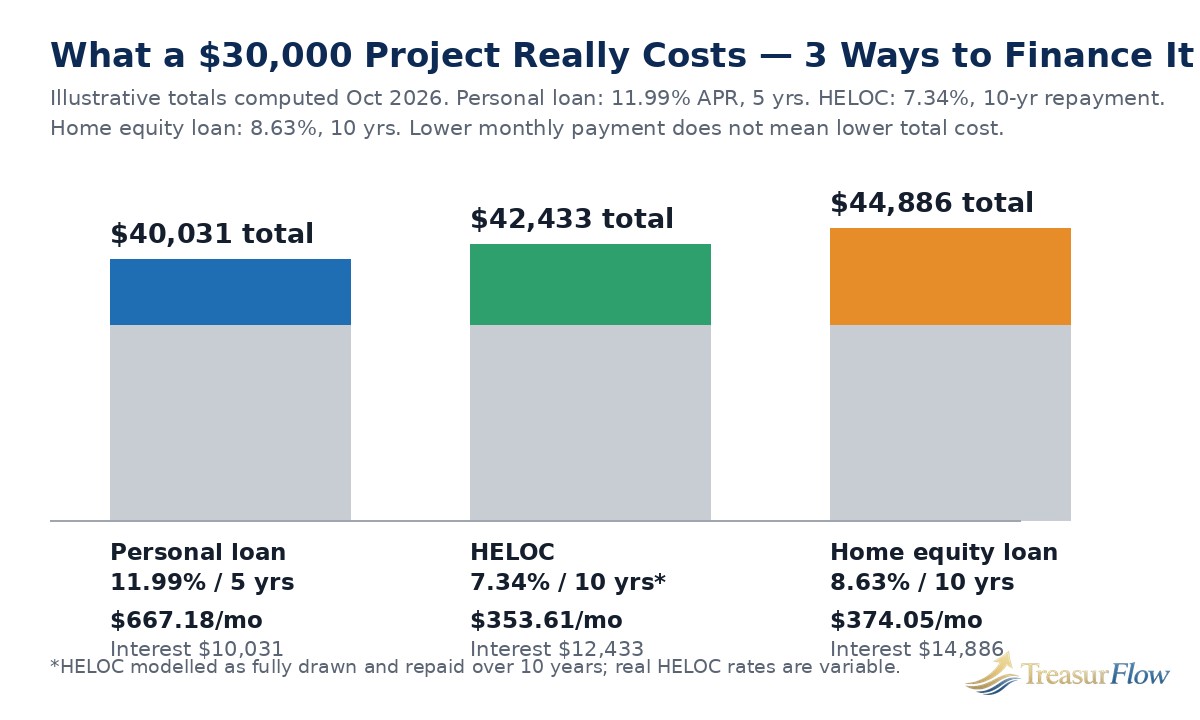
Read the table the way lenders hope you will not. The personal loan has by far the highest monthly payment — $667.18, nearly double the equity options — and the lowest total cost, because five years of interest at 11.99% is still less than ten years of interest at 7.34% or 8.63%. Stretch that same personal loan to seven years at the same 11.99% APR and the payment falls to $529.42, but total interest climbs to $14,471.41 — more than the ten-year HELOC. Term, not rate, is the lever that moves total cost most, and it is the lever borrowers reach for first because it is the one that makes the monthly number feel comfortable. The correct order of operations is the reverse: choose the shortest term whose payment fits your budget with room to spare, then shop for the lowest rate inside that term.
Three warnings belong on this math. First, a real HELOC rarely behaves like the middle row: during its draw period you may be required to pay only interest — on $30,000 at 7.34%, that is $183.50 a month, a seductively small number that reduces your balance by exactly nothing — and the rate is variable, so if the prime rate rises, every figure in that row rises with it. Model any HELOC at two points above its starting rate before you sign. Second, equity loans carry closing costs that this table excludes, and your home secures both equity rows; the personal loan’s higher payment buys you the fact that a missed payment damages your credit but cannot, by itself, take your house. Third, if your actual credit profile prices you at the top of the unsecured ranges — remember NerdWallet’s 33.47% average for bad credit — the comparison flips entirely, and equity financing, a co-borrower, a smaller project, or waiting to build credit will each beat signing a 30%-plus loan. Run your own pre-qualified numbers through the same three-row table before you decide. Ten minutes of arithmetic is the cheapest renovation advice in this article.
HELOC and Home Equity Loan Basics: Equity, CLTV, and the Risk Nobody Should Gloss Over
Home equity is simply your home’s current value minus what you still owe on it. Lenders ration access to it through the combined loan-to-value ratio (CLTV): your existing mortgage balance plus the new loan or line, divided by the home’s appraised value. Many lenders cap CLTV around 80% to 85%, though the cap varies by lender, product, and credit profile. A worked example makes the constraint concrete: on a home worth $500,000 with $300,000 still owed, you hold $200,000 of equity on paper — but at an 80% CLTV cap, total debt against the home cannot exceed $400,000, so your maximum new borrowing is $100,000, not $200,000. At an 85% cap it would be $125,000. This is why “I have $200,000 in equity” and “I can borrow $200,000” are different sentences, and why an appraisal that comes in low shrinks a HELOC before a single dollar is drawn.
Structurally, the two products diverge after approval. A home equity loan is a second mortgage in the plainest sense: one lump sum, a fixed rate, a fixed payment, and a term commonly between five and thirty years — best when the project cost is known and finished, like a signed roof contract. A HELOC is a revolving line with a draw period (commonly ten years, during which you borrow, repay, and borrow again, often paying interest only on the outstanding balance) followed by a repayment period in which the remaining balance amortizes. That flexibility is ideal for phased or uncertain projects and dangerous for undisciplined ones, because an undrawn line feels like savings when it is actually pre-approved debt secured by your home. Expect, for both products, an appraisal, income and asset verification, a title search, closing costs, and a funding timeline measured in weeks rather than the days an unsecured lender needs. For mid-size projects that can wait for that process, also comparison-shop the dedicated lenders in the home equity market — and if your project debt ever needs untangling from other balances afterward, an auto loan refinance or similar restructuring should be evaluated on its own math, never bundled into the renovation loan by default.
On rates, treat every average as a survey, not a promise. Bankrate’s national survey figures moved even within October 2026: its October 14, 2026 survey put the average HELOC rate at 7.34% and the average fixed home equity loan at 8.63%, while other trackers publishing the same month, using different lender panels and loan sizes, printed averages closer to 8% for both products. The lesson is not that one source is wrong; it is that your rate will be set by your CLTV, your credit score, your loan size, and your lender’s margin over prime — and the only average that matters is the one on your Loan Estimate. Two tax and risk points complete the picture. Under IRS Publication 936, interest on home equity debt is deductible only when the proceeds are used to buy, build, or substantially improve the home securing the loan — financing a renovation qualifies in principle, financing a holiday with the same line does not, and a tax professional should confirm your facts. And the CFPB’s standing warning deserves repetition in plain words: a HELOC or home equity loan is a mortgage. Default can lead to foreclosure. Never sign one for a project you would not be willing to keep paying for in a bad year.
FHA 203(k): The Renovation Mortgage for Major Rehabilitation
The FHA 203(k) program, insured by the Federal Housing Administration and overseen by HUD, exists for homes the ordinary market cannot finance — properties that need enough work that a standard lender will not lend against them as they sit. A 203(k) loan rolls the purchase price (or, on a refinance, the existing balance) and the rehabilitation cost into one mortgage, underwritten against the home’s after-improved value, with FHA’s familiar low down payment: 3.5% down with a credit score of 580 or higher, or 10% down with a score of 500 to 579, subject to lender overlays that are often stricter than FHA’s floor. The property must be your primary residence — investors and flippers are excluded — the loan must fall within your county’s FHA limits (for 2026, HUD’s schedule runs from a floor of $541,287 to a ceiling of $1,249,125 for one-unit properties in the highest-cost areas), and standard FHA mortgage insurance premiums apply, which is a real cost conventional borrowers should compare before assuming 203(k) is the cheap route.
The program comes in two variants, and choosing between them is mechanical. The Limited 203(k) covers non-structural, largely cosmetic and functional repairs — kitchens and baths, roofing, HVAC, painting, appliance replacement — up to $75,000 in total rehabilitation costs (a ceiling raised from $35,000 in November 2024; older articles still quoting $35,000 are out of date). It requires no HUD consultant, and the work must be completed within nine months of closing. The Standard 203(k) covers major rehabilitation, including structural work and additions, with a minimum of $5,000 in eligible repair costs and no separate cap beyond the county FHA limit. It requires a HUD-approved 203(k) consultant who prepares the work plan, inspects progress, and authorizes each draw from the repair escrow, and the work must be completed within twelve months. On both variants, funds for repairs sit in escrow and are released in draws as work is completed and inspected, licensed contractors must perform the work — do-it-yourself rehabilitation is generally not permitted — and the process takes materially longer to close than a personal loan or a standard mortgage. FHA also offers a separate Title I property improvement loan program for smaller work on homes you already own; HUD maintains the approved-lender search for it.
When is 203(k) the right rung, despite the paperwork? Three situations fit. You are buying a fixer-upper that needs structural or systems work before it can pass a standard appraisal, and you need one loan to do it. You already own a home needing rehabilitation on a scale — well into six figures — that unsecured lenders will not fund and your current equity cannot support on an as-is value, but the after-improved value can. Or your credit sits in the high-500s, where FHA’s 3.5%-down door is open while prime unsecured and equity pricing is punishing. When none of those is true — when the home is livable, the project is a normal kitchen, and your equity and credit are solid — the second rung of the ladder will almost always be simpler and cheaper than a 203(k). Process is a price; pay it only when it buys you something the simpler products cannot.
How to Apply: Pre-Qualify First, Then Let Lenders Compete
Whatever rung you land on, the application sequence is the same, and its order protects your credit and your wallet. First, check your own credit before any lender does: know your score, scan your reports for errors, and estimate your debt-to-income ratio, because those three numbers predict your pricing tier better than any advertisement. Second, fix the project budget: written contractor bids, plus the contingency from section two, produce the exact amount to request — borrowing “about thirty thousand” is how projects end up $3,000 short. Third, pre-qualify with at least three lenders using soft credit pulls, which NerdWallet and the lenders above confirm do not affect your credit score, and collect the same fields from each: APR, term, origination fee, net proceeds after fees, funding time, and prepayment terms. A fee-free 12.5% offer can beat an 11.99% offer carrying a 9.99% fee; only the net-proceeds comparison reveals it. Fourth, submit formal applications inside a short window — ideally the same week — so multiple hard inquiries for the same loan purpose bunch together in scoring models, and compare the official Loan Estimates or final disclosures side by side before signing anything. Fifth, time the funding to the contractor’s schedule, not the lender’s enthusiasm: money that arrives sixty days before work starts is money you are paying interest on while it sits in a checking account, which is why features like LightStream’s delayed funding window exist. If at any step a lender pressures you to skip comparisons, refuses to state an origination fee in writing, or quotes a rate it will not tie to a date and a credit tier, walk away. In a market priced between 6% and 36%, the lender who fears comparison is telling you where in that range your offer sits.
Paying the Contractor Safely: The Section That Protects the Loan
Financing gets the headlines, but payment structure is where renovation money is actually lost. The FTC’s guidance on avoiding home improvement scams, the CFPB’s home-equity warnings, and every consumer-protection office in the country converge on the same rules, and they cost nothing to follow. Treat any contractor who resists them as disqualified, whatever their bid.
Never pay in full upfront. A legitimate contractor expects to be paid as work is completed, not before it begins. A modest deposit — and, for standard materials, a documented payment when materials are delivered to your site — is normal in many trades and states (some states cap deposits by law). A demand for the entire contract price, or a large cash share of it, before work starts is the single most reliable predictor of an abandoned project. Structure the contract instead around milestone payments: defined amounts released when defined stages are finished and inspected — demolition complete, rough-in passed, cabinets set, final walkthrough signed off. Each milestone converts your loan proceeds from a gift of trust into payment for verified work, and it keeps the contractor’s incentive pointed at finishing your job rather than starting someone else’s.
Get a lien waiver with every payment. When you pay a general contractor, the subcontractors and suppliers behind them may hold legal rights — mechanics’ liens — against your home if the contractor fails to pass the money down. A signed lien waiver (partial waivers at each milestone, a final waiver at the last payment) is the contractor’s written confirmation that parties have been paid and lien rights for that stage are released. Collect them as routinely as receipts. This is also why you pay by check or card, never cash: your loan gives you a paper trail, and the paper trail is your evidence.
Put everything in a written contract, and verify the human. The contract should name the work, the materials by specification (not “or equivalent” without your written approval), the total price, the milestone schedule, start and completion dates, permit responsibility, and how changes are priced — in writing, signed, before any change-order work begins. Verify the contractor’s license and insurance with your state licensing board, confirm the business address is real, get at least three bids (a bid dramatically below the others is a warning, not a bargain), and check references for jobs similar to yours. Know, too, that the FTC Cooling-Off Rule generally gives you three business days to cancel certain contracts signed in your home — the seller must provide cancellation forms at signing — and many states add their own, sometimes longer, cancellation windows for home improvement contracts. If a salesperson pressures you to sign tonight “before the price expires,” that pressure is precisely what the rule was written for. Slow down, use the three days, and compare the bid. Finally, a rule specific to financed work: never let a contractor arrange your loan for you, steer you to a single lender, or ask you to sign completion certificates before work is genuinely complete — those certificates can trigger final payment for unfinished work, and contractor-arranged financing has been a documented channel for renovation scams. Your lender should be chosen by you, from your own shortlist, using the process in the section above.
How We Chose These Lenders — and What This Guide Cannot Tell You
The lenders named here were selected from October 2026 roundups by NerdWallet and Bankrate and cross-checked against lender-published ranges, prioritizing national availability, published (not teaser-only) pricing, clear fee disclosure, and features that map to real renovation situations: long terms for large projects, joint applications, fair-credit access, secured options, and fee-free structures. Averages cited for HELOCs and home equity loans come from Bankrate’s October 2026 national surveys and are labelled with their survey dates wherever they appear, because those averages moved during the month itself. Project costs come from the Remodeling 2025 Cost vs. Value Report as compiled in October 2026 roundups. The $30,000 comparison figures were computed from the stated APR and term assumptions using standard amortization, are illustrative, and exclude fees and closing costs, as noted where the table appears. One lender widely listed elsewhere, Marcus by Goldman Sachs, is discussed but given no rate range, because its ranges could not be verified consistently across dated October 2026 sources. Nothing in this guide is a quote, an approval, or financial advice: every APR you will actually be offered depends on your credit, income, equity, state, and the day you apply, and a same-day personalized pre-qualification is the only number that should drive a signing decision.
Before You Sign: Homeowners Ask About Renovation Loans
What credit score do I need for a home improvement loan in 2026?
It depends on the lender and loan type, as of October 2026. Upgrade and Best Egg list minimums around 600 and Happen Bank (formerly LendingClub) around 600, while LightStream and Discover list minimums around 660 and focus on good-to-excellent credit. HELOCs and home equity loans typically require stronger credit and sufficient equity, and an FHA 203(k) loan follows FHA rules: 580 or higher for 3.5% down, or 500 to 579 with 10% down. Your score also drives your price: NerdWallet’s October 2026 pre-qualification data put average APRs at 14.44% for excellent credit versus 33.47% for bad credit.
Is a personal loan or a HELOC cheaper for a $30,000 project?
It depends on the term, not just the rate. In our illustrative October 2026 example, a $30,000 personal loan at 11.99% APR over five years costs $667.18 a month and $10,030.91 in total interest. A $30,000 HELOC at 7.34% repaid over ten years costs less per month, $353.61, but more in total interest, $12,432.61, because the balance is outstanding twice as long — and a real HELOC rate is variable, so the cost can rise. Compare total interest over the full term, not the monthly payment alone.
How much equity do I need for a HELOC or home equity loan?
Most lenders cap your combined loan-to-value ratio, meaning your mortgage plus the new loan or line, at around 80% to 85% of your home’s value, though limits vary by lender. On a $500,000 home with a $300,000 mortgage, an 80% cap leaves up to $100,000 of borrowable equity. You will usually need an appraisal, income verification, and a credit check, and closing costs apply. Because your home secures the debt, missed payments can lead to foreclosure, which is the core risk the CFPB asks borrowers to weigh before tapping equity.
What is the difference between a Limited and a Standard FHA 203(k) loan?
The Limited 203(k) covers non-structural repairs up to $75,000, does not require a HUD consultant, and the work must be completed within nine months. The Standard 203(k) covers major and structural work of at least $5,000, requires a HUD-approved consultant to oversee the project, and allows twelve months for completion. Both are for owner-occupants only, follow your county’s FHA loan limits, and roll the purchase or refinance and the renovation into a single mortgage.
How can I avoid a contractor scam when I finance a renovation?
Get at least three written bids, verify the contractor’s license and insurance with your state, and put every promise, price, material, and deadline in a written contract. Never pay the full amount upfront: pay in milestones tied to completed, inspected work, and get a signed lien waiver each time you pay so subcontractors and suppliers cannot later claim they were not paid. Pay by check or card, not cash, keep copies of everything, and remember the FTC Cooling-Off Rule generally gives you three business days to cancel certain contracts signed in your home.
Is home improvement loan interest tax-deductible?
Interest on an unsecured personal loan used for home improvements is generally not tax-deductible. Interest on a home equity loan or HELOC may be deductible only when the money is used to buy, build, or substantially improve the home that secures the loan, under IRS rules in Publication 936, and limits apply. Energy-efficient upgrades may also qualify for federal tax credits listed by the IRS and ENERGY STAR. Tax rules are personal, so confirm your situation with the IRS guidance or a tax professional before you count on a deduction.
Conclusion: Borrow Against a Plan, Not a Picture
The best home improvement loans 2026 can offer share a trait that has nothing to do with any lender’s logo: they are taken out against a written project, at a term the borrower chose on purpose, after at least three priced comparisons. Start with the bid and a contingency. Climb the ladder only as high as the project requires — unsecured speed for small, defined work; equity pricing for mid-size and phased projects, with open eyes about the collateral; a 203(k) renovation mortgage when the home itself, not just a room in it, is the project. Respect the arithmetic: a shorter term at a higher rate routinely beats a longer term at a lower one, and every origination fee should be subtracted from the money your contractor actually receives before you call an offer cheap. Then protect the proceeds like the liability they are, with milestone payments, lien waivers, a verified license, and the cancellation rights the FTC guarantees you. A renovation should leave you with a better home and a smaller bank balance of debt every single month. Borrow in that order — project first, product second, lender third — and it will.

Muhammad Zakir is the founder of Treasurflow and the author of its personal finance guides. He researches consumer banking, credit, and personal loans, and every guide cites primary sources such as the CFPB, FDIC, FTC, and IRS. His content is educational and is not personalized financial advice.