
Best Vision Insurance 2026: Compare VSP, EyeMed, Davis Vision, Humana and UnitedHealthcare Before You Pay for Another Pair of Glasses
Vision insurance is the easiest insurance product to overpay for — and the easiest to get right once you understand how it works. Unlike health insurance, a vision plan is not protection against a catastrophe. It is a prepaid bundle: you pay a monthly premium, and in return you get a routine exam for a small copay, an allowance toward frames or contact lenses, and set prices on lens options. If the bundle costs less than the same exam and glasses at retail, the plan wins. If it costs more, you have bought your own glasses back in monthly installments.
That is why this guide does not start with a ranking. It starts with anatomy: the four numbers that decide whether any vision plan is worth its premium — the exam copay, the frame or contact lens allowance, the price list for lens options, and the network. Then we compare the plans most Americans actually buy in 2026 — VSP, EyeMed, UnitedHealthcare, Davis Vision and Humana — by the job each does best, and run an honest break-even calculation so you can see when a plan pays for itself and when paying cash beats every plan on this page.
Related Guides
Helpful Official Resources
- Medicare.gov — Eye exams (routine) — routine eye exams for eyeglasses or contact lenses are not covered; you pay all costs.
- HealthCare.gov — children’s vision is an essential health benefit in Marketplace plans; adult vision coverage varies by plan, and stand-alone adult vision plans are generally bought outside the Marketplace.
- NAIC Consumer Information Source — check an insurer’s licensing, financial and complaint information before you buy.
- American Optometric Association (AOA) — updated clinical guideline on annual eye exams — evidence-based guidance on comprehensive adult eye exams.
First, Learn How a Vision Plan Is Built: The Four Numbers That Decide Its Value
Most vision plan marketing leads with the monthly premium because it is the smallest, friendliest number on the page. But the premium is only what you pay to belong. What you get for belonging is defined by four other numbers, and two plans with the same premium can differ by hundreds of dollars a year once you use them. Read every plan in this order.
Number 1: The Exam Copay — What the Yearly Eye Exam Actually Costs You
Almost every plan here includes one routine comprehensive eye exam per benefit period, usually every 12 months, for a fixed in-network copay. In the named individual plans checked as of October 2026, that copay is typically $0 to $15: EyeMed Healthy lists $0, its Bold and Bright plans list $10, UnitedHealthcare lists $10 in network, and a published VSP standard-option comparison lists $15. Those are examples, not universal prices — your plan document governs.
Why does this number matter so much? Because the exam is the benefit almost every wearer uses every year — a contact lens prescription cannot be renewed indefinitely without one — and it is also a health screening. The AOA’s updated clinical guideline recommends annual comprehensive eye exams for ages 18 through 64, and notes that an in-person comprehensive exam can help uncover more than 270 systemic and chronic conditions, including diabetes and high blood pressure. Check what the copay excludes, too: a contact lens fitting is often priced separately, and optional retinal imaging may be extra.
Number 2: The Frame or Contact Lens Allowance — The Dollar Credit at the Center of the Plan
The allowance is the heart of a vision plan. It is a dollar credit — commonly $130 to $200 in the individual plans compared for this guide, and as low as $100 or as high as $250 in some bundled or premium products — that you spend on a frame, or, in most plans, on contact lenses instead of glasses. Three details decide what an allowance is really worth.
First, the amount itself. A $200 allowance is obviously worth $70 more than a $130 allowance if you spend at least $200 on frames. But allowances only pay up to what you spend. Buy a $95 pair of glasses at a low-cost retailer and a $200 allowance is not worth $200 to you — it is worth $95, and the rest evaporates.
Second, the discount on the overage. Many plans do not cut you off at the allowance. VSP individual comparisons, for example, describe a $150 frame allowance ($170 toward featured frame brands in that comparison) with 20% off the amount over the allowance, and Humana Extend documents describe 20% off the balance over a frame allowance and 15% off the balance over a contact lens allowance on some tiers. On a $300 frame with a $150 allowance and a 20% overage discount, you still pay $120 out of pocket for the frame portion, before lens copays.
Third, the either-or rule and the clock. In most plans you choose glasses or contacts in a benefit period, not both — UnitedHealthcare makes the distinction a headline feature: Plan A covers glasses or contacts, while Plan B covers glasses and contacts. Frequency matters just as much: frames may renew every 24 months even when lenses and exams renew every 12, so a frame allowance usable only every other year is worth half as much per year as the headline suggests. Read the frequency line for each benefit separately.
Number 3: Lens-Option Pricing — Where a Cheap Plan Quietly Gets Expensive
A frame allowance gets the headlines, but lens pricing is where two similar-looking plans separate. The base benefit usually covers standard single-vision, lined bifocal or trifocal plastic lenses for a materials copay — $25 in several named examples here, including published VSP individual and Humana Extend documents. Everything beyond the base lens is a menu, and each plan prices that menu differently.
The menu items to price before you enroll are progressive (no-line multifocal) lenses, anti-reflective coating, scratch coating, UV coating, tint, and polycarbonate lenses — especially for children, whose polycarbonate lenses are $0 for members under 19 in EyeMed’s Bold and Bright details. EyeMed’s published individual FAQ shows how granular this gets: Bold lists a $20 single-vision lens copay, $0 for UV, tint and standard scratch coating, $35 for standard polycarbonate and $40 for standard anti-reflective coating, while Bright lists $0 for standard polycarbonate and $0 for standard anti-reflective coating. A wearer who always buys those two options pays noticeably less per pair on the higher tier.
Number 4: The Network — Whether Your Doctor and Your Favorite Store Are In
An allowance you cannot spend where you actually shop is a coupon for a store you do not visit. Networks come in two flavors: some lean toward independent optometrists, others toward retail chains where exam and glasses happen in one trip. EyeMed is the clearest retail example — comparison sources describe access through LensCrafters, Target Optical and Pearle Vision, and EyeMed describes individual members as using its Advantage network, with tens of thousands of independent and retail access points. VSP is generally positioned around independent eye doctors — one comparison source reported more than 40,000 eye care professionals for VSP individual plans — although members can also use certain retail locations.
We are deliberately not crowning a “biggest network” winner, because published network counts are not measured the same way — some sources count doctors, some count access points, some count locations, and the same carrier can be described with very different figures in the same year. A national total tells you nothing about the three providers near your house. The only network test that matters is a name test: search the plan’s provider directory for your current eye doctor and the stores you would realistically use, confirm they are in network for the specific plan you are buying, and only then compare premiums. Out-of-network benefits, where they exist, are usually small fixed reimbursements, and some tiers describe them as limited.
Two More Lines to Read Before the Price: Waiting Periods and the Commitment
Vision plans are simpler than dental plans, but not all are instant or commitment-free. Some advertise benefits starting very soon after enrollment — one comparison source noted VSP individual benefits can start the day after enrollment, and EyeMed describes Healthy as having no waiting period — while UnitedHealthcare’s individual plans have historically required a 12-month premium commitment, and VSP individual plans have been sold as a year of coverage at a time. Bundled dental-and-vision products add dental waiting periods on top. Read the commitment line like a phone contract.
The Best Vision Insurance Plans in 2026, Picked by Need — Not by Hype
With the anatomy in place, here are the picks — each one the strongest answer to a different question. All figures are named-plan examples or ranges as of October 2026.
Best for the Largest Independent-Doctor Experience: VSP
If your loyalty is to a particular independent optometrist — the doctor who has examined your family for years, in a private practice rather than a mall store — VSP is usually the first network to test. Comparison sources for 2026 describe VSP individual allowances most commonly around $150 for frames, rising to $230 on select options, with a reported starting premium from $11.20 a month in some states, 20% off the amount over the allowance, and $170 toward featured frame brands against a $150 base allowance in one widely cited comparison. A separate published comparison listed a standard option at $16.39 a month with a $15 exam copay, a $25 basic lens copay and a $150 allowance. The spread between sources is itself the lesson: VSP sells several individual configurations, and your state decides which you can buy and what they cost.
Best for Retail Chains and One-Trip Shopping: EyeMed
EyeMed is the retail-network pick. If your idea of getting glasses is an exam at LensCrafters, Target Optical or Pearle Vision and walking out with a pair the same visit, EyeMed’s network is built around that habit, and its three individual tiers are the cleanest ladder in this guide. As published by EyeMed and summarized in comparison sources checked in October 2026: Healthy starts at $5 a month with a $0 exam copay and discounts instead of an allowance — 35% off frames and 15% off conventional contacts in comparison summaries. Bold is $17.50 a month with a $10 exam copay and a $130 allowance. Bright is $30 a month with a $10 exam copay and a $200 allowance, plus the richest lens-option pricing of the three, including $0 standard polycarbonate and $0 standard anti-reflective coating in EyeMed’s published details. EyeMed also says rates in most states are discounted by 5% when you pay for a full year.
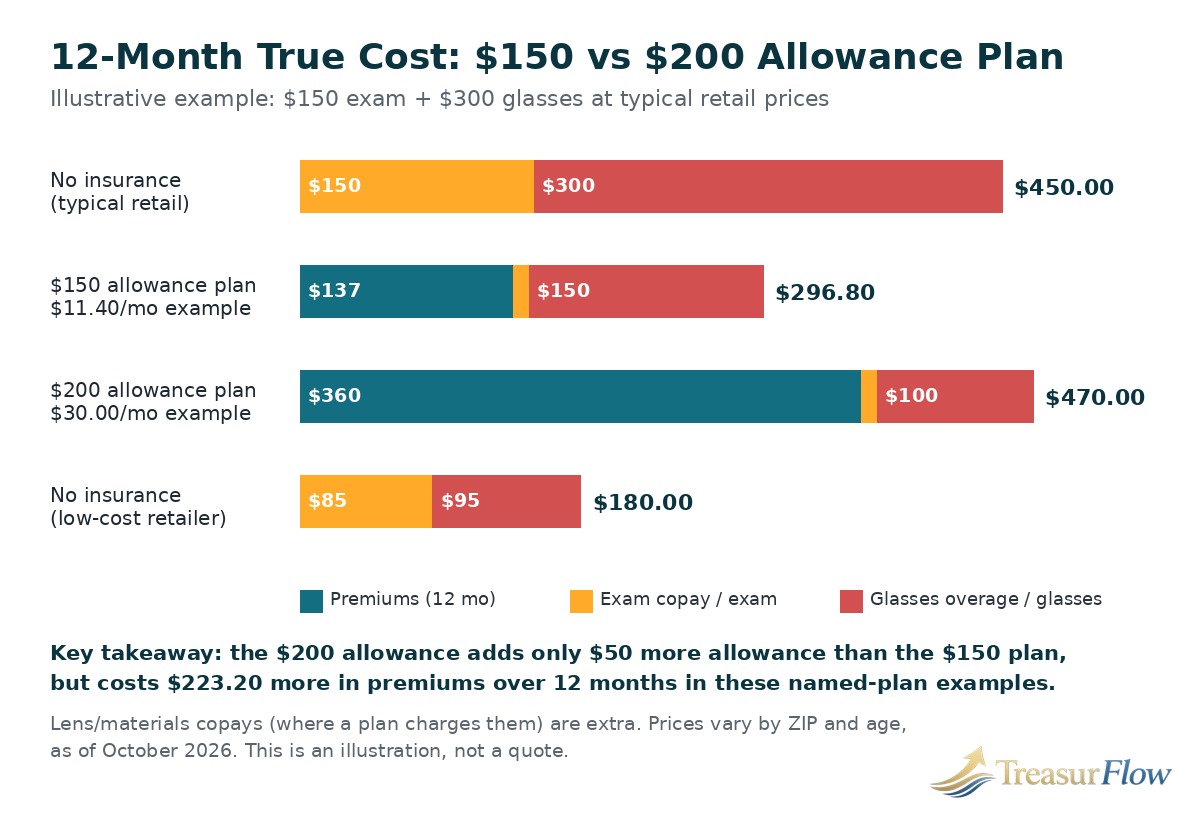
The honest caution on EyeMed is tier discipline. Healthy is not a stripped-down Bright; it is a different product — a cheap exam plus discounts, with no allowance at all. It can be excellent value for an exam-focused buyer, as the break-even math shows, and poor value for someone who assumed the $5 plan included a frame credit. And Bright’s $200 allowance comes attached to $360 a year in premiums, which — as the chart below makes clear — can erase the allowance advantage entirely for one pair of glasses a year. Choose the tier by your actual glasses, not by the biggest number in the brochure.
Best Simple Low-Premium Allowance Plan: UnitedHealthcare
UnitedHealthcare’s individual vision offering is refreshingly blunt: two plans, upfront prices, one main difference. Published UnitedHealthcare material lists Plan A at $11.40 a month and Plan B at $15.70 a month; 2026 comparison sources round those to about $11 and about $15, list a $10 in-network exam copay and a $150 frame allowance, and note a 12-month premium commitment and that the plans are not sold in every state — the comparison we relied on listed Alaska, Massachusetts, Minnesota, Montana, New Mexico and New York as not sold. Plan A covers an exam plus glasses or contacts. Plan B covers an exam plus glasses and contacts — the entire reason to pay the roughly $4.30 monthly difference if you wear contacts daily and keep glasses as backup.
Best for Families and Breakage Worries: Davis Vision
Davis Vision earns its place on a specific strength: what happens after you buy the glasses. Comparison sources for 2026 summarize Davis Vision individual and family options at about $12 to $24 a month, with exam copays typically $15 to $20 and an allowance up to $200 a year for glasses or contacts, and note that it replaces frames or lenses that break in the first year. Davis Vision’s current marketing through MetLife likewise describes fully covered frames plus an Exclusive Collection with a one-year breakage warranty. Exact warranty terms depend on the specific plan, so confirm them in your plan documents — but breakage protection is part of this brand’s pitch in a way it is not for the others.
That makes Davis Vision the natural family pick. Children break, sit on, lose and outgrow glasses at a rate adults do not, and a family premium in the $12–$24 comparison range covering allowances for multiple wearers — plus a breakage backstop — attacks the two costs families actually face. If nobody in your household has ever broken a pair, a cheaper allowance plan will probably win on pure math.
Best for One Bundled Bill — Dental, Vision and Hearing Together: Humana
Humana’s entry is not really a stand-alone vision plan. Its Extend products bundle dental, vision and hearing into one policy and one premium — and comparison sources described Extend options at just under $40 a month for some options, with a $0 vision exam copay and an allowance only on the higher tiers. Humana’s own pages show why tier reading matters. On Extend 2500, Humana lists a routine vision exam every 12 months with a $10 in-network copay, frames with a $100 in-network allowance once every 24 months, contacts with a $100 allowance, and standard lenses with a $25 copay. On Extend 5000, published summaries list a $0 routine exam copay and a $150 frame allowance, again with frames on a 24-month clock. Humana quotes these bundles by state and age, so any single monthly price is an example only.
Choose Humana when the bundle itself is the point: you genuinely need dental coverage too, you value one bill and one company, and the combined price beats buying dental and vision separately in your ZIP code. Do not choose it for the vision benefit alone — a $100–$150 vision allowance inside a bundle built mainly around a $2,500 or $5,000 dental maximum is a supporting actor. Our guide to the best life insurance for 2026 uses the same compare-the-actual-benefit approach for family protection.
The Alternative That Is Not Insurance at All: Paying Direct and Buying Smart
Every honest vision insurance guide needs this section, because for many readers the best “plan” is no plan. Warehouse optical departments, low-cost chains and online retailers have compressed cash prices until they compete directly with insurance. In the worked example published by one comparison source, a low-cost retailer charged $85 for an exam and $95 for glasses with prescription lenses — $180 all in, with no premium, no network and no allowance clock. Online prices can be lower still for basic single-vision glasses, though they rise with progressives, coatings and high-index materials, and an online purchase cannot include the exam.
The Break-Even Math: When a Vision Plan Actually Pays for Itself
Here is the calculation almost nobody does before enrolling, done openly. We computed every total below in a spreadsheet-style script from the stated inputs, and every input is labelled for what it is: a typical or illustrative retail price, or a named-plan example checked as of October 2026. Your local prices will differ. The method will not.
The illustrative shopping basket. One routine exam and one complete pair of glasses in 12 months. At typical retail prices — inside the ranges reported by the sources we reviewed, where an uninsured exam commonly falls between about $50 and $250 and a mid-priced complete pair commonly lands in the few-hundred-dollar range — we use a $150 exam and a $300 pair of glasses. Paying cash at typical retail therefore costs $450. At a low-cost retailer, using the published example of an $85 exam and $95 glasses, paying cash costs $180.
Plan 1 — a $150 allowance plan. UnitedHealthcare Plan A example: $11.40 a month is $136.80 over 12 months. Add the $10 in-network exam copay. Add the glasses overage: a $300 pair minus the $150 allowance leaves $150 out of pocket, before any lens or materials copays your specific plan charges and before any overage discount it may offer. Total: $136.80 + $10 + $150 = $296.80. Against $450 cash at typical retail, that is a saving of $153.20. Against the $180 low-cost cash route, the same plan costs $116.80 more. Both statements are true at once — which one describes your life depends on where you would actually have bought the glasses.
Plan 2 — a $200 allowance plan. EyeMed Bright example: $30 a month is $360 over 12 months. Add the $10 exam copay. Add the overage on the same $300 pair: $300 minus the $200 allowance is $100. Total: $360 + $10 + $100 = $470. That is $20 more than paying $450 cash at the same typical retail prices, and $173.20 more than the $150 allowance plan above — for the same exam and the same glasses. The reason is arithmetic marketing hopes you skip: Bright’s allowance is only $50 larger than Plan A’s, but its premiums are $223.20 larger over 12 months in these two named-plan examples. A bigger allowance on a much bigger premium is not a bigger benefit; it is a bigger prepayment. (Bright does include richer lens-option pricing — $0 standard polycarbonate and $0 standard anti-reflective coating in EyeMed’s published details — which can close some or all of that gap for a wearer who buys both options every year.)
Plan 3 — the discount-only plan. EyeMed Healthy example: $5 a month is $60 over 12 months, with a $0 exam copay. It has no allowance, but comparison sources describe 35% off frames. If that discount were applied to our full $300 illustrative pair — a simplification, since discounts apply to components — the pair would cost $195, for a total of $255. That beats typical-retail cash and even the $150 allowance plan in this basket, while still losing to the $180 low-cost cash route. The cheapest premium plus a real discount is a legitimate design — as long as you know there is no allowance inside it.
The exam-only year. Now remove the glasses. Cash costs $150 at our typical price or $85 at the low-cost example. The $150 allowance plan costs $136.80 in premiums plus a $10 copay — $146.80 — before you have bought anything else. That roughly ties a typical-priced cash exam and clearly loses to an $85 cash exam. In an exam-only year, most allowance plans do not pay for themselves — the most common way vision insurance quietly loses money is premiums paid through years when a prescription barely changes and nothing is bought.
The contacts and progressives years. Flip the basket the other way and plans look much better. Annual contact supplies, fittings and a backup pair of glasses routinely push a contacts wearer’s yearly spend well past our $300 basket — which is why UnitedHealthcare’s Plan B, at $188.40 over 12 months in the published example, exists for people who need glasses and contacts in the same year. Progressive lenses similarly raise the retail basket fast, and a plan with modest fixed progressive pricing can save far more than the frame-allowance comparison suggests. The pattern across all five baskets is the real rule of this guide: a vision plan pays when you use its full bundle at mid-range or higher prices, in network, on schedule — and it does not pay when you buy cheap, buy rarely or buy out of network.
A Five-Minute Break-Even Test You Can Run on Any Plan
You do not need our basket. Use yours. Take what you actually spent on your last exam and eyewear where you actually shop. Then, for any plan: multiply the monthly premium by 12, add the exam copay, add your lens copays for your exact lenses, and add what is left of your eyewear price after the allowance and any overage discount. If that total is comfortably below your cash price — not $5 below, comfortably below — the plan earns its premium. If it is close, the tie goes to cash, because cash has no network, no clock and no commitment. The tools in our roundup of the best budgeting apps for 2026 make that test easy to repeat yearly.
Employer Vision Plan vs. Individual Vision Plan: Which One Should You Take?
If your employer offers a vision plan, that offer changes the calculation before any brand comparison begins — usually in the employer’s favor, for one mechanical reason: the premium. Group premiums are often lower than individual premiums for a similar allowance, and the deduction you see may be only part of the true premium, with the employer absorbing the rest. A benefit that might cost $11 to $30 a month bought individually can appear on a pay stub as a much smaller deduction, and when the employee’s share drops, the break-even test gets much easier to pass.
Three checks still apply. First, confirm your eye doctor is in the employer’s network before open enrollment closes, not after. Second, read the frequency clocks — employer plans commonly run frames on a 24-month cycle even when exams and lenses are annual, which surprises families replacing children’s frames yearly. Third, do not double-buy: if one spouse’s employer plan covers the whole family at a reasonable family rate, carrying two vision plans for the same two eyes is almost never worth it, because vision benefits generally do not stack — you cannot usually spend two allowances on one pair of glasses.
Individual plans win where employer plans cannot reach. If you are self-employed, freelancing, between jobs, part-time without benefits, or retired outside Medicare Advantage, an individual plan is not the second-best option — it is the only plan option, and at $5 to $30 a month in the examples above it is an affordable one. Individual plans also win on timing: stand-alone vision plans are generally sold outside the HealthCare.gov Marketplace — adult vision is not an essential health benefit, while children’s vision coverage is included in Marketplace health plans — and enrollment is typically available year-round rather than only during an employer’s open enrollment window. Just remember the commitment lines: some individual plans expect a 12-month premium commitment, so year-round enrollment does not always mean cancel any month. One more note: if you have an HSA or FSA, exams, glasses and contacts are generally eligible expenses, so copays, overages or a cash purchase can often be paid with pre-tax dollars — check your own account’s rules.
The Medicare Gap: Original Medicare Does Not Pay for Routine Vision
This is the most expensive misunderstanding in American vision care, stated in Medicare’s own terms. Medicare.gov’s page on routine eye exams says plainly that Medicare does not cover routine eye exams — sometimes called eye refractions — for eyeglasses or contact lenses, and that you pay all costs for those exams. Routine eyeglasses and contact lenses are likewise not an Original Medicare benefit. Retirees who spent decades on employer plans where a $10 copay produced an exam and an allowance produced glasses can be genuinely shocked by their first full retail bill at 66.
What Original Medicare does cover is medical eye care, and the distinction is the reason for the visit. Part B can cover eye care tied to a medical condition or risk — diabetic eye exams, glaucoma testing for people at high risk, macular degeneration treatment, and cataract surgery, including one pair of eyeglasses or contact lenses after cataract surgery with an intraocular lens. An exam that uncovers a medical problem may be partly a Medicare visit and partly a routine-vision visit at the same appointment, and billing follows that split. If you are unsure which side of the line a service falls on, ask the provider beforehand — Medicare.gov itself advises asking how much a service will cost and whether Medicare covers it.
For routine vision, a Medicare beneficiary has three realistic routes. The first is a Medicare Advantage plan with a vision benefit — Medicare.gov notes that some Advantage plans offer extra benefits Original Medicare does not cover, like vision, hearing or dental — but Advantage vision benefits vary enormously, and switching is a much larger decision than buying glasses, with networks and drug coverage to check as a whole. The second is a stand-alone individual vision plan bought alongside Original Medicare; nothing about Medicare prevents you from buying one, and it is often the cleanest way to recreate the employer-plan experience in retirement. The third is disciplined direct pay, with the break-even test run honestly each year. What does not work is assuming coverage exists. If you are approaching 65 and wear glasses, put routine vision on your retirement checklist — and if you are also reviewing the home you will retire in, our guide to the best homeowners insurance for 2026 covers the other policy retirees most often under-review.
LASIK and Laser Vision Correction: Discounts Exist, Coverage Basically Does Not
Because LASIK questions attach themselves to every vision insurance search, here is the verified position. Vision insurance does not cover LASIK as a benefit in the plans compared here, because laser vision correction is treated as elective rather than medically necessary. UnitedHealthcare states that point directly in its member education material, and it is consistent across carriers. What members of several plans can get instead is access to a discount program at participating laser centers.
The discount figures that sources actually state are these. Multiple plan documents and comparisons describe the standard VSP and EyeMed laser arrangements as an average of about 15% off the regular price, or 5% off a promotional price, at contracted facilities. UnitedHealthcare’s own vision material says its members can save up to 35% on laser vision correction — an “up to” claim attached to its specific program, not a guaranteed percentage on your quote. We have deliberately not published a typical LASIK price or dollar saving here, because laser pricing is quoted per eye, per technology and per market after a candidacy evaluation, and a percentage off an unstated base price is not a number anyone can budget from. Use the discount as a second quote: get the center’s best direct price first, then the price through your plan’s program, and compare numbers — not percentages.
How to Buy a Vision Plan Without Getting Burned: A Step-by-Step Checklist
Step 1 — Reconstruct your last real year of vision spending. Find the receipts, or estimate honestly: exam, frames, lenses with your actual options, contacts, and any second pair. If the total is under about $200 where you shop, most allowance plans will struggle to beat cash for you, and a discount-only tier or no plan belongs at the top of your list.
Step 2 — Name your non-negotiables. Your current eye doctor in network. Progressives priced acceptably. Contacts and glasses in the same year. A breakage warranty. Frames every 12 months rather than 24. Whatever yours are, they eliminate plans faster and more reliably than any star rating, including ours.
Step 3 — Get ZIP-specific quotes for the three finalists. Premiums, allowances and even which tiers are sold vary by state — UnitedHealthcare’s individual plans, to use one documented example, are not sold in several states at all, and EyeMed describes its individual plans as available in most but not all states. A national comparison, this one included, can only take you to the finalists. The quote for your ZIP code takes you to the answer.
Step 4 — Price your exact pair of glasses on each finalist. Same frame price, same lens type, same coatings, using each plan’s lens-option list and overage discount. This is the step that separates VSP’s options from each other and EyeMed’s Bold from its Bright. Twenty minutes here is worth more than two hours of review-reading.
Step 5 — Check the insurer, not just the plan. Before paying, look the company up in the NAIC’s Consumer Information Source to confirm it is licensed and to see its complaint and financial information, and confirm the selling website is the carrier’s real site or a licensed seller. If anything about the seller cannot be verified, stop, call your state insurance department, and confirm before you enroll.
Step 6 — Calendar the clocks on day one. Note when each benefit renews, when any 12-month commitment ends, and when the plan auto-renews. Vision benefits do not roll over; an unused allowance is a sunk premium. Get the comprehensive exam on the AOA’s recommended schedule, use the benefits you have paid for, and re-run the break-even test every year before you renew — the same habit we argue for in how to save money in 2026.
Who Should Probably Skip Vision Insurance Entirely
Skip it, or choose only a discount-only tier, if you recognize yourself here: your prescription is stable and you replace glasses every two to three years; you are happy with sub-$100 complete glasses from a low-cost or online retailer; you would only use the exam in a typical year; your preferred doctor is out of network on every plan you priced; or a spouse’s employer plan already covers your eyes. There is no prize for owning insurance where your predictable, small, shoppable expenses are cheaper than the prepayment.
Who Should Almost Certainly Buy It
Buy it if the opposite picture is yours: several people in your household wear correction; someone wears contacts daily and needs glasses too; progressives or coatings are standard in your family; you buy frames at mid-range prices; or a cheap exam removes your last excuse for skipping the comprehensive exam your eyes should be getting anyway. For those households the plans above are not a gamble — they are a discount bought in bulk on spending that was going to happen regardless.
Related Insurance Guides
- Insurance Guides
- Best Dental Insurance 2026: Compare Premiums, Annual Maximums, Waiting Periods and Coverage
- Best Medicare Supplement Plans 2026: Plan G vs Plan N, Costs and How to Choose
Vision Plan Questions Readers Ask Before They Enroll in 2026
How much does vision insurance cost per month in 2026?
Individual vision insurance in the named-plan examples checked as of October 2026 ranged from $5 a month for EyeMed Healthy, a discount-only plan with a $0 exam copay and no frame allowance, to $30 a month for EyeMed Bright, with EyeMed Bold at $17.50 a month, UnitedHealthcare Plan A at about $11 to $11.40 a month and Plan B at about $15 to $15.70 a month, Davis Vision options at about $12 to $24 a month in comparison sources, and VSP individual plans starting from about $11.20 a month in some states. Premiums vary by ZIP code, state and, for some products, by age, so confirm your own quote before enrolling.
Is vision insurance worth it if I only need an eye exam this year?
Usually not. In this guide’s illustrative math, a $150 allowance plan example cost $146.80 for an exam-only year — $136.80 in 12 months of premiums plus a $10 exam copay — roughly the same as a $150 typical cash exam and clearly more than an $85 exam at a low-cost retailer. Vision plans pay for themselves when you use the exam plus the frame or contact lens allowance in the same year, at mid-range or higher retail prices, in network. If you only need an exam, or buy inexpensive glasses every few years, paying cash is usually cheaper.
Does Medicare cover routine eye exams and glasses?
No. Medicare.gov states that Medicare does not cover routine eye exams, sometimes called eye refractions, for eyeglasses or contact lenses, and that you pay all costs for those exams; routine eyeglasses and contact lenses are likewise not covered by Original Medicare. Part B can cover medical eye care, such as diabetic eye exams, glaucoma testing for people at high risk, macular degeneration treatment, and cataract surgery including one pair of eyeglasses or contact lenses after surgery. For routine vision on Medicare, the options are a Medicare Advantage plan with a vision benefit, a stand-alone individual vision plan, or paying cash at a fair price.
Can I get both glasses and contact lenses in the same year on one vision plan?
On most vision plans, no — glasses and contact lenses are usually an either-or choice in each benefit period, so you pick one and pay out of pocket for the other. A clear exception here is UnitedHealthcare’s individual Plan B, which published plan material describes as covering an eye exam plus glasses and contacts, while its Plan A covers glasses or contacts. If you wear contacts daily and also keep a current pair of glasses, check this rule before price: a plan covering both can be worth a higher premium, and a plan covering only one can leave you paying full retail for the second item.
What is the difference between VSP and EyeMed?
The practical difference is network style and tier design. VSP is generally built around a large network of independent eye doctors, with individual allowances commonly around $150 for frames and up to $230 on select options in 2026 comparison sources. EyeMed is built around retail access, including LensCrafters, Target Optical and Pearle Vision in comparison sources, with three individual tiers: Healthy at $5 a month with discounts instead of an allowance, Bold at $17.50 a month with a $130 allowance, and Bright at $30 a month with a $200 allowance, as published examples as of October 2026. Choose the network that contains your actual doctor or store.
Does vision insurance cover LASIK?
No, the vision plans compared in this guide do not cover LASIK as a benefit, because laser vision correction is treated as an elective procedure rather than a medically necessary one. What several plans offer instead is a discount program at participating laser centers: plan documents and comparisons describe the standard VSP and EyeMed arrangements as an average of about 15% off the regular price or 5% off a promotional price, and UnitedHealthcare states that its vision members can save up to 35% on laser vision correction through its program. Compare the discounted price against the center’s best direct price per eye before assuming the percentage saves you money.
Conclusion: Buy the Bundle Only When Your Real Glasses Cost More Than the Plan
The best vision insurance in 2026 is not a brand. It is a piece of arithmetic that happens to have a brand attached. Learn the four numbers — exam copay, allowance, lens-option pricing and network — before any ranking. Shortlist by situation: VSP if your independent doctor matters most, EyeMed for retail one-trip shopping, UnitedHealthcare for a simple low premium or glasses and contacts in the same year, Davis Vision for families and breakage protection, Humana if a dental, vision and hearing bundle is the real purchase. Then run the break-even test with your own last pair of glasses, check the insurer in the NAIC’s consumer tool, and confirm every figure against a quote for your ZIP code, because every premium and allowance here is a range or named-plan example as of October 2026.
And keep the honest alternative in view. If your eyes need only an exam this year, if your glasses cost $95 complete, or if your prescription has not changed in three years, the best decision available to you in 2026 may be no insurance at all — a fairly priced comprehensive exam, a sensibly priced pair of glasses, and the premium money still in your account. Insurance earns its place when it discounts spending that was truly going to happen. Buy it when it does, skip it when it does not, and let the math — not the brochure — make the call.

Muhammad Zakir is the founder of Treasurflow and the author of its personal finance guides. He researches consumer banking, credit, and personal loans, and every guide cites primary sources such as the CFPB, FDIC, FTC, and IRS. His content is educational and is not personalized financial advice.