
Your first credit card is not really a rewards decision. It is a habit decision made at the exact moment in life when your income is irregular, your expenses arrive in lumps at the start of each semester, and a single missed payment can follow you into your first apartment application after graduation. That is why this guide to the best student credit cards 2026 is built differently from a generic list. We start with your campus budget, then look at whether a student unsecured card or a secured card fits your situation, and only then compare rewards. A card that earns an extra 1% on food delivery is worthless if its limit, fees, or payment due date pushes you into interest charges.
All of the cards below charge no annual fee as of October 2026, which matters more than any welcome offer. A no-annual-fee card can stay open after graduation at no cost, preserving the age of the account while your credit history grows. Rates, rewards, and bonuses change often, so every figure in this guide is date-stamped as of October 2026 and you should confirm the current terms on the issuer’s own page before you apply. Nothing in this guide is a promise of approval. Issuers decide who qualifies based on the full application, and no legitimate card can guarantee approval to everyone.
Related guides
- Best Secured Credit Cards 2026 — the deposit-based route if a student unsecured card is not a fit yet.
- Best Cash Back Credit Cards 2026 — the cards many students graduate into once they have a year or two of history.
- No Credit Check Credit Cards 2026 — what those offers really are, and the trade-offs to read first.
- How Long Does It Take to Build Credit From Scratch? — a realistic timeline for a first score and a stronger file.
- Best Balance Transfer Credit Cards 2026 — useful context later in life, not a fix for student spending.
Helpful Official Resources
- Ask CFPB — clear answers about credit cards and other financial products — the Consumer Financial Protection Bureau’s question-and-answer database.
- CFPB: New students should look closely at college-sponsored bank accounts and shop around — why you should compare campus-marketed accounts instead of signing up under pressure at orientation.
- Before you apply for any card, read the issuer’s own rates-and-fees page for that card. That page, not a comparison article, is the legally binding disclosure.
Start With Your Campus Budget, Not the Rewards Poster
Walk past any campus banking table during orientation week and you will see the pitch in the wrong order: bonus first, rewards second, terms last. Reverse it. Before you compare a single card, write down three numbers from your real life. First, your reliable monthly income — the money that is actually yours and actually repeats, such as pay from a part-time job, a work-study award you have already been granted, or a regular deposit into an account in your own name. Second, your fixed monthly costs: phone, transport, subscriptions, and any share of rent or food you must cover even in a bad month. Third, the amount you could put on a card and still pay in full, every month, without hoping next month’s shifts cover it. That third number is your personal spending ceiling, and it should be well below whatever credit limit an issuer gives you.
This budget-first approach changes which card is “best” for you. If most of your card spending will be groceries and eating with friends, a card that pays a higher rate on dining and groceries fits better than a flat-rate card. If your spending is spread thinly across textbooks, transit, printing, and small online orders, a simple flat rate on everything removes the need to track categories at all. If you know you will not remember to activate rotating categories each quarter, the highest headline rate in this guide is the wrong card for you, however good it looks in a comparison table. Honesty about your attention is a financial skill.
There is also a timing decision. Applying at the start of a semester, when you have a stable address, a working bank account, and a clear picture of your class and work schedule, is calmer than applying during finals or the week you move dorms. Payment due dates, statements, and card deliveries all go more smoothly when your address and routine are settled. One card, used well for a year, builds more credit than three applications in a month, which can add hard inquiries to a very thin file and leave you managing multiple due dates before you have built the first habit.
The Shortlist at a Glance
The table below summarises the cards covered in detail in this guide. All figures are as of October 2026 and should be checked with the issuer before applying.
| Card | Best fit | Rewards as of October 2026 | Regular APR as of October 2026 | Annual fee |
|---|---|---|---|---|
| Discover it® Student Cash Back | Students who will activate quarterly categories | 5% cash back in rotating categories each quarter on up to $1,500 in combined purchases when you activate, plus 1% on other purchases; Cashback Match in the first year | 0% intro APR on purchases for 6 months, then 16.74%–25.74% variable | $0 |
| Capital One Savor Student Cash Rewards | Dining, groceries, entertainment and streaming | 3% on dining, at grocery stores (excluding superstores such as Walmart and Target), on entertainment and popular streaming services, plus 1% on other purchases | 18.74%–28.74% variable | $0 |
| Capital One Quicksilver Student Cash Rewards | Students who want one simple flat rate | Unlimited 1.5% cash back on every purchase | 18.74%–28.74% variable | $0 |
| Bank of America® Customized Cash Rewards credit card for Students | One big spending category you can choose | 6% in a category of your choice in the first year, then 3%; 2% at grocery stores and wholesale clubs; 1% on other purchases; bonus rates apply to the first $2,500 in combined choice-category, grocery and wholesale club purchases each quarter | 0% intro APR for 15 billing cycles on purchases and on balance transfers made in the first 60 days, then 17.74%–27.74% variable | $0 |
| Chase Freedom Rise® | New-to-credit applicants, including non-students | Unlimited 1.5% cash back on all purchases | 18.49%–27.99% variable | $0 |
A note on reading APRs in this table: the regular APR only matters if you carry a balance, and carrying a balance is exactly what a first card should be used to avoid practising. A lower APR does not make a card “cheaper” if you pay in full, because you pay no purchase interest at all. Treat the APR as the cost of a mistake, compare it, and then build the autopay and spending habits that keep you from ever paying it.
The Cards That Fit Most First-Card Situations
Discover it® Student Cash Back: the rewards ceiling, if you will do the small amount of work
The Discover it® Student Cash Back is the long-standing benchmark in this category, and it earns that position on structure rather than marketing. As of October 2026, it earns 5% cash back on everyday purchases in different places each quarter — categories such as grocery stores, restaurants, and gas stations have featured — up to the quarterly maximum on combined purchases, when you activate, and unlimited 1% cash back on all other purchases. New cardmembers also receive an unlimited Cashback Match: Discover automatically matches all the cash back earned at the end of the first year, with no minimum spending and no maximum on the match. For a student who spends modestly but consistently, that match can quietly double a small first-year total without requiring any extra spending to “earn” it.
The costs are transparent. There is no annual fee and no foreign transaction fee as of October 2026, and the card offers a 0% introductory APR on purchases for 6 months, after which a variable APR of 16.74%–25.74% applies as of October 2026. Do not let that introductory period become a reason to buy a laptop you cannot repay within those six months. The honest trade-offs are effort and acceptance. You must activate the rotating category each quarter or you earn the base rate, the 5% rate is capped, and Discover is accepted less widely outside the United States than Visa or Mastercard, which matters for some study-abroad plans even though the card charges no foreign transaction fee. You must be a student to apply for this card, and Discover states that no FICO® credit history is required to apply — which is not the same as a promise that every applicant is approved.
Capital One Savor Student: the campus social budget card
If your realistic spending is food, groceries, films, concerts, and streaming, the Capital One Savor Student Cash Rewards Credit Card maps onto student life unusually well. As of October 2026, Capital One lists unlimited 3% cash back at grocery stores and on dining, entertainment, and popular streaming services, and 1% cash back on all other purchases. Grocery stores exclude superstores such as Walmart and Target, a detail that matters if your weekly shop happens at a superstore rather than a supermarket. Capital One’s own student-card page also describes a cash bonus for new Savor Student cardholders — $100 after spending $300 on purchases within the first 3 months from account opening, as of October 2026 — subject to eligibility, with existing or previous accountholders potentially not eligible. Check the current offer on Capital One’s site before counting on it.
There is no annual fee and Capital One cards charge no foreign transaction fees as of October 2026, which makes this a practical study-abroad or travel companion for a student card. The regular APR is 18.74%–28.74% variable as of October 2026, and there is no long introductory APR story here, so the discipline is simple: this card rewards spending you were already doing, paid in full. Its strength is that the bonus categories are automatic. Unlike a rotating-category card, there is nothing to activate and no quarter to forget, which suits students whose spending pattern is social and food-led all year rather than seasonal.
Capital One Quicksilver Student: one rate, no tracking, no decisions
The Capital One Quicksilver Student Cash Rewards Credit Card is the low-maintenance sibling. As of October 2026 it earns unlimited 1.5% cash back on every purchase, every day, with the same $0 annual fee, no foreign transaction fee, and a regular APR of 18.74%–28.74% variable as of October 2026. Capital One’s student page describes the same style of new-cardholder bonus as the Savor Student — $100 after spending $300 on purchases within the first 3 months from account opening, as of October 2026, subject to eligibility — so verify the offer in force when you apply, because bonus terms are among the details issuers change most often, and at least one comparison site listed a different Quicksilver Student bonus at the time of writing.
Choose this card when your spending has no clear centre of gravity, or when you know category tracking will last exactly one month. A flat 1.5% on a textbook, a train ticket, a pharmacy run, and a birthday gift is predictable, and predictability is what lets a first-time cardholder reconcile a statement in two minutes and trust that the balance is payable. Students sometimes apologise for choosing the “boring” card. There is nothing to apologise for: the best first card is the one whose statement never surprises you.
Bank of America® Customized Cash Rewards for Students: pick your one big category
The Bank of America® Customized Cash Rewards credit card for Students takes a different approach: you choose where the top rate applies. As of October 2026, new cardholders earn 6% cash back in the first year in a category of their choice, and 3% in that category after the first year, from a list that includes gas and EV charging, online shopping, dining, travel, drug stores, and home improvement and furnishings. You also earn 2% at grocery stores and wholesale clubs and unlimited 1% on all other purchases. The 6%/3% and 2% rates apply only to the first $2,500 in combined purchases in the choice category and at grocery stores and wholesale clubs each quarter; after that cap, those purchases earn 1%. You can change the choice category, and if you do not choose, gas is the default — which is a wasted benefit for a student without a car, so make the selection deliberately in your first month.
The headline offer as of October 2026 is a $200 online cash rewards bonus after making at least $1,000 in purchases in the first 90 days of account opening, plus a 0% introductory APR for 15 billing cycles on purchases and on balance transfers made in the first 60 days, after which a variable APR of 17.74%–27.74% applies. That $1,000 spending requirement is the trap to think about honestly: do not manufacture spending to reach a bonus. If $1,000 in 90 days is not already inside your normal budget, the bonus is not a reason to choose this card. One further caution, flagged rather than hidden: some October 2026 comparison roundups describe Bank of America’s student cards as typically aimed at applicants with more established credit than a brand-new file. Bank of America’s own current eligibility wording is the authority here — check with the issuer before applying, especially if this would be your very first account of any kind.
Chase Freedom Rise®: not a student card, and that is sometimes the point
The Chase Freedom Rise® is not marketed only to students, and including it in a student guide is deliberate. Some first-card applicants are graduate students, gap-year workers, or older students who do not fit a neat undergraduate box, and Rise was built for people who are new to credit rather than for students specifically. As of October 2026 it earns unlimited 1.5% cash back on all purchases, charges no annual fee, and carries a variable APR of 18.49%–27.99%. New cardholders can earn a $25 statement credit by enrolling in automatic payments within the first three months of account opening and remaining enrolled for at least 90 days — a small bonus that rewards exactly the habit that protects a new credit file. Chase also reviews accounts for a credit line increase in as little as six months for cardholders in good standing, according to October 2026 reviews of the card.
Two practical details decide whether Rise belongs on your list. First, Chase notes that having a Chase checking or savings account with at least $250 can improve your approval odds — it does not guarantee approval, and opening an account purely on the hope of a card is a decision to make on the bank account’s own merits. Second, Rise charges a foreign transaction fee of 3% of each transaction in U.S. dollars as of October 2026, so it is a poor travel card compared with the no-foreign-fee options above. Its long-term value is as an entry point: simple rewards, a large issuer’s app and servicing, and a first account you can keep open at no annual cost while your file thickens.
Secured vs. Student Unsecured: The Comparison Most Guides Skip
“Student” and “secured” are not competing brands of the same thing. They solve different problems, and confusing them leads students to pay a deposit they did not need to pay, or to apply repeatedly for unsecured cards they were not yet positioned to get.
A student credit card is usually an unsecured card designed for enrolled students with limited or no credit history. Unsecured means there is no cash deposit held as collateral. The issuer extends a usually modest credit line based on your application — your enrollment, income, and ability to pay — and reports your payments to the credit bureaus. The cards in the shortlist above are all of this type. The advantages are obvious: your cash stays in your bank account for books and emergencies, and many student cards earn real rewards. The limitation is eligibility. You generally need to be a student, be at least 18, have a Social Security number or, for some issuers, an Individual Taxpayer Identification Number, and satisfy the under-21 income rules described below.
A secured credit card requires a refundable security deposit, and that deposit typically sets or supports your credit limit — deposit $300, and a $300 limit is a common structure. Because the issuer’s risk is covered by the deposit, secured cards are available to a wider group: people who are not students, people rebuilding after mistakes, and people whose income or documentation does not yet fit a student card application. The deposit is a real cost in cash-flow terms even though it is refundable, and many secured cards earn no rewards, although some do. After a period of on-time payments, some issuers review secured accounts for an upgrade to an unsecured card and a deposit refund; the timing and criteria are the issuer’s, so check with the issuer rather than assuming a graduation date.
So which route first? If you are an enrolled student with some income of your own and the identification your chosen issuer accepts, apply for one student unsecured card first — it preserves your cash and can earn rewards from day one. If you are not enrolled, have already been declined for a student card, or cannot yet document income, a secured card is not a failure or a consolation prize; it is the standard, well-trodden starting point, and our guide to the best secured credit cards 2026 compares that route in detail. If an offer markets itself mainly as needing no credit check, slow down and read what it actually is before applying — our explainer on no credit check credit cards 2026 walks through the fees and reporting questions to ask. Becoming an authorised user on a parent’s well-managed card is a third path that can help some students start a file, but it depends entirely on that person’s habits, because their missed payment can appear on your report too.
What Happens If You Are Under 21: The CARD Act Rules
Federal law treats younger applicants differently, and knowing the rule saves a confusing decline. Under the Credit CARD Act of 2009 and the Consumer Financial Protection Bureau’s Regulation Z ability-to-pay rule (12 CFR 1026.51), an issuer generally cannot open a credit card account for an applicant under 21 unless one of two things is true. Either the applicant shows an independent ability to make the required minimum payments on the account, or the application includes a cosigner, guarantor, or joint applicant who is at least 21, who has the ability to repay debts incurred on the account, and who agrees in writing to be liable for that debt.
“Independent” is the word students trip over. For an applicant under 21, an issuer can generally consider only income and assets that belong to the applicant — pay from your own job is the clearest example. Money a parent earns is not your independent income simply because your parent helps you, and listing household income you do not earn can lead to a decline or worse. Once you are 21 or older, the standard broadens: issuers may consider income you have a reasonable expectation of access to, which is why the same application can look different a year later. A cosigner is also a serious commitment, not a formality. A cosigner shares liability for the debt, so a balance you do not pay can damage their credit as well as yours. Most major student cards in the shortlist above do not build their application around a cosigner at all, which in practice means the independent-income route is the one most under-21 applicants will use. If you have no income of your own yet, the honest options are to wait until a campus job starts, to become an authorised user, or to look at the secured route — not to inflate the income figure on an application.
You must also be at least 18 to open a credit card in your own name in the United States. Students under 18 cannot shortcut that rule with a student card; the authorised-user route, arranged by a parent or guardian, is the usual alternative.
International Students and the No-SSN Problem
Most applications from major U.S. issuers ask for a Social Security number, and that single field stops many international students before they start. There are three realistic paths, and they are not equal.
First, if you have — or become eligible for — a Social Security number through authorised campus employment, or you obtain an Individual Taxpayer Identification Number, the mainstream student cards above open up, subject to each issuer’s rules on which number it accepts. Ask the issuer directly which it takes; do not assume an ITIN works everywhere an SSN does.
Second, a small number of cards are designed specifically for newcomers without an SSN. The Zolve Classic Credit Card is the option most often listed for international students in October 2026 roundups: it is described as allowing applications with alternative documentation such as a passport, visa, or Form I-20, with no Social Security number, no prior U.S. credit history, and no security deposit required, and no annual fee. Treat any specific credit limit, cashback rate, or score timeline promoted for newcomer cards as marketing to verify on the issuer’s current terms — check with the issuer before relying on a figure, because those promotional details change and were not consistently stated across October 2026 sources.
Third, a cautionary example of why you must check current availability: the Deserve EDU Mastercard was for years the best-known no-SSN student card, but October 2026 sources report that new applications for it are paused and existing accounts are being wound down. We therefore do not list it as a card you can apply for in this guide. If a site recommends it to you without that warning, that site has not been updated.
Whichever path you take, confirm three things before applying: that the card reports to all three major credit bureaus (Equifax, Experian, and TransUnion), because a card that does not report does not build a U.S. file; what identity documents the issuer accepts today, in writing on its site; and what happens to the account if your visa status or enrolment changes.
Credit Limits, Graduation Perks, and What Comes Next
Expect a modest starting limit. A first student card’s limit is set by the issuer from your application, and for a thin-file applicant it is commonly a few hundred dollars rather than a few thousand. That is not a snub; a low limit on a first card is a built-in guardrail while the payment habit forms, and it rises with demonstrated behaviour faster than most students expect.
Some issuers build in an early nudge. The Discover student card, for example, has offered an automatic credit line review beginning at seven months for eligible accounts, and the Chase Freedom Rise® has offered consideration for a credit line increase after six months of on-time payments — check with the issuer for the current terms and eligibility, because these review features and their timing are program details that can change. The practical point does not change: six to seven months of boring, on-time, low-balance use is what puts a higher limit on the table. Ask for one too early, or after a missed payment, and you are asking the issuer to ignore the only evidence it has.
Student-specific perks are real but small, and should be tie-breakers rather than reasons to choose a card. Discover has offered a Good Grade Reward — a $20 statement credit each school year your GPA is 3.0 or higher, for up to the next five years — and Capital One’s student cards have offered a small credit for paying on time each month during the first period of the account. Offers like these change; check with the issuer for current availability before counting one in your decision.
Graduation does not close a student card. In most cases the account simply continues, and the issuer may later invite you to product-change into a non-student version or apply for a stronger card with your now-established file. Keep the first card open if it has no annual fee, even after you qualify for something better: its age becomes part of your credit history’s length, and closing your oldest account to tidy up can shorten that history. The first card’s job after graduation is to sit in a drawer, carry one small recurring charge, and keep your file old and clean.
A Realistic Credit-Building Timeline: Semester by Semester
A first card does not produce a credit score overnight, and timelines copied from marketing pages tend to promise the fast version. What follows is the realistic version, assuming one card, small balances, and every payment on time. For a deeper version, see how long it takes to build credit from scratch.
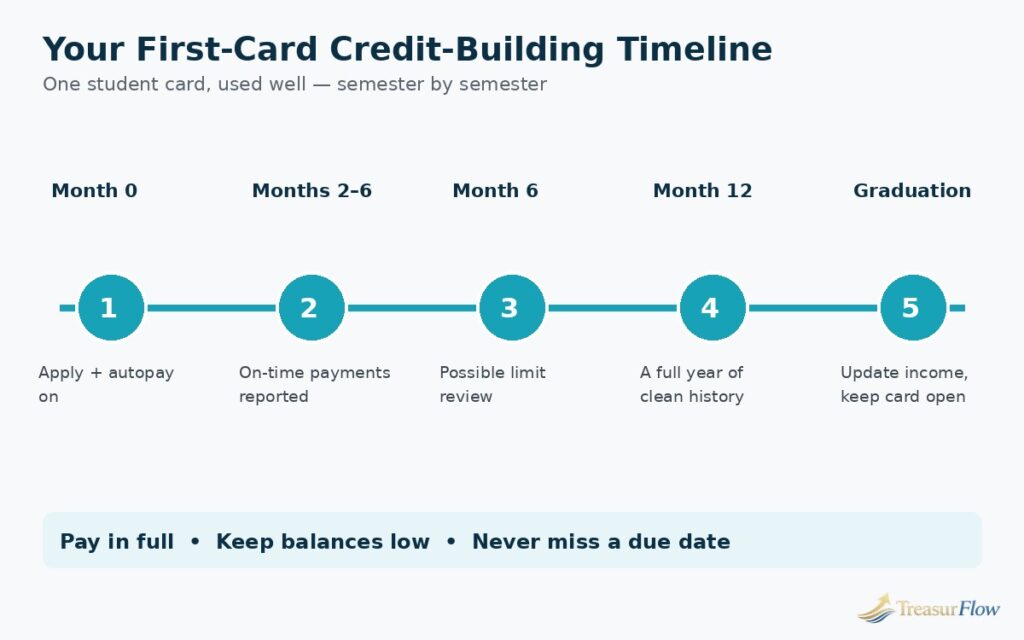
Months 0–1 — Set-up, not spending. You apply, get a decision, and receive a modest limit. Before the card arrives, set up the issuer’s app, turn on autopay for the full statement balance, and note the statement closing date and due date. Make one small planned purchase — a textbook, a transit pass — and stop. The goal this month is a reported on-time payment, not rewards.
Months 2–6 — The reporting rhythm. Each month the same small cycle repeats: charges post, the statement closes, the issuer reports your balance and payment status to the bureaus, and autopay clears the statement balance. After roughly six months of reported history, a FICO® Score can generally be generated for someone whose file was previously too thin to score — that is a general feature of how scoring works with a new file, not a promise about your number. Keep the statement balance low relative to the limit; on a $500 limit, even a $200 statement balance reports as 40% utilisation, so paying down before the statement closes, not just by the due date, keeps the reported number small.
Months 6–12 — The first review window. This is when the limit reviews described earlier can occur for eligible accounts, and when a year of clean history starts to make second products realistic. Resist opening several cards at once to celebrate; each application can add a hard inquiry, and a cluster of new accounts shortens your average account age right as it starts to help you.
Months 12–24 — A file that landlords and lenders recognise. With a year or more of on-time payments reporting to Equifax, Experian, and TransUnion, your file begins to do practical work: it supports applications for a first apartment, a better card, or eventually an auto loan on less punishing terms. Nothing dramatic happens at any single month; the value is the unbroken streak.
Graduation and after. Your income changes more than your credit needs at graduation. Update your income with the issuer, keep the no-annual-fee student card open for its age, and let the same autopay habit carry into your first salary. The students who come out ahead are not the ones who optimised cashback at 19; they are the ones whose reports show four quiet years of never missing.
How to Use the Card Without Letting It Use You
Four habits do almost all of the protective work, and none of them require willpower in the moment, because all four are set up in advance.
One card, one job. Put two or three predictable charges on the card — a streaming subscription, your phone bill, a weekly grocery run — and use a debit card or cash for variable social spending. Autopay the full statement balance, not the minimum; a minimum-payment habit on even a small balance is how a $400 textbook run becomes a year of interest at a variable APR in the high twenties. Keep reported utilisation low by paying before the statement closing date when a bigger purchase posts; what is reported is usually the statement balance, and low reported balances present a thinner-risk file. Treat the limit as a reporting tool, not a budget. Your real budget is the money in your bank account. If a purchase would not survive being bought with the debit card today, it does not belong on the credit card either. The credit card’s role in your first two years is evidence — evidence, filed monthly with three bureaus, that you borrow small and repay in full. Rewards are the by-product, not the purpose.
How We Chose These Cards
We compared student and first-card products available to U.S. applicants as of October 2026 and weighted, in order: no annual fee, because a first card should cost nothing to keep open; reporting to all three major bureaus, because a card that does not report cannot build a file; fit with a real campus budget — dining, groceries, online shopping, transit, and streaming — rather than travel or business categories students rarely use; transparency of rates and fees on the issuer’s own pages; and a realistic approval path for an applicant with limited or no history, including the under-21 income rules and the identification each issuer accepts. Every rate, reward, and offer figure in this guide is date-stamped October 2026 and drawn from the issuer’s published terms as of that date; figures change, and the issuer’s current page controls. We excluded cards that October 2026 sources report as paused to new applicants, cards whose main pitch is avoiding credit checks without clear bureau reporting, and any product that requires a deposit while marketing itself as an ordinary student card.
Student Card Questions, Answered Before You Apply
Can I get a student credit card with no income?
Usually not in your own name if you are under 21. Under the CARD Act ability-to-pay rule (12 CFR 1026.51), an issuer generally needs either your own independent income or assets, or a cosigner aged 21 or older with the ability to repay. Most of the major student cards in this guide do not offer a cosigner route, so a part-time job, paid internship, or regular income from your own work is the usual key. If you have no income yet, becoming an authorised user or starting with a secured card after you have income and a deposit are the realistic alternatives.
Can I get a student credit card at 17?
No. You must be at least 18 to open a credit card in your own name in the United States, and no student card overrides that rule. At 17, the route is to be added as an authorised user on a parent’s or guardian’s well-managed account, which can start your credit file depending on whether that issuer reports authorised-user activity to the bureaus.
Can international students get a credit card without an SSN?
Yes, through a narrow set of newcomer products. The Zolve Classic Credit Card is described in October 2026 sources as accepting applications with a passport, visa, or Form I-20, with no Social Security number, no U.S. credit history, and no security deposit required. Mainstream student cards generally require an SSN, and some accept an ITIN — confirm with the issuer. Note that the Deserve EDU card, long the best-known option here, is reported paused to new applications in October 2026, so it is not listed as an option in this guide.
Do student credit cards build credit as well as regular cards?
Yes, if they report to the credit bureaus — and the cards in this guide are from issuers that report to Equifax, Experian, and TransUnion. A payment history is a payment history; the “student” label describes who the card is for, not a lesser kind of reporting. What differs is the starting limit and the rewards structure, not the credit-building mechanism.
What credit limit will I get on my first student card?
The issuer sets the limit from your application, and first-card limits for thin-file students are commonly a few hundred dollars. Some issuers review accounts automatically after a period of on-time payments — Discover has described a review beginning at seven months for its student card, and Chase Freedom Rise® describes consideration after six months — check with the issuer for current terms. A low starting limit is normal and, early on, protective.
Is a secured card better than a student card for building credit?
Neither is inherently better; they fit different situations. A student unsecured card needs no deposit and often earns rewards, but generally requires enrolment, identification the issuer accepts, and — under 21 — independent income. A secured card works for a wider group, including non-students and rebuilders, at the cost of tying up a deposit. Both build credit when they report to all three bureaus and are paid on time; choose by eligibility and cash flow, not by which sounds more serious.
Conclusion: Pick the Card Your Budget Would Pick
The best student credit cards 2026 are not the ones with the loudest welcome offer; they are the ones that still make sense in month nine, when the semester is busy and the card has to run on autopilot. If your spending is dining and groceries, the Capital One Savor Student fits most campus budgets. If you will actually activate categories, the Discover it® Student Cash Back has the highest ceiling. If you want zero decisions, the Quicksilver Student’s flat 1.5% is the honest default. Bank of America suits a student with one dominant category, and the Chase Freedom Rise® opens the door to applicants — students or not — who bank with Chase but have no file yet.
Pick one, set autopay to the full statement balance before the card arrives, and let two quiet years of small, repaid balances do the work. And if the application questions raised here — how long a score takes, whether a deposit product fits better — are still open for you, the companion timeline on how long it takes to build credit from scratch is the right next read.

Muhammad Zakir is the founder of Treasurflow and the author of its personal finance guides. He researches consumer banking, credit, and personal loans, and every guide cites primary sources such as the CFPB, FDIC, FTC, and IRS. His content is educational and is not personalized financial advice.