
If your savings account is still paying almost nothing and your checking account still charges you for the privilege of keeping your own money in it, you are not stuck. The best online banks 2026 shoppers are switching to pay several times more interest than a typical branch account, charge no monthly maintenance fee on their main accounts, and let you do almost everything — open the account, deposit a check, move money, freeze a lost card, talk to support — from your phone.
This guide is built as a switch kit, not just a ranking. First, we answer who should actually switch and who should probably stay put. Then we organize our picks by the job you need the bank to do, because there is no single best bank for everyone. A rate chaser, a couple opening their first joint account, and a worker who needs their paycheck two days early do not need the same account. After the picks, we explain the trust question in plain language — how FDIC and NCUA insurance really work, and how a bank with no branches makes money at all. Then we compare online banks, traditional banks, and credit unions side by side, and finish with the exact step-by-step process for switching without missing a direct deposit or an autopay.
One promise on numbers: every rate and fee in this article is date-stamped “as of October 2026” and tied to a source we checked, such as the bank’s own site as reported in dated October 2026 roundups from Forbes Advisor, CNBC Select, Bankrate, and NerdWallet. Rates are variable and can change at any time, so always confirm the live rate on the bank’s site before you apply. Where we could not verify a figure, we left it out rather than guessing.
Related Guides
Helpful Official Resources
Who Should Switch to an Online Bank — and Who Should Not
You are a strong candidate to switch if most of your banking already happens on your phone. If you get paid by direct deposit, deposit checks with your camera, pay people with Zelle or a similar service, and cannot remember the last time you walked into a branch for something an app could not do, a branch is not a benefit to you anymore. It is a cost center you are funding through low interest and monthly fees.
You should also seriously consider switching if you keep a real cash cushion. The math is simple and it is not small. On a $10,000 balance, a savings account paying 3.10% APY earns about $310 in a year if the rate holds, and an account paying 4.20% APY earns about $420. A traditional savings account paying 0.01% APY, a rate still listed for a major bank’s standard savings account in October 2026 comparisons, earns about $1 on the same balance. Those are illustrations, not guarantees, because rates move — but they show why the gap matters more as your balance grows. If you keep $500 in savings, the difference is a few dollars and convenience should win. If you keep $15,000 or $25,000 for an emergency fund, a house deposit, or taxes, the difference is hundreds of dollars a year for the same insured money.
Switching also makes sense if monthly fees are quietly eating your account. A $12 monthly fee is $144 a year. Many of the online banks below charge $0 in monthly maintenance fees on their main checking and savings accounts as of October 2026, with no minimum balance to dodge the fee. If you have ever had to keep a minimum balance parked in a low-paying account just to avoid a fee, an online bank removes that trap.
There are honest reasons to stay, or to keep a traditional account open alongside a new online one. If you are paid in cash, run a cash-heavy side business, or need to deposit cash every week, a branch or a local credit union is still much easier. Some online banks accept cash through retail partners, sometimes for a fee, and some do not accept cash at all. If you regularly need a cashier’s check, a medallion signature guarantee, a safe deposit box, or in-person help with a complicated estate or business problem, keep a branch relationship. And if you are in the middle of a mortgage application or another major loan, do not close your main account until that process is finished — lenders like stability, and a mid-application bank switch creates paperwork you do not need.
Many people land in the middle, and that is fine. You do not have to move everything on day one. A common, low-risk pattern is to open an online savings account first, link it to your current checking, move only your emergency fund, and live with it for a month. If the app, transfers, and support work for you, move your direct deposit and your everyday spending next. The switch steps later in this guide work whether you move in one weekend or in stages.
Our Picks by Job: The Best Online Banks for 2026
We did not rank these banks 1 to 6 in a single list, because that hides the trade-offs. Instead, each pick below is the best tool for a specific job. Every pick is FDIC-insured in its own right, except where we clearly explain a fintech partnership model. Read the job headings, find yours, and start there.
Best Overall: Ally Bank
Ally Bank is the pick we would hand to most people who want one online bank to replace a traditional bank without giving anything important up. It offers checking (called a Spending Account), savings, money market, and CDs in one app, so you do not need three logins at three companies to run your everyday money.
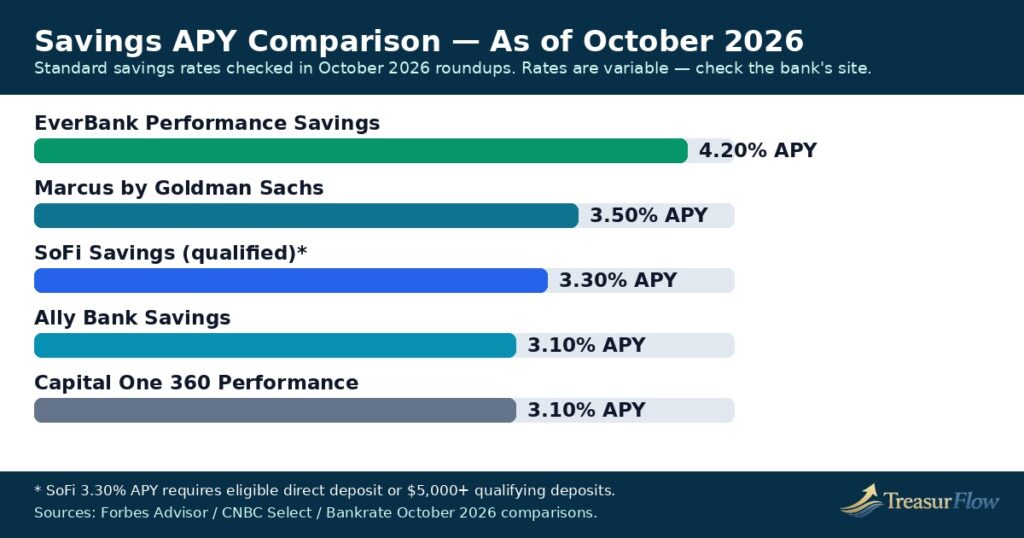
As of October 2026, Ally’s Savings Account paid 3.10% APY with $0 to open and no monthly fees, according to Ally.com rates reported on October 5, 2026 and October 8, 2026 in dated roundups. Its Spending Account paid 0.10% to 0.25% APY depending on balance, also with no monthly maintenance fee, as reported in early October 2026 comparisons. That savings rate is not the highest in this guide — EverBank below pays more — but Ally earns the overall spot on everything around the rate.
The standout feature is Buckets. Inside one savings account, you can create labeled buckets for separate goals — emergency fund, vacation, car repairs, taxes — and see each goal on its own without opening a new account for each one. Ally also offers round-ups and automated transfers from spending to savings. For people who know they should save but never quite get around to moving the money, that automation is worth more than a small rate difference.
Support is another reason Ally works as a main bank. Ally offers 24/7 phone support, which matters when a card is declined on a weekend or a transfer looks wrong at midnight. Cash is the main weakness, as it is for most online banks. Ally does not have branches, and cash deposit options are limited compared with a branch bank, so heavy cash users should read the trust and comparison sections below before committing. For everyone else, Ally is the balanced choice: a competitive rate, no monthly fee, strong tools, and a full set of accounts under one roof.
Best for Savings Rates: EverBank Performance Savings
If your main job for a new bank is simple — pay me the most interest on savings, without making me jump through hoops — EverBank’s Performance Savings was the strongest clean offer we verified for October 2026.
As of October 2026, EverBank Performance Savings paid 4.20% APY for new accounts, with $0 minimum to open and $0 monthly fee, and with no direct deposit requirement, according to the bank’s rate as shown on October 9, 2026 in Forbes Advisor and CNBC Select comparisons. That last point is the key difference from several rivals. Some banks advertise a rate above 4.00% APY that only lasts for a short promotional period, or only applies if you set up direct deposit, keep a large balance, or subscribe to a paid plan. EverBank’s 4.20% APY, as listed in October 2026, was the standard rate for new accounts without those conditions.
On $10,000, 4.20% APY is about $420 in a year if the rate stays the same, compared with about $310 at 3.10% APY. Rates are variable, so neither number is promised for a full year, but the starting gap is real.
The trade-off is scope. EverBank is a savings-led pick in this guide. If you want your highest savings rate and your everyday checking, debit card, and bill pay all in one place, Ally or SoFi below may fit better even at a lower savings rate. Many savers use EverBank the other way: keep everyday checking where it already works, and move only the cash cushion to EverBank to earn the higher rate. That two-bank setup is normal, it is insured at each bank separately, and it takes one linked transfer to set up. Check the bank’s site for the current rate and for any balance or new-account conditions before you open, because a rate this far above the big brands is exactly the kind of rate that can change.
For context, other strong no-strings savings rates we verified as of October 2026 included Synchrony Bank High Yield Savings at 3.55% APY and Marcus by Goldman Sachs Online Savings at 3.50% APY, both with $0 minimum and no monthly fees in October 10, 2026 comparisons. They pay less than EverBank, but some savers prefer a larger, long-established online bank for a big balance. All three are reasonable. Pick based on the rate you will actually earn, not the rate in a headline.
Best Checking: American Express Rewards Checking
Most checking accounts pay no interest at all, so a checking account that pays interest, charges no monthly fee, and gives you a huge fee-free ATM network stands out. That is American Express Rewards Checking.
As of October 2026, American Express Rewards Checking paid 1.00% APY with no monthly fee, according to NerdWallet’s October 2026 online checking roundup. NerdWallet also noted that American Express checking customers have access to more than 70,000 fee-free ATMs through the MoneyPass and Allpoint networks, and that customer service is available 24/7. American Express High Yield Savings separately paid 3.10% APY as of October 10, 2026, so you can keep checking and savings at the same institution if you want to.
There are two catches you need to know before you fall for the rate. First, eligibility. As reported by NerdWallet in October 2026, this checking account was only available to customers who had held an American Express credit card, high-yield savings account, or certificate of deposit for at least five days. If you are already an Amex cardholder, that is no barrier at all. If you are not, you would need to become an Amex customer first, which may not be worth doing just for a checking account. Second, overdraft handling. NerdWallet noted that American Express does not offer overdraft protection on this account in the usual linked-account sense; if you try to make a transaction without enough money in checking, the transaction will be declined. For disciplined spenders that is actually a feature — you cannot be charged for spending money you do not have — but if you rely on overdraft cover to smooth out the end of the month, read the account terms carefully.
If you do not qualify for Amex checking, the checking inside SoFi’s combined account below, paying 0.50% APY on checking as of September 23, 2026, is the next most complete interest-paying checking option in this guide.
Best No-Fee: Varo Bank
Varo Bank is our pick when the job is to stop paying bank fees, full stop. Varo is a chartered bank in its own right — Varo Bank, N.A., Member FDIC — not just an app layered on top of someone else’s bank, and its whole pitch is built around low-cost everyday banking.
As of October 2026, Varo charged $0 in monthly fees on its bank account, as listed in October 17, 2026 comparisons of Chime, Varo, and Current. Its savings account paid 3.75% APY on balances up to $5,000 in months when you meet its direct deposit condition, and 1.00% APY otherwise, according to Varo’s rate as listed as accurate as of July 1, 2026 and reported in October 2026 roundups. The condition reported in October 2026 was $1,000 or more in direct deposits in the month and ending the month with a positive balance — check the bank’s site, because the exact qualifying amount is the kind of detail that changes and that decides whether you earn the top rate or the base rate.
That savings structure tells you exactly who Varo is for. If you keep a small balance — a starter emergency fund, a buffer of a few thousand dollars — and your paycheck already lands in the account, 3.75% APY on up to $5,000 is a genuinely good return for money you would otherwise leave in checking earning nothing. If you keep $30,000 in savings, the $5,000 cap means most of your money earns the lower rate, and EverBank or Ally will likely pay you more in total. Do the math on your actual balance, not on the headline rate.
Varo also fits people rebuilding their banking history. If a past overdraft or a closed account has made it hard to open an account elsewhere, a no-monthly-fee online bank is often an easier place to start than a traditional bank with minimum-balance rules. We did not include any specific second-chance or no-ChexSystems claim for Varo in this article because we could not verify one from a dated October 2026 source — check the bank’s site for its current account-opening requirements.
Best for Joint Accounts: SoFi Checking and Savings
Sharing money is where a lot of online banks quietly fail. Some well-known apps do not offer joint accounts at all. SoFi does, and that, combined with a strong rate when you qualify, makes SoFi Checking and Savings our pick for couples and partners who want one shared account for bills, rent, and shared savings goals.
SoFi’s account is a combined checking and savings account from SoFi Bank, N.A., Member FDIC. As of October 2026, SoFi paid 3.30% APY on savings with an eligible direct deposit or $5,000 or more in qualifying deposits every 31 days, and 0.80% APY on savings without that qualifying activity, with checking paying 0.50% APY, according to SoFi’s rate as of September 23, 2026 reported by The Motley Fool and other October 2026 sources. There is no monthly account fee and no minimum balance to earn the rate, as reported in those same October 2026 sources.
New members also had a promotional offer as of October 2026: a 0.90% APY boost, taking savings to up to 4.20% APY for up to six months, plus a cash bonus described as $50 or $400, for new members who open a first SoFi Checking and Savings account and receive eligible direct deposits or qualifying deposits of $5,000 every 31 days by December 31, 2026, with terms applying at sofi.com. Treat that as a limited-time promotion, not as SoFi’s normal rate. The rate you will live with after the boost ends is the 3.30% APY qualified rate, so judge SoFi on that number.
For joint use, the practical benefits matter as much as the rate. Both account holders can access the shared money, savings can be organized into separate vaults for shared goals, and SoFi lists early access to direct deposit — typically up to two days early, depending on when the payroll file arrives — and access to 55,000 or more fee-free Allpoint ATMs, as reported in October 2026 comparisons. One warning for joint accounts anywhere, not just SoFi: a joint account normally gives each owner full access to the whole balance, including the right to withdraw all of it. Only open a joint account with someone you fully trust, and keep your own individual account as well. And note the FDIC detail in the next section: joint accounts are insured up to $250,000 per co-owner, which is why a couple can be insured for more at one bank than a single person can.
SoFi is also a reasonable standalone pick if you are not a couple. Just be honest about the direct deposit condition. If your paycheck will land at SoFi every month, the qualified rate is easy to keep. If it will not, you will earn 0.80% APY on savings, and Ally or Capital One-style no-condition accounts would pay you more. Check the bank’s site for current joint account rules before you open, because how a second owner is added can differ by bank.
Best for Early Direct Deposit: Chime
If getting paid sooner is the job — not the highest savings rate, not joint accounts, not a full suite of products — Chime is the name most people mean. Chime built its reputation on one promise: with direct deposit, you can get your paycheck up to two days early.
As of October 2026, Chime’s checking account had no monthly fee, no minimum opening deposit, and no minimum balance requirement, according to NerdWallet’s Chime review. NerdWallet also reported early direct deposit of up to two days, no foreign transaction fees from Chime itself, and a $2.50 fee per withdrawal at out-of-network ATMs. Chime’s own explanation, quoted by NerdWallet, is the honest version of every early-pay claim: early access depends on the timing of the payer’s payment file, and funds are generally made available on the day that file is received, which may be up to two days earlier than the scheduled payment date. No bank can promise two days early every payday, because no bank controls when your employer sends the file.
You need to understand what Chime is. Chime is a financial technology company, not a bank. Banking services are provided by The Bancorp Bank, N.A. or Stride Bank, N.A., Members FDIC, as Chime itself states. Your money is held at one of those partner banks, and FDIC insurance applies through that partnership when the requirements for pass-through coverage are met. That model is common and legitimate, but it is different from holding an account directly at a chartered bank, and it is one more reason to verify the partner bank on FDIC BankFind and to read Chime’s own disclosures.
Chime’s savings rates were tiered as of October 2026. October 17, 2026 comparisons listed Chime savings at 1.00% APY as the base rate, 3.00% APY with Chime Plus, and 4.00% APY with Chime Prime — check the bank’s site for what each tier requires, because tier names and conditions change and we are not going to guess at them here. Chime also offers SpotMe, a fee-free overdraft feature for eligible members, with coverage amounts that depend on your account and direct deposit history.
The deal-breaker to know up front: Chime does not offer joint accounts, as NerdWallet and BestMoney both noted in October 2026. If you need shared access, choose SoFi or Ally instead and accept that their early direct deposit, where offered, works the same employer-file way. If you bank alone, get paid by direct deposit, and want that pay as early as your employer’s file allows, with no monthly fee, Chime does that one job very well.
Can You Trust an Online Bank? Insurance, Explained Plainly
This is the section that decides whether the rates above are worth anything to you, so we will keep it exact.
FDIC insurance is federal deposit insurance for banks. If an FDIC-insured bank fails, the FDIC protects eligible deposits — checking, savings, money market deposit accounts, and CDs — up to $250,000 per depositor, per insured bank, per ownership category. That formula has three parts, and the third part is the one people get wrong. It is not $250,000 per account. If you have $150,000 in savings and $150,000 in checking, both in your name alone at the same bank, they are in the same ownership category, they are added together, and $250,000 is insured while $50,000 is not. On the other hand, a joint account is a different ownership category and is insured up to $250,000 per co-owner, so two co-owners can have $500,000 insured in a joint account at one bank. Retirement accounts and certain trust accounts have their own categories and rules. If you are anywhere near these limits, use the FDIC’s own tools and advice rather than a blog post, including this one.
Credit unions have the parallel system. Deposits at a federally insured credit union are insured by the National Credit Union Share Insurance Fund, administered by the NCUA, also up to $250,000 per share owner, per insured credit union, for each account ownership category. The structure is deliberately similar. Whether your money sits at a bank or a credit union, the question to ask is the same: is this institution federally insured, and how much of my money, in this ownership category, at this institution, is covered?
Insurance is automatic. You do not apply for it, you do not pay a separate premium for it, and you do not need to do anything when a bank fails to claim the insured portion. Banks pay for the FDIC fund through assessments. What you do need to do, once, is verify. Search for the bank in FDIC BankFind Suite on fdic.gov before you move serious money. For a credit union, use the NCUA’s credit union lookup on ncua.gov. For a fintech app that is not itself a bank, verify the partner bank it names in its disclosures — that partner is where your money is actually held. If a company cannot clearly tell you which insured bank or credit union holds your deposits, do not give it your deposits. That single check filters out almost every bad actor in this market.
Insurance covers a bank failure. It does not cover everything, and pretending otherwise would be dishonest. It does not cover investment products — stocks, bonds, mutual funds, crypto, or annuities — even if you bought them through your bank. It does not cover fraud where you were tricked into sending money yourself, although other consumer protection laws, including rules the CFPB enforces for electronic transfers, may help in some cases. And it does not stop an account from being frozen during a fraud investigation. Protect yourself the ordinary way: use a unique password, turn on two-factor authentication, turn on transaction alerts, never move money because a caller or a text told you to hurry, and contact your bank through the number or app you already trust, never through a link in an unexpected message.
So how does a bank with no branches make money, and why can it pay you more? A traditional bank spends heavily on rent, branch staff, and cash handling. An online bank skips most of that cost. It still earns money the way banks have always earned money: it lends deposits out as loans and credit cards at higher rates than it pays you, it earns interest on reserves and securities, and it collects interchange fees when you use your debit card, plus fees for specific services such as wires. Because its cost base is lower, it can afford to hand some of that saving back as a higher APY and no monthly fee, and still keep a margin. Higher rates at online banks are not a mystery and they are not, by themselves, a warning sign. The warning signs are different: no clear insured bank, pressure to move money fast, a rate with conditions buried in fine print, or a company that will not show you its fee schedule. Every bank in our picks publishes its rates and fees and names its insurer. Hold any bank you consider to that same standard.
Online Bank vs. Traditional Bank vs. Credit Union
| Feature | Online bank | Traditional bank | Credit union |
|---|---|---|---|
| Savings rates | Usually the highest, with several accounts above 3.00% APY as of October 2026 | Usually the lowest on standard savings, often well under 1.00% APY | Often in the middle, sometimes competitive on specific accounts |
| Monthly fees | Commonly $0 on main checking and savings accounts | Common, often waived only with a minimum balance or direct deposit | Often low, varies widely by credit union |
| Branches | None, or very few | Large branch network | Smaller local network, often with shared branching |
| Cash deposits | Limited; retail partners or partner ATMs, sometimes for a fee | Easy at any branch or own ATM | Easy at own locations, varies elsewhere |
| ATM access | Large fee-free partner networks such as Allpoint or MoneyPass | Large own network, fees outside it | Varies; many join shared ATM networks |
| Insurance | FDIC, up to $250,000 per depositor, per bank, per ownership category | FDIC, same limits | NCUA share insurance, up to $250,000 per share owner, per credit union, per ownership category |
| Who can join | Anyone who meets account-opening and identity checks | Anyone who meets account-opening and identity checks | Members only; you must meet the credit union’s field of membership |
| Support | Phone, chat, and in-app, often 24/7 at larger online banks | In person, phone, and app | In person locally, phone, and app |
| Best for | Rate, low fees, and phone-first banking | Cash, complex in-person services, and one national branch network | Local service, community lending, and members in its field |
Read that table as trade-offs, not as a winner. A credit union you qualify for can beat an online bank on a car loan and still pay less on savings. A traditional bank can be the right home for a business that deposits cash daily and the wrong home for an emergency fund that sits untouched for a year. Plenty of households use two of the three on purpose: a local account for cash and in-person needs, and an online account for savings and everyday low-fee spending. There is no rule that loyalty to one institution pays. On deposits, it usually costs.
How to Switch Banks: A Step-by-Step Switch Kit
Switching fails when people close the old account first and then discover a forgotten autopay. Do it in this order instead. The whole process takes about an hour of active work, spread over a few weeks of waiting.
Step 1: List everything that touches your old account. Open your last two or three statements and write down every direct deposit, every autopay, every subscription, every linked app, and every annual payment. Annual and quarterly charges are the ones people miss — insurance, software, memberships, tax payments. Check for paper checks you have written that have not cleared yet. This list is your switch checklist. Do not skip it.
Step 2: Open the new account before you move anything. Apply online with your ID and Social Security number, complete identity verification, and fund it with a small test deposit from your old account. Confirm the new account number and routing number from inside the new bank’s app or site — never from an email that claims to be from the bank. Set up the app, your password, two-factor authentication, alerts, and your debit card PIN. Make one small purchase and one ATM withdrawal if you can, so you know the card works before your paycheck depends on it.
Step 3: Move your direct deposit. Give your employer’s payroll department, or your benefits, pension, or Social Security payment provider, the new routing and account numbers. Many employers let you split a deposit, which is a useful bridge: send most of your pay to the new account and a small amount to the old one for one cycle, so the old account never hits zero while stragglers clear. Ask payroll when the change takes effect. One pay cycle is typical, but confirm it rather than assuming it.
Step 4: Move your money, but leave a cushion. Transfer most of your balance to the new account, and leave enough in the old account to cover every pending check, autopay that has not moved yet, and a safety margin for something you forgot. Transfers between banks commonly take one to three business days, so do not schedule a large transfer the day before a large bill is due from that account.
Step 5: Move every autopay and linked payment, one by one. Work down your Step 1 list. For each biller, log in to the biller’s own site — your utility, card, loan, insurer, streaming service, gym — and change the payment account there. Changing it only inside your old bank’s bill pay does not move a payment the biller pulls itself. Tick each one off, and note the first date it will pull from the new account. Update payment details stored in shopping, ride, food, and wallet apps too.
Step 6: Redirect incoming money beyond your paycheck. Move tax refund direct deposit details when you next file, payment apps that deposit into your bank, marketplace and freelance payouts, and any person who regularly sends you money by bank transfer. If you receive government benefits or a pension, use that provider’s own process and allow extra time, because those changes can take a full cycle or longer.
Step 7: Watch both accounts for one full cycle. For at least 30 days, and ideally 30 to 60 days, check the old account weekly. You are looking for anything you missed: a forgotten subscription, an annual charge, a check finally clearing. If something hits the old account, move that payment, top up the cushion if you need to, and reset your waiting period. Silence for a full cycle is your signal that the move is complete.
Step 8: Close the old account properly and keep proof. Once the old account has been quiet for a full cycle and its balance is at or near zero, close it through the bank’s official process and ask for written confirmation that the account is closed with a zero balance. Keep that confirmation, and keep statements for your records. An account left open and forgotten can collect fees, go negative on a stray charge, and create a problem in a database like ChexSystems that makes your next account harder to open. A clean, documented close is the last step of a good switch, not an optional extra.
Two final safety rules for the whole process. First, never close an account with pending transactions; a payment that hits a closed account can be returned unpaid, and the biller, not the bank, may charge you for that. Second, if a bonus or a promotional rate is part of why you chose the new bank, read its exact conditions — the deposit amount, the deadline, and how long the money must stay — and put those dates in your calendar on the day you open the account. Promotions are only worth having if you actually qualify for them.
Online Banking Questions, Answered Straight
Are online banks safe to use?
Yes, if the bank is FDIC-insured. Check the bank on FDIC BankFind before you open an account, turn on two-factor authentication and alerts, and your eligible deposits are insured up to $250,000 per depositor, per insured bank, per ownership category.
How is an online bank different from a traditional bank’s app?
A traditional bank runs branches and also offers an app. An online bank is built around the app and website, with no branch network to pay for, so it usually spends that saving on higher savings rates and lower fees instead.
Can I deposit cash and checks at an online bank?
Checks are usually easy, with mobile check deposit in the app. Cash is harder. Some online banks let you add cash at retail stores or partner ATMs, sometimes for a fee, while others do not accept cash at all, so check the bank’s site before you switch.
Will switching banks hurt my credit score?
Opening a checking or savings account does not normally hurt your credit score. Most banks do not do a hard credit pull for a deposit account, though some may check ChexSystems, a database of past bank account problems.
How long should I keep my old account open when I switch?
Keep your old account open for at least one full pay cycle, and ideally 30 to 60 days, until every direct deposit, autopay and pending payment has moved. Then close it in writing and keep the confirmation.
What happens if an online bank fails?
If an FDIC-insured bank fails, the FDIC protects eligible deposits up to the insurance limit and usually arranges for you to get your insured money or move it to another bank. No depositor has lost insured funds since the FDIC was created in 1933.
Conclusion: Pick the Bank That Fits the Job, Then Switch Carefully
There is no trophy for finding the single highest rate if the account makes your daily life harder. The best online banks 2026 has to offer split cleanly by job. Ally is the balanced all-rounder most people can move to and stop thinking about. EverBank pays the strongest clean savings rate we verified for October 2026 if you are willing to keep savings separate. American Express pays real interest on checking if you already qualify. Varo strips fees away for smaller balances. SoFi gives couples a genuine joint account with a strong qualified rate. Chime gets direct deposit to you as early as your employer’s file allows.
Whichever you choose, do the two things that actually protect you. Verify the insurance yourself on FDIC BankFind or the NCUA lookup, using the official resources at the top of this guide. And switch in the right order — list, open, direct deposit, cushion, autopays, watch, close — so nothing you owe goes unpaid in the middle. Do those two things, and an online bank stops being a leap of faith. It becomes what it should have been all along: the same insured money you already had, finally paying you a fair rate for keeping it there, with no monthly fee for the privilege.
Rates and offers in this article were checked as of October 2026 and are variable and subject to change. Confirm current rates, fees, and eligibility on the bank’s own site before opening any account. This article is general information, not personal financial advice.

Muhammad Zakir is the founder of Treasurflow and the author of its personal finance guides. He researches consumer banking, credit, and personal loans, and every guide cites primary sources such as the CFPB, FDIC, FTC, and IRS. His content is educational and is not personalized financial advice.