
If you served in the U.S. military, the VA home loan is very likely the most valuable financial benefit you will ever be offered — and also one of the most misunderstood. Every year, eligible veterans walk into conventional or FHA loans simply because nobody explained how the VA program actually works, and they leave thousands of dollars on the table in down payments and monthly mortgage insurance they never needed to pay.
This guide to the best VA loans 2026 takes a different approach from most lender roundups. Instead of jumping straight to a list of companies, we start where your loan actually starts: with eligibility. Before any lender can quote you a rate, the Department of Veterans Affairs has to confirm that you qualify, tell the lender how much entitlement you have available, and show whether you owe the VA funding fee or are exempt from it. Get those three things right first, and choosing a lender afterward becomes a simple comparison of price and service instead of a leap of faith.
Here is what a VA loan offers when you qualify: no down payment in most cases, no monthly private mortgage insurance (PMI) ever, competitive interest rates set by private lenders, limits on the closing costs a lender can charge you, and the ability to use the benefit again and again over your lifetime. The benefit does not expire when you leave service, and in many cases it can be restored and reused for your next home. Eligible borrowers include veterans, active-duty service members, members of the National Guard and Reserves who meet the service rules, and certain surviving spouses.
In the sections below, you will find a plain-English walkthrough of the Certificate of Eligibility (COE), a worked example that shows exactly how entitlement math plays out on a $500,000 home, the current VA funding fee table sourced from VA.gov, our lender picks organized by borrower type, a side-by-side VA vs. FHA vs. conventional comparison, and answers to the questions veterans ask most often before applying. Rates and fees charged by individual lenders change frequently, so where this guide mentions lender-specific terms, they are dated as of October 2026 — always confirm your figures on the Loan Estimate your lender is required to give you.
Related Guides
Helpful Official Resources
Who VA Loans Are For — and What the VA Actually Does
The first thing to understand is that the VA does not lend you money. VA loans are made by private lenders — banks, credit unions, and mortgage companies — and the VA guarantees a portion of each loan. That guaranty is the engine behind everything borrowers love about the program: because the government absorbs part of the lender’s risk if a borrower defaults, lenders can offer $0 down payment and skip monthly mortgage insurance without taking on the full loss themselves.
To use the program, you generally must fall into one of these groups, per VA.gov: you are a veteran, an active-duty service member, a current or former member of the National Guard or Reserves, or an eligible surviving spouse. Beyond group membership, you also have to meet the service-length requirements described in the next section, and both you and the property must satisfy the lender. The VA requires that you meet its credit and income standards and that the home pass a VA appraisal and meet the VA’s Minimum Property Requirements (MPRs), which are basic standards for safety, soundness, and sanitation.
One boundary is worth knowing up front: a VA loan can only be used for a home you will live in as your primary residence. It cannot be used for a pure investment property or a vacation home you do not occupy, although — as the entitlement section explains — you can sometimes keep a previous VA-financed home as a rental when you buy your next one, as long as entitlement math allows it.
Step One: Eligibility and Your Certificate of Eligibility (COE)
Your Certificate of Eligibility is exactly what it sounds like: the VA’s official confirmation that you have earned the home loan benefit and are eligible to use it. It also does two jobs most borrowers never hear about. First, it states how much entitlement you have available, which drives the math in the next section. Second, it shows whether you are exempt from the VA funding fee — a line item worth thousands of dollars. No VA loan can close without a COE, so treat getting yours as step one, not paperwork for later.
The service requirements, by group
Eligibility starts with service. The minimum service requirements below are summarized from VA.gov’s COE instructions; your lender or the VA can confirm which category fits your record.
- Wartime service, World War II era (September 16, 1940 – July 25, 1947): at least 90 days of active duty, unless you were discharged sooner for a service-connected disability.
- Post–World War II era (July 26, 1947 – June 26, 1950): at least 181 days of continuous active duty, with the same service-connected disability exception.
- Korean War era (June 27, 1950 – January 31, 1955): at least 90 days of active duty.
- Post–Korean War era (February 1, 1955 – August 4, 1964): at least 181 days of active duty.
- Vietnam War era (August 5, 1964 – May 7, 1975), or February 28, 1961 – May 7, 1975 if you served in the Republic of Vietnam: at least 90 days of active duty.
- Post-Vietnam era (May 8, 1975 – September 7, 1980 for enlisted members and October 16, 1981 for officers): at least 181 days of continuous active duty — and if you separated before completing 24 months or the full period you were called to serve, VA.gov advises checking the full eligibility rules, because some shorter-service veterans still qualify.
Members of the National Guard and Reserves qualify under their own rules: as a general guide, six years of service in the Selected Reserve or National Guard combined with an honorable discharge, placement on the retired list, transfer to the Standby Reserve or Ready Reserve after honorable service, or continued service — or 90 days of active-duty service under Title 32 orders (with at least 30 of those days consecutive) for service on or after July 28, 2020. Surviving spouses can also qualify: an unremarried spouse of a veteran who died in service or from a service-connected disability, a spouse of a service member missing in action or a prisoner of war, and certain remarried spouses may be eligible — and spouses receiving Dependency and Indemnity Compensation (DIC) benefits are typically exempt from the funding fee as well. If you were discharged for a service-connected disability, hardship, or certain other reasons, shorter service often still qualifies; when in doubt, apply — the VA decides eligibility, not the lender, and not a blog post.
How to get your COE: three routes
There are three ways to request your COE, according to VA.gov:
- Through your lender (usually the fastest). Most VA-approved lenders can pull your COE electronically through the VA’s Web LGY system, often in minutes, once you have chosen a lender and started an application.
- Online at VA.gov. Sign in to VA.gov and follow the prompts on the COE request page linked in the resources box above. This is the natural DIY route if you want your COE in hand before you talk to any lender — a good idea if you suspect an entitlement or exemption question.
- By mail. Complete VA Form 26-1880, Request for a Certificate of Eligibility, and mail it to the address shown on the form for your state, together with the required discharge documents. Mail is the slowest route, so plan ahead if you use it.
The documents you will need
Which documents you need depends on your service type. VA.gov’s list, in brief:
- Veterans: your DD214, Certificate of Release or Discharge from Active Duty. The VA wants the member-4 copy (or an equivalent copy) showing your character of service and the reason for separation.
- Current service members: a signed statement of service from your commander, adjutant, or personnel officer showing your full name, Social Security number, date of birth, entry date on active duty, the total time lost, and — if you are in the Guard or Reserves — that you remain a member.
- Current Guard or Reserve members who were never activated: your NGB Form 22 (Report of Separation and Record of Service) for each period of National Guard service, or your NGB Form 23 (Retirement Points Accounting) plus proof of the character of your service.
- Discharged Guard or Reserve members who were never activated: your most recent annual retirement points summary (NGB Form 23 or an equivalent) together with your discharge paperwork showing the character of service and the reason for separation.
- Surviving spouses receiving DIC benefits: VA Form 26-1817, Request for Determination of Loan Guaranty Eligibility — Unmarried Surviving Spouses, plus the veteran’s DD214 if available. Surviving spouses not receiving DIC benefits should first apply for DIC using VA Form 21P-534EZ, and the VA reviews loan eligibility alongside that application.
A practical tip: if your lender pulls the COE electronically, the VA’s records often match automatically and no documents are needed at all. Documents matter most when the VA’s database does not show your service — common with older separations, name changes, and some Guard and Reserve records. Keep your DD214 in a safe place and scan it now; discovering it is missing the week you find a house is a stress you do not need.
Entitlement Explained — With a Worked Example
Entitlement is the dollar amount the VA pledges to repay a lender if a VA loan goes into default — in effect, the VA’s insurance stake in your mortgage. It is also the key that unlocks the $0-down benefit: because the VA’s entitlement backstops a meaningful share of the loan, lenders accept little or no down payment. Your COE states your entitlement status, and lenders read it before they quote you anything.
Since January 1, 2020, under the Blue Water Navy Vietnam Veterans Act of 2019, the picture has two versions. Borrowers with full entitlement face no VA loan limit at all. Borrowers with partial entitlement — usually because they already have a VA loan outstanding or lost one to foreclosure or short sale without restoring it — are back under county loan limits, and the entitlement math decides whether they need a down payment.
Full entitlement: no VA loan limit
You have full entitlement if you have never used the benefit, or if your entitlement from a previous VA loan has been fully restored. In that case, VA.gov is unambiguous: there is no limit on the amount you can borrow, and you can put $0 down on any loan amount a lender approves — VA guidance is equally clear that lenders can add their own rules on very large loans, so expect extra scrutiny on credit, income, and reserves as prices climb. The VA also reminds borrowers of a detail nearly every roundup misses: even with full entitlement and no VA limit, if the home’s appraised value comes in below the purchase price, you may need to pay the difference in cash at closing, because the VA cannot guarantee a loan above the home’s reasonable value.
Worked example 1: full entitlement on a $500,000 home (illustrative)
The figures in both worked examples are illustrative. They show how the VA’s entitlement math works; they are not a quote, a pre-approval, or a promise of terms.
- Home price: $500,000
- Borrower status: first-time VA buyer with full entitlement
- VA loan limit: none — so there is no limit-based down payment calculation at all
- Down payment required by the VA: $0 (a down payment is voluntary)
- What you still owe at closing: the VA funding fee (covered in the next section — and it can usually be financed into the loan), plus ordinary closing costs and prepaid items, subject to the VA’s limits on lender charges
Partial entitlement: when the county limit comes back
If some of your entitlement is tied up in a VA loan you still have — say you kept your first VA home as a rental and now want to buy a primary residence in a new city — your remaining entitlement is what matters, and county loan limits apply again. The county limits for partial-entitlement borrowers are the same FHFA conforming loan limits used across the mortgage industry. VA.gov publishes a county loan limits tool, and because limits vary by county and change over time, always check the current figure for the county where you are buying rather than relying on a number printed anywhere — including here.
The mechanics, per VA.gov: if you have partial entitlement, the VA guarantees the lesser of 25% of the loan amount or 25% of the county loan limit minus the entitlement you have already used. When that remaining guaranty does not cover enough of the new loan, lenders typically ask for a down payment that makes up the difference — usually enough so that your cash plus the VA guaranty together equal 25% of the purchase price. That is the entire logic; the worked example below runs the numbers end to end.
Worked example 2: partial entitlement on a $500,000 home (illustrative)
- County loan limit (illustrative): $800,000
- Entitlement already used on a prior VA loan you still hold: $100,000
- Maximum guaranty available: 25% × $800,000 (county limit) − $100,000 (entitlement used) = $200,000 − $100,000 = $100,000
- New home price: $500,000; loan amount at $0 down: $500,000
- Check the guaranty against the loan: 25% of the $500,000 loan would be $125,000, but only $100,000 of entitlement remains — a $25,000 shortfall
- Down payment: $25,000, bringing the loan down to $475,000. Your $25,000 cash plus the VA’s $100,000 guaranty now total $125,000 — exactly 25% of the $500,000 price, so the lender’s coverage test is satisfied. That $25,000 works out to 5% down, and it is the entire down payment the situation requires.
The takeaway for every borrower: with full entitlement there is no calculation to do. With partial entitlement, two numbers — your county limit and the entitlement amount shown as used on your COE — decide whether you pay $0 down or some modest amount, and a good VA loan officer can run your exact figures in minutes. What you should never do is assume you are out of options; veterans buy second homes with partial entitlement every day.
Restoring entitlement you have already used
Used entitlement is not gone forever. VA.gov lists three ways it comes back: you sell the home bought with the earlier loan and pay that loan off in full; an eligible veteran buyer assumes your remaining loan and substitutes their own entitlement for yours (in which case your entitlement is restored and theirs is used instead); or you use the one-time restoration option — available if you have repaid your earlier VA loan in full but kept the home, with the important limit that once you use that one-time restoration, you must sell or otherwise dispose of every home bought with a VA loan before you can use the benefit again. Restoration is not automatic: you request it when you apply for a new COE, and your lender can file the paperwork with you. If you lost a VA home to foreclosure or a short sale in the past, ask about your status early, because the VA may require the government’s loss to be repaid before entitlement is restored.
The VA Funding Fee: What It Costs and Who Pays Nothing
The funding fee is the VA loan’s only built-in cost of the program itself, and understanding it is the fastest way to avoid nasty surprises. It is a one-time charge, expressed as a percentage of your loan amount and paid to the VA; VA.gov explains that it helps lower the cost of the loan program for taxpayers, since VA loans require little or no down payment and no monthly mortgage insurance. Unless you pay it in cash at closing, the fee is normally financed — rolled into your loan balance — which is why two borrowers with identical home prices can end up with slightly different loan amounts.
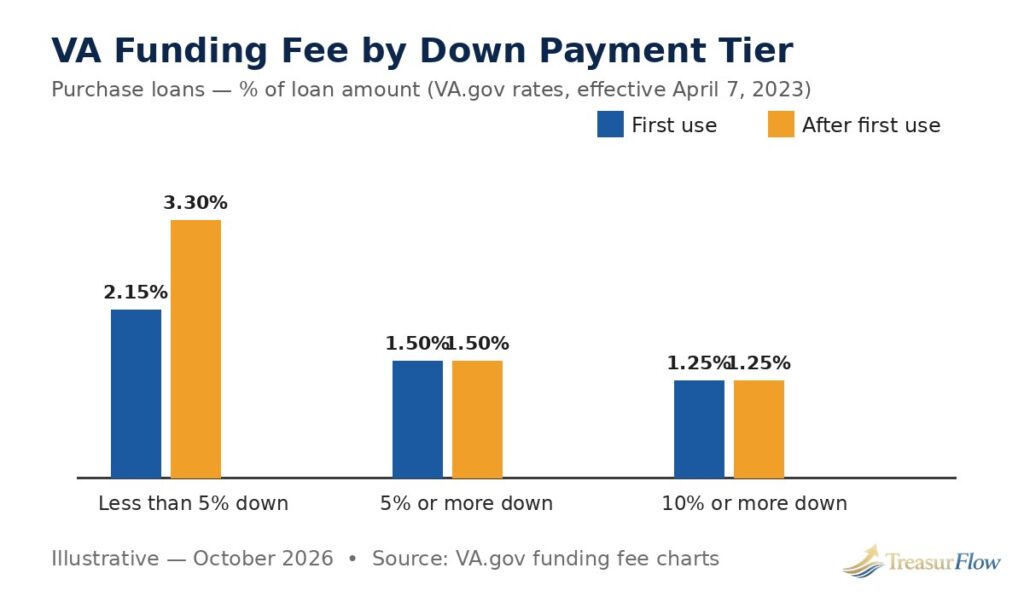
Your exact fee depends on three things: the type of loan, whether this is your first use of the benefit or a later one, and the size of your down payment. The current table from VA.gov’s lender resources — which VA.gov states applies to all loan types except IRRRLs, loan assumptions, and certain specially adapted housing grants — is:
VA funding fee table — purchase and construction loans (VA.gov)
| Down payment | First use | After first use |
|---|---|---|
| Less than 5% | 2.15% | 3.30% |
| 5% or more | 1.50% | 1.50% |
| 10% or more | 1.25% | 1.25% |
VA funding fee table — other loan types (VA.gov)
| Other loan types | Funding fee |
|---|---|
| Cash-out refinance — first use | 2.15% |
| Cash-out refinance — after first use | 3.30% |
| IRRRL (Interest Rate Reduction Refinance Loan) | 0.50% |
| Loan assumption | 0.50% |
| Manufactured home loan | 1.00% |
| Native American Direct Loan (NADL) — purchase | 1.25% |
| NADL — refinance | 0.50% |
| Vendee loan | 2.25% |
On a $400,000 loan with less than 5% down, a first-time user owes a funding fee of 2.15% × $400,000 = $8,600. Financed into the loan, that makes the starting balance $408,600 rather than $400,000 — real money, but a fraction of the $14,000–$60,000 a conventional borrower might need for a 3%–20% down payment, after which PMI would still apply until enough equity builds. One more VA.gov note: if your only prior VA loan was for a manufactured home, you still pay the first-time funding fee on your next purchase.
Who is exempt from the funding fee
A large share of VA borrowers legally pay no funding fee at all. According to VA.gov, you will not have to pay the VA funding fee if any of the following is true for you:
- You are receiving VA compensation for a service-connected disability.
- You are eligible to receive VA compensation for a service-connected disability, but you are receiving retirement or active-duty pay instead.
- You are receiving Dependency and Indemnity Compensation (DIC) as the surviving spouse of a veteran.
- You are a service member who received a proposed or memorandum rating before the loan closing date showing you are eligible for compensation because of a pre-discharge claim.
- You are an active-duty member of the Armed Forces and, on or before your loan closing date, you provide evidence that you received a Purple Heart.
Note what the exemption does not require: there is no minimum disability percentage in the VA.gov list — receiving compensation for a service-connected disability is what matters. If you are later awarded VA compensation with an effective date retroactive to before your loan closing date, you may be eligible for a refund of a funding fee you already paid; VA.gov directs borrowers who believe they qualify for a refund to contact their VA regional loan center. Check the funding fee status line on your COE before closing, and raise any error with your lender immediately — fixing an exemption before closing is far simpler than chasing a refund after it.
A few related cost rules from VA.gov round out the picture. The seller can pay some or all of your closing costs, and while the VA does not cap credits toward normal closing costs, seller concessions are limited to 4% of the home’s reasonable value as shown on the VA Notice of Value. On a purchase loan, the funding fee is the only charge you may finance into the loan — other closing costs are due at closing. Your lender also sets your interest rate, discount points, and its own closing fees, which is exactly why comparing lenders matters, and why the next section exists.
Best VA Lenders in 2026, Organized by Borrower Type
Here is the honest truth about VA lender rankings: the VA does not set your interest rate. Your lender does. Two lenders can approve the same veteran, on the same day, for the same home, and quote meaningfully different rates and fees — which is why the Consumer Financial Protection Bureau consistently advises mortgage shoppers to get multiple quotes. The VA also sets no minimum credit score; every minimum you will see below is a lender’s own overlay, reported in lender roundups as of October 2026, and each lender’s terms can change. Treat this section as a shortlist for quotes, not a verdict, and compare Loan Estimates line by line before you commit.
Best overall: Veterans United Home Loans
Veterans United is the largest VA purchase lender in the country by volume and the name that appears at or near the top of most October 2026 roundups, including Money’s review of more than 30 VA lenders, which named it best overall. The case for it is specialization: VA loans are its core business rather than one product among dozens, so its loan officers handle COEs, entitlement questions, and funding fee exemptions every day. Reported minimum credit score for VA loans is around 620 as of October 2026 (source: lender roundups, October 2026). If you want a VA-focused lender with deep experience in exactly your situation — first purchase, PCS move, or buying with partial entitlement — start your quote list here.
Best for refinancing and IRRRL: Rocket Mortgage and Freedom Mortgage
For a streamline refinance, speed and process matter most, because an Interest Rate Reduction Refinance Loan (IRRRL) is deliberately simple: it refinances an existing VA loan into a lower rate, generally with reduced documentation, and carries a funding fee of just 0.50% (VA.gov) — $1,500 on a $300,000 refinance, and $0 if you are funding-fee exempt. Rocket Mortgage, named best for refinancing in Money’s October 2026 roundup, built its reputation on a fast, fully digital process and reports a VA minimum credit score around 580 as of October 2026. Freedom Mortgage is another refinance heavyweight with a large VA servicing book — meaning it may proactively contact its own borrowers when an IRRRL makes sense — and roundups report it can work with credit scores as low as about 550 in some cases as of October 2026. Two VA rules protect you here: an IRRRL must produce a real benefit (for a fixed-to-fixed refinance, the new rate generally must be at least 0.50 percentage points lower), you must have made at least six monthly payments and be at least 210 days past your first payment due date, and the refinance costs must be recoupable within 36 months. If a refinance offer fails those tests, walk away.
Best online experience: Pennymac
Pennymac was named best online lender in Money’s October 2026 review and is one of the largest mortgage servicers in the country, which matters after closing: the company that services your loan is the one you will actually deal with for years. Its online application and rate tools suit borrowers who prefer to run the process digitally and compare numbers at their own pace rather than sit in a branch. As with every lender here, get its Loan Estimate and compare the rate, origination charges, and lender credits against at least two competitors on the same day.
Best for low credit: New American Funding and Freedom Mortgage
Because the VA sets no minimum credit score, the right lender for a thin or damaged credit file is the one whose overlays are the most flexible — and whose underwriters will look at the whole file, including residual income and compensating factors. New American Funding was named best for low credit borrowers in Money’s October 2026 roundup, with a reported VA minimum around 580 as of October 2026, and it is known for manual underwriting on files an automated system might reject. Freedom Mortgage, noted above, is the other name to quote if your score sits in the 500s. Be realistic about the trade-off: a lower credit score usually means a higher rate, so ask each lender what your payment would look like now versus after six months of credit repair — sometimes waiting is the cheapest move.
Best credit union options: Navy Federal and PenFed
If you prefer a member-owned institution, two credit unions anchor most 2026 VA lender lists. Navy Federal Credit Union, the largest credit union in the country, was NerdWallet’s 2026 winner for VA loans and is repeatedly cited for low APRs; eligibility requires membership, which is open to service members, veterans, and qualifying family and household members. PenFed Credit Union is open to anyone who joins, and roundups as of October 2026 report a flat $995 origination fee on VA purchase loans — a refreshingly simple fee structure, though you should still compare its rate against fee-free offers, because a lower fee paired with a higher rate can cost more over time. Credit unions sometimes move more slowly than national online lenders, so if your purchase contract has a tight closing deadline, ask about current VA closing timelines up front.
How to compare VA lenders in 30 minutes
Whichever names you shortlist, run the same comparison: (1) request Loan Estimates from at least three lenders within the same few days so rate quotes are comparable; (2) compare the APR and the lender fees section, not just the headline rate; (3) confirm your COE, entitlement, and funding fee exemption are recorded correctly on each estimate; (4) ask about origination fees and lender credits in writing; and (5) ask who will service the loan after closing. The CFPB’s mortgage shopping guidance makes the same point the VA does: the lender, not the government, sets most of your costs — so shopping is where your savings live.
VA vs. FHA vs. Conventional: A Side-by-Side Comparison
Plenty of veterans qualify for all three loan types, and a few situations genuinely favor FHA or conventional financing — for example, a conventional loan if you plan to put 20% down and want to avoid the VA funding fee, or an FHA loan if a lender’s VA overlays are stricter than FHA’s on your particular file. For most eligible borrowers buying a primary home with little money down, though, the VA loan wins on monthly cost because it is the only one of the three with no monthly mortgage insurance. Here is how they compare on the features borrowers ask about most:
| Feature | VA loan | FHA loan | Conventional loan |
|---|---|---|---|
| Who can use it | Eligible veterans, service members, Guard and Reserve members, and certain surviving spouses | Any qualified borrower | Any qualified borrower |
| Minimum down payment | 0% for most borrowers with sufficient entitlement | 3.5% with a credit score of 580 or higher; 10% with a score of 500–579 | As low as 3% on some programs; 20% avoids PMI |
| Upfront insurance or fee | VA funding fee of 1.25%–3.30% on purchases (0% for exempt borrowers) | Upfront mortgage insurance premium (UFMIP) of 1.75% | None |
| Monthly mortgage insurance | None — no PMI or MIP at any down payment | Annual MIP (commonly 0.55% for most 30-year borrowers), typically for the life of the loan when putting less than 10% down | PMI required with less than 20% down; can be cancelled once you reach 20% equity |
| Minimum credit score | No VA minimum; lender overlays commonly 580–620 | 500 with 10% down; 580 with 3.5% down | Commonly 620 |
| Loan limits | No limit with full entitlement; county limits apply with partial entitlement | County-based FHA limits | Conforming limit of $832,750 in most counties for 2026 (FHFA); higher amounts are jumbo loans |
| Occupancy | Primary residence only | Primary residence only | Primary residence, second home, or investment property |
| Assumable | Yes, with VA approval | Yes, with lender approval | Generally no |
| Seller concessions | Concessions capped at 4% of the home’s reasonable value, plus normal closing costs | Up to 6% of the purchase price | Varies by down payment, commonly 3%–9% |
Run the monthly math before you decide. On an FHA loan, the annual MIP is charged every month for years — and with less than 10% down it generally lasts the full loan term unless you refinance. On a conventional loan with 5% down, PMI adds a monthly charge until you build 20% equity. On a VA loan, the funding fee is one charge, paid once (or financed), and for exempt veterans it disappears entirely. That structural difference — one-time fee versus monthly insurance — is why the VA benefit is so hard to beat for borrowers who plan to stay in the home.
One more consideration: property standards. All three programs require the home to be safe and sound, but VA appraisals apply the VA’s Minimum Property Requirements, and some sellers in hot markets wrongly perceive VA offers as slower or stricter. A good listing-agent conversation — or a lender who closes VA loans on time — usually resolves that concern, and it should never push an eligible veteran into a more expensive loan by default.
How to Apply for a VA Loan: The Process From COE to Keys
With the pieces above in place, the application itself is straightforward. First, confirm your eligibility and get your COE — through your lender, online at VA.gov, or by mail with VA Form 26-1880. Second, choose your lender by comparing Loan Estimates from at least three VA-approved lenders, checking the rate, lender fees, funding fee treatment, and closing timeline. Third, get pre-approved: your lender will verify your income, debts, assets, and credit, and confirm your entitlement, so sellers take your offer seriously. Fourth, find your home and sign a purchase contract, keeping the primary-residence rule in mind. Fifth, your lender orders a VA appraisal; a VA-assigned appraiser values the home and checks it against the VA’s Minimum Property Requirements, and the lender issues a Notice of Value. The maximum loan is generally the lower of the appraised value or the purchase price, so if the appraisal comes in low, you will renegotiate, pay the difference in cash, or walk away if your contract allows. Finally, you close: you sign the loan documents, pay any closing costs not covered by seller credits, pay or finance the funding fee, and get your keys.
Keep two protections in mind throughout. The lender must give you a Loan Estimate shortly after you apply and a Closing Disclosure before you sign — compare them, and question any figure that moved. And if anything in the process feels off — a lender discouraging you from using your VA benefit without a clear cost reason, or a refinance pitch that fails the IRRRL benefit tests — the CFPB and the VA’s Loan Guaranty Service both exist to answer questions and take complaints.
VA Loan Questions Veterans Ask Before Applying
Can I use a VA loan more than once?
Yes. The VA home loan benefit is reusable. You can restore your entitlement after a prior VA loan is paid in full and the home is sold, through a one-time restoration if you have repaid the loan in full but kept the home, or when a qualified veteran assumes your loan and substitutes their entitlement. If your entitlement is only partly available, you may still buy with remaining entitlement, sometimes with a down payment.
Does the VA set a minimum credit score for VA loans?
No. The VA does not require a minimum credit score, but individual lenders set their own minimums, which commonly range from about 580 to 620 as of October 2026. Your lender will also review your income, debts, and overall credit history, so getting quotes from more than one lender matters if your score is on the lower side.
How much is the VA funding fee in 2026?
For purchase and construction loans, the VA funding fee is 2.15% of the loan amount for first use with less than 5% down, 1.50% with 5% or more down, and 1.25% with 10% or more down, according to VA.gov. After first use, the fee is 3.30% with less than 5% down and the same 1.50% and 1.25% at the higher down payment tiers. Borrowers who are exempt, including veterans receiving VA compensation for a service-connected disability, pay no funding fee.
How do I get my Certificate of Eligibility (COE)?
You can request a COE in three ways: through your lender, which can often pull it electronically through the VA’s Web LGY system; online at VA.gov; or by mail using VA Form 26-1880. Veterans generally need their DD214, active-duty service members need a signed statement of service, and Guard and Reserve members need the discharge or points documents that match their service history.
Is there a limit on how much I can borrow with a VA loan?
If you have full entitlement, the VA sets no loan limit, and you can borrow any amount a lender approves with no down payment, as long as the appraisal supports the purchase price. If you have partial entitlement because an earlier VA loan is still outstanding or your entitlement was not restored, county loan limits based on FHFA conforming limits apply, and you may need a down payment on the amount your remaining entitlement cannot cover.
What is a VA IRRRL and who should use one?
A VA IRRRL, or Interest Rate Reduction Refinance Loan, is a streamlined refinance from an existing VA loan to a new VA loan with a lower rate or a move from an adjustable rate to a fixed rate. It carries a funding fee of 0.50% of the loan amount, generally requires less documentation than a standard refinance, and requires that you have made at least six monthly payments and be at least 210 days past your first payment due date. It is designed for VA borrowers who want a lower payment, not for taking cash out.
Conclusion: Use the Benefit You Earned — in the Right Order
The best VA loans 2026 are not found by picking the loudest lender. They are found by working in the right order. First, prove eligibility and get your Certificate of Eligibility, so you know exactly where you stand. Second, read your entitlement: full entitlement means no VA loan limit and no down payment, while partial entitlement simply changes the math — sometimes by less than you would expect, as the $16,812.50 down payment on a $500,000 home in our worked example shows. Third, check your funding fee status before you price anything else, because an exemption can erase the VA loan’s only built-in cost entirely. Only then does lender shopping begin — and there, your job is comparison: at least three Loan Estimates, checked for rate, fees, and accurate COE and exemption details.
Do that, and the VA loan delivers what it promises: a primary home bought with little or no money down, no monthly mortgage insurance, and a benefit that resets for your next chapter of life. You earned it in service. Use it in full.

Muhammad Zakir is the founder of Treasurflow and the author of its personal finance guides. He researches consumer banking, credit, and personal loans, and every guide cites primary sources such as the CFPB, FDIC, FTC, and IRS. His content is educational and is not personalized financial advice.