
Thinking about a funeral is not easy, and thinking about paying for one can feel even harder. Burial insurance exists for a simple, kind reason: so the people you love are not handed a large bill at the same moment they are saying goodbye. It is a small, permanent life insurance policy designed to cover a funeral, burial or cremation, and the smaller final bills that arrive in the weeks after a death — things like remaining medical costs, a few outstanding debts, and travel for family who need to be there.
This guide to the best burial insurance 2026 walks through the decision in the order most families actually face it. First, we look at what a funeral really costs, using the most recent national study from the National Funeral Directors Association (NFDA). Then we explain the three kinds of policies you will be offered, including a warning about the two-year waiting period that catches many buyers by surprise. After that, we share our picks by buyer type, a side-by-side comparison with term life insurance and pre-need funeral plans, and a plain-spoken section on red flags — because these policies are often sold through television ads and mailers that leave out the most important details.
A note on how we handled numbers in this guide: every funeral cost figure is attributed to its source and study year, and every premium example is date-stamped and sourced. Premiums vary by age, sex, health, state, and tobacco use, so treat any monthly figure here as a starting point for comparison — not a quote. Your own price will come from an actual application.
Related Guides
Helpful Official Resources
What Burial Insurance Is — and Who It Is For
Burial insurance is also called final expense insurance or funeral insurance. The names are used interchangeably, and they all describe the same basic product: a small whole life insurance policy, most often sold in amounts from about $2,000 to $50,000, with a level premium that does not increase as you get older and coverage that lasts for your entire life as long as premiums are paid.
A few features define the category. There is usually no medical exam. Depending on the type of policy, you may answer a short list of health questions or no health questions at all. The policy builds a small amount of cash value over time, though that is not the main reason to buy it. When the insured person dies, the insurer pays the face amount as a lump sum of cash to the named beneficiary. That last point matters more than many people realize: the money goes to your beneficiary, not to a funeral home, and your beneficiary can use it for any purpose — the funeral, a cemetery bill, a medical balance, or simply keeping the household running while everything is sorted out.
Burial insurance tends to fit best for people in a few common situations. It can suit someone in their 50s, 60s, 70s, or early 80s who does not have a larger life insurance policy and does not want to leave funeral costs to a spouse, adult children, or other family. It can suit someone whose health would make a larger, fully underwritten policy difficult or impossible to get, because final expense underwriting is deliberately simpler. It can also suit someone who has set aside savings but prefers to keep those savings intact for a surviving spouse, and let a small dedicated policy handle final costs instead.
It is not the right tool for everyone. If you have enough liquid savings that your family could comfortably pay for a funeral tomorrow without hardship, you may not need it at all — you would, in effect, be self-insuring, which is a perfectly reasonable choice. If your main goal is to replace income for dependents or pay off a mortgage, a small final expense policy is far too little coverage, and term life insurance will usually provide much more protection per dollar while you are young and healthy enough to qualify. Burial insurance is a narrow product built for a narrow job. Judged on that job — making sure a modest, predictable set of final costs is covered — it can be a thoughtful purchase. Judged as an investment or as income protection, it will always disappoint.
What a Funeral Actually Costs in 2026
Before choosing a coverage amount, it helps to know what you are covering. The most widely cited national figures come from the National Funeral Directors Association’s 2023 General Price List Study, released in December 2023. It remains the NFDA’s most recent published national study as of October 2026, and it reports medians — the middle price in the study, meaning half of prices were lower and half were higher.
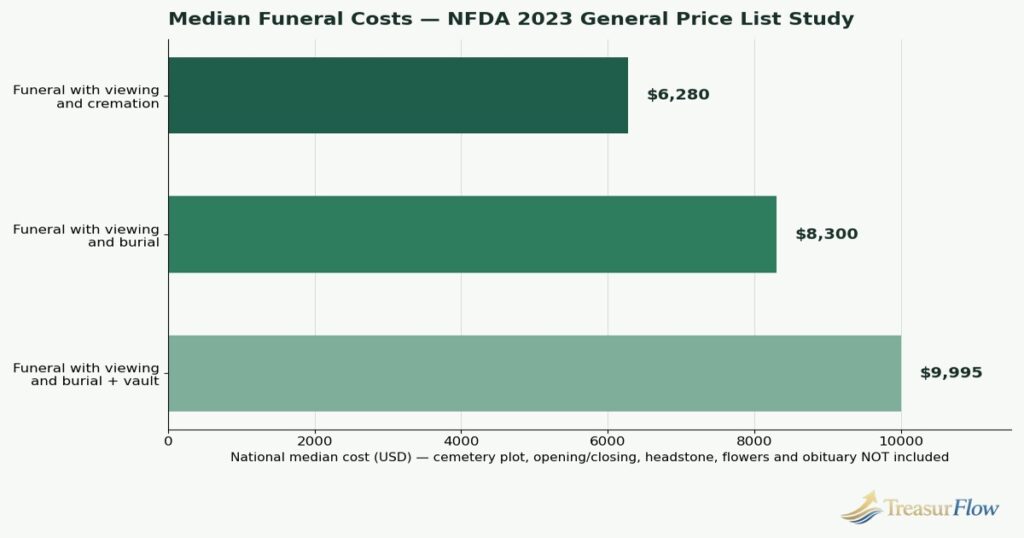
According to the NFDA 2023 General Price List Study:
- The median cost of a funeral with viewing and burial was $8,300.
- The median cost of the same funeral including a burial vault — a container many cemeteries require — was $9,995.
- The median cost of a funeral with viewing and cremation was $6,280.
Those figures cover the funeral home’s charges: the basic services fee, transfer of remains, embalming and other preparation, use of facilities and staff for a viewing and ceremony, a hearse and service vehicle, a basic printed memorial package, and a metal casket in the burial calculation. Please read the next sentence twice, because it is the most misunderstood part of funeral pricing: the NFDA medians do not include cemetery costs. A burial plot, opening and closing the grave, a headstone or marker, and a vault if the cemetery requires one are billed separately. Flowers, an obituary notice, certified copies of the death certificate, clergy or celebrant fees, and a reception are also extra. The Funeral Consumers Alliance, a nonprofit consumer group, has noted that a grave can cost around $500 in a small rural cemetery and $5,000 to $10,000 in some urban for-profit cemeteries, with opening and closing charged on top. That range is wide because land and labor prices are local — which is exactly why a national median is a starting point, not a promise.
Costs have also risen over time. The NFDA’s General Price List studies put the median for a funeral with viewing and burial at $7,181 in 2014 and $7,848 in 2021, before reaching $8,300 in 2023. No one can tell you your exact 2026 local price from a 2023 national study, and any article that pretends otherwise is guessing. What the study does give you is a defensible anchor: a family choosing a traditional burial with a viewing should expect the funeral home bill alone to land somewhere around the high four figures, and the all-in total — funeral home plus cemetery plus extras — to land higher.
A Simple Coverage-Sizing Worksheet
Use this worksheet with your own local prices wherever you can get them. Call one or two funeral homes — under the Federal Trade Commission’s Funeral Rule, they must give you prices over the phone — and ask for their General Price List. Then fill in your own numbers:
- Funeral home services: Start with the NFDA 2023 median that matches your plan — $8,300 for a viewing and burial, $9,995 if a vault will be required, or $6,280 for a viewing and cremation — then adjust up or down using the local price list you collected.
- Cemetery or cremation costs: For burial, add a plot, opening and closing, and a marker or headstone. For cremation, add the cremation fee if it is not already in the funeral home figure, plus an urn or a niche if you plan to place ashes in a cemetery.
- Final bills and extras: Add certified death certificates (you will need several), an obituary, flowers, any remaining medical bills or small debts you want cleared, and a modest allowance for family travel.
- Subtract what is already covered: If you already have a small life policy, a payable-on-death bank account earmarked for this purpose, or savings you are genuinely willing to dedicate, subtract that amount.
- Round up slightly: Prices rise over time, and a policy bought today may not be used for many years. Rounding your target up to the next common coverage level — for example, from $11,000 to $15,000 — is a calm way to build in a small cushion without overbuying.
As an illustration only: a family using the $9,995 burial-with-vault median, adding a modest cemetery plot and opening/closing, a simple marker, certificates and an obituary, and a small amount for final bills could reasonably land on a target in the $13,000 to $16,000 range. A family choosing cremation with a viewing, using the $6,280 median plus an urn and final bills, might land closer to $8,000 to $10,000. These are worksheet examples built from the attributed figures above, not quotes and not national averages — your local numbers will move the total, sometimes by a lot.
One more sizing rule is worth stating plainly: do not buy so much coverage that the premium strains a fixed monthly budget. A policy only helps if it is still in force when it is needed. A smaller policy you can pay for comfortably, every month, for years, is worth far more than a larger one that lapses.
The Three Kinds of Policies: Guaranteed Issue, Simplified Issue, and Level Benefit
Almost every burial insurance offer you will see falls into one of three buckets. The differences between them — what you are asked, what you pay, and when the full benefit becomes available — matter more than the brand name on the brochure.
Level-Benefit (Simplified Issue With Day-One Coverage)
A level-benefit policy is a simplified issue policy where the full face amount is payable from the first day of coverage if you qualify. You answer health questions — typically a short set of yes-or-no questions about serious conditions, recent hospitalizations, and certain medications — but there is no medical exam, no blood draw, and usually no requirement to release full medical records. Insurers may check prescription history and other permitted databases. If your answers place you in the healthiest tier, you get the full benefit immediately, at the lowest price the carrier offers for your age. For most buyers who can qualify, this is the best value in final expense insurance: full coverage, right away, at a lower premium than the other two types.
Simplified Issue and Graded Benefit Plans
Simplified issue is the broader application method described above. Some applicants who do not qualify for the level tier are offered a graded benefit version instead. Under a graded plan, if death from natural causes occurs during an initial period — commonly the first two years — the beneficiary receives a limited amount, often a return of premiums paid plus a stated percentage of interest, rather than the full face amount. Accidental death is typically covered in full from day one. After the graded period ends, the full face amount is payable for any cause of death. Mutual of Omaha’s Living Promise, for example, is sold in a Level Benefit version and a Graded Benefit version, and the graded version’s early benefit is a refund of premiums plus 10 percent. The lesson is not to avoid graded plans — for some health histories they are the best available option — but to know, in writing, which version you were actually issued.
Guaranteed Issue
Guaranteed issue (also called guaranteed acceptance) removes health questions entirely. If you fall within the eligible age range and meet basic residency requirements, you cannot be turned down for health reasons. That openness is genuinely valuable for people with serious conditions who cannot pass any health questionnaire. It comes with two trade-offs, and honest sellers will state both up front: premiums are higher per dollar of coverage, because the insurer is accepting everyone without screening, and coverage amounts are usually smaller.
⚠️ Important warning — the graded death benefit on guaranteed-issue policies: Nearly every guaranteed-issue burial policy includes a waiting period, commonly two years. If the insured dies from natural causes during that period, the beneficiary does not receive the full face amount. Instead, the policy typically pays back the premiums paid, plus a modest amount of interest. Gerber Life’s Guaranteed Life policy, for instance, pays 110 percent of premiums paid for a non-accidental death in the first two years, with the full face amount payable only after that period. Accidental death is generally covered in full from day one. This is not a scam and it is not hidden in the sense that it appears in the policy — but television ads and mailers rarely lead with it. If a policy is advertised as “guaranteed acceptance with no health questions,” assume a two-year graded benefit applies until you have read the policy language that proves otherwise. A guaranteed-issue policy bought today is a plan for a death that occurs years from now, not protection for next month.
The practical order of operations follows from all of this: always ask about simplified issue, level-benefit coverage first. Only move to guaranteed issue if your health answers close that door. Many people who assume they will be declined are pleasantly surprised by simplified issue underwriting, which was designed for common, managed conditions — and they end up with day-one full coverage at a lower price.
Our Picks: Best Burial Insurance 2026 by Buyer Type
We organized our picks by the situation they fit, rather than declaring one winner for everyone. Details below come from insurer-published product information and from two large independent comparisons — MoneyGeek’s analysis of 20 final expense insurers (updated September 22, 2026) and NerdWallet’s burial insurance review (updated October 2026). Premium examples are for a $10,000 policy for a 70-year-old nonsmoker as of October 2026, per MoneyGeek, unless otherwise noted. Your rate will differ.
Best Overall: Mutual of Omaha — Living Promise
Mutual of Omaha’s Living Promise is a simplified issue whole life policy for ages 45 to 85. The Level Benefit version offers $2,000 to $50,000 of coverage with the full benefit payable from day one for those who qualify; a Graded Benefit version offers $2,000 to $20,000 for applicants with more complex health histories. There is no medical exam, premiums are level for life, and the policy includes an accelerated death benefit for terminal illness, with an optional accidental death rider. MoneyGeek’s October 2026 analysis put its average rate at $53 per month for a 70-year-old woman and $75 per month for a 70-year-old man buying $10,000 of coverage. The company holds an A+ (Superior) financial strength rating from AM Best and ranked first in J.D. Power’s 2025 U.S. Individual Life Insurance Study, with an NAIC complaint index well below the industry baseline in MoneyGeek’s review. It earns our overall pick because it combines day-one coverage for qualifying buyers, a high $50,000 maximum at all issue ages, and a strong service record. Note that Mutual of Omaha does not sell life insurance in New York, and its separate Guaranteed Plus whole life product ($2,000 to $25,000, ages 45 to 85, per NerdWallet) is a different policy from Living Promise — confirm which product a quote is for.
Best Guaranteed Issue: Gerber Life — Guaranteed Life
When health questions are truly not an option, Gerber Life’s Guaranteed Life policy is a clear, easy-to-understand choice. Per Gerber Life’s own product information, it offers $5,000 to $25,000 of coverage (a $15,000 maximum in South Dakota; the product is not available in Montana) to applicants ages 50 to 80 — 75 in New York — with no medical exam and no health questions, and acceptance is guaranteed for eligible applicants. Premiums never increase, and the policy builds cash value. Read the graded benefit carefully, because it is the whole ballgame with this product: if death occurs in the first two policy years for any reason other than an accident, the beneficiary receives all premiums paid plus an additional 10 percent, not the face amount. After two years, the full face amount is payable. Gerber states these terms plainly, which is part of why it earns this spot. Alternatives worth comparing include Mutual of Omaha’s Guaranteed Plus and the AARP Guaranteed Acceptance policy issued by New York Life (up to $30,000, generally ages 50 to 85, per NerdWallet’s October 2026 review) — compare the graded-benefit formula and the price per $1,000 of coverage, not just the monthly premium.
Best for Ages 85 and Older: Aetna (Accendo) Final Expense
Most final expense carriers stop issuing new policies at age 85. Aetna’s final expense offering, sold through its Accendo subsidiary, stands out because MoneyGeek’s analysis found issue ages of 40 to 89 — the highest upper age limit in its review. Coverage runs from $2,000 up to $50,000 at younger ages, with a $25,000 maximum for applicants ages 76 to 89. MoneyGeek put its average rate at $58 per month for a 70-year-old woman and $73 per month for a 70-year-old man for $10,000 of coverage as of October 2026, and noted that Aetna accepts some higher-risk health conditions that other carriers decline, along with a discount for existing Medicare Supplement policyholders in some cases. If you are shopping at 86, 87, or 88 — for yourself or for a parent — Aetna is one of the few mainstream doors still open, and that alone earns it this category. Expect to work through an agent, and expect the health questions to still apply: a high issue age is not the same as guaranteed issue.
Best With No Waiting Period: Ethos — With a Day-One Simplified Issue Alternative
The single most valuable feature a burial policy can have is a full benefit that is in force immediately. NerdWallet’s October 2026 review highlights Ethos for exactly that reason: it lists no waiting periods among the pros of Ethos’s whole life offering, notes that coverage goes into effect once the first premium is paid, and describes a fully online application that takes about ten minutes, with coverage from $2,000 up to $100,000 for ages 45 to 85 (not available in New York). If speed and a simple online process matter most, start there — and still read the policy for any graded-benefit language before you pay, because product names and marketing labels vary. Prefer a traditional carrier? Mutual of Omaha’s Living Promise Level Benefit plan, described above, also pays the full benefit from day one for qualifying applicants. The broader point stands for every carrier on this page: “no medical exam” does not automatically mean “no waiting period,” and “guaranteed issue” almost always means the opposite. The waiting-period question deserves its own direct question — “Is the full face amount payable for natural death in the first year?” — and a written answer.
Best Budget Option: Transamerica — and a Warning About “Cheap”
Transamerica earned the lowest average rates in MoneyGeek’s October 2026 analysis: $53 per month for a 70-year-old woman and $70 per month for a 70-year-old man for $10,000 of coverage, the lowest figures in its review of 20 insurers. Its final expense policies are available across the broadest age range MoneyGeek reviewed — ages 18 to 85 — with coverage from $1,000 up to $50,000, stepping down by age band to a $25,000 maximum for applicants 76 to 85. Its Immediate Solution policy is a simplified issue product with level premiums, and its FE Express Solution can be completed fully online with a decision in minutes for many applicants; a funeral concierge rider is included at no extra cost. Two cautions keep this from being an unqualified endorsement: MoneyGeek flagged a high NAIC complaint index of 3.86 for Transamerica, and budget shopping in this category has a well-known trap, covered below — a low monthly number can hide a very small amount of coverage. Compare every quote as cost per $1,000 of coverage, with the waiting period stated, before calling anything “cheap.”
Burial Insurance vs. Term Life vs. Pre-Need Funeral Plans
These three products are often confused, and they solve different problems. Burial insurance pays cash to your beneficiary. Term life pays a much larger amount of cash to your beneficiary, but only if death occurs within a set term. A pre-need funeral plan pays a specific funeral home for specific goods and services you select in advance — it is a contract for a funeral, not a cash benefit for your family.
| Feature | Burial / Final Expense Insurance | Term Life Insurance | Pre-Need Funeral Plan |
|---|---|---|---|
| What it is | Small permanent whole life policy | Temporary life insurance for a set number of years | Prepaid contract with a specific funeral home for chosen goods and services |
| Typical amount | About $2,000–$50,000 | Commonly $100,000 and up, often much more | The price of the funeral you select |
| Who gets paid | Your named beneficiary, in cash | Your named beneficiary, in cash | The funeral home, for the contracted items |
| Can the money be used for anything? | Yes — beneficiary decides | Yes — beneficiary decides | Generally no — tied to the contract and that provider |
| Medical requirements | None (guaranteed issue) or health questions only (simplified issue); no exam | Often health questions; an exam may be required for larger amounts | Usually none — it is a purchase contract, not underwriting |
| Waiting period | Guaranteed issue: commonly 2-year graded benefit. Simplified issue level plans: often none | Usually none once issued, apart from standard contestability and suicide provisions | Not applicable in the same way; coverage depends on contract and payment status |
| Does it expire? | No — permanent, if premiums are paid | Yes — coverage ends when the term ends | Contract remains until used, subject to its terms |
| Premium pattern | Level for life | Level during the term, then rises sharply if renewed | Paid in a lump sum or installments until the plan is funded |
| Main strength | Accessible at older ages and with health issues; sized to final costs | Lowest cost per dollar of coverage for income protection | Locks in specific arrangements and, in some contracts, prices |
| Main limitation | High cost per $1,000 of coverage; small maximums | May be unavailable or expensive at advanced ages or with poor health; can expire before it is needed | Less portable if you move or the firm closes; refunds and transfers depend on state law and the contract |
Which one fits? If you are younger, healthy, and protecting a family that depends on your income, term life is usually the better buy by a wide margin. If you are older, want a modest amount that cannot expire, and may not pass full underwriting, burial insurance is built for you. If your strongest wish is to choose and arrange your own service in detail — the specific funeral home, readings, and merchandise — a pre-need plan addresses that directly, but ask hard questions first: Is the plan portable if you move? What happens if the funeral home is sold or closes? What is refundable if you change your mind or the plan is not fully paid? State rules differ, and your state insurance department or funeral board can explain the protections that apply where you live.
Red Flags: How These Policies Are Sold, and How to Avoid Overpaying
Burial insurance itself is a legitimate, regulated product. The way it is sometimes sold is where families lose money. Knowing the common patterns will protect you better than any single “best company” list.
The $9.95 Television Ad and the “Unit” Problem
The most famous example is Colonial Penn’s Guaranteed Acceptance policy, advertised for decades at “$9.95 a month.” The $9.95 figure is real — but it buys one unit of coverage, and the amount of coverage in a unit depends on your age and sex at purchase and your state. Figures published by NerdWallet in early 2026 and widely cited in reviews show how small a unit can be at older ages: at age 70, one unit provided about $689 of coverage for a man and about $1,000 for a woman; at age 80, about $426 for a man and $608 for a woman. A 70-year-old man who wanted roughly $10,000 of coverage would therefore need many units — at $9.95 each, the true monthly cost would be well over $100 — and the policy still carries the standard two-year limited-benefit period for natural death. None of this makes the policy fraudulent; it makes the advertisement incomplete. Whenever a price is quoted “per unit,” stop and ask the only question that matters: “How many dollars of coverage does one unit buy for someone my age and sex, and how many units do I need for the amount I actually want?”
Other Patterns Worth Watching For
- “Guaranteed acceptance” presented as immediate full coverage. Acceptance and benefit timing are different things. If no health questions are asked, assume a graded benefit for roughly the first two years until the policy proves otherwise.
- A low monthly premium with no coverage amount stated. Mailers sometimes lead with a payment — “$19 a month!” — and mention the face amount only in fine print. Always convert the offer to coverage amount, waiting period, and cost per $1,000 before comparing it with anything else.
- Pressure to buy on the first call or visit. A legitimate policy will still be available next week. Use your state’s free-look period — the NAIC’s Life Insurance Buyer’s Guide notes that a new policy can generally be returned within at least 10 days of delivery for a full refund, and many states and mail-order sales allow longer; the exact period is printed on the first page of your policy. Read the delivered policy during that window, not the brochure.
- Being sold guaranteed issue when you could qualify for simplified issue. This is the most expensive quiet mistake in the category. Buyers who answer a few health questions often get day-one coverage for less money. If an agent steers you to guaranteed issue without asking about your health, get a second quote.
- Paying premiums that will eventually exceed the benefit. With small policies bought at advanced ages, total premiums paid over a long life can pass the face amount. That is a known feature of whole life pricing, not a trick — but you should do the multiplication before you buy, especially for a policy bought in someone’s mid-80s.
- Vague claims about government programs. No burial insurance policy is a government benefit, and Social Security’s lump-sum death payment is only $255 for eligible survivors — it has not been a funeral fund for a very long time. Ads or callers implying that a policy is a new government program, or that you must act before a deadline to claim a benefit, should end the conversation.
- Not checking the insurer. Before buying, confirm the company is licensed in your state through your state insurance department, and look at its financial strength rating (AM Best is the most commonly cited) and its complaint record. The NAIC’s consumer resources and its Life Insurance Policy Locator — which also helps families find policies after a death — are free and worth bookmarking.
A Short Checklist Before You Buy
- Get at least two or three quotes for the same coverage amount.
- For each quote, write down: coverage amount, monthly premium, whether the premium is level for life, and the exact benefit payable for natural death in year one and year two.
- Ask whether you qualify for a level-benefit, simplified issue policy before accepting guaranteed issue.
- Ask for the total you would pay in premiums over 10 and 20 years, and compare it with the face amount.
- Name your beneficiary clearly, tell them the policy exists and where it is kept, and review the policy during the free-look period when it arrives.
- Use your FTC Funeral Rule rights on the other side of the purchase, too: get General Price Lists from local funeral homes, buy only the goods and services you want, and remember that a funeral home must accept a casket or urn you buy elsewhere without charging a handling fee.
Burial Insurance Questions Families Ask Us Most
1. How much burial insurance coverage do most families actually need?
Start with the funeral itself, then add the costs the headline figure leaves out. The NFDA’s 2023 General Price List Study put the median funeral with viewing and burial at $8,300, or $9,995 including a vault, and a funeral with viewing and cremation at $6,280 — and none of those medians include a cemetery plot, opening and closing, or a headstone. Many families who work through the worksheet in this guide land between $10,000 and $15,000 for a burial or somewhat less for cremation, but the right amount is the one built from your local prices and your family’s wishes, minus any savings or existing coverage already set aside for this purpose.
2. What happens if the insured dies during the two-year waiting period on a guaranteed-issue policy?
For a death from natural causes during the waiting period — commonly the first two policy years — the beneficiary typically receives a refund of the premiums paid, plus a modest amount of interest, rather than the full face amount. Gerber Life’s Guaranteed Life policy, for example, pays 110 percent of premiums paid in that situation. Accidental death is generally covered at the full face amount from the first day. After the waiting period ends, the full benefit is payable for any cause of death. This is the single most important clause to confirm in writing before buying any guaranteed-issue policy.
3. Can my beneficiary use the money for something other than the funeral?
Yes. A burial insurance death benefit is paid as cash directly to your named beneficiary, and the beneficiary may use it for any purpose — funeral and cemetery bills, remaining medical costs, small debts, travel, or everyday expenses while the estate is settled. It is not paid to a funeral home and it is not restricted to funeral items. That flexibility is a key difference from a pre-need funeral plan, which pays a specific provider for specific contracted goods and services.
4. Is burial insurance worth it if I already have some savings?
It depends on what those savings are for. If you have liquid savings your family could comfortably spend on a funeral without creating hardship — and without leaving a surviving spouse short — you may not need a policy, and setting the money aside in a clearly labeled account can work well. Burial insurance becomes more useful when savings are limited, when you want final costs kept separate from money a spouse will need to live on, or when you want the certainty of a defined benefit arriving quickly without touching other assets. Compare the total premiums you would expect to pay with the benefit, and be honest about whether a dedicated savings habit would reach the same goal.
5. What is the difference between no medical exam and no health questions?
They are not the same thing, and confusing them is expensive. “No medical exam” usually describes simplified issue policies: there is no exam, blood test, or doctor’s visit, but you do answer health questions, and your answers affect approval, price, and whether your benefit starts immediately or is graded. “No health questions” describes guaranteed issue policies: acceptance does not depend on your health at all, but premiums are higher and a graded death benefit — commonly two years — almost always applies. If you can answer health questions, a simplified issue policy will usually give you more coverage, sooner, for less money.
6. How quickly does burial insurance pay out, and how does my family file a claim?
Once a claim is filed with the required documents — typically a certified death certificate and a claim form — insurers generally aim to pay final expense claims promptly, and some state laws require timely payment or interest on delays; exact timelines vary by insurer and by how quickly documents are provided. To make the process as smooth as possible, tell your beneficiary now that the policy exists, which company issued it, and where the policy is stored. If a family cannot find a policy after a death, the NAIC’s free Life Insurance Policy Locator can help search for lost policies and annuities.
Conclusion
Burial insurance is a modest product, and that is its strength. It will not replace an income or build an estate. What it can do — bought carefully, in the right amount, from a licensed and financially sound insurer — is quietly remove one predictable bill from a difficult week, and let your family spend that week on each other instead of on payment arrangements.
If you take only four things from this guide, let them be these. First, size your coverage from real costs: the NFDA’s 2023 medians of $8,300 for a funeral with viewing and burial ($9,995 with a vault) and $6,280 for a funeral with viewing and cremation are a starting point, and cemetery and extras come on top. Second, try for a level-benefit, simplified issue policy first, so your full benefit is in force from day one. Third, if you buy guaranteed issue, do so with your eyes open about the two-year graded benefit — it is a long-term plan, not immediate protection. Fourth, compare every offer the same way: coverage amount, waiting period, and cost per $1,000, verified against the actual policy during your free-look period.
Take your time with this decision. Talk it over with the people the policy is meant to help, get prices from local funeral homes under your Funeral Rule rights, and get more than one insurance quote. A calm, informed purchase made on an ordinary afternoon is one of the kindest financial arrangements you can leave behind.

Muhammad Zakir is the founder of Treasurflow and the author of its personal finance guides. He researches consumer banking, credit, and personal loans, and every guide cites primary sources such as the CFPB, FDIC, FTC, and IRS. His content is educational and is not personalized financial advice.