
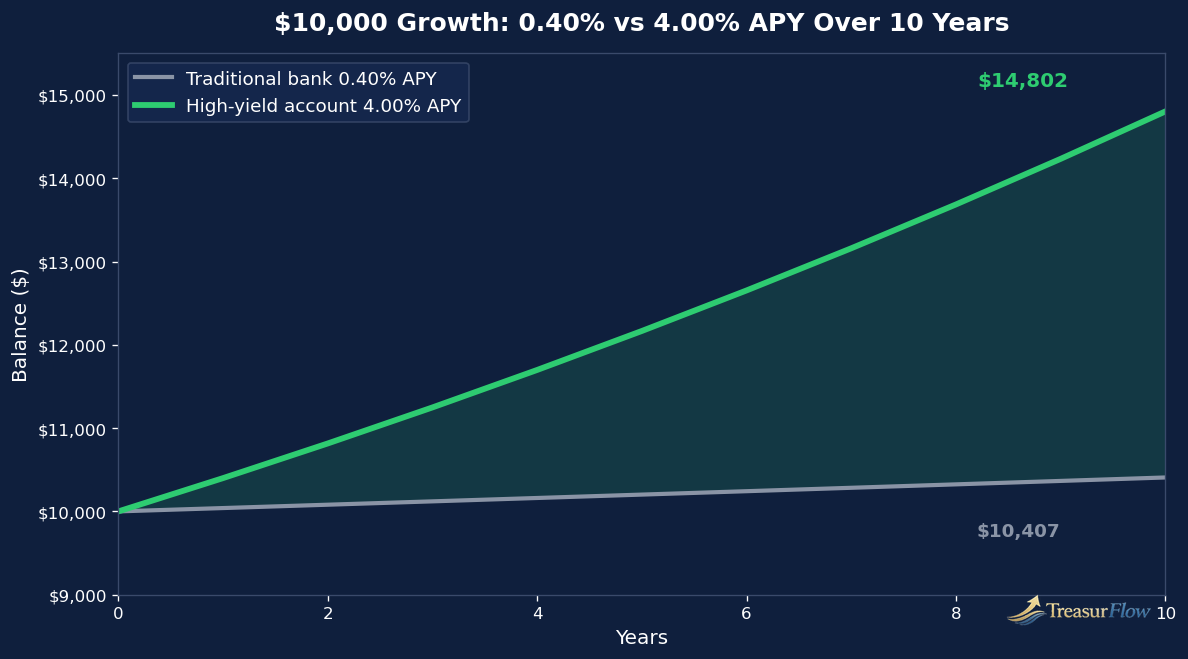
If your savings are sitting at a big traditional bank, I have uncomfortable news: your money is barely working at all. The national average savings rate hovers around 0.40% APY — some giant banks still pay 0.01%. Meanwhile, the best high-yield savings accounts in 2026 pay around 4% to 5% APY. Same dollars, same effort, roughly ten times the interest.
Here’s the wake-up call in plain numbers. Park $10,000 for a year:
- At 0.40% APY (national average): you earn about $40
- At 4.00% APY (a solid HYSA): you earn about $400
That $360 difference is the simplest raise you’ll ever get — no new job, no side hustle, just moving money from one account to another. And because these accounts are FDIC-insured up to $250,000, that extra yield comes with the same government-backed safety as your current bank.
But here’s what the big comparison sites won’t tell you: there is no single “best” account. The right pick depends on your saver situation — how much you’re stashing, whether you want a famous brand name or the absolute highest rate, and whether you’ll actually meet the fine-print requirements. So instead of another generic rate table, I ranked 10 standout accounts by the situation each one serves best.
A quick honesty note: APYs are variable and change without notice. Every rate below is accurate as of October 2026 based on bank-published data — always confirm the current rate on the bank’s site before you open an account.
Related Guides
- How to Build Wealth Slowly — once your emergency fund is full, investing grows long-term wealth far faster than any savings account.
- Emergency Loans With No Credit Check — a funded emergency account means never needing one of these.
- No Credit Check Bank Accounts 2026 — if past banking history is blocking you, start here.
- Best Balance Transfer Credit Cards 2026 — paying 24% APR on credit card debt while earning 4% on savings is losing math; kill the debt first.
Helpful Official Resources
- FDIC — Deposit Insurance — verify any bank’s insurance status and learn the $250,000 coverage rules.
- Consumer Financial Protection Bureau — free guides on choosing bank accounts and understanding fees.
- Federal Reserve — Interest Rates — why savings rates rise and fall with Fed policy.
The 10 Best High-Yield Savings Accounts for 2026, by Saver Situation
1. Best for rate chasers: Axos ONE — up to 5.00% APY
If your only question is “who pays the most right now?”, start here. Axos ONE advertises up to 5.00% APY for new customers during the first six months. That’s the highest headline rate in this roundup.
The fine print that matters: the top rate is promotional — it applies for the first 6 months, and you’ll want to check what it drops to afterward. This is the classic teaser-rate structure: fantastic if you’re willing to move money again when the promo ends, annoying if you want “set it and forget it.”
Best for: savers who chase the highest number and don’t mind switching.
Watch out for: the 6-month promo window; confirm the ongoing rate.
2. Best for small-balance starters: Varo — up to 5.00% APY
Varo pays up to 5.00% APY on balances up to $5,000 when you have qualifying direct deposit — and 2.50% on amounts above that. If you’re building your first emergency fund from zero, this is arguably the most rewarding account dollar-for-dollar at small balances.
Why it wins for starters: $0 to open, $0 monthly fees, and the high rate applies exactly where beginners live — the first few thousand dollars.
Best for: building your first $5,000 emergency fund.
Watch out for: requires qualifying direct deposit to earn the top tier.
3. Best for no-strings savers: Pibank — 4.25% APY
No tiers, no direct deposit requirement, no games: Pibank pays 4.25% APY with a $0 minimum balance to open and maintain. What you see is what you get.
Why it stands out: most 4%+ accounts make you earn it — monthly deposits, balance tiers, promo windows. Pibank just pays the rate. The tradeoff is brand familiarity; it’s a lesser-known online name, so verify FDIC insurance (it carries it) and decide if that matters to you.
Best for: savers who hate fine print.
Watch out for: lesser-known brand; mobile-focused experience.
4. Best for locking today’s rate: NexBank via Raisin — 4.25% APY
Raisin is a savings marketplace that places your deposit at partner banks — here, NexBank at 4.25% APY with a $1 minimum, and the rate is guaranteed for 60 days from when your funds post. In a falling-rate environment, a guarantee has real value.
How Raisin works: Raisin itself isn’t a bank; your money sits at partner banks where FDIC insurance applies (up to $250,000 per institution). One login, many bank offers.
Best for: savers worried rates will drop next month.
Watch out for: the 60-day guarantee expires; marketplace model isn’t for everyone.
5. Best for investors: E*TRADE Premium Savings — 4.25% APY
If you already invest with E*TRADE (now part of Morgan Stanley), this is the path of least resistance: 4.25% APY with the rate guaranteed for 6 months, plus occasional cash bonuses (a recent promo offered up to $800 with a code). Cash and investments under one login.
Why investors like it: idle cash between trades earns a real yield instead of sitting at ~0%, and transfers between brokerage and savings are instant.
Best for: existing E*TRADE investors.
Watch out for: the 6-month rate guarantee ends; best value is as a companion account.
6. Best all-rounder: SoFi Checking and Savings — up to 4.00% APY
SoFi bundles checking and savings with up to 4.00% APY on savings (with SoFi Plus), no account fees, and early direct deposit. It’s the “one app for everything” pick — budgeting tools, investing, and high yield in a single login.
Why it’s popular: the rare account that pays a top-tier savings rate AND works as a daily checking replacement, with a huge ATM network.
Best for: savers who want checking + savings + investing in one place.
Watch out for: top APY tier may require SoFi Plus or direct deposit.
7. Best for monthly depositors: Happen Bank LevelUp — 4.20% APY
Deposit $250 or more per month and Happen’s LevelUp rate pays 4.20% APY on your full balance (otherwise 3.00%). If you’re already auto-saving monthly — which you should be — this requirement is invisible.
The psychology is smart: the bank rewards exactly the habit that builds wealth: consistent deposits. Set up a $250 monthly auto-transfer and forget it.
Best for: anyone who saves a fixed amount every month.
Watch out for: miss the monthly deposit and the rate drops to 3.00%.
8. Best for brand trusters: Marcus by Goldman Sachs — around 3.70%–4.50% APY
Some savers will never put five figures in a bank they’ve never heard of, and that’s rational. Marcus — Goldman Sachs’s consumer bank — pairs a competitive yield with one of the most trusted names in finance. No minimums, no fees, same-day transfers up to $100,000.
Why trust matters: yield differences of 0.3% on $10,000 amount to $30 a year. If a famous brand helps you sleep at night, that’s cheap peace of mind.
Best for: savers who want a Wall Street name on the door.
Watch out for: rate is competitive, rarely the absolute highest.
9. Best for beginners and goal-setters: Ally Bank — around 3.00%–4.35% APY
Ally’s “buckets” let you visually divide one savings account into sub-goals — emergency fund, vacation, new car — without opening multiple accounts. Combined with 24/7 customer service and no fees or minimums, it’s the friendliest on-ramp in online banking.
Why beginners win here: the buckets feature teaches the single most important savings habit — giving every dollar a job — while the rate stays well above average.
Best for: first-time HYSA openers and visual goal-trackers.
Watch out for: headline rate moves around; check today’s number.
10. Best for service-first savers: Discover Online Savings — 3.90% APY
Discover’s savings account pays a strong 3.90% with no minimums or fees, backed by customer service that consistently tops satisfaction surveys. If you’ve ever spent 45 minutes on hold with a bank, you know service has a dollar value.
Why it makes the list: a genuinely high rate with none of the promo/tier gymnastics, from a brand millions already carry in their wallets.
Best for: savers who value human support over squeezing the last 0.2%.
Watch out for: no branch access (online only, like most on this list).
Compare All 10 at a Glance
| Account | APY (Oct 2026) | Min. to Open | Monthly Fee | Best For |
|---|---|---|---|---|
| Axos ONE | Up to 5.00%* | $0 | $0 | Rate chasers |
| Varo | Up to 5.00%* | $0 | $0 | Small balances |
| Pibank | 4.25% | $0 | $0 | No-strings savers |
| NexBank via Raisin | 4.25% | $1 | $0 | Rate guarantee |
| E*TRADE Premium | 4.25% | $0 | $0 | Investors |
| Happen LevelUp | 4.20%* | $0 | $0 | Monthly depositors |
| SoFi | Up to 4.00% | $0 | $0 | All-rounders |
| Discover | 3.90% | $0 | $0 | Service-first |
| Marcus | ~3.70%+ | $0 | $0 | Brand trust |
| Ally | ~3.00%+ | $0 | $0 | Beginners/goals |
*Promo, tier, or requirement applies — see the pick details above. Rates variable; verify before opening.
How to Choose: 5 Factors That Matter More Than the Headline Rate
1. The “all-in” rate you’ll actually earn. A 5.00% promo that drops to 3.50% in six months may lose to a steady 4.25% over a full year. Do the 12-month math, not the billboard math.
2. Requirements you’ll actually meet. Direct deposit minimums, monthly deposit thresholds, balance tiers — be brutally honest about your habits. The best account is the one whose top rate you qualify for on autopilot.
3. FDIC insurance, verified. Every dollar should sit at an FDIC-insured bank (or NCUA-insured credit union). With marketplaces like Raisin, confirm the partner bank is insured, not just the platform.
4. Transfer speed and access. Most online HYSAs move money via ACH in 1–2 business days. That’s fine for an emergency fund; it’s terrible for “I need cash tonight.” Keep a small buffer in checking.
5. Fees and minimums. The good news: nearly every account on this list charges $0 monthly fees with $0 minimums. If an account charges you to hold your money in 2026, walk away.
Are High-Yield Savings Accounts Safe? (The FDIC Explainer)
Yes — with one non-negotiable condition: the bank must be FDIC-insured (or the credit union NCUA-insured). Then your deposits are protected up to $250,000 per depositor, per insured bank, per ownership category — backed by the full faith and credit of the U.S. government. If the bank fails, you get your money back up to the limit. Period.
Three practical rules:
- Verify, don’t assume. Search the bank’s name on the FDIC’s BankFind tool before depositing. A slick website is not proof of insurance.
- Mind the $250k cap. Saving more than that at one bank? Spread it across institutions — each gets its own $250,000 coverage.
- Marketplaces are fine if the partner bank is insured. Raisin isn’t a bank, but your deposit lands at an FDIC-insured partner bank. That’s what counts.
What FDIC insurance does not protect you from: inflation quietly eroding purchasing power, and variable rates drifting downward. Safety of principal — yes. Guaranteed rate — no.
The Tax Surprise: Yes, the IRS Wants Its Cut
Interest from a savings account is ordinary taxable income. If you earn $10 or more in interest, your bank sends you (and the IRS) a 1099-INT at year-end. On $10,000 at 4% APY, that’s ~$400 of taxable interest — maybe $90–$130 in federal tax depending on your bracket.
This isn’t a reason to avoid HYSAs — it’s a reason to plan. Two notes: taxes apply whether you withdraw the interest or not, and state taxes may take another bite. Keep a rough estimate aside so April doesn’t sting.
HYSA vs CD vs Money Market: Which One Are You Actually Looking For?
| Feature | HYSA | CD (Certificate of Deposit) | Money Market Account |
|---|---|---|---|
| Typical APY | 3.50%–5.00% | 4.00%–5.50% (locked) | 3.50%–4.80% |
| Access | Anytime (1–2 day transfers) | Locked; early-withdrawal penalty | Anytime + check/debit access |
| Rate type | Variable | Fixed for the term | Variable |
| Best for | Emergency fund, short-term goals | Money you won’t touch for 6–24 months | Savings you occasionally tap by check |
Rule of thumb: HYSA for your emergency fund and short-term savings. CD when you want to lock a rate because you believe rates are falling. Money market if you want check-writing on savings. And money you won’t need for 5+ years? That belongs in investments, not any savings account — see our slow wealth guide.
5 Mistakes That Quietly Kill Your Yield
1. Falling for the teaser rate. “5.00% APY!” in giant letters, “for the first 6 months” in tiny ones. Always find the ongoing rate and do 12-month math.
2. Ignoring tier minimums. Some accounts pay 0.25% under $5,000 and 4% above it. If your balance lives below the tier line, the headline rate is fiction for you.
3. Parking too much cash. An emergency fund of 3–6 months’ expenses belongs in a HYSA. $80,000 sitting in savings “for safety” while inflation eats it is a different mistake — long-term money should be invested.
4. Forgetting the tax bill. See above: that 4% is pre-tax. Mentally haircut your yield by your marginal rate.
5. Keeping your emergency fund at 0.01%. The most expensive mistake is inertia. Every month your $15,000 emergency fund sits at a mega-bank paying 0.01%, you’re donating ~$50 in interest to shareholders.
When a High-Yield Savings Account Is NOT Worth It
Honesty section — because the right answer isn’t always “open one”:
- You’re carrying high-interest debt. Paying 24% APR on a credit card while earning 4% on savings is a guaranteed loss. Kill the debt first — our balance transfer guide shows how to do it at 0%.
- The money is for 5+ years from now. Retirement and long-term wealth belong in investments. A HYSA’s 4% won’t build real wealth; the market’s long-run ~8–10% will (with volatility, of course).
- You need the cash tomorrow. HYSA transfers take 1–2 business days. Rent due in the morning stays in checking.
- The “high yield” requires absurd hoops. If earning the top rate means 15 debit transactions, a $10,000 minimum, and a blood oath — skip it. A simple 4.25% beats a theoretical 5%.
How to Switch in 20 Minutes (Without the Headache)
- Pick your account from the list above based on your situation, not just the biggest number.
- Verify FDIC insurance on the FDIC website — 60 seconds, non-negotiable.
- Open online — ID, Social Security number, and 10 minutes. Most approvals are instant.
- Link your current bank with routing + account numbers; the new bank verifies with micro-deposits.
- Move money in stages — start with a test transfer, then move the bulk. Keep your old account open until everything clears.
- Set up auto-transfer — even $100/month on payday turns a savings account into a savings habit.
- Update direct deposit if you want the top-tier rate that requires it.
Frequently Asked Questions
Are high-yield savings accounts safe?
Yes — as long as the bank is FDIC-insured (or the credit union is NCUA-insured). Your deposits are protected up to $250,000 per depositor, per bank, even if the bank fails. Always verify insurance on the FDIC’s website before opening an account, especially with lesser-known online banks.
What is a good APY for a high-yield savings account in 2026?
Around 4.00% APY is a strong rate right now, with top accounts reaching 4.25%–5.00%. Anything above 3.00% is still roughly ten times the national average of ~0.40%. Be aware that the very highest advertised rates often come with conditions like monthly deposit requirements or short promo windows.
Can I lose money in a high-yield savings account?
No — not as long as the account is FDIC-insured and your balance stays under the $250,000 insurance limit. Your principal is protected and cannot fall with the stock market. The only ways to “lose” are keeping over $250k at one uninsured institution or letting inflation outpace your rate.
How often does interest compound in a HYSA?
Most high-yield savings accounts compound daily and credit interest monthly. Daily compounding means you start earning interest on your interest almost immediately — which is exactly why APY (which includes compounding) is the number to compare, not the plain interest rate.
What happens to my HYSA if interest rates drop?
Your APY will fall too — HYSA rates are variable and track the Federal Reserve’s policy moves. Your principal stays safe and insured; you’ll just earn less. If you believe rates are heading down and won’t need the money soon, a CD lets you lock today’s rate for a fixed term.
How much money should I keep in a high-yield savings account?
Three to six months of living expenses — your emergency fund — is the standard answer. Keep it somewhere reachable in a day or two. Money you won’t touch for a year or more can earn a fixed rate in a CD; money you won’t need for five-plus years generally belongs in investments instead.
Can I have more than one high-yield savings account?
Yes — there’s no limit. A common setup is one account chasing the top rate plus a second at a trusted brand for separate goals. Multiple banks also keep you under the $250,000 FDIC limit at each institution, and some savers use separate accounts as DIY “buckets” for different goals.
Do I have to pay taxes on HYSA interest?
Yes. Savings interest is ordinary taxable income. Your bank will send a 1099-INT if you earn $10 or more, and you’ll owe federal (and possibly state) tax on it — even if you never withdraw the interest. On $400 of interest at a 22% bracket, that’s about $88.
Are there fees on high-yield savings accounts?
Usually none. Nearly all top HYSAs in 2026 charge $0 monthly maintenance fees with $0 minimums — online banks save on branches and pass it to you. Always check for edge-case fees (excessive withdrawals, paper statements), but monthly fees are a deal-breaker: walk away.
What’s the catch with a 5.00% APY savings account?
Three usual catches: (1) it’s a promo rate that drops after a few months, (2) it only applies below a balance cap (e.g., first $5,000) or above a tier, or (3) it requires monthly direct deposits. None are scams — but the ongoing, no-hoops rate is the honest number to compare.
The Bottom Line
Moving your savings from 0.40% to 4%+ is the highest-return 20 minutes in personal finance. On $10,000, it’s the difference between $40 and $400 a year — every year — with FDIC insurance keeping every dollar just as safe.
Pick by your situation, not the billboard rate: chase the promo if you’ll move again, choose no-strings simplicity if you won’t, and trust the brand name if that helps you sleep. Then verify FDIC insurance, confirm today’s rate, and set up that auto-transfer. Your future self — the one with a real emergency fund — says thanks.

Muhammad Zakir is the founder of Treasurflow and the author of its personal finance guides. He researches consumer banking, credit, and personal loans, and every guide cites primary sources such as the CFPB, FDIC, FTC, and IRS. His content is educational and is not personalized financial advice.
8 thoughts on “Best High-Yield Savings Accounts 2026: 10 Picks Ranked by Your Saver Situation”