

Best Home Equity Loans 2026: Lenders Compared on Loan Amounts, CLTV and Closing Costs
The average American homeowner with a mortgage is sitting on roughly $300,000 of home equity, according to recent industry data — the largest pool of cheap borrowing capacity most families will ever have. A home equity loan lets you convert part of that equity into a lump sum at a fixed rate, with a predictable payment and a set payoff date. Used well, it funds the roof, the renovation or the debt consolidation at a fraction of credit-card interest. Used carelessly, it puts the house itself on the line.
This guide takes a math-first approach. We start with the two calculations that decide whether a home equity loan makes sense at all — how much your combined loan-to-value (CLTV) ratio actually lets you borrow, and what a $75,000 loan really costs at different rates — then compare the best home equity loan lenders of 2026 on loan amounts, maximum CLTV, fees and fit. Lender details are as published by Bankrate and Money in October 2026; rates move daily, so treat every figure as a dated snapshot, not a quote.
Related Guides
- Best Mortgage Refinance 2026 — when replacing your first mortgage beats borrowing on top of it
- Best Personal Loans 2026 — the unsecured alternative when you can’t or shouldn’t pledge your home
- Best Debt Consolidation Loans 2026 — if the plan is to wipe out high-interest card balances
Helpful Official Resources
- Consumer Financial Protection Bureau — What Is a Home Equity Loan?
- Consumer Financial Protection Bureau — consumerfinance.gov
- IRS — Publication 936: Home Mortgage Interest Deduction
First, the Borrowing Math: CLTV Decides Your Ceiling
Lenders do not ask “how much equity do you have?” They ask “what will your combined loan-to-value ratio be?” — the total of all loans secured by the home, divided by the home’s value. Most home equity lenders cap CLTV at 80–90%; a few go higher for strong borrowers.
Worked example. Your home is worth $450,000 and your remaining mortgage balance is $260,000:
- At an 80% CLTV cap: total liens may reach $360,000 → you can borrow up to $100,000
- At a 90% CLTV cap: total liens may reach $405,000 → you can borrow up to $145,000
Notice what the example teaches: the difference between an 80% lender and a 90% lender is not 10% more money — on this house it is 45% more ($145,000 vs $100,000). If you are borrowing near your ceiling, max CLTV is the first spec to shop. If you are borrowing well under it, rate and fees matter more.
What $75,000 Really Costs: Rate Scenarios
Home equity loan rates for well-qualified borrowers in October 2026 cluster in the high single digits — Money’s October 2026 review, for example, found leading lenders advertising fixed rates starting in the mid-7% range, with actual offers driven by credit score, CLTV and loan size. Because your quote will differ, model the loan at three illustrative rates on a $75,000, 15-year fixed loan:
| Illustrative APR | Monthly payment | Total interest over 15 years |
|---|---|---|
| 7.5% | $695 | $50,147 |
| 8.5% | $739 | $57,940 |
| 9.5% | $783 | $65,970 |
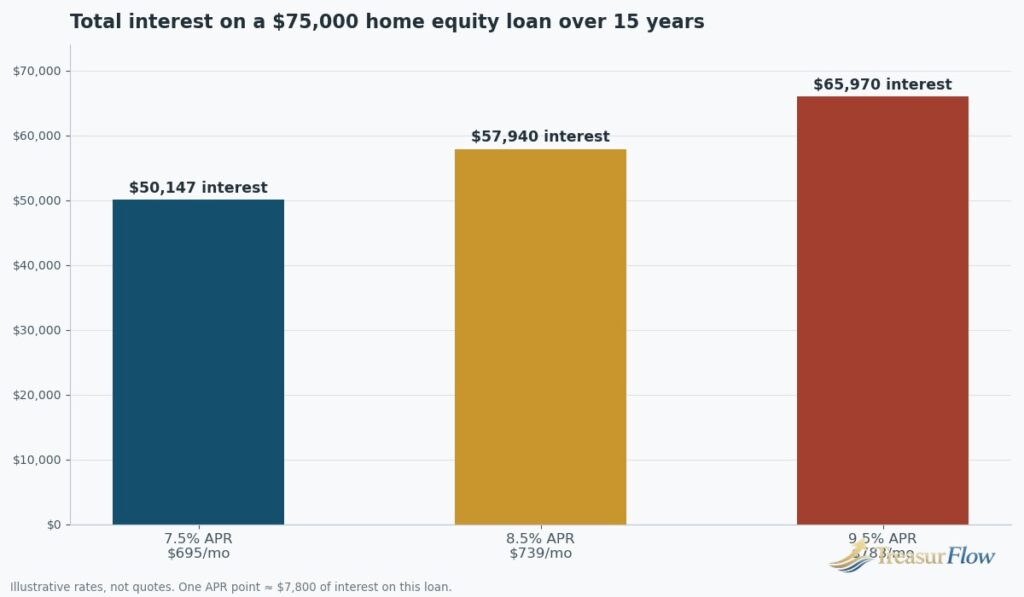
A single percentage point of rate is worth about $44 a month and $7,800 of interest on this loan; two points, nearly $15,800. That is why the CFPB’s standard advice — get at least three Loan Estimates and compare the APR and total cost, not the headline rate — is worth real money here. It is also why a slightly lower rate with heavy closing costs can lose to a slightly higher rate with none (see the costs section below).
Best Home Equity Loan Lenders of 2026
We compared national and major regional lenders on maximum loan amounts, CLTV ceilings, fee structures and borrower fit, using Bankrate’s and Money’s October 2026 lender data.
U.S. Bank — best for large loans
Home equity loans from $25,000 up to $750,000 — and up to $1 million in California — put U.S. Bank at the top for borrowers funding major projects. It lends nationally, offers terms as long as 30 years on some products, and will produce a loan estimate over the phone before a full application. If your project is big and your equity position is strong, start here.
BMO — best for small loans
Most lenders lose interest below $25,000. BMO’s home equity loans start at just $5,000, the lowest entry point in this comparison, which makes it the practical pick for a single-room repair or a modest project where a personal loan’s higher rate is the only alternative. BMO lends nationally except Texas.
PNC Bank — best overall (Money, October 2026)
Money’s October 2026 review of more than 60 home equity lenders scored PNC its best overall pick (4.85 out of 5), citing loans up to $1 million and advertised fixed rates from 7.49% (rates as of late September 2026, subject to change). PNC’s footprint is strongest east of the Mississippi, but its combination of high limits and competitive headline pricing is the benchmark other lenders are measured against this year.
Fifth Third Bank — best for comparison shoppers in its region
Fifth Third offers home equity loans from $10,000 to $500,000 across its 12-state regional footprint, and Bankrate’s reviewers highlight it for straightforward comparison shopping — transparent product structure and branch access for borrowers who want a human in the loop. If you live in the Midwest or Southeast and value an in-person process, it earns a quote.
Spring EQ — best for high equity access
Spring EQ built its name on letting qualified borrowers tap more of their equity than the big banks allow: home equity loans from $50,000 to $500,000, with advertised CLTVs reaching well above the standard 80% — as high as the mid-90s for the strongest profiles in recent comparisons. The trade-off for high-CLTV borrowing is pricing: expect the rate to reflect the extra risk, and compare its Loan Estimate line-by-line against an 80% offer if you qualify for both.
RenoFi — best for renovations
RenoFi is not a direct lender but a specialist platform connecting homeowners with lenders offering renovation-focused home equity products, from $25,000 to $500,000 (not available in HI, MA or NY). Its underwriting considers the home’s after-renovation value on qualifying products, which can unlock more borrowing power for a major remodel than a standard appraisal allows. If the entire loan is going into the house, RenoFi’s model is worth a look alongside direct lenders.
Connexus Credit Union — best no-appraisal route
Connexus, a Wisconsin-based credit union open to members nationwide, allows CLTVs up to 90%, offers both home equity loans and HELOCs, and is repeatedly cited for no-appraisal options that can cut weeks and hundreds of dollars from the process. Catch points: you must join the credit union (typically a small one-time association step), closing costs on some products run from a few hundred to about $2,000, and availability excludes a handful of states. For borrowers whose home is hard to appraise — rural, unique, or recently renovated — it solves a real problem.
Home Equity Loan vs HELOC vs Cash-Out Refinance
| Feature | Home equity loan | HELOC | Cash-out refinance |
|---|---|---|---|
| How you get the money | Lump sum, once | Draw as needed during draw period | Lump sum, replaces your mortgage |
| Rate type | Usually fixed | Usually variable | Fixed or adjustable |
| Effect on first mortgage | None — it’s a second loan | None | Replaces it entirely |
| Best when | You know the exact amount and want payment certainty | Expenses arrive over time (phased remodel) | Current mortgage rates are at or below your existing rate |
| Watch out for | Closing costs on a second loan | Payment shock when the draw period ends | Restarting your mortgage clock and losing a low first-mortgage rate |
The decision usually hinges on your existing first mortgage. If it carries a low rate from an earlier era, keep it untouched and borrow on top with a loan or HELOC. If today’s refinance rates are close to what you already pay, one cash-out loan can be simpler and cheaper in total.
Costs Beyond the Rate
Budget for closing costs of roughly 2% to 5% of the loan amount — on $75,000, that is $1,500 to $3,750 — covering items such as appraisal (often several hundred dollars), title work, recording and origination where charged. Some lenders advertise no closing costs; they typically recover the money in the rate, which is why the Loan Estimate’s five-year cost figure is the honest comparison. Other checks:
- Prepayment penalties are uncommon on modern home equity loans but not extinct — confirm yours has none.
- Annual fees are a HELOC feature, rarely a home equity loan one.
- Appraisal waivers exist at some lenders (Connexus above) and are worth real money and time when offered.
What Lenders Check Before They Say Yes
Typical approval standards across major lenders look like this — individual lenders vary:
- Credit score: many lenders set a floor around 620–660; the best pricing usually requires 700+, with the strongest offers at 740+.
- Equity: at least 15–20% remaining after the new loan at traditional lenders (an 80–85% CLTV cap), with the high-CLTV specialists as the exception.
- Debt-to-income ratio: total housing and other debts commonly capped around 43% of gross income, echoing mortgage underwriting.
- Income and property: documented income, a home appraisal or approved valuation, and the property insured with the lender named as loss payee.
Timeline: expect roughly two to six weeks from application to funding at traditional lenders; streamlined online processes can be faster. After closing on a loan secured by your main home, federal law gives you a three-business-day right of rescission — a cooling-off window to cancel for a full refund of fees. Use it if anything in the final paperwork surprises you.
One shopping tip from the CFPB’s mortgage guidance applies here too: submit your applications inside a focused window. Credit scoring models generally treat multiple mortgage-related inquiries made within a short period — commonly 14 to 45 days, depending on the scoring model — as a single inquiry, because they assume you are rate-shopping rather than stacking debt. Gathering your three Loan Estimates inside one fortnight therefore costs your credit score little more than applying once, while the rate differences it can uncover are worth thousands (see the scenario table above).
The Risk Section Nobody Should Skip
A home equity loan is secured debt. Miss payments and the lender can foreclose — the interest rate is low because the house is the collateral. Three disciplines keep the product safe:
- Borrow for things that outlast the loan — roofs, renovations, education, consolidating more expensive debt — not for consumption that will be gone in a year while the payments run for fifteen.
- Keep an equity cushion. Borrowing to 90%+ CLTV leaves nothing if local prices dip; borrowers who lived through 2008 can explain underwriting regret better than any article.
- Stress-test the payment against a job loss or rate environment change before signing, not after.
On taxes: under current IRS rules (Publication 936), interest on a home equity loan is deductible only if the money is used to buy, build or substantially improve the home that secures the loan. Interest on equity borrowed for debt consolidation or spending is not deductible, whatever the loan is named. Confirm your situation with a tax professional.
Using a Home Equity Loan for Debt Consolidation: The Honest Version
Consolidating credit card debt into a home equity loan is one of the most common uses of the product — and the one with the widest gap between its best and worst outcomes. The interest math is genuinely dramatic. Take $30,000 of card debt repaid over five years:
- At a 24% APR (a typical credit card rate): $863 a month, $21,782 of interest
- At an 8.5% APR home equity loan: $616 a month, $6,930 of interest
That is roughly $14,853 of interest avoided — real money, which is why our companion guide to the best debt consolidation loans treats secured borrowing seriously. But the swap has two costs no calculator shows. First, you have converted unsecured debt — where the worst case is a wrecked credit score — into debt secured by your home, where the worst case is foreclosure. Second, the strategy fails completely if the cleared cards fill back up: you then hold the consolidation loan and new card balances, which is strictly worse than where you started. The households this works for are the ones who pair the loan with closed or frozen cards and a budget that keeps them that way.
Choosing a Term: 10, 15, 20 or 30 Years?
Home equity loans are offered on terms from 5 to 30 years, and the choice matters more than small rate differences. On the same $75,000 loan at an illustrative 8.5% APR:
| Term | Monthly payment | Total interest |
|---|---|---|
| 10 years | $930 | $36,587 |
| 15 years | $739 | $57,940 |
| 20 years | $651 | $81,208 |
| 30 years | $577 | $132,607 |
Stretching from 10 to 30 years cuts the payment by about $353 a month but adds roughly $96,000 of interest — more than the amount borrowed. A useful discipline: match the term to the life of what you are funding (a roof that lasts 25 years can carry a longer term than a car or a vacation), and if a project only pencils out at 30 years, that is the market telling you the project is too big for the house’s equity right now.
Tapping Your Equity: Questions Homeowners Ask First
How much equity do I need to get a home equity loan?
Most lenders want you to keep at least 15–20% equity after the loan, which means a maximum combined loan-to-value (CLTV) of 80–85%. Some specialists go further — Spring EQ and Connexus reach around 90% CLTV or higher for qualified borrowers. Work an example: on a $450,000 home with a $260,000 mortgage, an 80% CLTV cap allows up to $100,000 of new borrowing; at 90%, up to $145,000.
What credit score do I need for a home equity loan?
Many major lenders approve scores in the 620–660 range, but pricing is tiered: borrowers above 700, and especially above 740, see the lowest rates. In October 2026 comparisons, advertised home equity rates started in the mid-7% range for the strongest profiles and rose from there. If your score is borderline, even a few months of on-time payments and lower card balances can move you into a cheaper tier before you apply.
How long does it take to get a home equity loan?
Typically two to six weeks from application to funding at traditional banks and credit unions, with the appraisal and title work setting the pace. Streamlined and no-appraisal programs can close faster. Once you sign, federal law gives you three business days to rescind a loan secured by your primary home, so funding usually lands just after that window closes. Plan project start dates around the full timeline, not the optimistic version.
Is home equity loan interest tax deductible?
Only in a specific case: under current IRS rules, the interest is deductible when the loan proceeds are used to buy, build or substantially improve the home that secures the loan. Interest on equity borrowed to consolidate credit cards, pay tuition or fund spending is not deductible, even though the loan itself is identical. The rules are in IRS Publication 936, and a tax professional can confirm how they apply to your return.
Can I lose my home with a home equity loan?
Yes. A home equity loan is secured by your property, and sustained non-payment can lead to foreclosure, exactly as with a first mortgage. This is the trade that buys the low rate: the lender’s risk is small because the house stands behind the loan. Borrow amounts you can repay through an income disruption, and contact the lender early if payments become difficult — servicers have more options before an account is seriously delinquent.
Which is cheaper: a home equity loan or a HELOC?
For a single known expense repaid steadily, a fixed-rate home equity loan is usually cheaper to predict and often cheaper in total, because the rate cannot rise. A HELOC can cost less if you borrow briefly during the draw period and repay before rates or the repayment phase bite, but its variable rate can move against you. Compare both on the same amount and timeline using each lender’s Loan Estimate rather than headline rates — the right answer depends on your draw pattern and how long the money stays out.
The Bottom Line
Shop a home equity loan in this order: CLTV ceiling first (it decides whether your project is even possible), then total five-year cost from at least three Loan Estimates, then lender fit — U.S. Bank or PNC for big loans, BMO for small ones, Spring EQ or Connexus when equity is tight or appraisals are awkward, RenoFi when the money is going back into the house. Keep the first mortgage if its rate is worth keeping, respect the foreclosure risk, and the cheapest secured money most families can access will do exactly the job it should.
Disclaimer: This article is educational information, not financial or tax advice. Lender amounts, CLTV limits and programs are as published by Bankrate and Money in October 2026 and change without notice; rates shown in scenarios are illustrative, not quotes. A home equity loan is secured by your home and non-payment can lead to foreclosure. Consult qualified financial and tax professionals before borrowing.

Muhammad Zakir is the founder of Treasurflow and the author of its personal finance guides. He researches consumer banking, credit, and personal loans, and every guide cites primary sources such as the CFPB, FDIC, FTC, and IRS. His content is educational and is not personalized financial advice.