
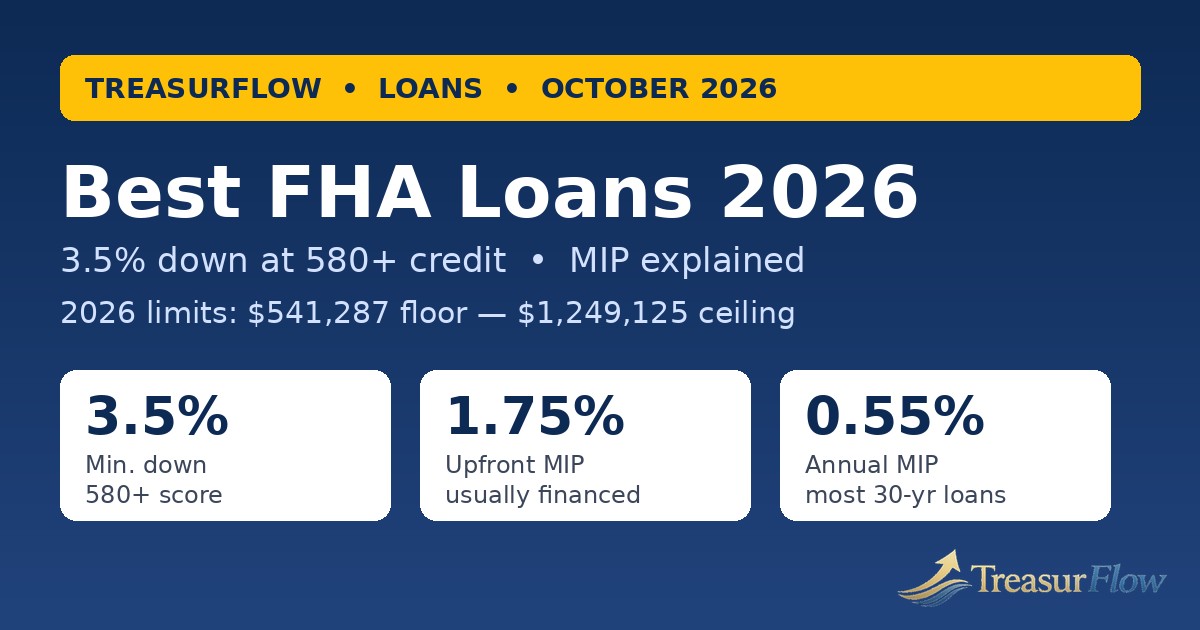
An FHA loan is not automatically the cheapest way to buy a home, and it is not automatically the easiest either. It is a specific tool, insured by the Federal Housing Administration (FHA), part of the U.S. Department of Housing and Urban Development (HUD), that solves a specific problem: you have steady income and you can afford a monthly payment, but your credit score or your savings would shut you out of a conventional mortgage. If that is your situation in 2026, the best FHA loans are the ones matched to your exact borrower profile — not the lender with the loudest advertisement.
This guide to the best FHA loans 2026 works in a different order from most listicles. First, it settles eligibility: the down-payment tiers, the mortgage insurance anatomy, the 2026 loan limits, and the property rules that can kill a deal late in the process. Only after you know whether you qualify, and what the insurance will cost you over the years you actually plan to stay in the home, does it make sense to compare lenders. So the lender picks in this guide are organized by borrower profile — a 500-to-579 credit score, a first-time buyer using gift funds, a self-employed borrower, a buyer who wants a big bank — rather than by a single generic ranking.
Related guides
- Best Mortgage Refinance Companies in 2026 — useful later, because refinancing out of FHA is how most borrowers eventually stop paying mortgage insurance.
- How to Save Money for a House While Renting in the USA (2026) — how to build the 3.5% down payment and closing-cost fund without derailing your budget.
- Best Homeowners Insurance Companies in 2026 — homeowners insurance is part of your monthly escrow payment on any FHA loan, so the quote matters.
- Best Personal Loans in 2026 — read this before you are tempted to borrow a down payment; FHA does not allow a personal loan as your down-payment source.
- DSCR Loan Rates in 2026 — included for contrast: DSCR loans are for investment property, and FHA loans are not. FHA is for a primary residence only.
Helpful Official Resources
- HUD — FHA Lenders and Single Family programs — HUD’s own hub for FHA single-family lending, including the FHA Mortgage Limits Search and Mortgagee Letter 2025-23, which set the 2026 loan limits.
- U.S. Department of Housing and Urban Development (HUD) — look up whether a lender is FHA-approved and search your county’s loan limit before you apply.
- Consumer Financial Protection Bureau — What is mortgage insurance and how does it work? — the CFPB’s plain-English explanation of mortgage insurance, including the FHA upfront premium you can roll into the loan.
- USA.gov — the federal government’s official portal for housing help, including HUD-approved housing counseling agencies that can review your budget for free or at low cost.
Rates, fees, and lender minimums in this article are stated as of October 2026. FHA rules cited here come from HUD and FHA program guidance. This article is educational information, not financial advice, and it is not a loan offer or a commitment to lend. Always compare the official Loan Estimate from at least three FHA-approved lenders before you choose.
What an FHA Loan Actually Is — and What It Is Not
The FHA does not lend you money. A private, FHA-approved lender makes the loan, and the FHA insures that lender against loss if you default. That insurance is the whole reason the program can be more forgiving: because the lender’s risk is covered, the lender can approve a borrower with a 580 credit score and 3.5% down, or even a borrower in the 500s with more money down, where a conventional lender working without that backstop would often say no.
That structure creates three consequences every borrower should understand before applying. First, you pay for the insurance yourself, through the mortgage insurance premium, or MIP. Unlike private mortgage insurance (PMI) on a conventional loan, MIP is not optional, it is not based on shopping around for an insurer, and its rates are set by FHA — every FHA lender charges the same MIP schedule, so lenders compete on interest rate, lender fees, service, and overlays, not on MIP. Second, the property has to satisfy FHA as well as you: the home must pass an FHA appraisal focused on safety, soundness, and security. Third, the loan must stay inside your county’s FHA loan limit. A home priced above that limit cannot be financed with a standard FHA loan in that county, no matter how strong the rest of your file is.
FHA loans are only for a primary residence. You must move in within 60 days of closing, and the property can have one to four units as long as you live in one of them. That four-unit rule is why some first-time buyers buy a duplex, live in one side, and rent the other — a legal, well-established use of the program. What you cannot do is use an FHA loan for a vacation home or a pure investment property you never intend to occupy.
Eligibility First: The Down-Payment and Credit Score Tiers
Eligibility for an FHA loan starts with a simple structure set by HUD, and the single most useful thing in this entire article is the tier table below. Everything else — lender choice, MIP cost, loan limits — hangs off which tier you fall into.
- 580 or higher: You qualify for maximum financing — 3.5% down, a 96.5% loan-to-value ratio.
- 500 to 579: You qualify, but with 10% down.
- Below 500: Not eligible for FHA financing.
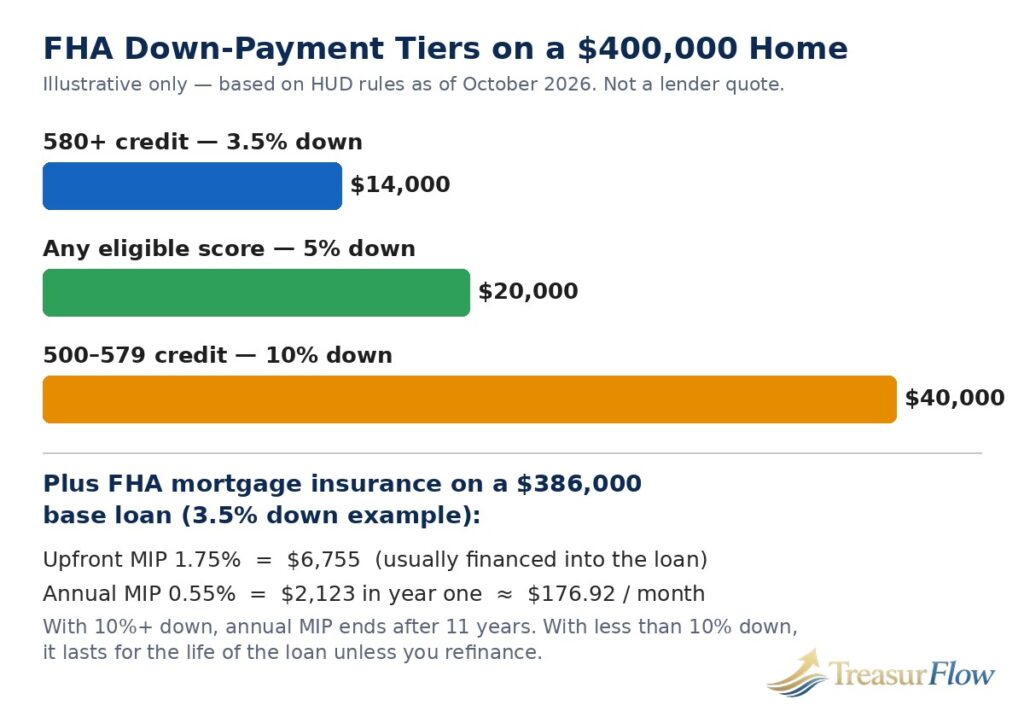
Put dollars on it. On a $300,000 home, a 580 score means $10,500 down; a 540 score means $30,000 down — nearly three times the cash for the same house. On a $400,000 home it is $14,000 versus $40,000. That gap is why a borrower sitting at 565 should price both paths honestly: waiting and repairing credit to cross 580 can be worth tens of thousands in preserved savings, but waiting also carries risk if prices or rates move. The tiers themselves do not change; what changes is which lender will actually work with you inside them.
The lender overlay trap
Here is the trap most borrowers fall into: they read that FHA allows a 500 score and assume every FHA lender will take them. FHA sets the floor, but each lender adds its own rules on top, called overlays. NerdWallet’s October 2026 comparison of FHA lenders shows how wide the spread is: Rocket Mortgage lists a 580 minimum, Rate lists 500, Chase lists 620, and NBKC lists 620. Same federal program, four different doors. A denial from a 620-overlay lender tells you nothing about your FHA eligibility — it tells you that you knocked on the wrong door. This is why the lender profiles later in this article are organized by borrower situation rather than by brand size.
Income, debt-to-income ratio, and employment
FHA underwriting looks at two ratios. The front-end ratio — your housing payment divided by gross monthly income — has a benchmark around 31%. The back-end ratio — all recurring debts including the new housing payment, divided by gross monthly income — has a benchmark around 43%. Those are benchmarks, not walls. With strong compensating factors, such as cash reserves, minimal payment increase over your current rent, or residual income, an automated approval through FHA’s TOTAL Scorecard can support ratios well above those benchmarks. Without compensating factors, a high back-end ratio is the most common reason an otherwise eligible borrower stalls.
Lenders generally want to see about two years of employment history, not necessarily with the same employer, and a reasonable expectation that the income continues. Self-employed borrowers should expect to document income with tax returns, and lenders average that income over time, which can help or hurt depending on the trend; a declining business is a harder file than a growing one at the same average. Recent graduates and career changers are not automatically disqualified — education and training for the job can count toward the history — but the file has to tell a coherent story.
Derogatory events have their own clocks. As a general rule, FHA looks for about two years after a Chapter 7 bankruptcy discharge and about three years after a foreclosure, with documented exceptions for certain extenuating circumstances and shorter paths in some Chapter 13 situations. If you are inside one of those windows, tell the lender on the first call, because it determines which lenders can help you now and which conversation is a waste of your time.
Where the down payment can come from
One of FHA’s genuine advantages is flexibility about where the money comes from. Gift funds from family are allowed, documented with a gift letter stating the money is a gift, not a loan, plus a paper trail. Approved down payment assistance programs — state, local, and certain nonprofit programs — can be layered on top, which is how some FHA buyers get in with very little of their own cash, though always confirm the specific program is approved for FHA use and that your lender participates. Seller concessions are also more generous than conventional norms: a seller can contribute up to 6% of the price toward your closing costs, which does not reduce your down payment but does reduce the other cash you need at the table.
What is not allowed matters just as much. The down payment cannot come from a personal loan, a credit card cash advance, or any new debt you take on for the purpose — borrowed down payment money defeats the point of a down payment, and underwriters look for exactly this in your bank statements. Large deposits that are not payroll will be questioned and must be sourced. Start moving money into the account you will document from two to three months before you apply, and leave it there, so the paper trail is boring. Boring is good.
The Anatomy of MIP: The Cost That Decides Whether FHA Is Worth It
If eligibility gets you in the door, MIP decides whether you should walk through it. Mortgage insurance is FHA’s main ongoing cost, and it comes in two parts that behave completely differently. Lenders cannot change either part — the rates are FHA’s — so this section is the same math at every lender. What a lender can change is your interest rate and fees, which is why MIP belongs in your comparison spreadsheet as a fixed cost and the rate and fees as the variables.
Part one: the upfront mortgage insurance premium
The upfront mortgage insurance premium (UFMIP) is 1.75% of the base loan amount, charged once at closing on essentially every FHA loan. Most borrowers finance it, meaning it is added to the loan balance rather than paid in cash — which also means you pay interest on it for as long as the loan runs. You can pay it in cash at closing if you prefer not to finance it, but almost nobody does. The key point: UFMIP is all-or-nothing. It is not reduced because you are a strong borrower, and it does not shrink with a bigger down payment. If you refinance out of FHA relatively soon, part of this sunk cost is simply the price of having used the program.
Part two: the annual mortgage insurance premium
The annual mortgage insurance premium is charged as a percentage of the loan amount and collected monthly as part of your payment. For the typical 30-year FHA purchase at or below a $726,200 base loan amount, the annual MIP is 0.55% per year when you put less than 5% down, and 0.50% per year when you put 5% or more down. Larger loans step up: on a 30-year term above $726,200, the annual MIP can reach 0.75%. Fifteen-year loans carry much lower annual MIP. The premium is recalculated on the outstanding balance over time, so the monthly dollar amount drifts down slowly as you pay principal — but on a minimum-down 30-year loan it does not disappear, which is the subject of the duration rule below.
Worked example: MIP on a $400,000 purchase (illustrative)
Assumptions, stated plainly so you can re-run them with your own numbers: a $400,000 purchase, 3.5% down, a 30-year term, and the standard MIP rates above. This is an illustration of the insurance cost only, not a loan quote.
- Home price: $400,000
- Down payment at 3.5%: $14,000
- Base loan amount: $386,000
- Upfront MIP: $386,000 × 1.75% = $6,755, usually financed, for a total initial loan balance of $392,755
- Annual MIP: $386,000 × 0.55% = $2,123 in the first year, about $176.92 per month
Across the first five years, that is roughly $6,755 plus about five years of annual MIP — on the order of $10,000 or more of insurance cost, slowly declining as the balance falls, before you count a dollar of interest. None of that makes FHA a bad deal; for a borrower who could not buy at all otherwise, it may be cheap at the price. But it does mean the honest comparison is never FHA-rate versus conventional-rate. It is FHA-rate-plus-MIP versus conventional-rate-plus-whatever-PMI-applies, over the years you realistically expect to keep the loan.
How long MIP lasts — the rule that changes the math
Here is the rule that surprises people: if you put less than 10% down, annual MIP lasts for the life of the loan. It does not cancel at 20% equity the way PMI on a conventional loan does. If you put 10% or more down, MIP ends after 11 years. For a minimum-down borrower, there are only two exits: pay the loan off, or refinance into a non-FHA loan once your credit and equity support it. That is why planning the refinance is part of choosing FHA intelligently from day one — see our guide to the best mortgage refinance options in 2026 for how that exit typically works, and keep your credit file refinance-ready while you hold the FHA loan.
2026 FHA Loan Limits: Check Your County Before You Shop
FHA loan limits are set county by county and announced by Mortgagee Letter. For 2026, Mortgagee Letter 2025-23, issued December 11, 2025, covers case numbers assigned on or after January 1, 2026. The one-unit floor — the limit in the lowest-cost counties — is $541,287, which is 65% of the 2026 national conforming loan limit of $832,750. The one-unit ceiling in the highest-cost areas is $1,249,125, which is 150% of that conforming limit. In Alaska, Hawaii, Guam, and the U.S. Virgin Islands, a special exception raises the one-unit ceiling to $1,873,625.
Multi-unit properties get higher limits. In floor areas for 2026, the limits are $693,050 for two units, $837,700 for three units, and $1,041,125 for four units; in ceiling areas they reach $1,599,375, $1,933,200, and $2,402,625 respectively. Two practical consequences follow. First, in most of the country the FHA limit is comfortably above the median home price, so the limit rarely binds — but in high-cost metros it binds hard, and buyers there sometimes discover FHA cannot reach the homes they are looking at. Second, remember the MIP step-up: once your base loan amount passes $726,200, the annual MIP tier rises, so a high-limit purchase carries a higher insurance rate as well as a bigger loan. Check your specific county in HUD’s FHA Mortgage Limits tool before you fall in love with a house, not after.
One more point that is easy to miss: the limit applies to the loan amount, not the price. Your price can exceed the limit only if you cover the difference in cash on top of the required down payment, which changes the cash math completely. If a home sits just above your county limit, that negotiated price reduction is worth more than it looks.
Property Standards: The Home Has to Qualify, Too
FHA appraisals do double duty: they estimate value and they check the property against FHA’s minimum property standards for safety, soundness, and security. Peeling paint on an older home, a roof at the end of its life, missing handrails, non-functioning systems, water intrusion, and similar health-and-safety items can all be flagged as required repairs before closing. This is the single biggest practical friction in FHA buying: some sellers, especially in competitive markets, prefer conventional or cash offers precisely because they fear the FHA repair list.
There are established ways through it. Repairs can be negotiated — a seller who fixes a short list of safety items keeps the deal alive, and many do. Homes needing bigger work can be financed with an FHA 203(k) rehabilitation loan, which rolls purchase and renovation into one FHA loan; the Limited 203(k) covers simpler, non-structural projects, while the Standard 203(k) covers major work with more process and oversight. And buyers should set expectations early with their agent: an FHA offer on a visibly distressed property is a different negotiation from an FHA offer on a well-kept home, where the appraisal usually passes without drama.
Condos have an extra gate: the project generally must be FHA-approved, or the unit must qualify for single-unit approval under FHA’s rules. Townhomes and condos that look perfect on paper can fail here, so verify the project’s status before writing the offer. Manufactured housing, unusual property types, and homes with certain deed restrictions also carry extra FHA conditions — another first-call question for your lender.
The Best FHA Lenders in 2026, Matched to Borrower Profiles
The FHA program rules — the tiers, MIP, limits, and property standards above — are identical at every approved lender. What differs is the overlay, the underwriting style, the fees, and the experience. So instead of a generic top-ten, this section matches lenders to the situations FHA borrowers actually have. Inclusion in a profile is not a verdict that a lender is cheapest for you; it is a pointer to where your profile fits. Prices move daily, which is why this article deliberately publishes no lender APRs: get same-day Loan Estimates and compare real numbers, using the routine at the end of this section.
One discipline note before the profiles: several minimums below come from NerdWallet’s October 2026 FHA lender comparison, and industry roundups from sources such as The Close corroborate the profiles. Lender minimums and programs change; treat every number here as a reason to call, not a promise, and confirm on the Loan Estimate.
Best for the lowest credit scores (500 to 579): lenders with no extra overlay on the FHA floor
If your score is in the 500s, your lender universe is short, and it starts with lenders that follow the FHA floor itself. Rate (NMLS #2611) lists a 500 credit-score minimum for FHA loans in NerdWallet’s October 2026 comparison — one of the very few major lenders publishing a minimum at the FHA floor rather than above it. Remember what the floor costs you: at 500 to 579 you are in the 10%-down tier, so the conversation with any floor-following lender is about documenting that larger down payment and the rest of the file cleanly. If a lender in this band offers manual underwriting, that is a genuine plus for a thin or recovering file, because a human underwriter can weigh compensating factors that an automated pass might miss. Bring bank statements that are boring, a sourced down payment, and a short written explanation for the derogatory items — at this tier, preparation is the difference between approval and a slow no.
Best for a fully digital, high-volume experience: Rocket Mortgage
Rocket Mortgage (NMLS #3030) is the default starting point for borrowers who want the whole process online, and NerdWallet’s October 2026 comparison lists its FHA minimum credit score at 580 — squarely in the 3.5%-down tier, but not a home for sub-580 files. Rocket was the largest FHA lender by volume in 2024 in NerdWallet’s analysis, and scale shows up as a polished digital application, fast document handling, and deep FHA operational experience. The trade-off to manage is the same as with any high-volume lender: your file moves through a system, so keep your own checklist, respond to conditions the same day, and get your Loan Estimate in writing early so you can use it as the benchmark quote when you shop the same scenario elsewhere.
Best for nontraditional and self-employed income: New American Funding
New American Funding (NMLS #6606) is the profile to look at when your income does not fit a single W-2 box: self-employment, multiple income streams, or a recent transition that needs a human to read the whole file. Industry coverage, including The Close’s FHA lender roundups, has cited New American Funding for manual underwriting capability — the process where an underwriter evaluates the file directly rather than relying only on an automated decision. For a self-employed borrower being averaged over two years of returns, or a borrower with compensating factors that need explaining, that capability can matter more than a headline rate. Ask directly whether your file will be manually underwritten if the automated system refers it, and what documentation they want up front; a good manual-underwriting lender will give you a precise list on the first call.
Best for buyers who want a major bank and in-person branches: Chase
Chase Home Lending (NMLS #399798) is the major-bank profile: branches, an existing-banking relationship for many borrowers, and a large servicing operation. Its overlay is the honest caveat — NerdWallet’s October 2026 comparison lists Chase’s FHA minimum credit score at 620, well above the FHA floor, and Chase’s own FHA listing describes a 3% minimum down payment, which is different from FHA’s 3.5% standard framing, so read the actual Loan Estimate rather than the marketing page. For a 620-plus borrower who values walking into a branch and keeping accounts under one roof, Chase is a legitimate quote to collect. For a sub-620 borrower, the overlay means your time is better spent with the floor-following profiles above.
Best for rate-and-fee shoppers with a 620+ score: NBKC and online lenders
NBKC (NMLS #409631) represents the online, cost-focused end of the market; NerdWallet’s October 2026 comparison lists its FHA minimum at 620. Lenders in this class tend to compete on lean overhead: fewer branches, centralized processing, and pricing that rewards a clean, well-documented file. If your score is 620 or higher and your file is straightforward, this profile is where an aggressive same-day quote often comes from — and even if you ultimately choose a different lender, a sharp online quote disciplines every other offer in your stack. The watch-outs are process questions: who is your point of contact, how are appraisal and conditions handled in your state, and what does the Loan Estimate show for lender fees, not just the rate.
Best for down payment assistance layering: state and local program lenders
The last profile is not a brand; it is a channel. If your plan depends on down payment assistance, the best FHA lender for you is the one approved to deliver your specific state or local program alongside the FHA loan. DPA programs have their own income limits, purchase-price limits, education requirements, and approved-lender lists, and a lender who is brilliant generally but not approved for your program cannot close your loan. Start from the program’s approved-lender list, then apply the comparison routine below among those lenders. Also price the assistance honestly: some programs carry a slightly higher rate or a second lien with its own terms, which can still be an excellent trade for preserving your emergency fund — but read those terms before you are committed.
How to compare FHA lenders in one afternoon
Whichever profiles fit, run the same routine. One: apply with three lenders inside the same 14-day window, so the credit inquiries group together for scoring purposes. Two: give each lender the identical scenario — same price, same down payment, same property type, same lock period — and require an official Loan Estimate from each, ideally the same day. Three: compare four numbers line by line: the interest rate, total lender fees, cash to close, and the monthly payment including MIP (which should be essentially identical across lenders at the same loan amount — if it is not, ask why). Four: ask each lender two profile questions — “What is your minimum credit score for FHA, and is that an overlay?” and “If my file gets referred by the automated system, will you manually underwrite it?” The lender who answers both plainly, prices cleanly, and returns documents fast is usually your lender.
FHA vs. Conventional Loans: The Full Comparison
Most FHA borrowers are really asking one question: FHA or conventional? Here is the comparison on the factors that actually differ, using 2026 FHA rules and typical conventional (conforming) practice.
| Feature | FHA loan (2026) | Conventional loan (2026) |
|---|---|---|
| Minimum credit score | 580 with 3.5% down; 500–579 with 10% down (lender overlays vary) | Commonly 620 minimum, with pricing that improves sharply at higher scores |
| Minimum down payment | 3.5% at 580+; 10% at 500–579 | As low as 3% for eligible first-time and low-to-moderate income buyers; 5%+ is common |
| Mortgage insurance | Upfront MIP 1.75% plus annual MIP (0.55%/yr typical at <5% down for 30-year loans at or below a $726,200 base loan) | PMI priced by credit score and down payment; no upfront premium on standard loans |
| Insurance duration | Life of loan if <10% down; ends after 11 years if 10%+ down | PMI can be removed at 20% equity and auto-terminates at 22% based on the original schedule |
| 2026 loan limit (one-unit) | $541,287 floor to $1,249,125 ceiling; $1,873,625 in AK, HI, GU, and USVI | $832,750 baseline conforming limit; higher in designated high-cost areas |
| Debt-to-income flexibility | Benchmarks around 31% front-end and 43% back-end, with higher ratios possible with compensating factors | Often up to about 45–50% back-end with strong files through automated underwriting |
| Gift funds | Allowed with a gift letter and paper trail; assistance programs may layer | Allowed under documentation rules that vary by down payment and property type |
| Seller concessions | Up to 6% of the price toward closing costs | Typically 3% when putting less than 10% down; higher percentages at larger down payments |
| Property standards | FHA appraisal checks minimum property standards (safety, soundness, security) | Appraisal focused on value; condition issues handled differently |
| Occupancy | Primary residence only; move in within 60 days; 1–4 units with owner occupying one | Primary, second home, or investment, with pricing and down payment changing by occupancy |
Read as scenarios, the table resolves quickly. Below a 640 score or with a small down payment, FHA usually wins: conventional may be technically available but priced so punitively — or blocked by PMI underwriting — that FHA’s fixed MIP is cheaper and the approval is real. At 740-plus with 20% down, conventional usually wins outright: no upfront premium, no ongoing insurance at all, and top-tier pricing. In the middle, quote both on the same day and compare the five-year cost including insurance, not the rate. The middle is where generic advice fails and arithmetic decides.
Two reminders that belong in every comparison: your monthly escrow includes homeowners insurance, so the policy you choose moves the payment either way — see the best homeowners insurance companies in 2026 — and none of this applies to investment-only financing, which is a different product family entirely, covered in our guide to DSCR loan rates in 2026.
How to Apply for an FHA Loan, Step by Step
Step zero happens before any application: assemble the file. You will need identification, recent pay stubs, two years of W-2s and tax returns (full returns if self-employed), two to three months of bank statements showing the down payment sourced and seasoned, and documentation for any derogatory items. If your down payment is still being built, our guide on how to save money for a house while renting is the practical companion. Then confirm your tier honestly: pull your actual scores, decide whether you are applying at 3.5% down or 10% down, and check your county’s loan limit against your target price range.
Then run the process in order. Get pre-approved with at least one lender matched to your profile — and get competing Loan Estimates once you have a property in view, using the one-afternoon routine above. Make your offer with the FHA specifics in mind: a realistic appraisal timeline and a seller who understands the property standards check. After the offer is accepted, the lender orders the FHA appraisal; respond to underwriting conditions immediately, every time, because conditions are where FHA timelines are won and lost. Before closing, review the Closing Disclosure against your Loan Estimate line by line — the rate, the fees, the UFMIP, and the monthly MIP should all match what you agreed to. After closing, move in within 60 days, and put a calendar marker two years out to revisit the refinance-out-of-MIP question with fresh eyes.
Common FHA Mistakes That Cost Borrowers Money
The expensive mistakes repeat themselves. One: assuming a headline FHA approval standard is the lender’s standard — the overlay trap — and wasting weeks with a lender who was never going to take your file. Two: comparing lenders on interest rate alone while ignoring lender fees and the five-year insurance cost, which is how a “cheaper” loan ends up costing more. Three: borrowing or moving down payment money in ways that cannot be documented, then watching underwriting stall over unsourced deposits. Four: falling for a home that cannot pass FHA property standards or sits above the county limit, and discovering it after paying for inspections. Five: forgetting that minimum-down MIP never cancels, and never building the refinance exit into the plan — the costliest mistake of all, because it quietly adds years of premiums. Every one of these is avoidable with the checks in this article, done in order.
Who Should — and Should Not — Choose an FHA Loan in 2026
Choose FHA if your credit score is between 500 and the mid-600s and your down payment is limited; if your file needs manual underwriting, gift funds, or layered down payment assistance; if you are buying a two-to-four-unit home you will live in; or if conventional pricing for your profile is worse than FHA’s fixed insurance cost over the years you expect to hold the loan. For these borrowers, FHA is not a fallback — it is the correctly priced tool.
Do not choose FHA by default if you have a 740-plus score and 20% to put down, where conventional is usually cheaper in every direction; if you are buying a condo in a project that is not FHA-approved; if you need a loan above your county’s FHA limit; or if the property plainly cannot meet FHA standards and the seller will not negotiate repairs. And whoever you are, do not choose any loan — FHA included — on a monthly payment you have not stress-tested against taxes, insurance, and maintenance. The right loan is the one whose total cost, over your real time horizon, you have actually computed.
FHA Questions Borrowers Ask Before They Sign Anything
What credit score do I need for an FHA loan in 2026?
Under FHA’s own rules, a 580 credit score qualifies for maximum financing with 3.5% down, scores from 500 to 579 qualify with 10% down, and scores below 500 are not eligible. The practical answer depends on the lender, because many lenders add overlays above the FHA floor — published minimums in October 2026 ranged from 500 to 620 depending on the lender — so match the lender to your score band rather than assuming one denial settles it.
How much is FHA mortgage insurance in 2026?
FHA mortgage insurance has two parts: an upfront premium of 1.75% of the base loan amount, usually financed into the loan, and an annual premium collected monthly. For a typical 30-year loan at or below a $726,200 base loan amount, the annual premium is 0.55% per year with less than 5% down and 0.50% with 5% or more down; larger 30-year loans can reach 0.75%. On a $386,000 base loan, that is $6,755 upfront and about $2,123 in the first year, roughly $176.92 a month.
What are the FHA loan limits for 2026?
For 2026, set by Mortgagee Letter 2025-23 for case numbers assigned on or after January 1, 2026, the one-unit limit runs from a floor of $541,287 in low-cost counties to a ceiling of $1,249,125 in high-cost areas, with a special exception ceiling of $1,873,625 in Alaska, Hawaii, Guam, and the U.S. Virgin Islands. Multi-unit properties have higher limits; check your county’s exact figure in HUD’s FHA Mortgage Limits tool before shopping.
Can my down payment come from a gift or assistance program?
Yes. FHA allows gift funds from family with a gift letter and a documented paper trail, and approved down payment assistance programs can be layered on top. What FHA does not allow is a down payment borrowed through a personal loan, a credit card advance, or any new debt taken on for that purpose, and any large non-payroll deposits will have to be sourced during underwriting.
How long do I have to pay FHA mortgage insurance?
If you put less than 10% down, the annual mortgage insurance premium lasts for the life of the loan — it does not cancel when you reach 20% equity the way conventional PMI does. If you put 10% or more down, it ends after 11 years. The practical exits for a minimum-down borrower are paying the loan off or refinancing into a non-FHA loan once credit and equity allow.
Does the home itself have to pass an inspection for an FHA loan?
The home must pass an FHA appraisal that checks value and FHA’s minimum property standards for safety, soundness, and security. Health-and-safety items — roof condition, peeling paint on older homes, water intrusion, non-working systems — can be required repairs before closing, and condos generally must be in an FHA-approved project or qualify for single-unit approval.
Conclusion
An FHA loan in 2026 is neither the bargain its fans describe nor the last resort its critics assume. It is a specific instrument: the most accessible path to ownership for borrowers with scores from the 500s upward and small down payments, priced with an insurance premium that is fixed, predictable, and — at minimum down — permanent until you refinance out of it. Work the problem in the order this article used: confirm your tier under HUD’s rules before you talk to anyone, price the insurance honestly against the conventional alternative for your exact profile, check your county’s limit and the property’s eligibility before you fall for a house, then make lenders with the right overlay and underwriting style compete for your file on identical same-day Loan Estimates. Do those four things and FHA stops being a gamble and becomes what it was designed to be — a fair-priced bridge into a home, with a planned exit.

Muhammad Zakir is the founder of Treasurflow and the author of its personal finance guides. He researches consumer banking, credit, and personal loans, and every guide cites primary sources such as the CFPB, FDIC, FTC, and IRS. His content is educational and is not personalized financial advice.