

Best Jumbo Loans 2026: An Underwriting-First Guide to Qualifying, Lenders, and Rates
If you need to borrow more than $832,750 to buy a one-unit home in most of the United States in 2026, you are not shopping for a normal mortgage anymore. You are shopping for a jumbo loan — and jumbo loans are won or lost in underwriting, not in a headline rate.
That is the idea behind this guide. Most jumbo loan pages lead with a rate table, as if the lowest number on a screen were the loan you will actually get. In the jumbo market, that order is backwards. First, a lender decides whether your credit, reserves, income, down payment, and property are strong enough for it to keep a very large loan on its own books. Only then does pricing matter — and when it does, the difference between lenders can be worth hundreds of dollars a month on the same house.
This guide therefore starts where underwriters start. It explains what makes a loan jumbo in 2026, who actually qualifies, how reserves and appraisals really work, and how to compare lenders by type — big bank and private-client, credit union, and online — instead of chasing a single national average. It then works through rate pricing with real, Python-computed payment math on a $1,200,000 loan, the jumbo-versus-conforming decision, the choice between an adjustable-rate mortgage (ARM) and a fixed rate in the jumbo market, and a realistic 45- to 60-day closing timeline with a reserve documentation checklist you can use before you apply.
A short note on rates before we begin: jumbo rates move daily and vary sharply by lender, loan size, credit profile, and property. This article does not print a “today’s rate” table as if it were a fact you can lock. Where rates appear, they are attributed, date-stamped survey or sample context from October 2026 sources, clearly labeled as such. Your only reliable rate is a same-day, written Loan Estimate based on your actual file. Get several, on the same day, for the same scenario — that discipline matters more in jumbo lending than in almost any other mortgage market.
Related Guides
- Best Mortgage Refinance 2026 — if you already own and are weighing a jumbo refinance instead of a purchase loan.
- Save Money for a House While Renting in the USA in 2026 — how to build the down payment and reserves a jumbo underwriter will want to see.
- DSCR Loan Rates in 2026 — a different underwriting model, for investment property financed on rental income rather than personal income.
- In-House Financing Guide in 2026 — how portfolio and in-house lending works when a loan is not sold onward.
Helpful Official Resources
- FHFA — Conforming Loan Limit Values for 2026 — the official announcement setting the 2026 baseline limit at $832,750 and the high-cost ceiling at $1,249,125.
- Consumer Financial Protection Bureau — Loan Estimate Explainer — how to read and compare the standardized Loan Estimate every lender must provide.
- Consumer Financial Protection Bureau — What Information Do I Have to Provide to Get a Loan Estimate? — the six pieces of information that trigger a lender’s duty to issue a Loan Estimate within three business days.
- Board of Governors of the Federal Reserve System — background on interest rates, monetary policy, and consumer credit conditions that shape mortgage pricing.
What Makes a Loan “Jumbo” in 2026 — and Why That Word Changes Everything
A jumbo loan is a mortgage that exceeds the conforming loan limit for its county and property type. “Conforming” means the loan conforms to the rules that allow it to be purchased by Fannie Mae or Freddie Mac, the two government-sponsored enterprises that buy, guarantee, and package most American mortgages for investors. A loan above the limit cannot be sold to them in the normal way. That single fact explains almost everything else in this article.
The 2026 limits, verified
For 2026, the Federal Housing Finance Agency (FHFA) set the baseline conforming loan limit for one-unit properties at $832,750 in most of the United States, up $26,250 from $806,500 in 2025. The increase reflects a 3.26% rise in average U.S. home prices between the third quarters of 2024 and 2025, as measured by the FHFA House Price Index.
In designated high-cost areas — where 115% of the local median home value exceeds the baseline — the limit is higher, up to a ceiling of $1,249,125 for a one-unit property, which is 150% of the baseline. Special statutory rules set still different figures for Alaska, Hawaii, Guam, and the U.S. Virgin Islands, where the one-unit baseline is $1,249,125 and the ceiling is $1,873,675.
Two warnings belong here, because stale information is everywhere in this market. First, many pages still cite $806,500 as “the” limit. That was the correct baseline for 2025, not 2026. If a lender page, a calculator, or a comparison site is still built around $806,500, treat everything else on that page with caution until you confirm it has been updated. Second, the limit that matters is your county’s limit for your property type, not the national headline. A $900,000 loan is jumbo in a baseline county and perfectly conforming in a high-cost county with a $1,100,000 limit. Always check the county figure before you assume which underwriting rules apply to you. The FHFA publishes the full county list alongside its announcement, linked in the resources box above.
Limits also rise with unit count. For 2026, the baseline limits are $1,066,250 for a two-unit property, $1,288,800 for three units, and $1,601,750 for four units, with correspondingly higher high-cost ceilings. This guide focuses on the far more common one-unit case, but if you are buying a small multifamily property as a primary residence, your jumbo threshold is higher than the headline number suggests.
Portfolio loans: the lender keeps the risk
Because a jumbo loan cannot be sold to Fannie Mae or Freddie Mac, the lender typically holds it in its own portfolio — at least for a time — or sells it into a much smaller private secondary market on its own terms. Either way, the lender, not a government-sponsored enterprise, bears the risk if you default on a seven-figure balance.
That is why jumbo underwriting is stricter, and also why it is more variable. A conforming loan is judged against a largely standardized rulebook, often through an automated underwriting system. A jumbo loan is judged against each lender’s own guidelines, risk appetite, and current desire — or lack of desire — to add large loans to its balance sheet. One lender may decline a file that another approves. One lender may price a strong file aggressively because it wants the borrower’s deposits and wealth relationship; another, with a full portfolio, may price the identical file half a point higher because it does not need the loan.
This variability is frustrating if you expect a single “jumbo rate.” It is an opportunity if you understand it: in jumbo lending, shopping across lender types is not a nicety, it is the strategy. The sections below are built around that fact.
Who needs a jumbo loan?
You need one if your loan amount — not your home price — exceeds your county limit. Note the distinction. On a $1,100,000 purchase in a baseline county with 20% down, your loan is $880,000, which is jumbo. With 30% down, your loan is $770,000, which is conforming. The down payment decision and the jumbo decision are therefore the same decision at the margin, a point we return to in the jumbo-versus-conforming section.
Jumbo loans are common in high-cost coastal markets, but they are increasingly ordinary elsewhere: a move-up purchase in Austin, Denver, Phoenix, Nashville, or suburban Chicago can cross $832,750 without anything resembling a mansion being involved. Rising prices have quietly turned jumbo underwriting into a mainstream skill for move-up buyers, self-employed professionals, and anyone buying in a market where the median detached home now costs seven figures.
Who Actually Qualifies for a Jumbo Loan in 2026
Underwriters look at a jumbo file as a package of compensating factors. No single number guarantees approval, and a weakness in one area must usually be offset by strength in another — more reserves, a larger down payment, or a lower debt-to-income ratio. Here is what each factor involves, in the order an underwriter tends to care about them.
Credit score: 700–720+ is the realistic center of gravity
Most jumbo programs center on a credit score of 700 to 720 or higher. Chase, on its own jumbo education pages, describes lenders as typically looking for scores of 680 or higher in general terms, while noting that a strong score — often 700 or higher — is what borrowers should expect to need in practice, and Rocket Mortgage’s published jumbo guidance similarly works with higher thresholds as loan size grows, including 680+ for amounts under $2 million and 720+ above $2 million in its cash-out refinance guidelines. Treat those figures as orientation, not promises: a lender’s live guidelines for your loan size and property type govern.
In practical terms:
- 740 and above is where the best jumbo pricing tiers usually open up. If you are near a tier boundary, even a 20-point improvement — paying a card balance down before the statement closes, correcting a reporting error, letting a hard inquiry age — can be worth real money on a seven-figure balance.
- 700–739 is approvable at many lenders with a sound file, but expect less pricing generosity and less forgiveness for other weaknesses.
- High 600s programs exist, but they generally demand compensating strength: a larger down payment, lower loan-to-value, substantial reserves, and a clean recent payment history. Do not build a purchase plan that depends on the most flexible program you can find mentioned online.
- Derogatory events — bankruptcy, foreclosure, short sale — carry longer waiting periods and heavier documentation in jumbo programs than many borrowers expect. Disclose them early. An underwriter who discovers a problem late is far less flexible than one who was told on day one.
Before you apply anywhere, pull your own credit reports, check them for errors, and ask each lender which score version and which bureau’s middle score it will use. Jumbo pricing tiers are unforgiving of surprises.
Down payment: 10–20% is the working range, 20% is the comfort zone
Plan on 10% to 20% down for most primary-residence jumbo purchases, with 20% as the benchmark that unlocks the widest lender choice and the cleanest pricing. Some well-qualified borrowers find 10% options; second homes and investment properties typically require more, often 20% to 30% or higher, and larger loan amounts tighten the requirement further.
The down payment matters for three separate reasons. First, it sets your loan-to-value (LTV) ratio, a primary pricing and approval variable: an 80% LTV file is simply a different risk from a 90% LTV file. Second, on some programs, putting less than 20% down triggers private mortgage insurance (PMI) or an equivalent pricing adjustment — although certain portfolio and “smart” jumbo products are marketed as not requiring PMI at lower down payments, so ask explicitly rather than assuming either way. Third, cash used for the down payment cannot also count as reserves, a sequencing problem that catches buyers who can just barely do both. Work through the saving and staging of these funds well before you shop — the Treasurflow guide to saving money for a house while renting covers the accumulation side of exactly this problem.
If you are close to the conforming limit, model the alternative: a larger down payment that brings the loan to $832,750 (or your county limit) and keeps you conforming. Sometimes the extra cash down is cheaper, in total cost and in approval certainty, than entering the jumbo market at 10% down. Sometimes it is not, if it would strip your reserves bare. The comparison section below works through that trade-off.
Reserves: 6–18 months, and this is where jumbo files live or die
Reserves are the funds you will still have after closing — after the down payment and closing costs are paid — expressed as months of your full housing payment: principal, interest, taxes, insurance, and any HOA dues (often shortened to PITI or PITIA). Jumbo lenders commonly require 6 to 18 months of reserves, with the requirement rising with loan size, number of properties owned, and property risk.
Published examples illustrate the scale. Rocket Mortgage’s jumbo guidance for its Jumbo Smart product lists 6 months of reserves for loans of $1 million or less, 12 months for loans between $2,000,001 and $2,500,000, and 18 months for loans between $2,500,001 and $3,000,000 — a clear illustration that reserve requirements step up with balance. Chase’s jumbo education material similarly describes a typical target of at least 6–12 months of payments in reserve. Your lender’s figure for your tier is the one that counts, so ask for it in writing at application, not at conditional approval.
To feel the scale: on a $1,200,000 loan at 7.00%, principal and interest alone are $7,983.63 a month (computed in the rate section below). Twelve months of principal and interest alone is about $95,804 — before adding taxes and insurance, which in a high-tax or high-insurance market can add thousands a month to the payment the reserve calculation is based on. Borrowers are routinely surprised that the reserve requirement, not the down payment, is their binding constraint. It does not have to be cash in a checking account at every lender — many programs count retirement and brokerage accounts, sometimes at a discounted value to allow for market moves and withdrawal taxes — but the rules for what counts, and at what haircut, are lender-specific and must be confirmed, not assumed.
Practical reserve rules:
- Seasoning and sourcing. Large deposits and recently moved funds invite questions. Expect to document the paper trail for significant deposits, gifts, and transfers between accounts.
- Gift funds may be allowed for part of the down payment at some lenders and restricted or disallowed for reserves. Get the gift policy in writing before a family member transfers anything.
- Do not move money casually between accounts during underwriting. Every transfer creates a documentation task. Consolidate early, then leave the money still.
- Retirement accounts are not automatically counted at full value. Ask what percentage your lender credits and what documentation — terms of withdrawal, most recent statements — it needs.
Debt-to-income ratio: lower than conforming, calculated more carefully
Jumbo lenders generally want a debt-to-income (DTI) ratio at or below about 43% — some programs allow a little more with strong compensating factors, many prefer less. DTI here means your total monthly debt payments — the new housing payment at the full PITI level, plus auto loans, student loans, minimum card payments, support obligations, and payments on other properties — divided by your gross monthly income.
Two jumbo-specific cautions apply. First, because the housing payment is large in absolute terms, a DTI that looks comfortable on a conforming loan can fail on a jumbo: 43% of a $25,000 monthly income is $10,750, and a $9,500 housing payment leaves very little room for any other debt at all. Paying off a car loan before applying can matter more than a small rate improvement. Second, income itself is scrutinized harder. Bonus, commission, RSU, and self-employment income typically need a documented history — commonly two years — and a reasonable expectation of continuation. Self-employed borrowers should expect two years of personal and business tax returns, a year-to-date profit-and-loss statement, and questions about business trends, not just averages. If your income rose sharply last year, do not assume the underwriter will simply use the higher figure; if it fell, expect the lower trend to dominate the analysis.
Employment, income documentation, and the full-file standard
Conforming lending has grown comfortable with streamlined documentation for strong files. Jumbo lending has not, to the same degree. Expect a full-documentation standard:
- Two years of tax returns (personal, and business if applicable), with IRS transcripts pulled by the lender to verify them.
- W-2s, recent pay stubs, and a verbal or written verification of employment.
- Two to three months of bank and asset statements — all pages, including blank ones.
- Explanations and documentation for large deposits, recent credit inquiries, and any derogatory credit events.
- For other real estate owned: mortgage statements, tax and insurance figures, leases, and evidence of rental income history.
Manual underwriting is common in jumbo lending — a human underwriter reviewing the whole file rather than an automated system issuing a clean approval. That slows things down, but it also means compensating factors can be argued and explained. A well-organized file with a short, factual cover note for anything unusual is a genuine advantage in manual underwriting. A disorganized file that forces the underwriter to hunt is a genuine disadvantage.
Appraisals: one is standard, two are common on larger or unusual properties
Every jumbo loan needs an appraisal, and on larger loans — commonly above thresholds in the $1.5 million to $2 million range at many lenders, though the trigger varies — or on unique, luxury, acreage, or otherwise hard-to-value properties, lenders frequently require two independent appraisals, sometimes supplemented by a field review. Chase’s jumbo cost guidance flags exactly this: the potential need for multiple appraisals to verify the value of a high-end property.
Budget for it in both money and time. Two appraisals cost more than one, and if the two values diverge materially, underwriting may work from the lower figure — which raises your LTV, potentially changes your pricing, and can even change your required down payment mid-process. Build a contingency into your purchase negotiation where you can, and ask at application: how many appraisals will you order on my file, what do they cost, and what happens if they disagree?
Property and occupancy: the same loan is not the same risk
Primary residences get the best jumbo terms. Second homes are priced and underwritten more cautiously; investment properties more cautiously still, with larger down payments, higher reserve requirements, and higher rates. Condominiums — especially in projects with litigation, low owner-occupancy, hotel-like features, or a single entity owning many units — face project-level review that can delay or derail a loan regardless of the borrower’s strength. Non-warrantable condos and co-ops are their own specialist market in places like New York. If your property is anything other than a detached single-family primary residence, raise its specifics with lenders before you fall in love with their rate quote, because property eligibility is a yes/no gate that no credit score can override.
Best Jumbo Lenders in 2026, by Type — and How to Choose Between Them
There is no single best jumbo lender. There is a best type of lender for your file, your timeline, and your relationship situation — and, within that type, a best quote on the day you lock. The picks below are organized by type, describe each lender’s documented positioning as verifiable from October 2026 sources, and deliberately avoid printing specific maximums, minimums, or rates for lenders whose current primary-source figures could not be verified — see the notes at the end of this section for what was omitted and why. Always confirm live terms directly with the lender; jumbo guidelines change without a press release.
Big banks and private-client lenders: Chase, Bank of America, and Wells Fargo
Best for: borrowers with substantial deposits or wealth relationships, complex income, very large loan amounts, or a preference for a lender that will hold and service its own portfolio loan.
Chase is a useful reference point because it publishes comparatively clear jumbo education material. Its own pages describe jumbo qualification in terms of a credit score of 680 or higher as a general lender expectation, a DTI around 43%, reserves covering a minimum of roughly 6–12 months of payments, a 20% down payment as the traditional standard with 10% or 15% options possible for highly qualified borrowers, and the possibility of two appraisals on high-value properties. Just as important is what that framing signals: Chase underwrites jumbo as a core, relationship banking product. Borrowers who bank or hold assets with a large institution should always ask about relationship pricing and private-client programs — and should also ask whether a stated relationship discount requires moving assets, and by when, because the fine print determines whether the discount is real for you.
Bank of America was named NerdWallet’s Best Mortgage Lender for Jumbo Loans in its 2026 roundup, which cited its standing in the jumbo market among the factors assessed. Like the other money-center banks, its jumbo positioning is built around scale, a national branch and servicing footprint, and relationship-based pricing for clients with deposits or Merrill wealth accounts. If you are an existing Preferred Rewards-style relationship client anywhere in big banking, your first jumbo quote should come from your own bank — not because it will necessarily win, but because its quote reveals what your relationship is actually worth in basis points, which is information you can then use in negotiation elsewhere.
Wells Fargo remains one of the historic names in high-balance and private banking mortgage lending, with jumbo and portfolio products closely tied to its private-client and wealth channels. Its positioning is similar in kind: strongest for borrowers whose overall balance sheet, not just whose W-2, makes the case, and for larger or less standard files that benefit from manual, relationship-based underwriting.
The big-bank trade-offs are consistent. Strengths: capacity for very large loans, tolerance — at the right relationship level — for complex files, interest-only and other portfolio structures that conforming channels cannot offer, and the stability of a lender that services what it originates. Weaknesses: speed and flexibility for ordinary files can lag specialist online lenders; overlays can be conservative; and the best treatment is often reserved for clients bringing significant assets. Go in with your eyes open, and get the relationship terms in writing.
Credit unions: Navy Federal and the member-owned alternative
Best for: eligible members with strong files who value lower fees and member-owned pricing over absolute speed, and VA-eligible borrowers in particular.
Navy Federal Credit Union, the largest credit union in the United States, serves military members, veterans, and their families, and offers jumbo and VA jumbo options to its members alongside its conventional products. Credit unions price differently from banks in a way that can matter on jumbo loans: as member-owned, not-for-profit institutions, they often compete on lower origination fees and relationship simplicity rather than on teaser pricing, and they typically hold a meaningful share of their mortgages in portfolio, which suits jumbo lending naturally. The constraint is eligibility — you must qualify for membership — and, at many credit unions, processing pace during busy periods.
If you are eligible for a large credit union, include it in your quote set even if you expect a bank or an online lender to win. Its Loan Estimate is a powerful negotiating benchmark precisely because its fee structure tends to be plain. And if you are VA-eligible, ask specifically about VA jumbo: borrowers with full VA entitlement are not bound by the same county loan limits in the way conventional borrowers are, and a VA jumbo can, for the right borrower, change the down payment calculation entirely. That is a specialist conversation — have it with a lender that closes significant VA volume.
Smaller regional credit unions and community banks deserve a mention here too. A local institution that knows your market’s property values intimately can be the most flexible underwriter in this entire article for an unusual property — a rural estate, a mixed-use building, a home with acreage — that national automated systems struggle to value. For an odd property, local portfolio knowledge is a product feature.
Online and nonbank lenders: Better, Rocket Mortgage, and NBKC
Best for: well-documented, straightforward files where speed, digital process, and transparent online pricing matter most; borrowers who want a fast, comparable quote to discipline every other lender’s pricing.
Rocket Mortgage publishes the most detailed jumbo underwriting guidance of the online group, which itself tells you something about its positioning: jumbo as a systematized, high-volume product, including its Jumbo Smart line. Its published material describes manual underwriting as frequent for jumbo loans, sets out the stepped reserve requirements quoted earlier in this guide (6 months at $1 million or less in its Jumbo Smart reserve table, rising to 18 months at the highest tier listed), and gives the credit orientation for jumbo refinancing noted above. For a clean file — salaried income, strong credit, standard property — a systematized process is an advantage: fewer surprises, faster document cycles, and a digital experience built for volume.
Better competes on the online, low-overhead model: digital application, an emphasis on no lender origination fees in its marketing positioning, and fast initial rate quotes by state and product. Its state-level jumbo rate pages via rate-display partners illustrate the online model well — for example, a Better jumbo sample for New York displayed on October 19, 2026 showed a 30-year fixed sample at 7.375% (7.418% APR) and a 7/6 ARM sample at 6.375%, on a clearly stated sample scenario ($350,000 loan, 760–850 credit band in that display — a conforming-sized sample used for display purposes, not a jumbo quote). Treat displays like that exactly as labeled: a sample, on a stated scenario, on a stated date. Better’s value in your process is a fast, real Loan Estimate on your scenario, which you can then hold every other lender to.
NBKC Bank represents the low-fee online bank end of the market — a Kansas City-based bank long known in mortgage circles for lean lender fees and strong online reviews, with jumbo among its home loan products. Lenders in this mold are worth including for a simple reason: on a $1,200,000 loan, lender fees and origination charges are a smaller percentage of the story than rate, but they are real money, and a low-fee lender’s Loan Estimate exposes how much of a competitor’s quote is rate and how much is charges.
The online trade-off mirrors the big-bank one in reverse. Strengths: speed, transparency, process quality, and aggressive pricing on clean files. Weaknesses: less appetite for genuinely complex income, unusual properties, or files that need a human to argue compensating factors to a credit committee — the very files big-bank private channels exist for. Match the lender type to your file type first; then compete lenders within and across types on price.
A note on what this section deliberately does not print
Aggregator and affiliate pages circulating in October 2026 attach very specific figures to some of the lenders above — maximum loan amounts, minimum scores, and headline rates — that could not be verified against the lender’s own current primary-source material, and in several cases rest on the stale 2025 conforming limit of $806,500. Those unverified specifics are omitted from this guide rather than repeated. A jumbo guide that copies an aggregator’s “$5 million maximum, 740 minimum” claim without a primary source is not informing you; it is decorating a guess. Ask each lender for its current guideline sheet for your loan size, occupancy, and property type, and work from that document.
How to run a fair lender comparison
- Fix the scenario. Same property, same price, same down payment, same loan type and term, same credit assumptions, same lock period — in writing, to every lender, on the same day.
- Demand Loan Estimates, not worksheets. Under CFPB rules, once you have provided the six required items — name, income, Social Security number, property address, estimated property value, and desired loan amount — a lender must issue a Loan Estimate within three business days. Worksheets and rate printouts are marketing; Loan Estimates are comparable legal documents.
- Compare the whole price. Rate, APR, lender fees, points, lender credits, PMI or its absence, appraisal count and cost, and lock terms — together, over the period you realistically expect to keep the loan.
- Ask the underwriting questions up front. Reserve requirement for my tier? One appraisal or two? How will my bonus/self-employment/RSU income be calculated? Any overlay above your published guidelines on my file? A cheap quote from a lender whose underwriter will later decline the file is the most expensive quote of all.
- If you are refinancing rather than purchasing, run the same comparison discipline — and see Treasurflow’s best mortgage refinance guide for 2026 for the break-even math that decides whether a refinance is worth its closing costs at all.
Jumbo Loan Rates in 2026: Portfolio Pricing, Lender Spread, and What $1.2 Million Really Costs
Why there is no single jumbo rate
Conforming rates cluster tightly because conforming loans are commodities, priced off a deep, standardized secondary market. Jumbo loans are not commodities. Each lender prices them off its own cost of funds, its deposit base, its current appetite for large-balance loans, its servicing values, and the relationship sitting in front of it. The result is spread: on any given day, the gap between the best and worst genuine jumbo quote for the same strong file can be a quarter to half a percentage point or more — a gap that would be unusual in conforming lending and is routine here.
That is also why the old rule of thumb that “jumbo rates are higher than conforming rates” is unreliable in 2026. Sometimes they are higher. Sometimes, when large banks are competing for high-balance relationships, jumbo pricing for top-tier borrowers runs close to — or occasionally through — conforming pricing. And sometimes, as in the October 2026 survey context below, jumbo averages sit noticeably above conforming averages. All three states are normal at different moments. The average tells you the weather; your quotes tell you your price.
October 2026 rate context — attributed and date-stamped
The following is survey and sample context, not a quote and not a promise of availability:
- Experian’s jumbo rate overview, citing Optimal Blue data via the Federal Reserve’s FRED database, put the average 30-year jumbo rate at 7.50% in October 2026, noting that jumbo averages had hovered around 7% over the preceding two years.
- MonitorBankRates, in rates verified October 19, 2026, listed 3/1 jumbo ARM rates ranging from 5.12% to 5.88% among the lenders it tracked — a reminder that short-fixed-period ARMs price materially below 30-year fixed jumbo rates, and that the range within a single product type on a single date spans more than three-quarters of a point.
- Sample state-level displays for Better’s jumbo products in mid-October 2026 showed 30-year fixed samples around 7.375% in the examples reviewed, with 15-year fixed samples lower and 7/6 ARM samples varying by state — again, on stated sample scenarios, not on any individual borrower’s file.
Read those three items together and the lesson is the spread itself: product, lender, and borrower profile move a jumbo price by amounts that dwarf most borrowers’ negotiating efforts in the conforming market. Which is why the next section, the actual math, matters.
The payment math on a $1,200,000 loan — computed, not copied
All figures in this section were computed with the standard amortization formula in Python for this article. They are illustrative principal-and-interest (P&I) figures for a 30-year fixed-rate loan of $1,200,000. They exclude property taxes, homeowners insurance, HOA dues, PMI, and closing costs, all of which will add to your real payment and to your reserve calculation.
| Rate (illustrative) | Monthly principal & interest | Total interest over 30 years |
|---|---|---|
| 6.75% | $7,783.18 | $1,601,943.78 |
| 7.00% | $7,983.63 | $1,674,106.78 |
| 7.25% | $8,186.12 | $1,747,001.53 |
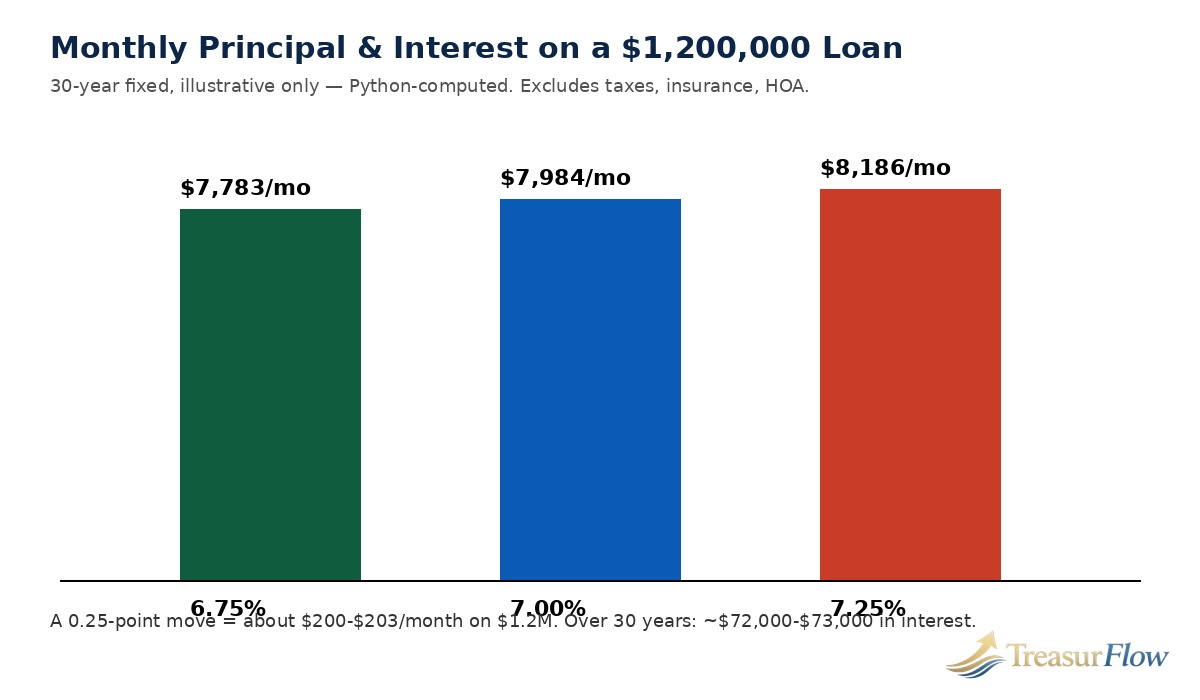
Now the point of the table. Moving from 6.75% to 7.00% — a single quarter-point — raises the payment by $200.45 a month, from $7,783.18 to $7,983.63, and adds about $72,163 in interest over the full 30-year term. Moving from 7.00% to 7.25% raises it by a further $202.49 a month, to $8,186.12. Across the half-point from 6.75% to 7.25%, the difference is $402.94 a month — roughly $4,835 a year, every year, for as long as you hold the loan at that rate.
That is the financial case for everything else in this guide. An afternoon spent collecting three same-day Loan Estimates, a credit score nudged over a pricing tier, a reserve position documented cleanly enough that a lender prices you as the strong file you are — each of those mundane acts is competing for a prize worth about $200 a month per quarter-point on a loan this size. Conversely, it is the case against two common mistakes: paying points without a break-even calculation (a point on $1,200,000 is $12,000 in cash — divide it by the monthly saving it buys to find how many months you must keep the loan for the point to pay off), and accepting a lender’s first quote because the monthly difference “sounds small.” On jumbo balances, small percentages are large dollars.
Run the same discipline on a 15-year comparison if your cash flow allows it: 15-year jumbo pricing typically sits below 30-year pricing, the payment is substantially higher, and total interest falls dramatically. The right term is the one whose payment you can sustain while still holding the reserves and liquidity that made you an attractive jumbo borrower in the first place — draining yourself to win a rate is a trade underwriters, and your future self, will both question.
Rate locks, points, and float-downs in the jumbo market
Ask each lender, in writing: What lock periods do you offer on jumbo loans — 45, 60, 90 days — and what does each cost? Is a float-down available, and at what price? What happens if closing slips past the lock because of a second appraisal or a slow condo review — who pays for the extension? On a 45- to 60-day jumbo timeline, lock management is not a detail. A lock expiring a week before closing on a $1,200,000 loan is a four-figure problem, and the cheapest initial quote can become the most expensive loan if its lock terms do not fit a realistic closing schedule. If you are also weighing structures beyond a standard purchase loan — for instance, investor financing underwritten on property income — the DSCR loan rates guide shows how differently pricing and qualification work when personal income is not the basis of the loan.
Jumbo vs. Conforming: The Decision at the Margin
If your loan amount sits anywhere near the conforming limit, you have a genuine choice, and it deserves a calculation rather than a reflex. Three structures cover most cases:
Strategy 1: Stay conforming with a larger down payment. Bring the loan down to the county limit and take the conforming loan. Advantages: the deepest, most competitive market; more lenders; conforming servicing standards; and, for strong files, streamlined documentation. Costs: the extra cash leaves your reserves — which may matter more than the rate difference — and if the extra down payment pushes you below comfortable liquidity, you have traded a paperwork advantage for a financial vulnerability. Run the reserve math both ways before choosing.
Strategy 2: Go jumbo with 10–20% down and preserve liquidity. Advantages: cash stays invested or available; the loan is simpler (one lien, one payment); and for top-tier files jumbo pricing is sometimes competitive with conforming. Costs: stricter underwriting, longer timelines, possible PMI or rate adjustments at higher LTVs, and reserve requirements that may force you to keep the liquidity on display in qualifying accounts anyway.
Strategy 3: Split the difference with a piggyback structure. A conforming first mortgage plus a smaller second loan or HELOC (the classic 80-10-10 shape) can keep the first loan conforming while reducing the cash to close. Costs: two underwritings, two payments, a second-lien rate that is materially higher, and — in a portfolio-driven market — second-lien availability and terms vary widely by lender. Piggybacks suit specific cash-flow plans; they are not a default answer.
Whichever structure you model, compare on total cost over your expected holding period, not on the first loan’s rate alone — and if your situation involves keeping an existing property while buying the next one, the sequencing strategies in the in-house financing guide cover a related set of trade-offs.
ARM vs. Fixed Rate in the Jumbo Market
Adjustable-rate mortgages hold a larger share of the jumbo market than of the conforming market, for sound reasons: jumbo borrowers are more likely to have shorter expected holding periods, more likely to refinance opportunistically, and better positioned to absorb adjustment risk. The October 2026 context above shows why the products tempt: 3/1 jumbo ARM rates tracked by MonitorBankRates ran from 5.12% to 5.88% while 30-year fixed jumbo averages sat near or above 7%. On a $1,200,000 balance, that gap is worth several hundred dollars a month during the fixed period.
Modern jumbo ARMs are mostly hybrid structures — 3/1, 5/6, 7/6, 10/6 — fixed for the stated first period, then adjusting periodically (the “/6” denotes six-month adjustments after the initial period, in the current SOFR-indexed convention) subject to caps: an initial adjustment cap, a periodic cap, and a lifetime cap. Those caps are the product. Before comparing any ARM quote, get all three caps, the index, the margin, and the fully indexed rate in writing, and calculate the payment at the lifetime cap. If that payment breaks your budget, the ARM’s teaser saving is not a saving; it is a deferred problem with a date on it.
Interest-only periods exist in parts of the jumbo and private-bank market. They lower the initial payment while building no equity through amortization, and they belong only in deliberate cash-flow strategies — a borrower managing lumpy income, for instance — never as a way to stretch into a larger purchase. If a quote’s attractiveness depends on the interest-only period, the purchase price, not the loan structure, is the problem.
Choose by horizon and by resilience, not by the teaser:
- If you are confident you will sell or refinance within the fixed period, a 5/6, 7/6, or 10/6 ARM matched to that horizon is a rational way to capture the lower rate — and the longer fixed periods (7/6, 10/6) buy insurance against timelines slipping.
- If this is a long-term or forever home, or if an adjustment to the cap would strain your budget, the 30-year fixed’s payment certainty is worth its premium, especially at balances where a two-point adjustment means roughly $1,600 more per month on a $1.2M loan.
- In every ARM case, hold reserves against the adjustment scenario, not just the initial payment — underwriters who see that in your file will treat the ARM as a strategy rather than a stretch.
Closing a Jumbo Loan: The 45- to 60-Day Timeline and Reserve Documentation Checklist
A realistic timeline
Plan on 45 to 60 days from application to closing for a jumbo purchase, and build that expectation into your purchase contract. Faster closings happen, but underwriting depth, possible second appraisals, and reserve verification make jumbo timelines longer and more variable than conforming ones.
- Days 1–3 — Application and Loan Estimate. Submit the complete file; the lender issues the Loan Estimate within three business days of receiving the required information.
- Days 3–10 — Processing and appraisal ordering. Documents are indexed and verified; the appraisal (or appraisals) is ordered early because it is the longest-lead item.
- Days 10–30 — Appraisal and underwriting. The appraisal is completed; a human underwriter reviews the full file and issues a conditional approval with a list of conditions.
- Days 30–45 — Clearing conditions. You supply remaining items — sourced deposits, explanations, updated statements — promptly; delays here are the most common cause of slipped closings.
- Days 45–60 — Final approval, Closing Disclosure, and closing. Federal rules require the Closing Disclosure to be delivered at least three business days before closing; review it line by line against your Loan Estimate.
Protect the timeline with behavior, not hope: respond to condition requests the same day, do not open new credit, do not change jobs or entity structures mid-process without telling the lender first, and do not move large sums between accounts unless the lender asks you to. Most jumbo delays are self-inflicted paperwork delays.
Reserve and document checklist
Assemble this file before you apply, in digital form, and you will clear conditions faster than almost anyone else in the pipeline:
Income and employment
- [] Two years of personal tax returns (all schedules); business returns if self-employed or holding 25%+ ownership
- [] Year-to-date profit-and-loss statement if self-employed
- [] Two years of W-2s and 1099s; most recent 30 days of pay stubs
- [] Employer contact for verification of employment; explanations for any gaps or changes
- [] Documentation for bonus, commission, or RSU income (two-year history and employer confirmation of continuance)
- [] Award letters for Social Security, pension, or annuity income if used to qualify
Assets and reserves
- [] Two to three months of statements for every account used — all pages
- [] Source documentation for every large deposit (payroll records, transfer trails, gift letter if applicable)
- [] Investment and retirement statements showing reserves after closing, with the lender’s valuation percentage noted
- [] Evidence of liquidation or transfer path for any funds needed to close
- [] Reserve summary: total post-closing liquid reserves ÷ monthly PITI = months of coverage (compute it yourself; hand the underwriter the answer)
Debts and property
- [] Mortgage statements, tax bills, insurance declarations, and HOA statements for all properties owned
- [] Leases and rental-income documentation for investment properties
- [] Purchase contract, homeowners insurance binder, and flood certification for the subject property
- [] Statements for debts not on the credit report (private loans, margin lines, alimony or support orders)
Identity and authorization
- [] Government ID and authorization for the lender to pull credit and IRS transcripts
- [] Entity or trust documents if title will be held by an entity or trust
Costs to budget beyond the rate
One appraisal is standard; a second, when required, adds several hundred dollars or more. Lender origination and underwriting fees vary by type — low-fee online lenders advertise minimal lender fees, while private-bank pricing may bundle differently. Title, escrow, recording, prepaid taxes and insurance, and possible discount points complete the picture, all itemized on your Loan Estimate and Closing Disclosure. Compare lenders on Sections A, B, and J of the Loan Estimate for lender-controlled costs, and separately total the prepaid and escrow items, which follow the property rather than the lender.
Conclusion: Win the Underwriting, Then Win the Rate
The best jumbo loans in 2026 do not go to the borrowers who find the lowest advertised number. They go to the borrowers who understand what a jumbo loan actually is — a portfolio loan, underwritten by hand, against a lender’s own balance sheet — and who present a file that makes that underwriting easy: a credit profile in the 700s with the best tier in reach, a down payment that leaves real reserves behind it, six to eighteen months of documented post-closing liquidity, a DTI an underwriter does not have to argue for, and paperwork complete enough that conditions clear in days rather than weeks.
So work in the order this guide has followed. Confirm whether your loan is actually jumbo in your county for 2026. Assemble the full file before you apply. Choose two or three lenders across types — a big bank or private-client lender if relationships matter, a credit union if you are eligible, an online lender if your file is clean and speed matters — and force them to compete on identical Loan Estimates on the same day. Then do the payment math yourself, at the rates you are actually quoted, and let the quarter-points argue for your attention: on a $1,200,000 loan, each one is worth about $200 a month.
Do that, and the jumbo market’s defining feature — its variability — stops being the thing that makes quotes hard to compare and becomes the thing that rewards you for comparing them.
Disclaimer: This article is educational information about U.S. mortgage lending, not financial, tax, or legal advice, and it does not recommend any specific lender or product. Loan limits cited are the FHFA’s 2026 conforming loan limit values; rates, programs, lender requirements, and award citations were drawn from the sources attributed in the text as of October 2026 and change without notice. Payment figures are illustrative computations for a hypothetical $1,200,000 loan and are not a quote, an offer, or a commitment to lend. Verify current limits, rates, and program terms with lenders and official sources, and consult qualified professionals about your own situation before borrowing.
Jumbo Loan Approval Questions Borrowers Ask Before They Apply
What is the jumbo loan limit in 2026?
For 2026, the FHFA baseline conforming loan limit for a one-unit property is $832,750 in most counties. A loan above that amount is jumbo. In designated high-cost areas, the ceiling rises to $1,249,125, and loans between the baseline and the local limit there are high-balance conforming rather than jumbo. Limits are higher for two- to four-unit properties and differ in Alaska, Hawaii, Guam, and the U.S. Virgin Islands. Always check your county’s 2026 limit, because older figures still circulate widely.
What credit score do you need for a jumbo loan in 2026?
Most jumbo programs center on 700–720 or higher. Chase publishes a minimum of 700 for its jumbo loans, and Rocket Mortgage’s Jumbo Smart guidance pairs a 680 minimum with 80% maximum LTV and 12 months of reserves at its published tier. The best pricing tiers usually open at 740 and above. Scores in the high 600s can work in narrower programs, typically with a larger down payment, stronger reserves, and less pricing flexibility. Your score affects approval and price separately — ask each lender which score and tier your file lands in.
How many months of reserves do jumbo lenders require?
Commonly 6 to 18 months of the full monthly housing payment (principal, interest, taxes, insurance, and HOA dues) held in liquid or documented assets after closing. Requirements scale with loan size, LTV, and properties owned: Rocket Mortgage’s published Jumbo Smart tier requires 12 months, and Chase states its reserve requirements vary by property type. On a $1,200,000 loan at 7.00%, principal and interest alone are $7,983.63 a month, so a 12-month reserve position against PITI is a six-figure sum — calculate it before you apply, and ask each lender its exact requirement for your tier.
Do jumbo loans require two appraisals?
Sometimes. One appraisal is standard, but many lenders require two on larger loans — commonly above thresholds around $1.5 million to $2 million in loan amount — and on unusual, rural, or otherwise hard-to-value properties at any size. If the two values differ, underwriting typically works from the lower one or orders a review. Budget for the possibility in both cost and time, and ask your lender at application which threshold applies to your loan.
Are jumbo loan rates always higher than conforming rates?
No. The relationship moves with lender appetite. In October 2026, Experian’s overview, citing Optimal Blue data via FRED, put the average 30-year jumbo rate at 7.50% — above conforming averages at the time. In other periods, competition among portfolio lenders has pushed top-tier jumbo pricing close to or below conforming pricing. What is constant is the spread between lenders: jumbo quotes for the same file vary far more than conforming quotes, which is why comparing same-day Loan Estimates matters more than watching averages.
How long does it take to close a jumbo loan?
Plan on 45 to 60 days from application to closing for a jumbo purchase. Manual underwriting, reserve verification, and the possibility of a second appraisal make timelines longer and more variable than conforming loans. You can protect the schedule: submit a complete document file at application, respond to underwriting conditions the same day, avoid new credit or job changes mid-process, and do not move large sums between accounts without telling the lender. Most jumbo delays are documentation delays, and most of those are preventable.

Muhammad Zakir is the founder of Treasurflow and the author of its personal finance guides. He researches consumer banking, credit, and personal loans, and every guide cites primary sources such as the CFPB, FDIC, FTC, and IRS. His content is educational and is not personalized financial advice.