
Most boat owners shop for insurance backwards. They ask for the cheapest premium, glance at the liability limit, sign, and only learn what they actually bought after a storm, a collision, or a theft — when the claims adjuster explains a single line in the policy that was there all along. That line is the settlement method: whether your boat is insured for an agreed value or for its actual cash value. It can be worth more than every other choice on the page combined, and it is the reason this guide to the best boat insurance 2026 starts there instead of with a list of company names.
As of October 2026, there are nearly 12 million registered boats in the United States, and boating remains a genuinely risky way to spend a weekend. The most recent Coast Guard statistics cited in 2026 roundups reported about $67.5 million in property damage from reported accidents in a recent year, along with 658 deaths and 2,641 injuries. You do not need to dwell on those numbers to take them seriously. A boat is an expensive, exposed asset that operates in an environment with no brakes, no lanes, changing weather, and other operators whose skill and insurance status you cannot control. The right policy does not just satisfy a marina office or a loan officer. It decides whether a bad day on the water stays a bad day or becomes a five-figure financial problem.
This guide helps you buy in the right order. First, the settlement-method trap, with a worked example. Next, the anatomy of a boat policy — hull, liability, uninsured boater, towing, fuel-spill, and medical coverage. Then our carrier picks by boat type: best overall for recreational boats, best for fishing boats and pontoons, best for personal watercraft, best for high-value boats and yachts, and best for member benefits. Finally, what drives your premium, when insurance is genuinely required, and a quote checklist to use line by line.
A quick note on prices before we begin. Every premium range in this guide comes from 2026 comparison roundups and is date-stamped as of October 2026. These are starting ranges and typical ranges reported in those roundups, not guaranteed quotes. Your price will depend on your boat, your waters, your experience, and your coverage choices, and the only way to know it is to get quotes written on the same limits and the same settlement method. Where a feature is described — such as disappearing deductibles or total-loss replacement — it is described as a carrier feature reported in 2026 roundups, with availability and terms that vary by policy and state. Read your own policy documents before you rely on any single feature.
Related Guides
Protecting a boat usually goes hand in hand with protecting everything else you own. If you are reviewing your coverage this year, start with our guide to the best homeowners insurance 2026, which covers the home policy many boat owners mistakenly assume will cover their boat as well. If your boating plans include a charter, a cruise, or a fishing trip away from home, see our picks for the best travel insurance 2026. And if your dog or cat is part of the crew, our guide to the best pet insurance 2026 explains how to protect them, too.
Helpful Official Resources
- U.S. Coast Guard Boating Safety — uscgboating.org: official federal boating safety information, accident statistics, life-jacket guidance, and links to state boating laws.
- BoatUS Foundation — boatus.org: free and low-cost boating safety courses, clean-boating guidance, and state-specific safety education resources.
- Your state boating authority: registration, operator education, and any state-specific insurance or financial-responsibility rules start with your state’s boating agency, which the Coast Guard site above will help you find.
The Settlement Trap: Agreed Value vs. Actual Cash Value
Here is the question that matters most on any boat insurance quote, and the one most buyers never ask: if your boat is destroyed or stolen tomorrow and never recovered, what dollar figure will the insurer actually use to write the check?
There are two common answers, and the gap between them grows every year you own the boat.
An agreed value policy (sometimes called agreed amount or stated value with an agreed-value endorsement — read the exact wording on your quote) settles a total loss at the value agreed when the policy was written. If you and the insurer agreed the boat was worth $30,000, a total loss pays $30,000, minus any applicable deductible, with no deduction for depreciation. The number is known in advance. There is no argument about what five seasons of sun, salt, and engine hours did to the resale price, because that argument was settled on the day you bought the policy.
An actual cash value (ACV) policy settles a total loss at the boat’s depreciated market value at the time of the loss. The insurer looks at the boat’s age, condition, comparable sales, and depreciation, and pays what the boat was worth on the used market the day before it sank, burned, or disappeared. For a newer boat the difference may be modest. For a boat that is five, eight, or twelve years old, the difference can be enormous — and it falls entirely on you.
The $30,000 Pontoon Example
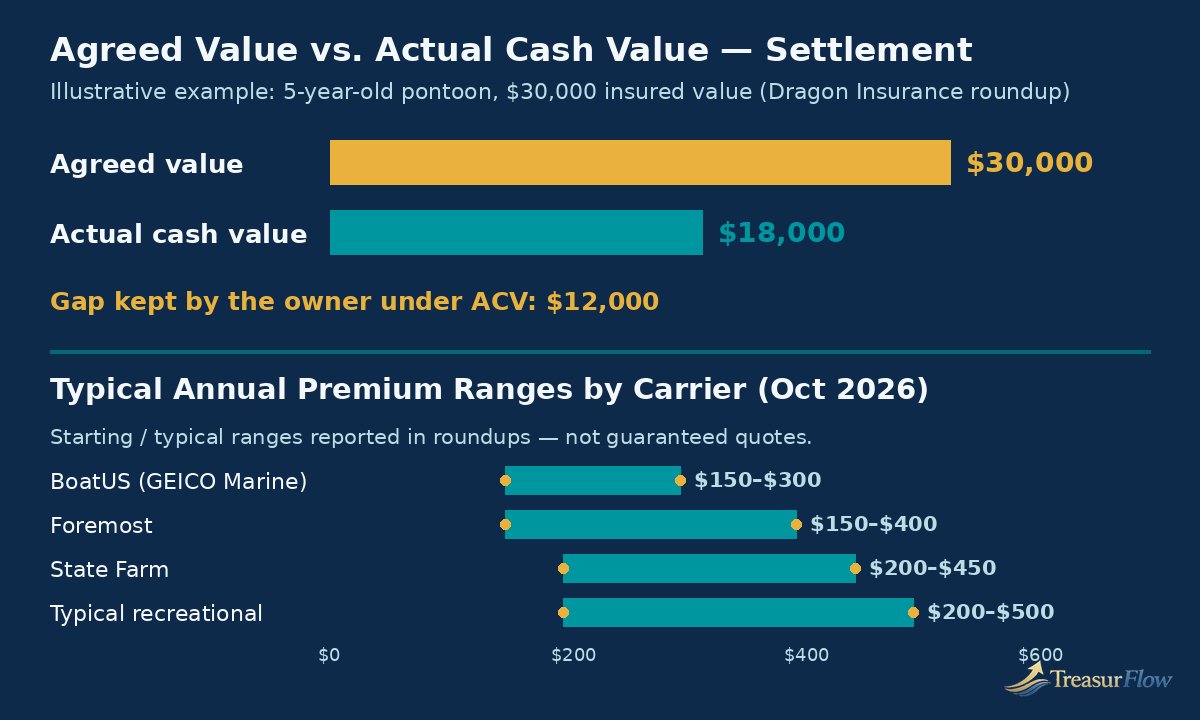
Consider the illustrative example used in the Dragon Insurance roundup, which we label here exactly as what it is: an illustrative example, not a promise about your claim. A 5-year-old pontoon boat originally insured at a $30,000 value might settle around $18,000 under actual cash value after depreciation, versus the full $30,000 agreed amount under an agreed-value policy.
That is a $12,000 gap on the same boat, the same storm, and the same total loss. If you still owe $22,000 on a boat loan, the ACV check does not even retire the loan — you would owe the lender $4,000 for a boat that no longer exists, and you would have nothing left toward a replacement. The agreed-value check retires the loan and leaves a real down payment on the next boat. Same premium conversation, completely different financial outcome. This is why experienced owners treat the settlement method as the first filter, not a footnote: a cheap ACV quote is not actually cheaper than an agreed-value quote once you price the risk you are keeping yourself.
The trap is that ACV quotes often look like bargains. Because the insurer’s maximum exposure shrinks as the boat depreciates, ACV premiums can be lower, and an agent or website sorting by price will happily show you the lower number first. Nothing about that is dishonest — ACV is a legitimate product, and for an older, low-value boat owned free and clear, it can be a rational choice. The trap is buying it by accident, assuming the $30,000 figure on the declarations page is what a total loss pays, when the policy actually promises only the depreciated value behind that figure.
Partial Losses: The Second Place Settlement Method Bites
Total losses get the attention, but most claims are partial: a lower unit strikes a submerged log, a trailer accident crumples a transom, a lightning strike fries the electronics, or storm surge batters the hull at the dock. Settlement wording matters here, too.
Under many ACV-based approaches, partial-loss repairs can also be depreciated, leaving you to cover the difference between a ten-year-old part’s book value and the real cost of a new part plus labor. Under many agreed-value policies, partial losses are settled on a repair-cost basis without depreciation on most parts, though some components may still follow special depreciation schedules. Chubb is specifically noted in 2026 roundups for agreed-value settlement with no depreciation on most partial losses. Treat that as the question to ask every carrier: “On a partial loss, do you depreciate parts, and which parts?” Get the answer in writing.
Three practical rules fall out of all of this. First, decide your settlement method before you compare prices, and compare quotes only against quotes using the same method. Second, revisit the agreed value every few years and after major upgrades — repowering with a new outboard, for example, changes what the boat is worth, and an agreed value set in 2021 may badly understate a boat repowered in 2025. Third, if a quote is dramatically cheaper than the others, check the settlement line before you celebrate. In boat insurance, a suspiciously low price is very often just depreciation wearing a disguise.
Coverage Anatomy: What a Boat Policy Actually Pays For
Once the settlement method is settled, the rest of the policy is a set of building blocks. A good policy is not one giant promise; it is six or seven specific promises, each with its own limit, deductible, and exclusions. Here is what each block does, in plain language, so you can spot a missing block before it matters.
Hull and Physical Damage Coverage
This is the part that repairs or replaces your boat itself after a covered loss: collision, sinking, storm damage, fire, theft, and vandalism are the classic perils, defined by your policy as named-peril or all-risk. It typically covers the hull, machinery, installed equipment, and often the trailer if listed. Your deductible applies here — and in coastal areas it is frequently a percentage of insured value for named-storm losses, so a 5% deductible on a $60,000 boat is $3,000, not the $500 you may expect from auto insurance. Confirm the boat is also covered on the trailer and in storage, where many losses happen.
Liability Coverage
Liability pays when you are legally responsible for injuring someone or damaging someone else’s property with your boat — the other boat you collided with, the dock you damaged, the skier injured behind your boat — plus legal defense costs. A serious injury claim can exceed your boat’s value many times over, which is why marinas commonly require this coverage. Choose the limit based on your total assets and income at risk, not the price of the boat, and ask whether a personal umbrella policy coordinates with your boat policy or leaves a gap.
Uninsured and Underinsured Boater Coverage
Boat insurance is not legally required for most operators in most states, which means the boater who runs into you may have no policy at all. Uninsured boater coverage fills that gap, paying for bodily injury to you and your passengers caused by an uninsured or hit-and-run operator, up to its limits. Many advisors consider it one of the most valuable blocks in the policy relative to its cost. Check that your policy includes it, that the limit matches your liability limit, and how it treats a hit-and-run on the water.
Towing and Assistance
Boats break down in inconvenient places by design — the water is the point. On-water towing, jump starts, fuel delivery, and soft ungrounding are handled in the marine world through towing assistance, offered both as policy endorsements and through membership programs such as the BoatUS towing ecosystem. A single non-member tow from a few miles offshore can cost more than several years of towing coverage, which is why this block punches above its weight. The key questions are practical: Is towing included in the policy or do you need a separate membership? What is the per-incident limit or service area? Does it cover the waters you actually use, including offshore runs?
Fuel-Spill Liability
A ruptured tank or a sinking can put fuel or oil into the water, and under federal and state environmental rules the boat owner can be responsible for cleanup costs and fines even when the spill was accidental. Fuel-spill liability is the block that pays those costs, and it is sometimes bundled inside the liability section and sometimes listed separately with its own limit. Because cleanup liability can attach regardless of fault in ways owners do not expect, confirm the limit explicitly rather than assuming a general liability figure covers it. This is also where official guidance helps in advance: the clean-boating resources from the BoatUS Foundation and the safety and environmental information at the U.S. Coast Guard Boating Safety site explain the prevention habits — fueling carefully, maintaining hoses and fittings, keeping absorbent pads aboard — that keep this coverage theoretical.
Medical Payments
Medical payments coverage pays for reasonable medical care for you and your passengers injured on your boat, typically regardless of who was at fault, up to a relatively modest limit. It is the fast, no-argument layer that handles the emergency room visit after a fall on deck or a docking mishap while liability questions are sorted out elsewhere. Limits are usually small compared with liability limits, so treat it as first aid for your finances, not as a substitute for health insurance or for adequate liability and uninsured boater limits. Check whether it covers water skiers and tubers being towed, since activities behind the boat are exactly where injuries happen and exactly where exclusions like to hide.
Optional Blocks Worth a Second Look
Beyond the core six, 2026 policies commonly offer personal effects coverage, fishing equipment coverage for rods, tackle, and electronics, wreck removal coverage (paying to raise a sunken boat when authorities require it — a cost that can rival the boat’s value), consequential damage coverage for losses following a breakdown, and ice and freeze coverage in northern states. None is mandatory; all are cheap to ask about and expensive to discover missing. The quote checklist below turns each into a yes-or-no question for every carrier.
Best Boat Insurance by Boat Type: Our 2026 Picks
There is no single best boat insurance company for every boat, because a 17-foot bass boat, a 24-foot pontoon, a pair of jet skis, and a $400,000 yacht are four different insurance problems wearing the same label. The picks below are organized by boat type and use case, drawn from 2026 comparison roundups including FinZelo, ValuePenguin, InsuredBetter, and Dragon Insurance roundups, with all prices date-stamped as of October 2026 and stated as roundup-reported ranges — not guaranteed quotes. Before you buy from any carrier on any list, including this one, check the carrier’s current AM Best financial-strength rating. We advise checking AM Best ratings directly rather than relying on any article’s snapshot, because ratings change and the rating is the independent check on whether the company will be able to pay a large claim years from now.
Best Overall for Recreational Boats: Progressive
Progressive takes the best-overall spot in multiple 2026 roundups, including FinZelo, ValuePenguin, and InsuredBetter, and the reasoning is consistent: the widest availability of the carriers reviewed, an easy online quoting path, and coverage that scales from small runabouts up to substantial cruisers. Per the FinZelo comparison table, Progressive writes boats up to 50 feet in length and up to $500,000 in value, which covers the overwhelming majority of recreational boats on American water. Roundups report Progressive policies starting from around $100 per year for basic coverage on smaller boats, with real-world premiums rising with boat value, limits, and options — treat that figure as a floor for minimal policies, not an expectation for a well-equipped family cruiser.
Two Progressive features are highlighted repeatedly in 2026 roundups. Disappearing deductibles reduce your deductible over claim-free policy periods. Total-loss replacement options, where available, provide replacement-oriented settlement terms for newer boats rather than a depreciated figure. Both are carrier features with eligibility rules and state variations; confirm in your quote documents whether they apply to your boat. For the typical recreational owner, Progressive is the sensible first quote to get — and the benchmark every other quote should be measured against on identical limits and settlement method.
Best for Member Benefits and the Towing Ecosystem: BoatUS (GEICO Marine)
BoatUS, with policies underwritten by GEICO Marine, is the pick in 2026 roundups for recreational boaters who want insurance embedded in a membership and towing ecosystem rather than bought as a standalone product. Roundup tables put BoatUS starting premiums in a range of about $150 to $300 per year for typical recreational boats as of October 2026, again as a starting range rather than a quote. The distinctive value is everything around the policy: BoatUS membership, its on-water towing network, and decades of boater-focused services mean the organization you call for a tow, a safety course referral, or a claim is the same boating organization throughout.
That integration matters most for new owners, who need more than indemnity after a loss: a tow at 7 p.m. on a Sunday and a claims process staffed by people who know what a lower unit is. If you already hold a BoatUS membership or towing plan, make sure the policy does not duplicate towing you own. If you do not, compare the all-in cost — policy plus membership plus towing — against a standalone policy plus a separate towing plan.
Best for Fishing Boats and Pontoons: National General
For the two boat types that dominate American lakes — fishing boats and pontoons — National General earns the best-for slot in FinZelo and Dragon Insurance roundups as of October 2026. The logic of the pick is fit: fishing boats carry expensive, easily stolen, easily damaged equipment — trolling motors, sonar and chartplotter electronics, rods and tackle — and pontoons live hard lives of docks, beaches, trailers, and crowded sandbars, with upholstery and aluminum structures that generate frequent mid-size claims rather than rare catastrophic ones. A carrier that roundups identify as strong for these segments is a carrier whose policy forms and claims experience are built around exactly those loss patterns.
If you fish, bring a written inventory of your electronics and gear values to the quote, and ask specifically how fishing equipment and personal effects are covered — inside the hull limit, under a separate sublimit, or only with an endorsement. If you run a pontoon, revisit the settlement example at the top of this guide: the $30,000 pontoon settling near $18,000 under ACV is a pontoon precisely because pontoons are the boats American families keep for a decade, financing and depreciation quietly widening the gap the whole time. Whichever carrier you choose for a pontoon, the agreed-value conversation is not optional homework. It is the purchase.
Best for Personal Watercraft: Markel and Foremost
Personal watercraft — jet skis and similar craft — are insured badly by default and well only on purpose. They are fast, frequently loaned to guests, often operated by the least experienced person in the group, and attractive to thieves. Two carriers stand out in the 2026 roundups for this segment. Markel, a specialty marine carrier, is cited by several roundups as a top choice for personal watercraft within its tiered program structure. Foremost, part of the Farmers Group, is rated best for personal watercraft and value in roundups, with a reported premium range of about $150 to $400 per year as of October 2026.
For PWC, the quote questions are specific. Does the policy cover every operator you actually allow, including guests and younger family members who meet state operator requirements, or named operators only? What is the liability limit when a guest is driving — the scenario your liability coverage most plausibly exists for? Is the craft covered on the trailer and in storage, when most PWC theft occurs? And does the policy treat multiple craft on one policy cleanly if you own a matched pair, as many PWC households do? Get those answers from Markel, Foremost, and at least one mainstream carrier, on the same limits, before price enters the conversation.
State Farm also deserves a mention in any value conversation: roundups describe it as a balance of cost and coverage, at about $200 to $450 per year as of October 2026. Bundling can be worth real money — provided the boat policy itself, read on its own settlement and limits, stands up.
Best for High-Value Boats and Yachts: Markel and Chubb
Above a certain value, boat insurance stops being a consumer product and becomes specialty underwriting, and two names dominate the 2026 roundups for this tier. Markel runs tiered programs — standard, high-performance, personal watercraft, and yacht — and its comparison-table entries show no upper value limit for high-value boats, which is precisely the point: when a mainstream carrier’s ceiling (Progressive’s table entry, for example, tops out at 50 feet and $500,000) is below your boat, a specialty carrier is not a luxury, it is the market. High-performance boats in particular — speed changes everything about risk — belong with a carrier that underwrites them deliberately rather than tolerating them.
Chubb, through its Masterpiece recreational marine program, is the roundups’ pick for yachts and high-dollar vessels, and its profile reads like a point-by-point answer to this guide’s opening section: agreed-value settlement, no depreciation on most partial losses, and mechanical breakdown coverage among its noted features. In March 2026, per National Fisherman / NME reporting cited in roundups, Chubb also became the preferred insurance partner across more than 150 Safe Harbor Marinas locations, which tells you where the high-value fleet actually docks. Yacht buyers should expect a genuinely different buying process at this tier — surveys, crew and captain considerations where applicable, navigation territory negotiated rather than clicked, and hurricane plans for coastal boats. At this level, work through a marine insurance broker who places high-value risks routinely, and still check the AM Best rating and the settlement wording yourself. Delegating the shopping is smart. Delegating the reading is not.
At a Glance: 2026 Carrier Comparison
The table below summarizes the picks using only the fact base described above. Premium figures are roundup-reported starting or typical ranges as of October 2026, not quotes.
| Carrier | Best for | Roundup-reported premium context (Oct 2026) | Notable points from 2026 roundups |
|---|---|---|---|
| Progressive | Best overall, recreational boats | Policies from ~$100/yr starting point | Boats up to 50 ft / $500,000 per FinZelo table; disappearing deductibles and total-loss replacement features |
| BoatUS (GEICO Marine) | Recreational boaters, member benefits and towing | ~$150–$300/yr starting range | Membership and on-water towing ecosystem integrated with the policy |
| National General | Fishing boats and pontoons | Varies by boat and limits — get a segment-specific quote | Best-for pick for fishing boats and pontoons in FinZelo/Dragon roundups |
| Markel | High-value boats, yachts, personal watercraft, high-performance | Varies — specialty underwriting | Tiered programs (standard / high-performance / PWC / yacht); no upper value limit per comparison table |
| Chubb | Yachts and high-dollar vessels | Varies — specialty underwriting | Masterpiece recreational marine; agreed value, no depreciation on most partial losses, mechanical breakdown coverage |
| Foremost (Farmers Group) | Personal watercraft and value | ~$150–$400/yr range | Best for PWC and value per roundups |
| State Farm | Balance of cost and coverage, bundled households | ~$200–$450/yr range | Agent-based service with bundling potential |
Read the table the way an underwriter would: the premium column is the least important column in it. The “best for” column tells you whose appetite matches your boat, and the notes column tells you which questions to ask.
How Much Does Boat Insurance Cost in 2026?
As of October 2026, 2026 comparison roundups put typical premiums at about $200 to $500 per year for standard recreational boats, with an industry average often cited at about $300 to $600 per year across sources. For comprehensive coverage on higher-value vessels, roundups estimate premiums at roughly 1% to 5% of the boat’s value per year — so a $150,000 cruiser might carry an annual premium anywhere from about $1,500 to $7,500 depending on where it sits in that range and on all the factors below. Attribute those figures correctly when you use them: they are roundup estimates that describe the market, not a promise about your quote. Two neighbors with sister ships can receive quotes hundreds of dollars apart because of territory, lay-up, experience, and claims history. What follows is the machinery behind the number, factor by factor, including the levers you can actually pull.
Boat Value, Type, Age, and Horsepower
Value is the base rate’s foundation: the insurer’s maximum hull exposure rises with the agreed or insured value, and the premium follows. Type matters because loss patterns differ — a high-performance boat’s speed, a sailboat’s rigging and keel, a pontoon’s upholstery-and-dock-rash claim profile, and a PWC’s theft rate all price differently. Age cuts both ways: an older boat is worth less to replace but may require a condition survey and can face parts-availability and maintenance questions in underwriting. Horsepower and top speed are classic rating factors because speed correlates with both accident frequency and severity. Be precise on your application about all four. An understated horsepower figure or a vague equipment list is not a saving; it is a future coverage dispute with a paper trail.
Navigation Territory
Where you are allowed to take the boat — your navigation territory or cruising limits — is one of the strongest price signals in marine insurance. Inland lakes price differently from coastal waters, which price differently again from offshore cruising. Map your real season before you quote: home waters, the annual trailer trip, the occasional coastal run. Buy territory that covers that map with a small margin, and learn how to extend it — many carriers will endorse a temporary extension for a specific trip if you ask before you cast off, not after a loss outside the territory.
Lay-Up Period
In northern states, most boats spend months hauled out and winterized. A lay-up period is the stretch of the year, written into the policy, when the boat is out of commission and stored; the insurer prices the reduced risk, and the premium drops accordingly. It is one of the cleanest legitimate savings in boat insurance — if you honestly do not use the boat from November through March, do not pay to insure in-water risk for those months. It is equally one of the easiest ways to void your own coverage: a boat used during its lay-up period, even for one unseasonable warm-weekend run, may not be covered if something happens. Choose lay-up dates you will actually honor, put them on the family calendar, and if an early spring tempts you, call for an endorsement before you launch, not after.
Safety Courses and Experience
Insurers usually discount premiums for completing an approved boating safety course — the BoatUS Foundation’s state-specific courses are the standard route, and the U.S. Coast Guard Boating Safety site explains operator education requirements. Many states require boater education anyway, so the discount is money you have already earned. Experience matters alongside the certificate: years of boating and prior ownership present as lower risk, while a first boat that is large or fast presents as the opposite. If you are new, take the course, start with strong liability and uninsured boater limits, and let a claim-free record compound at renewal.
Claims History, Credit-Based Factors, and Deductible Choices
Boat premiums also respond to your recent claims history and, where state law permits, to insurance scoring factors — so think twice before filing a very small claim, since the renewal impact can exceed the check. Your deductible is the most direct lever: raise it to the largest amount you could pay tomorrow without stress. Just confirm whether a separate percentage-based named-storm deductible applies in your area, because it may be your real storm-season exposure. Bundling home, auto, and boat can earn multi-policy savings, but bundle only after the boat policy wins on its own merits. A discount on the wrong settlement method is still the wrong settlement method.
When Is Boat Insurance Actually Required?
Owners are often surprised to learn that, unlike auto insurance, boat insurance is generally not required by state law for most recreational operators in most states. There is no nationwide mandate, and in much of the country you can legally register and operate a boat with no insurance at all. “Legally allowed,” however, is not the same as “actually possible in real life,” because three other gatekeepers impose requirements that function exactly like law for most owners.
Your Lender Requires It
If you financed the boat, your loan agreement will almost certainly require insurance — typically hull coverage protecting the lender’s collateral interest, maintained continuously until the loan is paid off, with the lender named on the policy. Letting coverage lapse on a financed boat can breach the loan agreement and can trigger force-placed insurance, where the lender buys coverage to protect itself and bills you for it, usually at a high price for protection that centers on the lender’s interest rather than yours. The settlement discussion at the top of this guide is sharpest here: remember the financed pontoon whose ACV check did not retire its loan. Lenders know this math, which is why some specify coverage terms in the loan documents. Read yours.
Your Marina Requires It
Most marinas, yacht clubs, and storage facilities require proof of liability insurance — and often a minimum liability limit — as a condition of renting a slip, a mooring, or dry storage space, and they commonly ask to be named as an additional interest or additional insured so they receive notice if the policy cancels. Requirements vary by facility, so ask the marina office for its exact minimums before you quote, and buy at least that liability limit even if you were considering less. The Chubb and Safe Harbor Marinas partnership noted earlier is a sign of how intertwined marinas and insurers have become at the high end; at every level, the practical rule is the same: no proof of insurance, no slip.
State Rules and Special Situations
A small number of states impose insurance or financial-responsibility requirements in specific situations, and rules also attach to particular activities: boats used commercially or for hire, boats in some state-run facilities or events, and operators with certain prior violations can all face mandates that casual recreational operators do not. Operator education and registration rules are separate from insurance rules and are easy to confuse with them. Because this varies by state and changes over time, verify your situation with your state boating authority — the U.S. Coast Guard Boating Safety site maintains the links — rather than relying on any national article, including this one. And keep the uninsured-boater point in mind as the flip side of “not required”: the law’s silence means the other boats around you may be uninsured, which is a reason to buy your own protection, not a reason to skip it.
Our bottom line: buy boat insurance because the financial exposure is real, and treat lender, marina, and state requirements as a floor, not a needs analysis. A policy sized only to satisfy a slip contract can still leave the ACV gap, a low uninsured limit, and a missing towing block in your lap.
The Quote Checklist: Compare Every Policy on the Same Terms
Boat insurance quotes are only comparable when they are identical in structure. Use this checklist with every carrier — Progressive, BoatUS (GEICO Marine), Markel, Chubb, Foremost, National General, State Farm, or any regional or broker-placed option — and refuse to rank quotes until every row is answered for each one.
Settlement and hull
- Is the settlement method agreed value or actual cash value, in writing, on the quote itself?
- On partial losses, are parts depreciated? Which parts, if any, are on a depreciation schedule?
- What is the standard hull deductible — and is there a separate percentage named-storm or hurricane deductible?
- Is the trailer covered, and is the boat covered in storage, on the trailer, and in transit?
Liability and people
- What is the liability limit, and does it meet or exceed your marina’s required minimum?
- Is fuel-spill liability included, and at what limit?
- What is the uninsured/underinsured boater limit, and does it match your liability limit?
- What is the medical payments limit, and does it cover skiers and tubers behind the boat?
Use and territory
- Does the navigation territory cover every waterway on your real seasonal map, including your annual trip?
- What are the lay-up dates, and what is the process and cost to endorse a change or a one-off trip outside territory or season?
- Are all regular operators covered, including guests on a PWC, or is coverage named-operator only?
Extras and gaps
- Is towing included, membership-based, or missing — and does it duplicate a towing plan you already own?
- Are personal effects and fishing equipment covered, at what sublimit, and is an endorsement needed for your actual gear values?
- Is wreck removal inside the hull limit or in addition to it? Is consequential damage covered after a breakdown?
Company and cost
- What is the carrier’s current AM Best financial-strength rating? (Check it yourself at quote time — do not rely on any article, including this one.)
- What is the total annual premium at identical limits, settlement method, territory, and lay-up — and what discounts (safety course, bundling, claim-free) are already applied?
Two habits make the checklist work. First, quote in the same week: roundup ranges describe the market, while your quotes describe you, and only the second set should drive the decision. Second, keep the winning declarations page and the losing quotes in one file, so next year’s renewal review takes twenty minutes instead of a fresh research project.
Boat Insurance Questions Owners Ask Before They Leave the Dock
Is boat insurance required by law?
In most states boat insurance is not required by law to register or operate a boat, but a lender will almost always require it until the loan is paid off and most marinas require proof of liability coverage to rent a slip or store a boat. A few states and specific boating situations do impose insurance or financial-responsibility rules, so check your state boating authority before you launch.
What is the difference between agreed value and actual cash value?
An agreed value policy pays the amount stated on the policy if the boat is a total loss, with no deduction for depreciation. An actual cash value policy pays the boat’s depreciated market value at the time of the loss, which can be thousands of dollars less. In the illustrative example used in this guide, a 5-year-old $30,000 pontoon might settle around $18,000 under actual cash value versus the full agreed amount under an agreed value policy.
How much does boat insurance cost per year?
As of October 2026, 2026 comparison roundups put typical premiums at about $200 to $500 per year for standard recreational boats, with an industry average often cited at about $300 to $600 per year. Comprehensive coverage on higher-value vessels is often estimated at roughly 1% to 5% of boat value per year. Your actual quote depends on boat value, type, navigation territory, lay-up period, experience, and coverage choices.
Does boat insurance cover towing and fuel spills?
Towing and fuel-spill liability are usually optional or bundled add-ons rather than automatic parts of a basic policy. Many carriers and membership programs offer on-water towing assistance, and fuel-spill liability helps pay cleanup costs and fines after an accidental discharge. Check whether these protections are included, what limits apply, and whether a separate towing membership would duplicate coverage you already have.
Will my homeowners insurance cover my boat?
A homeowners policy may provide very limited coverage for a small boat, often with low dollar limits, limited perils, and little or no liability protection on the water. Larger, faster, or financed boats almost always need a dedicated boat policy for full hull, liability, uninsured boater, towing, and medical coverage. Do not assume homeowners coverage is enough without reading the limits in writing.
How can I lower my boat insurance premium?
You can often lower your premium by completing an approved boating safety course, choosing a longer lay-up period if you store the boat in winter, raising your deductible, limiting your navigation territory to the waters you actually use, maintaining a clean boating and driving record, and comparing agreed value and actual cash value quotes from multiple carriers. Ask each carrier to quote the same limits and settlement method so the comparison is fair.
Conclusion: Buy the Settlement First, Then the Boat Type Fit, Then the Price
If you remember one thing from this guide, make it the order of operations. First, choose your settlement method with your eyes open: agreed value removes the depreciation argument from a total loss, while actual cash value can leave a gap like the illustrative $30,000 pontoon settling near $18,000 — a gap that lands on you and, if you have a loan, between you and your lender. Second, build the coverage anatomy completely — hull, liability, uninsured boater, towing, fuel-spill, and medical — because a policy with a missing block is not cheaper, it is just unfinished. Third, shop by boat type: Progressive as the best-overall benchmark for recreational boats, BoatUS (GEICO Marine) for member benefits and towing, National General for fishing boats and pontoons, Foremost and Markel for personal watercraft, and Markel and Chubb when value, performance, or yacht size pushes you into specialty underwriting — with State Farm in the mix when bundling and agent service matter to your household.
Then, and only then, compare price — on identical limits, territory, lay-up, and settlement wording, using the checklist above, and after checking each carrier’s current AM Best rating yourself. With typical recreational premiums in the $200 to $500 range in 2026 roundups as of October 2026, the difference between a thin policy and a complete one is usually tens of dollars a month, while the difference at claim time can be tens of thousands. Spend the small difference. Keep the big one.
Finally, treat the policy as a living document. Revisit the agreed value after a repower or major upgrade, update the territory before the big trip rather than after it, honor your lay-up dates or endorse them, and take the safety course if you have not. Insure the boat properly, then go use it.

Muhammad Zakir is the founder of Treasurflow and the author of its personal finance guides. He researches consumer banking, credit, and personal loans, and every guide cites primary sources such as the CFPB, FDIC, FTC, and IRS. His content is educational and is not personalized financial advice.