
Buying a house that already exists is simple in one specific way: the house is finished, an appraiser can walk through it, and the lender hands over one lump sum at one closing. Building a house removes all three of those comforts. The home does not exist yet. Its value is a prediction based on plans, a lot, and a builder’s contract. And the money cannot be released all at once, because a lender that pays for a finished house on day one may end up owning a concrete slab and a pile of lumber if the project stalls.
That is why construction loans work differently from every other mortgage — and why the best construction loans 2026 are not simply the ones with the lowest advertised rate. The right loan is the one whose payout structure, closing structure, and program rules fit your credit, your cash, your land, and your builder. Get the structure wrong and you can pay two sets of closing costs you did not need to pay, lose a rate lock halfway through a build, or discover — after the foundation is poured — that your lender will not approve your builder, your plans, or your change orders.
This guide takes a draw-schedule-first approach, because the draw schedule is where a construction loan actually lives. We start with how the money physically moves: the staged payouts called draws, the inspections that unlock them, and the interest-only math that determines what you pay each month while the house is being built. Then we settle the biggest structural decision — one-time close versus two-close — compare every major loan program side by side (conventional, FHA one-time close, VA construction, USDA construction, owner-builder, and land/lot loans), profile lenders with verifiable construction programs by borrower type, and finish with what lenders require, what the whole thing really costs, and the traps that catch first-time builders.
A note on numbers before we begin. Construction loan pricing is quoted borrower by borrower and lender by lender, and no lender in this guide publishes a guaranteed construction rate you can lock from an article. Where this guide cites rate or down payment ranges from a named third-party source, it says so and date-stamps the figure as of October 2026. Program rules — down payment minimums, eligibility, closing structure — are drawn from the official program sources listed in the Helpful Official Resources box and from lenders’ own published program pages. Your lender’s written Loan Estimate, not any article, is the document that governs your loan.
Related Guides
- Best Mortgage Refinance 2026 — the fallback plan if a two-close build ends with a permanent loan you want to replace
- Save Money for a House While Renting in the USA (2026) — how to build the down payment and contingency cash a build demands
- Best Homeowners Insurance 2026 — the coverage you will need in place the day your construction loan converts
Helpful Official Resources
- Consumer Financial Protection Bureau — What Is a Construction Loan?
- U.S. Department of Housing and Urban Development (HUD) — hud.gov — FHA program rules live in HUD Handbook 4000.1
- U.S. Department of Veterans Affairs — VA Home Loans
- USDA Rural Development — Single Family Housing Guaranteed Loan Program
How a Construction Loan Actually Pays Out: The Draw Schedule Comes First
The Consumer Financial Protection Bureau (CFPB) defines a construction loan as usually a short-term loan that provides funds to cover the cost of building or rehabilitating a home, with the money typically provided in a series of advances as construction progresses. Those advances are called draws, and understanding them matters more than understanding almost anything else about these loans, because draws control your builder’s cash flow, your monthly payment, and your protection if something goes wrong.
Here is the sequence, step by step:
- You close before construction starts. Unlike a purchase mortgage, where closing happens when you take ownership of a finished asset, a construction loan closes when the asset is still a set of plans. The lender has already approved you, your builder, your plans and specifications, and a fixed budget built from the builder’s contract.
- The land is handled first. If you are buying the lot as part of the loan, the purchase is typically funded at or right after closing. If you already own the land, its equity may count toward your down payment — a point we return to in the programs section, because it is one of the most underused advantages in construction financing.
- The builder works first, then asks for money. Draws are usually paid in arrears: the builder completes a stage of work, then requests a draw for that stage. The builder is effectively floating the cost of labor and materials between draws, which is one reason lenders insist on financially stable, experienced builders.
- An inspector verifies before the lender pays. Before each draw is released, an inspector or appraiser visits the site and confirms that the work the builder is billing for is actually complete and matches the plans. No inspection, no draw. This protects you as much as the lender — it is very hard to overpay for work that was never done when every dollar requires a site visit.
- You pay interest only, and only on what has been drawn. During construction you do not pay principal, and you do not pay interest on the full loan amount — only on the balance actually disbursed so far. Payments therefore start small and climb as the build progresses.
- The loan converts or is paid off at completion. When the home passes final inspection and receives its certificate of occupancy, a construction-to-permanent loan converts into its permanent mortgage phase. A standalone construction loan, by contrast, must be paid off — usually by taking out a separate permanent mortgage, which is the two-close structure explained below.
A Typical Draw Schedule
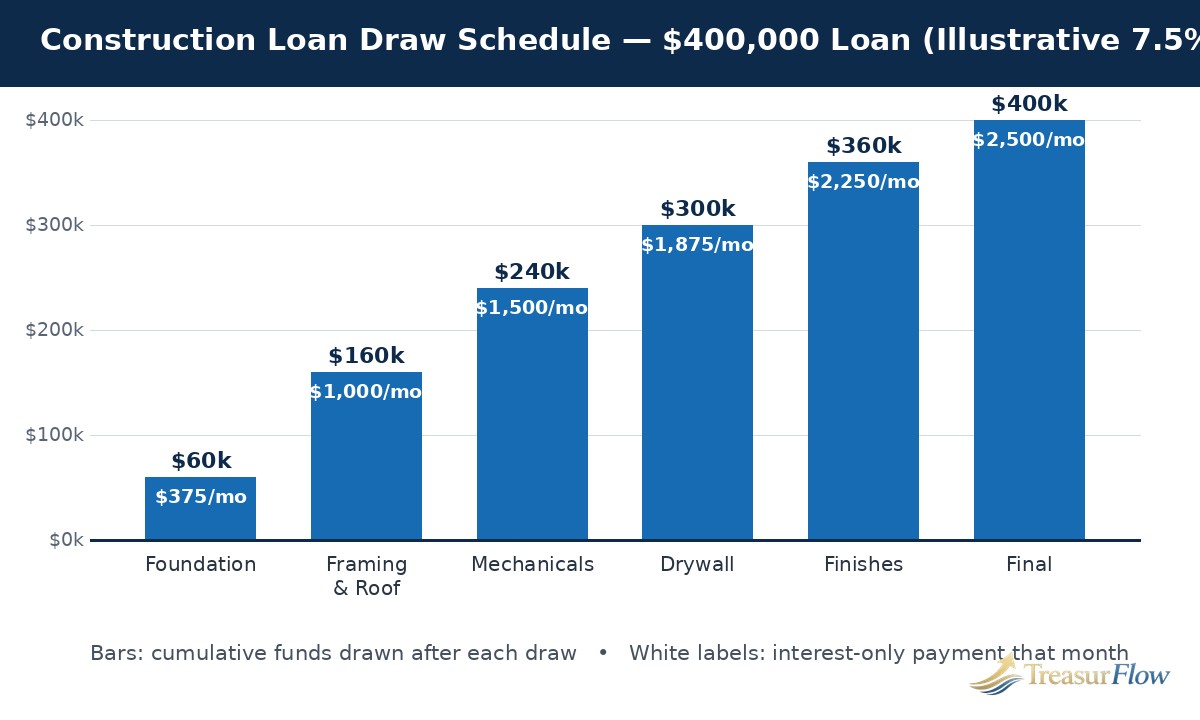
Most consumer construction loans release funds in typically 4 to 6 draws, tied to construction milestones rather than calendar dates. Schedules vary by lender and builder, but a representative six-draw schedule on a $400,000 loan looks like this:
| Draw | Milestone verified by inspection | Share of loan | Amount on a $400,000 loan | Cumulative drawn |
|---|---|---|---|---|
| 1 | Foundation complete | 15% | $60,000 | $60,000 |
| 2 | Framing and roofing complete | 25% | $100,000 | $160,000 |
| 3 | Mechanical systems roughed in (HVAC, plumbing, electrical) | 20% | $80,000 | $240,000 |
| 4 | Insulation, drywall, windows and exterior doors | 15% | $60,000 | $300,000 |
| 5 | Interior finishes (flooring, cabinets, fixtures, paint) | 15% | $60,000 | $360,000 |
| 6 | Final inspection and certificate of occupancy | 10% | $40,000 | $400,000 |
Illustrative schedule. Your lender and builder set the actual milestones and percentages in the construction agreement before closing.
Read that table the way a lender does. At no point is the builder holding money for work that has not been inspected. The final draw — the last 10% in this example — is only released when the home is complete and legally occupiable, which gives the builder a powerful incentive to finish the punch list rather than drift to the next job. Some lenders also withhold a small percentage of each draw, called retainage, until final completion; ask about it before closing, because it affects your builder’s cash flow and therefore, indirectly, your timeline.
The Interest-Only Math, Worked in Full
Because you pay interest only on the amount drawn, your monthly payment during the build is a moving target. The formula is simple:
Monthly interest-only payment = amount drawn so far × annual interest rate ÷ 12
Worked example (illustrative): a $400,000 construction loan at an illustrative 7.5% interest rate, following the draw schedule above.
| After this draw | Cumulative drawn | Monthly interest-only payment at 7.5% |
|---|---|---|
| Draw 1 — foundation | $60,000 | $375 |
| Draw 2 — framing and roof | $160,000 | $1,000 |
| Draw 3 — mechanicals | $240,000 | $1,500 |
| Draw 4 — drywall and insulation | $300,000 | $1,875 |
| Draw 5 — finishes | $360,000 | $2,250 |
| Draw 6 — final | $400,000 | $2,500 |
Three lessons hide in that table. First, your early payments are genuinely small — $375 a month while you may still be paying rent or a mortgage on the home you live in now. Second, the payment roughly septuples from the first draw to the last, so a budget built around the early payments will break by month eight. Third, none of these payments reduces your balance by a single dollar. When the loan converts, you begin principal-and-interest payments on the full $400,000. For scale, $400,000 amortized over 30 years at an illustrative 7% would be about $2,661 per month in principal and interest, before taxes and insurance — computed from the standard amortization formula, and shown only so you can compare the construction-phase payment with the permanent-phase payment on the same balance.
Two more details matter. Interest on construction draws is typically billed in arrears, so the payment you make in a given month reflects the balance drawn during the period before it. And on many standalone construction loans the rate during the build is variable, which means your payment can rise for two reasons at once — a bigger drawn balance and a higher rate. One-time close loans, covered next, exist largely to remove that second risk from the permanent phase.
One-Time Close vs Two-Close: The Decision That Shapes Everything Else
Every construction loan is one of two structures, and choosing between them is the single most consequential decision in this entire guide — more consequential than which lender you pick, because the structure determines how many times you pay closing costs, how many times you must qualify, and who carries the interest-rate risk while your house is being built.
One-Time Close (Single-Close, Construction-to-Permanent)
A one-time close loan combines the construction loan and the permanent mortgage into a single loan with a single closing, completed before construction begins. You qualify once. You pay closing costs once. Your permanent interest rate is set under the terms agreed at that closing — U.S. Bank, for example, describes its one-time close construction-to-permanent loans as letting borrowers lock in their rate before construction begins, with fixed-rate or adjustable-rate permanent options, and Truist similarly advertises a loan lock before closing on its construction-to-permanent program. During the build — which U.S. Bank notes usually ranges from 12 to 18 months — you make interest-only payments on drawn amounts. When construction is complete, the loan automatically converts to the permanent mortgage. There is no second application, no second credit check, and no second set of closing costs.
According to mortgage-info.com’s 2026 construction loan guide, a conventional one-time close loan typically requires 10–20% down with 1 closing. Treat that range as a market snapshot as of October 2026, not a promise: individual lenders set their own minimums inside it.
Choose one-time close if:
- You want certainty — one approval, one closing, and a permanent rate set before ground is broken.
- Your income or credit could plausibly change during a 9-to-18-month build (a job change, a retirement, a new business) and you do not want to bet the finished house on requalifying.
- You would rather pay a somewhat higher construction-phase cost than risk rates rising while you build.
- You qualify for an FHA, VA, or USDA single-close program, where the structure is the program’s main attraction.
The trade-offs: fewer lenders offer single-close construction loans than offer two-close loans, permanent terms may be less flexible, build timelines are usually capped (commonly around 12 months, with extensions possible for a fee), and design changes after closing are restricted because the loan was underwritten against specific plans and a specific budget.
Two-Close (Standalone Construction, Then a Permanent Mortgage)
A two-close structure uses two separate loans. The first is a short-term construction loan — typically 6 to 12 months, sometimes longer — that funds the draws and charges interest only. When the home is complete, you take out a second, entirely separate permanent mortgage that pays off the construction loan. You apply twice, qualify twice, and pay closing costs twice.
According to the same mortgage-info.com 2026 guide, a two-close construction loan typically requires 10–25% down with 2 closings, as of October 2026. The wider down payment range reflects the wider variety of lenders — community banks and credit unions are active in two-close construction lending even when they offer no single-close product.
Choose two-close if:
- You want maximum choice of permanent mortgage at the end — any lender, any program, shopped fresh against the finished, appraised house.
- You expect rates to fall during your build, or your finances to improve, and you want the second qualification to work in your favor.
- Your project is unusual or lengthy — heavy site work, a remote lot, a phased build — and exceeds single-close timeline or plan restrictions.
- A local bank or credit union that knows your builder offers a construction loan but no single-close product.
The trade-offs are the mirror image of one-time close: two sets of closing costs, a second full underwriting with your credit, income, and employment re-verified after the build, and full exposure to rate movements during construction. The nightmare scenario is real and worth naming: if you lose your job or your credit deteriorates mid-build, the finished house still has a construction loan on it that is coming due, and no guarantee you can qualify for the permanent loan that was supposed to replace it. That single risk is why one-time close has become the default recommendation for most owner-occupants, and why two-close should be chosen deliberately, not by default.
Side-by-Side
| Feature | One-time close | Two-close |
|---|---|---|
| Closings | 1, before construction | 2 — one before, one after construction |
| Closing costs | One set | Two sets |
| Qualification | Once | Twice; second loan fully re-underwritten |
| Permanent rate | Set at the single closing (program terms vary; some offer a one-time float-down) | Set when the permanent loan closes, after the build |
| Typical down payment (per mortgage-info.com, as of October 2026) | 10–20% conventional | 10–25% |
| Construction-phase payments | Interest-only on drawn amounts | Interest-only on drawn amounts |
| Lender choice for permanent loan | Locked to the original lender/program | Any lender |
| Main risk | Timeline caps; plan changes restricted after closing | Rate risk and requalification risk during the build |
Loan Programs Compared: Six Ways to Finance a Build
Structure is only half the choice. The other half is the program — the rulebook that sets your down payment, who is eligible, and which government agency, if any, stands behind the loan. Here is each major option, with the rules that actually differentiate them.
Conventional Construction Loans
The default for borrowers with solid credit and meaningful cash. Conventional construction loans are offered by banks, credit unions, and mortgage lenders without government backing, in both one-time close and two-close forms. Per mortgage-info.com’s 2026 guide (as of October 2026), expect 10–20% down for one-time close and 10–25% down for two-close, with the strongest pricing reserved for borrowers at the higher end of the credit range. Put down less than 20% on the permanent phase and private mortgage insurance may apply, just as on a conventional purchase loan. The advantages are flexibility — larger loan amounts, second homes at some lenders, wider builder and property latitude — and the absence of program-specific fees like FHA’s mortgage insurance premiums or the VA funding fee. The disadvantage is that flexibility is bought with cash: this is the most down-payment-hungry mainstream route.
FHA One-Time Close
The Federal Housing Administration’s construction-to-permanent program — administered under HUD Handbook 4000.1 and universally called the FHA One-Time Close or FHA OTC — folds the lot purchase, construction costs, and permanent mortgage into one FHA-insured loan with one closing. Its headline rule is the one that opens construction to borrowers conventional loans shut out: a minimum down payment of 3.5% for borrowers with a credit score of 580 or higher under standard FHA rules. Many individual OTC lenders set their own higher credit floors, so treat 580 as the program minimum, not a guarantee of approval at that score.
Key FHA OTC rules to know before you fall in love with a floor plan:
- Primary residence only, and the home must meet HUD property standards at completion.
- You cannot act as your own general contractor in the standard program — the builder must be licensed, insured, and approved by the lender, with a fixed-price contract and approved plans and specifications.
- Land equity can count. If you already own the lot, its equity can be applied toward the 3.5% down payment, and FHA rules allow the down payment to be covered by eligible gift funds.
- FHA loan limits apply to the total package — land plus construction — and FHA mortgage insurance (an upfront premium plus annual premiums) is part of the cost structure, which is the price of the low down payment.
- Funds are held and disbursed through the draw process, and the permanent phase begins once the completed home passes final inspection.
FHA OTC is the best construction loan in 2026 for one specific borrower: a first-time or lower-cash buyer with fair credit who has a conventional, stick-built project, a mainstream builder, and no VA or USDA eligibility. For everyone else, compare its mortgage insurance cost against a conventional loan with more money down.
VA Construction Loans
For eligible veterans, active-duty service members, and qualifying surviving spouses, the VA construction loan is — on paper and usually in practice — the strongest deal in this guide. VA’s benefit structure carries over to construction: eligible borrowers with full entitlement can finance land and construction with $0 down and no ongoing mortgage insurance, paying instead the one-time VA funding fee unless they are exempt (veterans with service-connected disabilities are typically exempt — confirm your status with VA and your lender, and verify your Certificate of Eligibility early).
The catch is availability, and it is a big one. The VA guarantees the loan but does not make it; private lenders do, and only a minority of VA-approved lenders offer the construction product, in either its one-time close or two-close form. Builders must meet lender and VA requirements, the home must be your primary residence and meet VA minimum property requirements at completion, and progress inspections gate the draws just as in every other program. Start a VA construction search by asking a lender one blunt question — “Do you close VA construction-to-permanent loans, in-house, this year?” — because a lender that only finances completed new homes is offering you a different product than the one in this section.
USDA Single-Close Construction-to-Permanent
USDA Rural Development’s Single Family Housing Guaranteed Loan Program offers a single-close construction-to-permanent option that combines the interim construction loan and the long-term permanent mortgage in a single closing — USDA states that since there is only one closing, the transaction can save considerable closing costs, and that the loan note guarantee may be issued once the interim construction loan closes, without waiting for completion. Like standard USDA guaranteed loans, the construction version offers up to 100% financing — $0 down — for eligible borrowers, and USDA program materials describe features such as contingency reserves escrowed to cover cost overruns and payment reserves that can allow a period of payments to be rolled into the loan amount during construction.
Eligibility is the gate here, in two places at once:
- The property must be in a USDA-eligible rural area — which includes much more of the map than most borrowers expect, including many small towns and outer suburbs; check the specific address with your lender or USDA’s eligibility maps.
- The household must meet USDA income limits: the guaranteed program serves households that do not exceed 115% of the area median household income.
- The home must be your primary residence, built by a builder who meets program standards — USDA single-close guidance expects an experienced, licensed, insured contractor; owner-builders are generally not eligible under this program.
- USDA charges a 1% upfront guarantee fee (which program materials note may be included in the loan amount) plus an annual fee, in place of conventional mortgage insurance.
If your lot is eligible and your income fits, USDA single-close belongs on your shortlist next to any $0-down VA option — and ahead of FHA for many rural buyers, because the fee structure is often lighter. If either gate fails, it fails completely: there is no partial USDA eligibility.
Owner-Builder Loans
An owner-builder loan lets you act as your own general contractor — hiring and managing the subcontractors yourself and capturing the builder’s margin as savings or equity. It is the most romantic option in this guide and the most restricted. Because the lender loses the protection of a professional builder’s track record, balance sheet, and insurance, owner-builder financing typically demands the strongest borrower profile in the category: mortgage-info.com’s 2026 guide places owner-builder loans at 20–25% down with the highest credit expectations of any type listed (as of October 2026), and many lenders require you to be a licensed builder or demonstrate professional construction experience. Government programs largely close this door — FHA and USDA construction financing are built around approved third-party builders — so owner-builder borrowing is usually conventional, local, and relationship-based. If you are a genuine tradesperson, it can be the cheapest way to build. If you are a enthusiastic amateur, the lender’s skepticism is information, not insult: a self-managed build that stalls is worth very little to anyone.
Land and Lot Loans
A land loan is not a construction loan — it finances the dirt, not the house — but it belongs in this guide because “buy the land now, build later” is a legitimate strategy and a common detour. The distinction that matters is between raw land (no utilities, no road access improvements, no immediate build plan) and an improved lot (utilities available, build-ready). Lenders price that distinction steeply: mortgage-info.com’s 2026 guide places raw land loans at roughly 35–50% down and improved lot loans at roughly 20–30% down (as of October 2026), with shorter terms and higher rates than construction-to-permanent financing. If you will build within a lender’s construction window, folding the lot into a construction-to-permanent loan is almost always cleaner and cheaper in total. Buy land separately only when your build is genuinely years away, when the lot itself is the scarce asset you cannot afford to lose, or when no construction lender will yet approve the project — and go in knowing the eventual construction loan will still need to appraise the finished home, land included, at a value that supports the full package.
Program Comparison Table
| Program | Typical down payment | Closings | Who it serves best | Defining restriction |
|---|---|---|---|---|
| Conventional one-time close | 10–20% (mortgage-info.com, Oct 2026) | 1 | Strong-credit buyers who want rate certainty | Largest cash requirement of the single-close options |
| Conventional two-close | 10–25% (mortgage-info.com, Oct 2026) | 2 | Rate shoppers and unusual/longer projects | Must requalify; two sets of closing costs |
| FHA one-time close | 3.5% at 580+ credit (FHA program minimum) | 1 | Lower-cash, fair-credit, first-time builders | No owner-builder; FHA mortgage insurance; loan limits |
| VA construction | $0 for eligible borrowers with full entitlement | 1 or 2, by lender | Eligible veterans and service members | Very limited lender availability; primary residence |
| USDA single-close | $0 for eligible borrowers | 1 | Low-to-moderate income buyers in eligible rural areas | Property location AND household income (≤115% of area median) must both qualify |
| Owner-builder | 20–25% (mortgage-info.com, Oct 2026) | 1–2 | Licensed/experienced builders building their own home | Strongest credit and experience requirements |
| Land / lot loan | 20–30% improved; 35–50% raw (mortgage-info.com, Oct 2026) | Separate | Buyers securing land well before building | Not a construction loan; shorter terms, higher rates |
Lender Picks by Borrower Profile
There is no honest universal ranking of construction lenders, because availability is regional, programs differ, and the lender that is wrong on paper but has closed thirty builds with your builder is often the right lender in practice. What follows instead are picks by profile, limited to lenders whose construction programs could be verified on their own published pages or program materials during research for this guide in October 2026. Construction menus change; confirm the product is still offered — and offered in your state — before sending anyone your documents.
Best for a Mainstream One-Time Close: U.S. Bank
U.S. Bank publishes a dedicated construction loan program built around one-time close construction-to-permanent financing for custom homes, with fixed-rate or adjustable-rate permanent options, a rate lock before construction begins, and interest-only payments during a construction phase it describes as usually 12 to 18 months. It also offers lot loans for borrowers not ready to build. Profile fit: the conventional borrower with a custom-home project who wants a national lender, a single closing, and the permanent rate settled upfront. Ask about maximum construction timeframes for your project type and whether your builder is already approved or must be vetted from scratch — builder vetting timelines are the most common source of closing delays at large lenders.
Best for Rate-Lock Protection With a Float-Down: Truist
Truist’s construction-to-permanent program is built on one closing for land and home together, a loan lock before closing, and — for fixed-rate transactions — a one-time float-down option at modification if rates are lower when the home is completed, per Truist’s published program features. A dedicated construction loan specialist supports the loan through the build, and Truist’s program covers rehabs, renovations, and tear-downs as well as new builds. Profile fit: the borrower who likes one-time close certainty but hates the idea of watching rates fall for a year with no way to benefit. The float-down is the differentiator — read its exact conditions (timing, one-time use, any fee) in writing before you value it.
Best for a Regional Bank With a Published Down Payment Floor: Fifth Third Bank
Fifth Third publishes unusually concrete construction-to-permanent terms: a down payment of at least 10% of the project total (land plus build, per its program information), one-time closing costs, interest-only payments during construction, the land purchase eligible to be included in the loan, and conversion to a 15- or 30-year permanent mortgage with fixed or adjustable rates, for a primary residence or second home. Profile fit: the Midwest/Southeast borrower inside Fifth Third’s footprint who has 10% or more to put down and wants a bank program whose basic economics are stated upfront rather than discovered in a sales call.
Best for Government Single-Close Programs (VA and USDA): GO Mortgage
Most national lenders that advertise VA or USDA loans do not close the construction versions. GO Mortgage publishes dedicated USDA Single Close Construction and VA One-Time Close Construction offerings — exactly the two hardest products in this guide to find — describing the USDA single-close as one loan, one closing package, one promissory note, and the VA one-time close as combining $0-down VA financing with a single closing and an upfront rate lock. Profile fit: the eligible veteran or rural buyer who has been told by two local lenders that “VA/USDA construction doesn’t exist.” It does — it is simply concentrated in fewer, more specialized lenders, and a specialist’s builder-approval and draw process will usually be smoother than a generalist’s first attempt. Verify current state licensing and program availability for your property before applying, as with any lender here.
Best for a Local, Flexible Two-Close: Your Community Bank or Credit Union
This is a profile pick, not a brand pick, and for many builds it is the correct one. Local banks and credit unions portfolio construction loans that national lenders will not touch: odd lots, rural properties outside program maps, local builders with no national approval file, longer or phased timelines. You will likely get a two-close structure, interest-only draws administered by someone who can drive past the site, and a permanent loan decision made by people who know the local appraisal market. Profile fit: the non-standard project. The cost of that flexibility is the two-close risk package — second qualification, second closing costs, rate exposure — so take it with open eyes and, ideally, a permanent-loan backup plan.
What to Ask Every Construction Lender Before You Apply
Whichever profile fits, the same eight questions separate a construction lender from a mortgage lender who also does construction:
- How many construction loans did you close in the last 12 months, and how many were my program (conventional / FHA / VA / USDA)?
- Is my builder already approved with you? If not, what does builder approval require, and how long does it take?
- What is the maximum construction period, what does an extension cost, and how is that fee calculated?
- How many draws are included, what does each additional draw or inspection cost, and who pays for inspections?
- Is the permanent rate locked at closing? Is there a float-down, and exactly when and how does it work?
- What contingency reserve do you require, who holds it, and what happens to unused contingency at completion?
- Are interest reserves or payment reserves allowed — can part of the construction-phase interest be financed?
- What happens, in writing, if the appraisal of the completed home comes in below the contract price?
A lender who answers all eight crisply is a construction lender. A lender who answers vaguely is a risk you do not need.
Related Guides
- DSCR Loan Rates in 2026 — if the finished property is meant to earn rent rather than house you, the financing logic changes completely
- How to Invest in Real Estate Without Buying Property — lower-hands-on ways to get real estate exposure while you plan a build
What Lenders Require: The Four Approvals Inside Every Approval
A construction loan approval is really four approvals wearing one coat. You can pass three and still be declined, which is why construction applications take longer and demand more paper than purchase mortgages.
1. You: Credit, Income, and Cash — in Three Layers
The borrower underwriting starts familiar — credit history, income stability, debt-to-income ratio, employment — and then adds construction-specific cash requirements. Expect lenders to look for credit at or above each program’s floor (580 for FHA’s 3.5%-down tier as a program minimum, with many lenders requiring higher; around 640 is a common lender benchmark in USDA guaranteed underwriting; conventional construction pricing improves substantially at the top of the credit range), a debt-to-income ratio the program accepts once the permanent payment is counted, and cash in three distinct layers:
- The down payment, per your program’s rules in the comparison table above.
- Closing costs — one set for single-close, potentially two for two-close.
- Cash reserves after closing. Lenders want to see that a bad month does not stall a half-built house. Reserves may be required in the loan structure itself (next section) and as verified liquid assets on your statements.
If you are still building that cash, the discipline in our guide to saving for a house while renting applies directly — with one construction-specific amendment: do not plan your reserves down to zero at closing. The build phase is precisely when surprises bill you.
2. The Builder: Approval Is Not a Formality
Every mainstream program requires a builder the lender approves, and the review is substantive: licensing, insurance (including commercial general liability at program-required levels — USDA single-close guidance, for instance, expects builders with at least two years of single-family construction experience and substantial liability coverage), references and completed-project history, financial stability, and a willingness to work inside a draw-and-inspection regime. The contract matters as much as the contractor: lenders typically require a fixed-price construction contract, so the loan amount is underwritten against a number, not an estimate with ambitions. Cost-plus contracts, handshake arrangements, and “we’ll figure out finishes later” budgets are where construction applications go to die. If your heart is set on a builder your lender will not approve — or your builder refuses draw-based payment — you do not have a disagreement to negotiate. You have a different loan, a different builder, or a different lender to find, and it is far cheaper to learn that before closing than after.
3. The Plans: Appraised Before They Exist
The lender orders an appraisal of the home as completed, built from your plans, specifications, and contract. That future value caps your loan: if the as-completed appraisal comes in under the total project cost, you cover the gap in cash or cut the project, because the loan-to-value math does not care what the build cost — only what it is worth. This is the quiet risk in over-customizing: the fourth bathroom, the imported tile, and the detached workshop may cost $80,000 and appraise at $30,000. Submit complete plans and a detailed specification list — materials, finishes, fixtures — because appraisers value what is documented, and vague plans produce conservative appraisals.
4. The Cushion: Contingency Reserve and Interest Reserve
Two reserves appear again and again in construction lending, and both protect the project’s completion rather than the lender’s profit:
- Contingency reserve. A fund — commonly around 10% of construction cost in program guidance; USDA single-close materials describe escrowing up to 10% to cover cost overruns — set aside for the overruns that genuinely happen: bad soil, a price spike in lumber, a code correction. Unused contingency is typically applied to your principal balance at completion rather than refunded as a shopping budget, which is exactly the right incentive.
- Interest (or payment) reserve. An account or loan component from which construction-phase interest — or, in some USDA single-close structures, full payments — is paid during the build. It smooths your cash flow while you may still be paying for housing elsewhere, but remember it is borrowed money: every dollar of interest paid from a reserve is a dollar added to what the project cost you.
Costs and Traps: Where Construction Loans Get Expensive
The interest rate is not the main event. These are.
Rate float during the build. The CFPB notes that construction loans generally carry higher interest rates than longer-term purchase mortgages, and standalone construction loans commonly float — tied to a benchmark that can move during your 12-to-18-month build. On a two-close loan, your permanent rate is not set until after construction, so a bad year for rates lands entirely on you. Mitigations, in order: choose one-time close to settle the permanent rate upfront; ask about a float-down if you go single-close; or, on two-close, get a written plan for locking the permanent loan as early as the lender allows near completion. What you cannot do is assume today’s rate will be waiting for you in fourteen months.
Extension fees. Construction loans have deadlines, and builds miss them — weather, permits, materials, labor. Extending the construction period typically costs a fee, often calculated as a percentage of the loan or a flat charge per extension period, and repeated extensions can trigger worse: rate re-pricing or, in a two-close, pressure to close the permanent loan on an unfinished house, which no permanent lender will do. Before signing, know your build deadline, the extension fee, and the maximum number of extensions — and build a schedule with slack, because a builder’s optimistic timeline is a marketing document, not a plan.
Cost overruns and change orders. The fixed-price contract fixes the price of the house described in the plans. Every change after closing — upgraded cabinets, a moved wall, a different roof — is a change order, priced on the spot, and usually payable in cash by you rather than added to the loan, because the loan was underwritten and appraised against the original specification. The contingency reserve absorbs legitimate overruns; it is not a change-order fund. The cheapest construction discipline in existence is a complete, specific, honestly-priced specification list signed before closing — and the most expensive sentence in home building is “while we’re at it…”
Paying for two homes at once. During the build you may carry rent or an existing mortgage plus rising interest-only payments plus, at the end, the permanent payment — with the overlap concentrated in the most expensive months. Model the worst month, not the average month: final-draw interest, current housing, and moving costs can stack. Our draw-schedule table above is the tool for this; run your own numbers before you sign, not after Draw 4.
Appraisal gap at completion (two-close). On a two-close loan, the permanent lender appraises the finished house. If it appraises below the amount needed to pay off the construction loan, you bring cash or the payoff fails. One-time close largely removes this risk by fixing the loan against the pre-construction appraisal — one more reason the structure decision matters more than rate shopping by an eighth of a point.
Insurance gaps. A house under construction needs builder’s risk coverage during the build and a full homeowners policy at conversion — and the transition is a classic gap, because each party assumes the other arranged it. Confirm in writing who carries builder’s risk (builder or you), when your homeowners policy must be bound, and what your lender requires at conversion. When you shop that policy, our comparison of the best homeowners insurance for 2026 is a reasonable place to start.
The refinance mirage. Borrowers sometimes accept a mediocre permanent loan planning to “just refinance later.” Sometimes that works — and our guide to the best mortgage refinance options in 2026 explains when it genuinely pays — but a refinance costs money, requires the home to appraise and you to qualify all over again, and depends on future rates cooperating. Treat a planned refinance as a backup, never as the plan.
How to Apply: A Realistic Sequence and Timeline
- Assemble the team before the loan. Builder first, lender second, plans third — most construction lenders will not seriously underwrite you without a builder and a draft budget, and no builder can price vapor.
- Get pre-qualified for the program, not just the amount. Confirm your program eligibility (VA entitlement, USDA property and income, FHA limits) before paying for architectural plans.
- Finalize plans, specifications, and the fixed-price contract. This package drives the appraisal and the loan amount.
- Full application and builder approval. Submit your financial file and your builder’s file in parallel; builder vetting is often the long pole.
- As-completed appraisal and final underwriting. Resolve any appraisal gap by adjusting cash or scope now, on paper, where it is cheap.
- Closing. Single-close borrowers set the permanent terms here. Everyone signs the construction agreement, draw schedule, and deadline.
- Construction with draws and inspections, typically 6 to 18 months depending on lender limits and project scale (U.S. Bank describes 12 to 18 months as usual). Attend to inspection scheduling — draw delays are cash-flow delays for your builder.
- Final inspection, certificate of occupancy, and conversion (single-close) or permanent-loan closing (two-close). Then the ordinary, happy business of living in the house you financed into existence begins.
Construction Loan Questions Borrowers Ask Before Breaking Ground
How much do you need down for a construction loan in 2026?
It depends on the program. Conventional one-time close loans typically require 10% to 20% down and two-close loans 10% to 25% down, according to mortgage-info.com’s 2026 guide. FHA one-time close requires 3.5% down with a credit score of 580 or higher, while eligible VA and USDA borrowers can often build with $0 down, subject to lender approval and program rules.
How many draws does a construction loan have?
Most consumer construction loans use typically 4 to 6 draws. The lender releases money in stages as the builder completes verified milestones such as the foundation, framing and roof, mechanical systems, drywall, and interior finishes. An inspector confirms each stage is complete before the lender releases the next draw, and the final draw is usually released after the final inspection and certificate of occupancy.
Do you make payments while the house is being built?
Yes, in most cases you make interest-only payments during construction, calculated only on the amount drawn so far rather than the full loan amount. For example, on a $400,000 loan at an illustrative 7.5% rate, $160,000 drawn would mean a monthly interest-only payment of about $1,000. Payments rise as more money is drawn, and principal-and-interest payments begin when the loan converts to its permanent phase.
Can you build a home with no money down?
Yes, if you qualify for a program that allows it. Eligible veterans and service members can often use a VA construction loan with $0 down, and eligible borrowers building in a USDA-eligible rural area within USDA income limits can often use a USDA single-close construction loan with $0 down. You will still need to cover or finance closing costs and program fees, and not every VA or USDA lender offers a construction loan.
Can you be your own builder on a construction loan?
Usually not under the government programs. FHA and USDA construction loans generally require a licensed, insured builder approved by the lender, and most conventional lenders do the same. A small number of lenders offer owner-builder loans, typically requiring professional building experience or a license, a higher down payment of around 20% to 25%, and strong credit, according to mortgage-info.com’s 2026 guide.
What happens if construction costs more than the loan amount?
You are responsible for the difference. Lenders typically require a contingency reserve, often around 10% of construction costs, to absorb genuine overruns, and any unused reserve is usually applied to your loan balance at completion. Change orders and upgrades after closing are normally paid in cash by you, and if the project runs past the construction deadline you may also pay extension fees, so a complete fixed-price contract before closing is essential.
Conclusion: The Best Construction Loan Is the One Built Around the Draw Schedule
Strip away the marketing and a construction loan is a supervised payout system with a mortgage attached. The borrowers who do well with the best construction loans 2026 has to offer are the ones who chose deliberately on the three decisions that actually determine cost and risk: the structure (one-time close for certainty and a single qualification; two-close for flexibility, accepted with open eyes), the program (conventional for flexibility with cash down, FHA OTC at 3.5% down, VA and USDA at $0 down for those who clear their eligibility gates), and the team (an approved builder with a genuinely fixed-price contract, and a lender who closes construction loans every month rather than every few years).
Before you sign anything, run the draw-schedule math on your own numbers, model your most expensive month rather than your average one, confirm your builder’s approval in writing, and get the extension fee, the draw fees, and the unused-contingency rule in the same writing. A construction loan rewards preparation more richly — and punishes improvisation more reliably — than any other mortgage product. Prepare well, and the staged, inspected, interest-only machinery described in this guide is not an obstacle between you and a new home. It is the thing that makes building one safely possible.
Disclaimer: This article is general educational information about construction loan structures and programs, not financial, legal, or tax advice, and not a loan offer or a commitment to lend. Program rules, eligibility limits, fees, and lender offerings change and vary by state, lender, and borrower; figures attributed to third-party sources are snapshots as of October 2026 and are labeled as such in the text. Verify all terms against official program sources (CFPB, HUD, VA, and USDA Rural Development) and your lender’s Loan Estimate before applying, and consult qualified professionals about your own situation.

Muhammad Zakir is the founder of Treasurflow and the author of its personal finance guides. He researches consumer banking, credit, and personal loans, and every guide cites primary sources such as the CFPB, FDIC, FTC, and IRS. His content is educational and is not personalized financial advice.