
Carrying a credit card balance has rarely been more expensive. According to the Federal Reserve’s G.19 Consumer Credit release, the average APR on credit card accounts that were actually charged interest reached 22.15% in the second quarter of 2026. That is the rate real borrowers — not the teaser rate in an advertisement — paid on real balances. On a $5,000 balance, interest at that level quietly eats more than $90 in the very first month alone, before you have bought anything new.
The good news is that you do not have to accept the average rate. The best low interest credit cards 2026 shoppers can choose from work in two very different ways. Some pause interest completely with a 0% introductory APR that lasts as long as 21 months. Others — mostly from credit unions — charge a permanently lower ongoing APR that stays in the low teens or even near 10% for the strongest borrowers. Picking the right kind for your situation matters more than picking a famous brand name, because the wrong “low rate” card can cost you hundreds of dollars in transfer fees, lost grace periods, or interest that snaps back the moment a promotion ends.
This guide is built APR-first. Before we name a single card, we explain how APR is actually constructed, why no ongoing card rate can fall below the prime rate, and exactly what a $5,000 balance costs at 22.15%, at about 15.99%, and at 0% over 12 months — with the arithmetic shown, not hidden. Then we match specific cards, with terms verified as of October 2026, to specific borrower needs: the longest possible interest-free window, the lowest ongoing rate, rewards combined with a low intro rate, and credit-union cards that play by different rules. We also cover the two traps that catch the most people — deferred interest and penalty APRs — and what it realistically takes to qualify.
One ground rule before we start: every rate, fee, and promotion in this article is date-stamped as of October 2026 and was checked against issuer terms and major October 2026 roundups. Card offers change frequently, sometimes mid-month. Always confirm the current terms on the issuer’s own application page before you apply. A rate printed anywhere — including here — is a snapshot, not a promise.
Our Quick Picks at a Glance
If you only have a minute, start here. Every card below charges no annual fee, and every term listed was current as of October 2026.
| Card | Best for | Intro APR (as of Oct 2026) | Ongoing APR after intro | Balance transfer fee | Annual fee |
|---|---|---|---|---|---|
| Wells Fargo Reflect® Card | Longest intro window on purchases and transfers | 0% for 21 months on purchases and qualifying transfers | 17.74%, 24.24%, or 28.49% variable | 5% (minimum $5) | $0 |
| BankAmericard® credit card | Longest intro window with the lowest post-intro starting APR | 0% for 21 billing cycles on purchases and on transfers made in the first 60 days | 15.24%–26.24% variable | 5% | $0 |
| Chase Slate® | Longest intro window from Chase | 0% for 21 months on purchases and transfers | 18.49%–28.49% variable | 5% | $0 |
| U.S. Bank Shield™ Visa® Card | Long intro window plus side perks | 0% for 21 billing cycles on purchases and transfers | 17.24%–28.24% variable | 5% (minimum $5) | $0 |
| Citi® Diamond Preferred® Card | Long transfer window with the lowest intro transfer fee | 0% for 21 months on transfers; 0% for 12 months on purchases | 16.74%–27.49% variable | 3% intro fee in the first 4 months, then 5% | $0 |
| Lake Michigan Credit Union Prime Platinum Visa® | Lowest ongoing APR, no promotion needed | No intro APR offer | 10.00%–18.00% variable | $0 | $0 |
| Bank of America® Customized Cash Rewards | Rewards plus a 15-cycle 0% window | 0% for 15 billing cycles on purchases and on transfers made in the first 60 days | 17.74%–27.74% variable | 3% intro fee for the first 60 days, then 5% | $0 |
| Blue Cash Everyday® Card from American Express | Grocery, gas, and online rewards plus 0% for 15 months | 0% for 15 months on purchases and transfers | 19.74%–28.74% variable | Check current terms at application | $0 |
| Capital One Quicksilver Cash Rewards | Simple flat-rate rewards plus 0% for 15 months | 0% for 15 months on purchases and transfers | 18.74%–28.74% variable | Fee applies; check current terms | $0 |
| Chase Freedom Flex® | Rotating 5% categories plus 0% for 15 months | 0% for 15 months on purchases and transfers | 18.49%–27.99% variable | 3% intro fee in the first 60 days, then 5% | $0 |
A note on honesty in this table: where major October 2026 sources disagreed about a card’s exact ongoing APR range or transfer fee — which happened for a small number of cards — we used the figures from NerdWallet’s October 1, 2026 roundup and issuer disclosures, and we flag the disagreements later in this article rather than quietly averaging them away. Rates and fees change; the issuer’s pricing page on the day you apply is the only version that legally matters.
The Two Kinds of “Low Interest” — and Why the Difference Decides What You Pay
Almost every argument about low interest cards goes wrong in the first sentence, because “low interest” describes two completely different products.
Kind 1: The 0% introductory APR card
This is the kind every major bank sells. A 0% intro APR card charges no interest at all for a fixed promotional window — currently as long as 21 months on the longest offers — on purchases, on balance transfers, or on both. When the window closes, the APR jumps to the card’s regular variable rate, which on today’s long-intro cards ranges roughly from the mid-teens to the high twenties depending on your credit.
Think of this card as a deadline, not a discount. Its entire value comes from one transaction: you move an existing balance, or make a necessary large purchase, and you divide the total by the number of months in the window and pay that amount every month without fail. A $5,000 balance on a 21-month card needs about $238.10 a month. The same balance on a 15-month card needs about $333.33 a month. If your budget can hit that number, the card costs you almost nothing beyond a possible one-time transfer fee. If it cannot — if you will still owe $2,000 when the music stops — the remaining balance starts accruing interest at 17% to 28% immediately, and part of your savings evaporates. The 0% card rewards planners and punishes hopeful thinking.
Two structural details matter here. First, purchases and transfers often have different intro lengths on the same card. The Citi Diamond Preferred, for example, offers 21 months at 0% on balance transfers but only 12 months at 0% on purchases as of October 2026. Second, transfers usually must be completed inside an early window — 60 days from account opening on the BankAmericard and the Bank of America rewards cards, 120 days on the Wells Fargo Reflect — to get the promotional rate at all. Miss that window and you may lose the offer entirely.
Kind 2: The low ongoing APR card
The second kind never makes the television commercials. A low ongoing APR card simply charges a lower regular rate, every month, with no promotion and no cliff. These cards are issued overwhelmingly by credit unions and smaller community banks, not by the national issuers — a pattern NerdWallet’s October 2026 roundup also highlights, noting that major issuers largely abandoned true low-rate cards when benchmark rates rose and never returned to them.
The clearest current example in this guide is the Lake Michigan Credit Union Prime Platinum Visa, with a variable APR of 10.00% to 18.00% as of October 20, 2026, no annual fee, and no balance transfer fee. There is no 0% period and no rewards program. What you get instead is predictability: if life interrupts your payoff plan in month nine, you are paying roughly 10% to 18% interest, not 26%. For a borrower whose income is irregular — seasonal work, commissions, freelance — that safety margin can be worth more than a promotional window they cannot guarantee they will beat.
The prime rate floor: why “low” can only go so low
Here is the piece of APR anatomy most card marketing hopes you never learn. Nearly every credit card APR is built as the prime rate plus a margin. The prime rate is a benchmark lending rate that moves with the Federal Reserve’s policy rate; after the Federal Reserve’s September 16, 2026 increase, the prime rate stood at 7.00% as of October 2026. Your card’s margin — the slice the issuer adds for risk, rewards, and profit — is set by your credit profile when you are approved.
That construction has a hard consequence, stated plainly by NerdWallet and worth repeating here: you will never find a card with an ongoing APR below the prime rate. At a 7.00% prime, the best ongoing card rates in the country sit a few points above 7%, and only for borrowers with excellent credit at member-owned credit unions. The Lake Michigan card’s 10.00% floor is prime plus about three points — about as thin a margin as mainstream lending offers. When an advertisement implies an ongoing card rate near zero outside of a timed promotion, you are almost certainly looking at deferred interest, a secured product, or a teaser that expires. We will dissect the deferred-interest trap in its own section below.
Understanding the prime floor also tells you how to shop. For ongoing-rate cards, compare the spread above prime, not just the headline number, because when the Federal Reserve moves, variable card APRs move with it — usually within one or two billing cycles. A card at prime plus 3% stays cheaper than a card at prime plus 11% in every rate environment.
Which kind should you choose?
Choose the 0% intro card if your balance is finite, your payoff date is realistic, and your monthly budget clears the balance divided by the months in the window — with room to spare. Choose the low ongoing card if your balance fluctuates, your income is uneven, or you know from experience that a hard deadline is more likely to ambush you than motivate you. And consider the hybrid reality: plenty of disciplined borrowers use a 0% card for a defined debt, then keep a low ongoing APR credit-union card as their long-term backup card for genuine emergencies. The two products solve two different problems.
How APR Actually Costs You: A $5,000 Balance, Three Rates, Real Arithmetic
Percentages are abstract; dollars are not. So let us run the numbers the way a statement actually generates them, using the Federal Reserve’s verified average and a representative low ongoing rate.
The worked example (illustrative). Imagine a $5,000 balance and a borrower who pays it off in 12 equal monthly payments that clear the balance completely at the end of month twelve — no new purchases, no fees, interest charged monthly on the declining balance. This is a simplified illustration, not a prediction of any specific account, because real issuers calculate interest on average daily balances. But it shows the true shape of APR cost far better than a headline rate does.
| Scenario | APR | Monthly payment to clear $5,000 in 12 months | Total interest paid | Total cost of the $5,000 |
|---|---|---|---|---|
| Average card, accounts assessed interest (Federal Reserve G.19, Q2 2026) | 22.15% | $468.33 | $620.00 | $5,620.00 |
| Low ongoing APR card (illustrative rate) | 15.99% | $453.63 | $443.57 | $5,443.57 |
| 0% intro APR card (paid off inside the window) | 0% | $416.67 | $0 | $5,000.00 |
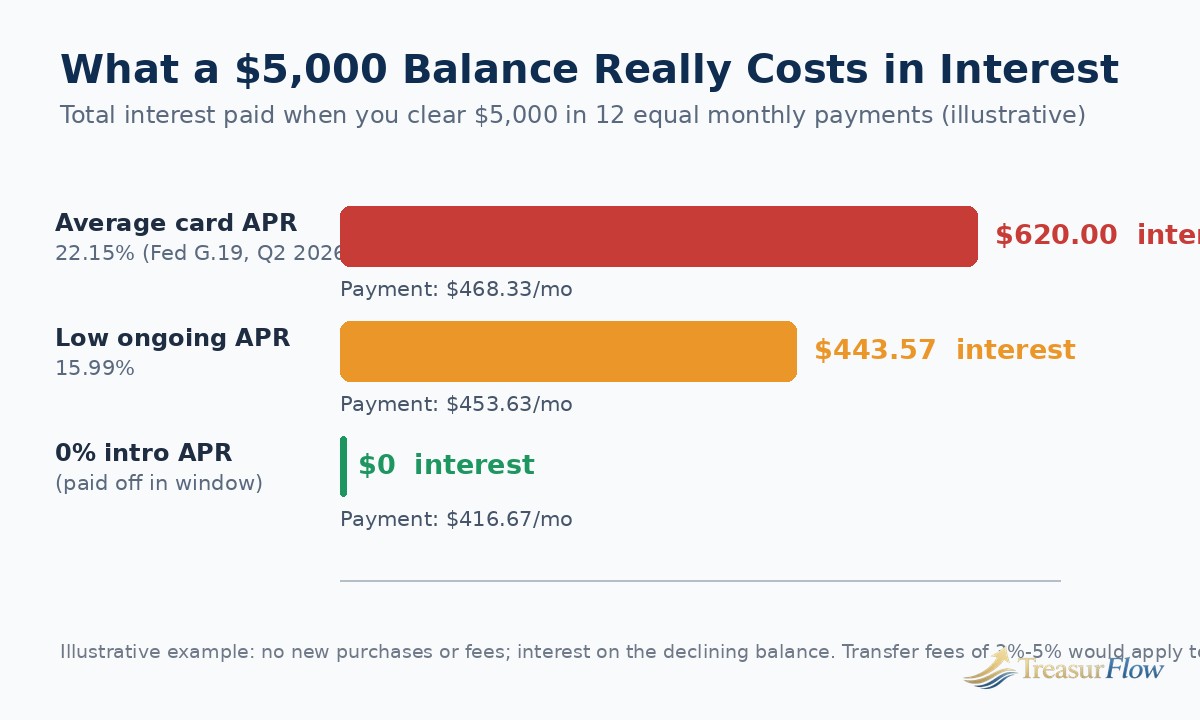
Read the table twice, because it teaches two lessons at once. The first lesson is the one card marketing wants you to see: the 0% card saves the full $620 against the average rate, and even the modest-looking gap between 22.15% and 15.99% — about six points — saves $176.43 over a single year on a single balance. Rate shopping is not trivia; it is a pay raise you give yourself.
The second lesson is quieter and more important: look at the monthly payments. The difference between the most expensive and cheapest row is about $52 a month. APR determines how much of your payment is wasted, but the payment itself determines whether you escape. A borrower who sends $468 a month to a 22.15% card is debt-free in a year. A borrower who sends the minimum to a 0% card and still owes money when the promotion ends can end up paying more total interest than either. Low interest is a multiplier on a payoff plan, never a substitute for one.
Now stretch the same balance the way minimum payments stretch it. At 22.15%, the first month’s interest alone on $5,000 is about $92.29. At 15.99% it is about $66.63. Typical minimum-payment formulas — often around 1% of the balance plus that month’s interest — mean a large share of an early minimum payment buys no debt reduction at all. Your statement is legally required to show a minimum payment warning: how long payoff takes paying only minimums, and what monthly payment clears the balance in three years. The Consumer Financial Protection Bureau (CFPB) urges borrowers to read that box, and so do we. It is the most honest paragraph your issuer sends you.
One more set of numbers belongs in every borrower’s head: the transfer fee math. Moving $5,000 costs $150 at a 3% balance transfer fee and $250 at 5%. Against $620 of interest saved in our example, either fee still wins comfortably if — and only if — you clear the balance inside the window. If you would clear the balance in three months anyway, the same fee buys you almost nothing. Fees are the price of time; only pay for time you will actually use.
Best for the Longest Intro Window: 21 Months at 0%
Four cards currently sit at the top of the market with 21-month or 21-billing-cycle 0% windows as of October 2026, plus one transfer specialist. They look similar in a comparison table and differ in the fine print, so we take them one at a time.
Wells Fargo Reflect® Card
The Reflect is the simplest long-window offer in the country: 0% intro APR for 21 months from account opening on purchases and on qualifying balance transfers, a $0 annual fee, and cell phone protection of up to $600 (subject to a $25 deductible) when you pay your phone bill with the card. Transfers must be made within 120 days of account opening to qualify for the intro rate — a more generous window than the 60 days several rivals allow. The transfer fee is 5% with a $5 minimum, which is at the high end of the typical range.
After the intro period, the ongoing APR is one of three fixed tiers — 17.74%, 24.24%, or 28.49% variable — assigned by creditworthiness. There are no rewards and no welcome bonus. That is not a flaw; it is the design. This card is a payoff instrument. Our take: choose the Reflect if you want the maximum number of interest-free months on both new purchases and transferred balances from a single card, and you are comfortable earning nothing on spending while you execute the payoff.
BankAmericard® credit card
Bank of America’s dedicated low-interest card matches the Reflect’s length in its own units: 0% intro APR for 21 billing cycles on purchases, and for balance transfers made within the first 60 days of account opening. Its ongoing APR after the intro period — 15.24% to 26.24% variable as of October 2026 — starts lower than any other 21-month card in this guide, which matters if there is any chance a small balance survives the promotion. The card charges no annual fee and, notably, no penalty APR: paying late will not automatically raise your interest rate, although late fees and credit damage still apply.
The transfer fee needs a careful sentence. NerdWallet’s October 2026 roundup states that a 5% fee applies to all balance transfers on this card, and WalletHub’s October 2026 data agrees. Some older summaries — including figures that circulated earlier in 2026 — listed a 3% introductory transfer fee for this card. We report the current 5% figure and flag the conflict openly rather than printing the more attractive number: verify the fee on Bank of America’s pricing page on the day you apply, because on a $5,000 transfer the difference between 3% and 5% is $100. The card earns no rewards and offers no bonus, so once the intro period ends, its remaining appeal is that comparatively low starting ongoing APR.
Chase Slate®
Chase’s Slate offers 0% intro APR for 21 months on both purchases and balance transfers, a $0 annual fee, and an ongoing APR of 18.49% to 28.49% variable after the window. The balance transfer fee is 5%, at the high end of typical. There are no rewards and no welcome bonus.
What Slate adds is the Chase ecosystem around a plain product: free access to your credit score and identity monitoring through Chase Credit Journey, zero liability protection, purchase protection on eligible new items, and extended warranty coverage that adds a year to eligible U.S. manufacturer warranties of three years or less. None of that pays your debt for you, but if you already bank with Chase and value having the payoff card inside the same app as your checking account, Slate is the natural 21-month choice. As with the Reflect, treat it as a single-purpose tool: transfer or charge, divide by 21, automate, and finish.
U.S. Bank Shield™ Visa® Card
The Shield matches the leaders on length — 0% intro APR for 21 billing cycles on purchases and balance transfers — with an ongoing APR of 17.24% to 28.24% variable and a $0 annual fee. Its balance transfer fee is 5% with a $5 minimum, and transfers must be completed within the window U.S. Bank specifies at application (60 days in its current issuer disclosures), so confirm the deadline when you apply.
Where the Shield separates itself is the extras, which are genuinely unusual in this category: 4% cash back on prepaid air, hotel, and car reservations booked directly through the U.S. Bank Travel Center, cell phone protection worth up to $600 in reimbursement if your phone is stolen or damaged and you pay your bill with the card, and a $20 annual statement credit after you make purchases in 11 consecutive months. A small recurring subscription plus autopay can make that last perk nearly automatic. If two cards tie on months and fees, perks like these are a legitimate tiebreaker — just never let a $20 credit justify carrying a balance into a 28% APR.
Citi® Diamond Preferred® Card
The Diamond Preferred is the transfer specialist of the group. As of October 2026 it offers 0% intro APR for 21 months on balance transfers and 0% for 12 months on purchases, with an ongoing APR of 16.74% to 27.49% variable and no annual fee. Its defining advantage is cost of entry: balance transfers completed in the first four months carry a 3% intro transfer fee ($5 minimum), rising to 5% afterward. On a $5,000 transfer that is $150 instead of $250 — a $100 saving against every 5%-fee rival in this section, in exchange for a purchase window that is nine months shorter.
Choose this card if your mission is purely an existing balance and you can execute the transfer promptly. Skip it if the plan involves a large new purchase you need 21 months to clear, because purchases revert to the regular APR after month twelve. It earns no rewards, which many debt-focused borrowers rightly count as a feature: the card gives you no excuse to spend on it.
If you are comparing these five against each other and feeling stuck, use our dedicated guide to the best balance transfer credit cards of 2026, which ranks transfer cards by debt situation and payoff timeline in more depth.
Best for a Low Ongoing Rate: Skip the Promotion Entirely
Now for the other philosophy. A low ongoing APR card will never show you a $0 interest line, and it will quietly save you money in every month your plan goes sideways — which, in real financial lives, is most plans.
Lake Michigan Credit Union Prime Platinum Visa®
This is the standout true low-rate card we could verify from the issuer’s own site in October 2026. The Prime Platinum Visa carries a variable APR of 10.00% to 18.00% as of October 20, 2026 — the lowest rate is reserved for borrowers with a credit score of 760 or above — with no annual fee, no balance transfer fee, zero-liability fraud protection, and free car rental insurance, with credit lines up to $25,000 subject to approval. There is no rewards program and no intro APR offer. One small transparency note: Lake Michigan’s own comparison page showed slightly different endpoints (9.75% to 17.75%) than its dated disclosure page (10.00% to 18.00%) during our October check. We use the dated disclosure figures; either way, the card’s floor sits roughly three points above the 7.00% prime rate, the thinnest margin in this guide.
Do the math on what that floor means. At 10.00%, the first month’s interest on a $5,000 balance is about $41.67 — less than half the $92.29 charged at the national average rate of 22.15%. A borrower who revolves a fluctuating balance for work expenses, medical bills, or an irregular income stream pays for that insurance every month in the form of forgone rewards, and receives it every month in the form of a survivable interest charge. Membership is required, as with all credit unions, and Lake Michigan’s membership is centered on Michigan — confirm your eligibility on its site before counting on this card. If you are not eligible, ask your local credit union what its equivalent low-rate platinum card charges; this product category, not this specific card, is the takeaway.
What about big-bank “low rate” cards after the intro ends?
Notice something in the quick-picks table: among the 21-month cards, the BankAmericard’s ongoing range starts lowest, at 15.24%, and the Citi Diamond Preferred’s range (16.74% to 27.49%) starts next. If you have excellent credit and land at the bottom of one of those ranges, your post-intro rate beats the illustrative 15.99% in our worked example. But a range is not a rate. Issuers assign your specific APR after reviewing your application, most approved borrowers do not receive the floor of the range, and you typically learn your exact rate only when you are approved. Never choose a card for a floor you may not get; choose it for the intro window you will definitely get, and treat a low assigned ongoing rate as a bonus.
A word on PenFed — and why we are not calling its card “low rate” in 2026
Roundups of low-rate cards have recommended the PenFed Gold Visa® Card for years, so we checked PenFed’s own current terms rather than repeating the tradition. As of our October 2026 check, the Gold Visa offers 0% intro APR for 15 months on purchases and on balance transfers made in the first 60 days, with a 3% transfer fee and no annual fee — a respectable intro offer, especially since PenFed membership is now open to everyone. But its ongoing purchase APR in PenFed’s own pricing disclosure is 17.99%. That is below the 22.15% national average, yet it is nowhere near the prime-plus-a-little pricing that made the card famous in older reviews, and it is higher than the post-intro floor of several cards above. We include the card honestly, as a credit-union intro-APR option with a moderate ongoing rate — and we flag the gap between its reputation and its current terms because that gap is exactly how borrowers end up paying more than they planned. Verify its rate on PenFed’s site before applying; if the ongoing APR has improved by the time you read this, the card deserves re-ranking, and if it has not, the Lake Michigan card shows what “low ongoing” should actually look like.
Best When You Want Rewards and a Low Rate Together
There is a real trade-off at the heart of this category, and NerdWallet’s October 2026 analysis states it cleanly: the longest 0% windows come on cards with no rewards, while rewards cards typically cap the 0% window at about 15 months. Fifteen months is still a long time. If your balance is moderate — say $3,000, needing $200 a month over 15 months — a rewards card lets you stop paying interest and start earning something on the spending you would do anyway, and it remains useful long after the payoff ends. Here are the strongest verified combinations as of October 2026.
Bank of America® Customized Cash Rewards credit card
This is the most flexible rewards-plus-intro package in the guide: 0% intro APR for 15 billing cycles on purchases and on balance transfers made in the first 60 days, then a variable APR of 17.74% to 27.74%, with a 3% intro balance transfer fee during the first 60 days (5% after) and no annual fee. The rewards structure lets you pick your own bonus category — options include gas, online shopping, dining, travel, and more — earning 6% cash back in that category for the first year and 3% after that, plus 2% at grocery stores and wholesale clubs, with the 6%/3% and 2% earnings sharing a $2,500 combined quarterly purchase cap, then 1%. Everything else earns 1%. There is also a $200 online cash rewards bonus after you spend at least $1,000 in the first 90 days. Bank of America customers in its Preferred Rewards program can boost rewards rates further. The catch is complexity: this card rewards people who will actually update a category and watch a cap, and quietly underpays people who will not.
Blue Cash Everyday® Card from American Express
The Blue Cash Everyday pairs 0% intro APR for 15 months on purchases and balance transfers with the strongest everyday-category rewards in this guide: 3% cash back at U.S. supermarkets, 3% on U.S. online retail purchases, and 3% at U.S. gas stations, each on up to $6,000 per year in purchases (then 1%), and 1% on everything else. Its ongoing APR after the intro period is 19.74% to 28.74% variable — the highest floor in this guide — and it charges no annual fee. American Express lists the welcome offer as variable, described as “as high as $200 cash back” after meeting its spending requirement, so treat any specific bonus figure for this card as unconfirmed until Amex shows you your own offer during application; we deliberately do not promise a number here. Verdict: an excellent household card for a planned purchase you will clear in 15 months, and a poor card for a balance that might linger, because that lingering balance meets a 19.74%-plus rate.
Capital One Quicksilver Cash Rewards Credit Card
Quicksilver is the simplicity pick: unlimited 1.5% cash back on every purchase, 5% on hotels, vacation rentals, and rental cars booked through Capital One Travel, a one-time $200 cash bonus after you spend $500 in the first three months, no annual fee, and no foreign transaction fees. Its 0% intro APR runs 15 months on purchases and balance transfers, followed by a variable APR of 18.74% to 28.74%. A balance transfer fee applies — confirm the exact percentage in Capital One’s current terms before you transfer, since fee schedules on this card have changed over time. If category calendars make your eyes glaze over and your balance is small enough to clear in 15 months, this is the rewards-plus-low-rate card that asks the least of you.
Chase Freedom Unlimited® and Chase Freedom Flex®
Chase fields two 15-month options with different personalities. The Freedom Unlimited earns a $200 bonus after you spend $500 in the first three months, then 5% cash back on travel purchased through Chase Travel, 3% at drugstores and on dining (including takeout and eligible delivery), and 1.5% on everything else — with 0% intro APR for 15 months on purchases and transfers, then 18.49% to 27.99% variable, and no annual fee. The Freedom Flex trades the flat 1.5% base for rotating 5% cash back categories you activate each quarter (on up to $1,500 in combined spending), keeps 5% on Chase Travel purchases and 3% on dining and drugstore purchases, and as of October 2026 carries a $250 bonus after $500 spent in the first three months, 0% intro APR for 15 months on purchases and transfers, then 18.49% to 27.99% variable, with a 3% intro balance transfer fee in the first 60 days (then 5%) and no annual fee. A transparency note: some sources still show the Flex with an older, higher ongoing APR range (19.24% to 29.24%). Current October 2026 issuer-aligned listings show 18.49% to 27.99%, which is what we print — but this is one more reason to read the pricing box on your own application screen.
For a deeper ranking of the rewards side of these cards, see our guide to the best cash back credit cards of 2026. And if your credit is still building, note that rewards-plus-intro cards all expect good to excellent credit — our guide to the best secured credit cards of 2026 covers the realistic starting point, while our roundup of no credit check credit cards for 2026 explains the trade-offs of skipping the credit check entirely.
The Two Traps That Erase Your Savings: Deferred Interest and Penalty APRs
Everything above assumes the card in your hand is a true APR card — interest either charged at a stated rate or genuinely waived during a promotion. Two contract features break that assumption, and both are legal, disclosed, and expensive.
Trap 1: Deferred interest — “no interest if paid in full” is not 0% APR
Store financing offers, retail cards, and some medical financing plans advertise “no interest if paid in full within 12 months.” Read that sentence the way a lawyer wrote it. Under a deferred interest plan, interest starts accruing on the original purchase amount from the purchase date, at the card’s regular APR, and sits in the background. Pay the entire balance before the deadline and the accrued interest is waived. Miss the deadline by one day, or leave even a small amount unpaid, and the full accrued interest — on the original amount, for the entire period — is added to your balance at once.
The CFPB’s own illustration shows how brutal the difference is: on a $400 purchase, a borrower who pays $300 during a 12-month promotion owes just the remaining $100 under a true 0% APR offer — but under a deferred interest plan with the same payments, they would owe $165, because $65 of retroactive interest lands on top of the $100 balance. Scale that to a $3,000 furniture or appliance purchase and the surprise can be several hundred dollars. The giveaway phrases are “if paid in full,” “deferred interest,” and “promotional financing” in the terms. None of the main cards in this guide uses deferred interest on its headline offer — they are true 0% intro APR cards, where any balance left at the end is charged interest only going forward, not retroactively. Keep it that way: if a retail checkout offers you financing, ask one question — “Is this a true 0% APR, or deferred interest?” — and walk away from the second answer.
Trap 2: The penalty APR — one late payment can reprice your whole balance
Many issuers reserve a penalty APR — a higher rate, often near the top of the card’s range or higher — that can be triggered when you pay late, miss a payment, or have a payment returned. Federal rules under the Credit CARD Act limit the worst version of this: a penalty rate generally cannot be applied to your existing balance unless you are more than 60 days late, and the issuer must review your account after six consecutive months of on-time payments and restore the standard rate if you qualify. But a penalty APR can still apply to new transactions sooner, it can persist, and at penalty levels the interest on a large balance compounds frighteningly fast.
Three practical defenses. First, autopay for at least the minimum — ideally a fixed amount aimed at your payoff date — set the day the account opens, not after the first scare. Second, know which cards forgive: the BankAmericard in this guide advertises no penalty APR, an unusual and genuinely valuable feature for a borrower whose risk is an occasional late payment rather than a large balance. Third, if a penalty APR is ever applied to your account, call the issuer after six months of perfect payments and ask for the review you are entitled to; issuers do not always volunteer it.
A related trap deserves one paragraph: the vanishing grace period. Most cards give you a grace period — typically at least 21 days — during which new purchases charge no interest if you pay your statement balance in full. The moment you carry a balance, that grace period generally disappears, and new purchases begin accruing interest from the transaction date. This is why the standard advice exists: a card carrying a transferred balance should go in a drawer. Charge daily spending to a different card you pay in full, or use debit, until the payoff is done. The CFPB has specifically warned that issuers marketing 0% transfer offers must disclose this loss-of-grace-period cost clearly, because so many borrowers have been surprised by it.
How to Qualify for the Best Low Interest Credit Cards in 2026
Issuers save their longest windows and lowest rates for the borrowers least likely to need them. That is unfair and also simply how the pricing works, so plan around it.
Credit score. The 21-month cards and the low ongoing rate floors in this guide generally require good to excellent credit — think FICO scores in the high 600s at a minimum, and 720 or above for the best odds and the best tiers. Lake Michigan Credit Union states openly that its 10.00% floor requires a score of 760. PenFed’s Gold Visa is generally recommended for borrowers with scores around 700 or higher. If your score is below that range, a secured card or a credit-builder strategy may be the honest first step; the internal guides linked in the rewards section above cover both paths.
Income and existing debt. Issuers evaluate income and your debt-to-income picture, not just your score. A spotless score with three other maxed cards still looks like risk. If you can pay other balances down before applying — even modestly — you improve both your utilization ratio and your approval odds at the same time.
Timing your applications. Each application generates a hard inquiry, and several applications in a short window can nudge your score down and make you look desperate to the next issuer. Apply for one card, chosen deliberately. Also respect issuer-specific rules and your own recent history: if you already hold a card from an issuer, balance transfers between two cards from the same issuer are typically prohibited (you cannot transfer a Bank of America balance to another Bank of America card, for example), so pick a destination issuer different from the one holding your current debt.
The 60-day and 120-day clocks. Qualification does not end at approval. To receive the intro rate on transfers, BankAmericard and the Bank of America rewards cards require transfers within the first 60 days; the Wells Fargo Reflect allows 120 days; Citi’s 3% intro fee on the Diamond Preferred requires completing the transfer within the first four months. Put the deadline in your calendar the day the card arrives. More borrowers lose promotional value to missed transfer windows than to any other single mistake.
Membership hurdles for credit unions. Credit union cards require membership. PenFed membership is open to everyone (joining typically involves opening a savings account with a small minimum deposit), while Lake Michigan Credit Union’s membership is geographically focused. Neither hurdle is large, but both add days to your timeline — start the membership step before you need the money.
If you are declined. A decline is information, not a verdict. Issuers must tell you the reasons. The fastest legitimate fixes are usually lowering utilization, correcting any error on your credit reports (you can dispute errors through the bureaus, and the FTC’s consumer site explains your rights), and waiting several months before applying again — this time for a card matched to the score you actually have. If your balances are large relative to your income, also compare the card route honestly against a fixed installment loan using our guide to the best debt consolidation loans of 2026: a loan’s fixed payment and fixed end date beat a card for some borrowers, precisely because the card’s flexibility is what got them in trouble.
Related Guides
Related Guides
- Best Balance Transfer Credit Cards 2026 — every major 0% transfer offer ranked by debt situation and payoff timeline.
- Best Cash Back Credit Cards 2026 — the rewards-first ranking, for balances you pay in full.
- Best Secured Credit Cards 2026 — the realistic starting point if your credit is still building.
- Best Debt Consolidation Loans 2026 — when a fixed loan beats a card for paying off balances.
- No Credit Check Credit Cards 2026 — what you gain, and what you give up, when no one checks your credit.
Helpful Official Resources
Helpful Official Resources
- Consumer Financial Protection Bureau (CFPB) — plain-language guides to how credit card interest, grace periods, and deferred interest work, plus the official complaint channel if an issuer breaks the rules.
- Federal Reserve — publisher of the G.19 Consumer Credit release behind the 22.15% average APR figure used in this guide, and of the policy decisions that move the prime rate.
- Federal Trade Commission (FTC) — your rights under federal consumer law, how to get free credit reports, and how to dispute errors that could be costing you a lower APR.
Low-APR Questions Borrowers Ask Before They Apply
What is considered a low APR for a credit card in 2026?
In 2026, a low ongoing APR means a rate well below the national average of 22.15% that the Federal Reserve reported for accounts assessed interest in the second quarter of 2026. Ongoing rates in the low-to-mid teens qualify as low, the best credit union cards start near 10%, and any 0% introductory APR is the lowest rate of all while it lasts.
Is a 0% intro APR card better than a low ongoing APR card?
A 0% intro APR card is better if you can pay the full balance before the promotional period ends, because you pay no interest at all apart from any balance transfer fee. A low ongoing APR card is better if your balance will fluctuate or take longer to repay, because its lower regular rate keeps interest costs manageable without a deadline.
Can I get a credit card with an APR below the prime rate?
No, you will not find a mainstream credit card with an ongoing APR below the prime rate, which stood at 7.00% in October 2026. Card APRs are built as the prime rate plus a margin, so the lowest ongoing rates sit a few points above prime, and only promotional 0% intro APR offers go below it for a limited time.
Do low interest credit cards require excellent credit?
Most low interest credit cards require good to excellent credit, because issuers reserve their longest 0% intro periods and lowest ongoing rates for lower-risk borrowers. The lowest advertised rates usually require the strongest scores — for example, a score of 760 or higher for the lowest rate on the Lake Michigan Credit Union Prime Platinum Visa.
What happens when my 0% intro APR period ends?
When a 0% intro APR period ends, any remaining balance starts accruing interest at the card’s regular variable APR, which on current cards ranges from the mid-teens to the high twenties depending on the card and your credit. Interest is charged from that point forward on the remaining balance, not retroactively, unless the offer was a deferred interest plan.
Is a 0% APR offer the same as deferred interest?
No, a true 0% APR offer waives interest during the promotion and charges interest only on any balance left afterward, while deferred interest keeps accruing in the background from the purchase date. If you do not pay a deferred interest balance in full by the deadline, all of that accrued interest is added to your balance at once.
Conclusion: Buy Time Cheaply, Then Use the Time
The best low interest credit cards 2026 has to offer split cleanly into two tools, and the whole decision is matching the tool to your honest payoff story. If your balance is a fixed number and your budget can divide that number by 21, the long-window cards — Wells Fargo Reflect, BankAmericard, Chase Slate, and U.S. Bank Shield — give you nearly two interest-free years, while the Citi Diamond Preferred trades a shorter purchase window for the cheapest transfer fee in its class. If your balance moves with your life, the Lake Michigan Credit Union Prime Platinum Visa shows what a real low ongoing rate looks like in October 2026: 10.00% to 18.00%, no promotion, no cliff, no drama. And if your balance is modest and your spending is steady, the 15-month rewards cards — Bank of America Customized Cash Rewards, Blue Cash Everyday, Capital One Quicksilver, and the Chase Freedom pair — let you stop paying interest and start earning cash back in the same motion.
Whatever you choose, the arithmetic from our worked example should travel with you: $620 of interest on a $5,000 balance at the national average rate, $443.57 at a low ongoing rate, and $0 inside a 0% window you actually finish. The gap between those numbers is the entire game — worth more than any welcome bonus advertised this year. So pick the card whose structure fits the borrower you actually are, set the autopay for the amount that ends the debt, keep the card in a drawer while the transferred balance dies, and verify every term on the issuer’s page before you apply. Interest is rent you pay on your own money. Pay as little of it as the market allows.
Disclaimer: This article is for general educational information only and is not financial, legal, or tax advice. Credit card APRs, fees, bonuses, and promotional periods change frequently; all terms in this article were checked as of October 2026, and the issuer’s current disclosures control. The worked examples are simplified illustrations based on stated assumptions, not predictions of any individual account’s cost. Treasurflow does not guarantee approval for any product mentioned. Consider speaking with a qualified financial professional about your specific circumstances before making borrowing decisions.

Muhammad Zakir is the founder of Treasurflow and the author of its personal finance guides. He researches consumer banking, credit, and personal loans, and every guide cites primary sources such as the CFPB, FDIC, FTC, and IRS. His content is educational and is not personalized financial advice.