
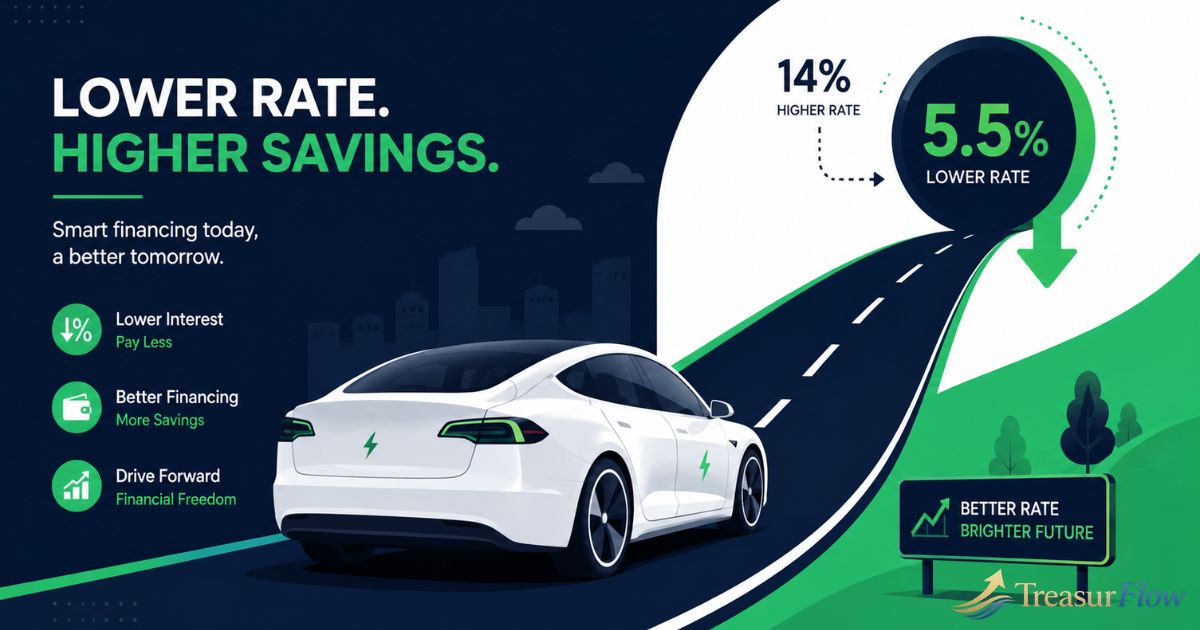
Car loan interest rates remain a major financial burden for millions of drivers. Whether you signed a contract in a high-rate market, bought a vehicle with temporary credit blemishes, or got stuck with a high dealer APR markup, keeping a high-interest auto loan can cost you thousands of extra dollars.
Direct Answer: To lower your car interest rate, refinance your loan with a local credit union or direct lender after improving your credit score, add a creditworthy co-signer, or shorten your remaining loan term. You can also reduce total interest without changing your contract by switching to bi-weekly payments, contributing extra principal directly, or negotiating rate modifications directly with your existing lender.
Key Takeaways
- Refinancing is the Fastest Fix: Dropping your APR by just 3% on a $30,000 balance saves roughly $2,500 to $4,000 in total interest over a 60-month term.
- Credit Score Tiers Control Rates: Moving from Subprime (below 600) to Prime (660+) can cut your auto interest rate nearly in half.
- Beware Dealer Rate Markup: Dealerships frequently add 1% to 3% above the lender’s base rate; bringing outside pre-approval gives you leverage to negotiate.
- Bi-Weekly Hacks Work Automatically: Making half-payments every two weeks results in 13 full payments per year, reducing your principal balance faster without altering your monthly lifestyle budget.
Related Credit Building & Debt Tools:
- If you are rebuilding your credit profile from scratch, learn how long the recovery process takes in our breakdown of how long it takes to build credit from scratch.
- Looking to structure your monthly household budget to free up cash for extra principal payments? See how to use ChatGPT to make a budget or try the envelope budgeting method.
7 Direct Strategies to Lower Your Auto Loan APR
1. Refinance Your Auto Loan with a Local Credit Union or Direct Lender
Refinancing replaces your original high-interest auto loan with a new loan at a lower annual percentage rate (APR). Credit unions are non-profit institutions that regularly cap interest rates 1% to 3% lower than traditional commercial banks or dealership finance departments. To compare lenders, see our guide to the best auto loan refinance 2026.
The Auto Refinancing Process:
- Establish History: Build 6 months of clean, on-time payment history on your current loan.
- Check Credit: Ensure your credit score is steady or has improved since buying the car.
- Compare Rates: Get pre-approval quotes from 2–3 local credit unions (request soft credit checks first).
- Finalize New Contract: Your new lender pays off your old loan balance, securing your lower APR and new monthly payment.
- Best Timing: Apply 6 to 12 months after taking out your original loan once you have established an on-time payment history, or apply immediately if overall market interest rates drop.
- Loan-to-Value (LTV) Limits: Lenders prefer a Loan-to-Value ratio under 100% to 120%. If you owe more than your vehicle’s current market value (negative equity), paying down a small cash chunk toward the principal can help you qualify for top-tier refinance rates.
2. Improve Your FICO Auto Score Before Reapplying
Your credit score directly dictates your interest rate tier. Raising your score by 30 to 50 points can move you into a higher credit tier, unlocking lower rates.
- Lower Revolving Balances: Pay down credit card balances below 30% (ideally under 10%) of your total limits prior to submitting refinance applications.
- Fix Credit Report Errors: Dispute inaccurate late payments or collections with credit bureaus (Equifax, Experian, and TransUnion) to raise your baseline score.
3. Add a Creditworthy Co-Signer to Unlock Prime Tiers
If your personal credit score is below 660, adding a family member or partner with a strong credit profile (720+) reduces lender risk. Lenders evaluate the joint application using the co-signer’s credit tier, unlocking lower APRs even if your personal credit profile is still recovering.
4. Restructure or Negotiate Rate Terms Directly with Your Current Lender
You do not always have to switch institutions to get a lower rate. Contact your existing bank or credit union and request a rate modification. If you have pre-approval offers from competing lenders, present those quotes to your current lender. Many institutions will lower your APR to retain your account rather than lose the remaining loan balance to a competitor.
5. Switch to a Bi-Weekly Payment Schedule
If refinancing is not an immediate option, you can pay less total interest by altering your payment frequency. Pay half of your required monthly payment every two weeks. Because there are 52 weeks in a year, you will make 26 half-payments—equaling 13 full monthly payments per year.
Important: Always verify with your lender that extra payments are applied directly toward the principal balance, rather than advancing your next calendar due date.
6. Recast Your Loan by Applying Lump Sum Cash to Principal
Applying lump sums—such as tax refunds, work bonuses, or inheritance—directly to your principal balance lowers the base balance on which daily interest accrues. Over a 48-to-60-month loan term, even a single $1,500 extra principal contribution cuts total interest costs significantly.
7. Shorten Your Remaining Term Length (e.g., 72 to 48 Months)
Lenders charge lower interest rates on shorter loan terms because shorter horizons reduce default risk. While a shorter term increases your required monthly payment, it slashes the total interest paid over the life of the loan.
| Loan Term | Average APR | Monthly Payment ($30k Loan) | Total Interest Paid | Total Lifetime Cost |
| 72 Months | 8.5% | $533 | $8,376 | $38,376 |
| 60 Months | 7.5% | $601 | $6,066 | $36,066 |
| 48 Months | 6.5% | $711 | $4,128 | $34,128 |
How to Lower Your Car Interest Rate with Bad Credit
Having a subprime credit score (below 600) often results in interest rates between 12% and 20%+. You are not trapped in that rate for the full duration of your loan.
- Establish a 6-Month Proof-of-Payment Track Record: Lenders want to see six consecutive months of on-time payment history on your current auto loan before considering a refinance application.
- Target Non-Profit Credit Unions over Commercial Lenders: Credit unions frequently operate under capped interest rate ceilings, keeping subprime rates lower than commercial buy-here-pay-here dealers.
- Address Negative Equity (Underwater Loans): If you owe $22,000 on a vehicle worth $18,000, you have $4,000 in negative equity. Paying down that $4,000 gap reduces your Loan-to-Value ratio, making subprime refinance approvals far easier.
Related Auto Financing & Credit Guides:
- If high interest rates are making your overall vehicle ownership too expensive, review our guide to cheap car insurance for bad credit to cut your monthly driving costs.
- If you need major mechanical repairs while working to lower your loan rate, explore engine financing with no credit check.
- For borrowers evaluating dealership finance options directly, compare terms using our guide on what is in-house financing and our breakdown of in-house financing pros and cons.
State-Specific Rules: Lowering Auto Interest Rates in California
California drivers operate under specific financial protections when managing auto financing:
- California Car Buyer’s Bill of Rights: Mandates clear, written itemization of all finance charges, preventing hidden dealer markups and undisclosed lender fees.
- California Credit Union Options: Regional, state-chartered institutions offer localized auto refinancing programs with strict rate ceilings.
- No Sales Tax on Refinancing: Refinancing an existing auto loan in California is a credit adjustment, not a vehicle sale. You do not pay state sales tax when transferring your loan balance to a new lender.
Calculating Savings: Car Loan & Refinance Interest Benchmarks
Average Auto Loan APR by Credit Tier
| Credit Tier | FICO Score Range | Average New Car APR (%) | Average Used Car APR (%) | Potential Monthly Savings* |
| Super Prime | 781 – 850 | 5.25% – 6.10% | 6.80% – 7.50% | Base Benchmark |
| Prime | 660 – 780 | 6.50% – 7.80% | 8.20% – 9.50% | ~$35 – $45 / month |
| Non-Prime | 601 – 659 | 9.50% – 11.20% | 12.10% – 13.80% | ~$95 – $110 / month |
| Subprime | 501 – 600 | 12.80% – 15.50% | 17.20% – 19.80% | ~$180 – $220 / month |
| Deep Subprime | 300 – 500 | 15.90% – 21.00%+ | 21.50% – 28.00%+ | ~$300+ / month |
*Estimated savings per $30,000 loan balance over 60 months when moving up from lower tiers.
Savings Impact of APR Reductions ($30,000 Loan, 60-Month Term)
| Loan Scenario | APR (%) | Monthly Payment | Total Interest Paid | Lifetime Total Savings |
| Original High-APR Loan | 14.5% | $706 | $12,351 | $0 |
| Refinanced (2% Reduction) | 12.5% | $675 | $10,494 | $1,857 |
| Refinanced (5% Reduction) | 9.5% | $630 | $7,795 | $4,556 |
| Refinanced Prime Tier (7% Reduction) | 7.5% | $601 | $6,066 | $6,285 |
Frequently Asked Questions
What’s considered a competitive car loan interest rate right now?
A good interest rate depends on your credit tier and whether the vehicle is new or used:
- Super Prime (781–850): 5.0% – 6.5% (New) | 6.5% – 7.5% (Used)
- Prime (660–780): 6.5% – 8.0% (New) | 8.0% – 9.8% (Used)
- Subprime (Below 600): Rates typically range from 12% to 18%.
What is the average APR for a 700 credit score?
A 700 credit score sits securely in the Prime tier. Borrowers with a 700 score average between 6.8% and 7.8% APR on new car loans and 8.5% to 9.5% APR on used car loans, depending on current benchmark market rates.
Can I negotiate my car loan rate?
Yes. Dealerships frequently add a markup (often 1% to 2.5%) above the wholesale buy rate offered by direct lenders. By securing a pre-approved auto loan from an outside credit union or bank before visiting the dealership, you gain leverage to force the dealer to match or beat your outside rate.
How to beat a high-interest car loan if I am underwater?
First, pay down the principal gap with a lump sum to bring your Loan-to-Value (LTV) ratio under 120%. Next, apply for refinancing with a local credit union after completing 6 consecutive months of on-time payments. Alternatively, add a creditworthy co-signer to qualify for prime rate tiers despite negative equity.
What information should you keep to yourself when negotiating with a car dealer?
When negotiating car financing, never reveal:
- Your maximum target monthly payment: Dealers can stretch loan terms (e.g., to 72 or 84 months) to meet a monthly target while masking high interest rates.
- Whether you are paying cash or pre-approved right away: Finalize the out-of-the-door vehicle price before discussing financing methods.
- Your trade-in expectations upfront: Negotiate vehicle purchase price, trade-in value, and financing as three separate steps.
How to pay off a 7-year car loan in 3 years?
To complete an 84-month loan in 36 months, divide your remaining principal balance by 36 and pay that target amount monthly. Alternatively, combine bi-weekly half-payments with applying annual tax refunds or work bonuses directly to the loan principal.
What happens if I pay an extra $100 a month on my car loan?
On a typical $25,000, 60-month auto loan at 10% APR, paying an extra $100 per month reduces your payoff timeline by 12 to 14 months and saves over $1,500 to $2,000 in total interest.
Why can paying off a car loan sometimes cause your credit score to drop?
Closing an active installment loan reduces your credit mix and eliminates an active payment history. This can cause a temporary drop of 10 to 30 points. Your score typically recovers within a few billing cycles as your remaining active credit accounts mature.
Do dealerships lose money if you pay off a car loan early?
If you pay off or refinance an auto loan within the first 60 to 90 days, the lender executes a commission chargeback. This requires the dealership to return the finance commission earned for originating your loan.
What is the 8% rule for cars?
The 8% rule recommends that your total monthly car payment (principal and interest) should not exceed 8% of your gross monthly income, ensuring your auto debt remains manageable relative to your overall household budget.
- Credit Bureau Dispute Portals: Experian Credit Bureau (Use when discussing credit report error corrections)
- Consumer Financial Protection Bureau: CFPB Auto Loan Guidance (Use when explaining dealer rate markups and borrower rights)
- Federal Reserve Rate Benchmarks: Federal Reserve Economic Data (FRED) (Use when citing national benchmark interest rate trends)
Some links on this page go to product or issuer pages. Treasurflow’s rankings are based on the criteria stated in each guide. See the About page for how the site is funded.

Muhammad Zakir is the founder of Treasurflow and the author of its personal finance guides. He researches consumer banking, credit, and personal loans, and every guide cites primary sources such as the CFPB, FDIC, FTC, and IRS. His content is educational and is not personalized financial advice.
3 thoughts on “How to Lower Your Car Interest Rate in 2026 (Even Bad Credit)”