
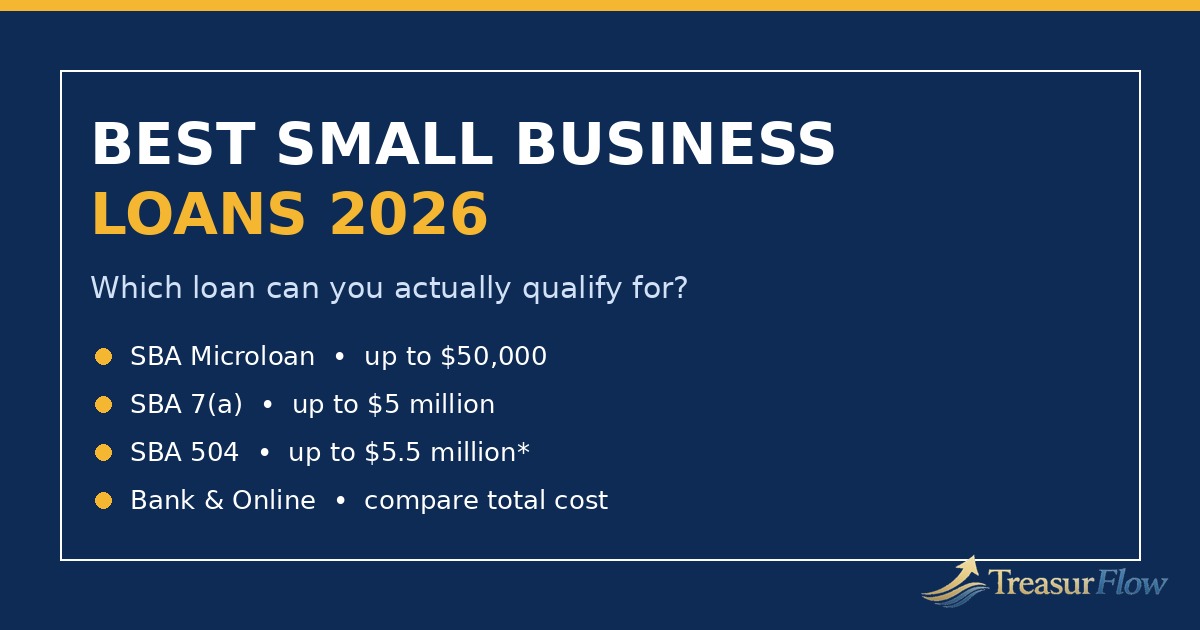
Most lists of the best small business loans 2026 start in the wrong place. They start with the lender with the biggest marketing budget, or the loan with the lowest headline rate, and leave you to discover — three weeks into an application — that you never qualified for it in the first place.
This guide starts somewhere more useful: with you.
As of October 2026, the cheapest business money in America is still government-backed money through the U.S. Small Business Administration (SBA). The fastest business money is still online money. And the most dangerous business money is still the money that does not quote you an annual percentage rate (APR) at all. Which of those three buckets you belong in is not really a matter of preference. It is a matter of three numbers you already know: your personal credit score, how long your business has been operating, and how much revenue it actually brings in.
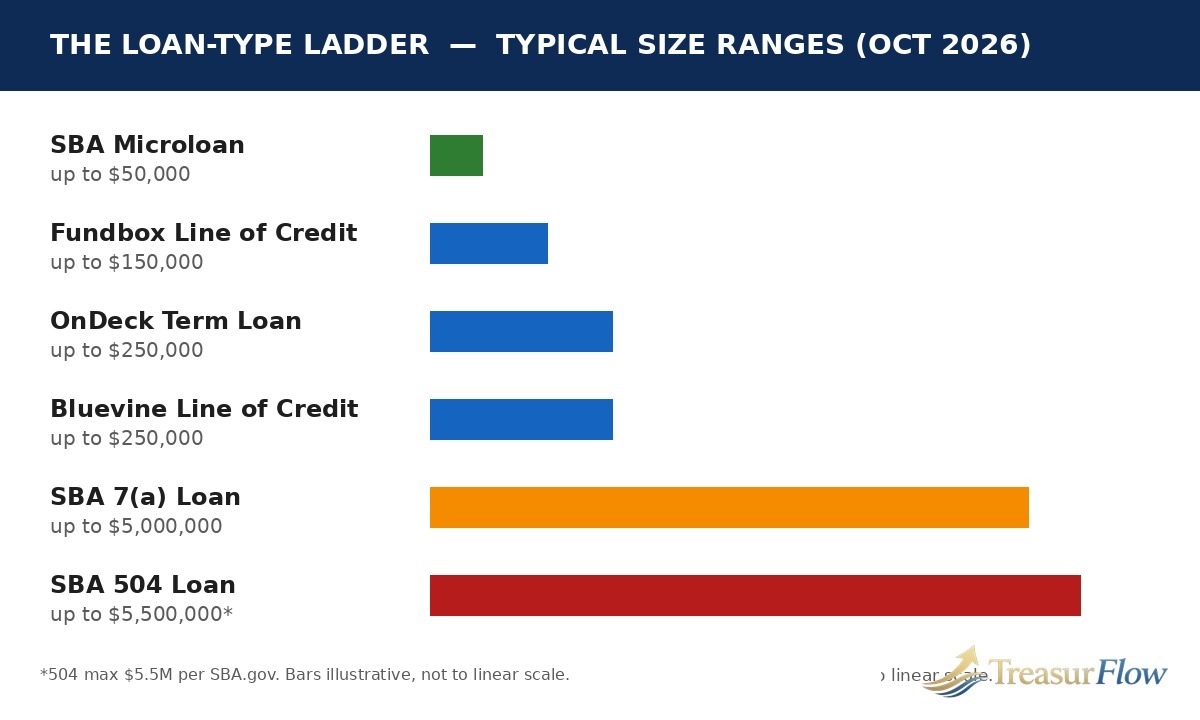
So this guide is built as a ladder. At the bottom are the loans almost anyone running a real business can reach — small, community-based, and forgiving. At the top are the loans banks reserve for established businesses with clean financials and years of tax returns. Every rung tells you, in plain language, what it takes to stand on it: the credit score lenders look for, the time in business they expect, and the revenue they want to see. Read the ladder from the bottom up, find the highest rung you can honestly reach today, and apply there first. That one habit — applying where you actually qualify — will save you more time, more hard credit inquiries, and more money than any rate comparison ever will.
Along the way we will walk through every major loan type in order — SBA microloans, SBA 7(a) loans, SBA 504 loans, bank term loans, online term loans, business lines of credit, equipment financing, and merchant cash advances — with the verified limits and rules straight from SBA.gov as of October 2026, a worked cost comparison you can check with a pocket calculator, lender picks matched to real scenarios (startup, established business, bad credit, fast funding, and equipment), and a documents checklist so your application does not stall for a missing tax return.
One warning before we start: business lending has no single “current rate” the way a mortgage market report might suggest. SBA rates are negotiated inside SBA caps. Online lenders price every borrower differently. And aggregator websites openly disagree with each other about the same lender’s APR range. Where that happens in this guide, we say so, attribute the range to its source, or leave the number out entirely. A guide that invents a tidy rate to fill a table is not helping you borrow money. It is helping you get surprised later.
Related Guides
Helpful Official Resources
- SBA 7(a) Loans — U.S. Small Business Administration
- SBA 504 Loans — U.S. Small Business Administration
- SBA Microloans — U.S. Small Business Administration
- CFPB Small Business Lending — Consumer Financial Protection Bureau
- FTC Business Center — Federal Trade Commission
- IRS — Deducting Business Interest and Business Expenses
Start Here: Which Loan Can You Actually Qualify For?
Every lender, from a nonprofit microlender in your county to a national bank, is really asking the same five questions. How long have you been in business? How much money does the business make? What does the owner’s personal credit look like? What are you buying with the money? And what happens to the lender if you cannot pay? Your answers sort you onto the ladder automatically.
The three numbers that decide almost everything
Your personal credit score. For most small businesses, especially young ones, the business itself has little or no credit history of its own. Lenders know this, so they underwrite the owner. Almost every product in this guide — including SBA loans, which are made by banks and other participating lenders, not by the SBA directly — will look at your personal FICO score, and almost every lender will ask owners of 20% or more of the business to personally guarantee the loan. That means if the business fails to pay, you pay. Treat your personal score as the business’s score until the business has built a track record of its own.
Your time in business. Time is proof. A business that has survived two full years and filed two tax returns has demonstrated something a three-month-old business simply cannot, no matter how good the idea is. That is why the ladder is organized the way it is: microloans and some online lines of credit will talk to businesses measured in months, bank term loans generally want years, and SBA 504 projects want an established, profitable operation buying a long-lived asset.
Your revenue. Revenue is repayment capacity. Lenders compare the new loan payment against the cash the business actually generates. A lender does not need you to be large. It needs the payment to be survivable in a bad month, not just a good one. When a lender states a minimum annual revenue — $100,000 is a common threshold among the online lenders covered below — it is not being arbitrary. It is drawing the line where a typical payment stops consuming an unreasonable share of a typical business’s cash flow.
The qualification ladder at a glance
Think of the rungs like this. These are typical qualification patterns drawn from SBA program rules and the published minimums of the lenders discussed in this guide, as of October 2026. Individual lenders can be stricter, and a strong file in one area can sometimes offset a weaker one in another — but if you are far below a rung on all three numbers, that rung is not your starting point.
- Rung 1 — SBA microloan: Best for businesses from brand new to a few years old, owners building or rebuilding credit, and borrowing needs under $50,000. Intermediary lenders set their own credit requirements, and many are mission-driven lenders accustomed to thin files.
- Rung 2 — Online line of credit (for example Fundbox or Bluevine): Published minimums in current reviews cluster around a 600 to 625 personal credit score, as little as 3 to 12 months in business depending on the lender, and roughly $100,000 to $120,000 in annual revenue. You trade a higher cost for speed and a light application.
- Rung 3 — Online term loan (for example OnDeck): OnDeck’s own published minimums are one year in business, $100,000 in annual business revenue, and a 625 personal FICO score. Funding can be as fast as the same business day for qualifying borrowers.
- Rung 4 — SBA 7(a) loan: The SBA sets no universal minimum credit score on SBA.gov — the participating lender does — but in practice this is a documented, fully underwritten loan. Expect the lender to want a creditworthy owner, a feasible plan, and the ability to repay from business cash flow. Loans can reach $5 million with maturities far longer than online loans offer.
- Rung 5 — Bank term loan: The strictest conventional rung. NerdWallet’s lender guidance describes the typical bank borrower as having a credit score of 680 or higher, two or more years in business, and $100,000 or more in annual revenue. In exchange, established borrowers usually get the most straightforward pricing and a real banking relationship.
- Rung 6 — SBA 504 loan: Not harder than a bank loan so much as narrower. You need an eligible, for-profit, owner-occupied project — a building or long-term equipment — the ability to contribute typically 10% of project cost, and a business that meets SBA size standards. In return you get long-term, fixed-rate financing on terms of 10, 20, or 25 years.
Notice what the ladder is telling you. The question is almost never “which loan is best?” It is “which loan is best among the ones I can get, for the thing I am buying, at a payment I can carry?” Keep that framing and the rest of this guide becomes a sorting exercise rather than a guessing game.
Four questions to answer before you apply anywhere
First, how much do you actually need — not the round number that sounds good, but the invoice, the equipment quote, or the payroll gap, plus a modest cushion? Borrowing too little strands a project half-finished; borrowing too much means paying interest on money sitting idle. Second, what exactly will the money buy? Lenders care deeply about this, and some products legally restrict it — an SBA 504 loan cannot fund working capital or inventory, and an SBA microloan cannot buy real estate or repay existing debt, per SBA.gov. Third, how fast do you truly need it? Speed is a product feature you pay for, sometimes dearly. If your need is six weeks away, you can afford to shop the cheaper, slower rungs. If payroll is Friday, you cannot — but be honest with yourself about how often a Friday emergency is really a planning problem in disguise. Fourth, what is the monthly payment at the worst plausible rate, not the best advertised one? If that payment breaks the business, the loan is too big or too expensive regardless of what the approval email says.
Rung 1: SBA Microloans — The First Real Yes for Many Businesses
The SBA Microloan program is the bottom rung of the ladder on purpose: it is designed for businesses that cannot yet get credit elsewhere on reasonable terms, including startups and very small businesses that a bank would turn away on day one.
What the SBA actually says
According to SBA.gov, the Microloan program provides loans of up to $50,000 to help small businesses and certain not-for-profit childcare centers start up and expand, and the average microloan is about $13,000. The SBA does not lend this money directly to you. It provides funds to specially designated intermediary lenders — nonprofit, community-based organizations with lending experience — and those intermediaries make the credit decisions and set the terms for your loan.
The SBA states that the maximum repayment term for an SBA microloan is seven years, and that interest rates generally run between 8% and 13%, varying by intermediary lender. Those two facts, taken together, are what make microloans so useful for a first borrowing: the amount is small enough to be manageable, the term is long enough that the payment stays modest, and the rate — while not the cheapest money in this guide — is dramatically lower than what high-cost online products and merchant cash advances typically charge borrowers with similar profiles.
What a microloan can and cannot pay for
SBA.gov lists the eligible uses plainly: working capital, inventory, supplies, furniture, fixtures, machinery, and equipment. Just as plainly, it states what microloan proceeds cannot be used for: paying existing debts, or purchasing real estate. If your plan is “borrow $40,000 to consolidate what I already owe and buy the building,” a microloan is the wrong tool twice over. If your plan is “borrow $18,000 to stock the shelves, buy a commercial mixer, and cover the first two months of supplies for a business that just opened,” you have described the program almost exactly as its designers intended.
Who should start here — and the hidden benefit
Start here if you are pre-revenue or newly trading, if your credit history is short or bruised, if you need less than $50,000, or if every bank conversation so far has ended with the word “unfortunately.” Each intermediary sets its own lending and credit requirements, and the SBA notes that intermediaries also provide management and technical assistance. Do not treat that assistance as a bureaucratic hoop. For a first-time owner, a few hours with a lender who has watched hundreds of local businesses succeed and fail is often worth as much as the loan itself — and a successful microloan, repaid on time, becomes the reference and the track record that moves you up the ladder to a 7(a) loan or a bank product next time.
The honest trade-off is size and speed. Fifty thousand dollars is a ceiling, not a suggestion, and community lenders move at a human pace. If you need $200,000 next Tuesday, this rung cannot help you. But if you need a first yes that builds the file for every future yes, there is no better-designed program in American small business finance.
Rung 2: SBA 7(a) Loans — The Main Event for Most Growing Businesses
If there is a single loan that deserves the phrase “best small business loan” for the widest range of established small businesses, it is the SBA 7(a) loan. It is the SBA’s primary business loan program, and its defining feature is a partial government guarantee to the lender: the SBA promises to repay a share of the loan if the borrower defaults, which makes lenders willing to approve businesses and terms they would not touch with a conventional loan alone.
The verified program facts, as of October 2026
From SBA.gov’s 7(a) program page: the maximum loan amount for a 7(a) loan is $5 million. The SBA’s published guarantee structure for 7(a) lending is 85% for loans of $150,000 or less and 75% for loans greater than $150,000 — that guarantee runs to the lender, not to you, and it does not reduce what you owe. It reduces the lender’s risk, which is precisely why the program works.
On interest rates, the SBA does not set one rate for everyone. Rates are negotiated between you and your lender, but they cannot exceed SBA maximums that are expressed as a spread over a base rate. The SBA’s published caps are tiered by loan size: loans of $50,000 or less cannot exceed the base rate plus 6.5%; loans of $50,001 to $250,000 cannot exceed base plus 6.0%; loans of $250,001 to $350,000 cannot exceed base plus 4.5%; and loans of $350,001 and greater cannot exceed base plus 3.0%. Read that structure carefully, because it contains a quiet lesson: larger, stronger 7(a) borrowers are protected by a tighter cap, while the smallest loans are allowed the widest spread. Always ask your lender to state your rate, the base rate it is built on, whether it is fixed or variable, and every fee — as separate numbers, in writing, before you sign.
On fees, be equally careful. SBA 7(a) borrowers have historically paid an upfront guaranty fee calculated on the guaranteed portion of the loan, and the SBA resets its fee schedule by fiscal year. In recent years the SBA has also waived or reduced that fee for certain categories of smaller loans — including, in announcements covering the fiscal year that began October 1, 2026, relief described for qualifying manufacturers, food supply chain businesses, and rural businesses on smaller loans. Because the eligibility lists, dollar thresholds, and fee percentages change from year to year, this guide deliberately does not print a single guaranty-fee percentage as if it applied to everyone. Ask your lender, in writing, what guaranty fee — if any — applies to your loan, on what dollar base it is calculated, and whether it can be financed into the loan. That answer is knowable, specific to you, and far more valuable than a stale percentage copied from last year’s article.
What 7(a) money can buy
The SBA lists a broad set of eligible uses, and the breadth is the point: acquiring, refinancing, or improving real estate and buildings; short- and long-term working capital; refinancing current business debt; purchasing and installing machinery and equipment (including AI-related expenses, in the SBA’s current wording); purchasing furniture, fixtures, and supplies; financing a complete or partial change of ownership — in other words, buying a business or buying out a partner; and multiple-purpose loans combining the above. Maturities follow the use: working capital loans run shorter, equipment loans track the equipment’s useful life, and owner-occupied real estate loans run longest, up to 25 years in standard program descriptions. A longer maturity is not a trivial detail. Spreading a major purchase over ten or twenty-five years instead of two is the single biggest reason an SBA payment can fit a real business’s cash flow when an online loan’s payment cannot.
A 2026 change worth knowing: 7(a) and 504 limits no longer eat each other
In May 2026, the SBA issued Policy Notice 5000-879058, effective for loans receiving an SBA loan number on or after July 4, 2026, clarifying how the 7(a) and 504 maximums interact. The individual 7(a) maximum remains $5 million. What changed is the counting: a borrower’s outstanding 7(a) balance, up to the maximum, does not reduce the maximum amount available under the 504 program, except as specifically provided in the notice. In practical terms, as lender and industry summaries of the notice explain, a qualifying business may be able to combine up to $5 million of 7(a) financing with up to $5 million of standard 504 financing — up to $10 million combined — when the structure, sequencing, and eligibility fit. The SBA’s own sequencing guidance matters here: when both programs are planned, the 7(a) loan should generally be approved first. This is not a raise of any single loan’s limit, and it will not matter to most readers borrowing $150,000. But for a growing business buying a building and needing working capital and equipment, it removes a ceiling that used to force an either/or choice.
Who should apply, and what slows people down
Apply for a 7(a) loan when you have an operating, for-profit business in the United States, a use of funds on the eligible list, an owner willing to guarantee the loan and typically contribute equity on larger purchases, and the patience to assemble a real loan file. Expect the lender to test whether conventional financing is genuinely unavailable on reasonable terms — 7(a) is a guarantee program for creditworthy borrowers who fall just outside conventional boxes, not a grant and not a last-resort product. What slows applicants down is rarely the SBA. It is missing tax returns, financial statements that do not match the tax returns, an unexplained dip in revenue, or a use-of-funds story that changes between the first meeting and the application. The checklist near the end of this guide exists to prevent exactly that.
Rung 3: SBA 504 Loans — Cheap, Patient Money for Buildings and Big Equipment
The 504 program is the specialist on the ladder. It does one thing — finance major fixed assets that promote business growth and job creation — and it does that one thing with a structure no other product in this guide can match: long-term, fixed-rate financing that lets a small business buy the building it operates from, instead of renting it forever.
The verified program facts, as of October 2026
SBA.gov describes the 504 program as providing long-term, fixed-rate financing of up to $5 million for major fixed assets, and states that the maximum loan amount for a 504 loan is $5.5 million — the higher figure applying to certain manufacturing and energy-related projects under program rules, a distinction your Certified Development Company (CDC) can confirm for your project. Repayment terms of 10, 20, and 25 years are available. The SBA states that 504 interest rates are pegged to an increment above the current market rate for 10-year U.S. Treasury issues, and that the SBA portion of the financing carries a fixed rate for the life of that portion — the predictability is the product.
A 504 loan is never one loan. It is a three-part structure delivered through a CDC, the SBA’s nonprofit, community-based partners, working with a senior lender such as a bank. In the standard structure described consistently by CDCs, the bank or senior lender funds about 50% of the project and takes the first lien, the CDC funds about 40% through an SBA-backed debenture and takes the second lien, and you contribute about 10%. Two common variations raise your contribution: a start-up business (operating two years or less) typically contributes 15%, and a single-purpose building can also add 5% — so a brand-new business buying a special-purpose property can face a 20% contribution. On a $600,000 building, that is the difference between $60,000 and $120,000 of your own money. Know which structure applies to you before you fall in love with a property.
The hard boundaries — read these before you plan around a 504
SBA.gov is explicit about what a 504 loan can fund: the purchase, construction, or renovation of existing buildings or land, and long-term machinery and equipment with a useful remaining life of at least 10 years, plus certain refinancing of qualified debt under the cited regulations. It is equally explicit about what it cannot fund: working capital, inventory, debt that does not meet the definition of qualified debt, and speculation or investment in rental real estate. Your business must be an operating, for-profit business located in the United States, small under SBA size standards, and the property must be substantially owner-occupied. A 504 loan will not stock your shelves, make your payroll, or buy you an investment property. Projects also carry job-creation or other public-policy goals administered by the CDC. None of this is fine print designed to trick you; it is the program working as Congress intended. But every year, owners waste months trying to bend a 504 loan toward a working-capital problem it is forbidden to solve. If you need both the building and the operating cash, that is the classic 504-plus-7(a) conversation to have with your CDC and lender together — especially after the July 2026 clarification described above.
Who should climb this rung
Climb it when the asset will outlive the loan, when you plan to occupy the building for the long term, when locking a fixed rate on the SBA portion for 20 or 25 years is worth more to you than speed, and when you can genuinely fund your 10% to 20% contribution without starving the business of working capital on day one. Expect a slower, more document-heavy process than any online product and a prepayment structure on the SBA debenture that penalizes very early payoff — another reason this loan rewards businesses that are buying a home for the next two decades, not flipping a property in three years.
Rung 4: Bank Term Loans — The Conventional Benchmark
A bank term loan is the simplest product in this guide to describe and, for many young businesses, the hardest to get. You borrow a fixed amount from a bank or credit union, at a fixed or variable rate, and repay it in equal installments over a set term — commonly one to five years for general business loans, and longer when real estate or major equipment secures the loan. There is no SBA guarantee behind it. The bank lends entirely on the strength of your file.
That purity cuts both ways. Because the bank keeps all the risk, it underwrites the most conservatively: expect it to want, in the pattern NerdWallet describes for bank borrowers generally, a personal credit score around 680 or higher, two or more years in business, and $100,000 or more in annual revenue, supported by business and personal tax returns, financial statements, and often collateral. Because the bank keeps all the risk on a strong borrower, however, it also has every reason to price that borrower well and to build a relationship — deposit accounts, a line of credit, merchant services — that an online lender never will. Bank of America, for example, is a major SBA preferred lender as well as a conventional lender, which illustrates a practical point: the same bank conversation can produce either a conventional offer or an SBA-guaranteed offer, and a good business banker will tell you which door your file fits.
Choose the bank rung when your file is strong, your need is not urgent — bank timelines are measured in weeks, not hours — and the total cost matters more than the speed. Decline it gracefully when a banker tells you the file is not ready, and ask the most valuable question in all of small business lending: “What would need to change for this to be a yes?” The answer is your homework list for the next six months, and it is free.
Rung 5: Online Term Loans — Speed You Can Calculate
Online term loans exist because banks left a gap: established-enough businesses that need $25,000 to $250,000 quickly, without a three-ring binder of paperwork, and are willing to pay more for that convenience. The honest way to evaluate them is not “are they expensive?” — compared with SBA and bank loans, they usually are — but “is the speed worth this specific, fully disclosed price, for this specific use?”
OnDeck as the reference example
OnDeck is one of the most established names in this category, and helpfully, it publishes its minimums on its own website. As listed by OnDeck, qualifying requires one year in business, $100,000 in business annual revenue, and a 625 personal FICO score, plus a business checking account. Its term loans run from $5,000 to $250,000, and its line of credit is a separate product with its own limits. OnDeck states that qualifying borrowers can receive funding as soon as the same business day. Current reviews also note daily or weekly repayment schedules and terms far shorter than SBA loans — commonly up to about 24 months for term loans — which is the crucial structural fact: a $75,000 loan repaid over 18 months with weekly payments is a fundamentally different cash-flow commitment than the same $75,000 repaid monthly over seven years, even before you compare rates.
On pricing, this guide is deliberately cautious. Reviews and secondary sources that attempt to summarize OnDeck’s APRs disagree with each other by wide margins, and OnDeck prices each approved borrower individually. We therefore do not print a single OnDeck APR range as a universal fact. What you should do instead is use the tool OnDeck itself promotes — its loan comparison disclosure — and insist on three numbers for your actual offer: the total amount you will repay, the payment amount and frequency, and the APR or equivalent annualized cost as the lender discloses it for your contract. If a lender will not state the total repayment amount plainly, that is your answer about the lender.
Marketplaces such as Lendio sit beside direct online lenders rather than replacing them: you submit one application and Lendio matches you with lending partners across products, with advertised amounts in current roundups reaching up to $5 million through matched lenders. A marketplace is useful when you do not know which rung you belong on, because it shops several at once. It is less useful if you already know you qualify for an SBA loan, where going directly to an experienced SBA lender is usually the cleaner path.
Rung 6: Business Lines of Credit — Borrow, Repay, Borrow Again
A term loan is a bucket of water delivered once. A line of credit is a tap. The lender approves a maximum limit; you draw what you need, when you need it; you pay interest or fees on what you have drawn, not on the whole limit; and as you repay, the capacity becomes available again. For businesses whose problem is timing — payroll is Tuesday, the customer’s check arrives in 30 days, inventory must be bought before the season that pays for it — a line matches the shape of the problem better than any lump sum can.
Bluevine: the established-business line
Bluevine’s business line of credit is the name that recurs most consistently across current 2026 comparisons for this product, offered up to $250,000. In NerdWallet’s current review, the core 26/52-week line carries minimums of a 625 credit score, 12 months in business, and $120,000 in annual revenue (described elsewhere by NerdWallet as more than $10,000 in monthly revenue). The same review notes weekly repayments, a personal guarantee, funding that can be available within about 24 hours for qualifying draws (with a fee for instant disbursement in some cases), and unavailability in North Dakota, South Dakota, and Nevada. Bluevine also offers a separate 12-month, monthly-payment version with materially stricter requirements — NerdWallet describes it as requiring a 700 score, three years in business, and much higher monthly revenue — which is itself a perfect illustration of the ladder: the better terms live on the higher rung, even inside one lender.
On Bluevine’s pricing, we again decline to print one tidy APR range, because current reputable sources flatly disagree: NerdWallet’s review lists APR figures spanning from the mid-teens to very high double digits depending on borrower and product version, while Finder describes rates as starting at 7.8% APR for the most qualified applicants and notes that Bluevine does not publish a maximum on its website. Both can be describing real offers to different borrowers — which is exactly why your only meaningful rate is the one on your offer screen, for your draw, with its repayment schedule. Draw small the first time, watch the actual weekly payment against your actual cash flow, and let experience, not a headline, size your second draw.
Fundbox: the newer-business line
Fundbox aims one rung lower. Bankrate’s current review lists its line of credit at $1,000 to $150,000, with 12- or 24-week repayment terms, a 600 minimum personal credit score, three months in business, and $100,000 in minimum annual revenue, with next-business-day funding available and a soft credit check on application. Instead of conventional interest, Bankrate lists Fundbox’s cost as a fee starting at 4.66% for a 12-week term and 8.99% for a 24-week term — a structure you must annualize in your head before comparing it to anything. A fee of 4.66% for borrowing money for 12 weeks is not “a 4.66% loan” in the way a one-year loan at 4.66% APR would be; you are paying that fee for roughly a quarter of a year of use, and if you roll draws back-to-back all year, the fees stack accordingly. Fundbox’s accessibility is real and valuable for a young business managing invoice gaps. So is the discipline it demands: short terms mean the line should finance things that turn back into cash within those same weeks — receivables, fast-moving inventory, a contracted job — never long-lived assets or old losses.
Whichever line you choose, adopt two rules. Never treat a fully drawn line as your normal condition; a line that never breathes back toward zero is a term loan you have not admitted to taking, at line-of-credit prices. And never draw a line to make the payment on another debt. That is the first step of the stacking spiral the FTC warnings below describe, and it ends with several lenders debiting the same shrinking bank account on the same morning.
Rung 7: Equipment Financing — Let the Asset Help You Qualify
Equipment financing breaks the ladder’s usual logic in a helpful way: the thing you are buying helps secure the loan for it. A lender financing a $90,000 commercial oven, a skid steer, a dental chair, or a delivery truck can repossess and resell a specific, identifiable asset if you default — so it can sometimes approve a borrower, or a larger amount, than an unsecured working-capital loan would allow. The loan is typically structured as a term loan tied to the equipment’s useful life, or as a lease, and the equipment itself is the primary collateral, though personal guarantees remain common.
This is why equipment financing appears in so many startup and bad-credit strategies, and why two of our related guides on Treasurflow — on equipment refinancing and on semi-truck financing — exist at all: for asset-heavy businesses, the financing question is often answered by the asset, not the owner’s score alone. It is also why you should compare an equipment loan against the SBA alternatives rather than assuming they are separate worlds. The same purchase may be fundable as a standalone equipment loan, inside a broader SBA 7(a) loan, or — when the equipment has a useful life of at least 10 years and the project fits — inside an SBA 504 structure at a long, fixed rate. The equipment vendor’s in-house financing offer, meanwhile, is the one to scrutinize hardest: it is the fastest to sign and, not coincidentally, often the least compared. Get the vendor’s quote, then get one outside quote. On a five- or seven-year equipment loan, a few points of rate difference is real money — as the worked example in the next section shows.
Before signing any equipment financing, confirm five things in writing: whether you own the equipment at the end or must buy it out (the defining difference between many loans and leases), the total of all payments over the full term, any upfront and documentation fees, what happens if you want to pay early or upgrade mid-term, and whose name is on the title or UCC filing. A low monthly payment achieved by stretching a lease with a large residual buyout is not a low cost. It is a cost you have agreed to meet later, in a lump.
The Worked Cost Comparison: Why Term and Rate Both Matter
Numbers persuade better than adjectives, so here is the only math in this guide — and you can verify every figure with the standard loan payment formula, or by pasting the same inputs into any amortization calculator.
The scenario: You borrow $100,000, repaid in equal monthly payments over 5 years (60 months), with no fees, at two clearly labelled illustrative fixed rates. These are not quotes, not averages, and not predictions of what you will be offered. They are arithmetic, chosen to show what a rate difference does over a realistic SBA-or-bank-style term.
- At an illustrative 8% fixed rate: the monthly payment is $2,027.64. Over 60 months you repay $121,658.37 in total, of which $21,658.37 is interest.
- At an illustrative 14% fixed rate: the monthly payment is $2,326.83. Over 60 months you repay $139,609.51 in total, of which $39,609.51 is interest.
The difference between those two loans is $299.19 every month and $17,951.14 over the life of the loan — on the identical $100,000, borrowed on the identical day. That $17,951 is roughly the cost of a good used delivery vehicle, or a part-time hire for many months, or the entire average SBA microloan several times over. It is the price of borrowing from a higher rung because it was faster or easier, and sometimes that price is genuinely worth paying — a contract you would otherwise lose can be worth far more. But you should pay it with your eyes open, knowing the dollar figure, not discover it by adding up a year of debits.
Now compress the term and the lesson sharpens. Online loans and lines commonly repay over weeks or a handful of months, not five years. A shorter term means each payment must carry far more principal, so the payment shock arrives long before the total-interest comparison even matters. This is why two loans with the same headline amount can produce utterly different outcomes for the same business: one takes $2,028 a month and leaves the business room to operate; another takes the equivalent of that amount every week or two and consumes the cash the loan was supposed to create. When you compare offers, compare them in this order — total amount repaid, payment amount, payment frequency, term — and only then admire the rate.
Rung 8 — Handle With Care: Merchant Cash Advances and Factor Rates
A merchant cash advance (MCA) is not, legally, a loan — and that distinction is the source of nearly every problem with it. An MCA provider purchases a fixed amount of your future receivables at a discount and collects by taking a fixed amount or percentage from your daily or weekly sales until the purchased amount is delivered. You do not get an interest rate. You get a factor rate.
Here is how a factor rate works, in the plainest possible example. You receive a $50,000 advance at a 1.35 factor rate. You must deliver $50,000 × 1.35 = $67,500. The cost of the money is $17,500, regardless of how the sales pitch describes it — and if you deliver that $67,500 quickly, over a few months of strong sales, the annualized cost of having had the money for only that short period is extremely high, far higher than the “35” in “1.35” leads most people to assume. The faster you repay an MCA, the higher its effective annual cost climbs — the exact opposite of a normal loan, where paying early saves you interest.
This is not this guide’s opinion alone. In its staff perspectives on small business financing, summarized from the FTC’s “Strictly Business” forum on financing, the FTC noted that MCA providers typically require repayment of the advance plus a factor often between 20% and 50% of the amount advanced, that advances are typically repaid within a few months to one year through daily collections, and that forum participants raised specific concerns about high costs, aggressive and potentially misleading marketing, failures to reconcile payments downward when sales fall, and potentially abusive collection practices. The same FTC discussion flagged a structural trap for all small business borrowers: the federal Truth in Lending Act’s standardized APR disclosures, which protect consumers on personal credit, generally do not apply to small business financing — so no law forces every business lender to show you the one number that would make comparison easy. Comparing offers in a common unit is therefore your job, not the salesperson’s.
Our advice is narrow and firm. Treat an MCA as emergency bridge financing of last resort, for days-to-weeks problems with a certain, near-term source of repayment — never as working capital, never stacked on top of another advance, and never signed the same day it is pitched. Before signing anything, demand in writing: the advance amount, the total purchased amount you must deliver, the factor rate, the daily or weekly collection amount or percentage, the estimated term at your current sales volume, every fee, and the reconciliation policy if sales drop. If any of those answers is evasive, walk away. A business that cannot survive without an MCA this week deserves a hard conversation with a nonprofit lender, an SBA resource partner, or its existing bank about restructuring what it already owes — not a second advance debiting the same account. Fora Financial and similar providers appear in many 2026 roundups as accessible options for owners with scores as low as 570 and as little as six months in business; accessibility is precisely why the discipline above matters most with exactly these products.
Lender Picks by Scenario: Match the Loan to Your Situation
There is no single winner to crown, so instead here are the starting points we would hand to five different owners walking in with five different files. Use the scenario closest to yours, then verify the lender’s current terms directly before applying — requirements change, and the lender’s own page always outranks any guide, including this one.
Best for startups and first-time borrowers: SBA microloan intermediaries
If you have been operating for less than a year, need $50,000 or less, and your file is more story than history, start with an SBA microloan intermediary in your state (find one through SBA.gov) rather than with a bank application you already know will fail. You get a decision-maker built to evaluate young businesses, rates the SBA describes as generally 8% to 13%, up to seven years to repay, and technical assistance alongside the money. Supplement it with a business credit card for very small, revolving needs if you must — and read our personal loans guide before ever mixing personal borrowing into a business plan, because the protections and the risks differ.
Best for established businesses ready to grow: SBA 7(a) through an experienced SBA lender
If you have two or more years of operating history, real revenue, and a need between roughly $100,000 and $5 million — an acquisition, a partner buyout, a refinance combined with expansion, equipment plus working capital — the 7(a) program is your default first application. Choose the lender for SBA experience, not just proximity: NerdWallet’s current SBA lender rankings, drawn from the SBA’s own fiscal-year 2026 lending data, list high-volume preferred lenders such as Huntington National Bank, Live Oak Bank, U.S. Bank, and others that have closed thousands of 7(a) loans. A lender that does this weekly will spot a documentation problem in your first meeting that a first-time SBA lender discovers in week six.
Best for bad or thin credit: microloan first, Fundbox-style line second, MCA never first
If your score sits around 600 and your business is young, your realistic ladder is short but real: a microloan intermediary (requirements vary, and many specialize in borrowers banks decline), or a Fundbox line (Bankrate minimums: 600 score, three months in business, $100,000 revenue, up to $150,000) used strictly for fast-turning needs and repaid inside its 12- or 24-week term. While you borrow small and repay perfectly, do the unglamorous work — separate business banking, on-time trade payments, correcting credit report errors — that moves you a rung up within a year. What you must not do is start at the most accessible product of all, the MCA, whose cost structure punishes exactly the thin cash flow that made your credit thin.
Best for fast funding when the file is solid: OnDeck or Bluevine
If you have a year or more in business, $100,000 or more in revenue, a score of 625 or higher, and a time-sensitive use that will itself generate the repayment — a discounted inventory buy, a signed contract needing materials — the online rung earns its price. OnDeck publishes the clearest minimums in the category and funds qualifying term loans as fast as the same business day; Bluevine’s line funds draws in about a day and suits needs that recur rather than arrive once. Apply to one, read the total-repayment disclosure like a contract (because it is one), and decline it if the payment frequency does not match how your revenue actually arrives.
Best for equipment and buildings: compare equipment financing, 7(a), and 504 side by side
If the money buys a specific long-lived asset, get three structures priced on the same asset: a standalone equipment loan or the vendor’s financing, an SBA 7(a) loan that may also cover installation, soft costs, and working capital, and — for owner-occupied real estate or equipment with a life of 10 years or more — an SBA 504 project with its 50/40/10 structure and long fixed rate on the SBA portion. The right answer depends on your contribution cash, how long you will keep the asset, and whether you also need operating money. Owners financing trucks and heavy equipment will find the detailed walk-throughs in our semi-truck financing and equipment refinancing guides useful companions to this section.
Documents to Gather Before You Apply: The Checklist That Prevents Delays
More applications die of missing paper than of bad credit. Gather these before your first lender meeting and every timeline in this guide gets shorter. SBA lenders and CDCs will ask for most of this list outright; online lenders ask for a subset, and having the full set ready is what lets you move up a rung when an online offer turns out too expensive.
Identity, ownership, and business basics
- Government-issued ID for every owner of 20% or more
- Business formation documents (articles of incorporation or organization) and EIN letter
- Business licenses and permits for your industry
- Ownership breakdown showing every owner’s percentage
- Business address proof and, for real estate loans, the lease or purchase agreement
- A one-page summary: what the business does, how long it has operated, what the loan buys, and how it gets repaid
Financial history
- Business tax returns for the last three years (or every year you have operated, if fewer)
- Personal tax returns for the last three years for each owner of 20% or more
- Year-to-date profit and loss statement and balance sheet, signed and dated
- Business bank statements for the last three to six months (online lenders may ask you to connect the account instead — or as well)
- A schedule of existing business debts: lender, balance, payment, and maturity for each
- Accounts receivable and payable aging reports, if you are seeking a line of credit or working capital loan
Forward-looking and loan-specific documents
- A personal financial statement for each owner of 20% or more, listing personal assets and debts — SBA lenders require this on their standard form
- Projections for the next one to two years, with the assumptions written down, for startups, acquisitions, and larger requests
- For a business acquisition: the purchase agreement, the seller’s business tax returns and financial statements, and a business valuation
- For equipment or real estate: vendor quotes, invoices, appraisals, or the signed purchase contract, plus proof of your equity contribution where one is required (commonly on 7(a) purchases and always in a 504 structure)
- Collateral documentation where applicable: property details, equipment lists with serial numbers, or vehicle titles
Assemble this as one folder — physical or digital — before you apply anywhere, and update the financial statements monthly while you shop. The owner who walks in with this folder is not just faster to underwrite. They signal, before a single number is crunched, exactly the kind of operator a lender wants to be repaid by.
How to Apply in the Right Order: A Simple Sequence That Works
First, pull your own personal credit reports and scores so no lender tells you something about your file you have not already seen. Second, place yourself on the ladder honestly using the three numbers — score, time in business, revenue — and pick the highest rung you plausibly qualify for today. Third, prepare the document folder above. Fourth, apply at that rung and, if you are comparison-shopping, cluster your applications closely together and keep every offer’s total repayment amount in a single simple table: amount, total repaid, payment, frequency, term, fees, prepayment rules. Fifth, if you are declined, ask exactly why, in specific terms, and whether the reason is curable in months — lenders and SBA resource partners will often tell you, and a microloan taken and repaid in the meantime can be the bridge. Finally, once funded, set the payment on autopay from the business account, calendar a six-month review of whether a cheaper rung has opened to you, and refinance expensive money the moment your file honestly supports it. The ladder works in both directions, and climbing down the cost curve as your business strengthens is where the real savings in this whole guide are eventually banked.
Small Business Loan Questions Business Owners Ask Before They Sign
Q1: What credit score do you need for the best small business loans in 2026?
It depends on the loan type. SBA microloan intermediaries set their own requirements and are often the most flexible. Online lenders in this guide publish minimums around 600 to 625. SBA 7(a) lenders set their own minimums since the SBA publishes no universal minimum. Bank term loans typically look for a score of 680 or higher, along with two or more years in business.
Q2: How much can you borrow with an SBA 7(a) loan in 2026?
The maximum loan amount for an SBA 7(a) loan is $5 million, according to SBA.gov. The SBA guarantee is 85% for loans of $150,000 or less and 75% for loans greater than $150,000. Since July 2026, an outstanding 7(a) balance does not reduce the amount available under the separate SBA 504 program, so qualifying borrowers may combine the two programs.
Q3: Can a startup with no revenue get a small business loan?
It is very difficult to get a traditional business loan with no revenue. The most realistic starting point is an SBA microloan of up to $50,000 through a nonprofit intermediary lender, where requirements vary by lender and technical assistance is provided. Most online and bank lenders require several months to two years in business and minimum annual revenue, often $100,000 or more.
Q4: What is the difference between a factor rate and APR on a business loan?
APR expresses the yearly cost of borrowing with interest and fees spread over a full year. A factor rate is a multiplier used on merchant cash advances and some short-term products: you multiply the advance by the factor to get the total you must repay. A $50,000 advance at a 1.35 factor rate means repaying $67,500. A factor rate is not an APR, and repaying quickly makes its effective annual cost much higher.
Q5: How long does it take to get an SBA loan vs. an online loan?
Online lenders are much faster. OnDeck states that qualifying borrowers can be funded as soon as the same business day, and Bluevine and Fundbox describe funding in about one business day for qualifying draws. SBA loans take longer because they require full documentation and lender underwriting, typically measured in weeks rather than days. The trade-off is that SBA loans usually offer larger amounts and much longer repayment terms.
Q6: Is business loan interest tax deductible?
Generally, interest on a loan used for business purposes is deductible as a business expense, according to IRS guidance on deducting business expenses. The loan proceeds must be used for the business, and larger businesses may face additional limits on business interest deductions. Keep records of how funds were used and confirm your specific situation with a tax professional or the IRS resources linked in this guide.
Conclusion: Borrow From the Highest Rung You Can Honestly Reach
The best small business loans 2026 are not a single product, and anyone who sells them to you as one is selling something. They are a ladder: a $13,000-average microloan that gives a new business its first yes; a 7(a) loan that lets a proven business borrow up to $5 million on terms its cash flow can survive; a 504 loan that turns rent into ownership over 25 fixed-rate years; a bank loan that rewards a strong file; an online loan or line that trades price for days saved; equipment financing that lets an asset argue your case; and, at the very bottom of the cost ladder, a merchant cash advance whose factor rate the FTC itself warns deserves your suspicion.
Your job is simpler than the marketing suggests. Know your three numbers. Gather the folder. Apply at the highest rung you honestly qualify for, compare every offer by its total repayment amount and its payment — not its headline — and climb down toward cheaper money as your business earns the right to it. Borrowed well, a business loan is the cheapest employee you will ever hire: it works every day, it never calls in sick, and it pays for itself. Borrowed from the wrong rung, it is the opposite. You now have the ladder. Start climbing from where you actually stand.

Muhammad Zakir is the founder of Treasurflow and the author of its personal finance guides. He researches consumer banking, credit, and personal loans, and every guide cites primary sources such as the CFPB, FDIC, FTC, and IRS. His content is educational and is not personalized financial advice.