
Most riders shop for motorcycle insurance backwards. They compare monthly prices first, pick the cheapest number, and only discover what their policy actually does on the worst day of their riding life — in a hospital parking lot, staring at a bent frame and a bill they did not expect to pay themselves.
This guide flips that order. We start by dissecting a motorcycle policy piece by piece, so you understand exactly what bodily injury liability, collision, comprehensive, uninsured motorist, medical payments, accessory coverage, and roadside protection each pay for — and what each one leaves on you. Then we look at what drives your price, walk through a fully worked claim scenario with the math shown, and only then match companies to rider types: the daily commuter, the cruiser and Harley owner, the sport bike rider, the brand-new rider, the budget liability-only rider, and the classic and custom bike owner.
Every cost figure in this guide is attributed to a named source as of October 2026, because motorcycle insurance averages move a lot depending on who was quoted, what bike they ride, and where they live. As you will see below, two reputable studies published for 2026 do not even agree with each other — and that disagreement is itself useful information. It tells you that your quote, on your bike, in your state, is the only number that finally matters.
Related Guides
Helpful Official Resources
- NAIC — National Association of Insurance Commissioners consumer insurance guides — check an insurer’s complaint record and learn how state regulation works before you buy.
- Insurance Information Institute (III) — Motorcycle Insurance — the industry nonprofit’s plain-English breakdown of motorcycle coverage types.
- NHTSA — Motorcycle Safety — federal crash data, helmet guidance, and rider safety resources from the National Highway Traffic Safety Administration.
- Your state insurance department — minimum limits, filing rules, and complaint help are set state by state; find your department through the NAIC directory above and confirm your state’s current motorcycle requirements before you register a bike.
A Motorcycle Policy, Dissected: What Each Coverage Actually Pays For
A motorcycle policy is not one product. It is a bundle of separate protections, each with its own limit, its own deductible or lack of one, and its own job in a crash. The Insurance Information Institute (III) makes the starting point plain: most states require you to carry a minimum amount of liability coverage, while the other types of coverage are usually optional — although a lender will normally require comprehensive and collision for as long as you owe money on the bike. Understanding the bundle matters because two policies that both call themselves “full coverage” online can protect you in completely different ways when a claim arrives.
Think of the policy in three layers. The first layer protects other people from you. The second layer protects you from other people — including people with no insurance at all. The third layer protects the machine itself, plus the gear and parts you have added to it. A cheap policy usually keeps layer one, thins layer two, and drops layer three entirely. That is fine if you choose it deliberately. It is a disaster if you discover it after the fact.
Bodily Injury and Property Damage Liability: The Legal Core
Liability coverage is the foundation of almost every motorcycle policy, and in most states it is the only part the law forces you to carry. It splits into two halves.
Bodily injury liability pays for injuries you cause to other people while riding — their medical bills, and in many cases related costs that flow from those injuries — up to the limit you bought. Property damage liability pays to repair or replace other people’s property that you damage: the car you slid into, the fence you went through, the mailbox that did not survive the afternoon.
Liability limits are written as three numbers, such as 25/50/10. The first number is the most the insurer will pay for one person’s injuries in an accident you cause, in thousands of dollars. The second is the most it will pay for all injuries in that accident combined. The third is the most it will pay for property damage. So a 25/50/10 policy pays up to $25,000 for one injured person, up to $50,000 total for everyone injured, and up to $10,000 for property damage — and not a dollar more. Anything above those limits is your personal debt.
Two things follow from that structure. First, liability never pays for you. It does not fix your bike, and it does not pay your hospital bill. Riders who assume “I have insurance, so I am covered” are often holding a policy that only ever writes checks to strangers. Second, state minimum limits are a legal floor, not a financial plan. As the state-law section below shows with sourced examples, minimums vary widely by state, and in several states the property damage floor is low enough that one modern car door could exhaust it. Many experienced riders carry limits well above the minimum for exactly this reason, and comparison guides routinely suggest considering liability limits such as 100/300/100 if you have income or assets to protect. Treat the minimum as the price of being legal, not the price of being safe.
One related coverage to ask about is guest passenger liability. The III notes that guest passenger liability — protection if a passenger riding with you is injured — may be included in or added to a policy depending on state law and the company issuing it. If you regularly carry a passenger, confirm in writing whether your bodily injury liability extends to them or whether you need this as a separate element. Do not assume.
Collision Coverage: Paying to Put Your Own Bike Back Together
Collision coverage pays for damage to your own motorcycle when it collides with another vehicle or an object — a car, a guardrail, a pothole that wins — or when the bike tips or rolls over, minus your deductible. The III describes the standard settlement basis: the insurer pays for damages, usually up to the book value of the bike before the loss occurred, minus your deductible.
The deductible is the amount you absorb first. Choose a $500 deductible and a $4,200 repair bill becomes a $3,700 insurer payment and a $500 payment from you. Raise the deductible and your premium falls, because you are volunteering to self-insure the first, most common slice of damage. Lower it and the premium rises. There is no universally right answer, but there is a useful rule: never choose a deductible you could not pay this week without borrowing. A deductible you cannot fund is a claim you cannot use.
Collision is also where bike value discipline matters. On a paid-off bike worth $1,800, paying year after year for collision coverage with a $1,000 deductible buys you at most $800 of theoretical protection before premiums are counted. On a $22,000 touring bike, the same coverage is the difference between a bad week and a five-figure loss. The coverage did not change. The arithmetic did.
Comprehensive Coverage: Theft, Fire, Weather and Everything That Is Not a Crash
Comprehensive coverage — sometimes listed as “other than collision” — pays for damage to your bike from events that are not a collision: theft, vandalism, fire, flood, hail, falling objects, and contact with animals, again up to the bike’s value minus your deductible.
For motorcycles, comprehensive deserves more respect than many riders give it. A motorcycle is far easier to steal than a car: it can be lifted, rolled, or loaded by a small crew in minutes, and it often sleeps in places — apartment lots, driveways, open carports — that offer little resistance. Theft is a comprehensive claim. So is the storm that drops a branch through your seat, the garage fire that takes the bike with it, and the deer strike on a rural road at dusk. If your bike is financed, your lender will almost certainly require comprehensive as well as collision, because the lender’s collateral can disappear in exactly these non-crash ways.
Notice what comprehensive does not do. It does not pay for mechanical breakdown, wear and tear, or maintenance. A worn clutch, a tired battery, and a stretched chain are ownership costs, not insurance events, in every standard policy. Comparison sources make the same point: motorcycle insurance protects against accidents and covered incidents such as theft and weather damage — not against the bike simply getting older.
Uninsured and Underinsured Motorist Coverage: Protection From the Driver With Nothing
Uninsured motorist (UM) coverage steps in when the driver who hits you has no insurance. Underinsured motorist (UIM) coverage steps in when that driver has insurance, but not enough — when their liability limit runs out in the middle of your medical bills. The III summarises the purpose directly: UM/UIM pays for damages to you and, in typical policies, can cover medical treatment and lost wages, and in some cases property damage, caused by a driver with no insurance or inadequate insurance.
For a motorcyclist, this is arguably the most important optional coverage on the page, for a simple physical reason. In a car-versus-bike crash, the rider absorbs the injury risk. Your medical exposure in someone else’s mistake can be enormous, while the other driver’s policy may be a state-minimum policy with limits that a single emergency room visit can exhaust. UM/UIM effectively lets you buy liability protection for everybody else on the road and attach it to your own policy, at limits you choose.
Some states require UM coverage or require insurers to offer it with a signed rejection if you decline. Rules vary by state, so treat any online generalisation with care and check your own state’s position through your state insurance department. Where you have the choice, matching your UM/UIM limits to your own liability limits is a common, defensible approach: it says the injuries you suffer deserve at least the protection you extend to strangers.
Medical Payments and Personal Injury Protection: Your Own Bills, Regardless of Fault
Medical payments coverage — MedPay — pays medical expenses for you and, typically, a passenger after an accident, regardless of who was at fault, up to a relatively modest limit you select. Personal injury protection (PIP) is the broader no-fault cousin: where it is available or required, it can cover medical costs plus related losses such as lost wages and replacement services for tasks you cannot perform while injured. Availability and structure are heavily state-dependent, because PIP belongs to state no-fault systems, and motorcycle treatment under those systems differs from state to state.
MedPay and PIP matter because health insurance and motorcycle crashes do not always fit together neatly or quickly. Deductibles, out-of-network bills, and the simple timing problem — bills arrive in weeks, settlements arrive in months — can leave a rider funding recovery out of pocket. A MedPay limit will not rebuild your finances after a catastrophic injury; that is the job of high liability limits on the other driver, your UM/UIM, and your health coverage working together. What MedPay does well is remove friction from the first, most chaotic bills, without a fault argument.
Ask two precise questions when you quote. First, does the medical coverage extend to a passenger, or only to you? Second, how does it coordinate with health insurance — does it pay first, or only after health coverage has paid? The answers differ by insurer and state, and they change the real value of the same headline limit.
Accessory and Custom Parts Coverage: Where Stock Policies Quietly Stop
Here is the coverage gap that catches custom and cruiser riders most often. Standard comprehensive and collision coverage is built around the bike as it left the factory. The III warns that many policies will only cover factory standard parts, or will limit coverage for anything beyond them. Chrome, custom paint, aftermarket exhausts, upgraded seats, saddlebags, lighting, trailers, and sidecars can all sit partly or wholly outside the base settlement unless you add accessory or custom parts and equipment coverage.
Progressive — the largest motorcycle insurer in the United States by market presence, and the company most comparison studies rank first overall for 2026 — publishes the clearest mainstream example of how this works. On its own motorcycle coverages page, Progressive states that when you carry comprehensive and collision, $3,000 of accessories and custom parts/equipment coverage is automatically included, and you can purchase up to $30,000 if your build demands it. The same page confirms two companion features that matter at repair time: original equipment manufacturer (OEM) parts are used for OEM parts in repairs, and parts are paid without depreciation — Progressive’s own example describes paying the cost of a new part rather than its depreciated value.
Do the inventory before you quote. Walk around the bike with your phone, photograph every addition, and add up receipts or replacement prices. Riders are routinely surprised by their own total: an exhaust, a seat, bars, bags, and paint can pass $3,000 faster than the build felt like it should. Then set the accessory limit at or above that total. An accessory limit is cheap compared with the parts it protects, but only if it is set before the loss, not argued about after it.
Roadside Assistance and Trip Interruption: Small Price, Very Specific Job
Roadside assistance pays for help when the bike stops: towing to a repair facility, and depending on the policy, services such as fuel delivery, battery help, or flat-tire assistance. Trip interruption goes one step further for riders who tour: if a covered breakdown or accident strands you far from home, it can help with lodging, food, and alternative transportation while the bike is repaired.
Neither coverage will ever be the reason a policy is good or bad overall, and neither substitutes for mechanical preparation. Their value is situational and real. A commuter riding six miles from home may rationally skip them. A touring rider three states from home, on a Sunday, with a dead bike and a hotel bill forming, will find trip interruption the best few dollars in the policy. Buy these for the riding you actually do, and confirm the towing distance and the distance-from-home trigger in the policy wording rather than in the brochure.
What “Full Coverage” Actually Means — and What It Never Means
“Full coverage” is not a legal term and not a coverage you can buy by that name. In common use by insurers, agents, and comparison sites, it means a policy that combines liability with comprehensive and collision — the liability the law wants, plus physical damage protection for your own bike. ValuePenguin’s 2026 methodology is a clean illustration of the term in practice: its “full coverage” quotes combine higher-than-minimum liability limits with comprehensive and collision, a $500 deductible, uninsured/underinsured motorist limits, and $5,000 of medical payments on a standard test bike.
Even a genuinely full policy excludes plenty. It does not pay for racing or organised speed events under standard wording. It does not pay for wear, breakdown, or routine maintenance. It does not automatically cover a side business use such as delivery riding unless that use is disclosed and accepted. And it only covers custom parts to the accessory limit discussed above. Read “full coverage” as a starting bundle, never as a promise that everything is covered.
What Motorcycle Insurance Costs in 2026 — With the Sources Shown
Now the numbers, with their labels on. Two major comparison studies anchor the 2026 market picture, and they illustrate why a single “average cost of motorcycle insurance” headline should never be trusted on its own.
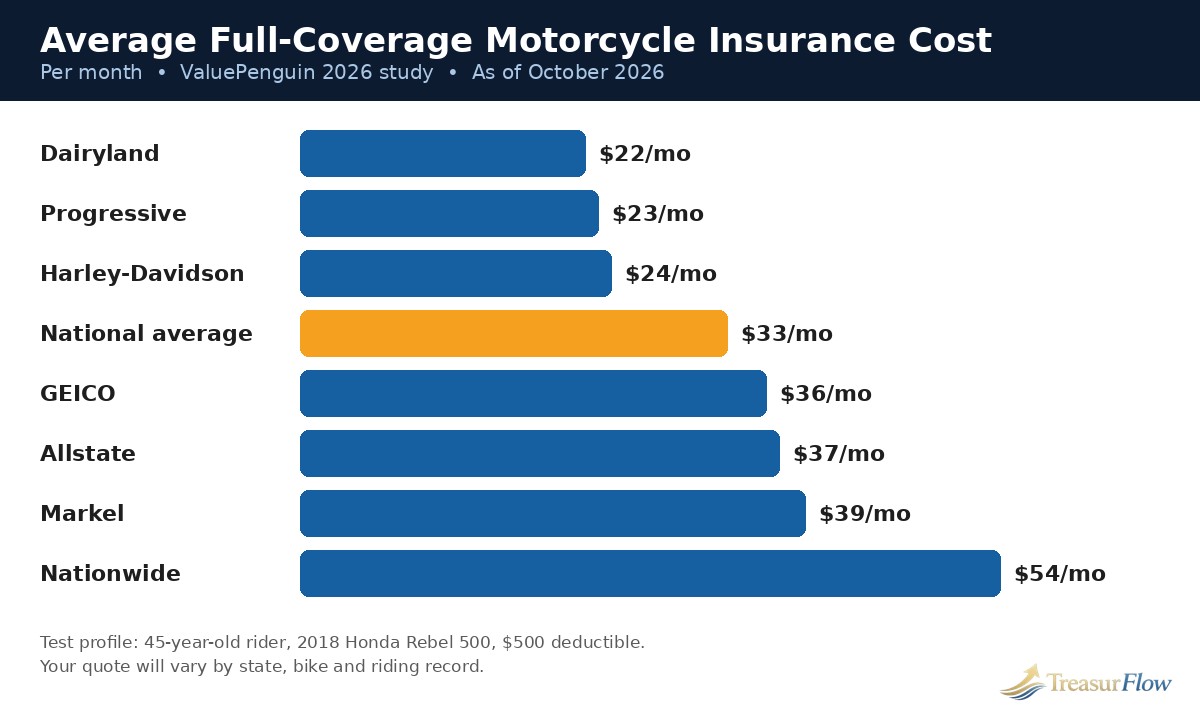
ValuePenguin, in its best motorcycle insurance companies guide updated September 25, 2026, puts the average cost of full coverage motorcycle insurance at $33 per month in the United States. Its company averages for full coverage are: Dairyland at $22 per month, Progressive at $23 per month, Harley-Davidson Insurance at $24 per month, GEICO at $36 per month, Allstate at $37 per month, Markel at $39 per month, and Nationwide at $54 per month. Those figures come from a defined test profile — a 45-year-old rider insuring a 2018 Honda CMX500 Rebel, with liability limits of $50,000 per person and $100,000 per accident, $25,000 of property damage, matching uninsured/underinsured motorist limits, $5,000 of medical payments, and a $500 deductible on comprehensive and collision. Change the rider, the bike, or the limits, and every number moves.
MoneyGeek, in its 2026 best motorcycle insurance analysis, reports a different test profile and, unsurprisingly, different averages: Progressive at $384 per year, Dairyland at $377 per year, GEICO at $364 per year, Harley-Davidson at $234 per year, and Markel at $670 per year, with Progressive scoring 4.9 out of 5 overall on the strength of affordability, 15 coverage options, and 12 discount opportunities. MoneyGeek’s company pages also split minimum and full coverage — for example, listing Progressive at an average of $18 per month for minimum coverage and $45 per month for full coverage within its own profile set.
Those two studies do not contradict each other so much as they photograph the market from different angles: different rider ages, bikes, limits, and state mixes produce different “averages,” all honestly labelled. The lesson for your wallet is direct. Use published averages only to build a shortlist and a rough budget — somewhere in the low hundreds of dollars per year for a standard bike on a clean record, rising sharply for young riders, powerful bikes, and dense urban garaging — and then get at least three live quotes on identical limits and deductibles. Comparison guides consistently make the same recommendation, because insurer pricing for the same rider can diverge by hundreds of dollars a year for reasons no average can predict.
One more cost truth belongs here, because it saves riders from a common budgeting error: the cheapest quote in a comparison is very often the quote with the least in it. A liability-only price and a full coverage price are not two prices for the same product. Before you celebrate a low number, confirm which coverages, limits, and deductibles produced it, using the anatomy above as your checklist.
The Five Cost Factors That Move Your Quote Most
Insurers price the rider, the bike, and the place together. The III lists the core rating factors plainly: your age and driving record, where you live, the model, make, and horsepower of your motorcycle, and where you store and drive it. Each factor below is one of those levers, explained the way an underwriter sees it.
1. Your Age and Riding Experience
Age is a proxy for crash frequency, and newness compounds it. A rider in their first licensed years, on their first bike, presents an insurer with almost no reassuring data, and the premium reflects that uncertainty. MoneyGeek’s profile tables show the pattern inside a single insurer: at Progressive, for example, its young-rider profile averages notably higher full coverage pricing than its adult and senior profiles on the same methodology, and GEICO’s young-rider full coverage average likewise sits well above its senior average. Experience helps in two ways — it lowers the base risk the insurer assigns to you, and it unlocks record-based discounts sooner. There is no shortcut around the first years except training, a sensible first bike, and a clean record, which is why the new-rider pick below emphasises exactly those levers.
2. The Bike Itself: Type, Engine and Value
A motorcycle is not a motorcycle to an underwriter. A mild standard bike or small cruiser is cheap to repair, rarely stolen relative to its numbers, and usually ridden moderately. A litre-class sport bike is expensive to repair, disproportionately crashed, disproportionately stolen, and bought precisely for performance. A heavy touring bike costs more to replace but is typically ridden by experienced owners and garaged carefully. Engine size and horsepower feed the model directly — that is the III’s “model, make and horsepower” factor in action — as do the bike’s value, parts prices, and theft record for that model. If premium cost matters to you, choose the bike with insurance in the room. Getting a quote on the exact model before you buy takes minutes and can save you from owning a bike you love and a premium you resent.
3. Your State and Your Neighbourhood
Where you live sets the legal template (minimum limits, UM and PIP rules, no-fault elements) and much of the risk template: traffic density, theft rates, weather exposure, medical and repair costs, and litigation patterns all vary by state and by ZIP code. The state-level studies published alongside the national ones show how wide the spread gets — the same insurers trade cheapest-place rankings from state to state, and state full coverage averages can sit far above or below the national figure. A rider who moves states should expect a reprice even with the identical bike and record, and should shop the move rather than simply transferring the old policy on autopilot.
4. Your Riding and Driving Record
Tickets, at-fault accidents, and especially serious violations such as DUI raise motorcycle premiums and can move you out of standard pricing altogether. The profile tables in the 2026 studies show violation and accident profiles priced above clean-record profiles at the same insurer, and riders with serious violations may need a specialist or non-standard carrier — one reason Dairyland, which comparison guides consistently describe as willing to insure higher-risk and custom riders, appears in the picks below. Time is the repair: violations age, claim-free periods accumulate, and discounts for responsible, claim-free riding — Progressive, for instance, advertises responsible-driver and claim-free elements within its discount set — reward the record you build after a bad one.
5. How and Where the Bike Is Garaged
Storage is the quiet factor riders underestimate. A bike kept in a locked garage presents a fraction of the theft and weather risk of the same bike kept on an open street or in an unfenced lot, and insurers price that difference, sometimes through an explicit garaging discount — Dairyland’s published discount lists, for example, include a garaging discount among its savings options. Anti-theft devices work the same direction: GEICO’s official discount page lists an anti-theft discount for equipped vehicles, alongside its course and multi-policy savings. Tell the insurer the truth about storage — misstating where a bike is kept can endanger a theft claim — and if you can improve the storage, do it before you quote and say so.
Two secondary factors deserve a sentence each. Annual mileage and use matter: a bike ridden daily in commuting traffic accumulates exposure a Sunday bike never sees, and low-mileage specialists exist for exactly that reason, as the Markel pick below explains. And in most states, insurance-based credit information can influence pricing, which is one more reason two neighbours with identical bikes can receive surprisingly different quotes.
A Worked Claim, With the Math Shown: With Coverage vs. Without
Averages persuade nobody at claim time. So here is one clearly labelled illustrative scenario. The rider, bike, and bills below are invented for the arithmetic — the coverage behaviour is standard — so you can watch each policy element do its job, or fail to.
The illustrative setup. You ride a cruiser with a pre-accident book value of $9,000. One evening you misjudge a tightening corner, leave the road, and strike a fence. Nobody else is hurt. The fence belongs to a homeowner. Your bills are: $6,800 to repair the bike, $1,400 to repair the fence, and $3,900 in emergency and follow-up medical bills for your own injuries. Total loss: $12,100.
Scenario A — you carry liability only, at limits of 25/50/10. Your liability coverage pays the fence owner: $1,400 in property damage, comfortably inside your $10,000 property damage limit. Your insurer pays nothing toward the bike, because liability never covers your own machine and you bought no collision coverage. It pays nothing toward your $3,900 medical bills, because liability never covers you and you bought no MedPay. Your out-of-pocket total: $6,800 + $3,900 = $10,700. The policy performed exactly as written. It was simply never designed to protect you or the bike.
Scenario B — you carry full coverage: the same liability, plus collision with a $500 deductible, comprehensive (not triggered here — this was a crash, not a theft or storm), uninsured motorist (not triggered — no other driver), and MedPay with a $5,000 limit. The fence is paid as before: $1,400 by liability. The bike repair is a collision claim: $6,800 minus your $500 deductible = $6,300 paid by the insurer. Your medical bills fall under MedPay, which pays regardless of fault up to its limit: $3,900 paid in full, inside the $5,000 limit. Your out-of-pocket total: the $500 deductible, and nothing else — $500.
Same rider, same corner, same $12,100 of damage. The difference between $10,700 out of pocket and $500 out of pocket is not luck, negotiation, or a generous adjuster. It is the coverage list you chose, possibly months earlier, in about ten minutes online. That is why this guide dissected the policy before it priced a single company.
Run the scenario the other way, too, because honesty about trade-offs is what makes the example useful. If you ride a paid-off bike worth $1,600, Scenario B’s collision coverage could only ever have saved you $1,100 after the same $500 deductible — and a liability-only policy at a lower premium may be the rational choice for that bike, provided you keep strong liability and UM/UIM limits for the injuries, which are where the real money always is. Protect the person first, the machine second, in proportion to what each is worth.
Best Motorcycle Insurance Companies in 2026, Matched to Rider Type
There is no single best motorcycle insurance company. There is a best match between a company’s strengths, a bike, and a rider — which is why the picks below are organised by rider type rather than crowned in a single ranking. Ratings and averages cited for each company come from the MoneyGeek and ValuePenguin 2026 analyses described above, and from the insurers’ own published coverage and discount pages, all as of October 2026. Get live quotes before acting on any of them: your state and profile will re-rank this list.
Best for the Daily Commuter: Progressive
If you ride to work, your bike is transportation, not a hobby, and your policy needs breadth, uptime, and painless claims handling more than it needs any single exotic feature. Progressive is the default starting point for that brief. MoneyGeek scores it 4.9 out of 5, its best overall rating for 2026, citing affordable rates averaging $384 per year in its analysis, 15 coverage options, and 12 discount opportunities. ValuePenguin puts Progressive’s full coverage average at $23 per month against a $33 national average in its own study, and names it the best motorcycle insurance for most people.
The substance behind the rankings suits commuters specifically. Comprehensive and collision automatically bring the $3,000 of accessory coverage (raisable to $30,000), OEM parts in repairs, no depreciation on parts, and safety riding apparel coverage of up to $3,000 for gear damaged in a covered collision, per Progressive’s own coverages page — the helmet, jacket, and boots a commuter wears daily are real money, and Progressive is unusually explicit about protecting them. Roadside assistance is available for the morning the bike will not start. And a disappearing deductible feature, described in MoneyGeek’s summary of Progressive’s offerings, reduces your deductible across claim-free periods, rewarding the uneventful riding commuters aim for. Quote Progressive first, then use its number as the benchmark every other insurer must beat on identical limits.
Best for Cruiser and Harley Owners: Harley-Davidson Insurance
Harley-Davidson Insurance exists for one brand’s ecosystem, and for owners inside that ecosystem it is a serious contender rather than a novelty. MoneyGeek rates it 4.3 out of 5 and names it best for H.O.G. members, with the lowest average annual premium in its top group at $234 per year in its analysis. ValuePenguin lists Harley-Davidson at $24 per month for full coverage in its study — a dollar above Progressive and Dairyland — and rates it among its top-rated companies overall for dependable service and useful coverage options.
The fit is about more than the badge. Cruiser ownership concentrates exactly the risks this guide has flagged: high bike values, extensive chrome and customisation, and expensive accessories. A brand specialist understands agreed values, factory and Screamin’ Eagle parts, and the Harley Owners Group world its riders live in, and Dairyland’s published discount lists even recognise H.O.G. membership as a discount category across the market — a reminder that rider-group affiliation is real rating currency for cruiser owners. If you ride a Harley, quote the house insurer alongside Progressive and Dairyland, and interrogate the accessory limit hardest: on a heavily dressed cruiser, that single number can matter more than the premium.
Best for Sport Bike Riders: Dairyland, Quoted Against Progressive
Sport bike riders face the market’s harshest pricing logic: high horsepower, high repair costs, high theft appeal, and a rider demographic insurers view as risk-forward. The winning strategy is to quote the companies comparison guides identify as most willing to insure high-performance machines. MoneyGeek names Dairyland — 4.6 out of 5 in its analysis, averaging $377 per year — the best for custom and modified motorcycles, and describes it as insuring more motorcycle types than its competitors, from 1000cc-plus sport bikes and heavily customised cruisers to vintage and electric machines that standard guidelines reject. ValuePenguin goes further on price, ranking Dairyland the cheapest motorcycle insurance in its 2026 study at $22 per month on average.
For a sport bike rider, that combination — willingness to write the risk, plus the lowest average price in one major study — makes Dairyland the essential second quote next to Progressive. Do not stop at two: sport bike pricing varies more violently between insurers than any other segment, and the rider-specific factors stack. A middleweight bike rather than a litre bike, an advanced rider course, locked garaging, and an anti-theft device each pull the quote in the right direction. And keep UM/UIM and medical coverage strong even if you trim physical damage on an older machine: on a sport bike, the injury exposure dwarfs the bike’s value, always.
Best for New Riders: GEICO
New riders need three things: a forgiving price while experience is thin, discounts they can earn immediately through training, and a claims and service operation that will not confuse them at the worst moment. GEICO fits that brief in the 2026 evidence. MoneyGeek scores it 4.4 out of 5, names it best for young riders, and credits it with the lowest rates for young riders and for seniors in its analysis, at a $364 average annual premium overall. ValuePenguin lists GEICO at $36 per month for full coverage in its study — above the cheapest specialists, but pairs it with fewer-than-average complaints and strong customer service marks.
The decisive detail for a beginner is on GEICO’s own motorcycle discounts page: up to 10% for completing a Motorcycle Safety Foundation or Military Safety Course, up to 20% if you are a current MSF instructor, up to 10% for transferring a policy, up to 10% for multiple motorcycles, up to 10% on renewal, up to 10% for a multi-policy bundle, and an anti-theft discount, with percentages varying by state. A new rider can stack training, anti-theft, and bundling savings from month one, while the course itself teaches the low-speed and hazard skills that keep a first-year record clean — the discount and the survival skill arrive in the same package. GEICO also partners for agreed-value vintage coverage through Hagerty, per MoneyGeek’s summary, which matters less to beginners than to collectors but signals breadth behind the headline price. Start on a modest bike, take the course before you quote, and let GEICO and Progressive compete for you.
Best for Budget, Liability-Only Riders: Dairyland and Progressive, Compared Head-to-Head
If your strategy is deliberate minimalism — an older, paid-off bike, strong liability limits, and no physical damage coverage — your shopping is a two-horse race on the published evidence, and you should run both horses. MoneyGeek’s minimum coverage averages put Progressive at $18 per month and Dairyland at $13 per month within its profiles, while its company summaries note Progressive’s pay-in-full discount can save up to 21% on full coverage policies in its analysis — a reminder to ask what paying annually does to a minimum policy quote as well. ValuePenguin’s full coverage table, meanwhile, has Dairyland cheapest overall, which tells budget riders that Dairyland’s pricing strength is not confined to one coverage tier.
Two warnings protect this strategy from itself. First, budget must never mean bare-minimum liability limits. The gap between minimum limits and responsible limits is often a few dollars a month, while the gap in a serious claim is your savings. Buy the liability and UM/UIM limits first and cut the bike coverages, not the people coverages. Second, confirm the strategy still fits the bike: the moment the machine’s value climbs — a newer purchase, a custom build — the worked scenario earlier in this guide stops being a story about someone else. Revisit the decision at every renewal, not just at purchase.
Best for Classic and Custom Bikes: Markel and Dairyland
Classic, vintage, and custom machines break standard insurance assumptions. Their value is not a depreciating book figure; it is an agreed value grounded in rarity, restoration, and the build itself. Parts are scarce, repairs are specialist work, and mileage is often low and seasonal. Two names from the 2026 studies serve this world directly.
Markel, rated 4.3 out of 5 by MoneyGeek and named its best for low-mileage riders, averages $670 per year in that analysis — the highest in the top group, reflecting specialist positioning rather than mass-market pricing — and builds its model around low-mileage use, including pay-per-mile style pricing tracked through monthly odometer photos via its VOOM partnership, per MoneyGeek’s summary. For a collector whose bike covers 800 careful miles a year, paying for exposure you never create is waste; Markel’s model prices the riding you actually do. Availability is limited to a subset of states, so confirm it writes in yours before investing quote time.
Dairyland is the other half of the classic-and-custom answer, for builds that are ridden rather than displayed and for customs that exceed standard guidelines: MoneyGeek credits it with vintage, custom, and specialty coverage and OEM replacement protection for custom and modified bikes, and its own state pages list agreed value, replacement cost, diminishing deductibles, and physical damage options among its available coverages. Whichever specialist you choose, the non-negotiables are the same: an agreed value in writing, an accessory and custom parts limit that matches your documented build sheet, and photographs and receipts on file before any loss. On a classic, documentation is not paperwork. It is the claim.
What About Allstate and State Farm?
Two household names deserve an honest paragraph. Allstate appears in ValuePenguin’s 2026 pricing at $37 per month for full coverage — mid-pack on price — with fewer-than-average complaints noted in its ratings table, and comparison summaries credit it with the ability to raise custom parts coverage within its full coverage customisation. For a rider already bundling home and auto with Allstate, the multi-policy economics can outweigh a few dollars of standalone premium. State Farm is named among the top picks for 2026 in the Independent Agent magazine-linked rankings summarised in search results, and its agent-led model suits riders who prefer a local human to an app. Neither company’s motorcycle pricing, in the studies opened for this guide, beats the specialists above on the profiles tested — which is precisely why the advice is to quote them for the bundle and service, not to assume the famous name wins the motorcycle line by default.
The Discounts Checklist: Savings to Ask For by Name
Discounts are not automatically applied with perfect generosity at every insurer. The winning habit is to walk into a quote with a checklist and ask, by name, about each item. Every discount below appears on an insurer’s own published page or in a 2026 study summary cited in this guide, as of October 2026. Availability and percentages vary by state and insurer, and discounts generally cannot all be stacked without limit — which is a reason to ask, not a reason to stay silent.
- Safety course discount. Completing an approved rider course — the Motorcycle Safety Foundation course is the standard example — earns up to 10% at GEICO per its official discounts page, and course discounts also appear in Progressive’s and Dairyland’s published lists. Take the course even if your insurer’s percentage is small; the skill is the real saving.
- Pay-in-full discount. Paying the annual premium upfront rather than monthly earns a discount at Dairyland and at Progressive, where MoneyGeek’s summary describes savings of up to 21% on full coverage policies. If cash flow allows one annual payment, this is frequently the largest single discount on the list.
- Multi-policy / bundling discount. Insuring your motorcycle alongside auto, home, or renters coverage earns up to 10% on the motorcycle policy at GEICO per its official page, and appears across Progressive’s (up to 13% in MoneyGeek’s summary) and Dairyland’s multi-line lists. Bundle quotes must still be compared line by line — a bundle can hide one overpriced policy inside a discounted pair.
- Multi-bike / multi-vehicle discount. Insuring more than one motorcycle earns up to 10% at GEICO and a multi-cycle discount at Dairyland. Households with two riders should never quote the bikes separately without also quoting them together.
- Transfer / switch discount. Moving your policy from another insurer earns up to 10% at GEICO, and both Progressive and Dairyland list transfer or policy-switch savings. Your existing insurer’s renewal letter is a negotiating document; bring it.
- Renewal and loyalty discounts. GEICO lists up to 10% on renewal; Dairyland lists loyalty savings for continuous coverage beyond a year, plus claim-free renewal and prompt-payer elements in its state discount lists. Longevity pays, but verify annually that it still beats the transfer offers elsewhere.
- Homeowner discount. Owning a home, condo, or townhouse earns a discount at Dairyland — described by MoneyGeek as among the largest homeowner savings in the industry — and appears in other insurers’ lists as well. Renters should ask anyway; some insurers extend related savings more broadly than the label suggests.
- Rider group and association discounts. Membership in a recognised rider organisation — the Harley Owners Group is the canonical example, appearing in both Dairyland’s and Progressive’s association discount descriptions — can earn savings, as can memberships such as USAA affiliation noted in Progressive’s list. If you belong to any rider association, name it during the quote.
- Motorcycle endorsement / licence discount. Holding a full motorcycle licence or endorsement, rather than a permit alone, earns a discount in Dairyland’s published lists and Progressive’s. Get fully licensed before you quote if you possibly can.
- Anti-theft discount. An approved anti-theft or bike-recovery device earns a discount at GEICO per its official page and at Dairyland per its state pages. A tracker you were going to fit anyway should be declared and priced.
- Garaging discount. Keeping the bike garaged earns an explicit discount in Dairyland’s published state lists. If your storage improves — a rented garage space, a moved bike — tell your insurer at renewal and ask for the reprice.
- Advance quote, automatic payment, and paperless-style savings. Quoting before your current policy expires, setting up automatic payment, and paying on time each appear in Progressive’s and Dairyland’s published discount inventories, typically as small percentages that quietly compound. Small is not nothing: four 5% class savings on one policy is real money across a decade of riding.
- Responsible and claim-free rider discounts. Clean-record and claim-free periods earn recognition in Progressive’s discount set as summarised by MoneyGeek, including a responsible-driver element for three years free of accidents and violations. You cannot buy this discount, but you build it one season at a time, and it follows you when you shop.
Work the checklist in order, in one call or quote session, and write down which discounts each insurer actually applied. Comparing three quotes where each insurer applied a different discount set is comparing fiction. Identical coverage, identical discounts declared, identical deductibles — then, and only then, is the cheapest quote the cheapest quote.
State Law Notes: Minimums, Helmets and Why Your State Rewrites Your Policy
Motorcycle insurance in the United States is fifty-plus related markets wearing one name, because insurance is regulated state by state. Three state-level realities change what you must buy, what you should buy, and what riding legally even looks like.
Minimum limits vary — widely. The III notes that mandatory minimum liability limits where required for motorcyclists are generally similar to those required for automobiles in the same state, but “similar to your state’s auto minimum” is not a national number. Sourced examples from the research for this guide show the spread plainly. Dairyland’s own Virginia requirements page lists Virginia motorcycle liability minimums of $50,000 per person, $100,000 per accident, and $25,000 for property damage, alongside matching uninsured/underinsured motorist minimums. ValuePenguin’s state requirements guide, by contrast, describes New York’s minimum as 25/50/10 and Texas’s as 30/60/25. No figure in this paragraph is “the” American minimum, and any article that prints one state’s numbers as national fact is misleading you. Before you register or insure a bike, confirm your own state’s current minimums with your state insurance department or department of motor vehicles — the only source that can bind you is your state’s.
A small number of states do not mandate liability the usual way — and that changes nothing about your risk. Comparison and consumer sources consistently note exceptions: MoneyGeek’s guide summary states that riders in 47 states need liability coverage while Florida, Montana, and New Hampshire do not legally require it in the standard way, and other consumer guides describe Florida’s financial responsibility approach — you may register without insurance, but if you cause an accident you must be able to pay for the injuries and damage. Read those exceptions carefully. “Not required to buy it” has never meant “not required to pay.” An uninsured rider who injures someone owes the same damages as an insured one; the insurance was only ever the mechanism for not paying them personally.
Helmet law is a three-tier patchwork, and it follows the road, not your home state. Summaries of state law published for 2025 converge on the same structure: roughly 19 states plus the District of Columbia require helmets for all riders and passengers; most remaining states require them only for younger riders or riders meeting certain conditions; and three states — Illinois, Iowa, and New Hampshire — impose no general helmet requirement. Exact counts and age thresholds shift as legislatures act, so verify the rule for any state you will ride through, not just the state you live in: a tour that crosses from a no-requirement state into a universal-helmet state changes your legal position at the border sign. Whatever the law says, the safety position of federal and state safety agencies is unambiguous in favour of helmet use, and NHTSA’s motorcycle safety resources — linked in the official resources box at the top of this guide — are the authoritative place to read the evidence rather than an insurance article’s summary of it.
One related variance deserves a final line: uninsured motorist and personal injury protection requirements are also set state by state. Some states mandate UM coverage or require a signed rejection to decline it; PIP structures differ across no-fault and traditional states, and motorcycles are sometimes treated differently from cars inside the same state’s system. When you move states, change bikes, or cross from permit to full licence, treat the policy as due for a legal review, not merely a price check.
How to Buy: A 30-Minute Quote Routine That Actually Compares Policies
Everything in this guide compresses into one disciplined half hour.
First, write your coverage specification before opening a single quote site: liability limits you have chosen deliberately (not the state minimum by default), UM/UIM limits matched to them, MedPay or PIP position for your state, comprehensive and collision yes or no based on the bike’s value, one deductible figure you can genuinely afford, and an accessory limit built from your photographed parts inventory. Second, quote that identical specification at a minimum of three insurers — Progressive, GEICO, and Dairyland cover most rider types between them; add Harley-Davidson Insurance for a Harley, Markel for a low-mileage classic, and your existing auto or home insurer for the bundle price. Third, run the discounts checklist aloud with each insurer and record which discounts were applied. Fourth, compare annual premiums, not monthly payments, on the identical specification, and read the cheapest quote’s exclusions before celebrating it. Fifth, check the insurer’s complaint standing through the NAIC resources linked at the top of this guide; a company that is hard to deal with at claim time is expensive at any premium.
Then set a renewal reminder. Rider profiles change — records clean up, bikes change, garages improve, courses get completed — and every one of those changes is a repricing event the insurer will not always volunteer. The best motorcycle insurance 2026 offers you is not a company name. It is the habit of buying coverage deliberately, in that order, every year.
Related Insurance Guides
- Insurance Guides
- Car Insurance for Unlicensed Drivers (2026): How to Get Covered
- Complete Ultimate Guide: How to Get Cheap Car Insurance For Bad Credit
Rider Questions Before You Buy Your Next Policy
How much does motorcycle insurance cost in 2026?
In ValuePenguin’s 2026 study, full coverage motorcycle insurance averaged $33 per month in the U.S., with Dairyland at $22 per month, Progressive at $23 per month and Harley-Davidson Insurance at $24 per month for its test rider. Your own cost will differ because insurers price your age, bike, state, record and garaging, so treat published averages as a budgeting guide and compare live quotes on identical coverage.
What does full coverage motorcycle insurance include?
Full coverage is a common shorthand, not a formal coverage name. It usually means liability insurance plus comprehensive and collision coverage for your own bike. It does not automatically include every add-on: uninsured motorist, medical payments, accessory coverage, roadside assistance and trip interruption may be included, offered separately or limited, so check the policy schedule before you buy.
Is motorcycle insurance required in every state?
No. Most states require motorcycle liability insurance, but minimum limits vary by state and a few states handle the requirement differently. Even where buying a policy is not mandated in the usual way, you remain financially responsible for injuries and damage you cause. Always confirm your own state’s current minimums with your state insurance department before you ride.
Which company is best for a new rider?
GEICO is a strong starting quote for new riders because MoneyGeek rated it best for young riders in 2026 and GEICO’s own discounts page offers up to 10% for completing a Motorcycle Safety Foundation course. Progressive is the other essential quote, as the best overall pick in both MoneyGeek and ValuePenguin’s 2026 studies. Compare both on identical limits after completing a safety course.
Does motorcycle insurance cover custom parts and riding gear?
Only up to the limits in your policy. Standard comprehensive and collision coverage is built around factory parts, so custom parts usually need accessory or custom parts coverage. Progressive, for example, includes $3,000 of accessory coverage with comprehensive and collision and allows riders to buy up to $30,000, and it offers safety riding apparel coverage of up to $3,000 for gear damaged in a covered collision.
How can I lower my motorcycle insurance premium?
Complete an approved safety course, bundle your motorcycle with auto or home insurance, pay in full, insure multiple bikes together, fit an approved anti-theft device, garage the bike, hold a full motorcycle endorsement and keep a clean, claim-free record. Ask each insurer to apply every discount you qualify for, then compare at least three quotes with the same limits and deductibles.
Conclusion: Buy the Cover You Will Thank Yourself For
The best motorcycle insurance 2026 can offer is not found; it is assembled. It starts with a policy you understand layer by layer — liability that protects strangers generously enough to protect your own finances, uninsured motorist and medical coverage that protects you from the road’s worst arithmetic, physical damage coverage proportioned to what your bike is actually worth, and accessory limits that match the machine you built rather than the one the factory shipped. It is priced by factors you partly control — training, record, storage, bike choice — and discounted by a checklist you have to ask for out loud. And it is matched, finally, to the rider you are: Progressive’s breadth for the commuter, Harley-Davidson’s specialism for the cruiser owner, Dairyland’s willingness and price for sport and budget riders, GEICO’s training-friendly value for the beginner, and Markel’s low-mileage logic for the classic in the garage.
Do the 30-minute routine. Quote the identical specification at three insurers. Read the coverage before the price. Then go riding, knowing — not hoping — what your policy will do if the worst afternoon of your season ever arrives.

Muhammad Zakir is the founder of Treasurflow and the author of its personal finance guides. He researches consumer banking, credit, and personal loans, and every guide cites primary sources such as the CFPB, FDIC, FTC, and IRS. His content is educational and is not personalized financial advice.