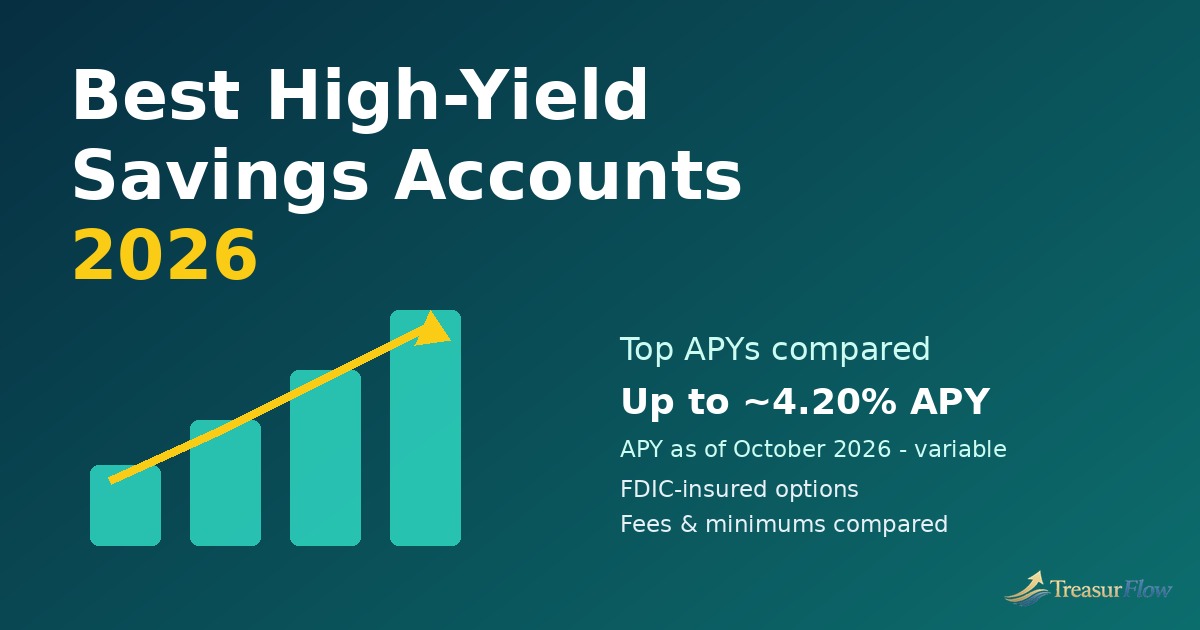
If your savings are sitting in a traditional bank account earning almost nothing, you are not alone — and you are not stuck. As of October 2026, the FDIC national average savings rate is about 0.37%. The best high yield savings accounts 2026 pay roughly ten times that, with top APYs in this guide ranging from about 3.10% to about 4.20%. That gap is not a gimmick or a short-term bonus. On a real emergency fund, it is the difference between earning a few dollars a year and earning a few hundred dollars a year for doing exactly the same thing: keeping cash safe and accessible.
This is a rate-first ranked guide. We start with the number most savers care about — the annual percentage yield, or APY — and then we look just as hard at what sits behind that number. A headline rate means very little if it only applies above a balance you do not have, disappears unless you set up a specific direct deposit, or comes with fees that quietly eat the extra interest. So every account below is ranked on its rate first, and then checked for minimums, tiers, conditions, fees, and how easy the money is to actually use when you need it.
All rates in this article are labeled the same way, and you should read every one of them the same way: APY as of October 2026 — variable, check the bank’s site before opening. High-yield savings APYs are not fixed and they are not guaranteed. Banks can raise or lower them at any time. What is true in October 2026 may not be true three months later, which is exactly why the final step before you open any account on this list should be a quick check of the live rate and terms on the bank’s own website.
We picked seven accounts for this guide, and only from verified October 2026 rate information. Our top rate is EverBank Performance Savings at about 4.20% APY, followed closely by Bread Savings at 4.00% APY and Bask Bank Interest Savings at 3.90% APY. But the highest rate is not automatically the best account for you. If you are starting with $100, an account with no minimum may serve you better than a slightly higher rate with a $5,000 tier. If you like organizing money by goal, a feature like Ally’s Savings Buckets may be worth more than a few extra tenths of a percent. The deep dives below are written to help you make that trade-off honestly, not to push you toward a single winner.
One more thing before the rankings: safety. Every type of account discussed here should be checked for FDIC insurance, which covers up to $250,000 per depositor, per insured bank, per ownership category. That protection is what makes a high-yield savings account a sensible home for an emergency fund, a house deposit, or any money you cannot afford to put at risk in the market. You are not chasing a return here. You are simply refusing to be underpaid for keeping cash safe.
Related Guides
- Compare term-based saving in our guide to the best CD rates for 2026 if you can lock money away for a set period.
- Pair a new savings account with one of the best budgeting apps for 2026 to automate transfers on payday.
- Once your emergency fund is full, look at the best Roth IRA accounts for 2026 for long-term, tax-advantaged investing.
Helpful Official Resources
- FDIC — Deposit Insurance: fdic.gov
- Consumer Financial Protection Bureau (CFPB): consumerfinance.gov
- Federal Reserve: federalreserve.gov
Quick Picks: The 7 Best High Yield Savings Accounts at a Glance
| Rank | Account | APY as of October 2026 — variable, check the bank’s site before opening | Minimum / Tier to Know | Best For |
|---|---|---|---|---|
| 1 | EverBank Performance Savings | ~4.20% APY | Check live terms before opening | Highest headline rate in this guide |
| 2 | Bread Savings | 4.00% APY | $100 to open | Strong rate with a modest opening amount |
| 3 | Bask Bank Interest Savings | 3.90% APY | Check live terms before opening | High rate without a complicated tier in this guide |
| 4 | CIT Bank Platinum Savings | 3.75% APY on balances $5,000+; 0.25% APY below $5,000 | $100 to open | Savers who can clear the $5,000 tier |
| 5 | Synchrony High Yield Savings | 3.55% APY | Comes with an ATM card | Savers who want ATM access to savings |
| 6 | Marcus by Goldman Sachs | 3.50% APY | No minimum, no fees | Beginners and no-fuss saving |
| 7 | Ally Online Savings | ~3.10% APY | Savings Buckets feature | Organizing money by goal in one account |
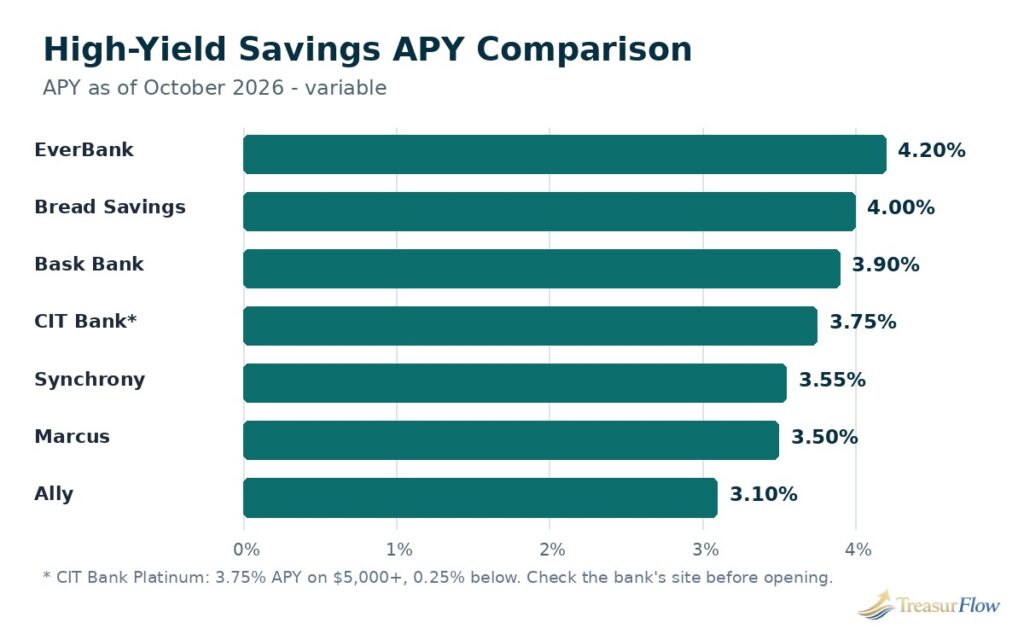
Read the table as a starting point, not a verdict. EverBank leads on rate alone, but CIT Bank is the clearest warning in this entire guide about why rate-first does not mean rate-only: 3.75% APY is attractive, and 0.25% APY below $5,000 is not. Same account, same name, completely different outcome depending on your balance. Details like that are what the rest of this article is for.
How We Ranked These Accounts
Our ranking starts with APY, because that was the promise of this guide, but no account earned its place on rate alone. Here is the order we applied, and the questions we asked at each step.
1. Headline APY, as of October 2026. We compared the standard APY each account was offering in October 2026 roundups, not a temporary teaser and not a rate that required an unrelated product bundle. Where a range or condition was part of the verified information — for example, a tier at CIT Bank — we printed it next to the rate instead of burying it in fine print further down the page.
2. What you need to actually get that rate. Next, we checked minimums to open, balance tiers, and conditions. An account that pays its top rate from the first dollar is ranked with that simplicity in mind. An account that pays its top rate only above $5,000, or only with an eligible direct deposit, is not automatically disqualified — for the right saver it may still be the best choice — but the condition is treated as part of the rate itself, because for your wallet, it is.
3. Fees. Fees are interest in reverse. A monthly fee, however small, cancels out part of what a higher APY earns you, especially on a smaller balance. Marcus by Goldman Sachs stands out in this guide specifically because the verified information lists no minimum and no fees, which makes its 3.50% APY easier to evaluate at face value.
4. Access and usefulness. A savings account should be boring to own and easy to use. We noted practical differences that show up in real life, such as Synchrony’s ATM card and Ally’s Savings Buckets, because how you interact with an account affects whether you keep contributing to it. The best account on paper is worthless if its setup makes you stop saving.
5. Safety and clarity. We only included established, widely covered accounts from the verified fact sheet for this guide, and we remind readers throughout to confirm FDIC insurance and live terms directly. We did not invent rates, minimums, or product terms beyond that sheet, and we did not include an account simply because it advertises heavily.
What we did not do matters too. We did not rank by sign-up bonuses, because a one-time bonus is not a savings rate. We did not assume a promotional rate will last, because variable APYs, by definition, do not have to. And we did not copy competitor rankings — different guides weigh access, apps, and customer service differently, and reasonable people can order these same seven accounts differently. Our order is transparent so you can re-rank them for your own situation.
APY, Tiers, and Rate Conditions: Read This Before You Compare Any Two Rates
What APY actually means
APY stands for annual percentage yield. It tells you how much your money would grow in a year if interest compounded and you left the balance alone, expressed as a percentage. It is not quite the same as a simple interest rate, because APY accounts for compounding — earning interest on interest you have already earned. For comparing savings accounts, APY is the right number to use, because every bank has to present it in a standardized way.
A simple example makes the stakes concrete. Put $10,000 in an account paying the FDIC national average of about 0.37% APY and, roughly speaking, you would earn around $37 in a year if the rate stayed the same. Put the same $10,000 in an account paying 4.20% APY and you would earn around $420 over the same period, again assuming the rate did not change. Neither figure is a promise — variable rates move — but the math explains why shopping for a savings account is worth an hour of your time. You do not need to take more risk to get the higher number. You mainly need to move the money.
APY also helps you see smaller differences honestly. A gap between 3.10% and 3.50% APY sounds trivial, and on $1,000 it is only a few dollars a year. On $25,000, it is about $100 a year. Whether that is worth switching banks for depends on your balance, which is why this guide keeps returning to the same advice: run the rate against your actual balance, not against an imaginary one.
Tiers: the same account can pay two very different rates
A tier means the APY changes depending on how much money is in the account. CIT Bank Platinum Savings is the textbook example in this guide. It pays 3.75% APY on balances of $5,000 or more, but only 0.25% APY below $5,000. If you open that account with $600 and never build it past that level, you are not earning a high yield at all — you are earning less than the national average, in an account whose marketing leads with 3.75%.
Tiers are not dishonest, but they are easy to misread if you only look at the largest number on the page. Before opening any tiered account, ask three questions. What is the threshold? What rate applies below it? And, realistically, how soon will my balance cross it? If the answer to the last question is “not for a year or more,” a simpler no-tier account with a slightly lower headline rate may pay you more in practice.
Promotional rates vs. standard rates
Some savings offers in the wider market are promotional: a higher rate for an introductory period, a bonus for depositing a certain amount, or a rate tied to opening another product. Promotions can be genuinely worthwhile, but they should never be compared directly with a standard APY as if they will last forever. When you see a promotion anywhere, find its end date, find what the rate becomes afterward, and decide based on the afterward rate if you plan to keep the account long term.
The accounts in this guide were selected on their standard APYs as reported in October 2026 roundups, with their stated conditions shown alongside. Even so, standard does not mean permanent. A standard variable APY can be changed by the bank at any time, with no introductory period involved at all.
Direct-deposit and activity conditions
Some banks pay their best savings rate only if you meet an ongoing condition, most commonly an eligible direct deposit. SoFi Checking & Savings is a well-known example of this structure in the current market — up to about 3.30% APY with eligible direct deposit, and lower without it — which is why we did not place it in our top seven despite a competitive headline number: the rate you get depends on behavior you have to maintain every month.
Conditions are not a reason to avoid an account automatically. If your paycheck already lands in that bank, a direct-deposit condition costs you nothing. But if meeting the condition means rerouting your pay, splitting deposits, or monitoring a requirement each month, price that effort into your decision. A slightly lower, unconditional rate often wins on real life, even when it loses on a comparison chart.
Why rates move at all
High-yield savings rates tend to follow the broader interest-rate environment, which is heavily influenced by the Federal Reserve. When the Fed raises its benchmark rate, savings APYs usually climb, with a lag. When the Fed cuts, savings APYs usually fall, sometimes quickly. That is why a guide like this one has a shelf life, why we date every rate to October 2026, and why checking the live APY before opening — and a few times a year afterward — is part of using these accounts well, not an optional extra.
The 7 Best High Yield Savings Accounts 2026, In Detail
1. EverBank Performance Savings — Best for the Highest Headline Rate
APY as of October 2026 — variable, check the bank’s site before opening: ~4.20% APY
Who it’s best for: Savers whose first priority is the rate itself, and who are comfortable with an online-focused account in exchange for the top APY in this guide.
EverBank Performance Savings tops this ranking for one straightforward reason: at about 4.20% APY, it pays the highest rate of the seven accounts we verified for October 2026. On a $20,000 emergency fund, even a few tenths of a percent over the next account down this list adds up to real money over a year, assuming rates hold — and as we keep stressing, they may not, for any bank on this page.
What makes a top rate usable, rather than just impressive, is everything around it. Before opening, confirm on EverBank’s site the current APY, any minimum or tier that applies to that rate, how transfers in and out work, and how long external transfers take to arrive. Those operational details, not the headline number, are what you will actually live with month after month.
Pros
- Highest APY in this guide at ~4.20% as of October 2026.
- A clear first choice if maximizing interest on a larger balance is your main goal.
- Keeps the decision simple: rate-first savers do not need to weigh a goal-bucket feature or an ATM card to justify it.
Watch-outs
- The APY is variable and can fall — recheck it periodically rather than assuming 4.20% is locked in.
- Verify the live minimums and transfer terms on the bank’s site before opening, as those details were not specified in the verified fact sheet for this guide.
2. Bread Savings — Best Strong Rate With $100 to Open
APY as of October 2026 — variable, check the bank’s site before opening: 4.00% APY; $100 to open
Who it’s best for: Savers who want a rate at the top of the market without needing thousands of dollars on day one.
Bread Savings earns the second spot by pairing a 4.00% APY with a clear, modest entry point: $100 to open. That combination matters more than it might look. Many savers are not moving a finished emergency fund from one bank to another. They are starting one, and an account that lets them start at $100 and still pay 4.00% APY removes the most common excuse for waiting — “I’ll open the good account once I have more saved.”
At 4.00% APY, Bread sits only slightly below EverBank, and well above the rest of this list and dramatically above the 0.37% national average. If you are choosing between the top two or three accounts here, day-to-day usability and how quickly you can move money out in an emergency are reasonable tie-breakers, because the rate difference on most balances is modest.
Pros
- 4.00% APY as of October 2026, second-highest in this guide.
- $100 to open makes it accessible to savers who are just getting started.
- Straightforward proposition: a competitive rate without a $5,000-style tier in the terms we verified.
Watch-outs
- The $100 opening amount still matters if you plan to start with less — in that case, look at the no-minimum option below.
- APY is variable, so today’s 4.00% is a snapshot for October 2026, not a rate you are promised for the life of the account.
3. Bask Bank Interest Savings — Best High Rate Without a Complicated Story
APY as of October 2026 — variable, check the bank’s site before opening: 3.90% APY
Who it’s best for: Savers who want a near-top rate and a simple, single-purpose savings account.
Bask Bank Interest Savings, at 3.90% APY, rounds out a clear top three in this guide. All three pay close to or above 3.90%, and all three sit in a different league from a traditional savings account at a large branch bank. Bask’s appeal is focus: this is an interest-focused savings product, and for savers who do not need branch access, an ATM card, or goal-tracking tools, that simplicity is a feature.
When rates cluster this closely — 4.20%, 4.00%, and 3.90% — small practical questions deserve more weight than they usually get. How fast are transfers? Is the website or app easy for you to use? Do you already have a relationship with the bank that makes managing everything simpler? A 0.10% or 0.20% difference on a typical emergency fund is only a few dollars a month, so picking the account you will actually fund consistently is the smarter move.
Pros
- 3.90% APY as of October 2026, firmly in this guide’s top tier.
- Simple, interest-focused proposition for savers who do not need extras.
- A strong alternative if you prefer not to put every dollar with the single highest-rate provider.
Watch-outs
- No extra feature, such as buckets or an ATM card, is highlighted in the verified information for this account — check the bank’s site if a specific feature matters to you.
- As with every account here, the variable APY can change at any time.
4. CIT Bank Platinum Savings — Best If You Can Clear the $5,000 Tier
APY as of October 2026 — variable, check the bank’s site before opening: 3.75% APY on balances $5,000+; 0.25% APY below $5,000; $100 to open
Who it’s best for: Savers who already have, or are about to deposit, at least $5,000 — and only those savers.
No account in this guide illustrates “read the tier” better than CIT Bank Platinum Savings. Above $5,000, its 3.75% APY is genuinely competitive, ranking fourth here on merit. Below $5,000, its 0.25% APY is below the national average. Both statements are true about the same account, which is why we list CIT fourth with a warning rather than higher on the strength of its top rate alone.
The practical way to use this account is to open it when you are ready to fund it properly. It takes $100 to open, but opening is not the same as benefiting. If you have a $6,000 tax refund, a bonus, or an existing savings balance to transfer in one move, CIT becomes a straightforward, strong choice. If you are building up from $200 a month, you would spend a long time in the 0.25% tier — and a no-tier account would pay you far more during exactly the months when building the habit matters most.
Pros
- 3.75% APY on balances of $5,000 or more as of October 2026.
- Only $100 to open, so you can set the account up ahead of a larger deposit.
- Competitive top rate from an established online-bank name in the savings market.
Watch-outs
- The 0.25% APY below $5,000 is the single biggest watch-out in this guide. Do not open this account for a small, slow-growing balance.
- Keep an eye on your balance if it hovers near $5,000; dipping below the tier changes what you earn.
5. Synchrony High Yield Savings — Best for ATM Access to Your Savings
APY as of October 2026 — variable, check the bank’s site before opening: 3.55% APY; comes with an ATM card
Who it’s best for: Savers who like the idea of a high yield but feel uneasy about money they cannot reach in cash if they ever need to.
Synchrony High Yield Savings pays 3.55% APY, which puts it in the middle of this ranking on rate, and it offers something none of the accounts above it emphasize in our verified information: an ATM card. For some savers, that single feature resolves the main psychological objection to online savings — the feeling that the money has disappeared into an app and would take days to get back in a genuine emergency.
Used well, that access is a safety valve you rarely touch. A savings account should not become a second checking account, and frequent withdrawals defeat the point of separating the money in the first place. But knowing you can reach the funds can make it easier to move a larger share of your cash out of a low-paying checking account and into a rate that actually works for you. If that describes you, Synchrony’s slightly lower APY compared with the top three may be a fair price for peace of mind.
Pros
- 3.55% APY as of October 2026, comfortably above Marcus and well above the national average.
- ATM card gives a level of direct access most online savings accounts do not lead with.
- A good middle option: strong rate without a $5,000 tier to clear.
Watch-outs
- Easy access cuts both ways. If an ATM card makes you more likely to dip into savings for non-emergencies, a less accessible account may protect your goals better.
- Confirm current transfer, ATM, and account terms on Synchrony’s site before opening.
6. Marcus by Goldman Sachs — Best No-Minimum, No-Fees Starting Point
APY as of October 2026 — variable, check the bank’s site before opening: 3.50% APY; no minimum, no fees
Who it’s best for: First-time high-yield savers, and anyone starting with a small amount who wants zero friction.
Marcus by Goldman Sachs pays 3.50% APY — only 0.05% below Synchrony — with the cleanest entry terms in this entire guide: no minimum and no fees in the verified information. That combination makes Marcus the easiest recommendation here for someone opening their very first high-yield savings account, or starting an emergency fund with whatever they have this week, even if that is $25.
There is a real financial argument for simplicity, not just a convenience one. On a $500 starting balance, the difference between 3.50% APY and the top rate of 4.20% APY is only a few dollars over a whole year. The difference between 3.50% APY and leaving that $500 in a 0.37% account — or in checking, earning nothing — is proportionally much bigger, and the difference between starting now and waiting until you have “enough” is bigger still. Marcus removes every reason to wait. You can also move later: nothing stops you from opening here, building the habit, and transferring to a higher-rate account once your balance makes the gap worth the paperwork.
The Goldman Sachs name may also matter to some savers who are nervous about online-only brands they have never heard of. The protection that counts is FDIC insurance, which you should verify for any bank, but there is nothing wrong with preferring a name you recognize while you get comfortable with online saving.
Pros
- 3.50% APY as of October 2026 with no minimum and no fees.
- The lowest-friction way in this guide to start earning a high yield today, at any balance.
- No tier to fall below, so your rate does not collapse if your balance is small.
Watch-outs
- Its APY trails the top three accounts by 0.40% to 0.70%, which becomes meaningful on balances well into five figures.
- No special feature, such as buckets or an ATM card, is highlighted in the verified information for this account.
7. Ally Online Savings — Best for Organizing Savings by Goal
APY as of October 2026 — variable, check the bank’s site before opening: ~3.10% APY; Savings Buckets feature
Who it’s best for: Savers juggling several goals at once — an emergency fund, a vacation, a car, a house deposit — who want to see each one separately without opening several accounts.
Ally Online Savings pays about 3.10% APY, the lowest rate among our seven picks, tied on headline rate in the broader October 2026 market with accounts such as Capital One 360 Performance Savings and American Express High Yield Savings, both also around 3.10% APY. So why does Ally take this spot? Because of Savings Buckets, its feature for dividing one account into labeled goals. Instead of one undifferentiated balance, you can watch “emergency fund,” “Japan trip,” and “new tires” grow side by side, each with its own target.
That visibility changes behavior, and behavior is worth money. Savers are less likely to raid a bucket clearly labeled for a house deposit than a generic pool of cash, and more likely to add a small extra transfer when a bucket is visibly $80 from its goal. If buckets help you save an extra $50 a month, that easily outweighs the rate gap versus a higher-paying account you contribute to less reliably. Pair that habit with one of the best budgeting apps for 2026 and you have a simple system: budget the transfer, automate it on payday, and watch each bucket fill.
Ally is also a sensible choice if you expect your balance to stay modest for a while and value organization over squeezing out the last fraction of a percent. And nothing prevents a two-account strategy later — buckets at Ally for everyday goals, plus a top-rate account for a large, single-purpose emergency fund.
Pros
- Savings Buckets let you organize multiple goals inside one account with one APY.
- ~3.10% APY as of October 2026 is still more than eight times the 0.37% national average.
- Well suited to savers who find a single lump-sum balance hard to manage mentally.
Watch-outs
- Lowest APY in this guide; on a large single balance, the gap versus EverBank or Bread costs real money over a year.
- If you only have one savings goal, the buckets feature adds little, and a higher-rate account is the cleaner pick.
High-Yield Savings vs. CDs vs. Money Market Accounts
These three products are often grouped together because they are all relatively safe places to hold cash, but they solve different problems. Choosing the wrong one is usually not a disaster — it is a mismatch between the product and your timeline.
High-yield savings accounts pay a variable APY and keep your money accessible. That combination is why they are the default home for an emergency fund and for goals within the next year or two where the date might move. The trade-off is uncertainty: the rate you sign up for is not the rate you are guaranteed to keep.
Certificates of deposit (CDs) work the other way around. You agree to leave money with the bank for a set term, and in exchange the bank generally gives you a fixed rate for that term. If you may want this structure, compare current offers in our guide to the best CD rates for 2026. CDs suit money with a known future date — a tuition payment, a planned purchase next year — where you value certainty about the rate over the freedom to withdraw. Taking money out early typically triggers a penalty, so a CD is a poor place for your only emergency cash.
Money market accounts sit between the two in feel. They are bank deposit accounts that usually pay a variable rate and often come with more transactional features, such as a debit card or check-writing, than a standard savings account. Their rates can be competitive, but they vary widely and may come with higher minimums. A money market account can make sense if you want savings-level interest with checking-like access in a single account, but compare its APY and minimums carefully against a high-yield savings account before assuming it pays more — often, it does not.
A common, sensible setup uses more than one: a high-yield savings account for emergencies and flexible goals, a CD ladder for money earmarked for specific future dates, and, once cash reserves are genuinely complete, long-term investing for money you will not need for many years. That last step belongs in a different product entirely — see our look at the best Roth IRA accounts for 2026 — because investing involves risk that insured deposit accounts do not, and the two should never be blurred together.
| Feature | High-Yield Savings | CD | Money Market Account |
|---|---|---|---|
| Rate type | Variable APY | Generally fixed for the term | Variable APY |
| Access to money | Flexible | Locked until term ends, early-withdrawal penalties typically apply | Often includes card or check access |
| Best job | Emergency fund, flexible goals | Money needed on a known future date | Cash you want accessible with some transactional features |
| Main trade-off | Rate can fall at any time | Money is committed for the term | Rates and minimums vary widely |
How to Open a High-Yield Savings Account in 5 Steps
Opening one of these accounts is usually a 15-minute job. Doing it carefully, in the right order, saves you the small frustrations that make people abandon the process halfway through.
Step 1: Pick the account that fits your balance, not just the highest rate. Look back at the quick-picks table with your real starting balance in mind. Under $5,000, the CIT Bank tier should rule it out as a main account for now. Starting from scratch, Marcus and its no-minimum, no-fees terms are hard to beat. Chasing the top rate, EverBank, Bread, and Bask are your shortlist. Write down why you chose the account you chose — it will stop you second-guessing the decision every time a slightly higher rate appears somewhere else.
Step 2: Verify the live rate, terms, and FDIC insurance. Go directly to the bank’s official website — not an ad, not a comparison page, including this one — and confirm three things: the current APY today, any minimum or tier attached to it, and the bank’s FDIC-insured status. You can cross-check deposit insurance using the FDIC resources at fdic.gov. If the live rate has moved since October 2026, that is normal for a variable product; decide based on the rate in front of you now.
Step 3: Gather what you need and apply. Banks typically ask for your full legal name, address, date of birth, Social Security number, and a government-issued ID, plus the routing and account numbers of the bank account you will fund from. This identity information is a normal, legally required part of opening a US bank account, but only ever enter it on the bank’s official, secure website that you navigated to yourself.
Step 4: Fund the account and confirm the funding rules. Make your opening deposit, respecting any amount required to open — $100 for Bread Savings and CIT Bank Platinum Savings in this guide, for example. Then note how long external transfers take, any transfer limits that apply, and when interest starts accruing. If you opened a tiered account, set a calendar reminder to check that your balance has crossed — and stays above — the threshold for the higher APY.
Step 5: Automate the habit and schedule a rate check. Set up an automatic transfer for every payday, even a small one. Automatic transfers are what turn an account opening into an emergency fund. Finally, put a reminder in your calendar every three to six months to compare your current APY with the market. If your bank’s variable rate has drifted far below what competitors pay, moving money is usually straightforward — and that occasional check is the entire ongoing cost of earning a high yield instead of the 0.37% average.
Savings Questions, Answered Honestly
Are high-yield savings accounts safe?
Yes, if the account is at an FDIC-insured bank. FDIC insurance covers up to $250,000 per depositor, per insured bank, per ownership category. Always confirm a bank’s insured status on fdic.gov before you deposit money.
How much more can I earn with a high-yield savings account?
It depends on your balance and the APY. As of October 2026, top high-yield accounts pay around 3.10% to 4.20% APY, compared with an FDIC national average savings rate of about 0.37%. On a $10,000 balance, that difference can mean hundreds of dollars more in interest over a year, though APYs are variable and can change.
Do high-yield savings accounts have fees or minimums?
Some do and some do not. Marcus by Goldman Sachs has no minimum and no fees on the fact sheet used for this guide, while CIT Bank Platinum Savings requires $100 to open and pays its top APY only on balances of $5,000 or more. Always check the minimum, tier, and fee terms before opening.
Will my APY change after I open the account?
Yes, it can. High-yield savings account APYs are variable, not fixed or guaranteed. Banks can raise or lower them at any time, often in response to Federal Reserve rate moves, so check your rate regularly and compare it with current offers.
How many high-yield savings accounts should I have?
One account is enough for most people, but some savers open more than one to separate goals. Ally’s Savings Buckets feature is one way to organize multiple goals inside a single account. Keep track of FDIC limits if your total balances grow large.
Is a high-yield savings account better than a CD?
It depends on your timeline. A high-yield savings account keeps your money accessible, while a CD usually locks money up for a set term in exchange for a fixed rate. Many savers use a savings account for their emergency fund and CDs for money they know they will not need until a specific date.
Conclusion: Take the Rate, Keep the Habit
The best high yield savings accounts 2026 share one simple advantage over the account you may be using now: they pay you meaningfully for money that was going to sit in cash anyway. EverBank leads this guide at about 4.20% APY as of October 2026, Bread Savings and Bask Bank follow close behind at 4.00% and 3.90%, and Marcus makes the strongest case for anyone starting small, with 3.50% APY, no minimum, and no fees. Ally earns its place for organization, Synchrony for ATM access, and CIT for savers who can clear its $5,000 tier — and only for those savers.
Do not let the perfect account delay the good decision. The gap between any account on this list and the 0.37% national average is far larger than the gaps between the accounts themselves. Pick the one that fits your balance and your habits, verify the live APY and FDIC status on the bank’s own site, open it, and automate a transfer for payday. Then get on with your life, checking the rate a few times a year. That is all a high-yield savings account asks of you, and for an emergency fund earning hundreds of dollars a year instead of a handful, it is a very fair trade.
Disclaimer: This article is for educational purposes only and is not financial advice. APYs are variable, are shown as of October 2026, and can change at any time. Always check the bank’s official website for current rates, terms, fees, and FDIC insurance status before opening an account, and consider speaking with a qualified financial professional about your own situation.

Muhammad Zakir is the founder of Treasurflow and the author of its personal finance guides. He researches consumer banking, credit, and personal loans, and every guide cites primary sources such as the CFPB, FDIC, FTC, and IRS. His content is educational and is not personalized financial advice.
11 thoughts on “Best High Yield Savings Accounts 2026: Top APYs Compared, Ranked Rate-First”